200
Improving Word Embeddings Using Kernel PCA
Vishwani Gupta Sven Giesselbach Stefan R ¨uping Christian Bauckhage
Fraunhofer IAIS, Sankt Augustin, Germany
Abstract
Word-based embedding approaches such as Word2Vec capture the meaning of words and relations between them, particularly well when trained with large text collections; however, they fail to do so with small datasets. Exten-sions such as fastText reduce the amount of data needed slightly, however, the joint task of learning meaningful morphology, syntac-tic and semansyntac-tic representations still requires a lot of data. In this paper, we introduce a new approach to warm-start embedding mod-els with morphological information, in order to reduce training time and enhance their per-formance. We use word embeddings gener-ated using both word2vec and fastText mod-els and enrich them with morphological infor-mation of words, derived from kernel princi-pal component analysis (KPCA) of word sim-ilarity matrices. This can be seen as explic-itly feeding the network morphological simi-larities and letting it learn semantic and syn-tactic similarities. Evaluating our models on word similarity and analogy tasks in English and German, we find that they not only achieve higher accuracies than the original skip-gram and fastText models but also require signifi-cantly less training data and time. Another benefit of our approach is that it is capable of generating a high-quality representation of in-frequent words as, for example, found in very recent news articles with rapidly changing vo-cabularies. Lastly, we evaluate the different models on a downstream sentence classifica-tion task in which a CNN model is initialized with our embeddings and find promising re-sults.
1 Introduction
Continuous vector representations of words learned from unstructured text corpora are an ef-fective way of capturing semantic relationships among words. Approaches to computing word embeddings are typically based on the context
of words, their morphemes, or corpus-wide co-occurrence statistics. As of this writing, arguably the most popular approaches are the Word2Vec
skip-gram model (Mikolov et al.,2013a) and the fastText model (Bojanowski et al., 2017). The skip-gram model generates embeddings based on windowed word contexts. While it incorporates semantic information, it ignores word morphol-ogy. Yet, the latter might be beneficial espe-cially for morphologically rich languages such as German and Turkish. Bojanowski et al. (2017) therefore introduced fastTextwhich builds on the Word2Vec approach but also incorporates mor-phology by considering sub-word units and rep-resenting a word by a sum of its character n-grams as well as the word itself.
To learn high-quality embeddings, Word2Vec requires huge text corpora with billions of words and still fails to generate high-quality vector rep-resentations for less frequent or unknown words. Although fastText improves the results by incor-porating subword information, it still fails in many cases. This is particularly evident in the news do-main where frequently new words such as names occur over time which, in turn, impacts the per-formance of downstream applications. In this pa-per, we therefore propose an alternative approach which not only makes use of morphological in-formation but also performs well when trained on smaller datasets or domains with rapidly changing vocabulary. Research questions we answer in this paper are:
1. Can high-quality word embeddings be trained on small datasets?
2. Can high-quality embeddings be generated for infrequent words?
linguistically cushitic couscous
sardinian austroasiatic
hassaniya
(a) Skip-gram
linguistically
linguistic artistically
linguistica calling
recalling
(b) KPCA skip-gram
linguistically
artistically stylistically
linguistica
simplistically
altruistically
(c) FastText
linguistically linguistic
distinguishable
linguists
distinguishes
distinguishing
[image:2.595.112.487.61.464.2](d) KPCA fastText
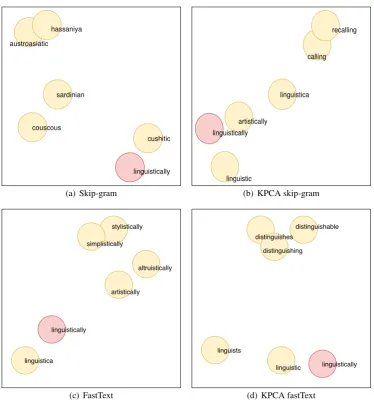
Figure 1: Visualization of5-nearest neighbors for the word “Linguistically”.
2 Related work
Mikolov et al.(2013a) proposed log-bilinear mod-els to learn vector representations of words from the context in which they appear in large corpora. These are the Continuous Bag-of-Words Model (CBOW) and the Continuous Skip-gram Model (skip-gram) which predict target words from source context words and source context words from target words, respectively. An extension pro-posed byMnih and Kavukcuoglu(2013) involves training lightweight log-bilinear language models with noise-contrastive estimation and achieves re-sults comparable to the best previous models with one quarter of the training data and in less com-puting time.
There are some recent works which try to incorporate morphological structures into the computation of embeddings. Soricut and Och
(2015) learn vector representation of morpholog-ical transformations and are able to obtain repre-sentations for unseen words.Cotterell et al.(2016) presented a morpheme-based post-processor for word embeddings. They proposed a Gaussian graphical model which can be extended to contin-uous representations for unknown words as well as helps in smoothing the representations of the observed words in the training dataset. Bhatia
et al. (2016) proposed a new unified
in-cluding sub-word information. This is achieved by not only representing words with vectors but also the subword parts they consist of. Word vector representations are finally built as the sum of their sub-word vectors and their own representation.
3 KPCA-based skip-gram and fastText models
In this section, we propose a general extension to word embedding methods which we evaluate on the skip-gram model as well as on the fast-Text model. We propose pre-training embeddings with a kernel PCA computed on word similarity matrices, generated using a string similarity func-tion, for words in a vocabulary and then inject-ing the pre-trained embeddinject-ings in the Word2Vec and fastText embeddings by initializing them with the KPCA word and subword embeddings. This seamlessly incorporates sub-word structures in Word2Vec and yields a better starting point for fastText training. It is especially useful for mor-phologically rich languages because their seman-tically similar words often share some common morphemes such as roots, affixes, and syllables.
3.1 Kernel PCA on string similarities
Embedding words according to morphological similarities can be seen as a clustering problem in a higher dimensional feature space which can be tackled using Kernel PCA (Sch¨olkopf et al.,
1997), a nonlinear form of principal component analysis. Suppose a vocabularyV of wordswi, a string similarity measureS (e.g. then-gram simi-larity (Brito et al.,2017)), and a non-linear kernel functionK (e.g. the Gaussian) to be given. This allows us to compute a|V| × |V|word similarity matrixKwhere
Kij =K S(wi, wj)
(1)
Centering this kernel matrix (Sch¨olkopf et al.,
1997) yields a feature space representation of words in V, because column vectorki ofK can be seen as a|V|-dimensional representation ofwi. Performing PCA in this feature space then allows for selecting the firstd < |V|nonlinear principal components vi which, in turn, allow for project-ing word vectors into lower dimensional spaces. Using projection matrix,
P=
v1
λ1
, ...,vd λd
(2)
generated by selecting d eigenvectors v1 to vd corresponding to the highest eigenvalues,λ1toλd, thed-dimensional projections are
ei=P|ki. (3)
3.2 Models with KPCA embeddings
Computing Kernel PCA for a large vocabulary is computationally demanding. We thus restrict our vocabulary V to contain only the most frequent words of a text corpus. For anyneworout of
vo-cabulary word snew not contained in V, we can
compute its kernel vector
knew=K S(snew, V)
(4)
and obtain a lower dimensional representation as
enew=P|knew. (5)
Note that word embeddings computed this way only encode morphological similar-ity. To incorporate semantic similarities, we initialize Word2Vec and fastText models with the pre-trained KPCA embeddings. We train the Word2Vec skip-gram model with negative sampling (Mikolov et al.,2013b) on our morpho-logical embeddings using the C implementation of Word2vec package1.
To initialize the fastText model with morpho-logical embeddings, we also compute the KPCA vectors for the subword units in the dictionary, as fastText also has vector representations for character n-grams contained in words. We train the fastText model initialized with our morpholog-ical embeddings using the C++ implementation of fastText 2. After training both the models, we obtain embeddings encoded with semantic, syntactic and morphological similarities whose practical merits we evaluate in the next section.
4 Experimental Results
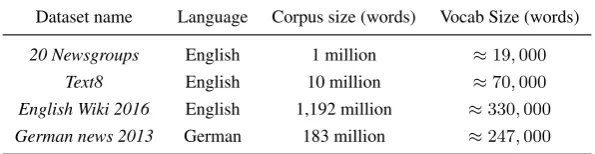
To evaluate our models’ performance when trained on datasets of different sizes, we consider English and German datasets such as Text8 3, 20 News
1https://code.google.com/p/word2vec/ 2
https://github.com/facebookresearch/ fastText/
Dataset name Language Corpus size (words) Vocab Size (words)
20 Newsgroups English 1 million ≈19,000 Text8 English 10 million ≈70,000
[image:4.595.150.448.65.142.2]English Wiki 2016 English 1,192 million ≈330,000 German news 2013 German 183 million ≈247,000
Table 1: Details of the datasets used for evaluation.
groups 4, English Wiki 2016 and German news
20135 for training. Each dataset contains articles crawled from news websites or Wikipedia. These raw text corpora contain a large amount of irrele-vant text and are pre-processed using a script by Mahoney6. In Table1, we list all the datasets that we have used to train the models.
4.1 Baseline
One of our main results is the observation that the KPCA fastText model and the KPCA skip-gram model generate high-quality word embed-dings even when trained only on small datasets when compared to fastText or skip-gram model respectively. To compare how well our models perform in comparison to the original skip-gram model and fastText model, we consider both of them as the baselines in all our experiments and use the same parameters and datasets for generat-ing and evaluatgenerat-ing embeddgenerat-ings for all models.
4.2 Evaluation
We evaluate our models usingintrinsic evaluation
tasks which assess how well the vectors capture
meanings of and relationships between words. In particular, we evaluate all the models with respect to
1. Word similarity taskswhich include finding a
word’s nearest neighbors.
2. Word analogy tasks which include
calculat-ing the semantic and the syntactic similarities between words and their relations.
3. Performance in a downstream application
which illustrates how well the embeddings
4
http://qwone.com/˜jason/ 20Newsgroups/
5http://www.statmt.org/wmt14/
training-monolingual-news-crawl/news. 2013.de.shuffled.gz
6http://mattmahoney.net/dc/textdata.
html
work for subsequent processing steps such as a sentence classification task (Kim,2014).
4.3 Word similarity Evaluation
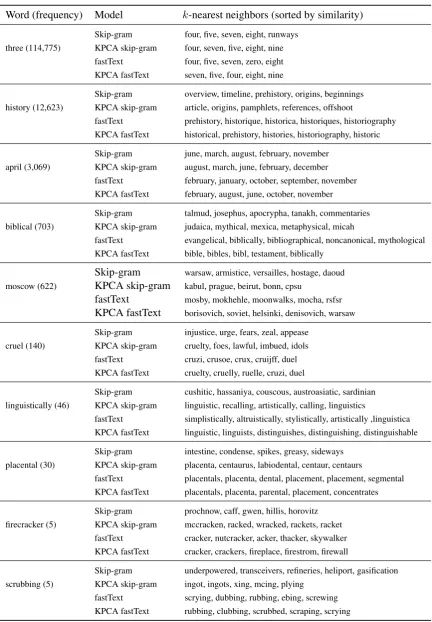
Word similarity tasks evaluate word embeddings in terms of theirk-nearest neighbors. For selected words, we show nearest neighbors according to cosine similarity for vectors trained using the pro-posed models as well as the baseline models. Here we illustrate how the models performed for fre-quent as well as for infrefre-quent words. Table 2
presents examples for all the models obtained af-ter being trained for an epoch on the small Text8
dataset.
The table illustrates that for the frequent words, all the models learn a good representation and are able to produce relevant nearest neigh-bors. For the infrequent words, the skip-gram did not learn a very good representation as there are not enough examples for the word to learn from. In these cases the nearest neighbor of the skip-gram model are not very meaningful, e.g. it places firecracker close to “prochnow”, while the KPCA fastText model places it closer to “cracker” and “fire” related words. Since the fast-Text model uses sub-word information, it achieves better performance at this task compared to the skip-gram model. It finds meaningful neighbors for “placental”, however it fails for words such as “cruel”. KPCA skip-gram gets a warm start with the morphological information learned from KPCA, which helps in learning a better represen-tation for scarce words, thus producing better k -nearest neighbors for words such as “cruel”.
Word (frequency) Model k-nearest neighbors (sorted by similarity)
three (114,775)
Skip-gram four, five, seven, eight, runways KPCA skip-gram four, seven, five, eight, nine fastText four, five, seven, zero, eight
KPCA fastText seven, five, four, eight, nine
history (12,623)
Skip-gram overview, timeline, prehistory, origins, beginnings
KPCA skip-gram article, origins, pamphlets, references, offshoot
fastText prehistory, historique, historica, historiques, historiography KPCA fastText historical, prehistory, histories, historiography, historic
april (3,069)
Skip-gram june, march, august, february, november KPCA skip-gram august, march, june, february, december fastText february, january, october, september, november
KPCA fastText february, august, june, october, november
biblical (703)
Skip-gram talmud, josephus, apocrypha, tanakh, commentaries
KPCA skip-gram judaica, mythical, mexica, metaphysical, micah
fastText evangelical, biblically, bibliographical, noncanonical, mythological KPCA fastText bible, bibles, bibl, testament, biblically
moscow (622)
Skip-gram warsaw, armistice, versailles, hostage, daoud
KPCA skip-gram kabul, prague, beirut, bonn, cpsu
fastText mosby, mokhehle, moonwalks, mocha, rsfsr
KPCA fastText borisovich, soviet, helsinki, denisovich, warsaw
cruel (140)
Skip-gram injustice, urge, fears, zeal, appease
KPCA skip-gram cruelty, foes, lawful, imbued, idols fastText cruzi, crusoe, crux, cruijff, duel KPCA fastText cruelty, cruelly, ruelle, cruzi, duel
linguistically (46)
Skip-gram cushitic, hassaniya, couscous, austroasiatic, sardinian KPCA skip-gram linguistic, recalling, artistically, calling, linguistics
fastText simplistically, altruistically, stylistically, artistically ,linguistica
KPCA fastText linguistic, linguists, distinguishes, distinguishing, distinguishable
placental (30)
Skip-gram intestine, condense, spikes, greasy, sideways
KPCA skip-gram placenta, centaurus, labiodental, centaur, centaurs
fastText placentals, placenta, dental, placement, placement, segmental KPCA fastText placentals, placenta, parental, placement, concentrates
firecracker (5)
Skip-gram prochnow, caff, gwen, hillis, horovitz KPCA skip-gram mccracken, racked, wracked, rackets, racket fastText cracker, nutcracker, acker, thacker, skywalker
KPCA fastText cracker, crackers, fireplace, firestrom, firewall
scrubbing (5)
Skip-gram underpowered, transceivers, refineries, heliport, gasification
KPCA skip-gram ingot, ingots, xing, mcing, plying
[image:5.595.83.516.58.681.2]fastText scrying, dubbing, rubbing, ebing, screwing KPCA fastText rubbing, clubbing, scrubbed, scraping, scrying
Table 2: Thek= 5-nearest neighbors of word embeddings inR128, trained on theText8dataset.
Epoch No. Model Total Semantic Syntactic
1
Skip-gram 7.84% 3.92% 11.24% KPCA skip-gram 15.74% 2.96% 26.71% fastText 36.89% 0.89% 67.80%
KPCA fastText 38.04% 1.12% 69.76%
2
Skip-gram 17.09% 9.59% 23.50%
KPCA skip-gram 21.14% 7.26% 33.07% fastText 41.19% 1.60% 75.19% KPCA fastText 40.48% 2.10% 73.43%
5
Skip-gram 24.21% 19.28% 28.45% KPCA skip-gram 26.20% 15.56% 35.34% fastText 43.60% 5.51% 76.31%
KPCA fastText 43.42% 7.37% 74.39%
10
Skip-gram 26.68% 24.61% 28.45%
[image:6.595.160.439.62.323.2]KPCA skip-gram 28.65% 22.22% 34.18% fastText 44.49% 12.10% 71.75% KPCA fastText 44.68% 13.17% 72.29%
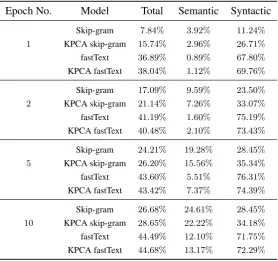
Table 3: Analogy accuracies of embeddings inR128trained for different epochs onText8dataset.
Epoch No. Model Total Semantic Syntactic
1
Skip-gram 0.18% 0.20% 0.17% KPCA skip-gram 15.47% 0.66% 19.80%
fastText 3.07% 0.26% 3.89% KPCA fastText 33.66% 0.79% 43.26.%
2
Skip-gram 0.99% 1.26% 0.91%
KPCA skip-gram 14.83% 1.65% 18.68% fastText 28.52% 0.33% 36.76% KPCA fastText 45.85% 1.19% 58.91%
3
Skip-gram 0.96% 1.46% 0.81% KPCA skip-gram 14.07% 1.92% 17.62%
fastText 44.84% 0.79% 57.71% KPCA fastText 47.44% 1.39% 60.90%
Table 4: Analogy accuracies of embeddings in R128
trained for different epochs on20 Newsgroupsdataset.
4.4 Word Analogy Evaluation
Pre-trained word vectors are available for a dataset of 100 billion words from Google News.Mikolov et al.(2013a) observed that, when word vectors are trained on such a large dataset, they are able to an-swer very subtle relationships between words. Yet, for the news data or for a small dataset such re-sults cannot be achieved. Warm-starting the mod-els with our KPCA embeddings, however, yields good performance in such settings, too.
To assess accuracies in the word analogy task, we use a comprehensive test set provided
by Mikolov et al. (2013a). This test consists of
semantic and syntactic similarity questions which include relationships like adjective-to-adverb, cur-rency, plural-verbs, city-in-state, comparative, su-perlative relationships, and others. A question is assumed to be correctly answered only if the clos-est word to the vector is exactly the same as the correct word in the question; synonyms are con-sidered as mistakes. In order to use this evalua-tion to compare our models’ results to those of the skip-gram and the fastText models, we train the models on the different datasets shown in Table1. Results are reported in Tables3,4,5and6.
[image:6.595.73.290.365.561.2]skip-gram or the fastText models can also learn from smaller datasets. The answer for the 20
News-groupas well as for thetext8datasets is “yes”, but
only if they are trained for several epochs.
The results for the 20 Newsgroups dataset in Table 4 also show that the skip-gram models completely fail to learn analogies on this dataset. The KPCA fastText embeddings benefit from their warm-start and show a quicker convergence rate. We make the following observations from the ac-curacies obtained after each epoch of training. During the1st epoch, the skip-gram and the fast-Text model do not perform well. However, after the2nd epoch, the fastText model starts perform-ing better on the syntactic questions. Meanwhile KPCA skip-gram and KPCA fastText models still achieve higher accuracies than the respective skip-gram and fastText models. Hence, considering ac-curacies from the initial epochs, we can conclude that training of our model converges faster than the training of the fastText model and the skip-gram model.
From Table3, we observe that the skip-gram model always seems to perform better on the se-mantic questions but when we compare these ac-curacies with the nearest neighbors results from Table 2, it can be observed that although KPCA models seem to work badly on semantic tasks, they generate betterk-nearest neighbors than the respective skip-gram and fastText models.
We also compare the accuracies achieved by the models when trained for one epoch on a large data set, namelyEnglish Wikipedia dataset. The results in Table5, illustrate the performance of the different models when training them on a large training dataset size. When compared to fast-Text, KPCA skip-gram performs better on seman-tic questions, but worse on syntacseman-tic questions. Noticeably KPCA fastText performs better on se-mantic questions than all the other models. How-ever plain fastText outperforms it on the syntactic questions. The overall accuracy of fastText is also slightly higher than for KPCA fastText model.
We also report accuracies for the analogy task when the models are trained on the
Ger-man news dataset for morphologically rich
Ger-man language. We use the GerGer-man version of the semantic/syntactic analogy dataset, introduced by (K¨oper et al.,2015) for evaluation. Table6shows how different models perform on the analogies tasks. We note that morphological information
Epochs Model Total Sem Syn
1
Skip-gram 70.95% 85.29% 66.67% KPCA skip-gram 75.00% 85.29% 71.93% fastText 81.43% 82.35% 80.46%
[image:7.595.308.525.190.267.2]KPCA fastText 80.41% 88.24% 78.07%
Table 5: Analogy accuracies of embeddings in R128
trained for one epoch onEnglish Wiki 2016dataset.
Epochs Model Total Sem Syn
1
Skip-gram 34.43% 35.89% 31.69% KPCA skip-gram 35.71% 37.72% 31.94%
[image:7.595.306.526.316.454.2]fastText 29.56% 14.34% 58.20% KPCA fastText 30.15% 14.54% 59.56%
Table 6: Analogy accuracies of embeddings in R128
trained for one epoch onGerman news 2012dataset.
Dataset Model Accuracies
20 Newsgroups
Skip-gram 72.82%
KPCA Skip-gram 73.57%
fastText 72.07%
KPCA fastText 72.73%
english Wiki 2016
Skip-gram 73.90%
KPCA Skip-gram 74.56%
fastText 73.96%
KPCA fastText 74.09%
Table 7: Sentence classification task trained using pre-trained embeddings obtained from different models af-ter10epochs of training.
significantly improves the syntactic tasks when we compare KPCA fastText and fastText with KPCA skip-gram and skip-gram. While the semantic ac-curacy degrades for both KPCA fastText and fast-Text. Initializing the skip-gram and fastText with KPCA embeddings has improved the performance of both the models. The KPCA skip-gram model shows the overall best performance. This shows that the initialization of the models with morpho-logical information, is beneficial for the German language as well.
4.5 Evaluation of performance on downstream applications
convo-lutional neural network proposed in (Kim,2014) and evaluate it with the embeddings in a sentence classification task. We initialize the CNN with the embeddings obtained from the different embed-ding models and keep the embedembed-dings static dur-ing traindur-ing. Initializdur-ing the word vectors with the pre-trained word embeddings instead of random embeddings improves the performance as noted by (Collobert et al.,2011) and (Iyyer et al.,2014).
In our experiment, the classification task is a sentiment classification task, i.e. detecting whether reviews are positive or negative. The dataset used for it, consists of movie reviews7with one sentence per review. We use embeddings gen-erated by training the embedding models on the20
NewsgroupsandEnglish Wikipedia datasets. The
CNN network is trained for10epochs.
In Table 7, we list the accuracies for the model trained with different embeddings obtained from the two datasets. In both cases, the model ini-tialized with embeddings generated using KPCA skip-gram model and the KPCA fastText outper-form the models initialized with the respective cold-start embeddings, albeit with a small margin. The models initialized with the KPCA skip-gram model achieve the best results in both cases.
5 Conclusion
In this paper, we explored a simple method to improve models for computing word embeddings and evaluated it with the popular skip-gram and fastText models.
Our approach relies on string similarity ma-trices computed from small vocabularies which, in a first step, are subjected to kernel PCA (KPCA) in order to generate non-linear, morphologically informed word embeddings. In a second step, the KPCA-based vector representations of words are used as input to the skip-gram model in order to obtain embeddings that also account for word con-texts.
In practical experiments, we evaluated the quality of our embeddings using intrinsic mea-sures such as word similarity and word anal-ogy. In our experiments the KPCA skip-gram and KPCA fastText were found to outperform the original continuous skip-gram and fastText model. In particular, we found that the continuous skip-gram model can learn similarity among words
7http://www.cs.cornell.edu/people/
pabo/movie-review-data/
only when it has seen a sufficiently large num-ber of examples. When feeding the models with morphologically informed vector representations of words, they seem to be able to learn from a better starting point when computing semantically informed embeddings. Using KPCA fastText or KPCA skip-gram model, we found that it is possi-ble to obtain high-quality word vectors even when training with small datasets and fewer epochs.
6 Future Work
Future work concerns deeper analysis of how to choose words in the vocabulary to construct the projection matrix used to generate Kernel PCA embeddings. We would like to explore different string similarity functions which would help in creating better clusters of the similar words. We would also like to extend our experiments to different embeddings such as GloVe as well as to further downstream tasks such as Named Entity Recognition or Relation Extraction.
7 Acknowledgements
This work was funded by the German Federal Ministry of Education and Research under the Competence Center Machine Learning Rhine-Ruhr ML2R, Foerderkennzeichen 01S18038B.
References
Parminder Bhatia, Robert Guthrie, and Jacob Eisen-stein. 2016. Morphological priors for proba-bilistic neural word embeddings. arXiv preprint arXiv:1608.01056.
Piotr Bojanowski, Edouard Grave, Armand Joulin, and Tomas Mikolov. 2017. Enriching word vectors with subword information. Transactions of the Association for Computational Linguistics, pages 135–146.
Eduardo Brito, Rafet Sifa, Kostadin Cvejoski, Cesar Ojeda, and Christian Bauckhage. 2017. Towards german word embeddings: A use case with pre-dictive sentiment analysis. In Proceedings of Data Science, Analytics, and Applications, pages 59–62.
Ronan Collobert, Jason Weston, L´eon Bottou, Michael Karlen, Koray Kavukcuoglu, and Pavel Kuksa. 2011. Natural language processing (almost) from scratch. Journal of machine learning research, 12(Aug):2493–2537.
54th Annual Meeting of the Association for Com-putational Linguistics (Volume 1: Long Papers), pages 1651–1660.
Mohit Iyyer, Peter Enns, Jordan Boyd-Graber, and Philip Resnik. 2014. Political ideology detection using recursive neural networks. InProceedings of the 52nd Annual Meeting of the Association for Computational Linguistics (Volume 1: Long Pa-pers), pages 1113–1122.
Yoon Kim. 2014. Convolutional neural networks for sentence classification. In Proceedings of the 2014 Conference on Empirical Methods in Nat-ural Language Processing, pages 1746–1751.
Maximilian K¨oper, Christian Scheible, and Sabine Schulte im Walde. 2015. Multilingual reliability and semantic structure of continuous word spaces. InProceedings of the 11th Interna-tional Conference on ComputaInterna-tional Semantics (IWCS).
Tomas Mikolov, Kai Chen, Greg Corrado, and Jef-frey Dean. 2013a. Efficient estimation of word representations in vector space. arXiv preprint arXiv:1301.3781.
Tomas Mikolov, Ilya Sutskever, Kai Chen, Greg Cor-rado, and Jeffrey Dean. 2013b. Distributed rep-resentations of words and phrases and their com-positionality. InAdvances in neural information processing systems, pages 3111–3119.
Andriy Mnih and Koray Kavukcuoglu. 2013. Learn-ing word embeddLearn-ings efficiently with noise-contrastive estimation. InAdvances in neural in-formation processing systems, pages 2265–2273.
Bernhard Sch¨olkopf, Alexander Smola, and Klaus-Robert M¨uller. 1997. Kernel principal component analysis. InInternational conference on artificial neural networks, pages 583–588.