ISSN Online: 1945-3124 ISSN Print: 1945-3116
DOI: 10.4236/jsea.2017.1012049 Nov. 13, 2017 873 Journal of Software Engineering and Applications
Design of Secure and Traceable Requirement
Engineering Process for Security-Sensitive
Projects
Abdul Ahad
1, Luqman Tariq
2, Saba Niaz
1, Muhammad Inam
31Department of Computer Science, Virtual University, Lahore, Pakistan 2Department of Computer Science, Preston University, Islamabad, Pakistan
3Department of Computer Science, Beijing University of Technology, Beijing, China
Abstract
With continuous evolution in software industry, security is becoming very important in software projects. However, in many development methodolo-gies, security is thought to be added in the project at later stages of the devel-opment lifecycle. There are also many proposed methodologies where the se-curity measures are considered at requirement engineering stage of the de-velopment lifecycle, but many of them still do not seem adequate for applica-bility due to the reason that these approaches do not provide sufficient sup-port for mapping the security requirements to the later stages of development. So, we are in need of a software requirement engineering approach, which is not only helpful in security requirement specification at requirement engi-neering stage but also provides support for using the specified security re-quirements at later stages of development. To meet this requirement, we in-troduce a new method Secure and Traceable Requirement Engineering Process (STREP). This method also helps the non-security-expert requiment engineers to specify requirerequiments in such a way that the specified re-quirements can be used to derive security related test cases. STREP method not only deals with security issues of the system at requirement engineering stage, but also makes the security requirements more traceable to be used at later stages of development lifecycle, and as a result, secure systems are pro-duced that are also usable as the customer wishes.
Keywords
Traceable, Usable, Security Requirements, Requirement Specification, Development Lifecycle, SRE Method
How to cite this paper: Ahad, A., Tariq, L., Niaz, S. and Inam, M. (2017) Design of Se-cure and Traceable Requirement Engineering Process for Security-Sensitive Projects. Jour-nal of Software Engineering and Applica-tions, 10, 873-883.
https://doi.org/10.4236/jsea.2017.1012049
Received: September 19, 2017 Accepted: November 10, 2017 Published: November 13, 2017
Copyright © 2017 by authors and Scientific Research Publishing Inc. This work is licensed under the Creative Commons Attribution International License (CC BY 4.0).
DOI: 10.4236/jsea.2017.1012049 874 Journal of Software Engineering and Applications
1. Introduction
In a software development lifecycle, this requirements engineering is the first im-portant and main stage. It is the requirements engineering stage where software developers and the users/customers meet each other to decide what functionalities the software to-be-developed should have [1]. Requirement engineering stage has strong effects on the software development lifecycle. Good requirement engineer-ing helps in producengineer-ing successful projects. Bad requirement engineerengineer-ing introduc-es errors in the requirements specification, and thintroduc-ese errors are propagated to next stages of software development lifecycle, resulting in an unsuccessful system de-velopment. Security related requirements and non-functional requirements can get a lot befit from a good requirement engineering process.
Security-sensitive systems require the safety of their resources and informa-tion. Security is essential all the way from processing and storing the resources and information to transmitting them to other remote systems. There may be many threats to security of resources and information e.g. unauthorized access to resources and information, changing the information during the transmis-sion, or disabling the authorized access [2] etc.
Security specific requirements are of the great importance for security sensi-tive systems at the requirements specification stage, and what is more impor-tance is to provide some means to shift these security specific requirements to next stages of the development lifecycle.Our major goal is to introduce a securi-ty specific requirement engineering process that is not only helpful at require-ments specification stage but also helpful at the next stages of development life-cycle. The requirement engineering process should be applicable at system ar-chitecture, system design, system implementation, system testing, and system deployment stages of the development lifecycle. In the development of securi-ty-sensitive system, secure requirements are used at all stages of development li-fecycles, and therefore, there should be proper processes for specifying secure requirements at requirement engineering stage. The unhappy fact is that the current techniques that are used to collect secure requirements [3] are not very much beneficial at later stages of the development lifecycle.
In this paper, a process STREP, Secure and Traceable Requirement Engineer-ing Process, is beEngineer-ing proposed with the intent to be helpful and Traceable at the later stages of the development lifecycle. The basic purposes of proposing the STREP method are:
1) To have a more efficient and user-friendly process for security requirement specification. To achieve this, the benefits of three security requirement engi-neering techniques have been combines. These techniques are Misuse Cases [4], USeR, and CLASP [5]. These will help us in specifying clearer, more complete, and better understandable security requirements.
DOI: 10.4236/jsea.2017.1012049 875 Journal of Software Engineering and Applications 3) To provide guidelines and some tool assistance that will help in mapping the securing requirements to security related test cases [6]. STREP will help us in this mapping.
Organization of paper as follows: In Section II, discussion about software de-sign, design concept, design attribute, design process and design principles. In Section III, the target problem will be discussed and previous work on the prob-lem will be briefly described. In Section IV, reasons for proposing the STREP method will be described. In Section V, the STREP method will be explained. In Section VI, the expected contribution of the proposed method will be discussed. Section VII will conclude the paper.
2. Software Design
Software design is a process of applying software solutions to one or more groups of problems. Software requirements analysis (SRA) is one of the main components of software design. Software requirements analysis (SRA) is the part of software development process which lists specifications used in the software engineering. If the software is user centred or semi-automated, software design may include user experience design yielding a storyboard to help show those specifications. If the software is completely automated, a software design may be as simple as text or flow chart to describing a planned sequence of events.
2.1. Design Concept
Design concept provided software designer with a groundwork from which more classy methods can be applied. A set of fundamental design concepts has evolved. They are following
1) Abstraction: Abstraction is a process or result of generalization by mini-mizing the information content of a concept or a noticeable phenomenon, typi-cally in order to recall the only information which is applicable for specific pur-pose. It is a performance of representing important features without including the background explanations.
2) Refinement: Refinement is the process of explanation. Hierarchy is devel-oped by decaying a macroscopic statement of a function in step-wise manner till programming language statements are reached. In every step, one or more commands of a given program are decayed into many detailed instructions. Re-finement and Abstraction are complementary concepts.
3) Modularity: Software architecture is separated into components which is
called modules.
4) Software Architecture: Software Architecture is the overall structure of
software and this structure provides theoretical integrity for a system. A good software architecture will produce a good return on investment with respect to the wanted outcome from the project, e.g. in terms of quality, cost, schedule and performance.
organi-DOI: 10.4236/jsea.2017.1012049 876 Journal of Software Engineering and Applications zation of program elements and implies a hierarchy of control.
6) Structural Partitioning: A program structure can be divided into both ho-rizontal and vertical. Hoho-rizontal partitions describe the separate branches of a modular hierarchy for every major program function. Vertical partitions suggest that the control and work should be distributed top down in program structure.
7) Data Structure: Data Structure represents the logical relationship between the individual elements of data.
8) Software Procedure: Software Procedure focuses on the processing of every module individually.
9) Information Hiding: Modules should be designed and specified so that the
information inside module is inaccessible to every other module that has no need for such information.
2.2. Design Process
Design process is a repetitive process through which requirements are translated into a model. The design is represented at a high level of abstraction, i.e. a level to design representation at much lower levels of abstraction.
Design is only way by which we accurately a finished software product or sys-tem.
The design process must follow the following three general points.
1) The design must implement all explicit requirements contained in analysis model and it must accommodate all implicit requirements desired by the cus-tomers.
2) The design must be readable; understandable for those who generate code and for those who test and subsequently maintain the software.
3) The design should provide a complete picture of the software. Its data structure, function and behavior etc.
Each of the above maintained characteristics represents the goal of a good de-sign. The designer can achieve this goal by following these characteristics. To evaluate the quality of design representation, we have to establish technical crite-ria for a good design. These are
1) A design should be a modular.
2) A design should contain both data and procedural abstraction. 3) A design should be derived using repeatable method.
4) A design should lead to interfaces. 5) A design should display a hierarchal.
The above mentioned technical criteria can be achieved by applying funda-mental design principles, systematic, methodologies throw review etc.
2.3. Software Design Quality Attributes
DOI: 10.4236/jsea.2017.1012049 877 Journal of Software Engineering and Applications Some quality attributes for a software system design are following [7]
1) Verifiability: The first objective of design is verifiability which means that the design should be verifiable and correct. It refers to set of activities that en-sure the software correctly implemented a specific function.
2) Completeness: It means that design should be complete in all aspects. All
the number of modules needed should be specified.
3) Consistency: The design should be consistence, i.e. one module should not have two different responses to different entities.
4) Efficiency: The design should be efficient; an efficient system is that which consumes processor time and requires less memory.
5) Traceability: It is an important property that can aid design verification. It requires that all desire elements must be traceable to the requirements.
6) Simplicity and understand ability: The design must be readable;
unders-tandable guide for those who generate code and for those who test and subse-quently maintain the software.
2.4. Design Principles
The design of a large system is a complex task. The basic guiding principles are followed to produce a good design of a system. These design principles reduce the complexity as well as the efforts needed for design and design cost. The error that can be occurred during design process also reduced this way.
The basic design principles help a software engineer to navigate the design process. The basic design principles suggested by the Davis for the software en-gineering are given below.
1) The design process should not suffer from Turmel sight. It means a good designer should be considering alternative approaches; judging each based on the requirements of problems. 1.
2) The resources available to do the job and the design concepts. 3) The design should be traceable to the analysis model.
4) The design should not re-invent the wheel. The system is constructed by dividing the problem into manageable small pieces of pattern that can be solved separately. These patterns are referred as re-usable design components. They should be chosen as an alternative to re-invent.
5) The design should minimize the intitulé between the software and problem as it exists in the real world.
6) The design should display uniforms and integration. It means that rules and format should be defined for a design team before design work begins.
7) Design should to be structured well to accommodate new changes.
8) The design should be structured to be acceptable even when varying data, events or operating conditions are encountered.
9) The design is not coding and coding is not design.
DOI: 10.4236/jsea.2017.1012049 878 Journal of Software Engineering and Applications 11) The design should be reviewed to minimize the conceptual errors.
When the above-mentioned design principles are properly applied, the system design is created that shows both external and internal quality factors.
1) The external factors are those properties of the system or software that can be observed by the users.
2) The internal factors are those properties of the software can be observed by the software engineer. The internal factors lead to the high-quality design.
3. Problem Definition and Related Work
Security needs become important when stakeholders find that the system to-be-developed has some assets (e.g. money or confidential information) of great value for the organization, and stakeholder want to save them from attacks or damage [8][9]. Software requirement engineering process should, therefore, be concerned about saving these valuable assets from requirement perspective. Different approaches are available for gathering secure requirements, but unfor-tunately, they do not provide significant support for using these secure require-ments at the later stages of the software development lifecycle. We believe that security requirements need equal attention at the later stages of development li-fecycle as well so that the traceability and usability of the secure requirement may be ensured at later stages [10].
In [3], a survey has been conducted to know the support of existing SRE me-thods for security requirements. The support was evaluated against five areas of security requirements. These five areas were requirement elicitation, requiment analysis, requirerequiment specification, requirerequiment maintenance, and re-quirement support for later stages of the development. SRE methods were se-lected on the basis of their maturity towards industry and academia. References for each of these SRE methods have also been given in [3]. Selected SRE methods were CLASP [5], Misuse Cases, USeR method, abuser stories, secure TROPOS, SQUARE [11], Anti-Models, and security Problems Frames etc.
Survey revealed that these methods have shortcomings in three different im-portant areas.
1) In most of the methods, it is difficult to specify the security requirements, and if specified, it is difficult to understand the security requirements.
2) These methods provide little support for using the security requirements at later stages of development lifecycle.
3) These methods do not provide sufficient support for non-security experts to get benefit from them.
In this paper, we are proposing “Secure and Traceable Requirement Engi-neering Process (STREP)” that will address all the three shortcomings just de-scribed.
4. Reasons to Propose the STREP Method
DOI: 10.4236/jsea.2017.1012049 879 Journal of Software Engineering and Applications society. Now a day, the security threats are increasing in frequency, spread, se-riousness. The Internet is one major medium for different types of security threats. People are increasingly making security attacks to systems from outside organization, especially using the Internet. Nature and number of attacks is in-creasing day by day. Security threats may also occur from inside the organiza-tions.
The major reasons to propose the STREP method is not just that to show that the security threats are increasing day by day. But rather the major rea-sons to propose STREP method is to emphasize the fact that, just like any oth-er attribute of software, the security should also be addressed at starting stage of the development lifecycle [12]. The security should be considered as an es-sential attribute for the system to-be-developed and addressed immediately at the early stages.
The proposed STREP method not only deals with security issues of the system at requirement engineering stage, but also makes the security requirements more traceable to be used at later stages of development lifecycle, and as a result, se-cure systems are produced that are also usable as the customer wishes.
5. The STREP Method
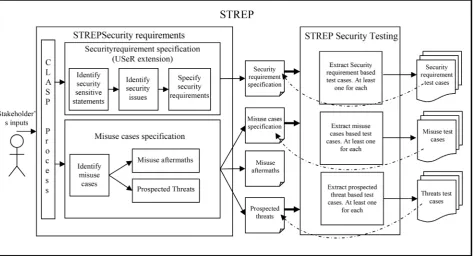
The STREP (Secure and Traceable Requirement Engineering Process) collects the software requirements just like the conventional requirements engineering processes do i.e. eliciting requirements, analysing requirements, specifying re-quirements, but in a modified way such that the security requirements are also captured. The STREP also documents the security threats to the system and mi-suse scenarios at very early stages (i.e. requirement engineering stage) of the sys-tem development lifecycle. Moreover, STREP also helps in extracting testing components from the security requirements. The STREP method has been shown in Figure 1.
The conventional requirement engineering method has been modified to STREP by adding two additional stages; STREP security requirement stage and STREP security testing stage. At a higher abstraction level, the advantages and prominent features of STREP are;
1) It is helpful for experts that are not well known with security and also helpful for customer, in the requirement specification stage.
2) It helps in creation of security components while dealing and addressing with security issues at requirement specification stage.
3) It helps in extracting testing components from the security requirement specified earlier through it.
STREP method has been shown in Figure 1 and described in the followings.
5.1.
STREP Security Requirements
DOI: 10.4236/jsea.2017.1012049 880 Journal of Software Engineering and Applications
Figure 1. The STREP process.
1) Specification Planning: To specify the security requirements for different projects, STREP plans to uses the CLASP method discussed in [5]. CLASP de-fines 30 activities. In our STREP method, we plan to select some of them which are more important for security-sensitive projects. After the specification plan-ning phase, the developers have set of tasks (CLASP activities) that will be ex-ecuted in order to complete the requirement specification phase in a successful and secure manner.
2) Security Requirements Specification: The Security requirements are speci-fied in three steps as shown in Figure 1. Each step refines the specification process. These three steps have been derived from USeR method [13]. The de-scription of these three steps is as follows:
• Security Sensitive Statements: We find that the customers are not fully aware
of security issues of system. Requirement engineers and customers normally specify requirement with respect to the functional aspect. At this stage, func-tional requirements are reviewed to identify and extract the security re-quirement.
• Security Issues: Security requirements identified in step 1 help the developers to know the issue associated with the functional requirements. One or more issues are detected from the security statements.
• Security Requirement: When the security issues are reviewed, they help in
specifying the security requirements. Each security issue can help in specify-ing one or more security requirements [14].
DOI: 10.4236/jsea.2017.1012049 881 Journal of Software Engineering and Applications security experts themselves, to specify the security requirements.
3) Misuse Cases Specification: The STREP method also uses the “Misuse
Cas-es” technique to provide assistance in security requirement specification. Misuse cases propose an inverse approach to specify the security requirements. The in-verse approach is to think in term of attacks to harm the system to achieve mali-cious goals. Each identified misuse case gives two new security related informa-tion; aftermaths and threats.
In misuse aftermaths, we consider the consequences that a successful attack could have to the system. Considering the consequences assists the system de-velopers in prioritizing the security requirements. It also helps to know the af-fects of a successful attack on the other modules of the system.
In misuse threats, we consider the possible threats to the system resources. Considering the security threat at the requirement engineering stage alarm us about different possible ways a system can be illegally accessed or harmed. This early consideration will help the developers make the affects of these threats less severe.
5.2. STREP Security Testing
As described earlier, one of the goals of STREP is to make the security require-ment specification traceable and usable at later stages of the system developrequire-ment lifecycle. STREP decides to assist the developers at testing stage. In doing so, STREP guides the developers in extracting the test case from security require-ment specification.
STREP introduces three types of test cases; security requirement based test cases, misuse case based test cases, and prospected threat based test cases.
1) Security Requirement Based Test Cases: These are the first type of test cases that are extracted from the requirement stage using STREP. Security require-ments have information that, on a focused consideration, gives us one or more security test cases.
2) Misuse Cases Based Test Cases: Misuse cases give us information of how a
requirement can be misused and illegally accessed using different ways. This in-formation helps the developers to derive the test cases. The inin-formation in each misuse case can produce one or more test cases.
3) Prospected Threat Based Test Cases: STREP identifies different possible
threats to requirements. These prospected threats are used to derive test cases. One is more test case are extracted from each prospected threat.
6. Contributions of the Proposed Method
us-DOI: 10.4236/jsea.2017.1012049 882 Journal of Software Engineering and Applications able at the later stage of development lifecycle. Keeping the mentioned point in mind, some of the contributions of the STREP method are:
1) Introduction of a new approach for software requirement engineering, which increases the traceability and usability of security requirements.
2) Assistance for mapping the security requirements to design, implementa-tion, and testing stages of development lifecycle.
3) Introduction of a kind of relationships between security requirements. 4) Introduction of a testing mechanism on the basis of specifications of re-quirements.
5) A platform for bringing the stakeholders closer.
A similar mechanism as in STREP but with a different focus can open a way to introduce new SRE methods for systems other than security-sensitive systems. For example, if we shift our focus from security to time, we can introduce a STREP like new SRE method for real-time systems.
7. Conclusions
Security is very important in software projects. Most of the current security re-quirement approaches do not seem adequate for applicability due to the reason that these approaches do not provide sufficient support for mapping the security requirements to the later stages of development. Secure and Traceable Require-ment Engineering Process (STREP) is our proposed method which is not only helpful in security requirement specification at requirement engineering stage but also provides support for using the specified security requirements at later stages of development.
We have completely outlined the STREP method and our next task is to eva-luate how the STREP is more effective as compared to other major SRE ap-proaches. We also have a plan to perform a larger evaluation of the STREP me-thod so that we may quantify its support for making security requirements spe-cification more usable, useful, and understandable.
References
[1] Høegh, R.T. (2006) Usability Problems: Do Software Developers Already Know? Aalborg University Department of Computer Science, Aalborg East, DK-9220, Denmark.
[2] De Landtsheer, R. and van Lamsweerde, A. (2005) Reasoning About Confidentiality at Requirements Engineering Time. Département d’Ingénierie Informatique, Un-iversité catholique de Louvain B-1348 Louvain-la-Neuve (Belgium).
[3] Romero Mariona, J. and Richardson, D. (2009) Security Requirements Engineering: A Survey. University of California, Irvine.
[4] Whittle, J. and Wijesekera, D. (2008) Executable Misuse Cases for Modeling Securi-ty Concerns. Federal Railroad Administration 1120 Vermont Ave Washington, DC 20590.
[5] Viega, J. (2005) Building Security Requirements with CLASP. Secure Software, Inc. 2010 Corporate Ridge, Suite 820 McClean, VA.
DOI: 10.4236/jsea.2017.1012049 883 Journal of Software Engineering and Applications
Nelson Mandela Metropolitan University P O Box 77000, Port Elizabeth, 6031 South Africa.
[7] Software Quality Attributes and Trade-Offs. (2005) Authors: Patrik Berander, Lars-Ola Damm, Jeanette Eriksson, Tony Gorschek, Kennet Henningsson, Per Jönsson, Simon Kågström, Drazen Milicic, Frans Mårtensson, Kari Rönkkö, Piotr Tomaszewski.
[8] Constantine, L.L. and Lockwood, L.A.D. (2003) Usage-Centred Software Engineer-ing: An Agile Approach to Integrating Users, User Interfaces, and Usability into Software Engineering Practice. University of technology, Sydney (Australia), Con-stantine & Lockwood, Ltd.
[9] Beznosov, K. and Kruchten, P. (2004) Towards Agile Security Assurance. University of British Columbia 2356 Main Mall Vancouver, BC, V6T 4Z1 Canada.
[10] Luckey, M., Baumann, A. and Méndez, D. (2010) Reusing Security Requirements Using an Extended Quality Model. University of Paderborn, Paderborn.
[11] Mead, N.R. and Stehney, T. (2005) Security Quality Requirements Engineering (SQUARE) Methodology. Carnegie Mellon University 5000 Forbes Avenue Pitts-burgh.
[12] Ardi, S., Byers, D. and Shahmehri, N. (2006) Towards a Structured Unified Process for Software Security. Department of Computer and Information Science Linköping University, SE-58183 Linköping, Sweden.
[13] Romero-Mariona, J. and Ziv, H. (2009) Later Stages Support for Security Require-ments. University of California, Irvine Donald Bren School of Information and Computer Sciences.