of Tree-Local Multi-Component
Tree-Adjoining Grammar
Rebecca Nesson
∗School of Engineering and Applied Sciences,
Harvard University
Giorgio Satta
∗∗Department of Information Engineering University of Padua
Stuart M. Shieber
†School of Engineering and Applied Sciences
Harvard University
Tree-Local Multi-Component Tree-Adjoining Grammar (TL-MCTAG) is an appealing formal-ism for natural language representation because it arguably allows the encapsulation of the appropriate domain of locality within its elementary structures. Its multicomponent structure allows modeling of lexical items that may ultimately have elements far apart in a sentence, such as quantifiers andwh-words. When used as the base formalism for a synchronous grammar, its flexibility allows it to express both the close relationships and the divergent structure necessary to capture the links between the syntax and semantics of a single language or the syntax of two different languages. Its limited expressivity provides constraints on movement and, we posit, may have generated additional popularity based on a misconception about its parsing complexity.
Although TL-MCTAG was shown to be equivalent in expressivity to TAG when it was first introduced, the complexity of TL-MCTAG is still not well understood. This article offers a thorough examination of the problem of TL-MCTAG recognition, showing that even highly restricted forms of TL-MCTAG are NP-complete to recognize. However, in spite of the provable difficulty of the recognition problem, we offer several algorithms that can substantially improve processing efficiency. First, we present a parsing algorithm that improves on the baseline parsing
∗School of Engineering and Applied Sciences, Harvard University, 38 Plymouth St., Cambridge, MA 02141. E-mail: [email protected].
∗∗Department of Information Engineering, University of Padua, via Gradenigo 6/A, 1-35131 Padova, Italy. E-mail: [email protected].
†School of Engineering and Applied Sciences, Harvard University, Maxwell Dworkin Laboratory, 33 Oxford Street, Cambridge, MA 02138. E-mail: [email protected].
method and runs in polynomial time when both the fan-out and rank of the input grammar are bounded. Second, we offer an optimal, efficient algorithm for factorizing a grammar to produce a strongly equivalent TL-MCTAG grammar with the rank of the grammar minimized.
1. Introduction
Tree-Local Multi-Component Tree-Adjoining Grammar (TL-MCTAG) is an appealing formalism for natural language representation because it arguably allows the encapsu-lation of the appropriate domain of locality within its elementary structures (Kallmeyer and Romero 2007). Its flexible multicomponent structure allows modeling of lexical items that may ultimately have elements far apart in a sentence, such as quantifiers and wh-words. Its limited expressivity provides constraints on movement and, we posit, may have generated additional popularity based on a misconception about its parsing complexity.
TL-MCTAG can model highly structurally divergent but closely related elementary structures, such as the syntax and the semantics of a single word or construction or the syntax of a single word or construction and its translation into another language, with a pair of elementary trees. This flexibility permits conceptually simple, highly expressive, and tightly coupled modeling of the relationship between the syntax and semantics of a language or the syntax and semantics of two languages. As a result, it has frequently been put to use in a growing body of research into incorporating semantics into the Tree-Adjoining Grammar (TAG) framework (Kallmeyer and Joshi 2003; Han 2006; Nesson and Shieber 2006, 2007). It is also under investigation as a possible base formalism for use in synchronous-grammar based machine translations systems (Nesson 2009). Similar pairing of elementary structures of the TAG formalism is too constrained to capture the inherent divergence in structure between different languages or even be-tween the syntax and semantics of a language. Pairing of more expressive formalisms is too flexible to provide appropriate constraints and has unacceptable consequences for processing efficiency.
Although TL-MCTAG was first introduced by Weir (1988) and shown at that time to be equivalent in expressivity to TAG, the complexity of TL-MCTAG is still not well understood. Perhaps because of its equivalence to TAG, questions of processing efficiency have not been adequately addressed. This article offers a thorough exami-nation of the problem of TL-MCTAG recognition, showing that even highly restricted forms of TL-MCTAG are NP-complete to recognize. However, in spite of the provable difficulty of the recognition problem, we offer several algorithms that can substantially improve processing efficiency. First, we present a parsing algorithm that improves on the baseline parsing method and runs in polynomial time when both the fan-out (the maximum number of trees in a tree set) and rank (the maximum number of trees that may be substituted or adjoined into a given tree) of the input grammar are bounded. Second, we offer an optimal, efficient algorithm for factorizing a grammar to produce a strongly equivalent TL-MCTAG grammar with the rank of the grammar minimized.
1.1 Summary of Results
generalize TAG by allowing elementary structures to be sets of TAG trees. One member of the MCTAG formalism group is Tree-Local MCTAG (TL-MCTAG), in which all trees from a single elementary tree set are constrained to adjoin or substitute into a single tree in another elementary tree set. Weir (1988) shows that this constraint is sufficient to guarantee that TL-MCTAG has weak generative capacity equivalent to the polynomially parsable TAG.
Recent work on the complexity of several TAG variants has demonstrated indirectly that the universal recognition problem for TL-MCTAG is NP-hard. This result calls into question the practicality of systems that employ TL-MCTAG as the formalism for expressing a natural language grammar. In this article we present a more fine-grained analysis of the processing complexity of TL-MCTAG. We demonstrate (Section 3) that even under restricted definitions where either the rank or the fan-out of the grammar is bounded, the universal recognition problem is NP-complete.
We define a novel variant of multi-component TAG formalisms that treats the elementary structures as vectors of trees rather than as unordered sets (Section 4). We demonstrate that this variant of the definition of the formalism (thevector definition) is consistent with the linguistic applications of the formalism presented in the literature. Universal recognition of the vector definition of TL-MCTAG is NP-complete when both the rank and fan-out are unbounded. However, when the rank is bounded, the universal recognition problem is polynomial in both the length of the input string and the grammar size.
We present a novel parsing algorithm for TL-MCTAG (Section 5) that accommo-dates both the set and vector definitions of TL-MCTAG. Although no algorithms for parsing TL-MCTAG have previously been published, the standard method for parsing linear context-free rewriting systems (LCFRS)–equivalent formalisms can be applied directly to TL-MCTAG to produce a quite inefficient baseline algorithm in which the polynomial degree of the length of the input string depends on the input grammar. We offer an alternative parser for TL-MCTAG in which the polynomial degree of the length of the input string is constant, though the polynomial degree of the grammar size depends on the input grammar. This alternative parsing algorithm is more appealing than the baseline algorithm because it performs universal recognition of TL-MCTAG (vector definition) with constant polynomial degree in both the length of the input string and the grammar size when rank is bounded.
It may not be generally desirable to impose an arbitrary rank bound on TL-MCTAGs to be used for linguistic applications. However, it is possible given a TL-MCTAG to minimize the rank of the grammar. In the penultimate section of the paper (Section 6) we offer a novel and efficient algorithm for transforming an arbitrary TL-MCTAG into a strongly equivalent TL-MCTAG where the rank is minimized.
1.2 Related Work
MCTAG, although not specifically for TL-MCTAG. The method proposed differs from ours in that MCTAGs are parsed first as a standard TAG, with any conditions on tree or set locality checked on the derivation forest as a second step. No specific algorithm is presented for performing the check of tree-locality on a TAG derivation forest, so it is difficult to directly compare the methods. However, that method cannot take advantage of the gains in efficiency produced by discarding inappropriate partial parses at the time that they are first considered. Aside from Kallmeyer’s work, little attention has been paid to the problem of directly parsing TL-MCTAG.
Søgaard, Lichte, and Maier (2007) present several proofs regarding the complexity of the recognition problem for some linguistically motivated extensions of TAG that are similar to TL-MCTAG. Their work shows the NP-hardness of the recognition problem for these variants and, as an indirect result, also demonstrates the NP-hardness of TL-MCTAG recognition. This work differs from ours in that it does not directly show the NP-hardness of TL-MCTAG recognition and does not further locate and constrain the source of the NP-hardness of the problem to the rank of the input grammar, nor does it provide mitigation through rank reduction of the grammar or by other means.
Our work on TL-MCTAG factorization is thematically though not formally related to the body of work on induction of TAGs from a treebank exemplified by Chen and Shanker (2004). The factorization performed in their work is done on the basis of syn-tactic constraints rather than with the goal of reducing complexity. Working from a treebank of actual natural language sentences, their work does not have the benefit of explicitly labeled adjunction sites but rather must attempt to reconstruct a derivation from complete derived trees.
The factorization problem we address is more closely related to work on factorizing synchronous context-free grammars (CFGs) (Gildea, Satta, and Zhang 2006; Zhang and Gildea 2007) and on factorizing synchronous TAGs (Nesson, Satta, and Shieber 2008). Synchronous grammars are a special case of multicomponent grammars, so the prob-lems are quite similar to the TL-MCTAG factorization problem. However, synchronous grammars are fundamentally set-local rather than tree-local formalisms, which in some cases simplifies their analysis. In the case of CFGs, the problem reduces to one of identifying problematic permutations of non-terminals (Zhang and Gildea 2007) and can be done efficiently by using a sorting algorithm to binarize any non-problematic per-mutations until only the intractable correspondences remain (Gildea, Satta, and Zhang 2006). This method is unavailable in the TAG case because the elementary structures may have depth greater than one and therefore the concept of adjacency relied upon in their work is inapplicable. The factorization algorithm of Nesson, Satta, and Shieber (2008) is the most closely related to this one but is not directly applicable to TL-MCTAG because each link is presumed to have exactly two locations and all adjunctions occur in a set-local rather than tree-local manner.
2. Technical Background
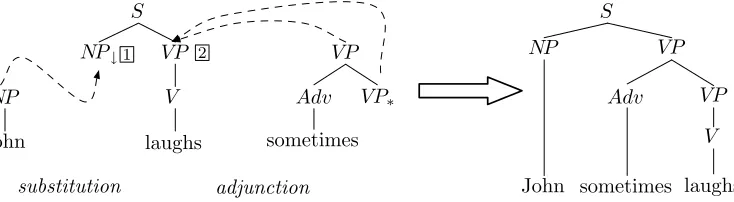
are called initial trees. Examples of the adjunction and substitution operations are given in Figure 1. For further background, we refer the reader to the survey by Joshi and Schabes (1997).
A TAG derivation can be fully specified by aderivation tree, which records how the elementary structures are combined using the TAG operations to form the derived tree. The nodes of the derivation tree are labeled by the names of the elementary trees and the edges are labeled by the addresses at which the child trees substitute or adjoin. In contrast to CFGs, the derivation and derived trees are distinct.
We depart from the traditional definition in notation only by specifying adjunc-tion sites explicitly with numbered links in order to simplify the presentation of the issues raised by multi-component adjunctions. Each link may be used only once in a derivation. Adjunctions may only occur at nodes marked with a link. A numbered link at a single site in a tree specifies that a single adjunction is available at that site. An obligatory adjunction constraint indicates that at least one link at a given node must be used (Joshi, Levy, and Takahashi, 1975; Vijay-Shanker and Joshi 1985). We notate obligatory adjunction constraints by underlining the label of the node to which the constraint applies. Because we use explicit links, the edges in the derivation tree are labeled with the number of the link used rather than the traditional label of the address at which the operation takes place.
Multiple adjunction refers to permitting an unbounded number of adjunctions to occur at a single adjunction site (Vijay-Shanker 1987; Shieber and Schabes 1994). In the standard definition of TAG, multiple adjunction is disallowed to ensure that each derivation tree unambiguously specifies a single derived tree (Vijay-Shanker 1987). Be-cause each available adjunction is explicitly notated with a numbered link, our notation implicitly disallows multiple adjunction but permits a third possibility: bounded mul-tiple adjunction. Bounded mulmul-tiple adjunction permits the formalism to obtain some of the potential linguistic advantages of allowing multiple adjunction while preventing unbounded multiple adjunction. The usual constraint of allowing only one adjunction at a given adjunction site may be enforced in our link notation by permitting only one link at a particular link site to be used.
[image:5.486.63.430.524.625.2]MCTAG generalizes TAG by allowing the elementary items to be sets of trees rather than single trees (Joshi and Schabes 1997). The basic operations are the same but all trees in a set must adjoin (or substitute) into another tree set in a single step in the derivation. To allow for multi-component adjunction, a numbered link may appear on two or more nodes in a tree, signifying that the adjoining trees must be members of the same tree set. Any tree in a set may adjoin at any link location if it meets other adjunction or substitution conditions such as a matching node label. Thus a single multicomponent
Figure 1
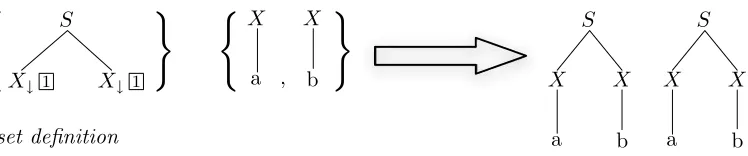
Figure 2
An example of the way in which two tree sets may produce several different derived trees when combined under the standard definition of multicomponent TAG.
link may give rise to many distinct derived trees even when the link is always used by the same multicomponent tree set. An example is given in Figure 2. This standard definition of multicomponent adjunction we will call theset definitionfor contrast with a variation we introduce in Section 4. Aderivation treefor a multicomponent TAG is the same as for TAG except that the nodes are labeled with the names of elementary tree sets.
An MCTAG istree-localif tree sets are required to adjoin within a single elementary tree (Weir 1988). Using the numbered link notation introduced earlier for adjunction sites, a tree-local MCTAG (TL-MCTAG) is one in which the scope of the link numbers is a single elementary tree. An example TL-MCTAG operation is given in Figure 3. In contrast, an MCTAG isset-localif the trees from a single tree set are required to adjoin within a single elementary tree set and an MCTAG isnon-localif the trees from a single tree set may adjoin to trees that are not within a single tree set. In a set-local MCTAG the scope of a link is a single elementary tree set, and in a non-local MCTAG the scope of a link is the entire grammar.
Weir (1988) noted in passing that TL-MCTAG has generative capacity equivalent to TAG; a combination of well-chosen additional constraints and additions of duplicates of trees to the grammar can produce a weakly equivalent TAG. Alternatively, a feature-based TAG where the features enforce the same constraints may be used. Although the generative capacity of the formalism is not increased, any such conversion from TL-MCTAG to TAG may require an exponential increase in the size of the grammar as we prove in Section 3.
3. Complexity
[image:6.486.51.351.525.623.2]We present several complexity results for TL-MCTAG. Søgaard, Lichte, and Maier (2007) show indirectly that TL-MCTAG membership is NP-hard. For clarity, we present a direct
Figure 3
proof here. We then present several novel results demonstrating that the hardness result holds under significant restrictions of the formalism.
For a TL-MCTAGGwe write|G|to denote the size ofG, defined as the total number of nodes appearing in all elementary trees in the tree sets of the grammar.Fan-out,f, measures the number of trees in the largest tree set in the grammar. We show that even when the fan-out is bounded to a maximum of two, the NP-hardness result still holds. The rank,r, of a grammar is the maximum number of derivational children possible for any tree in the grammar, or in other words, the maximum number of links in any tree in the grammar. We show that when rank is bounded, the NP-hardness result also holds.
A notable aspect of all of the proofs given here is that they do not make use of the additional expressive power provided by the adjunction operation of TAG. Put simply, the trees in the tree sets used in our constructions meet the constraints of Tree Insertion Grammar (TIG), a known context-free–equivalent formalism (Schabes and Waters 1995). As a result, we can conclude that the increase in complexity stems from the multi-component nature of the formalism rather than from the power added by an unconstrained adjunction operation.
3.1 Universal Recognition of TL-MCTAG is NP-Complete
In this section we prove that universal recognition of TL-MCTAG is NP-complete when neither the rank nor the fan-out of the grammar is bounded.
Recall the 3SAT decision problem, which is known to be NP-complete. Let V= {v1,. . .,vp}be a set of variables andC={c1,. . .,cn}be a set of clauses. Each clause inC
is a disjunction of three literals over the alphabet of all literalsLV={v1,v1,. . .,vp,vp}.
We represent each clause by a set of three literals. The language 3SAT is defined as the set of all conjunctive formulas over the members ofCthat are satisfiable.
Theorem 1
The universal recognition problem for TL-MCTAG with unbounded rank and fan-out is NP-hard.
Proof
LetV,Cbe an arbitrary instance of the 3SAT problem.1We use the derivations of the grammar to guess the truth assignments forVand use the tree sets to keep track of the dependencies among different clauses inC. Two tree sets are constructed for each vari-able, one corresponding to an assignment oftrueto the variable and one corresponding to an assignment offalse. The links in the single initial tree permit only one of these two sets to be used. The tree set for a particular truth assignment for a particular variablevi
makes it possible to introduce, by means of another adjunction, terminal symbols taken from the set{1,. . .,n}that correspond to each clause inCthat would be satisfied by the given assignment tovi. In this way, the stringw=1· · ·ncan be generated if and only if
all clauses are satisfied by the truth assignment to some variable they contain.
We define a tree-local MCTAGGcontaining the following tree sets. The initial tree setScontains the single tree:
In this tree, the “rows” correspond to the variables and the “columns” to the clauses. Each non-terminal node within a row is labeled with the same link to ensure that a tree set representing a single variable’s effect on each clause will adjoin at each link.
For every variablevi, 1≤i≤p, tree setTi, used when representing an assignment of
the valuetruetovi, containsntrees, one for each clausecj, 1≤j≤n, defined as follows:
For every variablevi, 1≤i≤p, tree setFi— used when representing an assignment
of the valuefalsetovi — containsntrees, one for each clausecj, 1≤j≤n, defined as
follows:
For every clausecj, 1≤j≤n, tree setCjcontains a single tree as shown here. This
tree allows the corresponding clause number terminal symbol to be recognized by an appropriate variable instance.2
2 Note that because adjunction is not obligatory, the tree fromCjneed not adjoin into the tree for a
particular variable. In fact, to generatew, exactly one instance ofCjmust adjoin for each clause even if
From the definition ofGit directly follows thatw∈L(G) implies the existence of a truth assignment that satisfiesC. A satisfying truth assignment can be read directly off of any derivation tree forw. IfTi(respectively,Fi) is a child ofSin the derivation tree,
then vk istrue(respectively, false). The converse can be shown by using a satisfying
truth assignment forCto construct a derivation forw∈L(G).
G,wcan be constructed in deterministic polynomial time because the number of tree sets in the grammar is 2p+2n+1, the total number of trees in the grammar is bounded by n(2p+2n+1), and the length ofw isn. All trees in the grammar have constant size except for the initial tree, which has sizenp.
Theorem 2
The universal recognition problem for TL-MCTAG with unbounded rank and fan-out is in NP.
Proof
We show that given an arbitrary TL-MCTAG grammarGand any input stringw, the determination ofw∈L(G) can be performed in non-deterministic polynomial time.
Note that the collection of elementary tree sets of Gthat can generate the empty string,E, can be generated in time polynomial in|G|using the standard graph reach-ability algorithm used for context-free grammars in time polynomial in|G|(Sippu and Soisalon-Soininen 1988).
We begin by showing that given an arbitrary input stringwand derivation treeD forw∈L(G), there must exist a truncated derivation tree forwthat has size no larger than|G| · |w|. We define atruncated derivation treeas a derivation tree in which the children of elementary tree sets inEare optionally removed.
Consider D. Each node in D represents an elementary structure ofG: a tuple of one or more TAG trees. We call a node n of Da non-splitting nodeif a single one of its children in the derivation tree, ni, generates the same lexical material from the
input string as n itself.3 We call it a splitting node if more than one of its children generates a non-empty part of the portion of the input string generated by n itself or if n itself contributes lexical material. We proceed from the root of D examining chains of non-splitting nodes. Assume that the root of Dis a non-splitting node. This means that it has a single child node,ni, that generates the lexical material for the entire
input string. Its other children all generate the empty string (and therefore must also be members ofE). We truncate the derivation tree at each child ofnother thanni. We now
iterate the process on node ni. If during the examination of a chain of non-splitting
nodes we encounter a node identical to one that we have already seen, we remove the entire cycle from the derivation tree because it is not essential to the derivation. Because all cycles are removed, the longest possible chain of non-splitting nodes we can find before encountering a splitting node or reaching the bottom of the derivation tree is|G|.
If a splitting node is encountered, we truncate all child nodes that generate the empty string and then iterate the process of non-splitting node identification on those
3 The child tree tuplenimay generate the same lexical material in several distinct pieces, which are
children that generate lexical material. In the worst case, the process encountersw−1 splitting nodes, each of which may be separated by a chain of non-splitting nodes of maximum length bounded by |G|. This process, therefore, produces a truncated derivation tree with size bounded by|G| · |w|.
The truncation of the tree at each node that generates the empty string is necessary because the size of the subderivation tree generating the empty string may not be bounded by a polynomial in the size of the grammar. However, the content of the part of the derivation tree used to generate the empty string is not necessary for determining membership ofw∈L(G) because we know that each truncated node is a member ofE.
To show that TL-MCTAG membership is in NP, we construct a Turing machine that will non-deterministically guess a truncated derivation tree of size no larger than |G| · |w|. It then checks that the guessed derivation successfully derivesw. Because the correctness of the derivation can be checked in linear time, this is sufficient to show that TL-MCTAG membership is in NP.
We know from the equivalence of LCFRS and SL-MCTAG (and the rule-to-tree-tuple conversion method used to prove equivalency) (Weir 1988) and the fact that LCFRS membership is complete that SL-MCTAG membership is also PSPACE-complete (Kaji et al. 1992, 1994). Until the results shown in Theorems 1 and 2 it was not known whether TL-MCTAG was in NP. Although the difference in generative capacity between TL-MCTAG and SL-MCTAG is well known, this proven difference in complexity (assuming NP=PSPACE) is novel.
To understand the reason underlying the difference, we note that the bound on the length of non-splitting chains does not hold for set-local MCTAG. In set-local MCTAG a tree tuple may be non-splitting while also performing a permutation of the order of the lexical output generated by its children. Permutation is possible because set-locality allows the tuple of strings generated by a tree tuple to be held separate for an arbitrary number of steps in a derivation. This directly follows the basis of the reasoning of Kaji et al. (1992) in their proof that LCFRS is PSPACE-complete.
3.2 Universal Recognition of TL-MCTAG with Bounded Fan-Out is NP-Complete
The grammar constructed in the proof of Theorem 1 has fan-out n, the number of clauses. However, the hardness result proved herein holds even if we restrict tree sets to have at most two elements (TL-MCTAG(2)).4 The result provided here is as tight as possible. If tree sets are restricted to a maximum size of one (TL-MCTAG(1)), the formalism reduces to TAG and the hardness result does not hold.
Theorem 3
The universal recognition problem for TL-MCTAG(2) with fan-out limited to two and unbounded rank is NP-complete.
Proof
Let V,C be an arbitrary instance of the 3SAT problem. We define a more complex stringw=w(1)w(2)· · ·w(p)wcwherewcis a representation ofCandw(i)controls the truth
assignment for the variablevi, 1≤i≤p. The proof strategy is as follows. We construct
a TL-MCTAG(2) grammarGsuch that eachw(i)can be derived fromGin exactly two ways using the left members of tree sets of size 2 that correspond to the variables (and a single initial tree set of size 1). We call the part ofwcomprisingw(1)w(2)· · ·w(p)theprefix string. The prefix string enforces the constraint of permitting only two derivations by requiring a strictly alternating string of terminal symbols that can only be generated by the grammar when the truth assignment is stable for a particular variable. The derivation of the prefix stringw(1)w(2)· · ·w(p)therefore corresponds to a guess of a truth assignment forV. The right trees from the tree sets derive the components ofwcthat are
compatible with the guessed truth assignments forv1,. . .,vp. Subsequently we explain
howG,wis constructed given an instance of 3SATV,C.
For every variable vi, 1≤i≤p, let Ai={cj|vi∈cj}and Ai={cj|vi∈cj}be the
sets of clauses in whichvioccurs positively and negatively, respectively; let alsomi=
|Ai|+|Ai|be the number of occurrences of the variablevi. LetΣ={ai,bi|1≤i≤p}
be an alphabet of not already used symbols; let w(i) (again for 1≤i≤p) denote a sequence ofmi+1 alternating symbolsaiandbisuch that ifmiis evenw(i)=(aibi)mi/2ai
and if miis oddw(i)=(aibi)(mi+1)/2. We define three functions, α, γ, and γ, to aid in
the construction. The functionsγandγare used to produce pieces of the prefix string and will only produce the correct prefix string for a variable if the truth assignment is consistent within the derivation. The functionαis used to produce strings representing the clauses satisfied by a particular truth assignment to a variable. For every variable vi, 1≤i≤p, the clauses α(i, 1),α(i, 2),. . .,α(i,|Ai|) are all the clauses in Ai and the
clausesα(i,|Ai|+1),. . .,α(i,mi) are all the clauses inAi. Further, for every 1≤i≤p, let
γ(i, 1)=aibiand letγ(i,h)=aiifhis even andγ(i,h)=biifhis odd, for 2≤h≤mi. For
every 1≤i≤p, letγ(i,h)=aiifhis odd, andγ(i,h)=biifhis even for 1≤h≤mi−1
and letγ(i,mi)=aibi ifmi is odd andbiai if mi is even. The crucial property of γand
γ is that a stringw(i) can be parsed either as a sequence ofγ(i,·) orγ(i,·) strings, not intermixed elements. The grammar must “commit” to parsing the string one way or the other, corresponding to committing to a value for the variablevi.
We define a TL-MCTAG(2)Gto consist of the tree sets described herein. We con-struct: (1) a tree set of length two for each combination of a variable and clause that the variable can satisfy under some truth assignment, (2) two filler tree sets for each variable (one for each truth assignment) of length two that only contribute the string indicating the truth assignment of the variable but no satisfied clause, and (3) a singleton tree set containing only an initial tree rooted inS. The initial tree hasn+1 branches with the first branch intended to yield the prefix stringw(1)· · ·w(p)and the (k+1)-st branch intended to yieldckwhere 1≤k≤n. Although it is possible to generate strings not of
the form ofwusing this construction, given a pairG,wwherewrespects the definition above, we show thatw∈L(G) if and only ifCis satisfiable.
The initial tree setScontains the single tree pictured in Figure 4.5The name of each link in the initial tree set is composed of three indices that indicate the role of the link. The first index,i, corresponds to variablevi. The second is an index into the series 1· · ·mi
wheremiis defined fromvias described previously. The third index,j, corresponds to a
clausecj. The use of multiple indices to name the links is for clarity only. They may be
renamed freely.
Figure 4
The start tree for TL-MCTAG(2) grammar G. The multiply-indexed link numbers are for clarity only and are treated as simple link names.
For every variablevi, 1≤i≤p, and indexh, 1≤h≤mi:
r
ifh≤ |Ai|, tree setT(h)+i contains the following two trees:
r
ifh>|Ai|, tree setF(h)+r
for allh, tree setT(h)−i contains the following two trees:
r
for allh, tree setF(h)−i contains the following two trees:
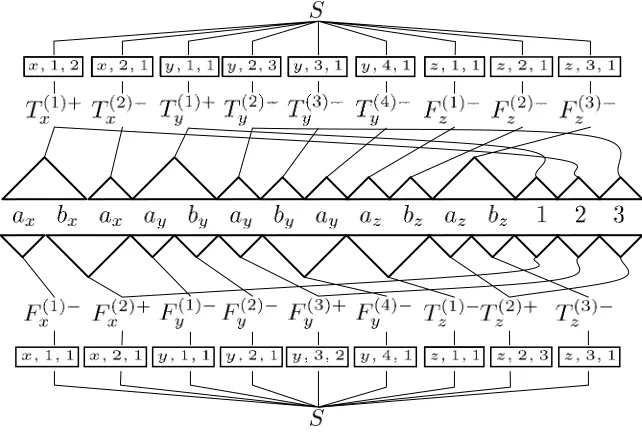
An illustrative example is provided in Figure 5. In this example we demonstrate derivations of two possible satisfying truth assignments for Boolean formula (x∨y∨ z)∧(x∨y∨z)∧(y∨y∨z). The truth assignments correspond to whether theTorFtree sets are used in the derivation of the prefix string for a particular variable. As can be seen from the example, the structure of the prefix string enforces the requirement that either allTtree sets or allFtree sets are chosen for a particular variable. Each tree set marked with a+is used to satisfy a single clause. Which clause a tree set satisfies can be read off the link number at which it adjoins.
[image:13.486.55.376.410.626.2]Inspection of the grammar and construction of the input string show that|G|and |w|are polynomially related topandn. The sum of themiis maximally 3n. There are no
Figure 5
more than 9pn+1 tree sets and no more than 18pn+1 total trees. The size of the initial tree is bounded by 3pnand all other trees have constant size.
From a derivation of w∈L(G) we can find a truth assignment satisfying C by examining the derivation. If the tree sets Ti(h)+orTi(h)− are children of S for some i and allhwhere 1≤i≤pand 1≤h≤mi, thenvi is true. If the tree setsF(ih)+orF
(h)− i
are children ofS for someiand all hwhere 1≤i≤p and 1≤h≤mi, thenviis false.
By the construction, if w is of the form just described, for a given variable vi only
two derivations of w(i) will be possible, one in which all tree sets corresponding to that variable are Ttree sets and one in which all areFtree sets. Starting from a truth assignment that satisfies C, we can prove thatw∈L(G) by induction on|V|.
That this problem is in NP can be seen from the same reasoning as in the proof of Theorem 2.
3.3 Universal Recognition of TL-MCTAG with Bounded Rank is NP-Complete
We now show that universal recognition of TL-MCTAG is NP-complete even when the rank is bounded.
We briefly recall here the definition of a decision problem called3PAR. Lettandsi≤
tbe positive integers, 1≤i≤3m,m≥1. The language 3PAR is defined as the set of all tupless1,. . .,s3m,t, satisfying the following condition: The multisetQ={s1,. . .,s3m}
can be partitioned into multisetsQi, 1≤i≤m, such that for every 1≤i≤m,|Qi|=3
ands∈Q is=t.
Language 3PAR is strongly NP-complete (Garey and Johnson 1979). This means that 3PAR is NP-complete even in case the integerssiare all represented in unary notation.
Theorem 4
The universal recognition problem for TL-MCTAG with rank 1 and unbounded fan-out is NP-complete.
Proof
We provide a reduction from 3PAR.6Lets
1,. . .,s3m,tbe an input instance of the 3PAR
problem, with all of the integerssirepresented in unary notation. Our target grammarG
is defined as follows. We use a set of nonterminal symbols{S,A}, withSbeing the start symbol. We take the set of terminal symbols to be{a, $}.Gcontains two elementary tree sets. The first set has a single elementary tree γ, corresponding to a context-free production of the formS→(AAA$)m−1AAA:
Tree γ has a unique link impinging on all of the 3moccurrences of nonterminal A. The second (multi)set ofGcontains elementary treesγi , 1≤i≤3m. Eachγi
corre-sponds to a context-free production of the formA→asi:
We also construct a stringw=(at$)m−1at.
If there exists a partition for multisetQ={s1,. . .,s3m}satisfying the 3PAR
require-ment, we can directly construct a derivation forwinG, by sorting the elementary trees in the second set accordingly, and by inserting these trees into the link of the elementary tree γ. Conversely, from any derivation of w in G, we can read off a partition for Q satisfying the requirement for membership in 3PAR for the input instance of the 3PAR problem.
Finally, it is easy to see thatGandwcan be constructed in linear deterministic time with respect to the size of the input instance of the 3PAR problem.
That this problem is in NP can be seen from the same reasoning as in the proof of Theorem 2.
3.4 Universal Recognition of TL-MCTAG with Fixed Input String is NP-Complete
We now show the unusual complexity result that universal recognition of TL-MCTAG is NP-complete even when the input string is fixed. Although it is uncommon to require this result, we rely on it in Section 5 to demonstrate that our parser has better time complexity than the baseline parsing method for TL-MCTAG that we generalize from the standard parsing method for LCFRS-equivalent formalisms.
We reduce from a variant of the 3SAT problem introduced above in which each variable occurs in at most four clauses with no repeats in a clause. This problem was shown to be NP-complete by Tovey (1984).
Theorem 5
Universal recognition of TL-MCTAG is NP-complete when the input string is fixed.
Proof
LetV,Cbe an arbitrary instance of the 3SAT problem where each variable occurs in no more than four clauses and does not repeat within a single clause. As in the proof of Theorem 1, we use the derivations of the grammar to guess the truth assignments for Vand use the tree sets to keep track of the dependencies among different clauses inC. Two tree sets are constructed for each variable, one corresponding to a true assignment and one corresponding to a false assignment. The prohibition on multiple adjunction ensures that only one of these two tree sets can be used for each variable. The tree set of a particular truth assignment for a particular variablevimakes it possible to satisfy the
obligatory adjunction constraints for the nonterminal symbols representing each of the clauses thatvisatisfies in the 3SAT formula.7Additional adjunction sites for each clause
provide overflow space in the event that more than one variable satisfies a particular clause. We fix the input stringwto be the empty string. None of the trees of the grammar contain any terminal symbols. However, a successful parse of the empty string can only be achieved if all of the obligatory adjunction constraints are satisfied and this occurs if and only if all clauses of the formula are satisfied by the truth assignment to some variable.
We define a tree-local MCTAG G containing the following tree sets. We notate obligatory adjunction constraints by underlining the nodes at which they apply. The initial tree setScontains the single tree:
For every variablevi, 1≤i≤p, tree setTi(respectively,Fi) is used when
represent-ing an assignment of the valuetrue(respectively,false) tovi.Ti(respectively,Fi) contains
at most five trees, one for the variable itself and one for each clausecj, 1≤j≤n, such
that whenviis true (respectively false)cjis satisfied. More formally, tree setTicontains
treesVi∗andCj∗if and only ifvi∈cj, for 1≤j≤n. Tree setFicontains treesVi∗andCj∗
if and only ifvi∈cj, for 1≤j≤n.
Note that the diagram of the initial tree does not show the explicitly notated link locations that we have used throughout the article. We omit the link locations to avoid cluttering the diagram. However, because each variable occurs at most four times in the formula, the total number of links is bounded bypn12.
From the definition ofGit directly follows thatε∈L(G) implies the existence of a truth assignment that satisfiesC. A satisfying truth assignment can be read directly off of any derivation tree forw. IfTi(respectively,Fi) is a child ofSin the derivation tree,
then vk istrue (respectively, false). The converse can be shown by using a satisfying
truth assignment forCto construct a derivation forw∈L(G).
G,wcan be constructed in deterministic polynomial time because the number of tree sets in the grammar is 2p+1, the total number of trees in the grammar is bounded byn(2p+1), and the length ofwis 0. All trees in the grammar have constant size except for the initial tree, which has size 3n+p.
That this problem is in NP can be seen from the same reasoning as in the proof of Theorem 2.
4. An Alternative Definition of TL-MCTAG: Tree Vectors
The proof of NP-hardness of TL-MCTAG in the bounded rank case given in Theorem 4 depends crucially on the treatment of the elementary structures of the TL-MCTAG as unordered sets. In order to produce the satisfying partitions for the 3PAR problem, any tree from the second tree set must be able to adjoin at any location of link 1 in the first tree set. This is in accordance with the usual definition of multi-component TAG. An alternative definition of multi-component TAG in which the elementary structures are treated as vectors is suggested by the explicit use of numbered links at the available adjunction sites. Under this definition, each location of a link is also given an index and only the tree at that index in a given vector may adjoin at that link location. An example contrasting the two definitions is given in Figure 6.
The dependence of our bounded-rank proof on the set definition of TL-MCTAG does not in itself show that vector-definition TL-MCTAG is polynomial in the bounded rank case. We show this constructively in Section 5 by presenting a parser for vector definition TL-MCTAG for which the polynomial degree of both the length of the in-put string and the grammar size is constant when the rank of the inin-put grammar is bounded.
[image:17.486.56.433.458.626.2]The difference in complexity between the set and vector definitions of TL-MCTAG makes the vector definition an appealing possibility for research using TL-MCTAG for natural language applications. Although all uses of TL-MCTAG in the computational linguistics literature assume the set definition of TL-MCTAG, the linguistic analyses therein do not require the additional flexibility provided by the set definition (Kallmeyer and Joshi 2003; Nesson and Shieber 2006, 2007; Kallmeyer and Romero 2007; Nesson 2009). This is not a coincidence. Multicomponent tree sets are generally used to model syntactic and semantic constructs in which one tree in the set strictly dominates another and has a different syntactic or semantic type: for instance, a quantifier and its bound variable. The locations at which the trees in these sets adjoin are not interchangeable both because of the dominance constraint and because of the difference in type (and, correspondingly, root node label). As a result, these grammars may be converted to the
Figure 6
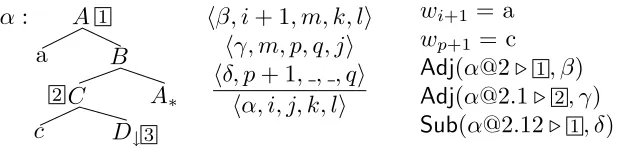
Figure 7
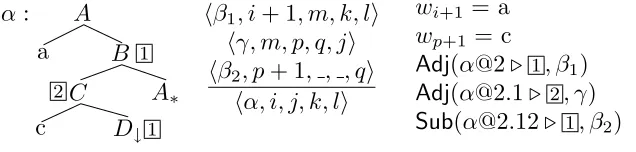
The deductive rule generated for treeαusing the naive TAG parsing method.
vector definition without any change in the elementary trees, the generated language, or grammar size but with crucial gains in the worst case bounds on processing efficiency.8
5. Parsing
Although no algorithms for parsing TL-MCTAG have previously been published, the standard method for parsing LCFRS-equivalent formalisms can be applied directly to TL-MCTAG to produce an algorithm with complexityO(|G|p|w|q) (Seki et al. 1991). We offer a novel parser for TL-MCTAG for which q is constant. With our algorithm, for the set definition of TL-MCTAGp depends on both the rank and fan-out of the input grammar. For the vector definition of TL-MCTAGpdepends on the rank of the input grammar but contains no index of the fan-out.
We begin with a brief introduction to TAG parsing before discussing our novel TL-MCTAG parsing algorithm.
5.1 CKY-Style TAG Parsing
Following the method of Seki et al. (1991), a naive parser for TAG may be constructed by generating a single inference rule for each tree in the grammar. For a tree containing rlinks, the rule will haverantecedents with each antecedent item representing a tree that can adjoin at one of the links. Each adjoining tree will cover a span of the input string that can be represented by four indices, indicating the left and right edges of the span and of the subspan that will ultimately be dominated by its foot node. Because the location of the links within the consequent tree is known, the indices in the antecedent items are not entirely independent. An example is given in Figure 7. Observation shows that there will be a worst case of 2(r+1) independent indices in a given rule. Because each adjoining tree is independent, there may ber+1 different trees represented in a single rule. This results in a time complexity ofO(n2(r+1)|G|r+1) wherenis the length of the input string,|G|is a representation of the grammar size, andris the rank of the input grammar.
Following Graham, Harrison, and Ruzzo (1980) in their optimization of the Earley parser (Earley 1970), the identifiers of specific trees need not be represented in the items of the parser. Rather the tree identifiers may be replaced by the labels of the root nodes of those trees, effectively bundling items of trees that share a root node label and cover the same span. This modification to the algorithm reduces the time complexity of the parser toO(n2(r+1)|G|).
We refer to this method of reducing complexity by removing unnecessary informa-tion about specific elementary structures from the items of the parser as the GHR opti-mization. When applied, it reduces the time complexity in the grammar size but does not alter the basic form of the time complexity expression. There remains a single term consisting of the product of a polynomial in the input string length and a polynomial in the grammar size. We will return to this observation when examining the complexity of TL-MCTAG parsing.
Shieber, Schabes, and Pereira (1995) and Vijay-Shanker (1987) apply the Cocke-Kasami-Younger (CKY) algorithm, first introduced for use with CFGs in Chomsky normal form (Kasami 1965; Younger 1967), to the TAG parsing problem to generate parsers with a time complexity of O(n6|G|2). The speed-up in the parser comes from traversing elementary trees bottom-up, handling only one link at a time. As a result, no inference rule needs to maintain information about more than one link at a time. If the GHR optimization is applied, the time complexity is reduced toO(n6|G|).
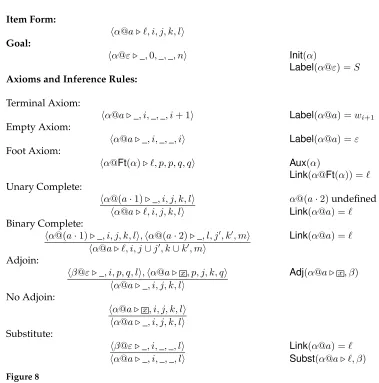
In order to clarify the presentation of our TL-MCTAG parser, we briefly review the algorithm of Shieber, Schabes, and Pereira (1995) with minor modifications, using the deductive inference rule notation from that paper. As shown in Figure 8, items in CKY-style TAG parsing consist of a node in an elementary tree and the indices that mark the edges of the span dominated by that node. Nodes, notatedα@a, are specified by three pieces of information: the identifier αof the elementary tree the node is in, the Gorn address aof the node in that tree,9 and the linkavailable at that node if there is one. When no link is present, it is indicated by an underscore, . The node notation
α@amay be read as “nodeαat addressawith link”.
Each item has four indices, indicating the left and right edges of the span covered by the node as well as any gap in the node that may be the result of a foot node dominated by the node. The indices are constrained to be non-decreasing from left to right in an item. Nodes that do not dominate a foot node will have no gap in them, which we indicate by the use of underscores in place of the indices for the gap. To limit the number of inference rules needed, we define the following functioni∪jfor combining indices:
i∪j= ⎧ ⎪ ⎪ ⎨ ⎪ ⎪ ⎩
i j=
j i=
i i=j
undefined otherwise
The Adjoin rule has two indices,pandq, that appear in the antecedent but not in the consequent. These indices specify the gap in one antecedent item and the edges of the span in the other antecedent item, indicating that one antecedent item will fill the gap in the span of the other antecedent item. The Foot Axiom similarly makes use of unbound indicespandq. In this rule the entire span of the item is the gap that must be
Figure 8
The CKY algorithm for binary-branching TAG.
filled when the item adjoins to another item. As noted in Shieber, Schabes, and Pereira (1995), the parser can be made more efficient by only introducing foot items of this sort once an appropriate tree to adjoin into has been parsed for the span fromptoq.
Each item of the formα@a,i, , ,lmaintains the invariant that the input gram-mar can derive a subtree rooted atα@awith no foot node that spanswi+1. . .wl. Items
of the formα@a,i,j,k,lmaintain the invariant that the input grammar can derive a subtree rooted atα@awith a foot node such that the fringe of the tree is the string wi+1. . .wjLabel(Foot(α))wk+1. . .wl. The invariants for items of the formα@a ,i, , ,l
Figure 9
The deductive rule generated for treeαusing the baseline TL-MCTAG parsing method.
Consistent with the usual definition of TAG, only one link is permitted at a given node. This effectively rules out multiple adjunction. Bounded multiple adjunction may be permitted without affecting the complexity of the parsing algorithm by allowing a list of links at a node. Although it first appears that the introduction of multiple links at a single node could result in an exponential increase in the number of derivations, this is not the case. The link diacritics themselves carry no information about the trees which may adjoin at the associated adjunction site. Any restrictions, such as the requirement of a matching node label, arise from the node itself. As a result, the links are fully interchangeable and serve only as counters of the number of available adjunctions at a node.10
5.2 CKY-Style Tree-Local MCTAG Parsing
As shown in Figure 9, the naive algorithm for parsing TAG may also be applied to TL-MCTAG. The only difference is that each link may have multiple locations within a given tree. Letrandf represent the rank and fan-out of the input grammar, respectively. The time complexity of the naive parser will therefore beO(n2(rf+1)|G|r+1). However, the GHR optimization cannot straightforwardly be applied because the maintenance of tree locality requires items to carry information about the identities of the specific trees involved rather than just the labels of the root nodes. Theorem 5 addresses the case in which the input string length is 0. Therefore, in this case, any factor in the complexity including the input string length cannot contribute to the overall time complexity. By showing that the problem is NP-complete when the input string length is 0, Theorem 5 demonstrates that there must be some exponential factor or term in the time complex-ity expression other than the input string length factor. Due to the earlier observation that the GHR optimization does not change the form of the time complexity expression, Theorem 5 therefore shows that the GHR optimization cannot reduce the exponent of the grammar size term to a constant unless P=NP. This leaves open the possibility of the existence of an algorithm that is polynomial in the grammar size but has an addi-tional exponential term in the time complexity expression. However, such an algorithm, if it exists, cannot be generated by application of the GHR optimization to the baseline parser.
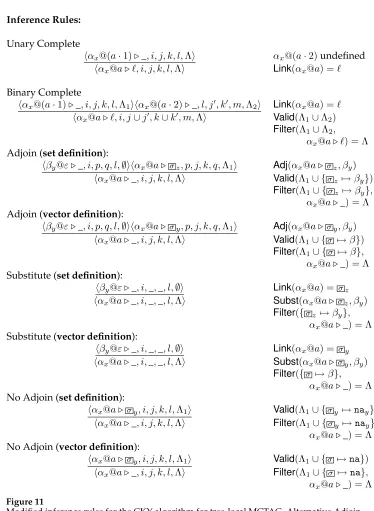
We can generalize the CKY TAG parsing algorithm presented above to the TL-MCTAG case. This is an improvement over the standard LCFRS algorithm because it reduces theqin the|w|qfactor of the complexity to a constant. The direct specification
of a CKY-style tree-local MCTAG parser is given in Figures 10 and 11. For a tree set or vectorαfromG, we notate the trees in the set or vector using indices that are indicated as subscripts on the tree set identifier. A tree set or vectorαfromGwith length two will therefore contain treesα1andα2. Under the set definition these indices serve only as a way of differentiating the members of the tree set. Under the vector definition, the index must match the index of the link location where the tree will adjoin.
In order to directly parse tree-local MCTAG, items must keep track of the trees that adjoin at each multicomponent link. We handle this by adding alink historyto each item. Under the set definition, a link history is an associative array of links notated with indices and tree set identifiers notated with indices to identify a unique tree within the set. Note that because under the set definition a tree may adjoin at any location of a link, the indices of the link and tree set need not match. The axioms introduce empty link histories, indicating that no adjunctions have yet occurred. When an adjunction takes place, the tree identifier of the adjoining tree is associated with the link at which it adjoins. In order for an adjunction to take place at a multicomponent link, the adjoining tree’s tree set must be the same as that of any tree identifier already stored for that link. This is enforced by theValid(Λ) condition (Figure 12) defined on link histories. The Filter(Λ,α@a) function removes links that are completely used from the argument link history. An empty link history indicates that tree locality has been enforced for the subtree specified by the item; thus no additional information need be maintained or passed on to later stages of the parse.
For the vector definition, the link histories may be simplified because each location of a link fully specifies which tree from within a vector may adjoin there. As a result, the link history is an associative array of links (not annotated with indices) and tree vector identifiers. An example contrasting the link histories for the set and vector definitions is given in Figure 13.
Figure 10
Figure 11
Modified inference rules for the CKY algorithm for tree-local MCTAG. Alternative Adjoin, Substitute, and No Adjoin rules are given for the set and vector definitions of TL-MCTAG. The item form, goal item, and axioms are given in Figure 10.
Figure 12
Definition of theValidcondition, which ensures that all locations of a link are used by unique trees from the same tree set. Under the set definition there is an entry for each link location and both the identity of the tree set and the uniqueness of the tree from that tree set must be checked. Under the vector definition only the link name and the tree vector identifier are stored because the link locations uniquely select trees from within tree vectors.
Figure 13
A sample TL-MCTAG with examples of the possible link histories under the set and vector definitions when the parser reaches the top of the circled node. Although the tree sets are notated in set definition, the reader may substitute angle braces to get the corresponding vector definition items.
isO(n6|G|r+22rf). Under the vector definition, the number of possible values for each element of a link history is on the order of the number of tree sets in the grammar. Thus, for the vector definition, the complexity of the algorithm isO(n6|G|r+2). Note that the variable representing fan-out,f, is present only in the complexity of the set definition. This demonstrates the novel result that when rank is bounded, even with unbounded fan-out, parsing the vector definition of TL-MCTAG is polynomial.
Permitting multiple adjunction may be accomplished by a method similar to the one described for the TAG algorithm. Rather than associating each node with at most one link, we permit nodes to be accompanied by a set of links. In contrast to the TAG case, here we must use a set rather than a list to allow for the expressivity that multiple adjunction can provide. In the TAG case a list is sufficient because the links at a node are fully interchangeable. In the TL-MCTAG case, because the links are defined not just by the node where they appear but by the full set of nodes at which locations of that link appear, the links at a given node are not interchangeable. It must be possible to use them in any order.11 Because the links can be used in any order, the
addition of multiple adjunction adds a factor of 2rto the time complexity of the parsing algorithm.
6. Link Factorization
The parser presented in the previous section has the advantage of running in polyno-mial time if the elementary structures of the input TL-MCTAG are defined as vectors and if the rank of the grammar is bounded by some constant. Bounding the rank by a constant might be too strong a limitation in natural language parsing applications, however. Thus, in the general case the running time of our algorithm contains a factor that is an exponential function of the rank of the input grammar. To optimize parsing time, then, we seek a method to “factorize” the elementary trees of the grammar in such a way that the rank is effectively reduced and the set of derived trees is preserved. Although the precise meaning of factorization should be inferred from the subsequent definitions, informally, by factorize we mean splitting a single elementary tree into sev-eral smaller elementary trees without violating the locality constraints of the grammar formalism. In this section we present a novel and efficient algorithm for factorizing a TL-MCTAG into a strongly equivalent TL-MCTAG in which rank is minimized across the grammar. Here, strongly equivalent means that the two grammars generate the same set of derived trees.12
6.1 Preliminaries
Letαbe some elementary tree. We write|α|to denote the number of nodes ofα. For a linkl, we write|l|to denote the number of nodes ofl.
For an elementary treeα, we call afragmentofαa complete subtree rooted at some node n of α, written α(n), or else a subtree rooted atn with a gap at node n in its yield, writtenα(n,n). See Figure 14 for an example. We also useϕto denote a generic fragment with or without a gap node in its yield.
Consider some fragmentϕofα. LetNαbe the set of all nodes ofαand letNϕbe the
set of nodes ofϕwith the exclusion of the gap node, in caseϕhas such a node. We say thatϕis anisolatedfragment iffϕincludes at least one link and no link inαimpinges both on nodes inNϕand on nodes inNα−Nϕ. Figure 14 provides an example.
Intuitively, we can “excise” an isolated fragment from α without splitting apart the links ofαitself, and therefore preserving the tree locality. This operation may also reduce the number of links inα, which is our main goal. The factorization algorithm we present in Section 6.2 is based on the detection and factorization of isolated fragments.
Letnbe a node from some elementary treeα. We writelnodes(n) to denote the set of all nodes from fragmentα(n) that are part of some link fromα. Nodenismaximalif
r
lnodes(n)=∅;andr
nis either the root node ofαor, for its parent noden, we have lnodes(n)=lnodes(n).Figure 14
An elementary treeγdemonstrating fragments, isolation, and maximal nodes. Fragment
ϕ1=α(n1,n2) contains all locations of links 2 and3, because links at the root node of a
fragment are contained within that fragment. It does not contain any locations of link4, because links at the gap node of a fragment are not contained within that fragment. Because links 2 and
3 impinge only on nodes inϕ1and all other links impinge only on nodes not inϕ1,ϕ1is an
isolated fragment. Fragmentϕ2=α(n4) is not an isolated fragment because it contains only one
of the link locations of 4. Note also thatn4is a maximal node butn5is not.
Note that for every node n of α such that lnodes(n)=∅ there is always a unique maximal nodensuch thatlnodes(n)=lnodes(n) (see Figure 14). Thus, for the purpose of TL-MCTAG factorization, we can consider only maximal nodes. The first criterion in the definition of maximal node, stating that a maximal node always dominates (possibly reflexively) some node involved in a link, will often be implicitly used in the following.
We need to distinguish the nodes inlnodes(n) depending on their impinging links. Assume that{l1,l2,. . .,lr}is the set of all links occurring inα. For 1≤j≤r, we write
lnodes(n,lj) to denote the set of all nodes from fragment α(n) with impinging link lj.
Thus, rj=1lnodes(n,lj)=lnodes(n). We associate with each maximal node n of α a signature σ(n), defined as a vector of size r and taking values over the subsets of lnodes(n). For eachj, 1≤j≤r, we define
σ(n)[j]= ⎧ ⎨ ⎩
lnodes(n,lj), if 0<|lnodes(n,lj)|<|lj|;
∅, if|lnodes(n,lj)|=0 or
|lnodes(n,lj)|=|lj|.
Observe that, in this definition,σ(n)[j]=∅means that none or all of the nodes ofljare
found within fragmentα(n). Theemptysignature, written 0, is the signature with all of its components set to∅.
Consider maximal nodes n1 and n2 such that n1 =n2, σ(n1)=0, and σ(n2)=0. It is not difficult to see that σ(n1)=σ(n2) always implies that one of the two nodes dominates the other. This observation is implicitly used in several places subsequently. When visiting nodes of αin a path from some leaf node to the root node,13 one may encounter several maximal nodes having the same non-empty signature. In our factorization algorithm, we need to consider pairs of such nodes that are as close as possible. Consider two maximal nodesn1 andn2,n1 = n2, such thatn1 dominatesn2.
The ordered pair (n1,n2) is called aminimal pairif σ(n1)=σ(n2)=0 and, for every maximal noden3 in the path fromn2ton1 withn3=n1andn3 =n2, we haveσ(n3)=
σ(n1). Consider now a sequencen1,n2,. . .,nq,q≥2, of nodes fromα. Such a sequence
is called amaximal chainif each pair (ni−1,ni) is a minimal pair, 2≤i≤q, and all nodes
nfromαwithσ(n)=σ(n1) are included in the sequence itself.
Notice that two maximal nodes belonging to two different maximal chains must have different signatures, and thus one maximal node cannot belong to more than one maximal chain. We now prove some basic properties of the notions just introduced that will be used later in the development of our factorization algorithm and in the proof of some of its mathematical properties.
Lemma 1
Letαbe an elementary tree and letn,nbe maximal nodes, withnproperly dominating nin (ii).
(i) σ(n)=0 if and only ifα(n) is an isolated fragment; (ii) σ(n)=σ(n) if and only ifα(n,n) is an isolated fragment.
Proof
(i). Ifσ(n)=0, then for each linklwe have that either all nodes impinged on bylare dominated (possibly reflexively) bynor none of these nodes is dominated byn. Because nis maximal, we further conclude that at least some linklis found withinα(n).
Conversely, ifα(n) is an isolated fragment then all or none of the nodes impinged on by some linklare dominated byn, and thusσ(n)=0.
(ii). Letσ(n)=σ(n), with nproperly dominatingn. For each link lj, there are two
possible cases. First consider the case whereσ(n)[j]=σ(n)[j]=∅. In order for this to be true, the link must be in one of three configurations, all of which satisfy the requirement that the locations ofljmust be all inside or all outside of the fragmentα(n1,n2).
r
lnodes(n,j)=∅. In this configuration no one of the nodes on whichlj impinges is dominated byn.r
|lnodes(n,j)|=|lj|. We distinguish two possible cases.– lnodes(n,j)=∅. In this configuration all the nodes on whichlj
impinges are within the fragmentα(n1,n2).
– |lnodes(n,j)|=|lj|. In this configuration all the nodes on whichlj
impinges are “below” the fragmentα(n,n).
Now consider the case whereσ(n)[j]=σ(n)[j]=∅. The nodes inlnodes(n,j) are dom-inated (possibly reflexively) by n and therefore fall “below” α(n,n). The remaining nodes on whichlj impinges cannot be dominated (possibly reflexively) byn. We thus
conclude that no nodes impinged on byljoccur within the fragmentα(n,n).
Assume now thatα(n,n) can be isolated. We can use exactly the same arguments in the analysis of setslnodes(n,j) andlnodes(n,j), and conclude thatσ(n)=σ(n).
Lemma 2
Let (n1,n2) be some minimal pair. Then
(i) for any noden3in the path fromn2ton1,σ(n3)=0;
(ii) for any minimal pair (n3,n4), neither or both ofn3andn4are found in the path fromn2ton1.
Proof
(i). Becauseσ(n2)=0, there is some linkljfor whichσ(n2)[j]=lnodes(n2,j)=∅. Be-causen3dominatesn2,n3dominates the nodes inlnodes(n2,j). Therefore, the only way
σ(n3) could equal 0 is if|lnodes(n3,j)|=|lj|. But thenσ(n1)[j]=∅becausen1dominates n3. This is a contradiction.
(ii). Assume that n4 is on the path from n2 to n1. From the definition of minimal pair, there must exist a link lk such that σ(n4)[k]=σ(n2)[k]. By the same reasoning as in the proof of statement (i) for any link lj such that σ(n2)[j]=∅, we must have
σ(n2)[j]=σ(n4)[j]=σ(n1)[j]. We thus conclude thatσ(n2)[k]=∅andσ(n4)[k]=∅. Be-causeσ(n4)[k]=σ(n3)[k]=∅andσ(n2)[k]=σ(n1)[k]=∅, noden3 must be in the path fromn2ton1.
By a similar argument, we can argue that if n3 is on the path fromn2 ton1, then noden4must be in that path as well.
6.2 Factorization Algorithm
LetGbe an input TL-MCTAG grammar. In this subsection we provide a method for the construction of a TL-MCTAG that produces a grammar that generates the same derived trees asGand that has minimal rank. We start with the discussion of some preprocessing of the input.
We annotate each elementary tree α as follows: We compute sets lnodes(n,lj)
for all nodes n and all links lj of α. This can easily be done with a bottom up
visit of α, by observing that if an internal node n has children n1,n2,. . .,nk then
lnodes(n,lj)=
k
i=1lnodes(ni,lj)∪Xj, whereXj=∅ifljdoes not impinge onnandXj=
{n}if it does. Using setslnodes(n,lj), we can then mark all nodesninαthat are maximal,
and compute the associated signaturesσ(n).
We also mark all maximal chains within α. This simple procedure is reported in Figure 15. We maintain an associative array with node signatures as entries and node lists as values. We visit all maximal nodes ofαin a top–down fashion, creating a list for each different signature and appending to such a list all nodes having that signature.
In the following algorithm we excise isolated fragments from each elementary tree
α. We now introduce some conventions for doing this. Although it would be possible to
Figure 15