12
Deconstructing Supertagging into Multi-task Sequence Prediction
Zhenqi Zhu
School of Computing Science Simon Fraser University
Burnaby, BC , Canada
Anoop Sarkar
School of Computing Science Simon Fraser University
Burnaby, BC , Canada
Abstract
Supertagging is a sequence prediction task where each word is assigned a piece of com-plex syntactic structure called a supertag. We provide a novel approach to multi-task learn-ing for Tree Adjoinlearn-ing Grammar (TAG) su-pertagging by deconstructing these complex supertags in order to define a set of re-lated but auxiliary sequence prediction tasks. Our multi-task prediction framework is trained over the exactly same training data used to train the original supertagger where each aux-iliary task provides an alternative view on the original prediction task. Our experimental re-sults show that our multi-task approach signifi-cantly improves TAG supertagging with a new state-of-the-art accuracy score of 91.39% on the Penn treebank supertagging dataset.
1 Introduction
A treebank for lexicalized tree-adjoining grammar
(TAG) (Joshi and Schabes, 1997) consists of
an-notated sentences where each word is provided a complex tree structure called a supertag and the overall parse of the sentence combines these su-pertags into a parse tree. Supertagging is a task that learns a sequence prediction task from this an-notated data and is able to then assign the most likely sequence of supertags to an input sequence
of words (Bangalore and Joshi,1999). Once the
right supertag is assigned then parsing is a much easier task and may not even be needed for many applications where information about syntax is needed but a full parse is unnecessary.
Supertagging has been shown to be useful for
both Tree Adjoining Grammar (TAG) (
Banga-lore and Joshi, 1999) and combinatory
catego-rial grammar (CCG) (Hockenmaier and Steedman,
2007) parsing. In this paper we aim to improve
the state-of-the-art for the task of learning a TAG
supertagger from an annotated treebank (Kasai
et al., 2018). We observe that supertag predic-tion does not take full advantage of the complex structural information contained within each su-pertag. Neural models have been used to learn em-beddings over these supertags and thereby share
weights among similar supertags. Friedman et al.
(2017) provide tree-structured neural models over
supertags which can learn interesting relationships between supertags but the approach does not lead to higher supertagging accuracy.
Our main contribution is to provide several novel ways to deconstruct supertags to create mul-tiple alternative auxiliary tasks, which we then combine using a multi-task prediction framework and we show that this can lead to a significant im-provement in supertagging accuracy.
Multi-task learning (MTL) (Caruana, 1997)
learns multiple heterogenous tasks in parallel with a shared representation so that what is learned for one task can be shared for another task. In most cases the improvement is due to weight sharing
be-tween different tasks (Collobert and Weston,2008;
Luong et al., 2015). While some combinations
may not provide any benefit in MTL (Bingel and
Søgaard, 2017) and the improvements might be simply due to training on more data. However, MTL can be effective even when using large pre-trained models (Liu et al.,2019).
Unlike most other work in multi-task learning with neural models we do not use different an-notated datasets for each task. Similar to the ap-proach to combining different representations for
phrase structure parsing in (Vilares et al., 2019)
we also construct multiple tasks from exactly the same training data set. Our approach is also dis-tinct in that we take advantage of the structure of the supertags by deconstructing the tree structure implicit in each supertag.
state-of-the-art accuracy score of 91.39% for TAG
supertagging on the Penn Treebank dataset (
Mar-cus et al.,1993;Chen et al.,2006) which is a sig-nificant improvement over the previous multi-task result for supertagging that combines supertagging
with graph-based parsing (Kasai et al.,2018).
2 The Supertagging Task
Supertagging assigns complex structural descrip-tions to each word in the sentence. The complex structural descriptions come from grammar for-malisms that are more expressive than context-free grammars for phrase structure trees or dependency trees. In Tree Adjoining Grammar (TAG), the su-pertags are tree fragments that can express vari-ous syntactic facts such as transitive verb, wh- ex-traction, relative clauses, appositive clauses, light verbs, prepositional phrase attachment and many other syntactic phenomena. In combinatory cat-egorial grammar (CCG) the supertags are types and their type-raised variants which also cap-ture similar syntactic phenomena as in TAG su-pertags. Supertagging can be viewed as “almost
parsing” (Bangalore and Joshi,1999) and can
pro-vide the benefits of syntactic parsing without a full parser.
In this paper we focus on the TAG supertagging task, however, our proposed methods can likely be used to improve CCG supertagging as well. Su-pertagging is a relatively simple linear time se-quence prediction task similar to part of speech
tagging. Supertagging can be useful in many
applications such as machine translation, gram-matical error detection, disfluency prediction, and many others while being a much simpler task than full parsing.
In addition, for both TAG and CCG, supertag-ging is an essential first step to parsing so any improvements in supertag prediction will benefit parsing as well. For all these reasons, in this paper we focus on the supertagging task. TAG and CCG can be parsed using graph-parsing methods in
O(n3) but the complexity of unrestricted parsing
for both formalisms isO(n6)which is prohibitive
on real-world data. Neural linear-time transition based parsers are still not accurate enough to com-pete with the state-of-the-art supertagging mod-els or parsers that use supertagging as the initial step (Chung et al.,2016;Kasai et al.,2018).
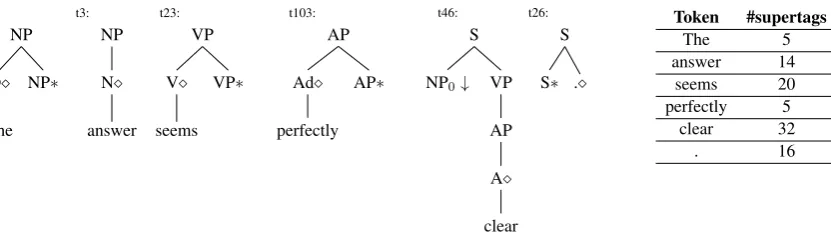
An example of the supertagging task for Tree
Adjoining Grammars (TAGs) is shown in Fig.1.
The↓symbol on a leaf node represents a
substitu-tion node which can be expanded by a tree rooted in the same label, e.g. t3 rooted in NP substitutes
into the NP↓node in t46. The∗symbol on the leaf
node of a treetrepresents an adjunction node (also
called a footnode) and signifies that tcan be
in-serted into an internal node of another tree with the same label, e.g. t103 adjoins into the AP node in
t46. Thenode is called theheadand represents
the node where the word token is inserted into the tree. The table on the right shows how many dif-ferent supertags are possible for each word in the sentence.
Three factors make supertagging a challenging task for sequence prediction: much more severe token level ambiguity when compared to other like part-of-speech tagging, a large number of dis-tinct supertag types (4727 disdis-tinct supertags in our dataset, including an unknown supertag) and a complex internal structure for each supertag.
3 Baseline Supertagging Model
For our baseline supertagging model we use the state-of-the-art model that currently has the
high-est accuracy on the Penn treebank dataset (Kasai
et al.,2018). For the supertagging model the main
contribution ofKasai et al. (2018) was two-fold:
the first was to add a character CNN for model-ing word embeddmodel-ings usmodel-ing subword features, and the second was to add highway connections to add more layers to a standard bidirectional LSTM. The output layer was a standard multi-layer perceptron that had a softmax output over the set of supertags. Another extension to the standard sequence
pre-diction model inKasai et al.(2018) was to
com-bine supertagging with graph-based parsing. In this paper, we focus on the supertagging model and compare only on supertagging accu-racy. The neural model for supertagging that we use as a baseline uses graph-based parsing as an auxiliary task and has the current highest accu-racy score on the Penn treebank (90.81%). The model has three main components: the input layer, the bidirectional LSTM component, and the out-put layer which comout-putes a softmax over the set of supertags. The input to the model is a sequence of words and the output is a sequence of supertags, one per word, which makes it a standard tagging aka sequence prediction task.
3.1 Input Layer
NP
NP∗
D
The
t1:
NP
N
answer
t3:
VP
VP∗
V
seems
t23:
AP
AP∗
Ad
perfectly
t103:
S
VP
AP
A
clear NP0↓
t46:
S
.
S∗
t26: Token #supertags
The 5
answer 14
seems 20
perfectly 5 clear 32
[image:3.595.93.509.62.181.2]. 16
Figure 1: An example that explains the supertagging task for Tree Adjoining Grammars (TAGs). For the sentence “The answer seems perfectly clear .” the correct supertag for each word is shown above. The table on the right shows how many different supertags are possible for each word in the sentence. See Section2for more details on the notation used to define the supertags and how the supertags can be combined to form a parse tree.
(Kasai et al.,2018) we use two components in the word embedding:
• a 30-dimensional character level
embed-ding vector computed using a char-CNN which captures the morphological
informa-tion (Santos and Zadrozny, 2014; Chiu and
Nichols, 2016; Ma and Hovy, 2016; Kasai et al., 2018). Each character is encoded as a 30-dimensional vector, and then we apply 30 convolutional filters with a window size of 5. This produces a 30-dimensional character embedding.
• a 100/200/300 size word embedding which
is initialized using GloVe (Pennington et al.,
2014). For words that do not appear in
GloVe, we randomly initialized the word em-bedding.
A start of sentence token and an end of sentence token is added into the beginning and ending po-sition of each sentence, but is not included in the computation of loss and accuracy.
Unlike (Kasai et al.,2018) we do not use
pre-dicted part of speech (POS) tags as part of the in-put sequence. In our experiments, the improve-ment was negligible and there was a significant overhead of having to do part of speech predic-tions at test time.
3.2 BiLSTM Layer
The core of this base model is a bidirectional recurrent neural network, in particular a Long
Short-Term Memory neural network (Graves and
Schmidhuber,2005). For the hyperparameters, we
use the settings inKasai et al. (2018) in order to
ensure a fair comparison.
Unlike (Kasai et al.,2018) we do not use
high-way connections in our model. We did
exper-iment with the addition of highway connections but we found no improvement in accuracy over the baseline BiLSTM-only model with a signifi-cant increase in training time.
The bidirectional representation has 1024 units, a combination of the 512 forward and backward
units each. Dropout layers (Gal and Ghahramani,
2016;Srivastava et al.,2014) are inserted between the input and BiLSTM layer, between BiLSTM
layers, and between recurrent time steps. The
dropout rate used was 0.5. We used 2-3 BiLSTM
layers. Kasai et al. (2018) provide some reasons
why>3layers do not provide any additional
ac-curacy even with highway connections.
3.3 Output Layer
We concatenate hidden vectors from both direc-tions of the last layer of BiLSTM and pass it into a multilayer perceptron (MLP). In practice a single layer perceptron performs just as well in this task. The number of input neurons of the single layer
perceptron equals 1024 (2×512) and the output
vector size equals the number of labels for each specific task: 4727 for the main supertagging task.
4 Deconstructing Supertags
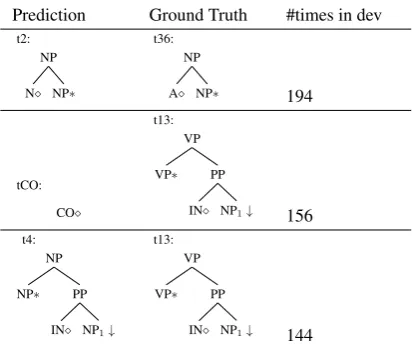
The error analysis of our baseline BiLSTM model
is shown in Fig. 1. We observed some
consis-tent ways in which the baseline model confused the correct supertag with the incorrect one. We also observed that the baseline BiLSTM model can achieve over 97% 3-best accuracy on the su-pertagging task. This means it should be possible to boost the accuracy by rescoring the alternatives
that already exist in then-best output of the
frame-Prediction Ground Truth #times in dev
NP
NP∗
N
t2:
NP
NP∗
A
t36:
194
CO
tCO:
VP
PP
NP1↓ IN
VP∗
t13:
156
NP
PP
NP1↓ IN
NP∗
t4:
VP
PP
NP1↓ IN
VP∗
t13:
[image:4.595.78.285.62.234.2]144
Table 1: The top-3 errors made by the state-of-the-art Bi-LSTM supertagger. tCO stands for a co-head in the case where a supertag has multiple heads. One example is a sentence fragment likepull it from the marketplace
which contains a multi-word predicate pull . . . from;
pullis the Vhead of tree t531 which has a INcnode
where tCO (headed byfrom) is inserted.
work we used a multi-task learning framework in order to boost the scores of correct supertags over the error-prone supertags. The auxiliary tasks we created based on our error analysis are as follows.
4.1 Auxiliary Tasks
4.1.1 HEAD
Consider the trees t2 and t36 in Table 1. t2 is
headed by a noun headN and t36 is headed by an
adjectiveA. The label of the head node is a
use-ful auxiliary task for disambiguation. We define
a function HEAD(t) to get the head node (marked
by a diamond) of supertagt. There are 29 distinct
HEAD labels.
4.1.2 ROOT
Consider the trees t4 and t13 in Table1. t4
mod-ifies an NP node while t13 modmod-ifies a VP node. This is a case of preposition attachment ambigu-ity. The label of the root node is a useful auxil-iary task for disambiguation. We define a function
ROOT(t) to get the root node of supertagt. There
are 48 distinct ROOT labels.
4.1.3 TYPE
Consider the trees tCO and t13 in Table1. tCO is a
supertag that does not use adjunction (this type of supertag is called an initial tree). In contrast, t13 modifies an internal VP node in another supertag (this type of supertag is called an auxiliary tree). In addition a left auxiliary tree modifies from the left
while a right auxiliary tree modifies from the right. To make this task more sensitive we also include the node label of the root (for initial trees) or
footn-ode which is the nfootn-ode marked with∗(for left/right
auxiliary trees). We define a function TYPE(t) to
obtain the type of each supertag. There are 67 dis-tinct types.
4.1.4 SKETCH
In many cases, the overall shape of the supertag is useful for disambiguation, ignoring the node la-bels. The following example keeps the tree struc-ture of the supertag but removes the node labels:
S
S∗
PP
NP1↓
IN
X
X X
X X
Tree sketches help disambiguation (see t81 in
Ta-ble5). We define a function SKETCH(t) that
re-turns the sketch. There are 602 distinct supertag sketches.
4.1.5 SPINE
The spine of a supertag is the path from the root
node to the head node (marked by). The
follow-ing example keeps only the path from root to head and produces a spine supertag:
S
S∗
PP
NP1↓
IN
S
PP
IN
Spine supertags are helpful for disambiguation as
well (see t132 in Table 5). We use a function
SPINE(t) to return the spine of supertagt. There
are 1372 distinct supertag spines.
4.2 Multi-task Framework
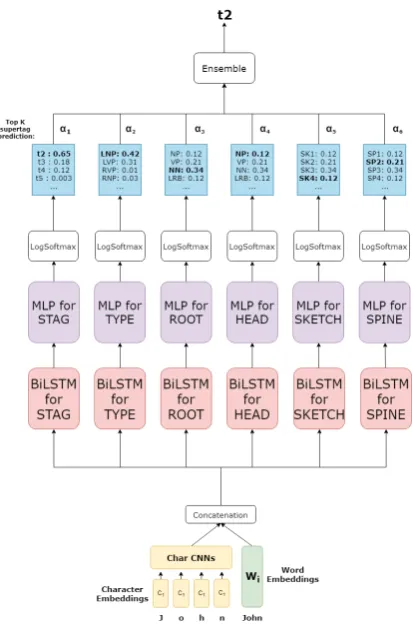
Figure 2: The prediction procedure of combining mod-els trained on separate tasks
The usual criticism of a fair comparison be-tween multi-task and single-task learning is that the multi-task setting simply uses more la-beled data instances (typically with different data sources) and as a result a fair comparison between a multi-task and a single-task setting should in-volve large pre-trained models trained using a
lan-guage modelling objective (such as ELMO (
Pe-ters et al.,2018) or BERT (Devlin et al., 2018)). In our case, because we re-use the same training set for multi-task learning, we have made sure our experimental settings exactly match the previous
best state-of-the-art method for supertagging (
Ka-sai et al.,2018) and we use the same pre-trained word embeddings to ensure a fair comparison.
We train six different neural sequence
predic-tion models independently on the supertagging
task, root node prediction (ROOT), head node pre-diction (HEAD), tree type prepre-diction (TYPE), tree sketch prediction (SKETCH) and tree spine pre-diction (SPINE) tasks. For each task, we use the state-of-the-art baseline supertagging model as
de-fined in Section 3. The only change is that the
output size for softmax is changed to reflect the number of output labels in each task. We obtain very high accuracies for each of the tasks. For example, on the dev set we obtain the following accuracies: ROOT = 97.04%, HEAD = 93.37%, TYPE = 93.14%, SKETCH = 93.74% and SPINE = 91.00%.
We train the model, including the word embed-ding (which is initialized using a pre-trained em-bedding) and character-level CNNs by optimiz-ing the negative log-likelihood of the predicted se-quences of output labels. The output labels for each task is different: supertag, root node, head node, tree type, sketch, spine. Training is done us-ing minibatches. The main hyperparameters are as follows: we use the ADAM optimizer with a batch
size of 100 and learning rate` = 0.001(Kingma
and Ba, 2015). After every training epoch, we evaluate the model on the dev set, if the accuracy on dev set has not been improved for five consecu-tive epochs, training stops. The maximum number of epochs is 70. After obtaining the best model
trained with ` = 0.001, we further fine-tune the
best model using`= 0.0001for at most 10 more
epochs. By conducting this step, we have seen 0.1% to 0.2% accuracy improvement depending on the task.
After obtaining the best trained model on each of the multiple tasks we combine the multiple tasks together in order to create a decoder for the supertagging task.
We first run the baseline supertagger to obtain
the distributionPSTAG and using this distribution
we select the top-K output supertags for each word in each sentence in the dev or test data. We exper-iment with different values of K but we know that even K=3 gives 97% accuracy for the supertagging task. For each dev or test sentence we also com-pute the output softmax distributions for each task,
PHEAD,PROOT,PTYPE,PSKETCH,PSPINE. Each of
these probabilities are defined as a sequence pre-diction task over the auxiliary tasks using the
func-tions defined in Section4.1.
PHEAD(t) = P(HEAD(t)) PROOT(t) = P(ROOT(t)) PTYPE(t) = P(TYPE(t))
PSKETCH(t) = P(SKETCH(t))
PSPINE(t) = P(SPINE(t))
We compute the argmax sequence of supertags
individ-ually from the top-K list by combining the proba-bilities from the different tasks as follows:
t∗i = arg max
ti∈S
(1)
α1PSTAG(ti) +α2PHEAD(ti) (2)
+α3PROOT(ti) +α4PTYPE(ti) (3)
+α5PSKETCH(ti) +α6PSPINE(ti) (4)
S is the top-K set of supertags for each word
in the input sequence. The hyperparameters αi
can be tuned. However we found in our experi-ments that the results were not very sensitive to the values, and the uniform distribution over all the tasks performed the best. The model and de-coding step for our multi-task model is shown in
Fig.2. We also experiment with a commonly used
multi-task model where some or all of the compo-nents are shared between the different (unlike our approach)..
5 Dataset
We use the dataset that has been widely used by previous work in supertagging and TAG
pars-ing (Bangalore et al., 2009; Chung et al., 2016;
Friedman et al., 2017; Kasai et al., 2017, 2018). We use the grammar and the TAG-annotated WSJ
Penn Tree Bank extracted by Chen et al. (2006).
As in previous work, we use Sections 01-22 as the training set, Section 00 as the dev set, and Sec-tion 23 as the test set. The training, dev, and test sets comprise 39832, 1921, and 2415 sentences; 950028, 46451, 56683 tokens, respectively.
The TAG-annotated version of Penn
tree-bank (Chen and Shankar,2001) includes 4727
dis-tinct supertags (including an unknown supertag) and the grammar file of all supertags is
down-loaded from http://mica.lif.univ-mrs.fr/.
There are 69 auxiliary tree TYPEs, 40 distinct types of ROOT node and 30 different types of HEAD node, 602 tree SKETCHes and 1372 tree SPINEs.
6 Results and Discussion
For our experiments, we implemented all of the
models we discussed above in PyTorch (Paszke
et al., 2017). We have various
hyperparame-ters and Table 2 shows the results obtained from
the different model configurations which were
de-scribed in Section 3. The table also includes the
results from the multi-task model and decoder
de-scribed in Section 4. We experiment with
pre-trained GloVe word embeddings of three different sizes: 100, 200 and 300.
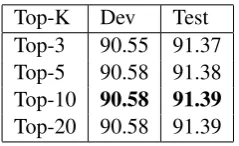
With our multi-task approach, all base mod-els gain significant improvements compared to a single supertagging base model between 0.4% to 0.65%. We also varied the parameter K which picks the top-K supertags from the baseline model
for use with the multi-task model. Table3that
in-creasing K helps up to a point. After K=10 there is no further improvement.
We obtain a new state-of-the-art result of 91.39% which is significantly better than the 90.81% result which combines supertagging with the parsing task and so is using more labeled train-ing information used by our supertagger models.
Table4shows the result of task ablation for each
task. We can see that adding a new task always improves the results. The best result is obtained by using all five auxiliary tasks.
We computed a significance score on
the accuracy of our best model
BiL-STM3+CNN+GloVe200 with and without
multi-task learning. On the dev set, using
McNemar’s significance test we found that the multi-task model is significantly better than the baseline model with a p-value of 0.0062; on the test set, the p-value is 0.0064.
We evaluated our own implementation of the baseline BiLSTM-only model and even with high-way connections we only obtained 89.25% on the dev set compared to the built-in BiLSTM imple-mentation in Pytorch (without highway connec-tions) which obtains 89.94%.
6.1 Task Contribution
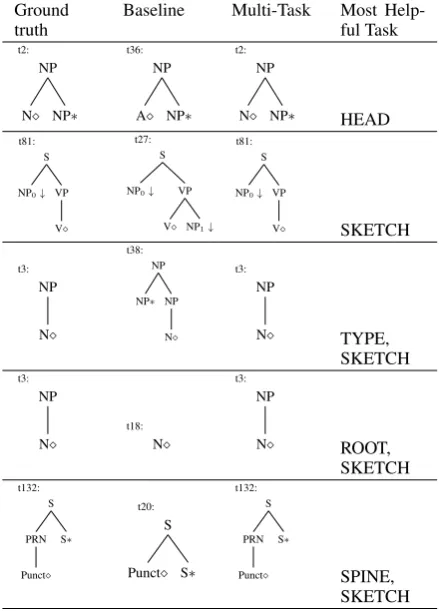
Table 5 shows some examples about how each
of auxiliary tasks can help in the correction of supertag prediction. Examples of each task are selected if a considerable number of predictions of each example are corrected after applying the multi-task model.
While the multi-task model can correct many wrong predictions made by the baseline model, the multi-task model may also override some correct predictions.
Model Multi-task Dev Test
BiLSTM3+HW+CNN+POS+GloVe100 (Kasai et al.,2018) - 90.45 90.81
BiLSTM2+GloVe100 No 89.11
-Yes 89.67
-BiLSTM2+CNN+GloVe100 No 89.45
-Yes 90.12
-BiLSTM3+GloVe100 No 89.41
-Yes 90.02
-BiLSTM3+CNN+GloVe100 No 89.83
-Yes 90.41
-BiLSTM3+CNN+GloVe200 No 89.94
-Yes 90.55 91.37
BiLSTM3+CNN+GloVe300 No 89.91
-Yes 90.45
-Shared BiLSTM layer (BiLSTM3+CNN+Glove200)
No 90.11 90.83
[image:7.595.90.503.61.284.2]Yes 90.11 90.83
Table 2: Supertagging task results. The number after BiLSTM represents the number of BiLSTM layers; CNN refers to the word embedding model using character-level CNN; the number immediately after GloVe represents the dimension of pre-trained GloVe word vectors. HW inKasai et al.(2018) refers to highway connections, and POS refers to the use of predicted part-of-speech tags as inputs. We do not use HW or POS in our models as they do not provide any benefit.
Top-K Dev Test
Top-3 90.55 91.37
Top-5 90.58 91.38
Top-10 90.58 91.39
Top-20 90.58 91.39
Table 3: Change in accuracy as K is increased when choosing Top-K supertags for rescoring. The model used is BiLSTM+CNN+GloVe200.
correctly predicted by the multi-task model. The ROOT, TYPE, SKETCH and SPINE are all the same for t2 and t36, the only difference is the
HEAD value,Nfor t2 andAfor t36. The model
for the HEAD task correctly predicts the head node of those words which is further improved us-ing our multi-task approach.
The second row demonstrates how the tree sketch can help discriminate supertags. t81 and t27 have exactly the same ROOT, HEAD, SPINE (S-VP-V) and TYPE (Init), the only difference be-tween these two supertags is the tree structure.
The third to fifth rows are examples of the ef-fect of multiple auxiliary tasks in getting the pre-diction right. The third row is an example of the prediction of TYPE and SKETCH that can help
differentiate supertags. The TYPE of t3 is Init,
while t38 has TYPELeft+NP. They also have
dif-ferent tree sketches. There are 11 words of which supertags are wrongly predicted as t3 by a single supertagging model, but correctly predicted as t38 by the multi-task model; also, 3 words of which supertags are wrongly predicted as t38 by a single supertagging model, but correctly predicted as t3 by the multi-task model.
The forth row is an example of how the predic-tion of the ROOT can help differentiate supertags.
The ROOT of t3 isNP, while t18 has ROOTN(N
is also its head node). For the last row, t132 and t20 have the same root node(S), head node(Punct) and tree type (Right+S) but they are different in
the tree spine (S-Punctfor t20 andS-PRN-Punct
for t132) and SKETCH. The joint effort of vari-ous models plays a significant role in getting the prediction right.
7 Related Work
Bangalore et al. (2009) and Chung et al. (2016) trained a feature based classification model for TAG supertags, that extract features using lexical, part-of-speech attributes from the left and right context in a 6-word window and the lexical, ortho-graphic (e.g. capitalization, prefix, suffix, digit) and part-of-speech attributes of the word being supertagged. Neural network based supertagging
[image:7.595.122.242.376.449.2]Multi-task setting Dev Test
None 89.94 90.73
HEAD 90.00 90.79
ROOT 90.06 90.91
TYPE 90.15 91.07
SKETCH 90.25 90.99
SPINE 90.22 91.08
HEAD+ROOT 90.15 90.94
TYPE+HEAD+ROOT 90.27 91.10
TYPE+HEAD+ROOT+SKETCH 90.48 91.27
[image:8.595.168.436.60.213.2]TYPE+HEAD+ROOT+SKETCH+SPINE 90.55 91.37
Table 4: Result of different multi-task combinations. The base model is BiLSTM+CNN+GloVe200.
Ground truth
Baseline Multi-Task Most Help-ful Task
NP
NP∗ N t2:
NP
NP∗ A t36:
NP
NP∗ N t2:
HEAD
S
VP
V
NP0↓
t81:
S
VP
NP1↓
V
NP0↓
t27:
S
VP
V
NP0↓
t81:
SKETCH
NP
N
t3: NP
NP
N
NP∗
t38:
NP
N t3:
TYPE, SKETCH
NP
N t3:
N t18:
NP
N t3:
ROOT, SKETCH
S
S∗
PRN
Punct
t132:
S
S∗ Punct
t20: S
S∗
PRN
Punct
t132:
SPINE, SKETCH
Table 5: Some examples of how the deconstructing of base models correct the prediction made by the su-pertagging model.
et al.,2015;Lewis et al.,2016;Xu,2016;Vaswani et al.,2016) have shown substantial improvement in performance, but the supertagging models are all quite similar as they all use a bi-directional RNN feeding into a prediction layer. Structural features of supertags are heavily used in pre-neural statistical parsing methods (Bangalore et al.,2009) and proved to be useful. The use of supertag
struc-ture was explored in (Friedman et al.,2017) where
they adopt grammar features into a tree-structured
neural model over the supertags but this model
was unable to beat the state-of-the-art. (Kasai
et al., 2018) combines supertagging with parsing which does provide state-of-the-art accuracy but at the expense of computational complexity.
Kasai et al.(2017) extends the BiLSTM model with predicted part-of-speech tags and suffix
em-beddings as inputs, thenKasai et al.(2018) further
extends the BiLSTM model with highway connec-tion as well as character CNN as input, and jointly train the supertagging model with parsing model and this work had the state-of-the-art accuracy
be-fore our paper on the Penn treebank dataset.
Fried-man et al. (2017) investigated a recursive tree-based vector representation of TAG supertags, but while their model can learn useful facts about su-pertags, about how one can be related to another, there was no performance improvement as a result
of their model on the supertagging task. Xu et al.
(2015) uses RNN for the CCG supertagging task,
Lewis et al. (2016) adopted the LSTM structure
into this task, whileVaswani et al.(2016) also
in-troduced another variation of Bi-LSTM into this
task. Xu(2016) then proposed an attention-based
Bi-LSTM supertagging model.
8 Conclusion
In this paper we have introduced a novel multi-task framework for the TAG supertagging multi-task. The approach involved a novel multi-task learning framework which led to a new state-of-the-art ac-curacy score of 91.39% for TAG supertagging on the Penn treebank dataset.
[image:8.595.71.291.259.565.2]pre-diction task.
In the future we would like to explore further tasks to integrate into our multi-task sequence pre-diction framework. We also believe that the idea of our multi-task framework can be applied into sim-ilar tasks such as CCG supertagging task of which the labels themselves contains the latent informa-tion. We would also like to investigate how to semi-automatically generate new tasks which can be of further help in the multi-task setting.
Acknowledgments
We would like to thank Logan Born and the anonymous reviewers for their helpful comments. The research was also partially supported by the Natural Sciences and Engineering Research Council of Canada grants NSERC RGPIN-2018-06437 and RGPAS-2018-522574 and a Depart-ment of National Defence (DND) and NSERC grant DGDND-2018-00025 to the second author.
References
Srinivas Bangalore, Pierre Boullier, Alexis Nasr, Owen Rambow, and Benoˆıt Sagot. 2009. Mica: A prob-abilistic dependency parser based on tree insertion grammars (application note). In Proceedings of Human Language Technologies: The 2009 Annual Conference of the North American Chapter of the Association for Computational Linguistics, Com-panion Volume: Short Papers, pages 185–188.
Srinivas Bangalore and Aravind K Joshi. 1999. Su-pertagging: An approach to almost parsing. Com-putational linguistics, 25(2):237–265.
Joachim Bingel and Anders Søgaard. 2017. Identify-ing beneficial task relations for multi-task learnIdentify-ing in deep neural networks. InProceedings of the 15th Conference of the European Chapter of the Associa-tion for ComputaAssocia-tional Linguistics: Volume 2, Short Papers, pages 164–169, Valencia, Spain. Associa-tion for ComputaAssocia-tional Linguistics.
Rich Caruana. 1997. Multitask learning. Machine learning, 28(1):41–75.
John Chen, Srinivas Bangalore, and K Vijay-Shankar. 2006. Automated extraction of tree-adjoining gram-mars from treebanks. Natural Language Engineer-ing, 12(3):251–299.
John Chen and Vijay Shankar. 2001. Towards efficient statistical parsing using lexicalized grammatical in-formation. Ph.D. thesis, Citeseer.
Jason PC Chiu and Eric Nichols. 2016. Named entity recognition with bidirectional lstm-cnns. Transac-tions of the Association for Computational Linguis-tics, 4:357–370.
Wonchang Chung, Siddhesh Suhas Mhatre, Alexis Nasr, Owen Rambow, and Srinivas Bangalore. 2016. Revisiting supertagging and parsing: How to use su-pertags in transition-based parsing. In12th Interna-tional Workshop on Tree Adjoining Grammars and Related Formalisms (TAG+ 12), pages 85–92.
Ronan Collobert and Jason Weston. 2008. A unified architecture for natural language processing: Deep neural networks with multitask learning. In Pro-ceedings of the 25th international conference on Machine learning, pages 160–167. ACM.
Jacob Devlin, Ming-Wei Chang, Kenton Lee, and Kristina Toutanova. 2018. Bert: Pre-training of deep bidirectional transformers for language understand-ing.arXiv preprint arXiv:1810.04805.
Dan Friedman, Jungo Kasai, R Thomas McCoy, Robert Frank, Forrest Davis, and Owen Rambow. 2017. Linguistically rich vector representations of su-pertags for tag parsing. InProceedings of the 13th International Workshop on Tree Adjoining Gram-mars and Related Formalisms, pages 122–131.
Yarin Gal and Zoubin Ghahramani. 2016. A theoret-ically grounded application of dropout in recurrent neural networks. InAdvances in neural information processing systems, pages 1019–1027.
Alex Graves and J¨urgen Schmidhuber. 2005. Frame-wise phoneme classification with bidirectional lstm and other neural network architectures. Neural Net-works, 18(5-6):602–610.
Julia Hockenmaier and Mark Steedman. 2007. Ccg-bank: a corpus of ccg derivations and dependency structures extracted from the penn treebank. Com-putational Linguistics, 33(3):355–396.
Aravind K Joshi and Yves Schabes. 1997. Tree-adjoining grammars. In Handbook of formal lan-guages, pages 69–123. Springer.
Jungo Kasai, Robert Frank, R Thomas McCoy, Owen Rambow, and Alexis Nasr. 2017. Tag parsing with neural networks and vector representations of su-pertags. In Conference on Empirical Methods in Natural Language Processing, pages 1712–1722.
Jungo Kasai, Robert Frank, Pauli Xu, William Merrill, and Owen Rambow. 2018. End-to-end graph-based TAG parsing with neural networks. In Proceed-ings of the 2018 Conference of the North American Chapter of the Association for Computational Lin-guistics: Human Language Technologies, NAACL-HLT 2018, New Orleans, Louisiana, USA, June 1-6, 2018, Volume 1 (Long Papers), pages 1181–1194.
Mike Lewis, Kenton Lee, and Luke Zettlemoyer. 2016. Lstm ccg parsing. InProceedings of the 2016 Con-ference of the North American Chapter of the Asso-ciation for Computational Linguistics: Human Lan-guage Technologies, pages 221–231.
Xiaodong Liu, Pengcheng He, Weizhu Chen, and Jian-feng Gao. 2019. Multi-task deep neural networks for natural language understanding. InProceedings of the 57th Annual Meeting of the Association for Computational Linguistics, pages 4487–4496, Flo-rence, Italy. Association for Computational Linguis-tics.
Minh-Thang Luong, Quoc V Le, Ilya Sutskever, Oriol Vinyals, and Lukasz Kaiser. 2015. Multi-task sequence to sequence learning. arXiv preprint arXiv:1511.06114.
Xuezhe Ma and Eduard Hovy. 2016. End-to-end sequence labeling via bi-directional lstm-cnns-crf.
arXiv preprint arXiv:1603.01354.
Mitchell P. Marcus, Beatrice Santorini, and Mary Ann Marcinkiewicz. 1993. Building a large annotated corpus of english: The penn treebank. Computa-tional Linguistics, 19(2):313–330.
Adam Paszke, Sam Gross, Soumith Chintala, Gre-gory Chanan, Edward Yang, Zachary DeVito, Zem-ing Lin, Alban Desmaison, Luca Antiga, and Adam Lerer. 2017. Automatic differentiation in pytorch. InNIPS-W.
Jeffrey Pennington, Richard Socher, and Christopher Manning. 2014. Glove: Global vectors for word representation. Proceedings of the 2014 conference on empirical methods in natural language process-ing (EMNLP).
Matthew E Peters, Mark Neumann, Mohit Iyyer, Matt Gardner, Christopher Clark, Kenton Lee, and Luke Zettlemoyer. 2018. Deep contextualized word rep-resentations. arXiv preprint arXiv:1802.05365.
Cicero D Santos and Bianca Zadrozny. 2014. Learning character-level representations for part-of-speech tagging. In Proceedings of the 31st International Conference on Machine Learning (ICML-14), pages 1818–1826.
Nitish Srivastava, Geoffrey Hinton, Alex Krizhevsky, Ilya Sutskever, and Ruslan Salakhutdinov. 2014. Dropout: a simple way to prevent neural networks from overfitting. The journal of machine learning research, 15(1):1929–1958.
Ashish Vaswani, Yonatan Bisk, Kenji Sagae, and Ryan Musa. 2016. Supertagging with lstms. In Proceed-ings of the 2016 Conference of the North Ameri-can Chapter of the Association for Computational Linguistics: Human Language Technologies, pages 232–237.
David Vilares, Mostafa Abdou, and Anders Søgaard. 2019. Better, faster, stronger sequence tagging con-stituent parsers. InProceedings of the 2019 Confer-ence of the North American Chapter of the Associ-ation for ComputAssoci-ational Linguistics: Human Lan-guage Technologies, Volume 1 (Long and Short Pa-pers), pages 3372–3383, Minneapolis, Minnesota. Association for Computational Linguistics.
Wenduan Xu. 2016. Lstm shift-reduce ccg parsing. In Proceedings of the 2016 Conference on Empiri-cal Methods in Natural Language Processing, pages 1754–1764.