Proceedings of NAACL-HLT 2018, pages 1896–1906
Multi-task Learning of Pairwise Sequence Classification Tasks
Over Disparate Label Spaces
Isabelle Augenstein1∗, Sebastian Ruder23∗, Anders Søgaard1 1Department of Computer Science, University of Copenhagen, Denmark
2Insight Research Centre, National University of Ireland, Galway 3Aylien Ltd., Dublin, Ireland
{augenstein|soegaard}@di.ku.dk,[email protected]
Abstract
We combine multi-task learning and semi-supervised learning by inducing a joint embed-ding space between disparate label spaces and learning transfer functions between label em-beddings, enabling us to jointly leverage un-labelled data and auxiliary, annotated datasets. We evaluate our approach on a variety of se-quence classification tasks with disparate la-bel spaces. We outperform strong single and multi-task baselines and achieve a new state-of-the-art for topic-based sentiment analysis.
1 Introduction
Multi-task learning (MTL) and semi-supervised learning are both successful paradigms for learn-ing in scenarios with limited labelled data and have in recent years been applied to almost all ar-eas of NLP. Applications of MTL in NLP, for ex-ample, include partial parsing (Søgaard and Gold-berg, 2016), text normalisation (Bollman et al., 2017), neural machine translation (Luong et al., 2016), and keyphrase boundary classification (Au-genstein and Søgaard, 2017).
Contemporary work in MTL for NLP typically focuses on learning representations that are useful across tasks, often through hard parameter shar-ing of hidden layers of neural networks (Collobert et al., 2011; Søgaard and Goldberg, 2016). If tasks share optimal hypothesis classes at the level of these representations, MTL leads to improve-ments (Baxter, 2000). However, while sharing hidden layers of neural networks is an effective regulariser (Søgaard and Goldberg, 2016), we po-tentiallyloose synergies between the classification
functionstrained to associate these representations
with class labels. This paper sets out to build an ar-chitecture in which such synergies are exploited,
?The first two authors contributed equally.
with an application to pairwise sequence classifi-cation tasks. Doing so, we achieve a new state of the art on topic-based sentiment analysis.
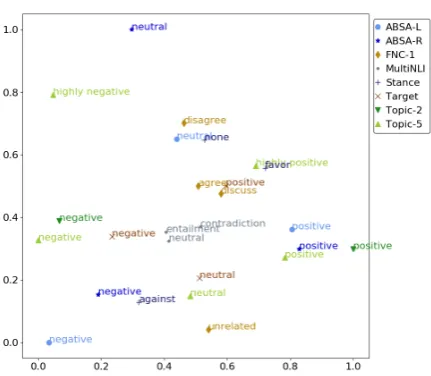
For many NLP tasks, disparate label sets are weakly correlated, e.g. part-of-speech tags corre-late with dependencies (Hashimoto et al., 2017), sentiment correlates with emotion (Felbo et al., 2017; Eisner et al., 2016), etc. We thus propose to induce a joint label embedding space (visualised in Figure 2) using a Label Embedding Layer that allows us to model these relationships, which we show helps with learning.
In addition, for tasks where labels are closely related, we should be able to not only model their relationship, but also to directly estimate the cor-responding label of the target task based on auxil-iary predictions. To this end, we propose to train a Label Transfer Network (LTN) jointly with the model to produce pseudo-labels across tasks.
The LTN can be used to label unlabelled and auxiliary task data by utilising the ‘dark knowl-edge’ (Hinton et al., 2015) contained in auxil-iary model predictions. This pseudo-labelled data is then incorporated into the model via semi-supervised learning, leading to a natural combi-nation of multi-task learning and semi-supervised learning. We additionally augment the LTN with data-specific diversity features (Ruder and Plank, 2017) that aid in learning.
Contributions Our contributions are: a) We model the relationships between labels by induc-ing a joint label space for multi-task learninduc-ing. b) We propose a Label Transfer Network that learns to transfer labels between tasks and propose to use semi-supervised learning to leverage them for training. c) We evaluate MTL approaches on a va-riety of classification tasks and shed new light on settings where multi-task learning works. d) We perform an extensive ablation study of our model.
e) We report state-of-the-art performance on topic-based sentiment analysis.
2 Related work
Learning task similarities Existing approaches for learning similarities between tasks enforce a clustering of tasks (Evgeniou et al., 2005; Jacob et al., 2009), induce a shared prior (Yu et al., 2005; Xue et al., 2007; Daumé III, 2009), or learn a grouping (Kang et al., 2011; Kumar and Daumé III, 2012). These approaches focus on homoge-neous tasks and employ linear or Bayesian mod-els. They can thus not be directly applied to our setting with tasks using disparate label sets. Multi-task learning with neural networks Re-cent work in multi-task learning goes beyond hard parameter sharing (Caruana, 1993) and considers different sharing structures, e.g. only sharing at lower layers (Søgaard and Goldberg, 2016) and induces private and shared subspaces (Liu et al., 2017; Ruder et al., 2017). These approaches, how-ever, are not able to take into account relationships between labels that may aid in learning. Another related direction is to train on disparate annota-tions of the same task (Chen et al., 2016; Peng et al., 2017). In contrast, the different nature of our tasks requires a modelling of their label spaces. Semi-supervised learning There exists a wide range of semi-supervised learning algorithms, e.g., self-training, co-training, tri-training, EM, and combinations thereof, several of which have also been used in NLP. Our approach is proba-bly most closely related to an algorithm called
co-forest(Li and Zhou, 2007). In co-forest, like here,
each learner is improved with unlabeled instances labeled by the ensemble consisting of all the other learners. Note also that several researchers have proposed using auxiliary tasks that are unsuper-vised (Plank et al., 2016; Rei, 2017), which also leads to a form of semi-supervised models. Label transformations The idea of manually mapping between label sets or learning such a mapping to facilitate transfer is not new. Zhang et al. (2012) use distributional information to map from a language-specific tagset to a tagset used for other languages, in order to facilitate cross-lingual transfer. More related to this work, Kim et al. (2015) use canonical correlation analysis to transfer between tasks with disparate label spaces. There has also been work on label transformations
in the context of multi-label classification prob-lems (Yeh et al., 2017).
3 Multi-task learning with disparate label spaces
3.1 Problem definition
In our multi-task learning scenario, we have access to labelled datasets forTtasksT1, . . . ,TT at
train-ing time with a target taskTT that we particularly
care about. The training dataset for taskTiconsists
ofNkexamplesXTi = {xT i
1 , . . . , xTNik}and their
labelsYTi = {yTi
1 , . . . ,yTNik}. Our base model is
a deep neural network that performs classic hard parameter sharing (Caruana, 1993): It shares its parameters across tasks and has task-specific soft-max output layers, which output a probability dis-tributionpTifor taskT
iaccording to the following
equation:
pTi = softmax(WTih+bTi) (1)
where softmax(x) = ex/Pkxk
i=1exi, WTi ∈
RLi×h, bTi ∈ RLi is the weight matrix and bias
term of the output layer of task Ti respectively,
h ∈ Rh is the jointly learned hidden
representa-tion,Li is the number of labels for taskTi, andh
is the dimensionality ofh.
The MTL model is then trained to minimise the sum of the individual task losses:
L=λ1L1+. . .+λTLT (2)
where Li is the negative log-likelihood
objec-tiveLi = H(pTi,yTi) =−N1 Pn
P
jlogpTjiyTji
andλi is a parameter that determines the weight
of taskTi. In practice, we apply the same weight
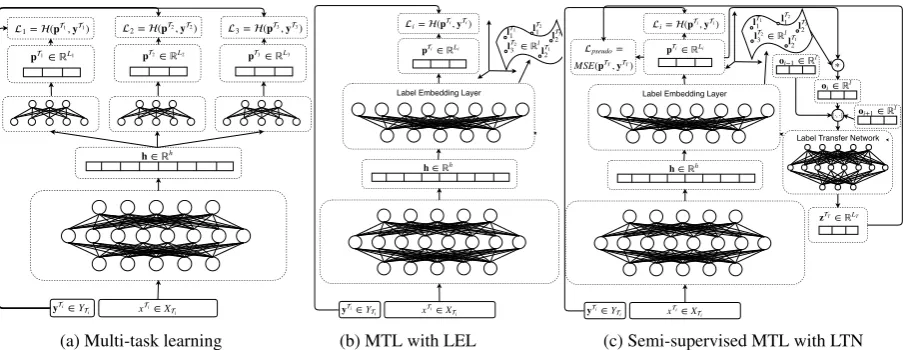
to all tasks. We show the full set-up in Figure 1a.
3.2 Label Embedding Layer
In order to learn the relationships between labels, we propose a Label Embedding Layer (LEL) that embeds the labels of all tasks in a joint space. In-stead of training separate softmax output layers as above, we introduce a label compatibility function c(·,·)that measures how similar a label with
em-beddinglis to the hidden representationh:
c(l,h) =l·h (3)
12/6/2017 multi-task_learning.html
1/2 ∈
xi X i
∈
p1 ℝL1 p2∈ℝL2 p3∈ℝL3
h ∈ ℝh
∈ yi Y
i
= ( , )
1 p1y1 2= (p2,y2) 3= (p3,y3)
(a) Multi-task learning
12/6/2017 label_embedding_layer.html
1/2 l3
2
l2
1
∈ pi ℝLi
h ∈ ℝh
Label Embedding Layer
l1
2
l1
1
∈ l2
3 ℝl
∈ xi Xi
∈ yi Y
i
= ( , ) i piyi
(b) MTL with LEL
12/6/2017 label_transfer_network.html
2/3 ∈
pi ℝLi
h ∈ ℝh
[image:3.595.74.526.61.236.2]Label Embedding Layer
[⋅, ⋅] ∈ oi−1 ℝl
Label Transfer Network
∈ zT ℝLT
∈ oi+1 ℝl
∗ ∈ oi ℝl
∈ xi X
i
∈ yi Y
i
= ( , ) i piyi
= pseudo
MSE(pT,yT)
l3
2
l2
1
l1
2
l1
1
∈ l2
3 ℝl
(c) Semi-supervised MTL with LTN Figure 1: a) Multi-task learning (MTL) with hard parameter sharing and 3 tasksT1−3andL1−3labels per task. A
shared representationhis used as input to task-specific softmax layers, which optimise cross-entropy lossesL1−3.
b) MTL with the Label Embedding Layer (LEL) embeds task labelslT1−3
1−Li in a joint embedding space and uses
these for prediction with a label compatibility function. c) Semi-supervised MTL with the Label Transfer Network (LTN) in addition optimises an unsupervised lossLpseudoover pseudo-labels zTT on auxiliary/unlabelled data.
The pseudo-labelszTT are produced by the LTN for the main taskT
T using the concatenation of auxiliary task
label output embeddings[oi−1,oi,oi+1]as input.
other models that use the dot product in the objec-tive function, we do not have to rely on negaobjec-tive sampling and a hinge loss (Collobert and Weston, 2008) as negative instances (labels) are known. For efficiency purposes, we use matrix multipli-cation instead of a single dot product and softmax instead of sigmoid activations:
p= softmax(Lh) (4)
where L ∈ R(PiLi)×l is the label embedding
matrix for all tasks andlis the dimensionality of the label embeddings. In practice, we setlto the hidden dimensionality h. We use padding if l < h. We apply a task-specific mask toLin order to
obtain a task-specific probability distributionpTi.
The LEL is shared across all tasks, which allows us to learn the relationships between the labels in the joint embedding space. We show MTL with the LEL in Figure 1b.
3.3 Label Transfer Network
The LEL allows us to learn the relationships be-tween labels. In order to make use of these re-lationships, we would like to leverage the predic-tions of our auxiliary tasks to estimate a label for the target task. To this end, we introduce the Label Transfer Network (LTN). This network takes the auxiliary task outputs as input. In particular, we define the output label embeddingoi of taskTi as
the sum of the task’s label embeddingsljweighted
with their probabilitypTi
j :
oi = Li
X
j=1
pTi
j lj (5)
The label embeddingslencode general
relation-ship between labels, while the model’s probability distributionpTi over its predictions encodes
fine-grained information useful for learning (Hinton et al., 2015). The LTN is trained on labelled tar-get task data. For each example, the correspond-ing label output embeddcorrespond-ings of the auxiliary tasks are fed into a multi-layer perceptron (MLP), which is trained with a negative log-likelihood objective
LLTNto produce a pseudo-labelzTT for the target taskTT:
LTNT = MLP([o1, . . . ,oT−1]) (6)
where[·,·]designates concatenation. The
can be directly used to produce predictions on un-seen data.
3.4 Semi-supervised MTL
The downside of the LTN is that it requires addi-tional parameters and relies on the predictions of the auxiliary models, which impacts the runtime during testing. Instead, of using the LTN for pre-diction directly, we can use it to provide pseudo-labels for unlabelled or auxiliary task data by utilising auxiliary predictions for semi-supervised learning.
We train the target task model on the pseudo-labelled data to minimise the squared error be-tween the model predictions pTi and the pseudo
labelszTiproduced by the LTN:
Lpseudo=M SE(pTT,zTT) =||pTT −zTT||2
(7) We add this loss term to the MTL loss in Equa-tion 2. As the LTN is learned together with the MTL model, pseudo-labels produced early during training will likely not be helpful as they are based on unreliable auxiliary predictions. For this rea-son, we first train the base MTL model until con-vergence and then augment it with the LTN. We show the full semi-supervised learning procedure in Figure 1c.
3.5 Data-specific features
When there is a domain shift between the datasets of different tasks as is common for instance when learning NER models with different label sets, the output label embeddings might not contain suffi-cient information to bridge the domain gap.
To mitigate this discrepancy, we augment the LTN’s input with features that have been found useful for transfer learning (Ruder and Plank, 2017). In particular, we use the number of word types, type-token ratio, entropy, Simpson’s index, and Rényi entropy as diversity features. We calcu-late each feature for each example.1 The features are then concatenated with the input of the LTN.
3.6 Other multi-task improvements
Hard parameter sharing can be overly restrictive and provide a regularisation that is too heavy when jointly learning many tasks. For this reason, we propose several additional improvements that seek 1For more information regarding the feature calculation, refer to Ruder and Plank (2017).
Task Domain N L Metric
Topic-2 Twitter 4,346 2 ρP N Topic-5 Twitter 6,000 5 M AEM Target Twitter 6,248 3 FM
1
Stance Twitter 2,914 3 FF A
1
ABSA-L Reviews 2,909 3 Acc ABSA-R Reviews 2,507 3 Acc FNC-1 News 39,741 4 Acc MultiNLI Diverse 392,702 3 Acc
Table 1: Training set statistics and evaluation metrics of every task.N: # of examples.L: # of labels.
to alleviate this burden: We use skip-connections, which have been shown to be useful for multi-task learning in recent work (Ruder et al., 2017). Furthermore, we add a task-specific layer before the output layer, which is useful for learning task-specific transformations of the shared representa-tions (Søgaard and Goldberg, 2016; Ruder et al., 2017).
4 Experiments
For our experiments, we evaluate on a wide range of text classification tasks. In particular, we choose pairwise classification tasks—i.e. those that condition the reading of one sequence on an-other sequence—as we are interested in under-standing if knowledge can be transferred even for these more complex interactions. To the best of our knowledge, this is the first work on transfer learning between such pairwise se-quence classification tasks. We implement all our models in Tensorflow (Abadi et al., 2016) and release the code at https://github.com/ coastalcph/mtl-disparate.
4.1 Tasks and datasets
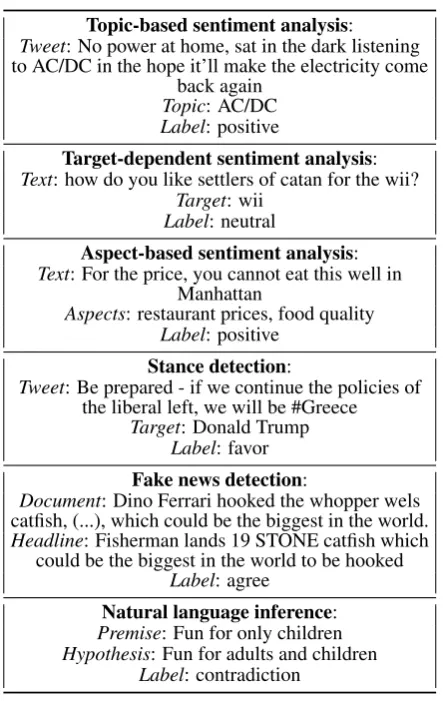
We use the following tasks and datasets for our experiments, show task statistics in Table 1, and summarise examples in Table 2:
Topic-based sentiment analysis:
Tweet: No power at home, sat in the dark listening to AC/DC in the hope it’ll make the electricity come
back again
Topic: AC/DC
Label: positive
Target-dependent sentiment analysis:
Text: how do you like settlers of catan for the wii?
Target: wii
Label: neutral
Aspect-based sentiment analysis:
Text: For the price, you cannot eat this well in Manhattan
Aspects: restaurant prices, food quality
Label: positive
Stance detection:
Tweet: Be prepared - if we continue the policies of the liberal left, we will be #Greece
Target: Donald Trump
Label: favor
Fake news detection:
Document: Dino Ferrari hooked the whopper wels catfish, (...), which could be the biggest in the world.
Headline: Fisherman lands 19 STONE catfish which could be the biggest in the world to be hooked
Label: agree
Natural language inference:
Premise: Fun for only children
Hypothesis: Fun for adults and children
[image:5.595.71.293.58.409.2]Label: contradiction
Table 2: Example instances from the datasets de-scribed in Section 4.1.
tweet “No power at home, sat in the dark listen-ing to AC/DC in the hope it’ll make the electric-ity come back again” known to be about the topic “AC/DC”, which is labelled as a positive senti-ment. The evaluation metrics forTopic-2 and Topic-5 are macro-averaged recall (ρP N) and macro-averaged mean absolute error (M AEM) respectively, which are both averaged across top-ics.
Target-dependent sentiment analysis Target-dependent sentiment analysis (Target) seeks to classify the sentiment of a text’s author towards an entity that occurs in the text as positive, neg-ative, or neutral. We use the data from Dong et al. (2014). An example instance is the ex-pression “how do you like settlers of catan for the wii?” which is labelled as neutral towards the target “wii’.’ The evaluation metric is macro-averagedF1(F1M).
Aspect-based sentiment analysis Aspect-based sentiment analysis is the task of identifying
whether an aspect, i.e. a particular property of an item is associated with a positive, negative, or neu-tral sentiment (Ruder et al., 2016). We use the data of SemEval-2016 Task 5 Subtask 1 Slot 3 (Pon-tiki et al., 2016) for the laptops (ABSA-L) and restaurants (ABSA-R) domains. An example is the sentence “For the price, you cannot eat this well in Manhattan”, labelled as positive towards both the aspects “restaurant prices” and “food quality”. The evaluation metric for both domains is accu-racy (Acc).
Stance detection Stance detection (Stance) requires a model, given a text and a target en-tity, which might not appear in the text, to pre-dict whether the author of the text is in favour or against the target or whether neither inference is likely (Augenstein et al., 2016). We use the data of SemEval-2016 Task 6 Subtask B (Mohammad et al., 2016). An example from this dataset would be to predict the stance of the tweet “Be prepared - if we continue the policies of the liberal left, we will be #Greece” towards the topic “Donald Trump”, labelled as “favor”. The evaluation met-ric is the macro-averagedF1score of the “favour” and “against” classes (FF A
1 ).
Fake news detection The goal of fake news de-tection in the context of the Fake News Challenge2 is to estimate whether the body of a news arti-cle agrees, disagrees, discusses, or is unrelated to-wards a headline. We use the data from the first stage of the Fake News Challenge (FNC-1). An example for this dataset is the document “Dino Ferrari hooked the whopper wels catfish, (...), which could be the biggest in the world.” with the headline “Fisherman lands 19 STONE catfish which could be the biggest in the world to be hooked” labelled as “agree”. The evaluation met-ric is accuracy (Acc)3.
Natural language inference Natural language inference is the task of predicting whether one sen-tences entails, contradicts, or is neutral towards another one. We use the Multi-Genre NLI cor-pus (MultiNLI) from the RepEval 2017 shared task (Nangia et al., 2017). An example for an in-stance would be the sentence pair “Fun for only children”, “Fun for adults and children”, which are in a “contradiction” relationship. The evaluation metric is accuracy (Acc).
Stance FNC MultiNLI Topic-2 Topic-5* ABSA-L ABSA-R Target
Augenstein et al. (2016) 49.01 - - -
-Riedel et al. (2017) - 88.46 - - -
-Chen et al. (2017) - - 74.90 - - - -
-Palogiannidi et al. (2016) - - - 79.90 - - -
-Balikas and Amini (2016) - - - - 0.719 - -
-Brun et al. (2016) - - - 88.13
-Kumar et al. (2016) - - - 82.77 86.73
-Vo and Zhang (2015) - - - 69.90
STL 41.1 72.72 49.25 63.92 0.919 76.74 67.47 64.01
MTL + LEL 46.26 72.71 49.94 80.52 0.814 74.94 79.90 66.42
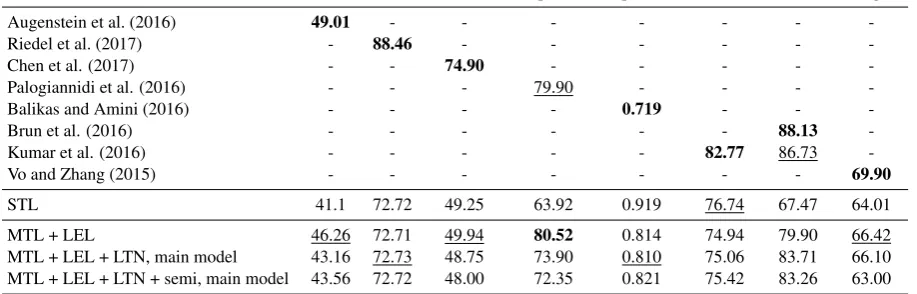
[image:6.595.71.530.75.222.2]MTL + LEL + LTN, main model 43.16 72.73 48.75 73.90 0.810 75.06 83.71 66.10 MTL + LEL + LTN + semi, main model 43.56 72.72 48.00 72.35 0.821 75.42 83.26 63.00 Table 3: Comparison of our best performing models on the test set against a single task baseline and the state of the art, with task specific metrics. *: lower is better. Bold: best. Underlined: second-best.
4.2 Base model
Our base model is the Bidirectional Encoding model (Augenstein et al., 2016), a state-of-the-art model for stance detection that conditions a bidirectional LSTM (BiLSTM) encoding of a text on the BiLSTM encoding of the target. Un-like Augenstein et al. (2016), we do not pre-train word embeddings on a larger set of unlabelled in-domain text for each task as we are mainly inter-ested in exploring the benefit of multi-task learn-ing for generalisation.
4.3 Training settings
We use BiLSTMs with one hidden layer of 100
dimensions,100-dimensional randomly initialised
word embeddings, a label embedding size of100.
We train our models with RMSProp, a learning rate of0.001, a batch size of128, and early
stop-ping on the validation set of the main task with a patience of3.
5 Results
Our main results are shown in Table 3, with a com-parison against the state of the art. We present the results of our multi-task learning network with la-bel embeddings (MTL + LEL), multi-task learn-ing with label transfer (MTL + LEL + LTN), and the semi-supervised extension of this model. On 7/8 tasks, at least one of our architectures is better than single-task learning; and in 4/8, all our archi-tectures are much better than single-task learning. The state-of-the-art systems we compare against are often highly specialised, task-dependent architectures. Our architectures, in contrast, have not been optimised to compare
favourably against the state of the art, as our main objective is to develop a novel approach to multi-task learning leveraging synergies between label sets and knowledge of marginal distributions from unlabeled data. For example, we do not use pre-trained word embeddings (Augenstein et al., 2016; Palogiannidi et al., 2016; Vo and Zhang, 2015), class weighting to deal with label imbalance (Balikas and Amini, 2016), or domain-specific sentiment lexicons (Brun et al., 2016; Kumar et al., 2016). Nevertheless, our approach outperforms the state-of-the-art on two-way topic-based sentiment analysis (Topic-2).
The poor performance compared to the state-of-the-art onFNCandMultiNLIis expected; as we alternate among the tasks during training, our model only sees a comparatively small number of examples of both corpora, which are one and two orders of magnitude larger than the other datasets. For this reason, we do not achieve good perfor-mance on these tasks as main tasks, but they are still useful as auxiliary tasks as seen in Table 4.
6 Analysis
6.1 Label Embeddings
Figure 2: Label embeddings of all tasks. Positive, neg-ative, and neutral labels are clustered together.
and middle-bottom).
Our visualisation also provides us with a pic-ture of what auxilary tasks are beneficial, and to what extent we can expect synergies from multi-task learning. For instance, the notion of posi-tive sentiment appears to be very similar across the topic-based and aspect-based tasks, while the con-ceptions of negative and neutral sentiment differ. In addition, we can see that the model has failed to learn a relationship betweenMultiNLIlabels and those of other tasks, possibly accounting for its poor performance on the inference task. We did not evaluate the correlation between label em-beddings and task performance, but Bjerva (2017) recently suggested that mutual information of tar-get and auxiliary task label sets is a good predictor of gains from multi-task learning.
6.2 Auxilary Tasks
For each task, we show the auxiliary tasks that achieved the best performance on the development data in Table 4. In contrast to most existing work, we did not restrict ourselves to performing multi-task learning with only one auxiliary multi-task (Søgaard and Goldberg, 2016; Bingel and Søgaard, 2017). Indeed we find that most often a combination of auxiliary tasks achieves the best performance. In-domain tasks are less used than we assumed; only Targetis consistently used by all Twitter main tasks. In addition, tasks with a higher number of labels, e.g. Topic-5are used more often. Such tasks provide a more fine-grained reward signal, which may help in learning representations that generalise better. Finally, tasks with large amounts
Main task Auxiliary tasks
Topic-2 FNC-1,MultiNLI,Target
Topic-5 FNC-1,MultiNLI,ABSA-L, Target
Target FNC-1,MultiNLI,Topic-5 Stance FNC-1,MultiNLI,Target ABSA-L Topic-5
ABSA-R Topic-5,ABSA-L,Target
FNC-1 Stance,MultiNLI,Topic-5, ABSA-R,Target
MultiNLI Topic-5
Table 4: Best-performing auxiliary tasks for different main tasks.
of training data such asFNC-1 and MultiNLI are also used more often. Even if not directly re-lated, the larger amount of training data that can be indirectly leveraged via multi-task learning may help the model focus on relevant parts of the rep-resentation space (Caruana, 1993). These obser-vations shed additional light on when multi-task learning may be useful that go beyond existing studies (Bingel and Søgaard, 2017).
6.3 Ablation analysis
We now perform a detailed ablation analysis of our model, the results of which are shown in Ta-ble 5. We ablate whether to use the LEL (+ LEL), whether to use the LTN (+ LTN), whether to use the LEL output or the main model output for prediction (main model output is indicated by
, main model), and whether to use the LTN as a
regulariser or for semi-supervised learning (semi-supervised learning is indicated by + semi). We further test whether to use diversity features (–
di-versity feats) and whether to use main model
pre-dictions for the LTN (+ main model feats). Overall, the addition of the Label Embed-ding Layer improves the performance over regular MTL in almost all cases.
6.4 Label transfer network
Stance FNC MultiNLI Topic-2 Topic-5* ABSA-L ABSA-R Target
MTL 44.12 72.75 49.39 80.74 0.859 74.94 82.25 65.73 MTL + LEL 46.26 72.71 49.94 80.52 0.814 74.94 79.90 66.42
[image:8.595.76.527.70.203.2]MTL + LTN 40.95 72.72 44.14 78.31 0.851 73.98 82.37 63.71 MTL + LTN, main model 41.60 72.72 47.62 79.98 0.814 75.54 81.70 65.61 MTL + LEL + LTN 44.48 72.76 43.72 74.07 0.821 75.66 81.92 65.00 MTL + LEL + LTN, main model 43.16 72.73 48.75 73.90 0.810 75.06 83.71 66.10 MTL + LEL + LTN + main preds feats 42.78 72.72 45.41 66.30 0.835 73.86 81.81 65.08 MTL + LEL + LTN + main preds feats, main model 42.65 72.73 48.81 67.53 0.803 75.18 82.59 63.95 MTL + LEL + LTN + main preds feats – diversity feats 42.78 72.72 43.13 66.3 0.835 73.5 81.7 63.95 MTL + LEL + LTN + main preds feats – diversity feats, main model 42.47 72.74 47.84 67.53 0.807 74.82 82.14 65.11 MTL + LEL + LTN + semi 42.65 72.75 44.28 77.81 0.841 74.10 81.36 64.45 MTL + LEL + LTN + semi, main model 43.56 72.72 48.00 72.35 0.821 75.42 83.26 63.00
Table 5: Ablation results with task-specific evaluation metrics on test set with early stopping on dev set. LTN
means the output of the relabelling function is shown, which does not use the task predictions, only predictions from other tasks. LTN + main preds featsmeans main model predictions are used as features for the relabelling function. LTN, main modelmeans that the main model predictions of the model that trains a relabelling function are used. Note that forMultiNLI, we down-sample the training data. *: lower is better. Bold: best. Underlined: second-best.
Task Main LTN Main (Semi) LTN (Semi)
Stance 2.12 2.62 1.94 1.28
FNC 4.28 2.49 6.92 4.84
MultiNLI 1.5 1.95 1.94 1.28
Topic-2 6.45 4.44 5.87 5.59
Topic-5* 9.22 9.71 11.3 5.90
ABSA-L 3.79 2.52 9.06 6.63
ABSA-R 10.6 6.70 9.06 6.63
[image:8.595.306.527.301.496.2]Target 26.3 14.6 20.1 15.7
Table 6: Error analysis of LTN with and without semi-supervised learning for all tasks. Metric shown: per-centage of correct predictions only made by either the relabelling function or the main model, respectively, relative to the the number of all correct predictions.
model, the main model performance first stag-nates, then starts to increase again. For some of the tasks, the main model ends up with a higher task score than the relabelling model. We hypothesise that the softmax predictions of other, even highly related tasks are less helpful for predicting main labels than the output layer of the main task model. At best, learning the relabelling model alongside the main model might act as a regulariser to the main model and thus improve the main model’s performance over a baseline MTL model, as it is the case forTOPIC-5(see Table 5).
To further analyse the performance of the LTN, we look into to what degree predictions of the main model and the relabelling model for individ-ual instances are complementary to one another. Or, said differently, we measure the percentage of correct predictions made only by the relabelling
Figure 3: Learning curves with LTN for selected tasks, dev performances shown. The main model is pre-trained for 10 epochs, after which the relabelling func-tion is trained.
7 Conclusion
We have presented a multi-task learning archi-tecture that (i) leverages potential synergies be-tween classifier functions relating shared represen-tations with disparate label spaces and (ii) enables learning from mixtures of labeled and unlabeled data. We have presented experiments with com-binations of eight pairwise sequence classification tasks. Our results show that leveraging synergies between label spaces sometimes leads to big im-provements, and we have presented a new state of the art for topic-based sentiment analysis. Our analysis further showed that (a) the learned label embeddings were indicative of gains from multi-task learning, (b) auxiliary multi-tasks were often ben-eficial across domains, and (c) label embeddings almost always led to better performance. We also investigated the dynamics of the label transfer net-work we use for exploiting the synergies between disparate label spaces.
Acknowledgments
Sebastian Ruder is supported by the Irish Re-search Council Grant Number EBPPG/2014/30 and Science Foundation Ireland Grant Number SFI/12/RC/2289. Anders Søgaard is supported by the ERC Starting Grant Number 313695. Isabelle Augenstein is supported by Eurostars grant Num-ber E10138. We further gratefully acknowledge the support of NVIDIA Corporation with the do-nation of the Titan Xp GPU used for this research.
References
Martín Abadi, Ashish Agarwal, Paul Barham, Eugene Brevdo, Zhifeng Chen, Craig Citro, Greg S Corrado, Andy Davis, Jeffrey Dean, Matthieu Devin, et al. 2016. Tensorflow: Large-scale machine learning on heterogeneous distributed systems. arXiv preprint arXiv:1603.04467.
Isabelle Augenstein, Tim Rocktäschel, Andreas Vla-chos, and Kalina Bontcheva. 2016. Twitter Stance Detection with Bidirectional Conditional Encoding. InProceedings of EMNLP.
Isabelle Augenstein and Anders Søgaard. 2017. Multi-task learning of keyphrase boundary detection. In
Proceedings of ACL.
Georgios Balikas and Massih-Reza Amini. 2016. TwiSE at SemEval-2016 Task 4: Twitter Sentiment Classification. InProceedings of SemEval.
Jonathan Baxter. 2000. A Model of Inductive Bias Learning.JAIR12:149–198.
Joachim Bingel and Anders Søgaard. 2017. Identify-ing beneficial task relations for multi-task learnIdentify-ing in deep neural networks. InProceedings of EACL. Johannes Bjerva. 2017. Will my auxiliary tagging
task help? Estimating Auxiliary Tasks Effectivity in Multi-Task Learning. In Proceedings of NODAL-IDA.
Marcel Bollman, Joachim Bingel, and Anders Søgaard. 2017. Learning attention for historical text normal-ization by learning to pronounce. InProceedings of ACL.
Caroline Brun, Julien Perez, and Claude Roux. 2016. XRCE at SemEval-2016 Task 5: Feedbacked En-semble Modelling on Syntactico-Semantic Knowl-edge for Aspect Based Sentiment Analysis. Pro-ceedings of SemEval.
Rich Caruana. 1993. Multitask Learning: A Knowledge-Based Source of Inductive Bias. In Pro-ceedings of ICML.
Hongshen Chen, Yue Zhang, and Qun Liu. 2016. Neu-ral Network for Heterogeneous Annotations. In Pro-ceedings of EMNLP.
Qian Chen, Xiaodan Zhu, Zhen-Hua Ling, Si Wei, Hui Jiang, and Diana Inkpen. 2017. Recurrent neural network-based sentence encoder with gated atten-tion for natural language inference. arXiv preprint arXiv:1708.01353.
Ronan Collobert and Jason Weston. 2008. A Uni-fied Architecture for Natural Language Processing: Deep Neural Networks with Multitask Learning. In
Proceedings of ICML.
Ronan Collobert, Jason Weston, Léon Bottou, Michael Karlen, Koray Kavukcuoglu, and Pavel Kuksa. 2011. Natural language processing (almost) from scratch. The Journal of Machine Learning Research
12:2493–2537.
Hal Daumé III. 2009. Bayesian multitask learning with latent hierarchies. InProceedings of UAI.
Li Dong, Furu Wei, Chuanqi Tan, Duyu Tang, Ming Zhou, and Ke Xu. 2014. Adaptive Recursive Neu-ral Network for Target-dependent Twitter Sentiment Classification. InProceedings of ACL. pages 49–54. Ben Eisner, Tim Rocktäschel, Isabelle Augenstein, Matko Bosnjak, and Sebastian Riedel. 2016. emoji2vec: Learning Emoji Representations from their Description. InProceedings of SocialNLP. Theodoros Evgeniou, Charles A. Micchelli, and
Mas-similiano Pontil. 2005. Learning multiple tasks with kernel methods. Journal of Machine Learning Re-search6:615–637.
Kazuma Hashimoto, Caiming Xiong, Yoshimasa Tsu-ruoka, and Richard Socher. 2017. A Joint Many-Task Model: Growing a Neural Network for Multi-ple NLP Tasks. InProceedings of EMNLP.
Geoffrey Hinton, Oriol Vinyals, and Jeff Dean. 2015. Distilling the Knowledge in a Neural Network.
arXiv preprint arXiv:1503.02531.
Laurent Jacob, Jean-Philippe Vert, Francis R Bach, and Jean-philippe Vert. 2009. Clustered Multi-Task Learning: A Convex Formulation. InProceedings of NIPS. pages 745–752.
Robert a. Jacobs, Michael I. Jordan, Steven J. Nowlan, and Geoffrey E. Hinton. 1991. Adaptive Mixtures of Local Experts. Neural Computation3(1):79–87.
Zhuoliang Kang, Kristen Grauman, and Fei Sha. 2011. Learning with Whom to Share in Multi-task Feature Learning. InProceedings of ICML.
Young-Bum Kim, Karl Stratos, Ruhi Sarikaya, and Minwoo Jeong. 2015. New Transfer Learning Tech-niques for Disparate Label Sets. InProceedings of ACL.
Abhishek Kumar and Hal Daumé III. 2012. Learning Task Grouping and Overlap in Multi-task Learning.
Proceedings of the 29th International Conference on Machine Learningpages 1383–1390.
Ayush Kumar, Sarah Kohail, Amit Kumar, Asif Ekbal, and Chris Biemann. 2016. IIT-TUDA at SemEval-2016 Task 5: Beyond Sentiment Lexicon: Combin-ing Domain Dependency and Distributional Seman-tics Features for Aspect Based Sentiment Analysis.
Proceedings of SemEval.
Ming Li and Zhi-Hua Zhou. 2007. Improve Computer-Aided Diagnosis With Machine Learning Tech-niques Using Undiagnosed Samples. IEEE Transac-tions on Systems, Man and Cybernetics37(6):1088– 1098.
Pengfei Liu, Xipeng Qiu, and Xuanjing Huang. 2017. Adversarial Multi-task Learning for Text Classifica-tion. InProceedings of ACL.
Minh-Thang Luong, Quoc V. Le, Ilya Sutskever, Oriol Vinyals, and Lukasz Kaiser. 2016. Multi-task Se-quence to SeSe-quence Learning. In Proceedings of ICLR.
Saif Mohammad, Svetlana Kiritchenko, Parinaz Sob-hani, Xiaodan Zhu, and Colin Cherry. 2016. Semeval-2016 task 6: Detecting stance in tweets. In
Proceedings of SemEval.
Preslav Nakov, Alan Ritter, Sara Rosenthal, Veselin Stoyanov, and Fabrizio Sebastiani. 2016. SemEval-2016 Task 4: Sentiment Analysis in Twitter. In Pro-ceedings of SemEval. San Diego, California.
Nikita Nangia, Adina Williams, Angeliki Lazaridou, and Samuel R. Bowman. 2017. The RepEval 2017 Shared Task: Multi-Genre Natural Language Infer-ence with SentInfer-ence Representations. InProceedings of RepEval.
Elisavet Palogiannidi, Athanasia Kolovou, Fenia Christopoulou, Filippos Kokkinos, Elias Iosif, Niko-laos Malandrakis, Haris Papageorgiou, Shrikanth Narayanan, and Alexandros Potamianos. 2016. Tweester at SemEval-2016 Task 4: Sentiment Anal-ysis in Twitter Using Semantic-Affective Model Adaptation. InProceedings of SemEval. pages 155– 163.
Hao Peng, Sam Thomson, Noah A Smith, and Paul G Allen. 2017. Deep Multitask Learning for Semantic Dependency Parsing. InProceedings of ACL 2017.
Barbara Plank, Anders Søgaard, and Yoav Goldberg. 2016. Multilingual Part-of-Speech Tagging with Bidirectional Long Short-Term Memory Models and Auxiliary Loss. InProceedings of ACL.
Maria Pontiki, Dimitris Galanis, Haris Papageor-giou, Ion Androutsopoulos, Suresh Manandhar, Mo-hammed AL-Smadi, Mahmoud Al-Ayyoub, Yanyan Zhao, Bing Qin, Orphée De Clercq, Veronique Hoste, Marianna Apidianaki, Xavier Tannier, Na-talia Loukachevitch, Evgeniy Kotelnikov, Núria Bel, Salud Maria Jiménez-Zafra, and Gül¸sen Eryi˘git. 2016. SemEval-2016 Task 5: Aspect Based Senti-ment Analysis. InProceedings of SemEval.
Marek Rei. 2017. Semi-supervised Multitask Learn-ing for Sequence LabelLearn-ing. InProceedings of ACL 2017.
Benjamin Riedel, Isabelle Augenstein, Georgios P Sp-ithourakis, and Sebastian Riedel. 2017. A sim-ple but tough-to-beat baseline for the Fake News Challenge stance detection task. InarXiv preprint arXiv:1707.03264.
Sebastian Riedel, Limin Yao, Andrew McCallum, and Benjamin M. Marlin. 2013. Relation Extraction with Matrix Factorization and Universal Schemas.
Proceedings of NAACL-HLTpages 74–84.
Sebastian Ruder, Joachim Bingel, Isabelle Augenstein, and Anders Søgaard. 2017. Sluice networks: Learn-ing what to share between loosely related tasks. In
CoRR, abs/1705.08142.
Sebastian Ruder, Parsa Ghaffari, and John G. Breslin. 2016. A Hierarchical Model of Reviews for Aspect-based Sentiment Analysis. Proceedings of EMNLP
pages 999–1005.
Sebastian Ruder and Barbara Plank. 2017. Learning to select data for transfer learning with Bayesian Opti-mization. InProceedings of EMNLP.
Duy-Tin Vo and Yue Zhang. 2015. Target-Dependent Twitter Sentiment Classification with Rich Auto-matic Features. In Proceedings of IJCAI. pages 1347–1353.
Ya Xue, Xuejun Liao, Lawrence Carin, and Balaji Kr-ishnapuram. 2007. Multi-Task Learning for Clas-sification with Dirichlet Process Priors. Journal of Machine Learning Research8:35–63.
Chih-Kuan Yeh, Wei-Chieh Wu, Wei-Jen Ko, and Yu-Chiang Frank Wang. 2017. Learning Deep Latent Space for Multi-Label Classification. In Proceed-ings of AAAI.
Kai Yu, Volker Tresp, and Anton Schwaighofer. 2005. Learning Gaussian processes from multiple tasks.
Proceedings of ICML22:1012–1019.