Abstractive Multi-document Summarization with Semantic
Infor-mation Extraction
Wei Li
Key Lab of Intelligent Info. Processing,
Institute of Computing Technology, CAS
Beijing, 100190, China
[email protected]
Abstract
This paper proposes a novel approach to generate abstractive summary for multi-ple documents by extracting semantic in-formation from texts. The concept of
Basic Semantic Unit (BSU) is defined to describe the semantics of an event or ac-tion. A semantic link network on BSUs is constructed to capture the semantic in-formation of texts. Summary structure is planned with sentences generated based on the semantic link network. Experi-ments demonstrate that the approach is effective in generating informative, co-herent and compact summary.
1
Introduction
Most automatic summarization approaches are extractive which leverage only literal or syntactic information in documents. Sentences are extract-ed from the original documents directly by rank-ing or scorrank-ing and only little post-editrank-ing is made (Yih et al., 2007; Wan et al., 2007; Wang et al., 2008; Wan and Xiao, 2009). Pure extraction has intrinsic limits compared to abstraction (Carenini and Cheung, 2008).
Abstractive summarization requires semantic analysis and abstract representation of texts, which need knowledge on and beyond the texts (Zhuge, 2015a). There are some abstractive ap-proaches in recent years: sentence compression (Knight and Marcu, 2000; Knight and Marcu, 2002; Cohn and Lapata, 2009), sentence fusion (Barzilay and McKeown, 2005; Filippova and Strube, 2008), and sentence revision (Tanaka et al., 2009). However, these approaches are sen-tence rewriting techniques based on syntactical
analysis without semantic analysis and abstract representation.
Fully abstractive summarization approach re-quires a separate process for the analysis of texts that serves as an intermediate step before the generation of sentences (Genest and Lapalme, 2011). Statistics of words or phrases and syntac-tical analysis that have been widely used in exist-ing summarization approaches are all shallow processing of text. It is necessary to explore summarization methods based on deeper seman-tic analysis.
We define the concept of Basic Semantic Unit
(BSU) to express the semantics of texts. A BSU
is an action indicator with its obligatory argu-ments which contain actor and receiver of the action. BSU is the most basic element of coher-ent information in texts, which can describe the semantics of an event or action. The semantic information of texts is represented by extracting
BSUs and constructing BSU semantic link net-work (Zhuge, 2009). Semantic Link Netnet-work consists of semantic nodes, semantic links and reasoning rules (Zhuge, 2010; 2011; 2012; 2015b). The semantic nodes can be any resources. In this work, the semantic nodes are BSUs ex-tracted from texts. We use semantic relatedness between BSUs as semantic links. Then summary can be generated based on the semantic link net-work through summary structure planning.
The characteristics of our approaches are as follows:
Each BSU describes the semantics of an event or action. The semantic relatedness be-tween BSUs can capture the context seman-tic relations of texts.
The BSU semantic link network is an ab-stract representation of texts. Reduction on the network can obtain important infor-mation of texts with no redundancy.
Summary is built from sentence to sentence to a coherent body of information based on the BSU semantic link network by summary structure planning.
2
Related Work
There are some abstractive summarization ap-proaches in recent years. An approach TTG at-tempts to generate abstractive summary by using text-to-text generation to generate sentence for each subject-verb-object triple (Genest and Lapalme, 2011). A system that attempts to gen-erate abstractive summaries for spoken meetings was proposed (Wang and Cardie, 2013). It iden-tifies relation instances that are represented by a lexical indicator with an argument constituent from texts. Then the relation instances are filled into templates which are extracted by applying multiple sequence alignment. Both of these sys-tems need to select a subset of the large volumes of generated sentences. However, our system generates summary directly by summary struc-ture planning. It can generate well-organized and coherent summary more effectively.
A recent work aims to generate abstractive summary based on Abstract Meaning Represen-tation (AMR) (Liu et al., 2015). It first parses the source text into AMR graphs, and then trans-forms them into a summary graph and plans to generate text from it. This work only focuses on the graph-to-graph transformation. The module of text generation from AMR has not been de-veloped. The nodes and edges of AMR graph are entities and relations between entities respective-ly, which are sufficiently different from the BSUs
semantic link network. Moreover, texts can be generated efficiently from the BSUs network. Another recent abstractive summarization meth-od generates new sentences by selecting and merging phrases from the input documents (Bing et al., 2015). It first extracts noun phrases and verb-object phrases from the input documents, and then calculates saliency scores for them. An ILP optimization framework is used to simulta-neously select and merge informative phrases to maximize the salience of phrases and meanwhile satisfy the sentence construction constraints. As the results show that the method is difficult to generate new informative sentences really differ-ent from the original sdiffer-entences and may generate some none factual sentences since phrases from different sentences are merged.
Open information extraction has been pro-posed by (Banko et al., 2007; Etzioni et al.,
2011). They extract binary relations from the web, which is different from our approach that extracts events or actions expressed in texts.
3
The Summarization Framework
Our system produces an abstractive summary for a set of topic related documents. It consists of two major components: Information extraction and summary generation.
3.1 Information Extraction
The semantic information of texts is obtained by extracting BSUs and constructing BSU semantic link network. A BSU is represented as an actor-action-receiver triple, which can both detects the crucial content and incorporates enough syn-tactic information to facilitate the downstream sentence generation. Some actions may not have the receiver argument. For example, “Flight
MH370 – disappear” and “Flight MH370 - leave
- Kuala Lumpur” are two BSUs.
BSU Extraction. BSUs are extracted from the sentences of the documents. The texts are pre-processed by name entity recognition (Finkel et al., 2005) and co-reference resolution (Lee et al., 2011). Constituent and dependency parses are obtained by Stanford parser (Klein and Manning, 2003). The eligible action indicator is restricted to be a predicate verb; the eligible actor and re-ceiver arguments are noun phrase. Both the actor and receiver arguments take the form of constit-uents in the parse tree. A valid BSU should have one action indicator and at least one actor argu-ment, and satisfy the following constraints:
The actor argument is the nominal subject or external subject or the complement of a pas-sive verb which is introduced by the preposi-tion “by” and does the acpreposi-tion.
The receiver argument is the direct object or the passive nominal subject or the object of a preposition following the action verb. We create some manual rules and syntactic constraints to identify all BSUs based on the syn-tactic structure of sentences in the input texts.
Constructing BSU Semantic Link Network.
The semantic relatedness between BSUs contains three parts: Arguments Semantic Relatedness
(ASR), Action-Verbs Semantic Relatedness
(VSR) and Co-occurrence in the Same Sentence
semantic analysis based on Wikipedia to com-pute semantic relatedness between concepts (Ga-brilovich and Markovitch, 2007). When compu-ting VSR, WordNet-based measure is used to calculate the semantic relatedness between action verbs (Mihalcea et al., 2006). CSS is measured whether two different BSUs co-occur in the same sentence. Semantic relations between BSUs are computed by linearly combining these three parts. Then BSUs that are extracted from the texts form a semantic link network.
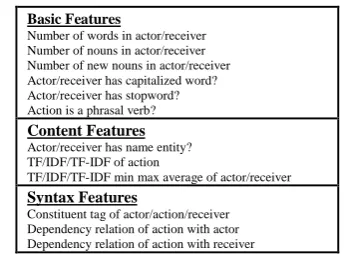
Semantic Link Network Reduction. A dis-criminative ranker based on Support Vector Re-gression (SVR) (Smola and Scholkopf, 2004) is utilized to assign each BSU a summary-worthy score. Training data was constructed from the DUC 2005 datasets which contain both the source documents and human generated refer-ence summaries. BSUs are extracted from these datasets. For each BSU in the source documents, if it has occurred in the corresponding human generated summaries or the semantic relatedness between the BSU and one BSU in the corre-sponding human generated summaries is above a threshold δ , then it is considered to be a positive sample and be assigned 1 to its summary-worthy score. Otherwise, the BSU is considered to be a negative sample and be assigned 0 to its sum-mary-worthy score. Table 1 displays the features of BSU used in the SVR model. Then the salien-cy score of each BSU in the semantic link net-work is calculated by the following equation:
( i) i* ij
j
Sal BSU =SW
∑
R (1)Where SWi is the summary-worthy score of
i
BSU ; Rij is the semantic relatedness between
i
BSU and BSUj.
BSUs in the semantic link network are clus-tered by hierarchical complete-link clustering methods. BSUs in each cluster are semantically similar. For example, Malaysia Airlines plane -
vanish and Flight MH370 – disappear. Only the
most important one with the largest saliency score is reserved in the network. These less im-portant BSUs are eliminated. The remaining BSU
semantic link network represents the important information of the texts with no redundancy.
3.2 Summary Generation
The summary for the documents is generated directly based on the BSU semantic link network. The summary should be well-structured and well-organized. It should not just be a heap of related information, but should build from
sen-tence to sensen-tence to a coherent body of infor-mation about a topic.
The summary structure is planned based on the BSU semantic link network. An optimal path which covers all the nodes in the network is found. The following two factors are considered when finding the optimal path: (1) Context Se-mantic Coherent. To make the summary seman-tic coherent, all adjacent sentences should be se-mantically related. We need to find an optimal path, in which every two adjacent nodes are strong semantically related. The optimal path is denoted as
1 2
[ , ,..., ]
n
r r r
P = p p p and maximize
1
1 1 1
i i
n r r i
n R
+
− =
∑
. (2) Clear-cut Theme. To make the theme of generated summary clear-cut, the important content should be put in prior position. The order of the ith node in the path is denoted as ui and its weight is denoted as(
)
1 /
i i
w = Sal BSU and maximize
1 n
i i i=u w
∑
.To combine the above two factors, we need to find an optimal path which covers each node on-ly once and has the longest distance. The biased-sum weight of all nodes in the path should be maximized. The problem can be proved to be NP-hard by reduction to TSP problem. It can be formalized as an integer linear programming (ILP) as follow. xij is defined to indicate wheth-er the optimal path goes from node i to node j.
1
0 ij
if the path goes from node i to node j x
otherwise
=
(2)
Since each node can be traversed only once, the following constraints must be satisfied.
1,
1,
1 1,...
1 1,...
n ij i j i n
ij j j i
x j n
x i n
= ≠
= ≠
= =
= =
∑
∑
(3)The nodes in the path are sequentially ordered. If the edge between two nodes is in the path, then
Basic Features
Number of words in actor/receiver Number of nouns in actor/receiver Number of new nouns in actor/receiver Actor/receiver has capitalized word? Actor/receiver has stopword? Action is a phrasal verb?
Content Features
Actor/receiver has name entity? TF/IDF/TF-IDF of action
TF/IDF/TF-IDF min max average of actor/receiver
Syntax Features
Constituent tag of actor/action/receiver Dependency relation of action with actor Dependency relation of action with receiver
[image:3.595.328.502.69.196.2]the order of the two nodes is sequentially close to each other, which can be formulated as follow:
1
1,... 1,...
i j ij
i
i
u u nx n i j n
u n i n
u i n
− + ≤ − 1 ≤ ≠ ≤ 1 ≤ ≤ =
∈ =
(4)
At last, we can formulate the objective func-tion as follow:
1 1, 1
max 1 n n ij ij n i i
i j j i i
n = = ≠ R x λ = w u
∑ ∑
+∑
(5)where parameter λ tunes the effect of the two parts and n is the quantity of BSUs in the final
BSU semantic link network (after reduction).
Sentence Generation. After the summary structure has been planned, sentences are gener-ated for each node in the BSU semantic link net-work. As the BSU contains enough semantic and syntactic information, sentence can be generated efficiently according to the following rules:
Generate a Noun Phrase (NP) based on the actor argument to represent the subject, a NP based on the receiver argument to represent the object if present.
Generate a Verb Phrase (VP) based on the action verb to link the components above. The tense of the verb is set to the same as in the original sentence, and most modifiers like auxiliaries and negation are conserved.
Generate complements for the VP when the
BSU has no receiver. The verb modifiers fol-lowing the action verb such as prepositional phrases and infinitive phrases can be used as the complement, in case that the verb would have no interesting meaning without a com-plement.
The process of sentence generation for each node is based on the syntactic structure of the source sentence where the BSU is extracted from. The time and location preposition phrases which
are important information of new events are kept. The generated sentences are organized according to the summary structure. If some adjacent sen-tences in the summary have the same subject, the subject of the latter can be substituted by a pro-noun (such as it or they) to avoid repetition of noun phrases. One sample summary generated by our system for “Malaysia MH370 Disappear” news is shown in Figure 1.
4
Evaluation Results
4.1 Dataset and Experimental Settings
In order to evaluate the performance of our sys-tem, we use two datasets that have been used in recent multi-document summarization shared tasks: DUC2005 and DUC2007. Each task has a gold standard dataset consisting of document clusters and reference summaries. In our experi-ments, DUC2005 was used for training and pa-rameter tuning, and DUC2007 was used for test-ing. Based on the tuning set, the parameter λ is set as 10 and δ is set as 0.7 after tuning.
Our system is compared with one state-of-the-art graph-based extractive approach MultiMR
(Wan and Xiao, 2009) and one abstractive ap-proach TTG (Genest and Lapalme, 2011). In ad-dition, we have implemented another baseline
RankBSU which uses the graph-based ranking
methods on the BSUs network to rank BSUs and select the top ranked BSUs to generate sentences.
4.2 Results
ROUGE-1.5.5 toolkit was used to evaluate the quality of summary on DUC 2007 dataset (Lin and Hovy, 2003). The ROUGE scores of the NIST Baseline system (i.e. NIST Baseline) and average ROUGE scores of all the participating systems (i.e. AveDUC) for DUC 2007 main task were also listed. According to the results in Ta-ble 2, our system much outperforms the NIST
Baseline and AveDUC, and achieves higher
ROUGE scores than the abstractive approach
TTG. So the abstract representation of texts and the information extraction process in our system are effective for multi-document summarization. Our system also achieves better performance than the baseline RankBSU, which demonstrates that the network reduction method is more effi-cient than the popular graph-based ranking methods. As compared with the state-of-art graph-based extractive method MultiMR, our system also achieves better performance. Fur-thermore, our system is abstractive with abstract representation and sentence generation. Incorrect
System ROUGE-1 ROUGE-2 ROUGE-SU4
OurSystem 0.42145 0.11016 0.15632 MultiMR 0.41967 0.10302 0.15385
RankBSU 0.39123 0.08742 0.14381
TTG 0.39268 0.09645 0.14553
AveDUC 0.39684 0.09495 0.14671
NIST Baseline 0.33126 0.06425 0.11114
Table 2. Comparison results (F-measure) on DUC 2007 under ROUGE evaluation.
System OurSystem MultiMR RankBSU TTG
Pyr (Th:0.6) 0.858 0.845 0.832 0.834
Pyr (Th:0.65) 0.743 0.731 0.718 0.721
parser and co-reference resolution will lead to wrong extraction of BSU. If with more accurate parser and co-reference resolution, our system will be expected to achieve better performance.
Since ROUGE metric evaluates summaries only from word overlapping perspective, we also use the pyramid evaluation metric (Nenkova and Passonneau, 2004) which can measure the sum-mary quality beyond simply string matching. The pyramid evaluation metric involves semantic matching of summary content units (SCUs) so as to recognize alternate realizations of the same meaning, which is a better metric for the abstrac-tive summary evaluation. Since the manual pyr-amid evaluation is time-consuming and the eval-uation results can’t be reproducible with different groups of assessors, we use the automated ver-sion of pyramid proposed in (Passonneau et al., 2013) and adopt the same setting as in (Bing et al., 2015). Table 3 shows the evaluation results of our system and the three baseline systems on DUC 2007. The results show that the perfor-mance of our system is significantly better than the three baseline systems, which demonstrates that the summaries of our system contain more SCUs than summaries of other systems. So our system can generate more informative summary.
In addition, large volumes of news texts for popular news events are crawled from the news websites. Figure 1 and 2 show the summaries for the “Malaysia MH370 Disappear” news event generated by our system and MultiMR respec-tively. The summary by MultiMR contains some repetition of facts obviously. And it is just a heap of information about MH370. The summary by our system doesn’t contain much repetition of facts, so it can contain more useful information. And it is built from sentence to sentence to a co-herent body. Obviously, the summary by our sys-tem is more coherent and compact.
5
Conclusions and Future Works
The proposed summarization approach is effec-tive in information extraction and achieves good performance on DUC datasets. Through the sample summary, we can find that the approach is very effective for summarizing texts that main-ly describe facts and actions of news event. Summaries generated by our system are informa-tive, coherent and compact.
But for texts expressing opinions, the ap-proach can’t settle it appropriately. For example, when the verbs of BSUs are not meaningful ac-tions, like “be”, the semantic relations between
them can’t be appropriately computed by the methods described in the paper. More efficient methods to computer semantic relations between
BSUs should be developed in the following work. The sentence generation process described in the paper is just a preliminary scheme. It should be developed to generate sentence relying less on the original sentence structure and aggregating information from several different BSUs.
Reference
Barzilay, R., and McKeown, K. R. 2005. Sentence fusion for multidocument news summarization. Computational Linguistics, 31(3): 297-328.
Banko, M., Cafarella, M. J., Soderland, S., et al. 2007. Open information extraction for the web. In IJCAI 2007, 7: 2670-2676.
Bing, L., Li, P., Liao, Y., Lam, W., et al., 2015. Ab-stractive Multi-Document Summarization via Phrase Selection and Merging. In ACL 2015, 1587-1597
Figure 1. The summary of “Malaysia MH370 Dis-appear” news event generated by our system.
Figure 2. The summary of “Malaysia MH370 Dis-appear” news event generated by MultiMR.
Malaysia Airlines said in a statement that flight MH370 had disappeared at 02:40 local time on Saturday after leaving Kuala Lumpur. Southeast Asian states have joined forces to search waters between Malaysia and Vietnam after a Malaysia Airlines plane vanished on a flight to Beijing, with 239 people on board. Flight MH370 had been expected to land in Beijing at 06:30. If Malaysia Airlines flight MH370 had impacted the ocean hard, resulting underwater sounds could have been detected by hydrophones, given favorable circumstances. Scientists from the CTBTO analyzed their recordings soon after flight MH370 disappeared, finding nothing of interest. The CMST researchers believe that the most likely explanation of the hydroacoustic data is that they come from the same event, but unrelated to Malaysia Airlines flight MH370. The lead research-er of the CMST team, Dr.Alec Duncan, believes thresearch-ere's a slim chance that the acoustic event is related to Malaysia Airlines flight MH370. Several IMOS recorders deployed in the Indian Ocean off northwestern Australia by CMST may have recorded data related to Malaysia Airlines flight MH370. Malaysia Airlines released the names and nationalities of the 227 passengers and 12 crew members, based on the flight manifest, later modified to include two Iranian passengers travelling on stolen passports. If the data relates to the same event, related to flight MH370, but the arc derived from analysis of the aircraft's satel-lite transmission is incorrect, then the most likely place to look for the aircraft would be along a line from HA01.
Carenini, G., and Cheung, J. C. K. 2008. Extractive vs. NLG-based abstractive summarization of evalua-tive text: The effect of corpus controversiality. Proceedings of the Fifth International Natural Lan-guage Generation Conference. Association for Computational Linguistics, 33-41.
Cohn, T., and Lapata, M. 2009. Sentence compres-sion as tree transduction. Journal of Artificial Intel-ligence Research, 637-674.
Etzioni, O., Fader, A., Christensen, J., et al. 2011. Open Information Extraction: The Second Genera-tion. In IJCAI 2011, 11: 3-10.
Finkel, J. R., Grenager, T., and Manning, C. 2005. Incorporating Non-local Information into Infor-mation Extraction Systems by Gibbs Sampling. In ACL 2005, 363-370.
Filippova, K., and Strube, M. Sentence fusion via dependency graph compression. In EMNLP 2008, 177-185.
Gabrilovich, E., and Markovitch, S. 2007. Computing Semantic Relatedness Using Wikipedia-based Ex-plicit Semantic Analysis. In IJCAI 2007, 7: 1606-1611.
Genest, P. E., and Lapalme, G. 2011. Framework for abstractive summarization using text-to-text gener-ation. In Proceedings of the Workshop on Mono-lingual Text-To-Text Generation, 64-73.
Joachims, T. 1999. Svmlight: Support vector machine. SVM-Light Support Vector Machine http://svmlight. joachims. org/,University of Dort-mund, 19(4).
Knight, K., and Marcu, D. 2000. Statistics-based summarization-step one: Sentence compression. In AAAI/IAAI 2000, 703-710.
Knight, K., and Marcu, D. 2002. Summarization be-yond sentence extraction: A probabilistic approach to sentence compression. In Artificial Intelligence. 139(1): 91-107
Klein, D., and Manning, C. D. 2003. Accurate unlexi-calized parsing. In ACL 2003, 423-430.
Liu, F., Flanigan, J., et al. 2015. Toward Abstractive Summarization Using Semantic Representations. In HLT-NAACL 2015.
Lin, C. Y., and Hovy, E. 2003. Automatic evaluation of summaries using n-gram co-occurrence statistics. In HLT-NAACL 2003, 71-78.
Lee, H., Peirsman, Y., Chang, A., et al. 2011. Stan-ford's multi-pass sieve coreference resolution sys-tem at the CoNLL-2011 shared task. In ACL 2011, 28-34.
Mihalcea, R., Corley, C., and Strapparava, C. 2006. Corpus-based and knowledge-based measures of text semantic similarity. In AAAI 2006, 6: 775-780.
Nenkova, A., and Passonneau, R. 2004. Evaluating content selection in summarization: The pyramid method. In HLT-NAACL, pages 145-152.
Passonneau, R. J., Chen, E., Guo, W., and Perin, D. 2013. Automated Pyramid Scoring of Summaries using Distributional Semantics. In ACL(2), pages: 143-147.
Smola, A. J., and Schölkopf, B. 2004. A tutorial on support vector regression. Statistics and computing, 14(3): 199-222.
Tanaka, H., Kinoshita, A., Kobayakawa, T., Kumano, T., and Kato, N. 2009. Syntax-driven sentence re-vision for broadcast news summarization. In Proceedings of the 2009 Workshop on Language Generation and Summarisation, 39-47.
Wan, X., Yang, J., and Xiao, J. 2007. Manifold-Ranking Based Topic-Focused Multi-Document Summarization. In IJCAI 2007, 7:2903-2908.
Wang, D., Li, T., Zhu, S., and Chris, D. 2008. Multi-document summarization via sentence-level se-mantic analysis and symmetric matrix factoriza-tion. In SIGIR 2008, 307-314.
Wan, X., and Xiao, J. 2009. Graph-Based Modality Learning for Topic-Focused Multi-Document Summarization. In IJCAI 2009, 1586-1591.
Wang, L., and Cardie, C. 2013. Domain-Independent Abstract Generation for Focused Meeting Summa-rization. In ACL 2013, 1395-1405.
Zhuge, H. 2009. Communities and Emerging Seman-tics in Semantic Link Network: Discovery and Learning, IEEE Transactions on Knowledge and Data Engineering, vol.21, no.6, 2009, pp. 785-799.
Zhuge, H. 2010. Interactive Semantics, Artificial In-telligence, 174(2010)190-204.
Zhuge, H. 2011. Semantic linking through spaces for cyber-physical-socio intelligence: A methodology, Artificial Intelligence, 175(2011)988-1019.
Zhuge, H. 2012. Chapter 2 in The Knowledge Grid: Toward Cyber-Physical Society. World Scientific.
Zhuge, H. 2015a. Dimensionality on Summarization, arXiv:1507.00209 [cs.CL], 2 July 2015.