Recognizing Textual Entailment Using Probabilistic Inference
Lei Sha, Sujian Li, Tingsong Jiang, Baobao Chang, Zhifang Sui
Key Laboratory of Computational Linguistics, Ministry of Education School of Electronics Engineering and Computer Science, Peking University Collaborative Innovation Center for Language Ability, Xuzhou 221009 China
{shalei, lisujian, tingsong, chbb, szf}@pku.edu.cn
Abstract
Recognizing Text Entailment (RTE) plays an important role in NLP applications in-cluding question answering, information retrieval, etc. In recent work, some re-search explore “deep” expressions such as discourse commitments or strict logic for representing the text. However, these ex-pressions suffer from the limitation of in-ference inconvenience or translation loss. To overcome the limitations, in this paper, we propose to use the predicate-argument structures to represent the discourse com-mitments extracted from text. At the same time, with the help of the YAGO knowl-edge, we borrow the distant supervision technique to mine the implicit facts from the text. We also construct a probabilistic network for all the facts and conduct infer-ence to judge the confidinfer-ence of each fact for RTE. The experimental results show that our proposed method achieves a com-petitive result compared to the previous work.
1 Introduction
For the natural language, a common phenomenon is that there exist a lot of ways to express the same or similar meaning. To discover such dif-ferent expressions, the Recognising Textual En-tailment (RTE) task is proposed to judge whether
the meaning of one text (denoted asH) can be
in-ferred (entailed) from the other one (T)(Dagan et al., 2006). For many natural language processing applications like question answering, information retrieval which involve the diversity of natural lan-guage, recognising textual entailments is a critical step.
PASCAL Recognizing Textual Entailment (RTE) Challenges (Dagan et al., 2006) have
witnessed a variety of excellent systems which intend to recognize the textual entailment in-stances. These systems mainly employ “shallow” techniques, including heuristics, term overlap, syntactic dependencies(Vanderwende et al., 2006; Jijkoun and de Rijke, 2005; Malakasiotis and Androutsopoulos, 2007; Haghighi et al., 2005). As Hickl (2008) stated, the shallow approaches do not work well for long sentences for the missing of underlying information which needs to be mined from the surface level expression.
Recently, some deep techniques are developed to mine the facts latent in the text. Hickl (2008) proposed the concept of discourse commitments which can be seen as the set of propositions in-ferred from the text, and used a series of syntax-level and semantic-syntax-level rules to extract the
com-mitments from theT-Hpairs. Then the RTE task
is reduced to the identification of the commitments
fromT which are most likely to support the
infer-ence of the commitments fromH. From the work
of Hickl (2008), we can see that a deep under-standing of text is critical to the RTE performance and discourse commitments can serve a good me-dia to understanding text. However, the limitation of Hickl (2008)’s work is, the extracted discourse commitments are still from the original text and do not explore the implicit meaning latent behind the text.
Another kind of deep methods involves first transferring natural language to logic represen-tation and then conducting strict logic inference based on the logic representations (de Salvo Braz et al., 2006; Tatu and Moldovan, 2006; Wotzlaw and Coote, 2013). Through logic inference, some implicit knowledge behind the text can be mined. However, it is not easy to translate the natural lan-guage text into formal logic expressions and the translation process inevitably suffer from great in-formation loss.
Through analysis above, in our work, we
T: Ayrton Senna was married to a doctor who lives in Austin, the capital of Texas, in 1998. H: Ayrton Senna lives in Texas.
T: R1(e11,e12)
R2(e21,e22)
R3(e31,e32)
H: RH(eH1,eH2)
Discourse commitment extract
R R R
R
...
Align the predicates to the YAGO database
R R R
R
...
YAGO
YAGO
R1(e11,e12)^R2(e21,e22)=>R3(e31,e32)
R4(e41,e42)^R5(e51,e52)=>R6(e61,e62)
R7(e71,e72)^R8(e81,e82)=>R9(e91,e92)
Rp(ep1,ep2)^Rq(eq1
...
,eq2)=>Rr(er1,er2)Inference rules
AIME Construct Markov Logic Network
train
T
H
facts MLN
P(RH)
[image:2.595.76.524.69.251.2]H is True or false?
Figure 1: The Framework of our RTE system
pose to use the predicate-argument structure to represent the extracted discourse commitments. Inspired by the work of (Mintz et al., 2009), we make use of the external knowledge YAGO and borrow the distant supervision technique to mine implicit facts for the extracted predicates. For ex-ample,
Ayrton Senna was married to a doctor who lives in Austin, the capital of Texas, in 1998.
We translate this example into the predicate-argument structures such as bemarried(Senna, doctor), livein(doctor, Austin), captial(Austin, Texas). Then through distant supervision, we can get some new facts livein(Senna, Austin), livein(Senna, Texas).
To judge the confidence of the new facts, we construct a probabilistic network with all the facts and adopt the Markov Logic Network (MLN) to calculate the probability of each new fact, which can be further used to recognize text entailments.
2 Our RTE System
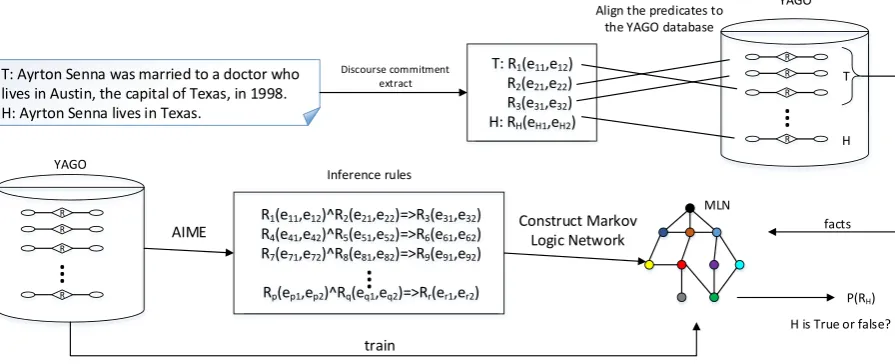
To make full use of the underlying information in sentences and lessen the effect brought by natu-ral language’s vagueness, we design a RTE sys-tem which is composed of three stages, as shown in Figure 1.
First, we decompose the sentences inT-Hpair
to a series of discourse commitments as Hickl (2008) did. Since the syntax of these commit-ments are very simple, we can directly transform them to predicates (or 3-arg tuples). Then we use
YAGO, a large semantic database including sev-eral thousands relations, to provide distant
super-vision. The predicates inT are matched to YAGO
facts due to some metrics. At last, we use the Markov Logic Network(MLN) (Richardson and Domingos, 2006) to infer the correctness of the
predicates in H. The MLN is constructed
us-ing the inference rules (“soft” rules) generated by AMIE system (Gal´arraga et al., 2013) on YAGO. Each rule has a weight which should be trained by real world facts. Using this framework, we can ap-ply the “soft” logic to the textual entailment recog-nition task.
2.1 Extracting Predicates from Sentences
Discourse commitment is our baseline system pro-posed by Hickl (2008) which can decompose one sentence to a series of shorter and simpler tences which completely contain the origin sen-tence’s information. One of the advantages of discourse commitments is that it can use a lot of syntax-level and semantic level rules to extract the underlying information of one sentence. For
ex-ample, the followingT-Hpair can be decomposed
as Figure 2. The discourse commitments ofT
con-tains the information: Ayrton Senna married in 1998, which is not easy to be captured by “shal-low” methods.
T : Ayrton Senna was married to a doctor who
lives in Austin, the capital of Texas, in 1998.
H: Ayrton Senna lives in Texas.
commit-Text: Ayrton Senna was married to a doctor who lives in Austin, the capital of Texas.
T1. Ayrton Senna was married to a doctor T2. [The] doctor lives in Austin T3. Austin [is] the capital of Texas
[image:3.595.326.497.62.155.2]Hypothesis: Ayrton Senna lives in Texas.
Figure 2: Text Commitments Example
Text: Ayrton Senna was married to a doctor who lives in Austin, the capital of Texas.
T1. bemarriedTo(Ayrton Senna,Doctor) T2. livein(Doctor, Austin)
T3. beCapitalof(Austin, Texas)
Hypothesis: Ayrton Senna lives in Texas. H1. livein(Ayrton Senna, Texas)
Figure 3: Text Predicates Example
ments to predicates. For example, the commit-ments in Figure 2 can be transformed to the pred-icates (or triples) shown in Figure 3. We use RE
-VERB (Fader et al., 2011) to extract the triples
(predicate + 2 Arguments). To make the infer-ence process in the next section more convenient, we order that all of the arguments should be NPs. Therefore, we check if the arguments in the triples contain or have overlap with any of the NPs, re-place it with that NP, and the predicates are suc-cessfully extracted.
2.2 Distant supervision with YAGO
The goal of distant supervision is to use the knowl-edge of YAGO (Mahdisoltani et al., 2014) to help the textual entailment recognition task. The facts in YAGO have various type of connections with each other. We think this connection is very useful for RTE. Therefore, the predicates in theT-Hpair should be matched to the YAGO facts for making advantage of the connection information.
Since YAGO is very large, the common predi-cates can easily matched to YAGO facts in most cases. However, YAGO cannot contain every
predicate in T. We run DIRT (Lin and
Pan-tel, 2001) system on 1GB text random sampled from Gigaword corpus and for each predicate we choose the top-10 similar predicates as its synony-mous predicate. If the origin predicate cannot be found in YAGO, we instead check for the top-10 similar predicates. If we still cannot find a match, that means this predicate has very little connection with other predicates and cannot be supervised by YAGO.
2.3 Probabilistic Inference
The goal of MLN (Richardson and Domingos, 2006) is to implement the probabilistic inference, or “soft” logic inference. MLN is constructed by an inference rule base. Each rule has a weight which needs to be well trained by real word
facts. We use AMIE to mine inference rules from YAGO.
AMIE1 (Gal´arraga et al., 2013) is a
state-of-the-art inference rule mining system. The motiva-tion of AMIE is that KBs themselves often already contain enough information to derive and add new facts. If, for example, a KB contains the fact that a child has a mother, then the mother’s husband is most likely the father.
motherOf(m, c)∧marriedT o(m, f)⇒fatherOf(f, c)
AMIE can mine such inference rules from large KBs. The inference rules can be directly used for constructing Markov logic network in the next sec-tion. In addition, the process of mining inference rules is quite efficient so that it is very helpful for our RTE task.
We use AMIE only to extract the inference rules. After the inference rules are prepared, we can construct a MLN. We give the related facts in YAGO to the MLN, then the weights of each infer-ence rule can tune to a best fit for these facts. After the weights of each inference rule are well trained, the MLN is well prepared to use. Given the pred-icates in T, we first select all the related rules to construct a simple MLN, and then give the MLN some facts. After that, the MLN will calculate the probabilities of the unknown new facts. The ar-guments of the new facts are the permutations of all the ground atoms (or entities). For example, if we give the facts “hasChild (Cliton, Chelsea)” and “IsMarriedto (Cliton, Hillary)”, the MLN will out-put the probability of “hasChild (Cliton, Hillary)”, “hasChild (Hillary, Chelsea)”, “IsMarriedto (Cli-ton, Chelsea)”, etc. Obviously, the probability of “hasChild (Hillary, Chelsea)” may be the highest, so that it is most likely to be true. The MLN constructing and inferring can be implemented by
1
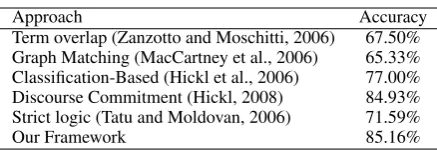
Approach Accuracy Term overlap (Zanzotto and Moschitti, 2006) 67.50% Graph Matching (MacCartney et al., 2006) 65.33% Classification-Based (Hickl et al., 2006) 77.00% Discourse Commitment (Hickl, 2008) 84.93% Strict logic (Tatu and Moldovan, 2006) 71.59%
[image:4.595.72.291.59.134.2]Our Framework 85.16%
Table 1: Performance of Inference based RTE
Alchemy2, which provides a series of algorithms
for statistical relational learning and probabilistic logic inference, based on the Markov logic repre-sentation.
After the new facts are inferred, we check if
these facts can cover the predicates in H. If so,
we decideT entailsH.
3 Experiment
We evaluate the performance of our framework
for RTE on the PASCAL RTE-23 and RTE-34
datasets, which has 1600 examples. We use the YAGO2 for aligning predicates and mining infer-ence rules. YAGO2 contains more than 940K facts and about 470K entities. We run the AMIE sys-tem on YAGO2 for only one time to get all infer-ence rules (about more than 1.8K in total). For
each T-H pair, we only choose a portion of
re-lated inference rules to construct MLN. The cho-sen rules must contain at least one predicate which
occurred in the predicates of T-H pair. We only
use the MLN to infer when the discourse
commit-ment paraphrasing cannot identify a T-H pair as
”Entailment”, which is a back-off method. We compare our result with 5 baseline systems: (1) Zanzotto and Moschitti (2006)’s simple term-overlap measure, (2) MacCartney et al. (2006)’s semantic graph-mapping approach, (3) Hickl et al. (2006)’s classification-based term alignment ap-proach. (4) Hickl (2008)’s discourse commitment based Alignment, (5) Tatu and Moldovan (2006)’s strict logic based method. The comparison of the 5 baselines and our framework is shown in Table 1. Since we only need to judge “Yes” or “No” for the 1600 examples, the precision is equal to the recall, so that we only report the precision.
According to the Table 1, the performance of our framework is higher than Hickl (2008)’s base-line, which is significant (Wilcoxon signed-rank
test, p < 0.05). The reason is that we have
2http://alchemy.cs.washington.edu/
3http://pascallin.ecs.soton.ac.uk/Challenges/RTE2/ 4http://pascallin.ecs.soton.ac.uk/Challenges/RTE3/
added the inference portion to Hickl (2008)’s
method. Therefore, someT-H pairs which had to
be judged by semantic reasoning can be corrected
by our framework. For instance, T is “Hughes
loved his wife, Gracia, and was absolutely
ob-sessed with his little daughter Elicia.” and H is
“Gracia’s daughter is Elicia.” It is not easy for the former baselines to recognize this entailment, but our framework can easily recognize it to be “true”. In this way, our framework has achieved a higher result.
4 Related work
Textual Entailment Recognizing (RTE) task has been widely studied by many previous works. Firstly, the method based on similarity and over-lap (Malakasiotis and Androutsopoulos, 2007; Ji-jkoun and de Rijke, 2005; Wan et al., 2006). This kind of methods can help solve the paraphrase recognition problem, which is a subset of RTE. Another important similarity-based method is tree kernel (Zanzotto and Moschitti, 2006), which rely on the cross-pair similarity between two pairs (T0, H0)and(T00, H00).
Secondly, some approaches extract the
knowl-edge inT-Hpair and check if the knowledge inT
contains the knowledge inH. Hickl (2008)
trans-formed theT-Hpair into discourse commitments,
reducing the RTE task to the identification of the
commitments from a T which support the
infer-ence of theH. Other works map the text to logical meaning representations, and then strict logic en-tailment methods, possibly by invoking theorem provers.
Thirdly, some works make use of statistical classifiers which leverages a wide variety of
fea-tures. The language expression of eachT-H pair
are represented by a feature vectorhf1, f2· · ·fmi.
The feature vector contains the scores of different similarity measures applied to the pair, and possi-bly other features.
There are also other works based on predicate-argument representations with Markov Logic for RTE, such as Rios et al. (2014) and Beltagy et al. (2013). However, they did not use discourse com-mitments to extract predicate-argument triples, which may lead to severe information loss.
5 Conclusion
framework makes full use of Markov logic net-work for probabilistic inference. We hold that probabilistic inference is better than strict logic method since transforming from language form to strict logic form could lose a lot of informa-tion. Therefore it is extremely hard for the theo-rem provers to perform well.
In addition, we use YAGO database for distant
supervision. The predicates extracted fromT-H
pair are first aligned with YAGO. If it succeeds, the inference procedure of MLN will become much more accurate. In addition, the inference rules for constructing MLN are also extracted from YAGO database using AIME system.
This framework can correctly recognize the
en-tailment T-H pairs which must be judged using
inference. This is our improvement over the pre-vious work.
Acknowledgement
This research is supported by National Key Basic Research Program of China (No.2014CB340504) and National Natural Science Foundation of China (No.61375074,61273318). The contact authors of this paper are Sujian Li and Baobao Chang.
References
Islam Beltagy, Cuong Chau, Gemma Boleda, Dan Gar-rette, Katrin Erk, and Raymond Mooney. 2013. Deep semantics with probabilistic logical form. In
Proceedings of the Second Joint Conference on
Lex-ical and Computational Semantics (* SEM-13).
Ido Dagan, Oren Glickman, and Bernardo Magnini. 2006. The pascal recognising textual entailment challenge. In Machine learning challenges. evalu-ating predictive uncertainty, visual object classifica-tion, and recognising tectual entailment, pages 177– 190. Springer.
Rodrigo de Salvo Braz, Roxana Girju, Vasin Pun-yakanok, Dan Roth, and Mark Sammons. 2006. An inference model for semantic entailment in natural language. InMachine Learning Challenges. Evalu-ating Predictive Uncertainty, Visual Object Classi-fication, and Recognising Tectual Entailment, pages 261–286. Springer.
Anthony Fader, Stephen Soderland, and Oren Etzioni. 2011. Identifying relations for open information ex-traction. In Proceedings of the Conference on
Em-pirical Methods in Natural Language Processing,
pages 1535–1545. Association for Computational Linguistics.
Luis Antonio Gal´arraga, Christina Teflioudi, Katja Hose, and Fabian Suchanek. 2013. Amie: associ-ation rule mining under incomplete evidence in on-tological knowledge bases. In Proceedings of the
22nd international conference on World Wide Web,
pages 413–422. International World Wide Web Con-ferences Steering Committee.
Aria D Haghighi, Andrew Y Ng, and Christopher D Manning. 2005. Robust textual inference via graph matching. InProceedings of the conference on Hu-man Language Technology and Empirical Methods
in Natural Language Processing, pages 387–394.
Association for Computational Linguistics.
Andrew Hickl, John Williams, Jeremy Bensley, Kirk Roberts, Bryan Rink, and Ying Shi. 2006. Recog-nizing textual entailment with lccs groundhog sys-tem. InProceedings of the Second PASCAL Chal-lenges Workshop.
Andrew Hickl. 2008. Using discourse commitments to recognize textual entailment. InProceedings of the 22nd International Conference on Computational
Linguistics-Volume 1, pages 337–344. Association
for Computational Linguistics.
Valentin Jijkoun and Maarten de Rijke. 2005. Recog-nizing textual entailment using lexical similarity. In
Proceedings of the PASCAL Challenges Workshop on Recognising Textual Entailment, pages 73–76.
Dekang Lin and Patrick Pantel. 2001. Dirt@ sbt@ discovery of inference rules from text. In Proceed-ings of the seventh ACM SIGKDD international
con-ference on Knowledge discovery and data mining,
pages 323–328. ACM.
Bill MacCartney, Trond Grenager, Marie-Catherine de Marneffe, Daniel Cer, and Christopher D Man-ning. 2006. Learning to recognize features of valid textual entailments. In Proceedings of the main conference on Human Language Technology Con-ference of the North American Chapter of the Asso-ciation of Computational Linguistics, pages 41–48. Association for Computational Linguistics.
Farzaneh Mahdisoltani, Joanna Biega, and Fabian Suchanek. 2014. Yago3: A knowledge base from multilingual wikipedias. In7th Biennial Conference
on Innovative Data Systems Research. CIDR 2015.
Prodromos Malakasiotis and Ion Androutsopoulos. 2007. Learning textual entailment using svms and string similarity measures. In Proceedings of the ACL-PASCAL Workshop on Textual Entailment and
Paraphrasing, pages 42–47. Association for
Com-putational Linguistics.
Natural Language Processing of the AFNLP:
Vol-ume 2-VolVol-ume 2, pages 1003–1011. Association for
Computational Linguistics.
Matthew Richardson and Pedro Domingos. 2006. Markov logic networks. Machine learning, 62(1-2):107–136.
Miguel Rios, Lucia Specia, Alexander Gelbukh, and Ruslan Mitkov. 2014. Statistical relational learning to recognise textual entailment. In Computational Linguistics and Intelligent Text Processing, pages 330–339. Springer.
Marta Tatu and Dan Moldovan. 2006. A logic-based semantic approach to recognizing textual en-tailment. In Proceedings of the COLING/ACL on
Main conference poster sessions, pages 819–826.
Association for Computational Linguistics.
Lucy Vanderwende, Arul Menezes, and Rion Snow. 2006. Microsoft research at rte-2: Syntactic con-tributions in the entailment task: an implementation.
In Proceedings of the Second PASCAL Challenges
Workshop.
Stephen Wan, Mark Dras, Robert Dale, and C´ecile Paris. 2006. Using dependency-based features to take the para-farce out of paraphrase. In Pro-ceedings of the Australasian Language Technology
Workshop, volume 2006.
Andreas Wotzlaw and Ravi Coote. 2013. A logic-based approach for recognizing textual entailment supported by ontological background knowledge.
arXiv preprint arXiv:1310.4938.
Fabio Massimo Zanzotto and Alessandro Moschitti. 2006. Automatic learning of textual entailments with cross-pair similarities. InInternational confer-ence on computational linguistics and the 44th An-nual meeting of the Association for computational
linguistics, volume 1, pages 401–408. Association