Personalizing PageRank for Word Sense Disambiguation
Eneko Agirre and Aitor Soroa IXA NLP Group
University of the Basque Country Donostia, Basque Contry
{e.agirre,a.soroa}@ehu.es
Abstract
In this paper we propose a new graph-based method that uses the knowledge in a LKB (based on WordNet) in order to perform unsupervised Word Sense Disam-biguation. Our algorithm uses the full graph of the LKB efficiently, performing better than previous approaches in English all-words datasets. We also show that the algorithm can be easily ported to other lan-guages with good results, with the only re-quirement of having a wordnet. In addi-tion, we make an analysis of the perfor-mance of the algorithm, showing that it is efficient and that it could be tuned to be faster.
1 Introduction
Word Sense Disambiguation (WSD) is a key enabling-technology that automatically chooses the intended sense of a word in context. Super-vised WSD systems are the best performing in public evaluations (Palmer et al., 2001; Snyder and Palmer, 2004; Pradhan et al., 2007) but they need large amounts of hand-tagged data, which is typically very expensive to build. Given the rela-tively small amount of training data available, cur-rent state-of-the-art systems only beat the simple most frequent sense (MFS) baseline1 by a small margin. As an alternative to supervised systems, knowledge-based WSD systems exploit the infor-mation present in a lexical knowledge base (LKB) to perform WSD, without using any further corpus evidence.
1This baseline consists of tagging all occurrences in the
test data with the sense of the word that occurs more often in the training data
Traditional knowledge-based WSD systems as-sign a sense to an ambiguous word by comparing each of its senses with those of the surrounding context. Typically, some semantic similarity met-ric is used for calculating the relatedness among senses (Lesk, 1986; McCarthy et al., 2004). One of the major drawbacks of these approaches stems from the fact that senses are compared in a pair-wise fashion and thus the number of computa-tions can grow exponentially with the number of words. Although alternatives like simulated an-nealing (Cowie et al., 1992) and conceptual den-sity (Agirre and Rigau, 1996) were tried, most of past knowledge based WSD was done in a subop-timal word-by-word process, i.e., disambiguating words one at a time.
Recently, graph-based methods for knowledge-based WSD have gained much attention in the NLP community (Sinha and Mihalcea, 2007; Nav-igli and Lapata, 2007; Mihalcea, 2005; Agirre and Soroa, 2008). These methods use well-known graph-based techniques to find and exploit the structural properties of the graph underlying a par-ticular LKB. Because the graph is analyzed as a whole, these techniques have the remarkable prop-erty of being able to find globally optimal solu-tions, given the relations between entities. Graph-based WSD methods are particularly suited for disambiguating word sequences, and they man-age to exploit the interrelations among the senses in the given context. In this sense, they provide a principled solution to the exponential explosion problem, with excellent performance.
them. The disambiguation is typically performed by applying a ranking algorithm over the graph, and then assigning the concepts with highest rank to the corresponding words. Given the compu-tational cost of using large graphs like WordNet, many researchers use smaller subgraphs built on-line for each target context.
In this paper we present a novel graph-based WSD algorithm which uses the full graph of WordNet efficiently, performing significantly bet-ter that previously published approaches in En-glish all-words datasets. We also show that the algorithm can be easily ported to other languages with good results, with the only requirement of having a wordnet. The algorithm is publicly avail-able2 and can be applied easily to sense invento-ries and knowledge bases different from WordNet. Our analysis shows that our algorithm is efficient compared to previously proposed alternatives, and that a good choice of WordNet versions and rela-tions is fundamental for good performance.
The paper is structured as follows. We first de-scribe the PageRank and Personalized PageRank algorithms. Section 3 introduces the graph based methods used for WSD. Section 4 shows the ex-perimental setting and the main results, and Sec-tion 5 compares our methods with related exper-iments on graph-based WSD systems. Section 6 shows the results of the method when applied to a Spanish dataset. Section 7 analyzes the perfor-mance of the algorithm. Finally, we draw some conclusions in Section 8.
2 PageRank and Personalized PageRank
The celebrated PageRank algorithm (Brin and Page, 1998) is a method for ranking the vertices in a graph according to their relative structural importance. The main idea of PageRank is that whenever a link fromvi tovj exists in a graph, a vote from nodeito nodejis produced, and hence the rank of nodejincreases. Besides, the strength of the vote from i toj also depends on the rank of nodei: the more important nodeiis, the more strength its votes will have. Alternatively, PageR-ank can also be viewed as the result of a random walk process, where the final rank of nodei rep-resents the probability of a random walk over the graph ending on nodei, at a sufficiently large time. Let G be a graph with N vertices v1, . . . , vN and di be the outdegree of node i; let M be a
2http://ixa2.si.ehu.es/ukb
N×Ntransition probability matrix, whereMji =
1
di if a link fromitoj exists, and zero otherwise. Then, the calculation of the PageRank vector Pr overGis equivalent to resolving Equation (1).
Pr=cMPr+ (1−c)v (1)
In the equation,vis aN ×1vector whose ele-ments are N1 andcis the so called damping factor, a scalar value between0 and1. The first term of the sum on the equation models the voting scheme described in the beginning of the section. The sec-ond term represents, loosely speaking, the proba-bility of a surfer randomly jumping to any node, e.g. without following any paths on the graph. The damping factor, usually set in the[0.85..0.95] range, models the way in which these two terms are combined at each step.
The second term on Eq. (1) can also be seen as a smoothing factor that makes any graph fulfill the property of being aperiodic and irreducible, and thus guarantees that PageRank calculation con-verges to a unique stationary distribution.
In the traditional PageRank formulation the vec-torvis a stochastic normalized vector whose ele-ment values are all N1, thus assigning equal proba-bilities to all nodes in the graph in case of random jumps. However, as pointed out by (Haveliwala, 2002), the vectorvcan be non-uniform and assign stronger probabilities to certain kinds of nodes, ef-fectively biasing the resulting PageRank vector to prefer these nodes. For example, if we concen-trate all the probability mass on a unique node i, all random jumps on the walk will return toiand thus its rank will be high; moreover, the high rank ofiwill make all the nodes in its vicinity also re-ceive a high rank. Thus, the importance of nodei given by the initial distribution ofvspreads along the graph on successive iterations of the algorithm. In this paper, we will use traditional PageRank to refer to the case when a uniformvvector is used in Eq. (1); and whenever a modifiedvis used, we will call it Personalized PageRank. The next sec-tion shows how we define a modifiedv.
PageRank is actually calculated by applying an iterative algorithm which computes Eq. (1) suc-cessively until convergence below a given thresh-old is achieved, or, more typically, until a fixed number of iterations are executed.
damping factors. Some preliminary experiments with higher iteration counts showed that although sometimes the node ranks varied, the relative order among particular word synsets remained stable af-ter the initial iaf-terations (cf. Section 7 for further details). Note that, in order to discard the effect of dangling nodes (i.e. nodes without outlinks) we slightly modified Eq. (1). For the sake of brevity we omit the details, which the interested reader can check in (Langville and Meyer, 2003).
3 Using PageRank for WSD
In this section we present the application of PageRank to WSD. If we were to apply the tra-ditional PageRank over the whole WordNet we would get a context-independent ranking of word senses, which is not what we want. Given an input piece of text (typically one sentence, or a small set of contiguous sentences), we want to disambiguate all open-class words in the input taken the rest as context. In this framework, we need to rank the senses of the target words according to the other words in the context. Theare two main alternatives to achieve this:
• To create a subgraph of WordNet which con-nects the senses of the words in the input text, and then apply traditional PageRank over the subgraph.
• To use Personalized PageRank, initializingv with the senses of the words in the input text
The first method has been explored in the lit-erature (cf. Section 5), and we also presented a variant in (Agirre and Soroa, 2008) but the second method is novel in WSD. In both cases, the algo-rithms return a list of ranked senses for each target word in the context. We will see each of them in turn, but first we will present some notation and a preliminary step.
3.1 Preliminary step
A LKB is formed by a set of concepts and relations among them, and a dictionary, i.e., a list of words (typically, word lemmas) each of them linked to at least one concept of the LKB. Given any such LKB, we build an undirected graphG = (V, E) where nodes represent LKB concepts (vi), and each relation between concepts vi andvj is rep-resented by an undirected edgeei,j.
In our experiments we have tried our algorithms using three different LKBs:
• MCR16 + Xwn: The Multilingual Central
Repository (Atserias et al., 2004b) is a lexical knowledge base built within the MEANING project3. This LKB comprises the original WordNet 1.6 synsets and relations, plus some relations from other WordNet versions auto-matically mapped4into version 1.6: WordNet 2.0 relations and eXtended WordNet relations (Mihalcea and Moldovan, 2001) (gold, silver and normal relations). The resulting graph has99,632vertices and637,290relations.
• WNet17 + Xwn: WordNet 1.7 synset and
relations and eXtended WordNet relations. The graph has109,359vertices and620,396 edges
• WNet30 + gloss: WordNet 3.0 synset and
relations, including manually disambiguated glosses . The graph has117,522vertices and 525,356relations.
Given an input text, we extract the listWi i = 1. . . m of content words (i.e. nouns, verbs, ad-jectives and adverbs) which have an entry in the dictionary, and thus can be related to LKB con-cepts. Let Conceptsi = {v1, . . . , vim} be the im associated concepts of word Wi in the LKB graph. Note that monosemous words will be re-lated to just one concept, whereas polysemous words may be attached to several. As a result of the disambiguation process, every concept in
Conceptsi, i= 1, . . . , mreceives a score. Then, for each target word to be disambiguated, we just choose its associated concept inGwith maximal score.
In our experiments we build a context of at least 20 content words for each sentence to be disam-biguated, taking the sentences immediately before and after it in the case that the original sentence was too short.
3.2 Traditional PageRank over Subgraph (Spr)
We follow the algorithm presented in (Agirre and Soroa, 2008), which we explain here for complete-ness. The main idea of the subgraph method is to extract the subgraph of GKB whose vertices and relations are particularly relevant for a given input
3
http://nipadio.lsi.upc.es/nlp/meaning
4We use the freely available WordNet mappings from
context. Such a subgraph is called a “disambigua-tion subgraph”GD, and it is built in the following
way. For each word Wi in the input context and each conceptvi ∈ Conceptsi, a standard breath-first search (BFS) over GKB is performed,
start-ing at nodevi. Each run of the BFS calculates the minimum distance paths betweenviand the rest of concepts ofGKB. In particular, we are interested
in the minimum distance paths betweenviand the concepts associated to the rest of the words in the context,vj ∈ Sj6=iConceptsj. Letmdpvi be the set of these shortest paths.
This BFS computation is repeated for every concept of every word in the input context, stor-ing mdpvi accordingly. At the end, we obtain a set of minimum length paths each of them hav-ing a different concept as a source. The disam-biguation graphGD is then just the union of the vertices and edges of the shortest paths, GD =
Sm
i=1{mdpvj/vj ∈Conceptsi}.
The disambiguation graph GD is thus a sub-graph of the originalGKBgraph obtained by com-puting the shortest paths between the concepts of the words co-occurring in the context. Thus, we hypothesize that it captures the most relevant con-cepts and relations in the knowledge base for the particular input context.
Once theGDgraph is built, we compute the tra-ditional PageRank algorithm over it. The intuition behind this step is that the vertices representing the correct concepts will be more relevant inGD than the rest of the possible concepts of the context words, which should have less relations on average and be more isolated.
As usual, the disambiguation step is performed by assigning to each wordWithe associated con-cept in Conceptsi which has maximum rank. In case of ties we assign all the concepts with maxi-mum rank. Note that the standard evaluation script provided in the Senseval competitions treats mul-tiple senses as if one was chosen at random, i.e. for evaluation purposes our method is equivalent to breaking ties at random.
3.3 Personalized PageRank (Ppr and Ppr w2w)
As mentioned before, personalized PageRank al-lows us to use the full LKB. We first insert the context words into the graphGas nodes, and link them with directed edges to their respective con-cepts. Then, we compute the personalized
PageR-ank of the graph G by concentrating the initial probability mass uniformly over the newly intro-duced word nodes. As the words are linked to the concepts by directed edges, they act as source nodes injecting mass into the concepts they are as-sociated with, which thus become relevant nodes, and spread their mass over the LKB graph. There-fore, the resulting personalized PageRank vector can be seen as a measure of the structural rele-vance of LKB concepts in the presence of the input context.
One problem with Personalized PageRank is that if one of the target words has two senses which are related by semantic relations, those senses reinforce each other, and could thus dampen the effect of the other senses in the con-text. With this observation in mind we devised a variant (dubbed Ppr w2w), where we build the graph for each target word in the context: for each target wordWi, we concentrate the initial proba-bility mass in the senses of the words surrounding Wi, but not in the senses of the target word itself, so that context words increase its relative impor-tance in the graph. The main idea of this approach is to avoid biasing the initial score of concepts as-sociated to target wordWi, and let the surround-ing words decide which concept associated toWi has more relevance. Contrary to the other two ap-proaches, Ppr w2w does not disambiguate all tar-get words of the context in a single run, which makes it less efficient (cf. Section 7).
4 Evaluation framework and results
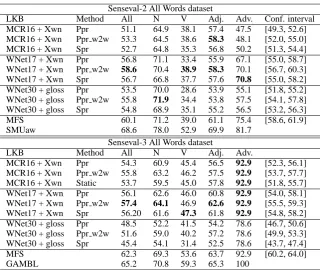
In this paper we will use two datasets for com-paring graph-based WSD methods, namely, the Senseval-2 (S2AW) and Senseval-3 (S3AW) all words datasets (Snyder and Palmer, 2004; Palmer et al., 2001), which are both labeled with WordNet 1.7 tags. We did not use the Semeval dataset, for the sake of comparing our results to related work, none of which used Semeval data. Table 1 shows the results as recall of the graph-based WSD sys-tem over these datasets on the different LKBs. We detail overall results, as well as results per PoS, and the confidence interval for the overall results. The interval was computed using bootstrap resam-pling with 95% confidence.
The table shows that Ppr w2w is consistently the best method in both datasets and for all LKBs.
Ppr and Spr obtain comparable results, which is
algo-Senseval-2 All Words dataset
LKB Method All N V Adj. Adv. Conf. interval
MCR16 + Xwn Ppr 51.1 64.9 38.1 57.4 47.5 [49.3, 52.6]
MCR16 + Xwn Ppr w2w 53.3 64.5 38.6 58.3 48.1 [52.0, 55.0]
MCR16 + Xwn Spr 52.7 64.8 35.3 56.8 50.2 [51.3, 54.4]
WNet17 + Xwn Ppr 56.8 71.1 33.4 55.9 67.1 [55.0, 58.7]
WNet17 + Xwn Ppr w2w 58.6 70.4 38.9 58.3 70.1 [56.7, 60.3]
WNet17 + Xwn Spr 56.7 66.8 37.7 57.6 70.8 [55.0, 58.2]
WNet30 + gloss Ppr 53.5 70.0 28.6 53.9 55.1 [51.8, 55.2]
WNet30 + gloss Ppr w2w 55.8 71.9 34.4 53.8 57.5 [54.1, 57.8]
WNet30 + gloss Spr 54.8 68.9 35.1 55.2 56.5 [53.2, 56.3]
MFS 60.1 71.2 39.0 61.1 75.4 [58.6, 61.9]
SMUaw 68.6 78.0 52.9 69.9 81.7
Senseval-3 All Words dataset
LKB Method All N V Adj. Adv.
MCR16 + Xwn Ppr 54.3 60.9 45.4 56.5 92.9 [52.3, 56.1]
MCR16 + Xwn Ppr w2w 55.8 63.2 46.2 57.5 92.9 [53.7, 57.7]
MCR16 + Xwn Static 53.7 59.5 45.0 57.8 92.9 [51.8, 55.7]
WNet17 + Xwn Ppr 56.1 62.6 46.0 60.8 92.9 [54.0, 58.1]
WNet17 + Xwn Ppr w2w 57.4 64.1 46.9 62.6 92.9 [55.5, 59.3]
WNet17 + Xwn Spr 56.20 61.6 47.3 61.8 92.9 [54.8, 58.2]
WNet30 + gloss Ppr 48.5 52.2 41.5 54.2 78.6 [46.7, 50.6]
WNet30 + gloss Ppr w2w 51.6 59.0 40.2 57.2 78.6 [49.9, 53.3]
WNet30 + gloss Spr 45.4 54.1 31.4 52.5 78.6 [43.7, 47.4]
MFS 62.3 69.3 53.6 63.7 92.9 [60.2, 64.0]
[image:5.595.138.459.59.329.2]GAMBL 65.2 70.8 59.3 65.3 100
Table 1: Results (as recall) on Senseval-2 and Senseval-3 all words tasks. We also include the MFS baseline and the best results of supervised systems at competition time (SMUaw,GAMBL).
rithm, compared to the more elaborate algorithm to construct the graph. The differences between methods are not statistically significant, which is a common problem on this relatively small datasets (Snyder and Palmer, 2004; Palmer et al., 2001).
Regarding LKBs, the best results are obtained using WordNet 1.7 and eXtended WordNet. Here the differences are in many cases significant. These results are surprising, as we would ex-pect that the manually disambiguated gloss re-lations from WordNet 3.0 would lead to bet-ter results, compared to the automatically disam-biguated gloss relations from the eXtended Word-Net (linked to version 1.7). The lower perfor-mance of WNet30+gloss can be due to the fact that the Senseval all words data set is tagged using WordNet 1.7 synsets. When using a different LKB for WSD, a mapping to WordNet 1.7 is required. Although the mapping is cited as having a correct-ness on the high 90s (Daude et al., 2000), it could have introduced sufficient noise to counteract the benefits of the hand-disambiguated glosses.
Table 1 also shows the most frequent sense (MFS), as well as the best supervised sys-tems (Snyder and Palmer, 2004; Palmer et al., 2001) that participated in each competition (SMUaw and GAMBL, respectively). The MFS is a baseline for supervised systems, but it is
consid-ered a difficult competitor for unsupervised sys-tems, which rarely come close to it. In this case the MFS baseline was computed using previously availabel training data like SemCor. Our best re-sults are close to the MFS in both Senseval-2 and Senseval-3 datasets. The results for the supervised system are given for reference, and we can see that the gap is relatively small, specially for Senseval-3.
5 Comparison to Related work
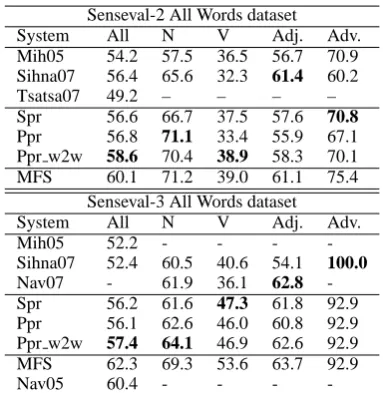
In this section we will briefly describe some graph-based methods for knowledge-based WSD. The methods here presented cope with the prob-lem of sequence-labeling, i.e., they disambiguate all the words coocurring in a sequence (typically, all content words of a sentence). All the meth-ods rely on the information represented on some LKB, which typically is some version of Word-Net, sometimes enriched with proprietary rela-tions. The results on our datasets, when available, are shown in Table 2. The table also shows the performance of supervised systems.
Senseval-2 All Words dataset
System All N V Adj. Adv.
Mih05 54.2 57.5 36.5 56.7 70.9
Sihna07 56.4 65.6 32.3 61.4 60.2
Tsatsa07 49.2 – – – –
Spr 56.6 66.7 37.5 57.6 70.8
Ppr 56.8 71.1 33.4 55.9 67.1
Ppr w2w 58.6 70.4 38.9 58.3 70.1
MFS 60.1 71.2 39.0 61.1 75.4
Senseval-3 All Words dataset
System All N V Adj. Adv.
Mih05 52.2 - - -
-Sihna07 52.4 60.5 40.6 54.1 100.0
Nav07 - 61.9 36.1 62.8
-Spr 56.2 61.6 47.3 61.8 92.9
Ppr 56.1 62.6 46.0 60.8 92.9
Ppr w2w 57.4 64.1 46.9 62.6 92.9
MFS 62.3 69.3 53.6 63.7 92.9
Nav05 60.4 - - -
-Table 2: Comparison with related work. Note that Nav05 uses the MFS.
of the links joining two synsets is calculated by executing Lesk’s algorithm (Lesk, 1986) between them, i.e., by calculating the overlap between the words in the glosses of the correspongind senses. Once the complete graph is built, the PageRank al-gorithm is executed over it and words are assigned to the most relevant synset. In this sense, PageR-ank is used an alternative to simulated annealing to find the optimal pairwise combinations. The method was evaluated on the Senseval-3 dataset, as shown in row Mih05 on Table 2.
(Sinha and Mihalcea, 2007) extends their pre-vious work by using a collection of semantic sim-ilarity measures when assigning a weight to the links across synsets. They also compare differ-ent graph-based cdiffer-entrality algorithms to rank the vertices of the complete graph. They use differ-ent similarity metrics for differdiffer-ent POS types and a voting scheme among the centrality algorithm ranks. Here, the Senseval-3 corpus was used as a development data set, and we can thus see those results as the upper-bound of their method.
We can see in Table 2 that the methods pre-sented in this paper clearly outperform both Mih05 and Sin07. This result suggests that analyzing the LKB structure as a whole is preferable than com-puting pairwise similarity measures over synsets. The results of various in-house made experiments replicating (Mihalcea, 2005) also confirm this ob-servation. Note also that our methods are simpler than the combination strategy used in (Sinha and Mihalcea, 2007), and that we did not perform any parameter tuning as they did.
In (Navigli and Velardi, 2005) the authors de-velop a knowledge-based WSD method based on lexical chains called structural semantic intercon-nections (SSI). Although the system was first de-signed to find the meaning of the words in Word-Net glosses, the authors also apply the method for labeling text sequences. Given a text sequence, SSI first identifies monosemous words and assigns the corresponding synset to them. Then, it iter-atively disambiguates the rest of terms by select-ing the senses that get the strongest interconnec-tion with the synsets selected so far. The inter-connection is calculated by searching for paths on the LKB, constrained by some hand-made rules of possible semantic patterns. The method was eval-uated on the Senseval-3 dataset, as shown in row Nav05 on Table 2. Note that the method labels an instance with the most frequent sense of the word if the algorithm produces no output for that instance, which makes comparison to our system unfair, specially given the fact that the MFS per-forms better than SSI. In fact it is not possible to separate the effect of SSI from that of the MFS. For this reason we place this method close to the MFS baseline in Table 2.
In (Navigli and Lapata, 2007), the authors per-form a two-stage process for WSD. Given an input context, the method first explores the whole LKB in order to find a subgraph which is particularly relevant for the words of the context. Then, they study different graph-based centrality algorithms for deciding the relevance of the nodes on the sub-graph. As a result, every word of the context is attached to the highest ranking concept among its possible senses. The Spr method is very similar to (Navigli and Lapata, 2007), the main differ-ence lying on the initial method for extracting the context subgraph. Whereas (Navigli and Lapata, 2007) apply a depth-first search algorithm over the LKB graph —and restrict the depth of the subtree to a value of3—, Spr relies on shortest paths be-tween word synsets. Navigli and Lapata don’t re-port overall results and therefore, we can’t directly compare our results with theirs. However, we can see that on a PoS-basis evaluation our results are consistently better for nouns and verbs (especially the Ppr w2w method) and rather similar for adjec-tives.
[image:6.595.85.277.60.257.2]Spanish Semeval07
LKB Method Acc.
Spanish Wnet + Xnet∗ Ppr 78.4
Spanish Wnet + Xnet∗ Ppr w2w 79.3
– MFS 84.6
– Supervised 85.10
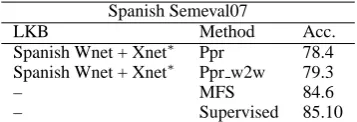
Table 3: Results (accuracy) on Spanish Semeval07 dataset, including MFS and the best supervised system in the competition.
search over the LKB. The authors apply a spread-ing activation algorithm over the subgraph for node ranking. Edges of the subgraph are weighted according to its type, following a tf.idf like ap-proach. The results show that our methods clearly outperform Tsatsa07. The fact that the Spr method works better suggests that the traditional PageR-ank algorithm is a superior method for rPageR-anking the subgraph nodes.
As stated before, all methods presented here use some LKB for performing WSD. (Mihalcea, 2005) and (Sinha and Mihalcea, 2007) use Word-Net relations as a knowledge source, but neither of them specify which particular version did they use. (Tsatsaronis et al., 2007) uses WordNet 1.7 enriched with eXtended WordNet relations, just as we do. Both (Navigli and Velardi, 2005; Nav-igli and Lapata, 2007) use WordNet 2.0 as the un-derlying LKB, albeit enriched with several new relations, which are manually created. Unfor-tunately, those manual relations are not publicly available, so we can’t directly compare their re-sults with the rest of the methods. In (Agirre and Soroa, 2008) we experiment with different LKBs formed by combining relations of different MCR versions along with relations extracted from Sem-Cor, which we call supervised and unsupervised relations, respectively. The unsupervised relations that yielded bests results are also used in this paper (c.f Section 3.1).
6 Experiments on Spanish
Our WSD algorithm can be applied over non-english texts, provided that a LKB for this partic-ular language exists. We have tested the graph-algorithms proposed in this paper on a Spanish dataset, using the Spanish WordNet as knowledge source (Atserias et al., 2004a).
We used the Semeval-2007 Task 09 dataset as evaluation gold standard (M`arquez et al., 2007). The dataset contains examples of the 150 most frequent nouns in the CESS-ECE corpus,
manu-Method Time
Ppr 26m46
Spr 119m7
[image:7.595.92.271.62.123.2]Ppr w2w 164m4
Table 4: Elapsed time (in minutes) of the algo-rithms when applied to the Senseval-2 dataset.
ally annotated with Spanish WordNet synsets. It is split into a train and test part, and has an “all words” shape i.e. input consists on sentences, each one having at least one occurrence of a tar-get noun. We ran the experiment over the test part (792 instances), and used the train part for cal-culating the MFS baseline. We used the Span-ish WordNet as LKB, enriched with eXtended WordNet relations. It contains105,501nodes and 623,316relations. The results in Table 3 are con-sistent with those for English, with our algorithm approaching MFS performance. Note that for this dataset the supervised algorithm could barely im-prove over the MFS, suggesting that for this par-ticular dataset MFS is parpar-ticularly strong.
[image:7.595.373.458.62.117.2]7 Performance analysis
Table 4 shows the time spent by the different al-gorithms when applied to the Senseval-2 all words dataset, using the WNet17 + Xwn as LKB. The dataset consists on 2473 word instances appear-ing on 476different sentences. The experiments were done on a computer with four 2.66 Ghz pro-cessors and 16 Gb memory. The table shows that the time elapsed by the algorithms varies between 30 minutes for the Ppr method (which thus dis-ambiguates circa 82 instances per minute) to al-most3hours spent by the Ppr w2w method (circa 15 instances per minute). The Spr method lies in between, requiring2 hours for completing the task, but its overall performance is well below the PageRank based Ppr w2w method. Note that the algorithm is coded in C++ for greater efficiency, and uses the Boost Graph Library.
per-57 57.2 57.4 57.6 57.8 58 58.2 58.4 58.6
0 5 10 15 20 25 30
R
ec
all
Iterations Rate of convergence
3 3 3
3 3 3 3 3
Figure 1: Rate of convergence of PageRank algo-rithm over the MCR17 + Xwn LKB.
formance, and20iterations are enough for achiev-ing convergence. The figure shows that, depend-ing on the LKB complexity, the user can tune the algorithm and lower the number of iterations, thus considerably reducing the time required for disam-biguation.
8 Conclusions
In this paper we propose a new graph-based method that uses the knowledge in a LKB (based on WordNet) in order to perform unsupervised Word Sense Disambuation. Our algorithm uses the full graph of the LKB efficiently, performing bet-ter than previous approaches in English all-words datasets. We also show that the algorithm can be easily ported to other languages with good results, with the only requirement of having a wordnet. Both for Spanish and English the algorithm attains performances close to the MFS.
The algorithm is publicly available5and can be applied easily to sense inventories and knowledge bases different from WordNet. Our analysis shows that our algorithm is efficient compared to previ-ously proposed alternatives, and that a good choice of WordNet versions and relations is fundamental for good performance.
Acknowledgments
This work has been partially funded by the EU Commission (project KYOTO ICT-2007-211423) and Spanish Research Department (project KNOW TIN2006-15049-C03-01).
References
E. Agirre and G. Rigau. 1996. Word sense disam-biguation using conceptual density. In In Proceed-ings of the 16th International Conference on Com-putational Linguistics, pages 16–22.
5http://ixa2.si.ehu.es/ukb
E. Agirre and A. Soroa. 2008. Using the multilin-gual central repository for graph-based word sense disambiguation. In Proceedings of LREC ’08, Mar-rakesh, Morocco.
J. Atserias, G. Rigau, and L. Villarejo. 2004a. Span-ish wordnet 1.6: Porting the spanSpan-ish wordnet across princeton versions. In In Proceedings of LREC ’04.
J. Atserias, L. Villarejo, G. Rigau, E. Agirre, J. Carroll, B. Magnini, and P. Vossen. 2004b. The meaning multilingual central repository. In In Proceedings of GWC, Brno, Czech Republic.
S. Brin and L. Page. 1998. The anatomy of a
large-scale hypertextual web search engine. Computer
Networks and ISDN Systems, 30(1-7).
J. Cowie, J. Guthrie, and L. Guthrie. 1992. Lexical disambiguation using simulated annealing. In HLT ’91: Proceedings of the workshop on Speech and Natural Language, pages 238–242, Morristown, NJ, USA.
J. Daude, L. Padro, and G. Rigau. 2000. Mapping WordNets using structural information. In Proceed-ings of ACL’2000, Hong Kong.
T. H. Haveliwala. 2002. Topic-sensitive pagerank. In WWW ’02: Proceedings of the 11th international conference on World Wide Web, pages 517–526, New York, NY, USA. ACM.
A. N. Langville and C. D. Meyer. 2003. Deeper inside pagerank. Internet Mathematics, 1(3):335–380.
M. Lesk. 1986. Automatic sense disambiguation us-ing machine readable dictionaries: how to tell a pine cone from an ice cream cone. In SIGDOC ’86: Pro-ceedings of the 5th annual international conference on Systems documentation, pages 24–26, New York, NY, USA. ACM.
L. M`arquez, L. Villarejo, M. A. Mart´ı, and M. Taul´e. 2007. Semeval-2007 task 09: Multilevel semantic annotation of catalan and spanish. In Proceedings of SemEval-2007, pages 42–47, Prague, Czech Re-public, June.
D. McCarthy, R. Koeling, J. Weeds, and J. Carroll. 2004. Finding predominant word senses in untagged text. In ACL ’04: Proceedings of the 42nd Annual Meeting on Association for Computational Linguis-tics, page 279, Morristown, NJ, USA. Association for Computational Linguistics.
R. Mihalcea and D. I. Moldovan. 2001. eXtended
WordNet: Progress report. In in Proceedings of
NAACL Workshop on WordNet and Other Lexical Resources, pages 95–100.
R. Navigli and M. Lapata. 2007. Graph connectivity measures for unsupervised word sense disambigua-tion. In IJCAI.
R. Navigli and P. Velardi. 2005. Structural seman-tic interconnections: A knowledge-based approach to word sense disambiguation. IEEE Trans. Pattern Anal. Mach. Intell., 27(7):1075–1086.
M. Palmer, C. Fellbaum, S. Cotton, L. Delfs, and H.T. Dang. 2001. English tasks: All-words and verb lexical sample. In Proc. of SENSEVAL-2: Second International Workshop on Evaluating Word Sense Disambiguation Systems, Tolouse, France, July.
S. Pradhan, E. Loper, D. Dligach, and M.Palmer. 2007. Semeval-2007 task-17: English lexical sample srl
and all words. In Proceedings of SemEval-2007,
pages 87–92, Prague, Czech Republic, June.
R. Sinha and R. Mihalcea. 2007. Unsupervised graph-based word sense disambiguation using measures of word semantic similarity. In Proceedings of the IEEE International Conference on Semantic Com-puting (ICSC 2007), Irvine, CA, USA.
B. Snyder and M. Palmer. 2004. The English all-words task. In ACL 2004 Senseval-3 Workshop, Barcelona, Spain, July.