Using Encyclopedic Knowledge for Named Entity Disambiguation
Razvan Bunescu
Department of Computer Sciences University of Texas at Austin
Austin, TX 78712-0233
Marius Pas¸ca
Google Inc.
1600 Amphitheatre Parkway Mountain View, CA 94043
Abstract
We present a new method for detecting and disambiguating named entities in open do-main text. A disambiguation SVM kernel is trained to exploit the high coverage and rich structure of the knowledge encoded in an online encyclopedia. The resulting model significantly outperforms a less in-formed baseline.
1 Introduction
1.1 Motivation
The de-facto web search paradigm defines the re-sult to a user’s query as roughly a set of links to the best-matching documents selected out of billions of items available. Whenever the queries search for pinpointed, factual information, the burden of filling the gap between the output granularity (whole documents) and the targeted information (a set of sentences or relevant phrases) stays with the users, by browsing the returned documents in or-der to find the actually relevant bits of information. A frequent case are queries about named entities, which constitute a significant fraction of popu-lar web queries according to search engine logs.
When submitting queries such as John Williams
orPython, search engine users could also be pre-sented with a compilation of facts and specific at-tributes about those named entities, rather than a set of best-matching web pages. One of the chal-lenges in creating such an alternative search result page is the inherent ambiguity of the queries, as several instances of the same class (e.g., different people) or different classes (e.g., a type of snake, a programming language, or a movie) may share the same name in the query. As an example, the
Work done during a summer internship at Google.
contexts below are part of web documents refer-ring to different people who share the same name
John Williams:
1. “John Williams and the Boston Pops con-ducted a summer Star Wars concert at Tan-glewood.”
2. “John Williams lost a Taipei death match against his brother, Axl Rotten.”
3. “John Williamswon a Victoria Cross for his actions at the battle of Rorke‘s Drift.”
The effectiveness of the search could be greatly improved if the search results were grouped together according to the corresponding sense, rather than presented as a flat, sense-mixed list of items (whether links to full-length documents, or extracted facts). As an added benefit, users would have easier access to a wider variety of re-sults, whenever the top 10 or so results returned by the largest search engines happen to refer to only one particular (arguably the most popular) sense
of the query (e.g., the programming language in
the case ofPython), thus submerging or “hiding”
Without solving it, a relation extraction system an-alyzing the sentences in the above example could mistakenly consider the third as evidence thatJohn Williamsthe composer fought atRorke’s Drift.
1.2 Approach
The main goal of the research reported in this pa-per is to develop a named entity disambiguation method that is intrinsically linked to a dictionary mapping proper names to their possible named en-titiy denotations. More exactly, the method:
1. Detects whether a proper name refers to a
named entity included in the dictionary (
de-tection).
2. Disambiguates between multiple named enti-ties that can be denoted by the same proper
name (disambiguation).
As a departure from the methodology of previous approaches, the paper exploits a non-traditional web-based resource. Concretely, it takes advan-tage of some of the human knowledge available in Wikipedia, a free online encyclopedia created through decentralized, collective efforts of thou-sands of users (Remy, 2002). We show that the structure of Wikipedia lends itself to a set of useful features for the detection and disambigua-tion of named entities. The remainder of the pa-per is organized as follows. Section 2 describes Wikipedia, with an emphasis on the features that are most important to the entity disambiguation task. Section 3 describes the extraction of named entity entries (versus other types of entries) from Wikipedia. Section 4 introduces two disambigua-tion methods, which are evaluated experimentally in Section 5. We conclude with future work and conclusions.
2 Wikipedia – A Wiki Encyclopedia
Wikipedia is a free online encyclopedia written collaboratively by volunteers, using a wiki soft-ware that allows almost anyone to add and change articles. It is a multilingual resource - there are about 200 language editions with varying levels of coverage. Wikipedia is a very dynamic and quickly growing resource – articles about news-worthy events are often added within days of their occurrence. As an example, the September 2005 version contains 751,666 articles, around 180,000 more articles than four months earlier. The work
in this paper is based on the English version from May 2005, which contains 577,860 articles.
Each article in Wikipedia is uniquely identified by its title – a sequence of words separated by underscores, with the first word always capital-ized. Typically, the title is the most common name for the entity described in the article. When the name is ambiguous, it is further qualified with a parenthetical expression. For instance, the
arti-cle on John Williams the composer has the title
John Williams (composer).
Because each article describes a specific en-tity or concept, the remainder of the paper some-times uses the term ’entity’ interchangeably to re-fer to both the article and the corresponding entity.
Also, let E denote the entire set of entities from
Wikipedia. For any entitye2E,e:titleis the title
name of the corresponding article, ande:T is the
text of the article.
In general, there is a many-to-many correspon-dence between names and entities. This relation
is captured in Wikipedia throughredirectand
dis-ambiguation pages, as described in the next two sections.
2.1 Redirect Pages
A redirect page exists for each alternative name that can be used to refer to an entity in Wikipedia. The name is transformed (using underscores for spaces) into a title whose article contains a redirect link to the actual article for that
en-tity. For example, John Towner Williams is the
full name of the composer John Williams. It
is therefore an alternative name for the com-poser, and consequently the article with the ti-tle John Towner Williams is just a pointer to the
article forJohn Williams (composer). An
exam-ple entry with a considerably higher number of redirect pages isUnited States. Its redirect pages correspond to acronyms (U.S.A.,U.S.,USA,US),
Spanish translations (Los Estados Unidos,
Esta-dos UniEsta-dos), misspellings (Untied States) or
syn-onyms (Yankee land).
For any given Wikipedia entitye2E, lete:Rbe
the set of all names that redirect toe.
2.2 Disambiguation Pages
Another useful structure is that ofdisambiguation
pages, which are created for ambiguous names, i.e. names that denote two or more entities in Wikipedia. For example, the disambiguation page
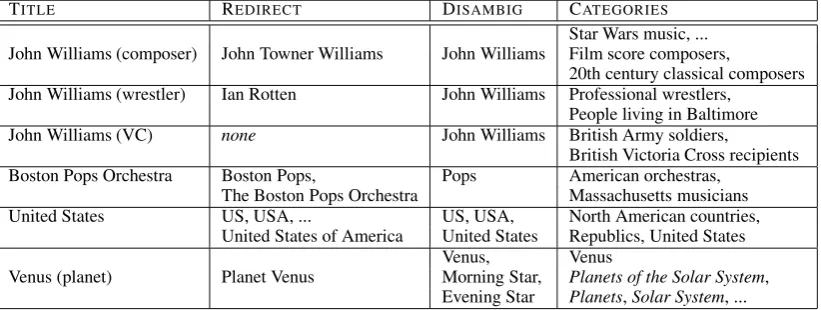
TITLE REDIRECT DISAMBIG CATEGORIES
Star Wars music, ... John Williams (composer) John Towner Williams John Williams Film score composers,
20th century classical composers John Williams (wrestler) Ian Rotten John Williams Professional wrestlers,
People living in Baltimore John Williams (VC) none John Williams British Army soldiers,
British Victoria Cross recipients Boston Pops Orchestra Boston Pops, Pops American orchestras,
The Boston Pops Orchestra Massachusetts musicians United States US, USA, ... US, USA, North American countries,
United States of America United States Republics, United States Venus, Venus
[image:3.595.94.505.63.218.2]Venus (planet) Planet Venus Morning Star, Planets of the Solar System, Evening Star Planets,Solar System, ...
Table 1: Examples of Wikipedia titles, aliases and categories
entities. Therefore, besides the non-ambiguous
names that come from redirect pages, additional aliases can be found by looking for all disam-biguation pages that list a particular Wikipedia en-tity. In his philosophical article “On Sense and Reference” (Frege, 1999), Gottlob Frege gave a famous argument to show that sense and reference are distinct. In his example, the planet Venus may be referred to using the phrases “morning star” and “evening star”. This theoretical example is nicely captured in practice in Wikipedia by two
disam-biguation pages,Morning Starand Evening Star,
both listing Venus as a potential referent.
For any given Wikipedia entity e2E, lete:D
be the set of names whose disambiguation pages contain a link toe.
2.3 Categories
Every article in Wikipedia is required to have at
least one category. As shown in Table 1, John
Williams (composer) is associated with a set of
categories, among them Star Wars music, Film
score composers, and20th century classical com-posers. Categories allow articles to be placed into one or more topics. These topics can be further categorized by associating them with one or more
parent categories. In Table 1 Venus is shown as
both an article title and a category. As a cate-gory, it has one direct parentPlanets of the Solar System, which in turn belongs to two more
gen-eral categories, Planets and Solar System. Thus,
categories form a directed acyclic graph, allowing multiple categorization schemes to co-exist simul-taneously. There are in total 59,759 categories in Wikipedia.
For a given Wikipedia entity e2E, lete:C be
the set of categories to which ebelongs (i.e. e’s
immediate categories and all their ancestors in the Wikipedia taxonomy).
2.4 Hyperlinks
Articles in Wikipedia often contain mentions of entities that already have a corresponding arti-cle. When contributing authors mention an ex-isting Wikipedia entity inside an article, they are required to link at least its first mention to the cor-responding article, by using linksor piped links. Both types of links are exemplified in the follow-ing wiki source code of a sentence from the article
on Italy: “The [[Vatican City|Vatican]] is now an
independent enclave surrounded by [[Rome]]”.
The string from the second link (“Rome”) denotes
the title of the referenced article. The same string is also used in the display version. If the author wants another string displayed (e.g.,“Vatican” in-stead of“Vatican City”), then the alternative string is included in a piped link, after the title string. Consequently, the display string for the
aforemen-tioned example is: “The Vatican is now an
inde-pendent enclave surrounded by Rome”. As de-scribed later in Section 4, the hyperlinks can pro-vide useful training examples for a named entity disambiguator.
3 A Dictionary of Named Entities
We organize all named entities from Wikipedia
into a dictionary structure D, where each string
entry d 2 D is mapped to the set of entities
d:E that can be denoted by d in Wikipedia. The
1. Ife:titleis a multiword title, check the
cap-italization of all content words, i.e. words other than prepositions, determiners, con-junctions, relative pronouns or negations.
Considere a named entity if and only if all
content words are capitalized.
2. Ife:titleis a one word title that contains at
least two capital letters, theneis a named
en-tity. Otherwise, go to step 3.
3. Count how many timese:titleoccurs in the
text of the article, in positions other than at
the beginning of sentences. If at least75%of
these occurrences are capitalized, theneis a
named entity.
The combined heuristics extract close to half a million named entities from Wikipedia. The sec-ond step constructs the actual dictionaryDas
fol-lows:
The set of entries inD consists of all strings
that may denote a named entity, i.e. ife2E
is a named entity, then its title namee:title,
its redirect names e:R, and its
disambigua-tion namese:Dare all added as entries inD.
Each entry stringd2Dis mapped tod:E, the
set of entities thatdmay denote in Wikipedia.
Consequently, a named entityeis included in
d:E if and only ifd = e:title, d 2e:R, or
d2e:D.
4 Named Entity Disambiguation
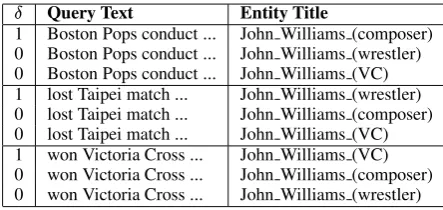
As illustrated in Section 1, the same proper name may refer to more than one named entity. The named entity dictionary from Section 3 and the hy-perlinks from Wikipedia articles provide a dataset of disambiguated occurrences of proper names, as described in the following. As shown in Sec-tion 2.4, each link contains the title name of an en-tity, and the proper name (the display string) used to refer to it. We use the termqueryto denote the occurrence of a proper name inside a Wikipedia article. If there is a dictionary entry matching the
proper name in the query q such that the set of
denoted entitiesq:Econtains at least two entities,
one of them the true answer entity q:e, then the
queryqis included in the dataset. More exactly, if
q:Econtains nnamed entities e
1, e
2, ..., e
n, then
the dataset will be augmented withnpairshq;e
k i
represented as follows:
hq;e k
i=[Æ(e k
;q:e) jq:T j e k
:title]
The field q:T contains all words occurring in a
limit length window centered on the proper name. The window size is set to 55, which is the value that was observed to give optimum performance in the related task of cross-document coreference
(Gooi and Allan, 2004). The Kronecker delta
function Æ(e
k
;q:e) is 1 when e
k is the same as
the entity q:e referred in the link. Table 2 lists
the query pairs created for the threeJohn Williams
queries from Section 1.1, assuming only three en-tities in Wikipedia correspond to this name.
Æ Query Text Entity Title
[image:4.595.306.528.222.327.2]1 Boston Pops conduct ... John Williams (composer) 0 Boston Pops conduct ... John Williams (wrestler) 0 Boston Pops conduct ... John Williams (VC) 1 lost Taipei match ... John Williams (wrestler) 0 lost Taipei match ... John Williams (composer) 0 lost Taipei match ... John Williams (VC) 1 won Victoria Cross ... John Williams (VC) 0 won Victoria Cross ... John Williams (composer) 0 won Victoria Cross ... John Williams (wrestler)
Table 2: Disambiguation dataset.
The application of this procedure on Wikipedia results into a dataset of 1,783,868 disambiguated queries.
4.1 Context-Article Similarity
Using the representation from the previous sec-tion, the name entity disambiguation problem can be cast as a ranking problem. Assuming that an
appropriate scoring functionscore(q;e
k
)is
avail-able, the named entity corresponding to queryqis
defined to be the one with the highest score:
^
e=argmax e
k
score(q;e k
) (1)
Ife^ = q:e then ^erepresents a hit, otherwisee^is
a miss. Disambiguation methods will then differ based on the way they define the scoring function. One ranking function that is evaluated experimen-tally in this paper is based on the cosine similarity between the context of the query and the text of the article:
score(q;e k
)=cos(q:T;e k
:T)= q:T
kq:Tk e
k :T
ke k
:Tk
The factors q:T and e
k
:T are represented in the
standard vector space model, where each compo-nent corresponds to a term in the vocabulary, and
the term weight is the standard tf idf score
(Baeza-Yates and Ribeiro-Neto, 1999). The
articles and recording, for each word stem w, its
document frequency df(w) in Wikipedia.
Stop-words and Stop-words that are too frequent or too rare
are discarded. A generic documentdis then
repre-sented as a vector of lengthjVj, with a position for
each vocabulary word. Iff(w)is the frequency of
word w in document d, and N is the total
num-ber of Wikipedia articles, then the weight of word
w2V in thetfidf representation ofdis:
d w
=f(w)ln N
df(w)
(2)
4.2 Taxonomy Kernel
An error analysis of the cosine-based ranking method reveals that, in many cases, the pairhq;ei
fails to rank first, even though words from the
query context unambiguously indicateeas the
ac-tual denoted entity. In these cases, cue words from the context do not appear ine’s article due to two
main reasons:
1. The article may be too short or incomplete.
2. Even though the article captures most of the relevant concepts expressed in the query con-text, it does this by employing synonymous words or phrases.
The cosine similarity betweenqande
kcan be seen
as an expression of the total degree of correlation
between words from the context of queryq and a
given named entitye
k. When the correlation is too
low because the Wikipedia article for named entity
e
k does not contain all words that are relevant to
e
k, it is worth considering the correlation between
context words and the categories to whiche
k
be-longs. For illustration, consider the two queries
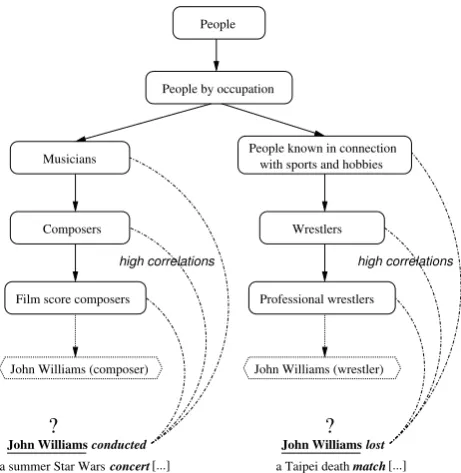
for the nameJohn Williamsfrom Figure 1.
To avoid clutter, Figure 1 depicts only two
enti-ties with the nameJohn Williamsin Wikipedia: the
composer and the wrestler. On top of each entity, the figure shows one of their Wikipedia categories (Film score composers andProfessional wrestlers
respectively), together with some of their ances-tor categories in the Wikipedia taxonomy. The two query contexts are shown at the bottom of the figure. In the context on the left, words such asconductedandconcertdenote concepts that are
highly correlated with theMusicians, Composers
andFilm score composerscategories. On the other hand, their correlation with other categories in Figure 1 is considerably lower. Consequently, a
Musicians
Composers
Film score composers
People by occupation People
People known in connection with sports and hobbies
Wrestlers
Professional wrestlers
high correlations high correlations
? ?
conducted
a summer Star Wars
John Williams John Williams
a Taipei death
[image:5.595.308.539.60.297.2]lost concert[...] match[...] John Williams (composer) John Williams (wrestler)
Figure 1: Word-Category correlations.
goal of this paper is to design a disambiguation method that 1) learns the magnitude of these cor-relations, and 2) uses these correlations in a scor-ing function, together with the cosine similarity. Our intuition is that, given the query context on the left, such a ranking function has a better chance of ranking the “composer” entity higher than the “wrestler” entity, when compared with the simple cosine similarity baseline.
We consider using a linear ranking function as follows:
^
e=argmax e
k
w(q;e k
) (3)
The feature vector (q;e
k
) contains a dedicated
feature
cos for cosine similarity, and
jVj jCj
features
w;c corresponding to combinations of
words w from the Wikipedia vocabulary V and
categoriescfrom the Wikipedia taxonomyC:
cos
(q;e k
) = cos(q:T;e k
:T) (4)
w;c
(q;e k
) =
1 ifw2q:T andc2e k
:C;
0 otherwise:
The weight vector w models the magnitude
problem in Figure 2. The aim of this formulation is
to find a weight vectorwsuch that 1) the number
of ranking constraintsw(q;q:e) w(q;e
k )
from the training data that are violated is
mini-mized, and 2) the ranking function w (q;e
k )
generalizes well beyond the training data.
minimize:
V(w;) = 1 2
ww+C P
q;k
subject to:
w((q;q:e) (q;e k
))1 q;k q;k 0 8q;8e k
2q:E fq:eg
Figure 2: Optimization problem.
C is a parameter that allows trading-off margin
size against training error. The number of linear ranking constraints is
P q
( jq:Ej 1). As an
ex-ample, each of the three queries from Table 2 gen-erates two constraints.
The learned w is a linear combination of the
feature vectors (q;e
k
), which makes it possible
to use kernels (Vapnik, 1998). It is straightforward to show that the dot product between two feature
vectors (q;e
k
) and (q 0
;e 0 k
) is equal with the
product between the number of common words in the contexts of the two queries and the number of categories common to the two named entities, plus the product of the two cosine similarities. The cor-responding ranking kernel is:
K hq;e k i;hq 0 ;e 0 k i =
q:T\q 0 :T e k :C\e
0 k
:C
+cos(q:T;ek:T)cos(q 0
:T;e 0 k
:T)
To avoid numerical problems, the first term of the kernel is normalized and the second term is
multi-plied with a constant=10
8
:
K hq;e k i;hq 0 ;e 0 k i =
jq:T\q 0
:Tj p
jq:Tjjq 0
:Tj
je k
:C\e 0 k :Cj p je k
:Cjje 0 k
:Cj
+cos(q:T;ek:T)cos(q 0
:T;e 0 k
:T)
In (McCallum et al., 1998), a statistical technique
called shrinkage is used in order to improve the
accuracy of a naive Bayes text classifier. Accord-ingly, one can take advantage of a hierarchy of classes by combining parameter estimates of par-ent categories into the parameter estimates of a child category. The taxonomy kernel is very lated to the same technique – one can actually re-gard it as a distribution-free analogue of shrinkage.
4.3 Detecting Out-of-Wikipedia Entities
The two disambiguation methods discussed above
(Sections 4.1 and 4.2) implicitly assume that
Wikipedia contains all entities that may be de-noted by entries from the named entity dictionary.
Taking for example the nameJohn Williams, both
methods assume that in any context, the referred entity is among the 22 entities listed on the dis-ambiguation page in Wikipedia. In practice, there
may be contexts whereJohn Williamsrefers to an
entity e
out that is not covered in Wikipedia,
es-pecially when e
out is not a popular entity. These
out-of-Wikipediaentities are accommodated in the ranking approach to disambiguation as follows. A special entitye
out is introduced to denote any
en-tity not covered by Wikipedia. Its attributes are set to null values (e.g., the article texte
out
:T =;,
and the set of categories e
out
:C = ;). The
rank-ing in Equation 1 is then updated so that it returns the Wikipedia entity with the highest score, if this score is greater then a fix threshold, otherwise it
returnse out:
e max
= argmax e k score(q;e k ) ^ e = e max if score(q;e max
)>; e
out otherwise
:
If the scoring function is implemented as a weighted combination of feature functions, as in Equation 3, then the modification shown above
re-sults into a new feature
out:
out
(q;e k
)=Æ(e k
;e out
) (5)
The associated weight is learned along with the
weights for the other features (as defined in Equa-tion 5).
5 Experimental Evaluation
The taxonomy kernel was trained using the SVMl ight
package (Joachims, 1999). As
de-scribed in Section 4, through its hyperlinks, Wikipedia provides a dataset of 1,783,868 am-biguous queries that can be used for training
a named entity disambiguator. The apparently
high number of queries actually corresponds to a moderate size dataset, given that the space of parameters includes one parameter for each word-category combination. However, assuming SVMl ight
TRAININGDATASET TESTDATASET
# CAT. QUERIES PAIRShq;e k
i # CONSTR. QUERIES PAIRShq;e k
i # SV TK(A) Cos(A) S1 110 12,288 39,880 27,592 48,661 147,165 19,693 77.2% 61.5% S
2 540 17,970 55,452 37,482 70,468 235,290 29,148 68.4% 55.8 % S3 2,847 21,185 64,560 43,375 75,190 261,723 36,383 68.0% 55.4% S
4 540 38,726 102,553 63,827 80,386 191,227 35,494 84.8% 82.3%
Table 3: Scenario statistics and comparative evaluation.
time consuming. Therefore, we decided to evalu-ate the taxonomy kernel under the following sce-narios:
[S
1]The working set of Wikipedia categories C
1
is restricted to only the 110 top level categories un-derPeople by occupation. The query dataset used for training and testing is reduced to contain only
ambiguous querieshq;e
k
ifor which any potential
matching entity e
k belongs to at least one of the
110 categories (i.e. e k
:C \C 1
6= ;). The set of
negative matching entities e
k is also reduced to
those that differ from the true answer e in terms
of their categories from C
1 (i.e. e
k
:C \ C 1
6= e:C\C
1). In other words, this scenario addresses
the task of disambiguating between entities with
different top-level categories underPeople by
oc-cupation.
[S
2]In a slight generalization of[ S
1], the set of
categories C
2 is restricted to all categories under People by occupation. Each category must have at least 200 articles to be retained,which results in a total of 540 categories out of the 8202 categories
underPeople by occupation. The query dataset is
generated as in the first scenario by replacing C
1
withC
2. [S
3] This scenario is similar with [ S
2], except
that each category has to contain at least 20 arti-cles to be retained, leading to 2847 out of 8202 categories.
[S
4] This scenario uses the same categories as
[S 2] (i.e.
C 4
=C
2). In order to make the task more
realistic, all queries from the initial Wikipedia dataset are considered as follows. For each query
q, out of all matching entities that do not have
a category under People by occupation, one is
randomly selected as an out-of-Wikipedia entity.
Then, out of all queries for which the true an-swer is anout-of-Wikipediaentity, a subset is ran-domly selected such that, in the end, the number of
queries without-of-Wikipediatrue answers is10%
of the total number of queries. In other words, the scenario assumes the task is to detect if a name
denotes an entity belonging to thePeople by
occu-pationtaxonomy and, in the positive cases, to
dis-ambiguate between multiple entities underPeople
by occupationthat have the same name.
The dataset for each scenario is split into a train-ing dataset and a testtrain-ing dataset which are dis-joint in terms of the query names used in their examples. For instance, if a query for the name
[image:7.595.76.516.62.127.2]John Williams is included in the training dataset, then all other queries with this name are allocated for learning (and consequently excluded from test-ing). Using a disjoint split is motivated by the fact that many Wikipedia queries that have the same true answer also have similar contexts, containing rare words that are highly correlated, almost exclu-sively, with the answer. For example, query names that refer to singers often contain album or song names, query names that refer to writers often con-tain book names, etc. The taxonomy kernel can easily “memorize” these associations, especially when the categories are very fine-grained. In the current framework, the unsupervised method of context-article similarity does not utilize the cor-relations present in the training data. Therefore, for the sake of comparison, we decided to prohibit the taxonomy kernel from using these correlations by training and testing on a disjoint split. Section 6 describes how the training queries could be used in the computation of the context-article similarity, which has the potential of boosting the accuracy for both disambiguation methods.
Table 3 shows a number of relevant statistics
for each scenario: #CATrepresents the number of
Wikipedia categories, #SV is the number of sup-port vectors, TK(A) and Cos(A) are the accuracy of the Taxonomy Kernel and the Cosine similar-ity respectively. The training and testing datasets are characterized in terms of the number of queries and query-answer pairs. The number of ranking contraints (as specified in Figure 2) is also
in-cluded for the training data in column #CONSTR.
inS
4, the termination error criterion
is changed
from its default value of0:001to0:01. Also, the
threshold for detectingout-of-Wikipediaentities
when ranking with cosine similarity is set to the value that gives highest accuracy on training data. As can be seen in the last two columns, the Tax-onomy Kernel significantly outperforms the Co-sine similarity in the first three scenarios, con-firming our intuition that correlations between words from the query context and categories from Wikipedia taxonomy provide useful information for disambiguating named entities. In the last sce-nario, which combines detection and disambigua-tion, the gain is not that substantial. Most queries in the corresponding dataset have only two
possi-ble answers, one of them anout-of-Wikipedia
an-swer, and for these cases the cosine is already do-ing well at disambiguation. We conjecture that a more significant impact would be observed if the dataset queries were more ambiguous.
6 Future Work
The high number of support vectors – half the number of query-answer pairs in training data – suggests that all scenarios can benefit from more training data. One method for making this feasible is to use the weight vector wexplicitely in a
lin-ear SVM. Because much of the computation time is spent on evaluating the decision function, using
wexplicitely may result in a significant speed-up.
The dimensionality of w (by default jVj jCj)
can be reduced significantly by considering only word-category pairs whose frequency in the train-ing data is above a predefined threshold.
A complementary way of using the training data is to augment the article of each named entity with the contexts from all queries for which this entity is the true answer. This method has the potential of improving the accuracy of both methods when the training and testing datasets are not disjoint in terms of the proper names used in their queries.
Word-category correlations have been used in (Ciaramita et al., 2003) to improve word sense dis-ambiguation (WSD), although with less substan-tial gains. There, a separate model was learned for each of the 29 ambiguous nouns from the Sense-val 2 lexical sample task. While creating a sepa-rate model for each named entity is not feasible –
there are 94,875 titles underPeople by occupation
– named entity disambiguation can nevertheless benefit from correlations between Wikipedia
cate-gories and features traditionally used in WSD such as bigrams and trigrams centered on the proper name occurrence, and syntactic information.
7 Conclusion
We have presented a novel approach to named en-tity detection and disambiguation that exploited the untapped potential of an online
encyclope-dia. Experimental results show that using the
Wikipedia taxonomy leads to a substantial im-provement in accuracy. The application of the new named entity disambiguation method holds the promise of better results to popular web searches.
8 Acknowledgments
We would like to thank Peter Dienes, Thorsten Joachims, and the anonymous reviewers for their helpful comments.
References
Ricardo Baeza-Yates and Berthier Ribeiro-Neto. 1999. Mod-ern Information Retrieval. ACM Press, New York.
Massimiliano Ciaramita, Thomas Hofmann, and Mark John-son. 2003. Hierarchical semantic classification: Word sense disambiguation with world knowledge. InThe 18th International Joint Conference on Artificial Intelligence, Acapulco, Mexico.
Robert Dale. 2003. Computational linguistics. Special Issue on the Web as a Corpus, 29(3), September.
Gottlob Frege. 1999. On sense and reference. In Maria Baghramian, editor, Modern Philosophy of Language, pages 3–25. Counterpoint Press.
Chung Heong Gooi and James Allan. 2004. Cross-document coreference on a large scale corpus. InProceedings of Hu-man Language Technology Conference / North American Association for Computational Linguistics Annual Meet-ing, Boston, MA.
Thorsten Joachims. 1999. Making large-scale SVM learn-ing practical. In B. Sch¨olkopf, C. J. C. Burges, and A. J. Smola, editors, Advances in Kernel Methods - Support Vector Learning, pages 169–184. MIT Press.
Thorsten Joachims. 2002. Optimizing search engines us-ing clickthrough data. InProceedings of the eighth ACM SIGKDD international conference on Knowledge discov-ery and data mining, pages 133–142.
Andrew McCallum, R. Rosenfeld, Tom Mitchell, and A. Y. Ng. 1998. Improving text classification by shrinkage in a hierarchy of classes. InProceedings of the Fifteenth In-ternational Conference on Machine Learning (ICML-98), pages 359–367, Madison, WI.
M. Remy. 2002. Wikipedia: The free encyclopedia. Online Information Review, 26(6):434. www.wikipedia.org.