Learning Gender-Neutral Word Embeddings
Jieyu Zhao Yichao Zhou Zeyu Li Wei Wang Kai-Wei Chang
University of California, Los Angeles {jyzhao, yz, zyli, weiwang, kwchang}@cs.ucla.edu
Abstract
Word embedding models have become a fun-damental component in a wide range of Natural Language Processing (NLP) appli-cations. However, embeddings trained on human-generated corpora have been demon-strated to inherit strong gender stereotypes that reflect social constructs. To address this con-cern, in this paper, we propose a novel training procedure for learning gender-neutral word embeddings. Our approach aims to preserve gender information in certain dimensions of word vectors while compelling other dimen-sions to be free of gender influence. Based on the proposed method, we generate a Gender-Neutral variant of GloVe (GN-GloVe). Quanti-tative and qualiQuanti-tative experiments demonstrate that GN-GloVe successfully isolates gender information without sacrificing the functional-ity of the embedding model.
1 Introduction
Word embedding models have been designed for representing the meaning of words in a vector space. These models have become a fundamen-tal NLP technique and have been widely used in various applications. However, prior stud-ies show that such models learned from human-generated corpora are often prone to exhibit so-cial biases, such as gender stereotypes (Bolukbasi et al.,2016;Caliskan et al., 2017). For example, the word “programmer” is neutral to gender by its definition, but an embedding model trained on a news corpus associates “programmer” closer with “male” than “female”.
Such a bias substantially affects downstream applications.Zhao et al.(2018) show that a coref-erence resolution system is sexist due to the word embedding component used in the system. This concerns the practitioners who use the embedding model to build gender-sensitive applications such
as a resume filtering system or a job recommenda-tion system as the automated system may discrimi-nate candidates based on their gender, as reflected by their name. Besides, biased embeddings may implicitly affect downstream applications used in our daily lives. For example, when searching for “computer scientist” using a search engine, as this phrase is closer to male names than female names in the embedding space, a search algorithm us-ing an embeddus-ing model in the backbone tends to rank male scientists higher than females’, hinder-ing women from behinder-ing recognized and further ex-acerbating the gender inequality in the community. To alleviate gender stereotype in word embed-dings, Bolukbasi et al. (2016) propose a post-processing method that projects gender-neutral words to a subspace which is perpendicular to the gender dimension defined by a set of gender-definition words.1 However, their approach has two limitations. First, the method is essentially a pipeline approach and requires the gender-neutral words to be identified by a classifier before em-ploying the projection. If the classifier makes a mistake, the error will be propagated and af-fect the performance of the model. Second, their method completely removes gender information from those words which are essential in some do-mains such as medicine and social science (Back et al.,2010;McFadden et al.,1992).
To overcome these limitations, we propose a learning scheme, Gender-Neutral Global Vectors (GN-GloVe) for training word embedding mod-els with protected attributes (e.g., gender) based on GloVe (Pennington et al., 2014).2 GN-GloVe represents protected attributes in certain
dimen-1Gender-definition words are the words associated with
gender by definition (e,g., mother, waitress); the remainder are gender-neutral words.
2The code and data are released athttps://github.
sions while neutralizing the others during training. As the information of the protected attribute is re-stricted in certain dimensions, it can be removed from the embedding easily. By jointly identifying gender-neutral words while learning word vectors, GN-GloVe does not require a separate classifier to identify gendneutral words; therefore, the er-ror propagation issue is eliminated. The proposed approach is generic and can be incorporated with other word embedding models and be applied in reducing other societal stereotypes.
Our contributions are summarized as follows: 1) To our best knowledge, GN-GloVe is the first method to learn word embeddings with protected attributes; 2) By capturing protected attributes in certain dimensions, our approach ameliorates the interpretability of word representations; 3) Qual-itative and quantQual-itative experiments demonstrate that GN-GloVe effectively isolates the protected attributes and preserves the word proximity.
2 Related Work
Word Embeddings Word embeddings serve as a fundamental building block for a broad range of NLP applications (dos Santos and Gatti,2014; Bahdanau et al., 2014; Zeng et al., 2015) and various approaches (Mikolov et al., 2013b; Pen-nington et al., 2014; Levy et al., 2015) have been proposed for training the word vectors. Im-provements have been made by leveraging se-mantic lexicons and morphology (Luong et al., 2013;Faruqui et al., 2014), disambiguating mul-tiple senses (ˇSuster et al.,2016;Arora et al.,2018; Upadhyay et al.,2017), and modeling contextual-ized information by deep neural networks (Peters et al., 2018). However, none of these works at-tempts to tackle the problem of stereotypes exhib-ited in embeddings.
Stereotype Analysis Implicit stereotypes have been observed in applications such as on-line advertising systems (Sweeney, 2013), web search (Kay et al.,2015), and online reviews ( Wal-lace and Paul,2016). Besides, Zhao et al.(2017) andRudinger et al.(2018) show that coreference resolution systems are gender biased. The sys-tems can successfully predict the link between “the president” with male pronoun but fail with the female one. Rudinger et al.(2017) use point-wise mutual information to test the SNLI ( Bow-man et al.,2015) corpus and demonstrate gender stereotypes as well as varying degrees of racial,
re-ligious, and age-based stereotypes in the corpus. A temporal analysis about word embeddings (Garg et al.,2018) captures changes in gender and ethnic stereotypes over time. Researchers attributed such problem partly to the biases in the datasets (Zhao et al.,2017;Yao and Huang,2017) and word em-beddings (Garg et al.,2017;Caliskan et al.,2017) but did not provide constructive solutions.
3 Methodology
In this paper, we take GloVe (Pennington et al., 2014) as the base embedding model and gender as the protected attribute. It is worth noting that our approach is general and can be applied to other embedding models and attributes. Follow-ing GloVe (Pennington et al.,2014), we construct a word-to-word co-occurrence matrixX, denoting the frequency of the j-th word appearing in the context of thei-th word asXi,j. w,w˜ ∈Rdstand
for the embeddings of a center and a context word, respectively, wheredis the dimension.
In our embedding model, a word vectorw con-sists of two partsw = [w(a);w(g)]. w(a) ∈Rd−k
andw(g) ∈Rkstand for neutralized and gendered
components respectively, where k is the number of dimensions reserved for gender information.3 Our proposed gender neutralizing scheme is to reserve the gender feature, known as “protected attribute” into w(g). Therefore, the information encoded in w(a) is independent of gender influ-ence. We use vg ∈ Rd−k to denote the
direc-tion of gender in the embedding space. We cat-egorize all the vocabulary words into three sub-sets: male-definition ΩM, female-definition ΩF,
and gender-neutral ΩN, based on their definition
in WordNet (Miller and Fellbaum,1998).
Gender Neutral Word Embedding Our mini-mization objective is designed in accordance with above insights. It contains three components:
J =JG+λdJD+λeJE, (1)
whereλdandλeare hyper-parameters.
The first component JG is originated from
GloVe (Pennington et al., 2014), which captures the word proximity:
JG= V X
i,j=1
f(Xi,j)
wiTw˜j +bi+ ˜bj−logXi,j 2
.
Here f(Xi,j) is a weighting function to reduce
the influence of extremely large co-occurrence fre-quencies. band˜bare the respective linear biases forwandw˜.
The other two terms are aimed to restrict gen-der information inw(g), such thatw(a)is neutral. Given male- and female-definition seed wordsΩM
andΩF, we consider two distant metrics and form
two types of objective functions.
InJDL1, we directly minimizing the negative dis-tances between words in the two groups:
JDL1 =−
X
w∈ΩM
w(g)− X
w∈ΩF w(g)
1
.
InJDL2, we restrict the values of word vectors in
[β1, β2]and pushw(g)into one of the extremes:
JDL2= X w∈ΩM
β1e−w
(g)
2
2+
X
w∈ΩF
β2e−w
(g)
2
2,
wheree ∈ Rkis a vector of all ones. β
1 andβ2 can be arbitrary values, and we set them to be1
and−1, respectively.
Finally, for words inΩN, the last term
encour-ages theirw(a) to be retained in the null space of the gender directionvg:
JE =
X
w∈ΩN
vgTw(a)
2
,
wherevg is estimating on the fly by averaging the
differences between female words and their male counterparts in a predefined set,
vg = 1
|Ω0|
X
(wm,wf)∈Ω0
(wm(a)−w(fa)),
whereΩ0is a set of predefined gender word pairs. We use stochastic gradient descent to optimize Eq. (1). To reduce the computational complexity in training the wording embedding, we assumevg
is a fixed vector (i.e., we do not derive gradient w.r.tvg in updatingw(a),∀w ∈ Ω0) and estimate
vgonly at the beginning of each epoch.
4 Experiments
In this section, we conduct the following qualita-tive and quantitaqualita-tive studies: 1) We visualize the embedding space and show that GN-GloVe sepa-rates the protected gender attribute from other la-tent aspects; 2) We measure the ability of GN-GloVe to distinguish between gender-definition
words and gender-stereotype words on a newly annotated dataset; 3) We evaluate GN-GloVe on standard word embedding benchmark datasets and show that it performs well in estimating word proximity; 4) We demonstrate that GN-Glove re-duces gender bias on a downstream application, coreference resolution.
We compare GN-GloVe with two embedding models, GloVe and Hard-GloVe. GloVe is a widely-used model (Pennington et al., 2014), and we apply the post-processing step introduced in (Bolukbasi et al.,2016) to reduce gender bias in GloVe and name it after Hard-GloVe. All the em-beddings are trained on 2017 English Wikipedia dump with the default hyper-parameters decribed in (Pennington et al.,2014). When training GN-GloVe, we constrain the value of each dimension within[−1,1]to avoid numerical difficulty. We set λdandλeboth to be 0.8. In our preliminary study
on development data, we observe that the model is not sensitive to these parameters. Unless other stated, we useJDL1in the GN-GloVe model.
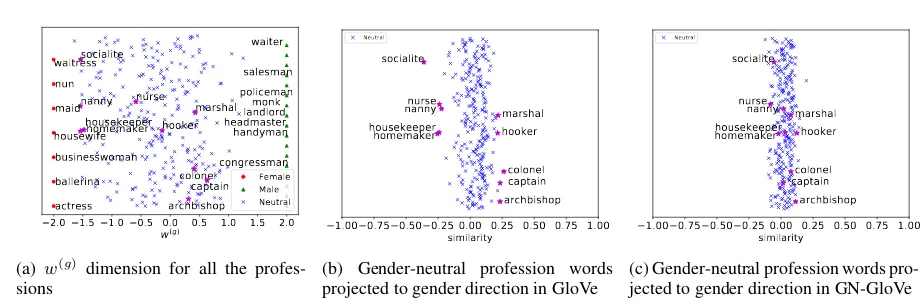
Separate protected attribute First, we demon-strate that GN-GloVe preserves the gender ciation (either definitional or stereotypical asso-ciations) in w(g)4. To illustrate the distribution of gender information of different words, we plot Fig. 1a using w(g) for the x-axis and a random value for the y-axis to spread out words in the plot. As shown in the figure, the gender-definition words, e.g. “waiter” and “waitress”, fall far away from each other inw(g). In addition, words such as “housekeeper” and “doctor” are inclined to dif-ferent genders and theirw(g)preserves such infor-mation.
Next, we demonstrate that GN-GloVe reduces gender stereotype using a list of profession titles from (Bolukbasi et al., 2016). All these profes-sion titles are neutral to gender by definition. In Fig. 1b and Fig. 1c, we plot the cosine similar-ity between each word vector w(a) and the gen-der directionvg (i.e., w
Tv g
kwkkvgk). Result shows that words, such as “doctor” and “nurse”, possess no gender association by definition, but their GloVe word vectors exhibit strong gender stereotype. In contrast, the gender projects of GN-GloVe word vectorsw(a)are closer to zero. This demonstrates
4We follow the original GloVe implementation using the
2.0 1.5 1.0 0.5 0.0 0.5 1.0 1.5 2.0
w(g) actress
ballerina businesswoman housewife maid nun waitress
waiter
landlord salesman policemanmonk
handyman congressman headmaster socialite
homemaker housekeeper nurse nanny
hookermarshal
archbishopcaptain colonel Female
Male Neutral
(a) w(g)
dimension for all the profes-sions
1.00 0.75 0.50 0.25 0.00 0.25 0.50 0.75 1.00
similarity
socialite
housekeeper nurse nanny
homemaker hooker marshal
archbishopcaptain colonel
Neutral
(b) Gender-neutral profession words projected to gender direction in GloVe
1.00 0.75 0.50 0.25 0.00 0.25 0.50 0.75 1.00
similarity
socialite
housekeeper nursenanny
homemaker hooker marshal
archbishop captaincolonel
Neutral
[image:4.595.64.526.64.217.2](c) Gender-neutral profession words pro-jected to gender direction in GN-GloVe
Figure 1: Cosine similarity between the gender direction and the embeddings of gender-neutral words. In each figure, negative values represent a bias towards female, otherwise male.
the gender information has been substantially di-minished fromw(a)in the GN-GloVe embedding. We further quantify the gender information ex-hibited in the embedding models. For each model, we project the word vectors of occupational words into the gender sub-space defined by “he-she” and compute their average size. A larger projection in-dicates an embedding model is more biased. Re-sults show that the average projection of GloVe is 0.080, the projection of Hard-GloVe is 0.019, and the projection of Gn-Glove is 0.052. Com-paring with GloVe, GN-GloVe reduces the bias by
35%. Although Hard-GloVe contains less gender information, we will show later GN-GloVe can tell difference between stereotype and gender-definition words better.
Gender Relational Analogy To study the qual-ity of the gender information present in each model, we follow SemEval 2012 Task2 (Jurgens et al.,2012) to create an analogy dataset,SemBias, with the goal to identify the correct analogy of “he - she” from four pairs of words. Each instance in the dataset consists of four word pairs: a genderdefinition word pair (Definition; e.g., “waiter -waitress”), a gender-stereotype word pair (Stereo-typ; e.g., “doctor - nurse”) and two other pairs of words that have similar meanings (None; e.g., “dog - cat”, “cup - lid”)5. We consider 20 gender-stereotype word pairs and 22 gender-definition word pairs and use their Cartesian product to generate 440 instances. Among the 22 gender-definition word pairs, there are 2 word pairs that
5The pair is sampled from the list of word pairs with
“SIMILAR: Coordinates” relation annotated in (Jurgens et al.,2012). The original list has 38 pairs. After removing gender-definition word pairs, 29 are left.
Dataset Embeddings Definition Stereotype None
SemBias
GloVe 80.2 10.9 8.9
Hard-Glove 84.1 6.4 9.5
GN-GloVe 97.7 1.4 0.9
SemBias (subset)
GloVe 57.5 20 22.5
Hard-Glove 25 27.5 47.5
GN-GloVe 75 15 10
Table 1: Percentage of predictions for each cate-gory on gender relational analogy task.
are not used as a seed word during the training. To test the generalization ability of the model, we generate a subset of data (SemBias (subset)) of 40 instances associated with these 2 pairs.
Table 1 lists the percentage of times that each class of pair is on the top based on a word embed-ding model (Mikolov et al., 2013c). GN-GloVe achieves 97.7% accuracy in identifying gender-definition word pairs as an analogy to “he - she”. In contrast, GloVe and Hard-GloVe makes signif-icantly more mistakes. On the subset, GN-GloVe also achieves significantly better performance than Hard-Glove and GloVe, indicating that it can gen-eralize the gender pairs on the training set to iden-tify other gender-definition word pairs.
Embeddings Analogy Similarity
Google MSR WS353-ALL RG-65 MTurk-287 MTurk-771 RW MEN-TR-3k
GloVe 70.8 45.8 62.0 75.3 64.8 64.9 37.3 72.2
Hard-GloVe 70.8 45.8 61.2 74.8 64.4 64.8 37.3 72.2
GN-GloVe-L1 68.9 43.7 62.8 74.1 66.2 66.2 40.0 74.5
GN-GloVe-L2 68.8 43.6 62.5 76.4 66.8 65.6 39.3 74.4
Table 2: Results on the benchmark datasets. Performance is measured in accuracy and in Spearman rank correlation for word analogy and word similarity tasks, respectively.
datasets. The analogy tasks are to answer the ques-tion “A is to BasC is to ?” by finding a word vectorwthat is closest towA−wB+wC in the
embedding space. Google (Mikolov et al.,2013a) and MSR (Mikolov et al.,2013c) datasets are uti-lized for this evaluation. The results are shown in Table 2, where the suffix “-L1” and “-L2” of GN-GloVe stand for the GN-GloVe usingJL1
D and
JDL2, respectively. Compared with others, GN-GloVe achieves a higher accuracy in the similarity tasks and its analogy score slightly drops indicat-ing that GN-GloVe is capable of preservindicat-ing prox-imity among words.
Coreference Resolution Finally, we investigate how the gender bias in word embeddings affects a downstream application, such as coreference res-olution. Coreference resolution aims at clustering the denotative noun phrases referring to the same entity in the given text. We evaluate our models on the Ontonotes 5.0 (Weischedel et al.,2012) bench-mark dataset and the WinoBias dataset (Zhao et al.,2018).6 In particular, the WinoBias dataset is composed of pro-stereotype (PRO) and anti-stereotype (ANTI) subsets. The PRO subset con-sists of sentences where a gender pronoun refers to a profession, which is dominated by the same gen-der. Example sentences include “The CEO raised the salary of the receptionist because he is gen-erous.” In this sentence, the pronoun “he” refers to “CEO” and this reference is consistent with so-cietal stereotype. The ANTI subset contains the same set of sentences, but the gender pronoun in each sentence is replaced by the opposite gender. For instance, the gender pronoun “he” is replaced by “she” in the aforementioned example. Despite the sentence is almost identical, the gender pro-noun now refers to a profession that is less repre-sented by the gender. Details about the dataset are in (Zhao et al.,2018).
6Specifically, we conduct experiments on the Type 1
ver-sion.
[image:5.595.73.526.62.139.2]Embeddings OntoNotes-test PRO ANTI Avg Diff GloVe 66.5 76.2 46.0 61.1 30.2 Hard-Glove 66.2 70.6 54.9 62.8 15.7 GN-GloVe 66.2 72.4 51.9 62.2 20.5 GN-GloVe(wa) 65.9 70.0 53.9 62.0 16.1
Table 3: F1 score (%) on the coreference system.
We train the end-to-end coreference resolution model (Lee et al., 2017) with different word em-beddings on OntoNote and report their perfor-mance in Table 3. For the WinoBias dataset, we also report the average (Avg) and absolute dif-ference (Diff) of F1 scores on two subsets. A smaller Diff value indicates less bias in a system. Results show that GN-GloVe achieves compara-ble performance as Glove and Hard-GloVe on the OntoNotes dataset while distinctly reducing the bias on the WinoBias dataset. When only thew(a) potion of the embedding is used in representing words, GN-GloVe(w(a)) further reduces the bias in coreference resolution.
5 Conclusion and Discussion
In this paper, we introduced an algorithm for train-ing gender-neutral word embeddtrain-ing. Our method is general and can be applied in any language as long as a list of gender definitional words is pro-vided as seed words (e.g., gender pronouns). Fu-ture directions include extending the proposed ap-proach to model other properties of words such as sentiment and generalizing our analysis beyond binary gender.
Acknowledgement
References
Sanjeev Arora, Yuanzhi Li, Yingyu Liang, Tengyu Ma, and Andrej Risteski. 2018. Linear algebraic struc-ture of word senses, with applications to polysemy.
Transactions of the Association of Computational Linguistics, 6:483–495.
Sudie E Back, Rebecca L Payne, Annie N Simpson, and Kathleen T Brady. 2010. Gender and pre-scription opioids: Findings from the national sur-vey on drug use and health. Addictive behaviors, 35(11):1001–1007.
Dzmitry Bahdanau, Kyunghyun Cho, and Yoshua Ben-gio. 2014. Neural machine translation by jointly learning to align and translate. arXiv preprint arXiv:1409.0473.
Tolga Bolukbasi, Kai-Wei Chang, James Y Zou, Venkatesh Saligrama, and Adam T Kalai. 2016. Man is to computer programmer as woman is to homemaker? debiasing word embeddings. In Ad-vances in Neural Information Processing Systems, pages 4349–4357.
Samuel R. Bowman, Gabor Angeli, Christopher Potts, and Christopher D. Manning. 2015. A large an-notated corpus for learning natural language infer-ence. In Proceedings of the 2015 Conference on Empirical Methods in Natural Language Processing (EMNLP). Association for Computational Linguis-tics.
Elia Bruni, Gemma Boleda, Marco Baroni, and Nam-Khanh Tran. 2012. Distributional semantics in tech-nicolor. In Proceedings of the 50th Annual Meet-ing of the Association for Computational LMeet-inguis- Linguis-tics: Long Papers-Volume 1, pages 136–145.
Aylin Caliskan, Joanna J Bryson, and Arvind Narayanan. 2017. Semantics derived automatically from language corpora contain human-like biases.
Science, 356(6334):183–186.
Manaal Faruqui, Jesse Dodge, Sujay K Jauhar, Chris Dyer, Eduard Hovy, and Noah A Smith. 2014. Retrofitting word vectors to semantic lexicons.
arXiv preprint arXiv:1411.4166.
Lev Finkelstein, Evgeniy Gabrilovich, Yossi Matias, Ehud Rivlin, Zach Solan, Gadi Wolfman, and Ey-tan Ruppin. 2001. Placing search in context: The concept revisited. InProceedings of the 10th inter-national conference on World Wide Web, pages 406– 414.
Nikhil Garg, Londa Schiebinger, Dan Jurafsky, and James Zou. 2017. Word embeddings quantify 100 years of gender and ethnic stereotypes. arXiv preprint arXiv:1711.08412.
Nikhil Garg, Londa Schiebinger, Dan Jurafsky, and James Zou. 2018. Word embeddings quantify 100 years of gender and ethnic stereotypes. Pro-ceedings of the National Academy of Sciences, 115(16):E3635–E3644.
Guy Halawi, Gideon Dror, Evgeniy Gabrilovich, and Yehuda Koren. 2012. Large-scale learning of word relatedness with constraints. In Proceedings of the 18th ACM SIGKDD international conference on Knowledge discovery and data mining, pages 1406– 1414. ACM.
David A Jurgens, Peter D Turney, Saif M Mohammad, and Keith J Holyoak. 2012. Semeval-2012 task 2: Measuring degrees of relational similarity. In Pro-ceedings of the First Joint Conference on Lexical and Computational Semantics-Volume 1: Proceed-ings of the main conference and the shared task, and Volume 2: Proceedings of the Sixth International Workshop on Semantic Evaluation, pages 356–364. Association for Computational Linguistics.
Matthew Kay, Cynthia Matuszek, and Sean A Munson. 2015. Unequal representation and gender stereo-types in image search results for occupations. In
Human Factors in Computing Systems, pages 3819– 3828.
Kenton Lee, Luheng He, Mike Lewis, and Luke Zettle-moyer. 2017. End-to-end neural coreference resolu-tion. EMNLP.
Omer Levy, Yoav Goldberg, and Ido Dagan. 2015. Im-proving distributional similarity with lessons learned from word embeddings. Transactions of the Associ-ation for ComputAssoci-ational Linguistics, 3:211–225.
Thang Luong, Richard Socher, and Christopher Man-ning. 2013. Better word representations with recur-sive neural networks for morphology. In Proceed-ings of the Seventeenth Conference on Computa-tional Natural Language Learning, pages 104–113.
Anna C McFadden, George E Marsh, Barrie Jo Price, and Yunhan Hwang. 1992. A study of race and gen-der bias in the punishment of school children. Edu-cation and treatment of children, pages 140–146.
Tomas Mikolov, Kai Chen, Greg Corrado, and Jef-frey Dean. 2013a. Efficient estimation of word representations in vector space. arXiv preprint arXiv:1301.3781.
Tomas Mikolov, Ilya Sutskever, Kai Chen, Greg S Cor-rado, and Jeff Dean. 2013b. Distributed representa-tions of words and phrases and their compositional-ity. InAdvances in neural information processing systems, pages 3111–3119.
Tomas Mikolov, Wen-tau Yih, and Geoffrey Zweig. 2013c. Linguistic regularities in continuous space word representations. InProceedings of the 2013 Conference of the North American Chapter of the Association for Computational Linguistics: Human Language Technologies, pages 746–751.
Jeffrey Pennington, Richard Socher, and Christopher Manning. 2014. Glove: Global vectors for word representation. InProceedings of the 2014 confer-ence on empirical methods in natural language pro-cessing (EMNLP), pages 1532–1543.
Matthew E Peters, Mark Neumann, Mohit Iyyer, Matt Gardner, Christopher Clark, Kenton Lee, and Luke Zettlemoyer. 2018. Deep contextualized word rep-resentations. arXiv preprint arXiv:1802.05365.
Kira Radinsky, Eugene Agichtein, Evgeniy Gabrilovich, and Shaul Markovitch. 2011. A word at a time: computing word relatedness using temporal semantic analysis. In Proceedings of the 20th international conference on World wide web, pages 337–346.
Herbert Rubenstein and John B Goodenough. 1965. Contextual correlates of synonymy. Communica-tions of the ACM, 8(10):627–633.
Rachel Rudinger, Chandler May, and Benjamin Van Durme. 2017. Social bias in elicited natural lan-guage inferences. In Proceedings of the First ACL Workshop on Ethics in Natural Language Process-ing, pages 74–79.
Rachel Rudinger, Jason Naradowsky, Brian Leonard, and Benjamin Van Durme. 2018. Gender bias in coreference resolution. InNAACL.
Cicero dos Santos and Maira Gatti. 2014. Deep con-volutional neural networks for sentiment analysis of short texts. In Proceedings of COLING 2014, the 25th International Conference on Computational Linguistics: Technical Papers, pages 69–78.
Simon ˇSuster, Ivan Titov, and Gertjan Van Noord. 2016. Bilingual learning of multi-sense embed-dings with discrete autoencoders. arXiv preprint arXiv:1603.09128.
Latanya Sweeney. 2013. Discrimination in online ad delivery. Queue, 11(3):10.
Shyam Upadhyay, Kai-Wei Chang, Matt Taddy, Adam Kalai, and James Zou. 2017. Beyond bilingual: Multi-sense word embeddings using multilingual context. In Proceedings of the 2nd Workshop on Representation Learning for NLP, pages 101–110.
Byron C Wallace and Michael J Paul. 2016. jerk or judgemental? patient perceptions of male versus fe-male physicians in online reviews.
Ralph Weischedel, Sameer Pradhan, Lance Ramshaw, Jeff Kaufman, Michelle Franchini, Mohammed El-Bachouti, Nianwen Xue, Martha Palmer, Jena D Hwang, Claire Bonial, et al. 2012. Ontonotes re-lease 5.0.
Sirui Yao and Bert Huang. 2017. Beyond parity: Fair-ness objectives for collaborative filtering. In Ad-vances in Neural Information Processing Systems, pages 2925–2934.
Daojian Zeng, Kang Liu, Yubo Chen, and Jun Zhao. 2015. Distant supervision for relation extraction via piecewise convolutional neural networks. In Pro-ceedings of the 2015 Conference on Empirical Meth-ods in Natural Language Processing, pages 1753– 1762.
Jieyu Zhao, Tianlu Wang, Mark Yatskar, Vicente Ordonez, and Kai-Wei Chang. 2017. Men also like shopping: Reducing gender bias amplifica-tion using corpus-level constraints. arXiv preprint arXiv:1707.09457.