A Phrase-Based, Joint Probability Model for Statistical Machine Translation
Daniel Marcu
Information Sciences Institute and Department of Computer Science University of Southern California 4676 Admiralty Way, Suite 1001
Marina del Rey, CA, 90292
William Wong
Language Weaver Inc. 1639 11th St., Suite 100A
Santa Monica, CA 90404
Abstract
We present a joint probability model for statistical machine translation, which au-tomatically learns word and phrase
equiv-alents from bilingual corpora.
Transla-tions produced with parameters estimated using the joint model are more accu-rate than translations produced using IBM Model 4.
1 Motivation
Most of the noisy-channel-based models used in statistical machine translation (MT) (Brown et al.,
1993) are conditional probability models. In the
noisy-channel framework, each source sentence e in a parallel corpus is assumed to “generate” a target sentence f by means of a stochastic process, whose parameters are estimated using traditional EM
tech-niques (Dempster et al., 1977). The generative
model explains how source words are mapped into target words and how target words are re-ordered
to yield well-formed target sentences. A variety
of methods are used to account for the re-ordering stage: word-based (Brown et al., 1993), template-based (Och et al., 1999), and syntax-template-based (Yamada and Knight, 2001), to name just a few. Although these models use different generative processes to explain how translated words are re-ordered in a tar-get language, at the lexical level they are quite sim-ilar; all these models assume that source words are
individually translated into target words.1
1
The individual words may contain a non-existent element, called NULL.
We suspect that MT researchers have so far cho-sen to automatically learn translation lexicons de-fined only over words for primarily pragmatic rea-sons. Large scale bilingual corpora with vocabu-laries in the range of hundreds of thousands yield very large translation lexicons. Tuning the probabil-ities associated with these large lexicons is a difficult enough task to deter one from trying to scale up to learning phrase-based lexicons. Unfortunately, trad-ing space requirements and efficiency for explana-tory power often yields non-intuitive results.
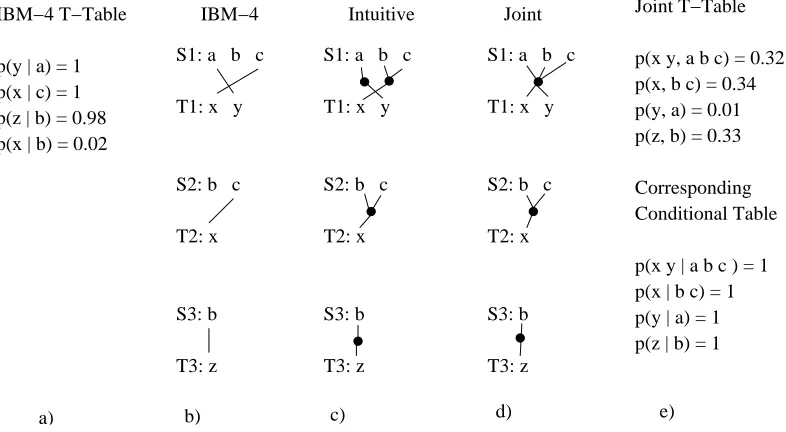
Consider, for example, the parallel corpus of three sentence pairs shown in Figure 1. Intuitively, if we allow any Source words to be aligned to any Target words, the best alignment that we can come up with is the one in Figure 1.c. Sentence pair (S2, T2) of-fers strong evidence that “b c” in language S means the same thing as “x” in language T. On the basis of this evidence, we expect the system to also learn from sentence pair (S1, T1) that “a” in language S means the same thing as “y” in language T. Unfortu-nately, if one works with translation models that do not allow Target words to be aligned to more than one Source word — as it is the case in the IBM mod-els (Brown et al., 1993) — it is impossible to learn that the phrase “b c” in language S means the same thing as word “x” in language T. The IBM Model 4 (Brown et al., 1993), for example, converges to the word alignments shown in Figure 1.b and learns the translation probabilities shown in Figure 1.a.2 Since in the IBM model one cannot link a Target word to more than a Source word, the training procedure
2
To train the IBM-4 model, we used Giza (Al-Onaizan et al., 1999).
IBM−4 T−Table
p(y | a) = 1 p(x | c) = 1 p(z | b) = 0.98 p(x | b) = 0.02
Joint T−Table
p(x, b c) = 0.34 p(y, a) = 0.01 p(x y, a b c) = 0.32
p(z, b) = 0.33
Corresponding Conditional Table
p(x y | a b c ) = 1 p(x | b c) = 1 p(y | a) = 1 p(z | b) = 1 S1: a b c
T1: x y
S2: b c
T2: x
S3: b
T3: z
S1: a b c
T1: x y
S2: b c
T2: x
S3: b
T3: z
S1: a b c
T1: x y
S2: b c
T2: x
S3: b
T3: z
Intuitive Joint
IBM−4
[image:2.612.110.503.74.290.2]a) b) c) d) e)
Figure 1: Alignments and probability distributions in IBM Model 4 and our joint phrase-based model.
yields unintuitive translation probabilities. (Note that another good word-for-word model is one that assigns high probability to p(x b) and p(z b) and low probability to p(x c).)
In this paper, we describe a translation model that assumes that lexical correspondences can be estab-lished not only at the word level, but at the phrase level as well. In constrast with many previous ap-proaches (Brown et al., 1993; Och et al., 1999; Ya-mada and Knight, 2001), our model does not try to capture how Source sentences can be mapped into Target sentences, but rather how Source and Tar-get sentences can be generated simultaneously. In other words, in the style of Melamed (2001), we es-timate a joint probability model that can be easily marginalized in order to yield conditional probabil-ity models for both source-to-target and target-to-source machine translation applications. The main difference between our work and that of Melamed is that we learn joint probability models of trans-lation equivalence not only between words but also between phrases and we show that these models can be used not only for the extraction of bilingual lexi-cons but also for the automatic translation of unseen sentences.
In the rest of the paper, we first describe our model (Section 2) and explain how it can be imple-mented/trained (Section 3). We briefly describe a
decoding algorithm that works in conjunction with our model (Section 4) and evaluate the performance of a translation system that uses the joint-probability model (Section 5). We end with a discussion of the strengths and weaknesses of our model as compared to other models proposed in the literature.
2 A Phrase-Based Joint Probability Model 2.1 Model 1
In developing our joint probability model, we started out with a very simple generative story. We assume that each sentence pair in our corpus is generated by the following stochastic process:
1. Generate a bag of concepts .
2. For each concept , generate a pair of
phrases
, according to the distribution
, where
and
each contain at least
one word.
3. Order the phrases generated in each language so as to create two linear sequences of phrases; these sequences correspond to the sentence pairs in a bilingual corpus.
For simplicity, we initially assume that the bag of concepts and the ordering of the generated phrases are modeled by uniform distributions. We do not
the pair
, but rather that
.
Un-der these assumptions, it follows that the probability of generating a sentence pair (E, F) using concepts
is given by the product of all
phrase-to-phrase translation probabilities, !
that
yield bags of phrases that can be ordered linearly so as to obtain the sentences E and F. For example, the sentence pair “a b c” — “x y” can be generated us-ing two concepts, (“a b” : “y”) and (“c” : “x”); or one concept, (“a b c” : “x y”), because in both cases the phrases in each language can be arranged in a sequence that would yield the original sentence pair. However, the same sentence pair cannot be gener-ated using the concepts (“a b” : “y”) and (“c” : “y”) because the sequence “x y” cannot be recreated from the two phrases “y” and “y”. Similarly, the pair can-not be generated using concepts (“a c” : “x”) and (“b” : “y”) because the sequence “a b c” cannot be created by catenating the phrases “a c” and “b”.
We say that a set of concepts can be linearized
into a sentence pair (E, F) if E and F can be obtained
by permuting the phrases
and
that characterize
all concepts "# . We denote this property
us-ing the predicate$%&')(*+,. Under this model, the
probability of a given sentence pair (E, F) can then be obtained by summing up over all possible ways
of generating bags of concepts -/. that can be
linearized to (E, F).
0
&')(12 3 465879;:=<?>@A> CB
D E F (1)
2.2 Model 2
Although Model 1 is fairly unsophisticated, we have found that it produces in practice fairly good align-ments. However, this model is clearly unsuited for translating unseen sentences as it imposes no con-straints on the ordering of the phrases associated with a given concept. In order to account for this, we modify slightly the generative process in Model 1 so as to account for distortions. The generative story of Model 2 is this:
1. Generate a bag of concepts .
2. Initialize E and F to empty sequencesG .
3. Randomly take a concept+HI and generate
a pair of phrases
, according to the
dis-tribution
, where
and each contain
at least one word. Remove then+ from .
4. Append phrase
at the end of F. Let J be the
start position of in F.
5. Insert phrase
at positionK in E provided that
no other phrase occupies any of the positions betweenK andKL
, where
gives the
length of the phrase
. We hence create the
alignment between the two phrases
and
with probabilityMON
7P Q 7 D RTS MVU 0 TKL XW!YZ+ whereU
\[)]8 is a position-based distortion
dis-tribution.
6. Repeat steps 3 to 5 until is empty.
In Model 2, the probability to generate a sentence pair (E, F) is given by formula (2), where0_^E`
M
denotes the position of wordJ of phrase
in
sen-tence F and0_^E` a
denotes the position in
sen-tence E of the center of mass of phrase .
0
&')(12 3 4T5879;:=<?>@A> CB
D E cb Hd 7P Q 7 D M S4e U 0_^E` M + 0_^E` a Xf (2)
Model 2 implements an absolute position-based distortion model, in the style of IBM Model 3. We
have tried many types of distortion models. We
eventually settled for the model discussed here be-cause it produces better translations during decod-ing. Since the number of factors involved in com-puting the probability of an alignment does not vary with the size of the Target phrases into which Source phrases are translated, this model is not predis-posed to produce translations that are shorter than the Source sentences given as input.
3 Training
1. Determine high-frequency n-grams in the bilingual corpus.
2. Initialize the t-distribution table.
3. Apply EM training on the
Viterbi alignments, while using smoothing.
4. Generate conditional model probabilities.
Figure 2: Training algorithm for the phrase-based joint probability model.
EM training algorithm exhaustively. To estimate the parameters of our model, we apply the algorithm in Figure 2, whose steps are motivated and described below.
3.1 Determine high-frequency n-grams in E and F
If one assumes from the outset that any phrases
gh4i and
*jki can be generated from a
con-cept, one would need a supercomputer in order to
store in the memory a table that models the
l
distribution. Since we don’t have access to comput-ers with unlimited memory, we initially learn t distri-bution entries only for the phrases that occur often in the corpus and for unigrams. Then, through smooth-ing, we learn t distribution entries for the phrases that occur rarely as well. In order to be considered in step 2 of the algorithm, a phrase has to occur at least five times in the corpus.
3.2 Initialize the t-distribution table
Before the EM training procedure starts, one has no idea what word/phrase pairs are likely to share the same meaning. In other words, all alignments that can generate a sentence pair (E, F) can be assumed to have the same probability. Under these conditions, the evidence that a sentence pair (E, F) contributes to the fact that
are generated by the same
con-cept is given by the number of alignments that can
be built between (E, F) that have a concept that
is linked to phrase
in sentence E and phrase
in sentence F divided by the total number of
align-ments that can be built between the two sentences. Both these numbers can be easily approximated.
Given a sentence E of K words, there are m*KlnJA
ways in which theK words can be partitioned intoJ
non-empty sets/concepts, where m*KlnJA is the
Stir-ling number of second kind.
m*KlnJA2po Jrq
M6s
e
3
Sut lv
o
Ew
J
[Tx
Jyvz[lF{ (3)
There are alsom*\|VnJA ways in which the| words
of a sentence F can be partitioned into J
non-empty sets. Given that any words in E can be
mapped to any words in F, it follows that there are
}
a
{
:=~>aB
M
S4e Jrq+m*KlnJAm*\|VnJA alignments that can be
built between two sentences (E, F) of lengths K and
| , respectively. When a concept generates two
phrases
of length and , respectively, there
are onlyKv' and| v" words left to link. Hence, in
the absence of any other information, the probabil-ity that phrases
and
are generated by the same
concept is given by formula (4).
}
a
{
:~ s;
>a s;
B
M
S4e Jrq+m*Kuvz_nJAm*\|v6nJA
}
a
{
:~>aB
M
S4e Jrq+m*KlnJAm*\|VnJA
(4)
Note that the fractional counts returned by equa-tion (4) are only an approximaequa-tion of the t distri-bution that we are interested in because the Stir-ling numbers of the second kind do not impose any restriction on the words that are associated with a given concept be consecutive. However, since for-mula (4) overestimates the numerator and denomi-nator equally, the approximation works well in prac-tice.
In the second step of the algorithm, we apply equation (4) to collect fractional counts for all un-igram and high-frequency n-gram pairs in the carte-sian product defined over the phrases in each sen-tence pair (E, F) in a corpus. We sum over all these t-counts and we normalize to obtain an initial joint distribution
. This step amounts to running the EM algorithm for one step over all possible alignments in the corpus.
3.3 EM training on Viterbi alignments
other tricks one can apply to collect fractional counts over all possible alignments in polynomial time. Starting with step 3 of the algorithm in Figure 2, for each sentence pair in a corpus, we greedily produce an initial alignment by linking together phrases so as to create concepts that have high t probabilities. We then hillclimb towards the Viterbi alignment of highest probability by breaking and merging con-cepts, swapping words between concon-cepts, and mov-ing words across concepts. We compute the prob-abilities associated with all the alignments we gen-erate during the hillclimbing process and collect t counts over all concepts in these alignments.
We apply this Viterbi-based EM training proce-dure for a few iterations. The first iterations estimate the alignment probabilities using Model 1. The rest of the iterations estimate the alignment probabilities using Model 2.
During training, we apply smoothing so we can associate non-zero values to phrase-pairs that do not occur often in the corpus.
3.4 Derivation of conditional probability model
At the end of the training procedure, we take marginals on the joint probability distributions
and
U
. This yields conditional probability distributions
and
U
0_^E`
(
0_^E`
&+ which we use for
decoding.
3.5 Discussion
When we run the training procedure in Figure 2 on the corpus in Figure 1, after four Model 1 iterations we obtain the alignments in Figure 1.d and the joint and conditional probability distributions shown in Figure 1.e. At prima facie, the Viterbi alignment for the first sentence pair appears incorrect because we, as humans, have a natural tendency to build align-ments between the smallest phrases possible. How-ever, note that the choice made by our model is quite reasonable. After all, in the absence of additional information, the model can either assume that “a” and “y” mean the same thing or that phrases “a b c” and “x y” mean the same thing. The model chose to give more weight to the second hypothesis, while preserving some probability mass for the first one.
Also note that although the joint distribution puts the second hypothesis at an advantage, the condi-tional distribution does not. The condicondi-tional
distri-bution in Figure 1.e is consistent with our intuitions that tell us that it is reasonable both to translate “a b c” into “x y”, as well as “a” into “y”. The condi-tional distribution mirrors perfectly our intuitions.
4 Decoding
For decoding, we have implemented a greedy pro-cedure similar to that proposed by Germann et al. (2001). Given a Foreign sentence F, we first pro-duce a gloss of it by selecting phrases in h i that
maximize the probability 0
&')(1. We then
itera-tively hillclimb by modifying E and the alignment between E and F so as to maximize the formula
0
&
0
( & . We hillclimb by modifying an
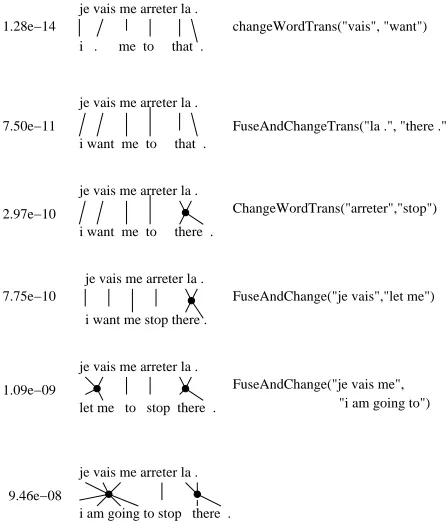
exist-ing alignment/translation through a set of operations that modify locally the aligment/translation built un-til a given time. These operations replace the En-glish side of an alignment with phrases of differ-ent probabilities, merge and break existing concepts, and swap words across concepts. The probability p(E) is computed using a simple trigram language model that was trained using the CMU Language Modeling Toolkit (Clarkson and Rosenfeld, 1997). The language model is estimated at the word (not phrase) level. Figure 3 shows the steps taken by our decoder in order to find the translation of sentence “je vais me arrˆeter l`a .” Each intermediate transla-tion in Figure 3 is preceded by its probability and succeded by the operation that changes it to yield a translation of higher probability.
5 Evaluation
To evaluate our system, we trained both Giza (IBM Model 4) (Al-Onaizan et al., 1999) and our joint probability model on a French-English parallel cor-pus of 100,000 sentence pairs from the Hansard corpus. The sentences in the corpus were at most
20 words long. The English side had a total
of 1,073,480 words (21,484 unique tokens). The French side had a total of 1,177,143 words (28,132 unique tokens).
prob-Model Percent perfect translations IBM Bleu score
Sentence length Sentence length
6 8 10 15 20 Avg. 6 8 10 15 20 Avg.
IBM 36 26 35 11 2 22 0.2076 0.2040 0.2414 0.2248 0.2011 0.2158
[image:6.612.68.548.71.143.2]Phrase-based 43 37 33 19 6 28 0.2574 0.2181 0.2435 0.2407 0.2028 0.2325
Table 1: Comparison of IBM and Phrase-Based, Joint Probability Models on a translation task.
je vais me arreter la .
i . me to that .
je vais me arreter la .
i want me to there . je vais me arreter la .
i want me to that .
je vais me arreter la .
i want me stop there .
je vais me arreter la .
let me to stop there . 7.75e−10
9.46e−08 1.09e−09 2.97e−10 7.50e−11 1.28e−14
ChangeWordTrans("arreter","stop")
FuseAndChange("je vais","let me") changeWordTrans("vais", "want")
FuseAndChangeTrans("la .", "there .")
je vais me arreter la .
i am going to stop there .
"i am going to") FuseAndChange("je vais me",
Figure 3: Example of phrase-based greedy decod-ing.
ability model. We also evaluated the translations automatically, using the IBM-Bleu metric (Papineni et al., 2002). The results in Table 1 show that the phrased-based translation model proposed in this pa-per significantly outpa-performs IBM Model 4 on both the subjective and objective metrics.
6 Discussion 6.1 Limitations
The main shortcoming of the phrase-based model in this paper concerns the size of the t-table and the cost of the training procedure we currently apply. To keep the memory requirements manageable, we arbitrarily restricted the system to learning phrase translations of at most six words on each side. Also,
the swap, break, and merge operations used dur-ing the Viterbi traindur-ing are computationally expen-sive. We are currently investigating the applicability of dynamic programming techniques to increase the speed of the training procedure.
Clearly, there are language pairs for which it would be helpful to allow concepts to be realized as non-contiguous phrases. The English word “not”, for example, is often translated into two French
words, “ne” and “pas”. But “ne” and “pas”
al-most never occur in adjacent positions in French texts. At the outset of this work, we attempted to de-velop a translation model that enables concepts to be mapped into non-contiguous phrases. But we were not able to scale and train it on large amounts of data. The model described in this paper cannot learn that the English word “not” corresponds to the French words “ne” and “pas”. However, our model learns to deal with negation by memorizing longer phrase translation equivalents, such as (“ne est pas”, “is not”); (“est inadmissible”, “is not good enough”); and (“ne est pas ici”, “is not here”).
6.2 Comparison with other work
A number of researchers have already gone be-yond word-level translations in various MT set-tings. For example, Melamed (2001) uses word-level alignments in order to learn translations of
non-compositional compounds. Och and Ney (1999)
[image:6.612.71.294.181.443.2]data. In our approach, phrases are not treated differ-ently from individual words, and as a consequence the likelihood of the EM algorithm converging to a better local maximum is increased.
Working with phrase translations that are learned independent of a translation model can also affect the decoder performance. For example, in our pre-vious work (Marcu, 2001), we have used a statis-tical translation memory of phrases in conjunction with a statistical translation model (Brown et al., 1993). The phrases in the translation memory were automatically extracted from the Viterbi alignments produced by Giza (Al-Onaizan et al., 1999) and re-used in decoding. The decoder described in (Marcu, 2001) starts from a gloss that uses the translations in the translation memory and then tries to improve on the gloss translation by modifying it
incremen-tally, in the style described in Section 4.
How-ever, because the decoder hill-climbs on a word-for-word translation model probability, it often discards good phrasal translations in favour of word-for-word translations of higher probability. The decoder in Section 4 does not have this problem because it hill-climbs on translation model probabilities in which phrases play a crucial role.
Acknowledgments. This work was supported by DARPA-ITO grant N66001-00-1-9814 and by NSF-STTR grant 0128379.
References
Yaser Al-Onaizan, Jan Curin, Michael Jahr, Kevin Knight, John Lafferty, Dan Melamed, Franz-Josef Och, David Purdy, Noah A. Smith, and David Yarowsky. 1999. Statistical machine translation. Fi-nal Report, JHU Summer Workshop.
Peter F. Brown, Stephen A. Della Pietra, Vincent J. Della Pietra, and Robert L. Mercer. 1993. The mathematics of statistical machine translation: Parameter estima-tion. Computational Linguistics, 19(2):263–311.
Philip Clarkson and Ronald Rosenfeld. 1997. Statistical language modeling using the CMU-Cambridge toolkit. In Proceedings of Eurospeech, September.
A. P. Dempster, N. M. Laird, and D. B. Rubin. 1977. Maximum likelihood from incomplete data via the EM algorithm. Journal of the Royal Statistical Society, 39(Ser B):1–38.
Ulrich Germann, Mike Jahr, Kevin Knight, Daniel Marcu, and Kenji Yamada. 2001. Fast decoding and optimal decoding for machine translation. In
Proceed-ings of the 39th Annual Meeting of the Association for Computational Linguistics (ACL’01), pages 228–235,
Toulouse, France, July 6–11. Decoder available at http://www.isi.edu/natural-language/projects/rewrite/.
Daniel Marcu. 2001. Towards a unified approach to memory- and statistical-based machine translation. In
Proceedings of the 39th Annual Meeting of the Associ-ation for ComputAssoci-ational Linguistics (ACL’01), pages
378–385, Toulouse, France, July 6–11.
Dan Melamed. 2001. Empirical Methods for Exploiting
Parallel Texts. The MIT Press.
Franz Josef Och, Christoph Tillmann, and Herman Ney. 1999. Improved alignment models for statistical ma-chine translation. In Proceedings of the Joint
Work-shop on Empirical Methods in NLP and Very Large Corpora, pages 20–28, University of Maryland,
Mary-land.
Kishore Papineni, Salim Roukos, Todd Ward, John Hen-derson, and Florence Reeder. 2002. Corpus-based comprehensive and diagnostic MT evaluation: Initial Arabic, Chinese, French, and Spanish results. In
Pro-ceedings of the Human Language Technology Confer-ence, pages 124–127, San Diego, CA, March 24-27.
Kenji Yamada and Kevin Knight. 2001. A syntax-based statistical translation model. In Proceedings of the
39th Annual Meeting of the Association for Compu-tational Linguistics (ACL’01), Toulouse, France, July