Performance Evaluation of Call Admission Control
Algorithm for Multiple Class Traffic in NGWN
Ramesh Babu H.S, Gowrishankar, Satyanarayana P.S
Abstract— The Quality of Service (QoS) measurement is one of the important concern in the next generation networks which is expected to pose many challenges to the researchers with respect to Radio resource management (RRM). The Call admission control is one of the Radio Resource Management (RRM) technique which plays instrumental role in ensuring the desired QoS to the users working on different applications which have diversified nature of QoS requirements. In this paper we propose an Analytical model based on higher order Markov chains for call admission control in a heterogeneous wireless network environment. The performance model is developed using the extension of Stochastic Petri networks called Stochastic Area Networks (SAN). The performance of the both analytical model and performance models are verified. In the proposed algorithm we have considered three classes of traffic having different QoS requirements and we have considered the heterogeneous network environment which can effectively handle these traffic. The traffic classes taken for the study are Conversational traffic, Interactive traffic and back ground traffic which are with varied QoS parameters. The paper compares the call blocking probabilities for all the three types of traffic in both the models.
Index words—call admission control, QoS, Heterogeneous wireless Networks, Stochastic Activity Networks, Radio resource management.
I. INTRODUCTION
The majority of research community in the field of wireless networks believes that the next stage beyond third-generation(3G) networks will include multiple wireless access technologies, all of which will coexist in a heterogeneous wireless access network environment[1,2] and use a common IP core to realize user-focused service delivery. The coexistence of Heterogeneous radio access technologies (RATs) will noticeably amplify the intensity difference in development of different high-speed multimedia services, such as video on demand, mobile gaming, Web browsing, video streaming, voice over IP and e-commerce etc.
The Manuscript received on January 14, 2010.
Ramesh Babu H.S. is with Department of Information Science and Engineering , Acharya Institute of Technology ( affiliated to Visvesvaraya Technological University), Bangalore-560090, INDIA , (phone +91 9448953800, [email protected])
Gowrishankar is with Department of Computer Science and Engineering, B.M.S. College of Engineering, (affiliated to Visvesvaraya Technological University), Bangalore-560019, INDIA ([email protected])
Satyanarayana P.S is with City Engineering College (affiliated to Visvesvaraya Technological University), Bangalore-560062, INDIA, ([email protected])
Seamless intersystem roaming across heterogeneous wireless access networks will be a major feature in the architecture of next generation wireless networks [3]. It is very well evident that no single RAT can provide ubiquitous coverage and continuously high quality services (QoS), the mobile users may have to roam among various radio access technologies to keep the network connectivity active to meet the applications/users requirements. With the increase in offered services and access networks, efficient user roaming and management of available radio resources becomes decisive in providing the network stability and QoS provisioning.
In this prevailing scenario the mobile users/subscribers have high QoS expectations and meeting these QoS requirements of the users is a challenge to the network service providers as the basic problem in the wireless networks is the scarce of the radio resources. The efficient RRM is very essential to tackle this scenario. The call admission control mechanism is one of the radio resource management techniques that plays dominant role in effectively managing the radio resources in wireless networks. The admission control in the wireless networks will reduce the call blocking probability in the wireless networks by optimizing the utilization of the available radio resources. The mobile communication environment is featured by moving terminals with different QoS requirements and in this current scenario the need of guaranteed QoS. The future users of mobile communication look for always best connected (ABC) anywhere and anytime in the Complementary access technologies like Wireless Local Area Networks (WLAN),Worldwide Inter operability for Microwave Access (Wi-Max) and Universal Mobile Telecommunication Systems (UMTS) and which may coexist with the satellite networks [4- 6].
The mobile communication networks are evolving into adaptable Internet protocol based networks that can handle multimedia applications. When the multimedia data is supported by wireless networks, the networks should meet the quality of service requirements. One of the key challenges to be addressed in this prevailing scenario is the distribution of the available channel capacity among the multiple traffic ensuring the QoS requirements of the traffic that are operating with different bandwidth requirements
.
There are many call admission control(CAC) algorithms proposed in the literature to handle single-class network traffic such as real-time traffic like voice calls [7-10].To serve the multiple classes of traffic we have the Partitioning CAC [11][12] and threshold based CAC [13] . The existing admission control strategies can handle the resource management in homogeneous wireless networks but are unable to handle the issues in the heterogeneous wireless environment. The mobility of the terminals in the mobile communication environment makes the resource allocation a challenging task when the resources are always in scarce. The efficient call admission control policies should be in place which can take care of this contradicting environment to optimize the resource utilization
The further sections of the paper are organized as follows. The section II discusses on the proposed system model for the call admission control based on multi dimensional Markov chains. Section IV presents the simulation results and finally conclusion and future work is presented in section V.
II. SYSTEM MODEL
In this paper we propose a novel admission control mechanism for reducing the call blocking probability there by increasing the resource utilization. This would achieve the Objective of guaranteeing the user QoS requirements. The proposed model is able to handle three types of applications that are considered for the study involving conversation traffic, interactive traffic and background traffic.
The proposed model is developed keeping in mind the WCDMA, Wi-Fi, and Wi-Max .The CAC mechanism proposed is focused only on the system’s ability to accommodate newly arriving users in terms of the total channel capacity which is needed for all terminals after the inclusion of the new user. In the case of a new call admission, if the channel load is precompiled and found to be higher than capacity of the channel, then the new call can be rejected if not new call can be admitted The decision of admitting or rejecting a new call in the network will be made only based on the capacity needed to accommodate the call.
We consider a heterogeneous network which comprises of a set of RATs Rn with co-located cells in which radio
resources are jointly managed. Cellular networks such as Wireless LAN and Wi-Max can have the same and fully overlapped coverage, which is technically feasible, and may also save installation cost. H is given as H{RAT 1, RAT 2,
RAT k } where K is the total number of RATs in the
heterogeneous cellular network. The heterogeneous cellular network supports n-classes of calls, and each RAT in set H
is optimized to support certain classes of calls.
The Analytical model for Call admission control mechanism in heterogeneous wireless networks is modeled using Higher order Markov Model. In the proposed model it is assumed that, whenever a new user enters the network will originate the network request at the rate λiand is assumed to follow a
Poisson process. The service time of the different class of traffic and types of calls is µi.The mean service time of all
types of users were assumed to follow negative exponential
distribution with the mean rate 1/µ.
The total number of virtual channel in the system are N. When the numbers of available channels are below the specified threshold the system will drop the calls. The threshold limit is determined by three positive integers A1,
A2 and A3. When the available number of channels falls
below the threshold A3 the proposed system will accept only
the voice calls and web browsing. When the available number of channels falls below the threshold A2 the
proposed system will accept only the voice calls .The P(0) is the probability that there is no allocated channels in the designated system .
Assuming that the arrival time of all types of traffic are equal i.e
λ
1=
λ
2=
λ
3=
λ
and the service time for the types of traffic are equal i.eµ
1=
µ
2=
µ
3=
µ
, the call blocking probability for type1 traffic could be expressed asn - 1 2 n - 3
( )
3
n n
a
P = P + P − + P (1)
Where a = λ / µ which should be generally less than one for the system stability. Similarly, the call blocking probability for type2 traffic Pn-1 is
1 n - 2 3 n - 4
( )
3
n n
a
P − = P + P − + P (2)
And the call blocking probability for type3 traffic Pn-2 is
represented as
2 ( n - 3 4 n - 5)
3
n n
a
P − = P + P − + P (3) The call blocking probability for the overall system traffic
Pnbcan be expressed as
1 - 2
( )
3
n b n n n
a
P = P + P − + P
(4)
III. PERFORMANCE MODEL
theoretical characteristics. Adding to these features it can also provide feature for analysing, executing or simulating in a computer is the fundamental capability that Mobius allows us. The performance model developed is based on SAN [14]. The SAN state space model will allow analyst to represent performance and availability aspect of the system. The SAN expressive capabilities allows analyst to model complex system dynamics [15].
The SAN, a variant of stochastic Petri nets, consist of four primitives: places, activities, input gates and output gates.
Places, represented by circles, represent the “state” of the modelled system in other words Place represents the state of the resource and in the proposed model the channel availability state is a Place. The place may contain tokens.
The token is used to represent the instances of a resource for example in the proposed model the each channel is represented as a token .Activities (“transitions” in Petri net terminology) represent actions of the modelled system that will change the state of the system, and are of two types: (a)
Timed and (b) Instantaneous. Timed activities (denoted by
hollow vertical bars) have durations which impact the performance of the modelled system. Instantaneous
activities (denoted by a thick vertical bar) represent actions
that complete in a negligible amount of time compared to other activities in a system.
The activity can be timed or instantaneous. Firing interval of the timed activity can be any continuous distribution, and in this model new user arrival is the activity. Input gates
have a finite set of inputs and one output, the each input gate
is associated with input predicate. The predicate can define inhibitory condition to each timed or instantaneous activity, here horizontal and vertical guard channel definition act as an inhibitory predicate to the new user arrival. The output
gates have finite set of output and single input, each output
gate has associated output function and will specify the action to be taken upon completion of the activity. In the proposed model the fading activity will deposit token from place channel availability to channel unavailability.
The major challenge in building the practical System-level dependability model needs an efficient modelling environment. There are many modelling tools has been dealing with largeness and complexity in the systems that are modelled. These modelling tools can easily represent, solve, and analyse toy models or highly abstracted system representations. However, many of these modelling tools have designs that slow down their effectiveness as the size or complexity of the models increases [16]. The Mobius is one such modelling tool that is able to address these issues. The Mobius was first introduced in [17] with the goal of providing a flexible, extensible, and efficient framework for implementing algorithms to model and solve discrete-event systems. It provides multiple primitive modelling components facilitating the representation of each part of a system in the study that is most appropriate.
A SAN performance model for the channel usage of type1, type2, and type3 traffic are specified in Figure 2. The performance model of the proposed system is shown in Figure 5.
Figure1: Primitive components of Stochastic Area Networks
.
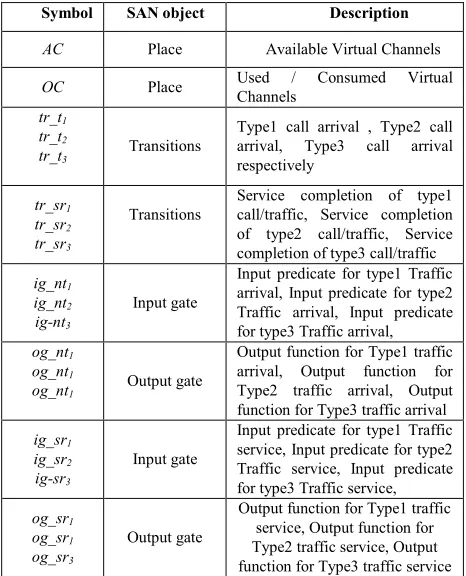
The primitive components used in the proposed model are shown in Table 1.The activities tr_t1, tr_t2 and tr_t3
represents the new user arrival/call arrival of traffic type1, traffic type2 and traffic type3 which are timed activities and the firing distribution is a Poisson distribution. The new traffic arrivals have an inhibitory input from the input gate
ig_nt1, ig_nt2 and ig_nt3 when the number of virtual
channels is less than A1 channels, A2and A3. The transition
tr_sr1,tr_sr2 and tr_sr3 represent user Service requests from
traffic type1, type2 and type3 to system. Service requests are hyper-exponential distribution. The places AC and OC in the channel usage model indicate available channels and
occupied channels /used channels.
The activity tr_t1represents the call arrival of traffic type1
on firing of transition tr_t1, the output gate og_nt1 shown in
the Traffic type1 SAN performance model will function and removes single token from place AC and deposit a single token in place OC as shown in figure 2. The transition tr_sr1
represents user Service requests from traffic type1 to system. Service requests are hyper-exponential distribution. After the call is serviced the channel is released to the timed activity tr_sr1 through inputgate ig_sr1 input gate. On firing
tr_sr1 the output gate og_sr1 will draw a token from OC and
deposit the token in place AC.
The performance model for type2 call is represented in figure 2. On firing of transition tr_t2 the output gate og_nt2
of the traffic type2 SAN performance model will function and removes single token from the place AC and deposit a single token in place OC. The transition tr_sr2 represents
user Service requests from traffic type2 to system. Service requests are hyper-exponential distribution. After the call is serviced the channel is released to the timed activity tr_sr2
through input gate ig_sr2. On firing tr_sr2 the output gate
og_sr2 will draw a token fromOC and deposit the token in
place AC.
The activity tr_nt3 in figure 2represents the call arrival of
traffic type3 and on firing of transition tr_t3 the output gates
og_nt3 in of the traffic type3 SAN performance will function
and removes single token from place AC and deposit a single token in place OC. The transition tr_sr3 represents
user Service requests from traffic type3 to system. Service requests are hyper-exponential distribution. After the call is serviced the channel is released to the timed activity tr_sr3
og_sr3 will draw a token fromOC and deposit the token in
place AC.
The transition tr_t1 represents an event of call arrival of
type1 traffic to the system. The transition new call/user arrival of traffic type1 has an inhibitory input from the input gate ig_nt1, when the total numbers of available channels are
less than A1 the transition tr_t1 is disabled. The transition
tr_t2 represents an event of call arrival of type2 traffic to the
system. The transition new user arrival of traffic type2 has an inhibitory input from the input gate ig_nt2, when the total
numbers of available channels are less than A2 the transition
tr_t2 is disabled. The tr_t3 is timed transition that represents
the event of arrival of type3 traffic to the system. The transition tr_nt3 is disabled when the available channel falls
below A3.
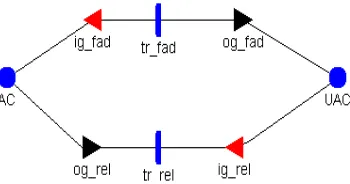
The figure 3 represents the fading model of the channel and AC and UAC are the places in fading model and will represent channel availability and channel non-availability respectively in the proposed system. The transition tr_fad
represent the fading rate in wireless network and fading rate generally follows Weibull distribution. The transition tr_fad
is fired if and only if the tokens are available in place AC
and this condition is implemented through input gate ig_fad .Transition tr_rel is the channel recovery process and is assumed to be exponential distribution. When the Timed activity tr_rel is fired the output gate og-rel will draw a token from the place UAC and send it to AC. This is nothing but when a channel fades then the channel will be in UAC state and when channel comes out of fading state it will trigger the transition tr_rel and place the token in AC. In other words the channel after coming out of fading state UAC will enter the available channel state AC.
The composed architectural model of the CAC model is represented in figure 4 and detailed SAN model of the CAC system is represented in figure 5.
IV. SIMULATION RESULTS AND DISCUSSION
In this section, we present the numerical results and compare the call blocking probabilities of the different types of traffic. The set of experiments were conducted varying the number of channels and the call blocking probability was compared of SAN model was compared `with the simulation results of the analytical model for all the three types of traffic.
The experiments are indicated by the simulation result shown in figure 6.The call blocking probability for a system with N channels which supports three types of traffic is conducted. The experiment considers that, whenever a new user enters the network will originate the network request at the rate λ1for type1 traffic, and λ2for type2 traffic and λ3 for
type3 traffic and is assumed to follow a Poisson process. The service time of the different types of traffic based calls is considered as µ1 for type1 traffic, µ2for type3 traffic and
µ3 for type3 traffic and is assumed to follow a Lognormal
random Process. For the first set of experiments we have considered the arrival rate of all the three types of traffic as
λ and service rate of all the three type of calls is same and is equal to µ.
The arrival rate of the calls was taken as the varying traffic intensity and call blocking probability of the type 1,
type2, type3 traffic, and overall call blocking probability of the system is plotted. The set of experiments conducted to compare the call blocking probabilities of the different types of traffic obtained for SAN performance model and the analytical model based on higher order Markov model. The proposed performance model for call admission control mechanism in the heterogeneous RATs and analyzing the call blocking probability keeping the variation in the number of channels was conducted. The graph obtained for the experiment setup conducted considering both the analytical model and SAN model for the blocking probability of type 1
Figure2. Performance model of the network traffic
[image:4.595.350.525.459.551.2]
Figure 3. Performance model for channel fading
Figure 5. Performance model for CAC system.
Table1. Structural Components of Traffic models
Symbol SAN object Description
AC Place Available Virtual Channels
OC Place Used / Consumed Virtual Channels
tr_t1
tr_t2
tr_t3
Transitions
Type1 call arrival , Type2 call arrival, Type3 call arrival respectively
tr_sr1
tr_sr2
tr_sr3
Transitions
Service completion of type1 call/traffic, Service completion of type2 call/traffic, Service completion of type3 call/traffic
ig_nt1
ig_nt2
ig-nt3
Input gate
Input predicate for type1 Traffic arrival, Input predicate for type2 Traffic arrival, Input predicate for type3 Traffic arrival,
og_nt1
og_nt1
og_nt1
Output gate
Output function for Type1 traffic arrival, Output function for Type2 traffic arrival, Output function for Type3 traffic arrival
ig_sr1
ig_sr2
ig-sr3
Input gate
Input predicate for type1 Traffic service, Input predicate for type2 Traffic service, Input predicate for type3 Traffic service,
og_sr1
og_sr1
og_sr3
Output gate
Output function for Type1 traffic service, Output function for Type2 traffic service, Output function for Type3 traffic service
Table2. Fading Model Structural Components
Symbol SAN object Description
AC Place Channel Availability
UAC Place Unavailability of Channel
tr_fad Transition Channel fading Rate
tr_rel Transition Channel recover y/release rate
ig_fad Input gate Input predicate for channel
fading
ig_rel Input Gate Service completion
og_fad Output
gate
Output function for fading transition
og_rel Output
gate
Output function for recovery transition
[image:5.595.55.288.300.588.2]
Figure 6. comparison of call blocking probability of the system
and blocking probability of the type 2, and type3 traffic of the system is plotted. The Figure 6 shows call blocking probability for all three types of traffic .The horizontal axis shows the number of channels while the vertical axis shows the call blocking probability of all types of traffic.
The parameters of analytic performance model are also called as Performance model parameters. The parameters are number of virtual channels (N), user arrival rate (λ), arrival rate of type 1 call (λ1), arrival rate of type 2 call (λ2.) arrival rate of type 3 call (λ3) and service time of the calls is taken as µ1 , µ2 and µ3.
The simulation results show that the call blocking probability of the different types of traffic will decrease with the increase in the number of channels in the system. The behaviour of analytical model and the performance model developed using stochastic activity network and simulated using the Mobius simulator behaves identically.
V. CONCLUSION AND FUTURE WORK
dynamic network condition. The future work of this research includes the use of intelligence in CAC decision making process by applying fuzzy Neural Network (NN) technique in making the decision of admitting or rejecting the call.
REFERENCES
[1] A. Sanmateu et al., “Seamless Mobility across IP Networks Using Mobile IP,” Int’l J. Computers and Telecommunications Networking, vol. 40, Sept. 2002, pp. 181–190.
[2] G.Wu et al., “MIRAI Architecture for Heterogeneous Networks,” IEEE Comm., vol. 40, no. 2, 2002, pp. 126–134.
[3] S.Y. Hui and K.H. Yeung, “Challenges in the Migration to 4G Mobile Systems,” IEEE Comm., vol. 41, no. 12, 2003, pp. 54–59.
[4] X.G. Wang, J.E. Mellor, G. Min, A QoS-based bandwidth management scheme in heterogeneous wireless networks international journal of simulation systems, Science and Technology, ISSN: 1473-8031, 5 (1-2) (2004) 9–17.
[5] E. Vanem, S. Svaet, F. Paint, Effects of multiple access alternatives in heterogeneous wireless networks, IEEE Wireless and Networking 3 (2003) 1696–1700.
[6] K. Murray, R. Mathur, D. Pesch, Network access and handover control in heterogeneous wireless networks for smart space environments, in: First International Workshop on Management of Ubiquitous Communications and Services, MUCS, Waterford, Ireland, December 11, 2003
[7] Y. B. Lin and I. Chlamtac, Wireless and Mobile Network Architecture, John Wiley and Sons, 2001.
[8] D. Hong and S. S. Rappaport, “Traffic model and performance analysis for cellular mobile radio telephone systems with prioritized and non-prioritized handoff procedures”, IEEE Trans. on Vehicular Technology, Vol. VT35. No.3, August 1986.
[9] R. Guerin, “ Queuing-blocking systems with two arrival streams and guarded channels”, IEEE Trans. On Communication, Vol. 36, February 1988, pp. 153-163
[10] L. Huang, S. Kumar, and C.-C. J. Kuo, “Adaptive resource allocation for multimedia QoS management in wireless networks ,”IEEE Trans. Vehicular Technology, Vol. 53, 2004, pp. 547-558.
[11] Y.-R. Haung and J.-M. Ho, “Distributed call admission control for a heterogeneous PCS network, ”IEEE Trans. on Computers, 51, 2002. pp. 1400-1409.
[12] J. Ye, J. Hou, and S. Papavassilliou, “A comprehensive resource management for next generation wireless networks”, IEEE Trans. on Mobile Computing, Vol. 1, No. 4, 2002, pp. 249-263.
[13] S. E. Ogbonmwan, W. Li and D. Kazakos. “Multi threshold bandwidth reservation scheme of an integrated voice/data wirelessnetwork,2005. International Conference on Wireless Networks, Communications and Mobile Computing, Maui, Hawaii, June 2005, pp. 226-231
[14] J.F. Meyer, A. Movaghar and W.H. Sanders, “Stochastic Activity Networks: Structure, Behaviour and Application”, Proceedings of the Int. Conf. On Timed Petri Nets, Turin, Italy, July 1985, pp 106-115. [15] J.F. Meyer, W.H. Sanders, “Specification and Construction of
Performability Models”, Proceedings of the Second International Workshop on Performability of Computer and Communication Systems, Mont. Saint-Michel, France, 28-30 July, 1993.
[16] Möbius 2.3: An extensible tool for dependability, security, and performance evaluation of large and complex system models Courtney, T.; Gaonkar, S.; Keefe, K.; Rozier, E.W.D.; Sanders, W.H. Dependable Systems & Networks, 2009. DSN apos;09. IEEE/IFIP International Conference on Volume, Issue, June 29 2009-July 2 2009 Page(s):353 – 358