Proceedings of the 2019 Conference on Empirical Methods in Natural Language Processing 1071
Semantic Role Labeling with Iterative Structure Refinement
Chunchuan Lyu1 Shay B. Cohen1 Ivan Titov1,2
1ILCC, School of Informatics, University of Edinburgh 2ILLC, University of Amsterdam
[email protected] [email protected] [email protected]
Abstract
Modern state-of-the-art Semantic Role Label-ing (SRL) methods rely on expressive sentence encoders (e.g., multi-layer LSTMs) but tend to model only local (if any) interactions be-tween individual argument labeling decisions. This contrasts with earlier work and also with the intuition that the labels of individual argu-ments are strongly interdependent. We model interactions between argument labeling de-cisions through iterative refinement. Start-ing with an output produced by a factorized model, we iteratively refine it using a refine-ment network. Instead of modeling arbitrary interactions among roles and words, we en-code prior knowledge about the SRL problem by designing a restricted network architecture capturing non-local interactions. This model-ing choice prevents overfittmodel-ing and results in an effective model, outperforming strong fac-torized baseline models on all 7 CoNLL-2009 languages, and achieving state-of-the-art re-sults on 5 of them, including English.
1 Introduction
Semantic role labeling (SRL), originally
intro-duced byGildea and Jurafsky(2000), involves the
prediction of predicate-argument structure, i.e., identification of arguments and their assignment
to underlying semantic roles. Semantic-role
rep-resentations have been shown to be beneficial in many NLP applications, including question
an-swering (Shen and Lapata,2007), information
ex-traction (Christensen et al., 2011) and machine
translation (Marcheggiani et al., 2018). In this
work, we focus on dependency-based SRL (Hajiˇc
et al.,2009), a popular version of the task which involves identifying syntactic heads of arguments rather than marking entire argument spans (see the
graph in red in Figure 1). Edges in the
depen-dency graphs are annotated with semantic roles
(e.g., A0:PLEASER) and the predicates are labeled
An standard for a state satisfy
An easier standard for a state to entity fulfilled (A1)
satisfy
easier to
pleaser (A0) entity fulfilled (A1)
satisfy.01
satisfy.01
Initial
Refined
=
gold
[image:1.595.313.522.231.284.2]An easier standard for a state to satisfy ...
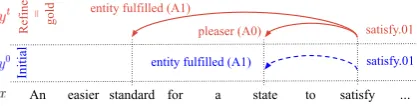
Figure 1: An example of structured refinement, the sen-tence fragment is from CoNLL-2009: the initial pre-diction by the factorized model in blue, the refined one (identical to the gold standard) in red.
with their senses from a given sense inventory
(e.g.,SATISFY.01 in the example).
Before the rise of deep learning methods, the most accurate SRL methods relied on model-ing high-order interactions in the output space (e.g., between arguments or arguments and pred-icates) (Watanabe et al., 2010; Toutanova et al.,
2008). Earlier neural methods can model such
output interactions through a transition system,
and achieve competitive performance (
Hender-son et al., 2013). However, current state-of-the-art SRL systems use powerful sentence en-coders (e.g., layers of LSTMs (Li et al.,2018;He et al.,2017) or multi-head self-attention (Strubell et al., 2018)) and factorize over small fragments
of the predicted structures. Specifically, most
modern models process individual arguments and perform predicate disambiguation independently. The trend towards more factorizable models is not unique to dependency-based SRL but common for
most structured prediction tasks in NLP (
Kiper-wasser and Goldberg, 2016; Dozat and
Man-ning, 2017, 2018). The only major exception
is language generation tasks, especially machine translation and language modeling, where larger amounts of text are typically used in training.
the output. However, capturing these interactions in the encoder would require substantial amounts of data. Even if we have domain knowledge about likely interactions between components of the pre-dicted graphs, it is hard to inject this knowledge in an encoder.
Consider the example in Figure 1. The
ar-gument ‘state’ appears in the highly
ambigu-ous syntactic position ’[.] to satisfy’. All
three core semantic roles of the predicate SAT
-ISFY.01 can in principle appear here: patient
(A1:ENTITY FULFILLED, as in ‘a sweet tooth to satisfy’), instrument (A2:METHOD, as in ‘a
lit-tle dessert to satisfy your sweet tooth’) and agent (A0: PLEASER, as in our actual example). The basic factorized model got it wrong, assigning A1
to the argument‘state’. However, taking into
ac-count other arguments, the model can correct the
label. The configuration ‘A1 to satisfy’ is more
likely when an agent (A0) is present in the sen-tence. The lack of an agent boosts the score for
the correct configuration ‘A0to satisfy’.
Our iterative refinement approach encodes the above intuition. In iterative refinement (Lee et al.,
2018), a refinement network repeatedly takes
pre-vious output as input and produces its refined ver-sion. Formally, we have
yt+1= Refine(x, yt).
Naturally, such refinement strategy also requires
an initial prediction y0, which is produced by a
(‘base’) factorized model.
Refinement strategies have been successful in machine translation (Lee et al.,2018;Novak et al., 2017;Xia et al., 2017; Hassan et al., 2018), but their effectiveness in other NLP tasks is yet to
be demonstrated.1 We conjecture that this
dis-crepancy is due to differences in data availabil-ity. Given larger amounts of training data typi-cally used in machine translation, their base mod-els and refinement networks overfit to a lesser ex-tent. Overfitting in (1) the base model and (2) the refinement network are both problematic. The first implies that either there are no mistakes in the base models in the training set or their distribution is very different from that in the test regime, so the training material for the inference networks ends up being misleading. The second naturally means that refinement will fail at test time. We address both these issues by designing restricted inference
1See extra discussion and related work in section2.
networks and adding a specific form of noise when training them.
Our structured refinement network is simple but encodes non-local dependencies. Specifically, it takes into account the information about the role distributions on the previous iteration aggregated over the entire sentences but not the informa-tion what the other arguments are. It is a coarse compressed representation of the prediction, yet it represents long-distance information not readily available within the factorized base model. While this is not the only possible design, we believe that the empirical gains from using this simple re-finement network, demonstrate the viability of our general framework of iterative refinement with re-stricted inference networks. They also suggest that intuitions underlying declarative constraints used
in early work on SRL (Punyakanok et al., 2008;
Das et al.,2012) can be revisited but now encoded in a flexible soft way to provide induction biases for the refinement networks. We leave this for fu-ture work.
We consider the CoNLL-2009 dataset (Hajiˇc
et al., 2009). We start with a strong factorized baseline model, which already achieves state-of-the-art results on a subset of the languages. Then, using our structure refinement network, we im-prove on this baseline on all 7 CoNLL-2009 lan-guages. The model achieves best-reported results in 5 languages, including English. We also ob-serve improvements on out-of-domain test sets, confirming the robustness of our approach. We perform experiments demonstrating the impor-tance of adding noise, and ablation studies show-ing the necessity of incorporatshow-ing output interac-tions. Furthermore, we provide analysis on con-straint violations and errors on the English test set.2
2 Related Work
Learning to refine predictions from neural struc-tured prediction models has recently received sig-nificant attention. Our approach bears similarity to methods used in machine translation (Lee et al., 2018;Novak et al., 2017; Xia et al., 2017). All these methods refine a translated sentence pro-duced by a seq2seq model with another seq2seq model. Among them, the deliberation networks
by Xia et al. (2017) rely on BiLSTMs and im-prove initial predictions from an competitive base-line and obtain state-of-art-results on
English-to-French translation. Later, it has been shown
that the deliberation networks can improve trans-lation when used within the Transformer frame-work (Hassan et al.,2018).
Certain approaches, not necessarily directly op-timized for refinement, can nevertheless be re-garded as iterative refinement methods. Structured prediction energy networks (SPENs) are trained to assign global energy scores to output structures, and the gradient descent is used during inference
to minimize the global energy (Belanger and
Mc-Callum, 2016). As the gradient descent involves iterative optimization, its steps can be viewed as
iterative refinement. In particular,Belanger et al.
(2017) build a SPEN for SRL, but for the
span-based formalism, not the dependency one we con-sider in this work. While they improve over their baseline model, their baseline model used multi-layer perceptron to encode local factors, thus the encoder power is limited. Moreover their refined model performs worse in the out-of-domain set-ting than their baseline model, indicaset-ting overfit-ting (Belanger et al.,2017).
In the follow-up work, Tu and Gimpel (2018,
2019) introduce inference networks to replace
gra-dient descent. Their inference networks directly refine the output. Improvements over competi-tive baselines are reported on part-of-speech tag-ging, named entity recognition and CCG
super-tagging (Tu and Gimpel, 2019). However, their
inference networks are distilling knowledge from a tractable linear-chain conditional random field (CRF) model. Thus, these methods do not pro-vide direct performance gains. More importantly, the interactions captured in these models are likely local, as they learn to mimic Markov CRFs.
Denoising autoencoders (Vincent et al.,2008)
can also be used to refine structure. Indeed, image segmentation can be improved through iterative
inference with denoising autoencoders (Romero
et al.,2017;Drozdzal et al.,2018). Their frame-work is very similar to ours, albeit we are frame-working in a discrete domain. One other difference is that by using a convolutional architecture in the refine-ment network, they are still modeling only local
interactions. At a more conceptual level, Bengio
et al.(2013) argued that a denoising autoencoder should not be too robust to the input variations as
to ignore the input. This indicates that we should not expect refinement networks to correct all the errors, even in theory, and hence, the refinement networks do not need to be particularly powerful.
Very recently, Wang et al. (2019) used high
order statistical model for Semantic Dependency
Parsing (Oepen et al.,2015), and obtain
improve-ments over strong baseline using BiLSTM. They attempted loopy belief propagation and mean field variational inference for inference, and train the model end to end. Such inference steps are well motivated. This work is similar to energy network
approach (Belanger and McCallum,2016), while a
global score function is provided, and approximate inference steps are used. Comparing to ours, the inference can also be regarded as iterative struc-ture refinement. Yet, we do not provide a global score and directly try to model the refinement. In principle, our formalization should give us more liberty in terms of designing the refinement net-work.
3 Dependency Semantic Role Labeling
In this section, we introduce the notation and present our factorized baseline model.
3.1 Notation
In dependency SRL, for each sentence of length
n, we have a sequence of words w, dependency
labelsdep, part-of-speech tagspos, each being a
discrete sequence of length n. To simplify
no-tation, we consider one predicate at a time. We
denote the number of roles by r, it includes the
‘null’ role, signifying that the corresponding word is not an argument of the predicate. Formally,
P ∈ ∆m−1 is the probability distribution overm
predicate senses, and∆m−1 represents the
corre-sponding probability simplex. We also have
pred-icate sense embeddingsΠ∈Rm×dπ, and indexj,
throughout the discussion, refers to the position of the target predicate in the sentence. R∈ ∆nr−1is
a matrix of sizen×rsuch that each row sums to
1, corresponding to a probability distribution over roles. In particular Ri,0 is the probability ofi-th
word not being an argument of the predicate. We index role label and sense predictions from different refinement iterations (‘time steps’) with
t, i.e. PtandRt. The indextranges from0toT,
and P0 and R0 denotes the predictions from the
3.2 Factorized Model
Similarly to recent approaches to SRL and seman-tic graph parsing (He et al.,2017;Li et al.,2018; Dozat and Manning, 2018), our factorized
base-line model starts with concatenated embeddingsx.
Then, we encode the sentence with a BiLSTM, further extract features with an MLP (multilayer perceptron) and apply a bi-affine classifier to the resulting features to label the words with roles. We also use a predicate-dependent linear layer for sense disambiguation.
More formally, we start with getting a sentence representation by concatenating embeddings. We
havexw ∈
Rn×dw,xdep ∈Rn×dδ,xpos ∈Rn×dp for words, dependency labels and part-of-speech tags, respectively. We concatenate them to form a sentence representation:
x=xw◦xdep◦xpos ∈Rn×dx (1)
We further encode the sentence with a BiLSTM:
h =BiLSTM(x)∈Rn×dh (2)
From these context-aware word representations, we produce features for argument identification and role labeling that will be used by a bi-affine classifier. Note that, for every potential predicate-argument dependency (i.e. a candidate edge), we need to produce representations of both endpoints: the argument and the predicate ‘sides’. For the
ar-gument side,hρ0 will be used to compute the
log-its for argument identification andhρ1 will be used for deciding on its role:
hρ0 =MLP(h)∈
Rn×dρ0 (3) hρ1 =MLP(h)∈
Rn×dρ1 (4) Similarly, for the predicate side, we also extract
two representations h%0 and h%1 (recall that the
predicate is at positionj):
h%0 =MLP(h
j)∈Rdρ0 (5) h%1 =MLP(h
j)∈Rdρ1 (6)
We then obtain logitsIρ0 corresponding to the
de-cision to label arguments asnull, and logitsIρ1for other roles. So, we have:
Iρ0 =BiAffine(h%0,hρ0)∈
Rn (7)
Iρ1 =BiAffine(h%1,hρ1)∈
Rn×(r−1) (8)
Unlike Dozat and Manning (2018), where
argu-ment identification and role labeling are trained
with two losses,3 we feed them together into a
single softmax layer to compute the semantic-role distributionR0:
Iα=Iρ0◦Iρ1 ∈
Rn×r (9)
R0=Softmax(Iα)∈∆nr−1 (10)
Now, for sense disambiguation, we need to extract
yet another predicate representationhπ:
hπ =MLP(hj)∈Rdπ (11)
In the formalism we use (PropBank), senses are predicate-specific, so we use predicate-specific
sense embedding matrices Π. The matrixΠ acts
as a linear layer before softmax:
Iπ =Π·hπ ∈Rm (12)
P0 =Softmax(Iπ)∈∆m−1 (13)
This ends the description of our baseline model, which we also use to get initial predictions for it-erative refinement.
4 Structured Refinement Network
In this section, we introduce the structured refine-ment network for dependency SRL. When doing refinement, it has access to the roles distribution
Rt∈∆nr−1and the sense distributionPt∈∆m−1
computed at the previous iteration (i.e. time t).
In addition, it exploits the sentence representation
x ∈ Rn×dx. Our refinement network is limited
and structured, in the sense that it only has access to a compressed version of the previous prediction, and the network itself is a simple MLP.
Similarly to our baseline model, we extract
fea-ture vectorsgfrom inputxand further separately
encode the argument representation gα and the
predicate token representationgπ:
g =BiLSTM(x)∈Rn×dh (14)
gα =MLP(g)∈Rn×dg (15)
gπ =MLP(gj)∈Rdg (16)
To simplify the notation, we omit indexing them byt, except forRtandPt. We use two refinement networks, one for roles and another one for predi-cate senses.
3The separate processing ofIρ0 andIρ1 rather than
4.1 Role Refinement Network
First, we describe our structured refinement
net-work for role labeling. We use i to index
argu-ments. We obtain a compressed representationoi
used for refiningRti by summing up the
probabil-ity mass for all roles, excluding the null role:
oi,u=
X
k6=i
Rtk,u∈R (17)
oi= [oi,u]∈Rr−1 (18)
Intuitively,oi is the aggregation of all other roles
being labeled by the current predicate. We
con-catenateoi with feature vectors of the current
ar-gument gα, predicate gπ, the relaxed predicate
sense embeddingΠ|·Ptand the role probability
it-self (Ri) to form the input to a two-layer network:
zαi =Rti◦oi◦giα◦gπ◦(Π|·Pt) (19)
zαi ∈R2r−1+2dg+dπ
Mαi =Wα·σ(Wα·zαi)∈Rr (20)
Mα=[Mαi,u]∈Rn×r, (21)
where σ is the logistic sigmoid function, Wα ∈
Rdr×(2r−1+2dg+dπ), Wα ∈Rr×dr are learned
lin-ear mappings. We obtain our refined logitsMα
i for
thei-th argument;Mαrefers to the stacked matrix
of logits for all arguments. To obtain the refined
role distribution, we add up Mα and Iα that we
got from the baseline model, and follow that by a softmax layer:
Rt+1=Softmax(Mα+ Iα)∈∆nr−1 (22)
4.2 Sense Refinement Network
To build a representation for sense disambigua-tion, we simply compute the probability mass for each role (excluding the null role) to obtainrπ, and concatenate this withgπandΠ|·Pt:
rπ =X
k
Rtk,1:∈Rr−1 (23)
zπ =(Π|·Pt)◦rπ◦gπ ∈Rr−1+dg+dπ (24)
Differently from the role refinement network, sense prediction is predicate-specific. Therefore,
we first map zπ to Rdπ, and then take the inner
product with the predicate-specific sense embed-dingsΠto get the refined logits:
Mπ =Π·Wπ·σ(Wπ·zπ)∈Rm (25)
Similarly to role refinement,σis the logistic func-tion,Wπ ∈ Rdr×(r−1+dg+dπ), Wπ ∈ Rm×dr are learned linear mappings. Again, we combine the
logitsMπ andIπbefore the softmax layer:
Pt+1=Softmax(Mπ+ Iπ)∈∆m−1 (26)
4.3 Weight Tying
Our refinement networks are similar to the
denois-ing autoencoders (DAEs;Vincent et al. 2008), so
we use the weight-tying technique popular with DAEs. We believe that the technique may be even more effective here as the amount of labeled data for SRL is lower than in many usual applications
of DAEs. We tie Wα with a subset of Wα rows:
specifically with the rows acting onRtiin the
com-putation ofMiα (see equations19and20).
Simi-larly, we tieWπ with the part ofWπ
correspond-ing toΠ|·Pt(see equations24and25). Formally,
Wα=Wα|[:r] (27)
Wπ =Wπ|[:dπ] (28)
whereW[:k]takes the firstkrows of matrixW.
4.4 Self Refinement
We describe a simpler version of the refinement network which we will use in experiments to test whether the improvements with the structured re-finement network over the factorized baseline are genuinely coming from modeling interaction be-tween arguments rather than from simply combin-ing multiple classifiers. This simpler refinement network does not account for any interactions
be-tween arguments. Instead of equations19and 24,
we have:
zαi =Rti◦gαi ◦gπ ∈Rr+2dg+dπ (29)
zπ =(Π|·Pt)◦gπ ∈Rdg+dπ (30) Everything else is kept the same as in the full
model, expect that the size ofWα andWπ needs
to be adjusted. We refer to this ablated network as theself-refinement network.
5 Training for Iterative Structure Refinement
In this section, we describe our training procedure.
5.1 Two-Stage Training
to converge. Instead, we train the factorized base-line model first and then optimize the refinement networks while keeping the baseline model fixed.
5.2 Stochastic Training
Our baseline model overfits to the training set, and, if simply training on its output, our refine-ment network would learn to copy the base
pre-dictions. Instead, we perturb the baseline
pre-diction during training. Naturally, we can add
dropout (Srivastava et al., 2014) and recurrent
dropout (Gal and Ghahramani, 2016) to our
neu-ral networks. However, for the smaller data set we use, we find this not sufficient. In particu-lar, we use Gumbel-Softmax instead of Softmax.
Gumbel-Softmax(I) = Softmax(I +λg), where
the random variableis drawn from the standard
Gumbel distribution (Maddison et al.,2017;Jang
et al.,2017), andλg is a hyper-parameter
control-ling decoding stochasticity.4
5.3 Loss for Iterative Refinement
Let us denote gold-standard labels for roles and
predicates as R∗ and P∗. We use two separate
lossesLbase(R∗,P∗, x)andLrefine(R∗,P∗, x)for
our two-stage training. We define losses for pre-dictions from each refinement iteration and sum them up:
Lbase(R∗,P∗, x) =L(R∗,R0) +L(P∗,P0)
(31)
Lrefine(R∗,P∗, x) = T
X
t=1
L(R∗,Rt) +L(P∗,Pt)
(32)
We adopt the Softmax-Margin loss (Gimpel and
Smith, 2010;Blondel et al., 2019) for individual
L. Effectively, we subtract 1 from the logit of the
gold label, and apply the cross entropy loss.
6 Experiments
Datasets We conduct experiments on
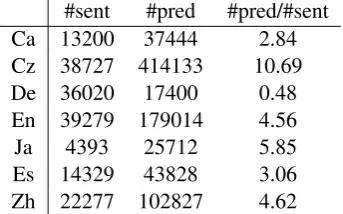
CoNLL-2009 (Hajiˇc et al.,2009) data set for all languages, including Catalan (Ca), Chinese (Zh), Czech (Cz), English (En), German (De), Japanese (Jp) and Spanish (Es). We use the predicted part-of-speech tags, dependency labels, and pre-identified predi-cate, provided with the dataset. The statistics of
datasets are shown in Table2.
4A more canonical way of controlling stochasticity is to use the temperature but we prefer not to scale the gradient.
Hyperparameters We use ELMo (Peters et al.,
2018) for English, and FastText embeddings (
Bo-janowski et al., 2017; Grave et al., 2018) for all
other languages. We train and run the
refine-ment networks for two iterations. All other hyper-parameters are the same for all languages, except BiLSTMs for English is larger than others.
Training DetailsTraining the refinement network
takes roughly 2 times more time than the baseline models, as it requires running BiLSTMs. The ex-tra computation for the structured refinement net-work is minimal. For English, training the iterative refinement model for 1 epoch takes about 6 min-utes on one 1080ti GPU. Adam is used as the
op-timizer (Kingma and Ba,2015), with the learning
rate of 3e-4. We use early stopping on the devel-opment set. We run 600 epochs for all baseline models, and 300 epochs for the refinement net-works. Batch sizes are chosen from 32, 64, or 128 to maximize GPU memory usage. Our
implemen-tation is based on PyTorch and AllenNLP (Paszke
et al.,2017;Gardner et al.,2018).
6.1 Results and Discussions
Test Results Results for all CoNLL-2009
lan-guages on the standard (in-domain) datasets are
presented in Table1. We compare our best model
to the best previous single model for the cor-responding language (excluding ensemble ones). Most research has focused on English, but we in-clude results of recent models which were eval-uated on at least 3 languages. When compared to the previous models, both our models are very competitive, with the exception of German. On the
German dataset,Mulcaire et al.(2018) also report
a relatively weak result, when compared toRoth
and Lapata (2016). The German dataset is the smallest one in terms of the number of predicates.
Syntactic information used by Roth and Lapata
(2016) may be very beneficial in this setting and
may be the reason for this discrepancy. Our struc-tured refinement approach improves over the best previous results on 5 out of 7 languages. Note that hyper-parameters of the refinement network are not tuned for individual languages, suggesting that the proposed method is robust and may be easy to apply to new languages and/or new base models. The only case where the refinement network was not effective is Chinese, where it achieved only a negligible improvement.
Model Ca Cz De En Ja Es Zh Avg.
Roth and Lapata(2016) - - 80.10 86.7 - 80.20 79.4
-Marcheggiani et al.(2017) - 86.00 - 87.7 - 80.30 81.2
-Mulcaire et al.(2018)* 79.45 85.14 69.97 87.24 76.00 77.32 81.89 79.57
Previous best single model 80.32 86.02 80.10 90.40 78.69 80.50 84.30 82.90
Baseline model 80.69 87.30 75.06 90.65 81.97 79.87 83.26 82.69
[image:7.595.79.520.62.161.2]Structured refinement 80.91 87.62 75.87 90.99 82.54 80.53 83.31 83.11
Table 1: Labeled F1 score (including senses) for all languages on the CoNLL-2009 in-domain test set. For previous best result, Catalan is fromZhao et al.(2009), Japanese is fromWatanabe et al.(2010), Czech is fromHenderson et al.(2013), German and Spanish are fromRoth and Lapata(2016), English is fromLi et al.(2018) and Chinese is fromCai et al.(2018). We report the best testing results fromMulcaire et al.(2018).
#sent #pred #pred/#sent
Ca 13200 37444 2.84
Cz 38727 414133 10.69
De 36020 17400 0.48
En 39279 179014 4.56
Ja 4393 25712 5.85
Es 14329 43828 3.06
Zh 22277 102827 4.62
Table 2: Number of sentences and predicates in train-ing set of different languages.
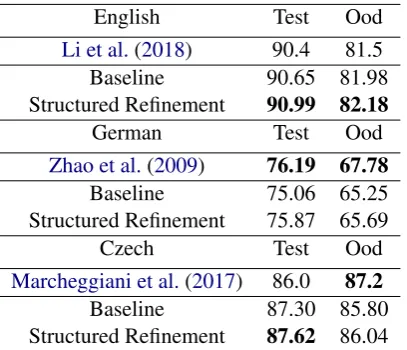
testing sets are presented in Table 4.5 We
ob-serve improvements from using refinement in all
the cases. This shows that our refinement
ap-proach is robust against domain shift.
Ablations We report development set results in
different settings in Table 3. Our full model
per-forms 2 refinement iterations, uses weight tying,
and the Gumbel noise.6 We select the best
con-figuration for each language to report the test set
performance in Table1and Table4.
As expected, weight tying is beneficial for
lower-resource languages such as Catalan,
Japanese and Spanish (see Table 2 for dataset
characteristics). The Gumbel noise helps for all languages except for Czech and English, the two largest datasets. In particular, we observe almost no improvement on the Spanish dataset without
using the Gumbel noise. We note relatively
consistent but small gains from using 2 refinement iterations. The magnitude of the gains may be an artifact of us having the loss terms L(R∗,Rt)
and L(P∗,Pt), encouraging not only the final
(second), but also the first, iteration to produce
5
Roth and Lapata (2016) has better in-domain testing
score, but did not report the out-of-domain score. 6We setλα
g = 5for role andλπg = 50for sense, so that
initial predictions contain around 20% errors.
accurate predictions. A potential alternative
explanation is that our refinement network is restricted to simple interactions, resulting in the fixed point reachable in one step.
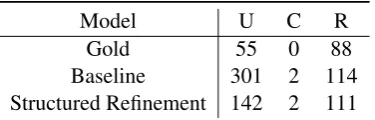
Constraints Violation We consider violation of
unique core roles (U), continuation roles (C) and
reference roles (R) constraints from Punyakanok
et al. (2008);FitzGerald et al.(2015) in Table6. U is violated if a core role (A0 - A5, AA) appears more than once; C is violated when the C-X role is not preceded by the X role (for some X); R is vi-olated if R-X role does not appear. Our approach results in a large reduction in the uniqueness con-straint violations. Our model slightly reduces the
number of R violations, whileHe et al.(2017)
re-ported that deterministically enforcing constraints is not helpful (albeit in span-based SRL). However learning those constraints in a soft way might be beneficial.
Argument Interaction vs. No Argument
In-teraction We compare the structured refinement
network and the self-refinement network in
Ta-ble 5. Both networks share the same
hyper-parameters. The structured refinement network
consistently outperforms the self-refinement coun-terpart. This suggests that the refinement model benefits from accessing information about other arguments when doing refinement. In other words, modeling argument interaction appears genuinely useful.
Improvement DecompositionWe report labeled
role precision, recall and sense disambiguation
accuracy in Table 7. Our structured refinement
[image:7.595.96.268.240.347.2]Model Ca Cz De En Ja Es Zh Avg.
Baseline 81.69 88.43 73.97 89.60 82.96 80.49 85.27 83.20
Full 82.11 88.62 74.95 89.82 83.60 81.19 85.52 83.69
1 iteration 82.07 88.62 75.07 89.93 83.49 81.03 85.47 83.40
un-tied 81.99 88.61 75.04 89.79 83.47 80.89 85.49 83.61
[image:8.595.122.479.61.147.2]no Gumbel 82.07 88.71 74.62 90.08 83.33 80.55 85.42 83.54
Table 3: Labeled F1 score (including senses) for all languages on development set for different configurations.
English Test Ood
Li et al.(2018) 90.4 81.5
Baseline 90.65 81.98
Structured Refinement 90.99 82.18
German Test Ood
Zhao et al.(2009) 76.19 67.78
Baseline 75.06 65.25
Structured Refinement 75.87 65.69
Czech Test Ood
Marcheggiani et al.(2017) 86.0 87.2
Baseline 87.30 85.80
[image:8.595.81.285.188.363.2]Structured Refinement 87.62 86.04
Table 4: Labeled F1 scores (including senses) on En-glish, German, Czech in-domain and out-of-domain test sets; we chose the previous models achieving the best scores on the out-of-domain test sets.
recall.
Error Correction Analysis We show the errors
that the structured refinement network corrects in
Figure2. In the baseline confusion matrix, we see
the errors are fairly balanced for all the roles we consider here. In the error correction matrix, the corrections are also fairly evenly distributed. Yet, this is not completely uniform. There is a tendency towards filtering out arguments rather than gener-ating new ones.
7 Conclusions and Future Work
We propose the structured refinement network for dependency semantic role labeling. The structured refinement network corrects predictions made by a strong factorized baseline model while modeling interactions in the predicated structure. The result-ing model achieves state-of-the-art results on 5 out of 7 languages in the CoNLL-2009 data set, and substantially outperforms the factorized model on all of these languages.
For the future work, the structured refinement network can be further improved. For example, we
Null A0 A1 A2 Baseline predicted role Null
A0
A1
A2
True role
0 345 401 225
324 0 106 22
405 101 0 62
238 47 101 0
Baseline Confusion Matrix
Null A0 A1 A2 Baseline predicated role
Corrected role
0 40 65 24
26 0 22 4
42 12 0 8
24 7 8 0 Error Correction Matrix
Figure 2: Confusion matrix for the baseline model, and a correction matrix where the errors were corrected by the refinement network. Only Null, A0, A1, A2 are presented here.
can take an inspiration from either declarative
con-straints used in the previous work (Punyakanok
et al., 2008) or from literature on lexical seman-tics of verbs, studying patterns of event and
argu-ment realization (e.g., Levin 1993). Indeed, the
unique role constraint as a declarative constraint is one of the motivation for the concurrent work
on modeling argument interaction in SRL (Chen
et al., 2019). That work relies on capsule
net-works (Sabour et al.,2017) and focuses primarily
on enforcing the role uniqueness constraint. The framework can be extended to other tasks. For example, in syntactic dependency parsing: the refinement network can rely on representations of grandparent nodes, siblings and children to pro-pose a correction. In general, structure refinement networks should allow domain experts to incorpo-rate prior knowledge about output dependencies and improve model performance.
Acknowledgments
[image:8.595.308.524.191.348.2]Model Ca Cz De En Ja Es Zh Avg.
Baseline Model 80.69 87.30 75.06 90.65 81.97 79.87 83.26 82.69
Self Refinement 80.65 87.32 74.83 90.71 82.27 80.08 83.32 82.74
[image:9.595.96.502.63.121.2]Structured Refinement 80.91 87.47 75.83 90.83 82.54 80.53 83.31 83.06
Table 5: Labeled F1 score (including senses) for all languages on the CoNLL-2009 in-domain test set.
Model U C R
Gold 55 0 88
Baseline 301 2 114
[image:9.595.89.277.162.222.2]Structured Refinement 142 2 111
Table 6: Unique core roles violations (U), continuation roles violations (C) and reference roles violations (R) on English in-domain test set.
Model RP RR Sense
Baseline 88.1 88.3 96.2
Structured Refinement 88.7 88.5 96.3
Table 7: Labeled roles precision (RP), recall (RR) and sense disambiguation accuracy (Sense) on English in-domain test set.
678254), the Dutch National Science Foundation (NWO VIDI 639.022.518) and Bloomberg L.P.
References
David Belanger and Andrew McCallum. 2016. Struc-tured prediction energy networks. InProceedings of the 33rd International Conference on Interna-tional Conference on Machine Learning - Volume 48, ICML’16, pages 983–992. JMLR.org.
David Belanger, Bishan Yang, and Andrew McCallum. 2017. End-to-end learning for structured prediction energy networks. InProceedings of the 34th Inter-national Conference on Machine Learning - Volume 70, ICML’17, pages 429–439. JMLR.org.
Yoshua Bengio, Li Yao, Guillaume Alain, and Pas-cal Vincent. 2013. Generalized denoising auto-encoders as generative models. In Proceedings of the 26th International Conference on Neural Infor-mation Processing Systems - Volume 1, NIPS’13, pages 899–907, USA. Curran Associates Inc.
Mathieu Blondel, Andr´e FT Martins, and Vlad Niculae. 2019. Learning with fenchel-young losses. arXiv preprint arXiv:1901.02324.
Piotr Bojanowski, Edouard Grave, Armand Joulin, and Tomas Mikolov. 2017. Enriching word vectors with subword information. Transactions of the Associa-tion for ComputaAssocia-tional Linguistics, 5:135–146.
Jiaxun Cai, Shexia He, Zuchao Li, and Hai Zhao. 2018. A full end-to-end semantic role labeler, syntactic-agnostic over syntactic-aware? In Proceedings of the 27th International Conference on Computational Linguistics, pages 2753–2765, Santa Fe, New Mex-ico, USA. Association for Computational Linguis-tics.
Xinchi Chen, Chunchuan Lyu, and Ivan Titov. 2019. Capturing argument interaction in semantic role la-beling with capsule networks. InEMNLP.
Janara Christensen, Mausam, Stephen Soderland, and Oren Etzioni. 2011. An analysis of open informa-tion extracinforma-tion based on semantic role labeling. In
Proceedings of the Sixth International Conference on Knowledge Capture, K-CAP ’11, pages 113–120, New York, NY, USA. ACM.
Djork-Arn´e Clevert, Thomas Unterthiner, and Sepp Hochreiter. 2016. Fast and accurate deep network learning by exponential linear units (elus). In4th International Conference on Learning Representa-tions, ICLR 2016, San Juan, Puerto Rico, May 2-4, 2016, Conference Track Proceedings.
Dipanjan Das, Andr´e FT Martins, and Noah A Smith. 2012. An exact dual decomposition algorithm for shallow semantic parsing with constraints. In Pro-ceedings of the First Joint Conference on Lexical and Computational Semantics-Volume 1: Proceed-ings of the main conference and the shared task, and Volume 2: Proceedings of the Sixth International Workshop on Semantic Evaluation, pages 209–217. Association for Computational Linguistics.
Timothy Dozat and Christopher D. Manning. 2017. Deep biaffine attention for neural dependency pars-ing. In 5th International Conference on Learning Representations, ICLR 2017, Toulon, France, April 24-26, 2017, Conference Track Proceedings.
Timothy Dozat and Christopher D. Manning. 2018. Simpler but more accurate semantic dependency parsing. InProceedings of the 56th Annual Meet-ing of the Association for Computational LMeet-inguis- Linguis-tics (Volume 2: Short Papers), pages 484–490, Mel-bourne, Australia. Association for Computational Linguistics.
Nicholas FitzGerald, Oscar T¨ackstr¨om, Kuzman Ganchev, and Dipanjan Das. 2015. Semantic role la-beling with neural network factors. InProceedings of the 2015 Conference on Empirical Methods in Natural Language Processing, pages 960–970, Lis-bon, Portugal. Association for Computational Lin-guistics.
Yarin Gal and Zoubin Ghahramani. 2016. A theoret-ically grounded application of dropout in recurrent neural networks. InProceedings of the 30th Interna-tional Conference on Neural Information Processing Systems, NIPS’16, pages 1027–1035, USA. Curran Associates Inc.
Matt Gardner, Joel Grus, Mark Neumann, Oyvind Tafjord, Pradeep Dasigi, Nelson F. Liu, Matthew E. Peters, Michael Schmitz, and Luke S. Zettlemoyer. 2018. Allennlp: A deep semantic natural language processing platform. CoRR, abs/1803.07640.
Daniel Gildea and Daniel Jurafsky. 2000. Automatic labeling of semantic roles. In Proceedings of the 38th Annual Meeting of the Association for Com-putational Linguistics, pages 512–520, Hong Kong. Association for Computational Linguistics.
Kevin Gimpel and Noah A. Smith. 2010. Softmax-margin CRFs: Training log-linear models with cost functions. InHuman Language Technologies: The 2010 Annual Conference of the North American Chapter of the Association for Computational Lin-guistics, pages 733–736, Los Angeles, California. Association for Computational Linguistics.
Edouard Grave, Piotr Bojanowski, Prakhar Gupta, Ar-mand Joulin, and Tomas Mikolov. 2018. Learning word vectors for 157 languages. InProceedings of the 11th Language Resources and Evaluation Con-ference, Miyazaki, Japan. European Language Re-source Association.
Jan Hajiˇc, Massimiliano Ciaramita, Richard Johans-son, Daisuke Kawahara, Maria Ant`onia Mart´ı, Llu´ıs M`arquez, Adam Meyers, Joakim Nivre, Sebastian Pad´o, Jan ˇStˇep´anek, Pavel Straˇn´ak, Mihai Surdeanu, Nianwen Xue, and Yi Zhang. 2009. The conll-2009 shared task: Syntactic and semantic dependencies in multiple languages. InProceedings of the Thir-teenth Conference on Computational Natural Lan-guage Learning: Shared Task, CoNLL ’09, pages 1–18, Stroudsburg, PA, USA. Association for Com-putational Linguistics.
Hany Hassan, Anthony Aue, Chang Chen, Vishal Chowdhary, Jonathan Clark, Christian Feder-mann, Xuedong Huang, Marcin Junczys-Dowmunt, William Lewis, Mu Li, Shujie Liu, Tie-Yan Liu, Renqian Luo, Arul Menezes, Tao Qin, Frank Seide, Xu Tan, Fei Tian, Lijun Wu, Shuangzhi Wu, Yingce Xia, Dongdong Zhang, Zhirui Zhang, and Ming Zhou. 2018. Achieving human parity on auto-matic chinese to english news translation. CoRR, abs/1803.05567.
Luheng He, Kenton Lee, Mike Lewis, and Luke Zettle-moyer. 2017. Deep semantic role labeling: What works and what’s next. InProceedings of the 55th Annual Meeting of the Association for Computa-tional Linguistics (Volume 1: Long Papers), pages 473–483. Association for Computational Linguis-tics.
James Henderson, Paola Merlo, Ivan Titov, and Gabriele Musillo. 2013. Multilingual joint pars-ing of syntactic and semantic dependencies with a latent variable model. Computational Linguistics, 39(4):949–998.
Eric Jang, Shixiang Gu, and Ben Poole. 2017. Cate-gorical reparameterization with gumbel-softmax. In
5th International Conference on Learning Represen-tations, ICLR 2017, Toulon, France, April 24-26, 2017, Conference Track Proceedings.
Diederik P. Kingma and Jimmy Ba. 2015. Adam: A method for stochastic optimization. In 3rd Inter-national Conference on Learning Representations, ICLR 2015, San Diego, CA, USA, May 7-9, 2015, Conference Track Proceedings.
Eliyahu Kiperwasser and Yoav Goldberg. 2016. Sim-ple and accurate dependency parsing using bidirec-tional LSTM feature representations. Transactions of the Association for Computational Linguistics, 4:313–327.
Jason Lee, Elman Mansimov, and Kyunghyun Cho. 2018. Deterministic non-autoregressive neural se-quence modeling by iterative refinement. In Pro-ceedings of the 2018 Conference on Empirical Meth-ods in Natural Language Processing, pages 1173– 1182, Brussels, Belgium. Association for Computa-tional Linguistics.
Beth Levin. 1993. English verb classes and alterna-tions: A preliminary investigation. University of Chicago press.
Zuchao Li, Shexia He, Hai Zhao, Yiqing Zhang, Zhu-osheng Zhang, Xi Zhou, and Xiang Zhou. 2018. De-pendency or span, end-to-end uniform semantic role labeling. CoRR, abs/1901.05280.
Chris J. Maddison, Andriy Mnih, and Yee Whye Teh. 2017. The concrete distribution: A continuous re-laxation of discrete random variables. In5th Inter-national Conference on Learning Representations, ICLR 2017, Toulon, France, April 24-26, 2017, Con-ference Track Proceedings.
Diego Marcheggiani, Anton Frolov, and Ivan Titov. 2017.A simple and accurate syntax-agnostic neural model for dependency-based semantic role labeling. InProceedings of the 21st Conference on Computa-tional Natural Language Learning (CoNLL 2017), pages 411–420, Vancouver, Canada. Association for Computational Linguistics.
Phoebe Mulcaire, Swabha Swayamdipta, and Noah A. Smith. 2018. Polyglot semantic role labeling. In
Proceedings of the 56th Annual Meeting of the As-sociation for Computational Linguistics (Volume 2: Short Papers), pages 667–672, Melbourne, Aus-tralia. Association for Computational Linguistics.
Roman Novak, Michael Auli, and David Grangier. 2017. Iterative refinement for machine translation.
CoRR, abs/1610.06602.
Stephan Oepen, Marco Kuhlmann, Yusuke Miyao, Daniel Zeman, Silvie Cinkov´a, Dan Flickinger, Jan Hajiˇc, and Zdeˇnka Ureˇsov´a. 2015. SemEval 2015 task 18: Broad-coverage semantic dependency pars-ing. InProceedings of the 9th International Work-shop on Semantic Evaluation (SemEval 2015), pages 915–926, Denver, Colorado. Association for Com-putational Linguistics.
Adam Paszke, Sam Gross, Soumith Chintala, Gre-gory Chanan, Edward Yang, Zachary DeVito, Zem-ing Lin, Alban Desmaison, Luca Antiga, and Adam Lerer. 2017. Automatic differentiation in pytorch.
Matthew Peters, Mark Neumann, Mohit Iyyer, Matt Gardner, Christopher Clark, Kenton Lee, and Luke Zettlemoyer. 2018. Deep contextualized word rep-resentations. In Proceedings of the 2018 Confer-ence of the North American Chapter of the Associ-ation for ComputAssoci-ational Linguistics: Human Lan-guage Technologies, Volume 1 (Long Papers), pages 2227–2237, New Orleans, Louisiana. Association for Computational Linguistics.
Vasin Punyakanok, Dan Roth, and Wen-tau Yih. 2008. The importance of syntactic parsing and inference in semantic role labeling. American Journal of Com-putational Linguistics, 34(2):257–287.
Adriana Romero, Michal Drozdzal, Akram Erraqabi, Simon J´egou, and Yoshua Bengio. 2017. Image segmentation by iterative inference from conditional score estimation.CoRR, abs/1705.07450.
Michael Roth and Mirella Lapata. 2016. Neural se-mantic role labeling with dependency path embed-dings. In Proceedings of the 54th Annual Meet-ing of the Association for Computational LMeet-inguistics (Volume 1: Long Papers), pages 1192–1202, Berlin, Germany. Association for Computational Linguis-tics.
Sara Sabour, Nicholas Frosst, and Geoffrey E Hin-ton. 2017. Dynamic routing between capsules. In
Advances in neural information processing systems, pages 3856–3866.
Dan Shen and Mirella Lapata. 2007. Using semantic roles to improve question answering. In EMNLP-CoNLL 2007, Proceedings of the 2007 Joint Con-ference on Empirical Methods in Natural Language Processing and Computational Natural Language Learning, June 28-30, 2007, Prague, Czech Repub-lic, pages 12–21.
Nitish Srivastava, Geoffrey Hinton, Alex Krizhevsky, Ilya Sutskever, and Ruslan Salakhutdinov. 2014. Dropout: A simple way to prevent neural networks from overfitting. Journal of Machine Learning Re-search, 15:1929–1958.
Rupesh Kumar Srivastava, Klaus Greff, and J¨urgen Schmidhuber. 2015. Training very deep networks. InAdvances in Neural Information Processing Sys-tems 28: Annual Conference on Neural Information Processing Systems 2015, December 7-12, 2015, Montreal, Quebec, Canada, pages 2377–2385.
Emma Strubell, Patrick Verga, Daniel Andor, David Weiss, and Andrew McCallum. 2018. Linguistically-informed self-attention for semantic role labeling. In Proceedings of the 2018 Confer-ence on Empirical Methods in Natural Language Processing, pages 5027–5038, Brussels, Belgium. Association for Computational Linguistics.
Kristina Toutanova, Aria Haghighi, and Christopher D. Manning. 2008. A global joint model for semantic role labeling. American Journal of Computational Linguistics, 34(2):161–191.
Lifu Tu and Kevin Gimpel. 2018. Learning approx-imate inference networks for structured prediction. In 6th International Conference on Learning Rep-resentations, ICLR 2018, Vancouver, BC, Canada, April 30 - May 3, 2018, Conference Track Proceed-ings.
Lifu Tu and Kevin Gimpel. 2019. Benchmarking ap-proximate inference methods for neural structured prediction. CoRR, abs/1904.01138.
Pascal Vincent, Hugo Larochelle, Yoshua Bengio, and Pierre-Antoine Manzagol. 2008. Extracting and composing robust features with denoising au-toencoders. In Machine Learning, Proceedings of the Twenty-Fifth International Conference (ICML 2008), Helsinki, Finland, June 5-9, 2008, pages 1096–1103.
Xinyu Wang, Jingxian Huang, and Kewei Tu. 2019. Second-order semantic dependency parsing with end-to-end neural networks. InACL.
Yingce Xia, Fei Tian, Lijun Wu, Jianxin Lin, Tao Qin, Nenghai Yu, and Tie-Yan Liu. 2017. Deliberation networks: Sequence generation beyond one-pass de-coding. InAdvances in Neural Information Process-ing Systems 30: Annual Conference on Neural In-formation Processing Systems 2017, 4-9 December 2017, Long Beach, CA, USA, pages 1782–1792.