University of Pennsylvania
ScholarlyCommons
Publicly Accessible Penn Dissertations
2017
Compositional Lexical Semantics In Natural
Language Inference
Ellie Pavlick
University of Pennsylvania, [email protected]
Follow this and additional works at:
https://repository.upenn.edu/edissertations
Part of the
Computer Sciences Commons
This paper is posted at ScholarlyCommons.https://repository.upenn.edu/edissertations/2519 For more information, please [email protected].
Recommended Citation
Pavlick, Ellie, "Compositional Lexical Semantics In Natural Language Inference" (2017).Publicly Accessible Penn Dissertations. 2519.
Compositional Lexical Semantics In Natural Language Inference
Abstract
The focus of this thesis is to incorporate linguistic theories of semantics into data-driven models for automatic natural language understanding. Most current models rely on an impoverished version of semantics which can be learned automatically from large volumes of unannotated text. However, many aspects of language
understanding require deeper models of semantic meaning than those which can be easily derived from word co-occurrence alone. In this thesis, we inform our models using insights from linguistics, so that we can continue to take advantage of large-scale statistical models of language without compromising on depth and interpretability. We begin with a discussion of lexical entailment. We classify pairs of words according a small set of distinct entailment relations: e.g. equivalence, entailment, exclusion, and independence. We show that imposing these relations onto a large, automatically constructed lexical entailment resource leads to
measurable improvements in an end-to-end inference task. We then turn our attention to compositional entailment, in particular, to modifier-noun composition. We show that inferences involving modifier-noun phrases (e.g. “red dress”, “imaginary friend”) are much more complex than the conventional wisdom states. In a systematic evaluation of a range of existing state-of-the-art natural language inference systems, we illustrate the inability of current technology to handle the types of common sense inferences necessary for human-like processing of modifier-noun phrases. We propose a data-driven method for operationalizing a formal semantics framework which assigns interpretable semantic representations to individual modifiers. We use our method in order to find instances of fine-grained classes involving multiple modifiers (e.g. “1950s American jazz composers”). We demonstrate that our proposed compositional model outperforms existing non-compositional approaches.
Degree Type Dissertation
Degree Name
Doctor of Philosophy (PhD)
Graduate Group
Computer and Information Science
First Advisor
Chris Callison-Burch
Keywords
Artificial Intelligence, Computational Linguistics, Machine Learning, Natural Language Processing, Paraphrasing, Semantics
COMPOSITIONAL LEXICAL SEMANTICS IN NATURAL LANGUAGE INFERENCE
Ellie Pavlick
A DISSERTATION
in
Computer and Information Science
Presented to the Faculties of the University of Pennsylvania
in
Partial Fulfillment of the Requirements for the
Degree of Doctor of Philosophy
2017
Supervisor of Dissertation
Chris Callison-Burch, Associate Professor of Computer and Information Science
Graduate Group Chairperson
Lyle Ungar, Professor of Computer and Information Science
Dissertation Committee
Chris Callison-Burch, Associate Professor of Computer and Information Science
Ido Dagan, Professor of Computer Science
Mitch Marcus, Professor of Computer and Information Science
Florian Schwarz, Associate Professor of Linguistics
COMPOSITIONAL LEXICAL SEMANTICS IN NATURAL LANGUAGE INFERENCE
c
COPYRIGHT
2017
Ellie Pavlick
This work is licensed under the
Creative Commons Attribution
NonCommercial-ShareAlike 3.0
License
To view a copy of this license, visit
Dedicated to my sisters, Cassie and Ginger.
ACKNOWLEDGEMENT
I am incredibly lucky to have had such a supportive advisor, Chris Callison-Burch. Chris
invested in me very early in my computer science career and had confidence in me well
before I had any idea what I was doing. He has been my go-to mentor and my strongest
advocate since. With every year, I have only become more excited about the field, and I
credit that to Chris’s consistent energy and encouragement. It is been a genuine privilege
to work together.
A huge thank you to my dissertation committee. Mitch Marcus has been a constant source
of wisdom and guidance, and his personality, in my mind, will always be synonymous with
Penn NLP and the wonderful intellectual environment I have experienced during my time
here. Lyle Ungar’s directness and pragmatism has been invaluable, and he has provided me
with clarity and perspective when trying to articulate my own thoughts. Florian Schwarz
gave me my first formal education in linguistics, and I am not exaggerating to say that that
has had the single largest influence on the way I approach research. Annual meetings with
Ido Dagan have been the most enlightening part of ACL conferences over the past several
years–his drive is inspiring and every conversation I have had with him has reaffirmed my
enthusiasm for the ambitiousness of NLP.
I have been fortunate to work with many other incredible research mentors. I have learned so
much from Ben Van Durme, Joel Tetreault, Peter Clark, and Niranjan Balasubramanian and
owe each of them a huge thank you. Thank you especially to Marius Pasca, for engaging in
every discussion with such depth and for challenging me on every opinion–working together
made me a holistically better researcher, and I am extremely grateful. Of course, thank
you also to my many coauthors and other collaborators, who have been a constant source
of new ideas and great conversations.
Finally, I am forever thankful to my family and friends who have been an unwavering
and for somehow managing to both keep me inspired and keep me grounded over the years.
Thank you to my parents, Karin and Michael, for endless love and encouragement and for
raising me to be confident and ambitious and unapologetic. Thank you to my sisters, Cassie
and Ginger–growing up with you two is the best thing that ever happened to me. Thank
you to Andrea, Jan, Howard, Nate, and Sherrie for all the love and support. Last, but never
least, thank you to all the friends I have made at Penn and within the ACL community, and
to the friends from my other lives at JHU, Peabody, and elsewhere, for all the happiness
ABSTRACT
COMPOSITIONAL LEXICAL SEMANTICS IN NATURAL LANGUAGE INFERENCE
Ellie Pavlick
Chris Callison-Burch
The focus of this thesis is to incorporate linguistic theories of semantics into data-driven
models for automatic natural language understanding. Most current models rely on an
im-poverished version of semantics which can be learned automatically from large volumes of
unannotated text. However, many aspects of language understanding require deeper models
of semantic meaning than those which can be easily derived from word co-occurrence alone.
In this thesis, we inform our models using insights from linguistics, so that we can continue
to take advantage of large-scale statistical models of language without compromising on
depth and interpretability. We begin with a discussion of lexical entailment. We classify
pairs of words according a small set of distinct entailment relations: e.g. equivalence,
en-tailment, exclusion, and independence. We show that imposing these relations onto a large,
automatically constructed lexical entailment resource leads to measurable improvements in
an end-to-end inference task. We then turn our attention to compositional entailment, in
particular, to modifier-noun composition. We show that inferences involving modifier-noun
phrases (e.g. “red dress”, “imaginary friend”) are much more complex than the
conven-tional wisdom states. In a systematic evaluation of a range of existing state-of-the-art
nat-ural language inference systems, we illustrate the inability of current technology to handle
the types of common sense inferences necessary for human-like processing of modifier-noun
phrases. We propose a data-driven method for operationalizing a formal semantics
frame-work which assigns interpretable semantic representations to individual modifiers. We use
our method in order to find instances of fine-grained classes involving multiple modifiers
(e.g. “1950s American jazz composers”). We demonstrate that our proposed compositional
TABLE OF CONTENTS
ACKNOWLEDGEMENT . . . iv
ABSTRACT . . . vi
LIST OF TABLES . . . xv
LIST OF ILLUSTRATIONS . . . xviii
CHAPTER 1 : Introduction . . . 1
1.1 Overview . . . 1
1.2 Outline of this Document . . . 8
CHAPTER 2 : Background and Related Work . . . 11
2.1 Definition of “Entailment” in Natural Language . . . 11
2.1.1 Entailment in Formal Linguistics . . . 11
2.1.2 Entailment in Natural Language Processing . . . 13
2.1.3 Types of Knowledge Tested by RTE . . . 14
2.1.4 RTE Systems and Approaches . . . 17
2.2 Lexical Entailment . . . 20
2.2.1 Word Denotations and Semantic Types . . . 20
2.2.2 Definition of Semantic Containment . . . 22
2.2.3 Basic Entailment Relations in Natural Logic . . . 23
2.2.4 Lexical Entailment Resources in NLP . . . 25
2.2.5 The Paraphrase Database . . . 28
2.3 Compositional Entailment in Modifier-Noun Phrases . . . 29
2.3.1 Classes of Modifiers in Formal Semantics . . . 30
2.3.3 Pragmatic Factors Affecting Modifier-Noun Composition . . . 36
2.4 Definition of Basic Entailment Relations used in this Thesis . . . 38
2.4.1 Relaxing Requirements of Exhaustivity . . . 38
2.4.2 Definitions . . . 40
CHAPTER 3 : Lexical and Non-Compositional Entailment . . . 42
3.1 Annotating Basic Entailment Relations . . . 43
3.1.1 Assumptions about Context . . . 43
3.1.2 Design of Annotation Task . . . 44
3.1.3 Labeled Datasets for Training and Evaluation . . . 46
3.2 Supervised Model for Lexical Entailment Classification . . . 50
3.2.1 Classifier Configuration . . . 51
3.2.2 Feature Groups . . . 51
3.2.3 Feature Analysis . . . 54
3.3 Intrinsic Evaluation of Predicted Relations . . . 55
3.3.1 Performance on Paraphrase Pairs Occurring in RTE Data . . . 57
3.3.2 Labeling All Paraphrase Pairs in PPDB . . . 58
3.4 Using Lexical Entailment Classifier to Improve End-to-End RTE . . . 60
3.4.1 The Nutcracker RTE System . . . 60
3.4.2 Experimental Setup . . . 61
3.4.3 Results . . . 62
3.5 Discussion . . . 64
CHAPTER 4 : Semantic Containment in Compositional Noun Phrases . . . 66
4.1 Annotating Compositional Noun Phrases in Context . . . 67
4.1.1 Focusing on Denotations vs. Focusing on Inferences . . . 67
4.1.2 Studying Composition through Atomic Edits . . . 68
4.1.3 Limitations of our Methodology . . . 69
4.2 Labeled Datasets for Analysis . . . 70
4.2.1 Data Selection . . . 71
4.2.2 Annotation . . . 73
4.2.3 Filtering and Post-Processing . . . 76
4.2.4 Reproducibility . . . 77
4.3 Analysis of Human Inferences . . . 78
4.3.1 Basic Entailment Relations Generated byM H Composition . . . 78
4.3.2 Generalizations for whenH entails M H . . . 82
4.3.3 Undefined Entailment Relations . . . 84
4.4 Privative and Non-Subsective Adjectives . . . 86
4.4.1 Experimental Design . . . 86
4.4.2 Results . . . 89
4.4.3 Analysis . . . 91
4.5 Performance of Current RTE Systems . . . 94
4.5.1 The Add-One Entailment Task . . . 95
4.5.2 Description of Evaluated RTE Systems . . . 96
4.5.3 Results and Analysis . . . 97
4.6 Discussion . . . 101
CHAPTER 5 : Noun Phase Composition for Class-Instance Identification . . . 105
5.1 Modeling the Semantics of Noun Phrases . . . 106
5.1.1 Modifiers in Formal Linguistics . . . 106
5.1.2 Desiderata . . . 107
5.1.3 Weaknesses of Existing Computational Approaches . . . 108
5.2 Modifier Interpretation . . . 109
5.2.1 Assumptions of our Approach . . . 110
5.2.2 Data Processing . . . 110
5.2.3 Associating Properties with Modifiers . . . 112
5.3 Class-Instance Identification . . . 116
5.3.1 Class Membership as a Real-Valued rather than Binary Attribute . . 117
5.3.2 Weakly Supervised Scoring Model . . . 118
5.3.3 Summary of Proposed Methods and Variations . . . 119
5.4 Evaluation . . . 120
5.4.1 Evaluation Data Sets from Wikipedia . . . 120
5.4.2 Experimental Setup . . . 122
5.4.3 Results and Analysis . . . 123
5.5 Discussion . . . 129
CHAPTER 6 : Conclusion . . . 131
6.1 Summary of Contributions . . . 131
6.2 Discussion and Future Directions . . . 134
APPENDIX . . . 136
A.1 Comparison of Lexical Entailment Annotation HIT Designs . . . 136
A.2 Instructions for Lexical Entailment HIT . . . 140
A.3 Feature Templates for Lexical Entailment Classifier . . . 141
A.4 SelectingM H Pairs and Contexts for Simplified RTE Annotation . . . 154
A.5 Instructions forM H Composition HIT . . . 161
A.6 Feature Templates for Weakly-Supervised Reranking Model . . . 167
LIST OF TABLES
TABLE 1 : Examples of different types of entailment relations appearing in the
Paraphrase Database (Ganitkevitch et al. (2013)). . . 3
TABLE 2 : Examples of contexts in which human inferences do not match what is expected given the classes of modifiers defined by formal semantics. 6 TABLE 3 : Example sentence pairs from four standard RTE datasets. . . 15
TABLE 4 : Examples of sentence pairs occurring in RTE datasets which rely on common sense inference and world knowledge rather than logical inference. . . 17
TABLE 5 : Inference rules associated with the basic entailment relations defined in MacCartney (2009). . . 24
TABLE 6 : Relationship between natural logic relations and formal semantics adjective classes. Table reads as a decision tree from left to right. . 34
TABLE 7 : Basic entailment relations generated by modifier-noun composition– i.e. inserting modifiers in front of nouns in context. . . 35
TABLE 8 : Descriptions of basic entailment relations from Section 2.4 shown to annotators on Amazon Mechanical Turk. . . 45
TABLE 9 : Random sample of noun pairs in the PpdbSampledataset. . . 47
TABLE 10 : Random sample of noun pairs in thePpdbSickdataset. . . 48
TABLE 11 : Random sample of noun pairs in thePpdbRtedataset. . . 48
TABLE 12 : Distribution of basic entailment relations appearing in our annotated datasets. These datasets are used for training and evaluating our lexical entailment classifier. . . 49
TABLE 14 : Inter-annotator agreement for each of the labelled datasets. . . 50
TABLE 15 : Accuracy and F1 score by classifier on 10-fold cross validation over
PpdbSick training data. . . 54
TABLE 16 : Change in F1 score (×100) achieved by classifier when ablating each
feature group. . . 55
TABLE 17 : Most similar pairs (x/y) in PpdbSick training data, according to
various similarity measures, along with their manually classified
en-tailment labels. . . 56
TABLE 18 : Precision, recall, and F1 score achieved by entailment classifier trained
on the training split of PpdbSick and tested on the test split. . . . 57
TABLE 19 : Precision, recall, and F1 achieved by entailment classifier trained on
the training split of PpdbRte2 and tested on the test split. . . 58
TABLE 20 : Example misclassifications from some of the most frequent and most
interesting error categories. . . 58
TABLE 21 : Precision of each predicted class, at varying confidence cutoffs, for
all 24M word and phrase pairs in PPDB. . . 59
TABLE 22 : Nutcracker’s overall system accuracy and proof coverage when using
different sources of lexical entailment axioms. . . 63
TABLE 23 : Precision, recall, and F1 measures achieved by Nutcracker on SICK
test data when using different sources of lexical entailment axioms. 63
TABLE 24 : Inference conditions used to determine which of the basic entailment
relations is generated by the composition of M withH. . . 69
TABLE 25 : Examples of modifier-noun pairs selected from each corpus for
an-notation. . . 72
TABLE 26 : Examples of some of the quality control questions embedded in our
tasks. . . 75
TABLE 27 : Number ofp/h pairs and uniqueM Hs in our dataset coming from
TABLE 28 : Examples of sentences removed by our filtering. . . 77
TABLE 29 : Examples of different types of basic entailment relations (β(e))
gen-erated by inserting a modifier in front of a noun (e= INS(M)). . . 81
TABLE 30 : Examples when composing the same modifierM with the same noun
H generates different entailment relations depending on context. . 82
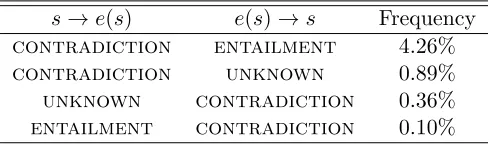
TABLE 31 : Frequency of p/h pairs in which human’s entailment judgements
result in INS(M) generating an “undefined” basic entailment relation. 84
TABLE 32 : Examples of contexts in which generate the Undefined (∅) relation:
i.e. M H was judged to entailH butH was judge to entail ¬M H. 85
TABLE 33 : 60 privative and plain non-subsective adjectives from Nayak et al.
(2014). . . 87
TABLE 34 : Examples of modifier-noun pairs for each modifier class appearing
in our sample. . . 88
TABLE 35 : Examples of sentences containing plain non-subsective modifiers;
these modifiers are judged to behave the same way as subsective
modifiers, i.e. to generate the Reverse Entailment (A) relation. . . 92
TABLE 36 : Examples of contexts in which privative modifier-noun composition
results in each of the basic entailment relations plus the Undefined
(∅) relation. . . 94
TABLE 37 : Precision, recall, and F1 score for all systems on AddOne RTE task. 100
TABLE 38 : Top 20 modifiers most likely to correspond to theentailmentclass
and most likely to correspond to the non-entailment class when
appearing in the hypothesis, according to the basic BOW classifier. 100
TABLE 39 : Examples of false positive predictions and false negative predictions
of the RNN (the best-performing of the systems we tested) on
Ad-dOne RTE test data. . . 101
TABLE 41 : Examplehsubjects, predicater, objectoituples from our fact
repos-itory D. . . 112
TABLE 42 : Example property profiles learned by observing predicates that
re-late the class H to modifier M (Ihead). Results, among top-ranked
properties, are similar when using Iinst. . . 115
TABLE 43 : Examples ofM Hs for which our central assumption–that
frequently-discussed relations between M and H capture relevant properties of
M H–does not hold. . . 115
TABLE 44 : Head-specific property profiles learned by relating instances ofH to
the modifier M (Iinst). Results are similar usingIhead. . . 116
TABLE 45 : Examples of properties learned byIinst that are not learned byIhead.
These are properties which entail M H, but are not necessarily
en-tailed by M H. . . 116
TABLE 46 : Top-ranked entities for a given class according to the naive score
model (defined in Equation 5.8) and according to a weakly-supervised
logistic regression model. . . 119
TABLE 47 : Summary of model variations proposed for the task of class-instance
identification given a class label C =M1. . . MkH and an entity e. . 120
TABLE 48 : Examples of class labels fromUniform. . . 122
TABLE 49 : Examples of class labels fromWeighted. . . 122
TABLE 50 : Precision@10 for several methods computed using Wikipedia as the
definitive gold standard and computed using manually-augmented
gold standard reference sets. . . 124
TABLE 51 : Total coverage, correct coverage, and mean average precision for each
method when identifying instances of arbitrary classes. Class labels
TABLE 52 : Instances extracted for several fine-grained classes using ModsI. †
denotes the instance was also returned by Hearst∩. Strikethrough
denotes the instance is incorrect. . . 127
TABLE 53 : Recall of instances on Wikipedia category pages, measured against
the full set of instances from all pages in sample. AUC captures
tradeoff between true and false positives. . . 127
TABLE 54 : Six entailment relations used to classify word pairs during pilot study
on task design. . . 136
TABLE 55 : Options for relations in first pass (top) and second pass (bottom)
of the two-pass HIT. Pairs for which the majority label in the first
pass was “equivalent (or nearly equivalent)” were shown to Turkers
in the second pass in order to receive a more fine-grained label. . . 138
TABLE 56 : Accuracy of the majority label in each HIT design. Benefits of using
the two-pass HIT design rather than the basic isolation design are
not conclusive. . . 139
TABLE 57 : Percent of workers in agreement for word pairs of each relation type. 139
TABLE 58 : Examples of hypernym/hyponym relationships labeled as synonyms.
In the above examples, at least 3 out of 5 workers chose the label
“synonym.” . . . 140
LIST OF ILLUSTRATIONS
FIGURE 1 : Example of a premisepand hypothesish. Recognizing similarities
and differences in sentence meaning requires understanding
differ-ent types of relationships that can exist between words, such as
equivalence (blue), entailment (green), and exclusion (red). . . 2
FIGURE 2 : Estimated distribution of fine-grained entailment relations across
the six different sizes of the Paraphrase Database (PPDB). Smaller
sizes have been filtered to contain higher precision sets of
para-phrases, yet they still contain a multitude of distinct fine-grained
entailment relations. . . 4
FIGURE 3 : Classes of modifiers based on the entailment relationship between
the denotation of the noun and that of the modified noun, as
tra-ditionally defined in formal semantics. . . 6
FIGURE 4 : Illustration of how the information required to infer Instance-Of
relations for fine-grained classes is often distributed across multiple
sentences, and thus requires compositional NLU models capable of
reasoning individually about each of the modifiers. . . 8
FIGURE 5 : Classes of modifiers in formal semantics. . . 31
FIGURE 6 : Confusion matrices for classifier trained using onlyMonolingual
versus only Bilingual. True labels are shown along rows,
pre-dicted along columns. . . 56
FIGURE 7 : Annotation interface used to collect entailment judgements forp/h
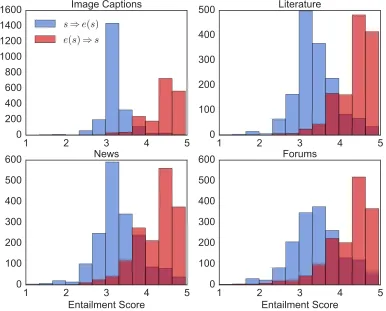
FIGURE 8 : Distribution of human entailments judgements (on a five-point scale)
for “forward” inferences (s → e(s)) and for “reverse” inferences
(e(s)→s) wheree= INS(M). . . 79
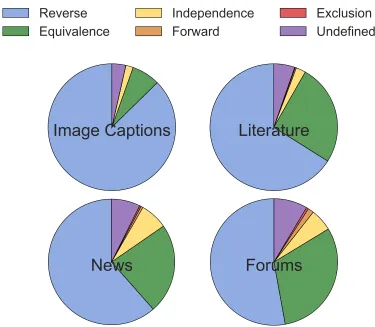
FIGURE 9 : Basic entailment relations generated by INS(M) edits across four
genres. . . 80
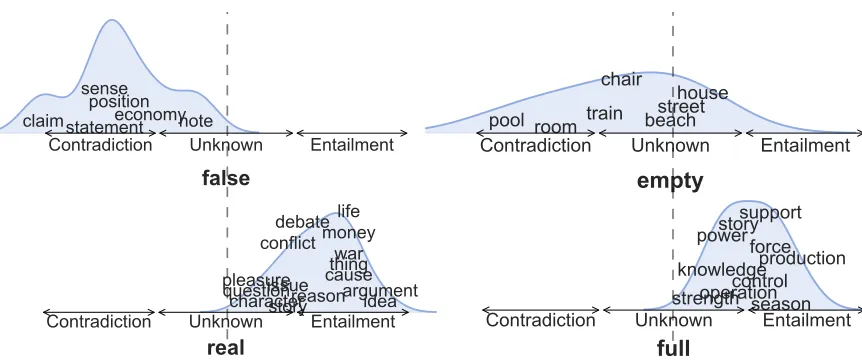
FIGURE 10 : Distribution over entailment scores generated when composing
sev-eral “presence” modifiers and sevsev-eral “absence” modifiers with
var-ious nouns. . . 83
FIGURE 11 : Unless otherwise specified, nouns are considered to be salient and
relevant. “Answers” are assumed to be “correct”, and“problems”
to be“current”. . . 83
FIGURE 12 : Distribution over entailment scores generated when composing
var-ious modifiers with the noun“beach”. . . 84
FIGURE 13 : Distribution over entailment scores generated when composing the
modifier“little” with various nouns. . . 84
FIGURE 14 : Expected vs. observed distributions of entailment judgements for
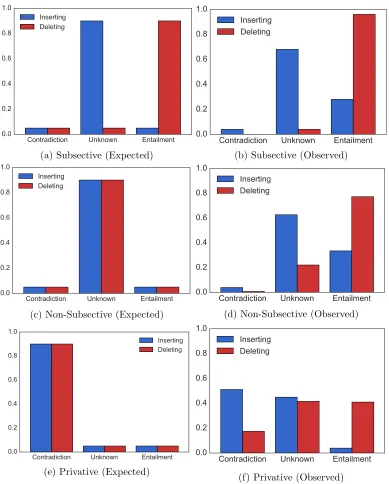
inserting and deleting of modifiers by modifier class. . . 89
FIGURE 15 : Distribution of entailment relations generated by the modifier-noun
compositions for modifiers of different classes. The subsective
(con-trol) chart reflects the distribution over 100 p/h pairs, the plain
non-subsective chart reflects 281p/hpairs, and the privative chart
reflects 178p/h pairs. See Table 6 for theoretical relationship
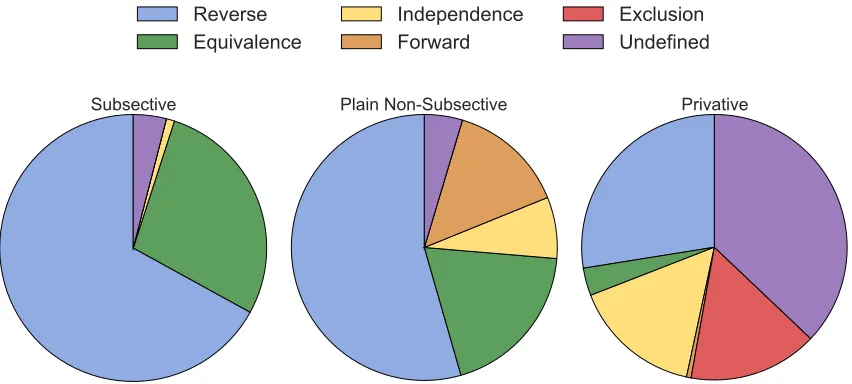
be-tween modifier classes and generated natural logic relations. . . . 91
FIGURE 16 : Performance of systems from Magnini et al. (2014) on the RTE3
FIGURE 17 : Performance of systems from Bowman et al. (2015) on the SNLI
dataset (the dataset on which they were originally developed) using
both the full training set (500K pairs) and a reduced training set
(5K pairs). . . 98
FIGURE 18 : Accuracy achieved by all tested RTE systems on AddOne RTE task. 99
FIGURE 19 : Distribution of AP over 100 class labels in Weighted. . . 126
FIGURE 20 : ROC curves of various methods for ranking instances based on
likelihood of belonging to a specified class. . . 128
FIGURE 21 : Pair of words as presented to annotators in the Isolation HIT. . . 136
FIGURE 22 : Pair of words as presented to annotators in the Context HIT and
the Two Pass HIT. . . 137
FIGURE 23 : Entailment judgements for whether H @ M H in native and in
artificial contexts. . . 160
FIGURE 24 : Relationship between human judgements of whetherH @M H and
CHAPTER 1 : Introduction
1.1. Overview
The focus of this thesis is to incorporate linguistic theories of semantics into data-driven
models for automatic natural language understanding (NLU). Current approaches to NLU
have tended toward shallow models of semantics which can be learned automatically from
large volumes of unannotated text. By trading depth for speed and scalability, current
techniques have enabled profound advances in language technology for many applications,
most notably information retrieval, machine translation, and speech recognition. However,
the majority of the models in widespread use today lack precise representations of
mean-ing and of inferences in language. As we ask computers to perform progressively more
complex natural language tasks, and to engage more interactively with humans, precision
and interpretability of inference become increasingly necessary. Attempting to learn deep
models of semantics naively from data–i.e. basing such models on statistical co-occurances
alone–quickly encounters problems stemming from data sparsity, spurious correlations, and
failure to recognize implicit “common sense” context. As a result, most current NLU
mod-els rely on an impoverished version of semantics in which two natural language expressions
(whether words, phrases, sentences, or documents) are either “similar” or “dissimilar”, but
their relationship more specifically is not made clear. This severely limits the depth of
natural language tasks that such models are able to perform.
In this thesis, we explore ways in which, by injecting insights about human language from
formal and experimental linguistics, we can increase the inference capabilities of automatic
NLU. We focus on lexical semantics, i.e. the meanings of and relationships between
indi-vidual words, and on compositional semantics, i.e. how the meanings of individual words
combine to produce the meanings of larger phrases. We devote most of our attention to
single words and short (two-word) phrases, but are able to show that incorporating
Denmark riots 12 editorialcartoons offensive Muhammad.
Twelve illustrations insulting the prophet caused unrest Jordan.
by
sparked to
in
Figure 1: Example of a premisepand hypothesish. Recognizing similarities and differences in sentence meaning requires understanding different types of relationships that can exist between words, such as equivalence (blue), entailment (green), and exclusion (red).
reasoning and inference about natural language.
Much of our work is motivated by the task of recognizing textual entailment (RTE), also
know as natural language inference. In natural language processing (NLP), this task is
defined simply as: given two natural language statements, a premise p and a hypothesis
h, would a typical person reading p likely infer h to be true? If the answer is yes, we say
thatp entails h (Dagan et al. (2006)). This task of determining whether or not differences
in wording correspond to differences in meaning is a core component of many important
NLP applications such as summarization, question answering, and information extraction.
Figure 1 shows an example of a premisep and a hypothesish that illustrate the RTE task.
In the example shown, p does not entail h. Recognizing this depends on knowing that
“Denmark” and “Jordan” refer to mutually-exclusive locations, and that this prevents p
from entailinghdespite the fact that much of other information in the two sentences is the
same, e.g. “Muhammad” is equivalent to “the prophet” and “riots” entail“unrest”.
The area of linguistics and NLP concerned with the relationships that hold between
indi-vidual words–whether they entail (“riots”/“unrest”) or contradict (“Denmark”/“Jordan”)
one another–is known as lexical entailment. Early computational work in this area focused
on the manual construction of lexical entailment resources such as WordNet (Fellbaum
se-mantic relationships between words and are intended to be used by automatic systems in
NLU tasks. For example, WordNet organizes nouns into an ontology which clearly specifies
whether words are related by synonymy (e.g. “the prophet”/“Mohammad”), hypernymy
(“riots”/“unrest”), or antonymy (“violence”/“peace”).
Equivalent Entailment Exclusion Unrelated
look at/watch little girl/girl close/open girl/play
a person/someone kuwait/country minimal/significant found/party clean/cleanse tower/building boy/young girl profit/year
away/out the cia/agency nobody/someone man/talk
distant/remote sneaker/footwear blue/green car/family phone/telephone heroin/drug france/germany holiday/series
Table 1: Examples of different types of entailment relations appearing in the Paraphrase Database (Ganitkevitch et al. (2013)).
More recently, work in lexical entailment has turned toward trying to build lexical entailment
resources automatically from data. Automatically constructed resources are less expensive
and less time-consuming to build than are manually-constructed ones, making them easier
to adapt to new languages or domains. However, resources extracted using automatic
processes lack the precise information available in hand-built ontologies. That is, rather than
specifying that a“riot” is a type of “unrest”, or that“peace” is the opposite of “violence”,
most automatically-built lexical entailment resources provide only a list of pairs of words
which are believed, with some degree of confidence, to have “similar” or “related” meanings.
The precise nature of that relation, however, is not known, and it may be different for each
pair in the resource. For example, in the Paraphrase Database (Ganitkevitch et al. (2013)),
words or phrases are considered to be “paraphrases” if they share a translation in some
foreign language (Section 2.2.5). This method extracts pairs with equivalent meanings, but
also pairs related by one-directional entailment (“tower”/“building”) and pairs that have
opposite meanings (“close”/“open”) (Table 1).
In order for automatically-constructed resources like the Paraphrase Database (PPDB) to
be applied in more nuanced NLU settings, like the RTE example shown Figure 1, they need
Figure 2: Estimated distribution of fine-grained entailment relations across the six different sizes of the Paraphrase Database (PPDB). Smaller sizes have been filtered to contain higher precision sets of paraphrases, yet they still contain a multitude of distinct fine-grained entailment relations.
3), we add explicit and interpretable lexical entailment relations, like those available in
WordNet, to each of the paraphrase pairs in PPDB. To do this, we build a statistical
classifier which, given a pair of English words or phrases, predicts which entailment relation
holds. Unlike prior work on building lexical entailment resources from data, our classifier is
able to combine multiple signals from varying types of corpora, enabling us to achieve high
precision even when distinguishing between subtle differences in semantic relations. Using
the classifier, we assign entailment relations to every paraphrase pair in PPDB, revealing
that a multitude of fine-grained entailment relations exist in the database (Figure 2). We
show that, using our automatically-annotated version of PPDB, a state-of-the-art RTE
system achieves measurable performance gains over what is achieved using either WordNet
or the original, unannotated version of PPDB .
In general, the study of lexical entailment is simplified by the fact that single words
(and some short phrases) can be treated as non-compositional. That is, we can treat
the words and phrases as atomic symbols that represent single units of meaning. As a
result, we can reason about the meaning associated with each word or phrase by, for
translated. While this method makes sense for single words (“girl”, “cartoon”), it makes
less sense for phrases which could be clearly decomposed into smaller units of meaning
(“little girl” → “little”+“girl”, “editorial cartoon” → “editorial”+“cartoon”). Modeling
language compositionally is important for a number of reasons. First, non-compositional
models are computationally inefficient: for a vocabulary of size N there are Nk k-word
phrases, meaning that modeling the semantics of all short sentences would become
in-tractable for even a small vocabulary. Perhaps more problematic is the fact that, in many
cases, non-compositional models are incapable of learning the meaning of a phrase
alto-gether. There are an infinite number of possible things that can be said in natural
lan-guage, and the probability that any specific expression we are interested in understanding
has been said before is very low. The probability that it has been said frequently enough
for us to robustly estimate, for example, its “typical” usage in a distributional sense is near
zero. Thus, compositional models of language are essential for advanced automatic natural
language understanding.
In this thesis, we focus our study of composition on one particular type: the
combina-tion of modifiers (e.g. “red”, “little”, “editorial”) with common nouns (e.g. “dress”,
“girl”,“cartoon”). Despite its apparent simplicity, modifier-noun composition proves to
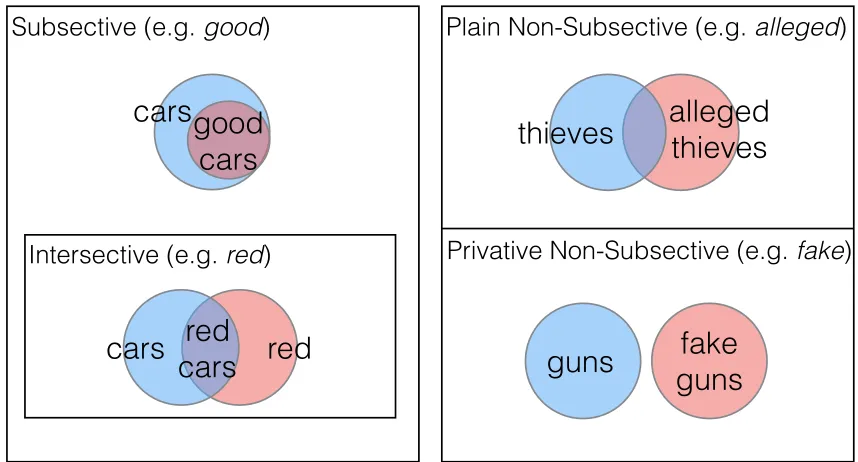
be highly complex. Traditionally, in formal semantics, modifiers are classified based on the
effect the modifier has on thedenotation of the noun it modifies (Figure 3). For example,
subsective modifiers like “red” lead to inferences of one-directional entailment: every“red
dress” is a “dress” but not every“dress” is a “red dress”. In contrast, privative modifiers
like “fake” lead to inferences of contradiction: a “fake gun” is not in fact a “gun”. Plain
non-subsective modifiers like“alleged” do not permit inferences of entailment or of
contra-diction: not every “alleged thief ” is a“thief ”, but some are. In previous work on RTE and
NLU, these classes have largely governed the way systems reason about modifiers. For
ex-ample, when the hypothesis contains a modifier that is not in the premise, systems usually
infer thatp does not entailh: e.g. “She is wearing a dress” does not entail“She is wearing
Privative Non-Subsective (e.g. fake)
Plain Non-subsective (e.g. alleged) Subsective
(e.g. red)
red
cars
cars
thieves
alleged
thieves
fake
guns
guns
Figure 3: Classes of modifiers based on the entailment relationship between the denotation of the noun and that of the modified noun, as traditionally defined in formal semantics.
We show, however, that the entailment behavior of modifier-noun composition is much more
complex than these classes suggest and than NLU systems frequently assume (Chapter 4).
Table 2 provides examples of the types of inferences that humans make in practice. As
shown, humans often accept the addition of modifiers that are not explicitly stated but
nonetheless can be inferred from context, and reject the addition of modifiers that are not
explicitly precluded but nonetheless deemed unlikely given the context. For example, even
though not every“crowd” is an “enthusiastic crowd”, when given the sentence“The crowd
roared”, humans easily infer that “crowd” entails“enthusiastic crowd”.
Sentence Pair Human Consensus
p: Thecrowd roared. p entailsh
h: Theenthusiastic crowdroared.
p: Some went for the history andpolitical culture. p doesn’t necessarily entailh h: Some went for the history and culture.
p: Bush spoke in Michigan on theeconomy. p contradictsh h: Bush spoke in Michigan on theJapanese economy.
Table 2: Examples of contexts in which human inferences do not match what is expected given the classes of modifiers defined by formal semantics.
These types of human inferences appear to be governed not by rigorous logical inference,
but rather by pragmatic inferences about what is most likely the case based on common
knowledge of the events that tend to happen and the way people tend to speak about those
events. We illustrate that this type of “common sense” reasoning is especially challenging
by a single modifier, like the examples given in Table 2, and evaluate the performance of a
variety of state-of-the-art RTE systems. We show that none of the systems tested achieve
significantly better than chance performance on this task. Our results demonstrate that
even for a linguistic phenomenon as seemingly simple as modifier-noun composition, current
statistical models fail to mimic human inferences.
One limitation of current treatments of modifier-noun composition in NLP is that they
concentrate exclusively on the semantic containment aspect of meaning. That is, they
focus exclusively on the fact that the set of “enthusiastic crowds” is a proper subset of the
set of all“crowds”. This inference, while useful, neglects the fact that“enthusiastic crowds”
are not just a random subset of “crowds”, but in fact have a specific set of properties that
qualify them as “enthusiastic”. In other words, most current approaches neglect to model
theintrinsic meaning of the modifier itself. As a result, even though a crowd that roars is
by definition “enthusiastic”, current approaches can infer only that not every “crowd” is
an“enthusiastic crowd” and so fail to infer that“crowd” entails“enthusiastic crowd” even
when the context unambiguously permits the inference.
Thus, the taxonomic approach to modeling modifier-noun phrases–i.e. focusing only on
the entailment relationship between the noun and the modified noun rather than on the
meaning of the modifier itself–limits the capability of NLU systems. This limitation is
especially visible in the task of class-instance identification: recognizing whether an entity
(e.g. “Charles Mingus”) belongs to a particular class (e.g. “jazz composers”). Because
current state-of-the-art approaches do not model the meaning of the modifiers themselves,
they often require that the entity be explicitly named as member of the class in order
to recognize that the instance-of relation holds. For example, in order to recognize that
“Charles Mingus” is a “jazz composer”, many current methods require that a phrase like
“Charles Mingus is a jazz composer” appears somewhere in a text corpus (Hearst (1992);
Snow et al. (2004); Shwartz et al. (2016)). This technique works for coarse-grained classes
American jazz composer”, for which the entire class label is unlikely to appear in even a
very large text corpus. For such fine-grained classes, class-instance relations are often still
inferable from text, but making the inferences requires compositional NLU models capable
of reasoning individually about each of the modifiers and about the properties that they
entail (Figure 4).
1950s American jazz composers
. . .seminalcomposers such asCharles Mingus and George Russell. . .
. . .virtuoso bassist and composer, Mingus irrevocably changed the face of jazz. . . . . .Mingus truly was a product of Americain all its historic complexities. . . . . .Mingus dominated the scene back in the 1950sand 1960s. . .
Figure 4: Illustration of how the information required to infer Instance-Of relations for fine-grained classes is often distributed across multiple sentences, and thus requires compo-sitional NLU models capable of reasoning individually about each of the modifiers.
As part of this thesis (Chapter 5), we operationalize a formal semantics model of
modifier-noun composition in which the intrinsic meaning of a modifier (e.g. “1950s”) corresponds to
the properties which differentiate instances of the modified-noun (“1950s composers”) from
instances of the noun (“composers”) more generally. We model the meaning of a modifier
as a list of properties, stated in natural language, which characterize the individual entities
for which that modifier holds. These properties are acquired by paraphrasing noun phrases
so that the usually-implicit relationship between the modifier and the head is made explicit
(“1950s composers”→“composers active in the 1950s”). We evaluate our method on its
ability to find all instances of a class given only the class name and a corpus of raw web
text. Our compositional model is able to achieve significant improvements over the
state-of-the-art non-compositional approaches on this task.
1.2. Outline of this Document
Chapter 2 gives an overview of the background and prior work relevant to this thesis. This
includes a discussion of how “entailment” has been formalized in both linguistics and in
NLP (Section 2.1), an introduction to how linguists and computer scientists have attempted
of work on composing word meanings to derive phrase meanings, specifically in the case of
combining modifiers with nouns (Section 2.3). Chapter 2 also includes definitions of the 5
basic entailment relations to which we refer throughout this thesis (Section 2.4).
Chapter 3 presents our work on assigning fine-grained lexical entailment relations to pairs of
natural language strings from the Paraphrase Database (PPDB). We describe our work on
building a gold-standard dataset of phrase pairs labeled according to our basic entailment
relations (Section 3.1). We use these labeled pairs to train a statistical classifier (Section
3.2), with which we transform PPDB into a fine-grained lexical entailment resource. We
evaluate the quality of our classifier intrinsically (Section 3.3) and demonstrate that this
automatically-annotated PPDB enables better performance for an end-to-end RTE system
(Section 3.4). This chapter covers work previously published in Pavlick et al. (2015a).
Chapter 4 begins our discussion of composition by looking at how modifier-noun
composi-tion affects inferences about semantic containment: how we decide whether a modifier-noun
phrase (e.g. “red dress”) entails or is entailed by the noun alone (“dress”). The chapter
out-lines our methodology for annotating and discussing modifier-noun composition in context
(Section 4.1) and describes the human-labeled dataset we build to analyze modifier-noun
composition in practice (Section 4.2). We analyze human inferences involving
modifier-noun composition (Section 4.3 and 4.4) and show that a wide range of state-of-the-art RTE
systems fail to learn human-like inferences in this seemingly simple setting (Section 4.5).
This chapter covers work previously published in Pavlick and Callison-Burch (2016a) and
Pavlick and Callison-Burch (2016b).
Chapter 5 focuses on how we can assign semantics to modifiers themselves in a meaningful
and applicable way. We build our model directly on the formalization of modifier-noun
composition given by formal semantics (Section 5.1). We assign meanings to modifiers
using techniques borrowed from noun-phrase paraphrasing (Sections 5.2), which we apply
to the task of class-instance identification, i.e. recognizing whether a given entity (e.g.
that our compositional approach to class-instance identification outperforms state-of-the-art
non-compositional baselines (Section 5.4). This chapter covers work previously published
in Pavlick and Pasca (2017).
Chapter 6 concludes with a summary of Chapters 3 through 5 and a general discussion of
CHAPTER 2 : Background and Related Work
2.1. Definition of “Entailment” in Natural Language
Natural language inference, broadly construed, is the process by which we draw conclusions
about what is true or false based on information expressed in natural language. Enabling
computers to perform natural language inference is a lofty goal, which depends on advances
not only in natural language processing, but in many areas of artificial intelligence, including
knowledge representation, reasoning, and learning.
The study of “entailment” provides a means by which to isolate the language component of
natural language inference, so that one can reason about how natural language expressions
relate to one another–e.g. whether statements reaffirm or contradict each other–even
with-out knowledge of whether those statements are actually true or false. According to Richard
Montague, characterizing entailment is the “basic aim” of semantics (Janssen (2012)). This
sentiment has been echoed in NLP, albeit is weaker terms, through the observation that
“many natural language processing applications, such as Question Answering (QA),
Infor-mation Extraction (IE), (multi-document) summarization, and machine translation (MT)
evaluation, need. . . to recognize that a particular target meaning can be inferred from
dif-ferent text variants” (Dagan et al. (2006)). As a result, defining and recognizing entailment
has received substantial attention, at varying levels of rigor, from linguists, logicians, and
computer scientists. In this section, I will give an overview of the most relevant prior work,
which influences the ideas and models presented throughout this thesis.
2.1.1. Entailment in Formal Linguistics
Formal semantics aims to understand natural language using tools traditionally applied
to formal languages, like mathematics or logic. Central to this analysis is model theoretic
semantics. Model theory was originally designed for formal languages, not for human
theory creates a distinction between the actual world and the abstract symbols we use to
talk about the world (that is, language). The “meaning” of a sentence in a language is
defined as the conditions in the world that would have to hold in order for the sentence to
be true. Under this definition, the meaning of a sentence is then independent of whether or
not those conditions hold in actuality.
For example, in mathematics, we might have a sentence S which is: “x > 17”. Whether
S is true depends on our interpretations of the symbols in the sentence, specifically, our
interpretations of “x” and “>”. We refer to I, an interpretation or model of the world,
which fills in concrete values for the symbols in our language. For example, we can have
one interpretationI in which “x” is equal to 29 and the relation “>” is the usual “greater
than” relation. We could also define a different interpretation, I0, in which “x” is equal
to 14 and “>” is the same as in I. In the first interpretation, the sentence S would be
true, and so we can say I models S, orI |=S. In I0, however, S is false, so I0 6|=S. The
“meaning” ofS, however, is unaffected by the choice of I.
Symbols in natural language (i.e. words) can be treated similarly. For example, we can
define the meaning of the word“cat” as a function that takes as input an entity and returns
true if that entity is a cat and false otherwise, as shown below. (We go into greater depth
on the formalization of words as functions in Section 2.2.1.)
J“cat
00
K(x) =
1 ifx is a cat
0 otherwise
It is possible to have an interpretation of the world in which J“cat
00
K(Eddy) = 1 and
J“cat
00
K(Lulu) = 0 and another in which J“cat
00
K(Eddy) = 0 and J“cat
00
K(Lulu) = 1. In
either case, the meaning of“cat” is still a function that takes as input an entity and returns
a boolean corresponding to whether or not that entity is a cat.
Under the above formalization, determining whether a given sentence (e.g. “Eddy is a
language; it requires specific interpretation of the world. In contrast, reasoning about
entailment means reasoning about truth conditions of natural language expressions and
sentences, independently of any specific interpretation of the world. In formal semantics
and logic, entailment can be defined as follows. Let p and h be sentences and I be an
interpretation of the world; then
p entailsh⇔ ∀I((I |=p)⇒(I |=h))
That is, in any interpretation of the world in whichpis true,his also true (Janssen (2012)).
For example, we can say that“Eddy is a cat” entails “Eddy is an animal” because in any
world where J“cat00
K(Eddy) = 1, it must be the case that J“animal
00
K(Eddy) = 1 as well.
This is dependent on the relationship between the definitions of J“cat00
K and J“animal
00
K,
not on the particular state of the world.
2.1.2. Entailment in Natural Language Processing
In the field of natural language processing (NLP), the concept of entailment has also
re-ceived considerable research attention. However, NLP researchers have adopted a much
less rigorous definition for what it means for a sentence p to entail a sentence h. The task
of recognizing textual entailment (RTE) was originally defined by Dagan et al. (2006) as
follows:
. . . [O]ur applied notion of textual entailment is defined as a directional
relation-ship between pairs of text expressions, denoted byp- the entailing Text, andh
-the entailed Hypo-thesis. We say that p entails h if, typically, a human reading
p would infer that h is most likely true. This somewhat informal definition is
based on (and assumes) common human understanding of language as well as
common background knowledge.1
1The original quote uses T and H for “text” and “hypothesis”. I have replaced these with the symbolsp
That is, an automatic RTE system receives as input a pair of sentences, p and h, and
returns entailment if a typical human would infer h from p and non-entailment
oth-erwise. Often, rather than treating the problem as a binary classification, systems treat it
as a three-way classification, in which a system should return entailment if p entails h,
contradictionifp directly contradictsh, andunknown ifp andh are compatible butp
does not necessarily entail h.
This working definition differs substantially from that used in formal semantics. Specifically,
in the definition used in NLP, entailment is defined probabilistically: h is entailed by p if,
givenp, a “typical” human would infer thathis “most likely” true. This is in sharp contrast
to the definition given in Section 2.1.1, in which h is entailed by p if there is no possible
world in whichpis true and his not. As a consequence, while the formal semantics notion
of entailment is invariant to any particular state of the world–i.e. ifpentailshin one world,
p entails h in any world–the NLP notion does not make this guarantee. In practice, in
nearly all NLP applications and datasets, judgments of whether p entails h are dependent
on one particular interpretation of the world: namely, the “real” world. For example, under
the NLP definition, the premise “My dad is the richest man in the world” would entail the
hypothesis “My dad is Bill Gates”, while this entailment would not hold under the formal
linguistics definition.
2.1.3. Types of Knowledge Tested by RTE
Popular Datasets
Because the NLP notion of entailment is intentionally informal and underspecified, it leaves
ample room for variation across datasets as what constitutes “common human
understand-ing of language” and “common background knowledge.” Below, I outline some of the most
significant and influential datasets for RTE, and describe the assumptions each makes about
the task. The lack of standardization makes it difficult, or impossible, to compare the
dif-ferent technological contributions often advance performance on one dataset at the expense
of performance on others. Table 3 shows examples from the three datasets described.
FraCas p The people who were at the meeting voted for a new chairman.
h Everyone at the meeting voted for a new chairman.
RTE2 p Actual statistics about the deterrent value of capital punishment are not available because it is impossible to know who may have been deterred from committing a crime.
h Capital punishment is a deterrent to crime.
SICK p A talk about an adult and a boy is given in the amphitheater.
h An adult is in the amphitheater and is talking to a boy.
SNLI p A woman in costume is marching with a large drum.
h She plays in a band.
Table 3: Example sentence pairs from four standard RTE datasets.
The FraCas Test Suite. One of the first RTE data sets was the FraCas test suite (Cooper
et al. (1996)), which consists of only a few hundred problems, each consisting of a short
sentence or group of sentences, followed by a hypothesis. The problems are designed to test
specific linguistic phenomena, such as quantification, negation, and ellipsis. The dataset
was especially popular for logic-oriented RTE systems, prior to the advent of statistical NLP
methods, although it has been used more recently for systems which use a hybrid of logical
and statistcal approaches (Lewis and Steedman (2013); Mineshima et al. (2015)). The
FraCas suite was the primary dataset used in the evaluation of MacCartney and Manning
(2008)’s NatLog system, which we discuss in detail in Section 2.2.3 and reference frequently
thereafter.
The PASCAL Challenges. Dagan et al. (2006)’s initial definition of the RTE task,
as quoted above, was accompanied by a series standardized RTE shared tasks, known as
the PASCAL RTE Challenges. These shared tasks and the accompanying datasets have
collectively been one of the biggest drivers of RTE system development. The datasets,
numbered RTE1 through RTE8, are mostly derived from news articles and headlines. As
FraCas. Instead, most inferences in the RTE datasets hinge on information from the text
itself (e.g. words, dependencies, etc.) or on encyclopedic knowledge (e.g. named entities,
locations, etc). The premise is usually substantially longer than the hypothesis, and often
contains much more information than what is necessary to infer the hypothesis.
Datasets Aimed at Distributional Semantics Models. At the time of writing,
ar-guably the most popular RTE dataset is the SICK dataset (Marelli et al. (2014a)), which
stands for “Sentences Involving Compositional Knowledge”. SICK was developed for the
SemEval 2014 shared task, and aimed at evaluating the increasingly-popular distributional
approaches to the RTE task. The sentences in the SICK data are mostly derived from
crowdsourced descriptions of images, and thus cover a small vocabulary consisting of fairly
concrete language. The inferences in SICK are intentionally designed not to require
en-cyclopedic knowledge, temporal knowledge, or knowledge of multiword expressions, as is
often the case for inferences in the older RTE data sets. Bowman et al. (2015) has recently
released a much larger dataset, designed similarly through crowdsourcing and based on
im-age captions. This dataset, called the Stanford Natural Languim-age Inference (SNLI) corpus,
consists of 570,000 sentence pairs, and is intended for training RTE systems based on deep
neural networks (Section 2.1.4).
Common Sense Inferences in RTE Datasets
While the RTE task has always been framed as a discrete classification task–systems must
label each p/hpair as one of entailment, contradiction, or unknown–the definition
of the task itself does not require that these judgements be objective. While earlier datasets
(i.e. FraCas) defined entailment in the formal semantics sense, newer datasets, especially
those built through crowdsourcing, have appealed more often to “common sense” knowledge
and subjective inferences. As a result, more and more of the inferences tested in the RTE
task depend on a much looser notion of entailment governed by context and assumptions
infer that if “two dogs are running along a beach”, then the dogs must be “playing”, an
inference which is certainly sensible, but is in no way logically entailed. Several examples
of “common sense” inferences occurring in RTE datasets are shown in Table 4.
SICK entail. p A couple of white dogs are running along a beach.
h Two dogs are playing on the beach.
RTE2 entail. p About one million years ago, people began to leave Africa.
h Humans existed 10,000 years ago.
SNLI entail. p People listening to a choir in a Catholic church.
h Choir singing in mass.
SNLI contra. p High fashion ladies wait outside a tram.
h The women do not care what clothes they wear.
Table 4: Examples of sentence pairs occurring in RTE datasets which rely on common sense inference and world knowledge rather than logical inference.
2.1.4. RTE Systems and Approaches
There have been a wide range of approaches to solving the RTE task, which demonstrate
different strengths and weaknesses, and for which the relative performance varies
substan-tially based on the dataset. I give a high-level review of several different approaches to RTE
below. It is important to note that each of the categories discussed represents a broad set of
methods used in building RTE systems and they are not mutually-exclusive. Many modern
RTE systems use two or more approaches simultaneously.
Logical Deduction
The earliest approaches to automatic natural language understanding sought to treat
nat-ural language like one would a formal language like logic or mathematics. In order to
solve RTE, such systems attempt to parse both the premise and the hypothesis into an
unambiguous logical representation, such as first order logic orλ-calculus, which is then fed
into a logical deduction system (Harabagiu et al. (2000); Akhmatova (2005); Bayer et al.
(2005); Fowler et al. (2005); Raina et al. (2005); Bos and Markert (2006); Mineshima et al.
(2015)). The deduction system, which is sometimes strict and sometimes probabilistic, then
“back-ground knowledge” or “axioms”. While the purely proof-based approaches are less common
for current RTE systems, the approach has not been abandoned altogether. Modern
sys-tems which used proof-based approaches often blend logical inference with shallower but
more robust statistical methods (Lewis and Steedman (2013); Bjerva et al. (2014)).
Transformation-Based Approaches
A more robust approach seeks to find an interpretable “proof” of an entailing or
contra-dictory relationship between p and h, but not in the form of a logical proof. RTE systems
taking this approach can be thought of as “transformation-based” or “alignment-based.”
Transformation-based systems operate on the assumption that, when p entails h,
every-thing stated in the hypothesis should correspond to some part of the premise (Haghighi
et al. (2005); Kouylekov and Magnini (2005); Chambers et al. (2007); MacCartney and
Manning (2008); Das and Smith (2009); Wang and Manning (2010); Heilman and Smith
(2010); Stern and Dagan (2012)). Performing an alignment between p and h lends some
interpretability to the system’s prediction, for example by allowing a system to point to
specific span in the hypothesis that could not be aligned, without using a fully logical
ap-proach. Most systems combine alignment with some amount of machine learning in order
to learn the importance of each alignment (or lack of alignment) from data.
Natural Logic
Natural logic is a proof framework originally described by Lakoff (1972) and further
devel-oped in S´anchez Valencia (1991). The primary focus of the theory of natural logic has been
on providing a system of deduction for natural language which operates on human-readable
natural language strings themselves, as opposed to using formal logical representations.
Such an approach is appealing from the point of view of computational NLU, as it requires
very little processing in order to make inferences about natural language. As a result,
sev-eral attempts have been made to incorporate the theory of natural logic into computational
(2008); Schubert et al. (2010); Angeli and Manning (2014)). The best known RTE
sys-tem based on natural logic is NatLog (MacCartney and Manning (2008)). At a high-level,
NatLog is a transformation-based system which finds a sequence of “atomic edits”–shallow
string operations including insertions, deletions, and substitutions–that can be used to
transform the premise p into the hypothesis h. NatLog then works through each edit in
the sequence, incrementally processing how each edit affects the entailment relationship
betweenp and h and ultimately producing an overall sentence-level entailment prediction.
We revisit several core components of natural logic later in the thesis: specifically, I describe
basic entailment relations in Section 2.2.3 and atomic edits in Section 2.3.2.
Feature-Based Classification
Over the course of the RTE shared tasks, there was a shift away from logical and
deduction-based approaches and toward machine learning systems which operate on featurized
repre-sentations of the premise and hypothesis. Bentivogli et al. (2010) observe that the sixth RTE
challenge marked the first year when none of the submitted systems took a logic-oriented
approach to the task. Heavily feature-engineered RTE systems typically combine a mix of
features capturing syntactic and semantic overlap between p and h, usually incorporating
external resources such as WordNet (Fellbaum (1998)) and VerbOcean (Chklovski and
Pan-tel (2004)) and linguistic analysis tools such as POS taggers and named-entity recognizers;
Bentivogli et al. (2010) and Bentivogli et al. (2011) provide an analysis of features used
by systems submitted to the RTE-6 and RTE-7 challenges, respectively. In more recent
years, systems have incorporated more distributional features, including topic models and
vector-space similarity of words and sentences; Marelli et al. (2014a) provides an analysis of
features used in systems submitted to the SemEval 2014 task, in which the dataset (SICK,
Deep Learning
With the advent of deep neural architectures, most current systems take an end-to-end
approach to reasoning about language. In these models, both the premise and the hypothesis
are represented as vectors, and their entailment relationship is a function of the relative
position of the two sentences in vector space (Bowman et al. (2015); Wang and Jiang
(2016)). Attention-based models, which are intended to capture the intuition of alignment
between p and h, have been especially popular (Rockt¨aschel et al. (2016); Parikh et al.
(2016)). More complex architectures have also been proposed which incorporate recursive
structure of the sentences (Socher et al. (2012); Mou et al. (2016)). It is worth noting
that while these architectures have demonstrated strong performance, evaluation has been
carried out almost exclusively on the SICK and SNLI datasets, and there has been little
evidence to suggest they capture the type of compositional or world knowledge tested by
other datasets like the FraCas test suite or the PASCAL challenge sets.
2.2. Lexical Entailment
The previous section introduced the notion of entailment between two natural language
sentences: what does it mean for a sentencep to entail or contradict a sentenceh? In this
section, I discuss the notion of entailment at the word level: what does it mean for a word to
entail or contradict another word? I describe several existing NLP resources and methods
designed to model lexical entailment relations.
2.2.1. Word Denotations and Semantic Types
Section 2.1.1 defineddenotationsandinterpretations, as commonly used in linguistic theory.
This formal semantics framework assumes two primitive types: truth values (type t) and
entities (typee). A truth valuet∈ {0,1}can be either true (1) or false (0). An entitye∈ U
can refer to any thing in the universe U that might be referenced or named (e.g. “John”,
modeled as a function that operates on these primitive types.
Throughout this section, J“w00K designates the meaning of the word w. J·K represents the
interpretation function which returns the denotation of a linguistic expression with respect
some model of the world. For example, as in Section 2.1.1, the meaning of a common noun
(e.g. “cat”) is a function that takes as input an entity and returns true if that entity is a
cat and false otherwise:
J“cat
00
K(x) =
1 ifx is a cat
0 otherwise
I.e. J“cat00Kis the characteristic function of a set of entities inU. Notationally, we say nouns
are functions of type < e, t >meaning they take inputs of typeeand return values of type
t. For simplicity throughout this thesis, rather than writing out characteristic functions in
this form, I will often use set notation as below. Note that these two representations are
equivalent for our purposes, and may be used interchangeably, as long as it is clear from
the context.
J“cat
00
K={x∈ U |x is a cat}
Not all words define sets, or can be written as functions of type < e, t >. For example,
simple transitive verbs can be formalized as functions of type < e, < e, t >>: e.g. “loves”
takes as input a entityx, and returns the characteristic function of the set of all entities in
U who x loves:
J“loves
00
K(x) ={y∈ U |x loves y}
Subsective modifiers (e.g. “red”,“good”,“tiny”) are of type << e, t >, < e, t >>, meaning
“cats” and return the set of“tiny cats”.
J“tiny
00
K(“cat
00
) ={x∈ U |J“cat00K(x) = 1∧xis tiny}
We will discuss the above formalization of modifiers as functions in more depth in Section
2.3 and in Chapters 4 and Chapter 5.
2.2.2. Definition of Semantic Containment
Given a formalization of individual words as functions, it is necessary to revisit the meaning
of entailment. Recall that the definitions of entailment given in Section 2.1.1 can only be
applied to declarative sentences that can be assigned truth values (i.e. are of type t).
Words, which may be of arbitrary semantic types, cannot be assigned truth values: it does
not make sense to say that“cat” is either true or false. S´anchez Valencia (1991) formalizes
what it means for a single word to entail another word through the notion of semantic
containment. The definition of semantic containment serves as the basis for the lexical
entailment relations defined by MacCartney (2009), which in turn serve as the basis for the
relations we define in Section 2.4 and use throughout this dissertation.
S´anchez Valencia (1991) defines semantic containment between two words x and y
condi-tioned on the fact thatxand yare of the same semantic type. Letx⇒τ ydenote semantic
containment between two words x and y, both of type τ. x ⇒τ y may be read informally
as “x entails y” or “x implies y”. LetDτ denote the set of all words of type τ defined over
the universe U. I.e. De is the set of all entities in U and Dt is simply {0,1}. Semantic
containment is then defined recursively as follows:
• If x, y ∈ Dt, then x ⇒t y iff x = 0 or y = 1. That is, for truth values, entailment
follows the rules of boolean logic, in which true is entailed by everything, and false
entails everything.