Proceedings of the 2019 Conference on Empirical Methods in Natural Language Processing 603
Translate and Label! An Encoder-Decoder Approach for
Cross-lingual Semantic Role Labeling
Angel Daza and Anette Frank
Leibniz ScienceCampus “Empirical Linguistics and Computational Language Modeling” Department of Computational Linguistics
Heidelberg University 69120 Heidelberg, Germany
{daza,frank}@cl.uni-heidelberg.de
Abstract
We propose a Cross-lingual Encoder-Decoder model that simultaneously translates and gen-erates sentences with Semantic Role Labeling annotations in a resource-poor target language. Unlike annotation projection techniques, our model does not need parallel data during in-ference time. Our approach can be applied in monolingual, multilingual and cross-lingual settings and is able to produce dependency-based and span-dependency-based SRL annotations. We benchmark the labeling performance of our model in different monolingual and multilin-gual settings using well-known SRL datasets. We then train our model in a cross-lingual set-ting to generate new SRL labeled data. Finally, we measure the effectiveness of our method by using the generated data to augment the train-ing basis for resource-poor languages and per-form manual evaluation to show that it pro-duces high-quality sentences and assigns accu-rate semantic role annotations. Our proposed architecture offers a flexible method for lever-aging SRL data in multiple languages.
1 Introduction
[image:1.595.318.518.243.316.2]Semantic Role Labeling (SRL) extracts semantic predicate-argument structure from sentences. This has proven to be useful in Neural Machine Trans-lation (NMT) (Marcheggiani et al.,2018), Multi-document-summarization (Khan et al., 2015), AMR parsing (Wang et al., 2015) and Read-ing Comprehension (Mihaylov and Frank,2019). SRL consists of three steps: i) predicate detection, ii) argument identification and iii) role classifica-tion. In this work we focus on PropBank SRL (Palmer et al.,2005), which has proven its validity across languages (van der Plas et al.,2010). While former SRL systems rely on syntactic features (Punyakanok et al.,2008;T¨ackstr¨om et al.,2015), recent neural approaches learn to model both ar-gument detection and role classification given a
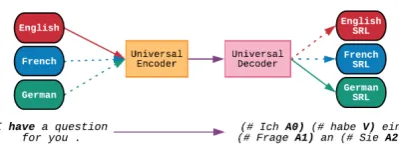
Figure 1: We propose an Encoder-Decoder model that translates a sentence into a target language and applies SRL labeling to the translated words. In this example we translate from English to German and label roles for the predicatehave.
predicate (Marcheggiani et al., 2017; He et al.,
2017), and even jointly predict predicates inside sentences (He et al.,2018;Cai et al.,2018). While these approaches alleviate the need for pipeline models, they require sufficient amounts of training data to perform adequately. To date, such models have been tested primarily for English, which of-fers a considerable amount of high-quality train-ing data compared to other languages. The lack of sufficiently large SRL datasets makes it hard to straightforwardly apply the same architectures to other languages and calls for methods to augment the training data in lower-resource languages.
There is significant prior work on SRL data aug-mentation (Hartmann et al.,2017), annotation pro-jection for monolingual (F¨urstenau and Lapata,
2012; Hartmann et al., 2016), and cross-lingual SRL (Pad´o and Lapata,2009;van der Plas et al.,
lan-guage and that learns to translate input sentences to another language while transferring semantic role annotations from the source to the target.
Techniques for low-resource Neural Machine Translation (NMT) show the positive impact on target predictions by adding more than one language during training, such as Multi-source NMT (Zoph and Knight,2016) and Multilingual NMT (Johnson et al., 2017; Firat et al., 2016a), whereas Mulcaire et al. (2018) show the advan-tages of training a single polyglot SRL system that improves over monolingual baselines in lower-resource settings. In this work, we propose a gen-eral Encoder-Decoder (Enc-Dec) architecture for SRL (see Figure1). We extend our previous Enc-Dec approach for SRL (Daza and Frank,2018) to a cross-lingual model that translates sentences from a source language to a (lower-resource) target lan-guage, and during decoding jointly labels it with SRL annotations.1
Our contributions are as follows:
• We propose the first cross-lingual multilin-gual Enc-Dec model for PropBank SRL.
• We show that our cross-lingual model can generate new labeled sentences in a target language without the need of explicit syntac-tic or semansyntac-tic annotations at inference time.
• Cross-lingual evaluation against a labeled gold standard achieves good performance, comparable to monolingual SRL results.
• Augmenting the training set of a lower-resource language with sentences generated by the cross-lingual model achieves im-proved F1 scores on the benchmark dataset.
• Our universal Enc-Dec model lends itself to monolingual, multilingual and crosslingual SRL and yields competitive performance.
2 An Extensible Model for SRL
2.1 One Model to Treat Them All
We define the SRL task as a sequence transduc-tion problem: given an input sequence of tokens
X = x1, ..., xi, the system is tasked to generate
a sequenceY =y1, ..., yj consisting of words
in-terleaved with SRL annotations. Defining the task in this fashion allowsX andY to be of different lengths and therefore target sequences may also
[image:2.595.316.520.73.143.2]1Code is available at: https://github.com/ Heidelberg-NLP/SRL-S2S.
Figure 2: Monolingual Enc-Dec model for SRL with copying (Daza and Frank, 2018). We generalize this architecture to multilingual and cross-lingual SRL.
contain word tokens of different languages if de-sired. This means that we could train an Enc-Dec model that learns not only to label a sentence, but to jointly translate it while applying SRL annota-tions directly to the target language. Moreover, following conceptually the multilingual Enc-Dec model proposed byJohnson et al.(2017), we can train a single model that allows for joint training with multiple language pairs while sharing param-eters among them. We apply a similar joint multi-lingual learning method to produce structured out-put sequences in the form of translations enriched with SRL annotations on the (lower-resource) tar-get language (cf. Figure 3). We will apply this universal structure-inducing Enc-Dec model to the Semantic Role Labeling task, and show that it can be deployed in three different settings:
i) monolingual: encode a sentence in a given language and learn to decode a labeled sequence by reproducing the source words and inserting the appropriate structure-indicating labels in the out-put (cf. Figure 2). A copying mechanism (Gu et al.,2016) allows this model to reproduce the in-put sentence as faithfully as possible.
ii)one-to-one multilingual: train a single, joint model to generate n different structure-enriched target languages given inputs in the same lan-guage. For example: Labeled English (EN-SRL) given an EN sentence or Labeled German ( DE-SRL) given a DE sentence. This multilingual model still relies on copying to relate each labeled output sentence to its corresponding input coun-terpart. However, unlike (i), it has the advantage of sharing parameters among languages.
iii)cross-lingual: generate outputs in n differ-ent target languages given inputs in m different source languages, for example: Labeled German (DE-SRL) and Labeled French (FR-SRL) given an
source sentence but train it totranslatethem. In Section 2.2we describe how the basic Enc-Dec model for SRL is constructed and in Section
2.3we describe the additional components that al-low us to generalize this architecture to the one-to-one multilingual and cross-lingual scenarios.
2.2 Encoder-Decoder Architecture
We reimplement and extend the Enc-Dec model with attention (Bahdanau et al.,2015) and copying (Gu et al.,2016) mechanisms for SRL proposed by
Daza and Frank (2018). This model encodes the source sentence and decodes the input sequence of words (in the same language) interleaved with SRL labels.
Data Representation. Similar to other prior work (Liu et al., 2018) and our own (Daza and Frank, 2018), we linearize the SRL structure in order to process it as a sequence of symbols suit-able for the Enc-Dec architecture. We restrict our-selves to argument identification and labeling of one predicate at a time. We feed the gold pred-icate in training and inference, and process each sentence as many times as it has predicates. An opening bracket(#indicates the start of a labeled-argument region; a closing labeled bracket, e.g.
A0), indicates the ending and the tag of the labeled region (see Figure2).
Vocabulary. We define a shared vocabulary consisting of all source and target words V =
{v1, ..., vN} ∪ {U N K}and the SRL labels L = {l1, ..., lM}. In addition, we employ a per-instance
extension set X = {x1..., xTx} containing all words from the source sequence. Our final vocab-ulary isV ∪ L ∪ X.
Encoder. In our prior work (Daza and Frank,
2018) we used a 2-layer BiLSTM as encoder. In this paper, we adopt the Deep BiLSTM Encoder from He et al. (2017) which has been shown to work well for SRL models. Again followingHe et al.(2017), we define the encoder input vector
xi as the concatenation of a word embedding wi
and a binary predicate-feature embeddingpi
indi-cating at each time-step whether the current word is a predicate or not2. The encoder outputs a se-ries of hidden statesh1, ..., hTx representing each token. We refer to this series of states asH.
Attention. To improve the access to the source sentence representation, we include the attention
2These two additions already show improvements
com-pared to the reported results inDaza and Frank(2018).
mechanism proposed by Bahdanau et al. (2015), which computes a context vector at each time step
tbased onHand the current decoder state. Decoder. We use a single-layer Decoder with LSTM cells (Hochreiter and Schmidhuber,1997) and a copying mechanism. It emits an output to-kenytfrom a learned scoreψgover the vocabulary
at each time steptgiven its state st, the previous
output tokenyt−1, and the attention context vector
ct. In addition, a copying scoreψc is calculated.
The decoder learns from these scores when to gerate a new token and when to copy from the en-coded hidden statesH. Formally we compute the scores as:
ψg(yt=vi) =Wo[st;ct], viV ∪ L
ψc(yt=xj) =σ(hTjWc)st, xj X
(1)
where WoRN×2ds and WcRdh×ds are learn-able parameters and st, ct are the current
de-coder state and context vector, respectively. These scores are used to compute two distributions: one for the likelihood of copying (c)ytand another for
the likelihood of generating (g)yt. Formally:
p(yt|st, yt−1, ct,H) =p(yt,g|st, yt−1, ct)+
p(yt,c|st, yt−1,H) (2)
The two distributions are then normalized by a final softmax layer from which we compute a joint likelihood of yt and choose the token with
the highest score within this joint likelihood.
2.3 Multilingual Extensions
We generalize the monolingual Enc-Dec model for SRL to a multilingual SRL system by adding two main components:
Translation Token.LikeJohnson et al.(2017), we prefix the source sequence with a special token that indicates the expected language of the target sequence. If the source is inENand the target is a German sentence with SRL labels, the source sen-tence will be preceded by the token<2DE-SRL>. Language Indicator Embeddings. We want the model to profit from the common role label inventory used across languages, yet at the same time there are subtle differences in role labeling and how roles are linguistically marked in the dif-ferent languages3. Hence, we define N different language indicators (e.g., FR, DE) and represent
3e.g. the role A2 (Beneficiary) can be PP in
Figure 3: A universal structure-inducing Enc-Dec model with copying and sharing of parameters across languages that jointly translates and labels sentences. It can also be trained cross-lingually and be augmented with classic machine translation data (as shown in the two bottom rows of the figure).
each of them with a randomly initialized language indicator vector that we tune during training. The model can use these language indicator embed-ding vectors to leverage language-specific proper-ties when generating SRL annotations. Also, by using these embeddings in the decoder, we can help it to stay consistent regarding the language it generates4.
Thus, in all multilingual settings, at each time step twe feed theEncoder with a concatenation of the previous encoder stateht−1, the word em-bedding wt of the current token, the embedded
predicate indicator pt and the language indicator
embeddinglt. The Encoder state update is defined
as:
ht=LST M([ht−1;wt;pt;lt]) (3)
Likewise, on the Decoderside we concatenate the representations for both word tokens and la-bel tokens with the language indicator vector to produce tokens in a specific language. For SRL-labeled output sentences the indicator token for the language embedding isDE-SRL, FR-SRL, ... de-pending on the target language. Formally, at each time step the decoder updates its state by taking into account the previous decoder state st−1, the
previous generated token5 yt−1, the language
in-4
Johnson et al.(2017) only use a translation token, but our training data is significantly smaller than theirs.
5During training we use teacher forcing, feeding the gold
target token instead of the previously generated token
dicator embeddinglt−1 and the attention context vectorct:
st=LST M([st−1;yt−1;lt−1;ct]) (4)
3 Data
3.1 SRL Monolingual Datasets
Two labeling schemes have been established for PropBank SRL: span-based and dependency-based. In the former, arguments are characterized as word-spans. This scheme was introduced in the CoNLL-05 Shared-task (Carreras and M`arquez,
2005) and is available only for English. In the dependency-based SRL format, only the syntactic heads of arguments are labeled. This format was defined in the CoNLL-09 Shared task (Hajiˇc et al.,
2009), which includes SRL labeled data for seven languages.6
We will use span-based and dependency-based data for English to benchmark the monolingual system. For the multilingual experiments, we use the dependency-based annotations, given that there is labeled data available in different lan-guages on this format. Specifically, we use the English and German portions of CoNLL-09 and the automatically annotated French SRL corpus ofvan der Plas et al. (2011) for training and the human-labeled sentences fromvan der Plas et al.
(2010) for testing. Both corpora contain a similar
6Note that CoNLL-09 is not a parallel corpus. All data
Mono- Language Train Test lingual # Sents w/ 1-Pred w/ 1-Pred CoNLL-05 EN [Span] 75,187 94,497 5,476 CoNLL-09 EN [Dep] 39,279 180,446 10,626 CoNLL-09 DE [Dep] 36,020 39,138 2,044 v.d. Plas FR [Dep] 40,075 73,094 2,036
Table 1: Train and Test Data for Monolingual Models. We show the original number of sentences and the size of the ”expanded” data with one copy per predicate.
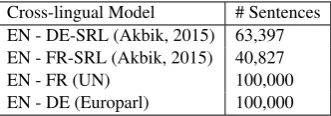
Cross-lingual Model # Sentences EN - DE-SRL (Akbik, 2015) 63,397 EN - FR-SRL (Akbik, 2015) 40,827 EN - FR (UN) 100,000 EN - DE (Europarl) 100,000
Table 2: Data used for Cross-lingual Models: From the SRL parallel data available we take90% for training and use the rest as aDevset for our experiments. We add the non-labeled data (from UN and Europarl) dur-ing traindur-ing to enforce translation knowledge.
label set as the English PropBank7. For statistics on the size of the datasets see Table1.
3.2 Datasets for Cross-lingual SRL
We use the dependency-based labeled German and French SRL corpus fromAkbik et al.(2015) which was produced via annotation projection. These sentences are already pre-filtered to ensure that the predicate sense of the source predicate is preserved in the target sentence. Since the role la-bels are projected from automatically PropBank-parsed English sentences, all languages share the same label set. The underlying corpus for this dataset is composed of Machine Translation (MT) parallel corpora: Europarl (Koehn,2005) for EN-DE (about 63K sents), and UN (Ziemski et al.,
2016) forEN-FR(about 40K sents).
Since we only had access to the labeled sen-tences (target-side), we constructed our parallel training pairsENtoFR-SRLandENtoDE-SRLby finding the original source English counterparts. We use Flair (Akbik et al.,2018) to predict Prop-Bank frames on the English source sentences and find the alignment to the labeled predicate on the target side using fast-align (Dyer et al.,2013).
In addition to the parallel SRL-labeled data, we choose a subset of 100K parallel (non-labeled) sentences for each language pair from the men-tioned MT datasets (Europarl and UN corpora) to
7French data was directly annotated using the English
la-belset but German CoNLL-09 contains additional core labels A5-A9 and does not containAM-modifier labels
improve the translation quality of the model, we use90%for training and the rest as a development set. The data is summarized in Table2.
4 Experiments and Results
4.1 General Settings
We use the AllenNLP (Gardner et al.,2018) Enc-Dec model as a basis for our implementation. Our model is trained to minimize the negative log-likelihood of the next token. Hyperparameters and model sizes are provided in Supplement A.1. We use pre-trained word embeddings (fine-tuned dur-ing traindur-ing) for the 3 languages: GloVe ( Pen-nington et al., 2014) for EN and the pre-trained vectors from Grave et al.(2018) for FRandDE. We also train versions with contextual word repre-sentations: pre-trained English 1024-dimensional ELMo (Peters et al.,2018) and multilingual 768-dimensional BERT-small (Devlin et al.,2019) rep-resentations.
4.2 Monolingual Experiments and Results
We train three separate monolingual versions for
EN, DE andFR. We first benchmark our system against a wide variety of English models (span-and dependency-based) that perform the role clas-sification task with gold predicates to show that our labeling performance is competitive with the existent SOTA neural models for English. This is shown in Table 3. The performance of DE and
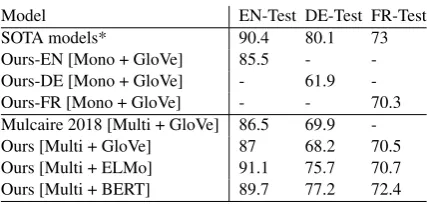
FR is shown in Table 4 where we compare all monolingual systems for the three languages (top half), against the one-to-one multilingual versions (bottom half). Results forEN show that the Enc-Dec architecture is competitive with the GloVe-based models (although still 4 F1 points below SOTA in most cases), however it benefits more from ELMo, achieving SOTA results for span-based and dependency-span-based SRL.
4.3 Multilingual Experiments and Results
[image:5.595.99.265.184.242.2]Type Model Word CoNLL-05 CoNLL-09 Repres. WSJ OOD WSJ OOD
Span
SRL
He 2017 GloVe 84.6 73.6 - -Daza 2018 GloVe 79.2 68.4 - -He, 2018 ELMo 83.9 73.7 - -Tan, 2018 GloVe 84.8 74.1 - -Strubell 18 [LISA] GloVe 84.6 74.5 - -Strubell 18 [LISA*] ELMo 86.5 78 - -Ouchi 2018 ELMo 88.5 79.6 -
-Dep SRL
Roth 2016 DPE* - - 87.7 76.1 Marcheggiani 2017 Dyer* - - 87.7 77.7 Cai et al 2018 GloVe - - 89.6 79
Dep
and
Span
SRL
[image:6.595.74.289.63.232.2]FitzGerald 2015 GloVe 80.3 72.2 87.8 75.5 Li 2019 ELMo 87.7 - 90.4 -Ours [Mono] GloVe 80.4 70.5 85.5 75.7 Ours [Mono] ELMo 88.3 80.9 90.8 84.1
Table 3: CoNLL-09 and CoNLL-05 Test Sets for En-glish. Our model with ELMo shows SOTA perfor-mance on both types of SRL. LISA* only reports ELMo with predicted predicates; DPE*: dependency path embeddings; Dyer*: Dyer et al. 2015.
Model EN-Test DE-Test FR-Test SOTA models* 90.4 80.1 73 Ours-EN [Mono + GloVe] 85.5 - -Ours-DE [Mono + GloVe] - 61.9 -Ours-FR [Mono + GloVe] - - 70.3 Mulcaire 2018 [Multi + GloVe] 86.5 69.9 -Ours [Multi + GloVe] 87 68.2 70.5 Ours [Multi + ELMo] 91.1 75.7 70.7 Ours [Multi + BERT] 89.7 77.2 72.4
Table 4: F1 scores for role labeling on dependency-based SRL data. EN and DE Tests: CoNLL-09; FR-Test:van der Plas et al.(2011). State of the art (SOTA) models∗ are: Cai et al.(2018) [GloVe] for EN,Roth and Lapata(2016) [Dependency-path Embeddings] for DE andvan der Plas et al.(2014) [Non-neural] for FR, respectively.
Multilingual training yields improvement on the three languages studied in this paper when com-pared to our monolingual baselines, particularly for German, which shows more than 6 points (F1) of improvement. In addition, we compare with the polyglot SRL system of Mulcaire et al.
(2018) (which also leverages data from multiple languages during training), obtaining better re-sults for English using GloVe. We then show that adding contextual representations to our model re-sults in bigger improvements across the board.
4.4 Cross-Lingual Experiments and Results
Training. After validating the robustness of our architecture when handling different languages at the same time, we now train a cross-lingual SRL version. This setting differs from the previous two
because the model needs to learn two tasks: be-sides generating appropriate SRL labels, it needs to translate from source into a target language. To do so, we train a single model using the concate-nation of the parallel datasets listed in Table2and described in Section3.2. We further include Ma-chine Translation (MT) data to reinforce the trans-lation knowledge of the model, so that it can gen-erate fluent (labeled) target sentences. As in the multilingual experiments, we train the model with alternating batches of instances randomly chosen from the individual language pairs. Note that the amount of MT data that we can add is restricted: the labeled multilingual data is relatively small and labeling performance suffers when the MT data gets too dominant.
Evaluating Cross-lingual SRL. As in classical MT, evaluation is difficult, since the system out-puts will approximate a target reference but will never be guaranteed to match it. Hence in this setting we do not have a proper gold standard to evaluate the labeled outputs, since we are generat-ing labeled target sentences from scratch. Similar to MT research, we apply BLEU score (Papineni et al.,2002) to measure the closeness of the out-puts against ourDevSet.
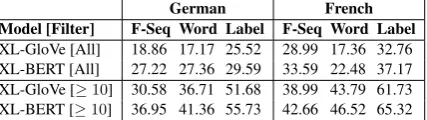
The upper part of Table 5compares the scores of two versions of the Enc-Dec model trained on the cross-lingual data from Table 2 systems, one using GloVe embeddings and the second using BERT, respectively. To better distinguish trans-lation vs. labeling quality, we compute BLEU scores for the system outputs against labeled ref-erence sentences in three different ways: onwords only, labels only, and on full labeled sequences
(both word and label outputs). We see that the pre-diction of words is similar in the two languages, but labeling is more difficult forDE than forFR
for both systems. Also we observe that adding multilingual BERT is very helpful to obtain even more fluent and correct labeled outputs (according to BLEU) resulting in ca. +9 points in German and +5 in French on the full sequences. This is very important given that we have a small training set compared to classic NMT scenarios.
The bottom part of Table 5 shows the scores when restricting the evaluation to sentences with score≥ 10. We observed that this threshold8 is a good trade-off in both the amount of kept sen-tences (above the threshold) and average BLEU
[image:6.595.74.288.314.416.2]German French Model [Filter] F-Seq Word Label F-Seq Word Label
[image:7.595.75.289.63.123.2]XL-GloVe [All] 18.86 17.17 25.52 28.99 17.36 32.76 XL-BERT [All] 27.22 27.36 29.59 33.59 22.48 37.17 XL-GloVe [≥10] 30.58 36.71 51.68 38.99 43.79 61.73 XL-BERT [≥10] 36.95 41.36 55.73 42.66 46.52 65.32
Table 5: Cross-lingual (XL) system results using BLEU score on individual languages inside theDevset. We compute BLEU on labeled sequences (F-Seq), and separately for words and only labels. We also show scores when pre-filtering on F-Seq with BLEU≥10.
score increase (presumably sentence quality). By keeping only the filtered subset of sentences we get an improvement on average of approx. 10 BLEU points on the full sequences (F-Seq), and almost double the score forlabels only. This holds for GloVe and BERT versions on both languages.
Output Filtering and Data Generation. We use our cross-lingual model as a labeled data gen-erator by applying it on EN sentences from Eu-roparl (100K) and UN corpora (100K)9 and let the model predictDE-SRLand FR-SRLas target languages. This results in unseen German and French labeled sentences. Since we cannot guar-antee that the generated sentences preserve the source predicate meaning, we filter all outputs by keeping only those that come close to the origi-nal sentence meaning. We approximate this by back-translating the generated outputs (stripping the labels and keeping only the words) using the pre-trainedDE-ENmodel from OpenNMT (Klein et al.,2017).
We compare the back-translations to the sen-tences that we originally presented to the sys-tem and, using the previously described filtering heuristic, we keep only those whose BLEU score is equal or greater than 10. The logic behind this is that if the back-translation is close enough to the source, the generated sentence preserves a fair amount of the original sentence meaning10. With this strategy, after applying the BLEU filter, we end up with a parallel dataset of 44K generated sentences for(EN, DE-SRL)and 32K for (EN, FR-SRL). In the next section we show more detailed evaluation measures of the system outputs, focus-ing on the filtered dataset that we just described.
9Note that these are taken from a different subset than the
parallel sentences used during training.
10BLEU score is used as a naive approach to avoid
exces-sively noisy data but we could also develop, for example, a se-mantic similarity metric to also keep sentences that are close enough to the original predicate sense meaning.
4.5 Cross-Lingual Detailed Evaluation
We are aware that BLEU score gives only a rough estimate of the actual quality of the outputs, there-fore we propose to measure the performance of our system in two more detailed evaluation set-tings: (i) a small-scale human evaluationwhere we evaluate the assigned SRL labels against 226 sentences that were manually judged and anno-tated to give an estimation of the quality of the generated data, (ii) anextrinsic evaluationusing labeled sentences generated by our system to aug-ment the training set for a resource-poor language. We conduct the extrinsic evaluation on German and French and the manual evaluation only on the German data, which proved to be the more chal-lenging language compared to French.
4.5.1 Human Evaluation
To provide an in-depth quality assessment of the generated sentences, we create a small-scale gold standard consisting of 226 sentences. To select a representative sample from our newly generated labeled sentences,11we analyze the distribution of labels in the data and apply stratified sampling to cover as many predicates as possible and as many role label variants as possible. We judge these sen-tences on the quality of the generated language and annotate them with PropBank roles.
SRL Gold Standard. As we are lacking trained PropBank annotators, we mimic the question-based role annotation method ofHe et al. (2015), who constructed QA pairs in order to label the predicate-argument structure of verbs. The anno-tation involves several subtasks: The first is to gen-erate questions targeting a specific verb in a sen-tence and to mark as answers a subset of words from the same sentence. The next subtask is to choose the head word of each selected subset and to assign a PropBank label to this head accord-ing to a table that correlates WH-phrases with the most likely label.12
We ask two linguistically trained annotators to perform the whole task independently and com-pute Krippendorff’s Alpha (Krippendorff, 1980) on the role labels, which results in an inter-annotator agreement score of 82.83. We resolved conflicting annotations through discussion among
11
i.e., the generated sentences for which we measured a BLEU score≥10 against the source using back-translation.
12We provide this correlation table and the full annotation
the annotators. The resulting gold standard con-tains 737 annotated roles. Notably, the most prominent roles (as in the CoNLL datasets) are A0 and A1 which are normally related to the agent and the patient in sentences, but the annotated data also includes modifier roles such as temporal, modal, discourse markers, among others13.
Translation Quality. We ask two different an-notators to score each output sentence (they see only the words, not the labels) on a scale of 1-5 forQuality(1: ‘is completely ungrammatical’; 5: ‘is perfectly grammatical’) and forNaturalness(1: ‘The sentence is not what a native speaker would write’; 5: ‘The sentence could have been written by a native speaker’). We obtain a high average score of 4.4 forQualityand 4.2 forNaturalness.
SRL Performance on Gold Standard. We use our human-annotated sentences to measure the au-tomatic labeling performance of our cross-lingual SRL model which we call XL-BERT). We obtain 73.21 F1 score (73.33 precision, 73.1 recall). We also measure the performance of the ZAP label projection system ofAkbik and Vollgraf(2018) on this data (we only consider arguments of the pred-icates that were annotated). ZAP obtains a low F1 score of 56.03 (42.65 precision, 81.7 recall). Thus, XL-BERT shows much better, and more precise results compared to this baseline and achieves overall very acceptable and stable labeling quality. This shows that the joint translation-labeling task is successful. ZAP, by contrast, shows more unsta-ble results, which might be due to word alignment noise. Although we train on such data, our model can also loose some of this noise, given that the same model is trained to produce more than one labeled language, namelyFR-SRLandDE-SRL.
4.5.2 Extrinsic Task: Data Augmentation
Finally, we augment the training sets of our two resource-poor languages DE andFR, in portions of 10K until we cover the complete generated data. We compare the increase in F1 score when training models with different amounts of additional data. We also add a comparison of the improvement achieved when adding the same amount of sen-tences produced by the labeled projection method of Akbik et al. (2015). We see in Table 6 that adding our German data shows improvement in F1 score, despite the fact that the CoNLL-09
la-13The label distribution is given in the Supplement, A.3.
Model + Training Data Data Size F1 Test DE [Mono] (Original) 39K 61.9 DE [Mono] +LabelProj 83K 62.37 DE [Mono] + OurGen10K 49K 62.4 DE [Mono] + OurGen20K 59K 62.46 DE [Mono] + OurGen30K 69K 62.81
DE [Mono] + OurGenALL 83K 63.57
FR [Mono] (Original) 73K 70.3 FR [Mono] +LabelProj 105K 70.45 FR [Mono] + OurGen10K 83K 70.33
FR [Mono] + OurGen20K 93K 70.52
[image:8.595.309.523.63.218.2]FR [Mono] + OurGenALL 105K 70.39
Table 6: We retrain the monolingual systemsDE, FR using the original training sets (BL: Original) shown in Table 1 and inject our generated data in different sizes. We also compare to the stronger baseline La-belProjwhere we add data created by label projection (Akbik et al.,2015).
bel scheme has arguments not seen in our train-ing data (namely A5-A9). Presumably we see this improvement because the frequency of the major roles is more prominent. In the case of French, we don’t see significant improvement, however also here the addition of projected data shows a similar trend.
5 Related Work
Encoder-Decoder Models. A wide range of NMT models are based on the Encoder-Decoder approach (Sutskever et al., 2014) with atten-tion mechanism (Bahdanau et al., 2015; Luong et al., 2015). More recent architectures (Zoph and Knight, 2016; Firat et al., 2016a) show that training with multiple languages performs better than one-to-one NMT. Multilingual models have also been trained to perform Zero-shot translation (Johnson et al., 2017; Firat et al., 2016b). The Enc-Dec approach has been tested in many tasks that can be formulated as a sequence transduc-tion problem: syntactic parsing (Vinyals et al.,
2015), AMR and Semantic Parsing (Konstas et al.,
Cross-lingual Annotation Projection.A com-mon approach to address the lack of annotations is projecting labels from English to a lower-resource language of interest. This has shown good results in the transfer of semantic information to target languages.Kozhevnikov and Titov(2013) propose an unsupervised method to transfer SRL labels to another language by training on the source side and using shared feature representations for pre-dicting on the target side.Pad´o and Lapata(2009) project FrameNet (Baker et al., 1998) SRL la-bels by searching for the best alignment in source and target constituent trees, defining label transfer as an optimization problem in a bipartite graph.
van der Plas et al. (2011) use intersective word alignments between English and French with ad-ditional filtering heuristics to determine whether a PropBank label should be transferred and then use this to train a joint syntactic-semantic parser for both languages. Akbik et al.(2015) proposes a higher-confidence projection by first creating a system with high precision and low recall and then using a bootstrap approach to augment the labeled data.
Separately, Minard et al. (2016) generated a multilingual event and time parallel corpus includ-ing SRL annotations. Their corpus was manually annotated on the English side and automatically projected to Italian, Spanish, and Dutch based on the manual alignment of the annotated elements. Unfortunately, the authors do not report the per-formance of the SRL task, making it difficult for us to use their data for benchmarking.
Semantic Role Labeling. Span-based SRL only exists on English data (Zhou and Xu,2015;
He et al.,2018;Strubell et al.,2018;Ouchi et al.,
2018). Dependency-based SRL models such as (Marcheggiani and Titov, 2017; Cai et al., 2018;
Li et al., 2019) are the state-of-the-art for En-glish. For French, we compare against van der Plas et al.(2014) since we did not find more recent work for that language. Roth and Lapata (2016) show a model based on dependency path embed-dings that achieved SOTA in English and German. The Polyglot SRL model ofMulcaire et al.(2018) shows some improvement over monolingual base-lines when aggregating all multilingual data avail-able from CoNLL-09, while more refined integra-tion did not show further improvement. Their sys-tem does not perform better than our multilingual models for English and German.
6 Conclusions
We presented the first cross-lingual SRL system that translates a sentence and concurrently labels it with PropBank roles. The proposed Enc-Dec architecture is flexible: as amonolingual system the model achieves SOTA for English PropBank role labeling, themultilingualSRL system shows that joining multiple languages improves SRL per-formance over the monolingual baselines, and a
cross-lingualsystem can be used to generate SRL-labeled data for lower-resource languages. Eval-uation of the cross-lingual system shows that the quality-filtered sentences are highly grammatical and natural, and that the generated PropBank la-bels can be more precise than label projection. Us-ing our labeled data beats a label projection base-line when using it to augment the training set of a lower-resource language.
An advantage of our proposed model is that it does not need parallel data at inference time. Our current model can possibly be further improved by adding more automatically generated data in the data augmentation scenario, or by targeted selec-tion in an active learning setting. Current limi-tations of the system may be alleviated by pre-training the model to acquire better translation knowledge from larger training data, and by de-veloping more refined filtering methods.
In future work we also aim to make the system more flexible, by extending it to few-shot or zero-shot learning, to alleviate the need for an initial big annotated set, and thus to be able to generate SRL data for truly resource-poor languages. Fur-ther challenges for this novel architecture are to extend it to joint predicate and role labeling for more than one predicate at a time.
Acknowledgements
We thank the reviewers for their insightful com-ments. This research is funded by the Leibniz ScienceCampus Empirical Linguistics & Compu-tational Language Modeling, supported by Leib-niz Association grant no. SAS2015-IDS-LWC and by the Ministry of Science, Research, and Art of Baden-Wurttemberg. We thank NVIDIA Corporation for donating GPUs used in this re-search. We are grateful to our annotators and to
´
References
Alan Akbik, Duncan Blythe, and Roland Vollgraf. 2018. Contextual string embeddings for sequence labeling. InCOLING 2018, 27th International Con-ference on Computational Linguistics, pages 1638– 1649.
Alan Akbik, L.b Chiticariu, M.b Danilevsky, Y.b Li, S.b Vaithyanathan, and H.b Zhu. 2015. Generat-ing high quality proposition banks for multilGenerat-ingual semantic role labeling. ACL-IJCNLP 2015, 1:397– 418.
Alan Akbik, Vishwajeet Kumar, and Yunyao Li. 2016. Towards Semi-Automatic Generation of Proposition Banks for Low-Resource Languages. Proceedings of the 2016 Conference on Empirical Methods in Natural Language Processing, pages 993–998.
Alan Akbik and Roland Vollgraf. 2018. ZAP: An open-source multilingual annotation projection frame-work. In Proceedings of the 11th Language Resources and Evaluation Conference, Miyazaki, Japan. European Language Resource Association.
Dzmitry Bahdanau, Kyunghyun Cho, and Yoshua Ben-gio. 2015. Neural machine translation by jointly learning to align and translate. In 3rd Inter-national Conference on Learning Representations, ICLR 2015, San Diego, CA, USA, May 7-9, 2015, Conference Track Proceedings.
Collin F. Baker, Charles J. Fillmore, John B. Lowe, Collin F. Baker, Charles J. Fillmore, and John B. Lowe. 1998. The Berkeley FrameNet Project. In Proceedings of the 17th international conference on Computational linguistics, volume 1, page 86, Mor-ristown, NJ, USA. Association for Computational Linguistics.
Jiaxun Cai, Shexia He, Zuchao Li, and Hai Zhao. 2018. A full end-to-end semantic role labeler, syntactic-agnostic over syntactic-aware? InCOLING, pages 2753–2765. Association for Computational Linguis-tics.
Xavier Carreras and Llu´ıs M`arquez. 2005. Intro-duction to the conll-2005 shared task: Semantic role labeling. InProceedings of the Ninth Confer-ence on Computational Natural Language Learn-ing, CONLL ’05, pages 152–164, Stroudsburg, PA, USA. Association for Computational Linguistics.
Angel Daza and Anette Frank. 2018. A sequence-to-sequence model for semantic role labeling. In Pro-ceedings of The Third Workshop on Representation Learning for NLP, pages 207–216. Association for Computational Linguistics.
Jacob Devlin, Ming-Wei Chang, Kenton Lee, and Kristina Toutanova. 2019. BERT: Pre-training of deep bidirectional transformers for language under-standing. In Proceedings of the 2019 Conference of the North American Chapter of the Association for Computational Linguistics: Human Language
Technologies, Volume 1 (Long and Short Papers), pages 4171–4186, Minneapolis, Minnesota. Associ-ation for ComputAssoci-ational Linguistics.
Li Dong and Mirella Lapata. 2016. Language to logi-cal form with neural attention. InProceedings of the 54th Annual Meeting of the Association for Compu-tational Linguistics (Volume 1: Long Papers), pages 33–43. Association for Computational Linguistics.
Chris Dyer, Victor Chahuneau, and Noah A. Smith. 2013. A simple, fast, and effective reparameter-ization of IBM model 2. In Proceedings of the 2013 Conference of the North American Chapter of the Association for Computational Linguistics: Hu-man Language Technologies, pages 644–648, At-lanta, Georgia. Association for Computational Lin-guistics.
Orhan Firat, Kyunghyun Cho, and Yoshua Bengio. 2016a. Multi-way, multilingual neural machine translation with a shared attention mechanism. In HLT-NAACL, pages 866–875. The Association for Computational Linguistics.
Orhan Firat, Baskaran Sankaran, Yaser Al-Onaizan, Fatos T. Yarman Vural, and Kyunghyun Cho. 2016b. Zero-resource translation with multi-lingual neural machine translation. In Proceedings of the 2016 Conference on Empirical Methods in Natural Lan-guage Processing, pages 268–277, Austin, Texas. Association for Computational Linguistics.
Hagen F¨urstenau and Mirella Lapata. 2012. Semi-Supervised Semantic Role Labeling via Structural Alignment. Journal of Computational Linguistics, 38(1):135–171.
Matt Gardner, Joel Grus, Mark Neumann, Oyvind Tafjord, Pradeep Dasigi, Nelson F. Liu, Matthew Pe-ters, Michael Schmitz, and Luke Zettlemoyer. 2018. AllenNLP: A deep semantic natural language pro-cessing platform. InProceedings of Workshop for NLP Open Source Software (NLP-OSS), pages 1– 6, Melbourne, Australia. Association for Computa-tional Linguistics.
Edouard Grave, Piotr Bojanowski, Prakhar Gupta, Ar-mand Joulin, and Tomas Mikolov. 2018. Learning word vectors for 157 languages. In Proceedings of the International Conference on Language Re-sources and Evaluation (LREC 2018).
Jiatao Gu, Zhengdong Lu, Hang Li, and Victor O.K. Li. 2016. Incorporating copying mechanism in sequence-to-sequence learning. In Proceedings of the 54th Annual Meeting of the Association for Com-putational Linguistics (Volume 1: Long Papers), pages 1631–1640, Berlin, Germany. Association for Computational Linguistics.
Nianwen Xue, and Yi Zhang. 2009. The conll-2009 shared task: Syntactic and semantic dependencies in multiple languages. InProceedings of the Thir-teenth Conference on Computational Natural Lan-guage Learning: Shared Task, CoNLL ’09, pages 1–18, Stroudsburg, PA, USA. Association for Com-putational Linguistics.
Silvana Hartmann, Judith Eckle-Kohler, and Iryna Gurevych. 2016. Generating training data for se-mantic role labeling based on label transfer from linked lexical resources. Transactions of the Asso-ciation for Computational Linguistics, 4:197–213.
Silvana Hartmann, Eva´ M´ujdricza-Maydt, Ilia Kuznetsov, Iryna Gurevych, and Anette Frank. 2017. Assessing SRL frameworks with automatic training data expansion. InProceedings of the 11th Linguistic Annotation Workshop, pages 115–121, Valencia, Spain. Association for Computational Linguistics.
Luheng He, Kenton Lee, Omer Levy, and Luke Zettle-moyer. 2018. Jointly predicting predicates and ar-guments in neural semantic role labeling. In Pro-ceedings of the 56th Annual Meeting of the Associa-tion for ComputaAssocia-tional Linguistics (Volume 2: Short Papers), pages 364–369. Association for Computa-tional Linguistics.
Luheng He, Kenton Lee, Mike Lewis, and Luke Zettle-moyer. 2017. Deep semantic role labeling: What works and whats next. In Proceedings of the An-nual Meeting of the Association for Computational Linguistics.
Luheng He, Mike Lewis, and Luke Zettlemoyer. 2015. Question-answer driven semantic role labeling: Us-ing natural language to annotate natural language. In Proceedings of the 2015 Conference on Empiri-cal Methods in Natural Language Processing, pages 643–653, Lisbon, Portugal. Association for Compu-tational Linguistics.
Sepp Hochreiter and J¨urgen Schmidhuber. 1997. Long short-term memory. Neural Comput., 9(8):1735– 1780.
Melvin Johnson, Mike Schuster, Quoc Le, Maxim Krikun, Yonghui Wu, Zhifeng Chen, Nikhil Thorat, Fernand a Vigas, Martin Wattenberg, Greg Corrado, Macduff Hughes, and Jeffrey Dean. 2017. Google’s multilingual neural machine translation system: En-abling zero-shot translation.Transactions of the As-sociation for Computational Linguistics, 5:339–351.
Atif Khan, Naomie Salim, and Yogan Jaya Kumar. 2015. A framework for multi-document abstrac-tive summarization based on semantic role labelling. Appl. Soft Comput., 30(C):737–747.
Guillaume Klein, Yoon Kim, Yuntian Deng, Jean Senellart, and Alexander Rush. 2017. OpenNMT: Open-source toolkit for neural machine translation.
In Proceedings of ACL 2017, System Demonstra-tions, pages 67–72, Vancouver, Canada. Association for Computational Linguistics.
Philipp Koehn. 2005. Europarl: A Parallel Corpus for Statistical Machine Translation.
Ioannis Konstas, Srinivasan Iyer, Mark Yatskar, Yejin Choi, and Luke Zettlemoyer. 2017. Neural AMR: Sequence-to-Sequence Models for Parsing and Gen-eration. In Proceedings of the 55th Annual Meet-ing of the Association for Computational LMeet-inguistics (Volume 1: Long Papers), pages 146–157, Vancou-ver, Canada.
Mikhail Kozhevnikov and Ivan Titov. 2013. Cross-lingual transfer of semantic role labeling models. In Proceedings of the 51st Annual Meeting of the Association for Computational Linguistics (Volume 1: Long Papers), pages 1190–1200. Association for Computational Linguistics.
Klaus Krippendorff. 1980. Content Analysis: An Intro-duction to Its Methodology. Sage.
Zuchao Li, Shexia He, Hai Zhao, Yiqing Zhang, Zhu-osheng Zhang, Xi Zhou, and Xiaoping Zhou. 2019. Dependency or span, end-to-end uniform semantic role labeling. InAAAI.
Jiangming Liu, Shay B. Cohen, and Mirella Lapata. 2018. Discourse representation structure parsing. In Proceedings of the 56th Annual Meeting of the Association for Computational Linguistics (Volume 1: Long Papers), pages 429–439, Melbourne, Aus-tralia. Association for Computational Linguistics.
Thang Luong, Hieu Pham, and Christopher D. Man-ning. 2015. Effective approaches to attention-based neural machine translation. In Proceedings of the 2015 Conference on Empirical Methods in Natural Language Processing, EMNLP 2015, Lisbon, Portu-gal, September 17-21, 2015, pages 1412–1421.
Diego Marcheggiani, Joost Bastings, and Ivan Titov. 2018.Exploiting semantics in neural machine trans-lation with graph convolutional networks. In Pro-ceedings of the 2018 Conference of the North Amer-ican Chapter of the Association for Computational Linguistics: Human Language Technologies, Vol-ume 2 (Short Papers), pages 486–492, New Orleans, Louisiana. Association for Computational Linguis-tics.
Diego Marcheggiani, Anton Frolov, and Ivan Titov. 2017.A simple and accurate syntax-agnostic neural model for dependency-based semantic role labeling. InProceedings of the 21st Conference on Computa-tional Natural Language Learning (CoNLL 2017), pages 411–420, Vancouver, Canada. Association for Computational Linguistics.
Conference on Empirical Methods in Natural Lan-guage Processing, pages 1506–1515. Association for Computational Linguistics.
Todor Mihaylov and Anette Frank. 2019. Discourse-Aware Semantic Self-Attention For Narrative Read-ing Comprehension. In Proceedings of the 2019 Conference on Empirical Methods in Natural Lan-guage Processing and 9th International Joint Con-ference on Natural Language Processing, EMNLP-IJCNLP 2019.
Anne-Lyse Minard, Manuela Speranza, Ruben Urizar, Bego˜na Altuna, Marieke van Erp, Anneleen Schoen, and Chantal van Son. 2016. MEANTIME, the NewsReader Multilingual Event and Time Corpus. In Proceedings of the Tenth International Confer-ence on Language Resources and Evaluation (LREC 2016), pages 4417–4422, Portoroˇz, Slovenia. Euro-pean Language Resources Association (ELRA).
Phoebe Mulcaire, Swabha Swayamdipta, and Noah A. Smith. 2018. Polyglot semantic role labeling. In Proceedings of the 56th Annual Meeting of the As-sociation for Computational Linguistics (Volume 2: Short Papers), pages 667–672, Melbourne, Aus-tralia. Association for Computational Linguistics.
Hiroki Ouchi, Hiroyuki Shindo, and Yuji Matsumoto. 2018. A span selection model for semantic role la-beling. InProceedings of the 2018 Conference on Empirical Methods in Natural Language Process-ing, Brussels, Belgium, October 31 - November 4, 2018, pages 1630–1642.
Sebastian Pad´o and Mirella Lapata. 2009. Cross-lingual annotation projection of semantic roles. J. Artif. Int. Res., 36(1):307–340.
Martha Palmer, Paul Kingsbury, and Daniel Gildea. 2005. The proposition bank: An annotated corpus of semantic roles. Computational Linguistics, 31.
Kishore Papineni, Salim Roukos, Todd Ward, and Wei-Jing Zhu. 2002. Bleu: a method for automatic eval-uation of machine translation. In Proceedings of the 40th annual meeting on association for compu-tational linguistics, pages 311–318. Association for Computational Linguistics.
Jeffrey Pennington, Richard Socher, and Christo-pher D. Manning. 2014. GloVe: Global vectors for word representation. InEMNLP.
Matthew Peters, Mark Neumann, Mohit Iyyer, Matt Gardner, Christopher Clark, Kenton Lee, and Luke Zettlemoyer. 2018. Deep contextualized word rep-resentations. In Proceedings of the 2018 Confer-ence of the NAACL-HLT, Volume 1 (Long Papers), pages 2227–2237, New Orleans, Louisiana. Associ-ation for ComputAssoci-ational Linguistics.
Lonneke van der Plas, Marianna Apidianaki, and Chen-hua Chen. 2014. Global methods for cross-lingual semantic role and predicate labelling. InCOLING.
Lonneke van der Plas, Paola Merlo, and James Hen-derson. 2011. Scaling up automatic cross-lingual semantic role annotation. In ACL (Short Papers), pages 299–304. The Association for Computer Lin-guistics.
Lonneke van der Plas, Tanja Samardzic, and Paola Merlo. 2010. Cross-lingual validity of propbank in the manual annotation of french. InLinguistic An-notation Workshop, pages 113–117. Association for Computational Linguistics.
Vasin Punyakanok, Dan Roth, and Wen-tau Yih. 2008. The importance of syntactic parsing and infer-ence in semantic role labeling. Comput. Linguist., 34(2):257–287.
Michael Roth and Mirella Lapata. 2016. Neural se-mantic role labeling with dependency path embed-dings. In Proceedings of the 54th Annual Meet-ing of the Association for Computational LMeet-inguistics (Volume 1: Long Papers), pages 1192–1202, Berlin, Germany. Association for Computational Linguis-tics.
Emma Strubell, Patrick Verga, Daniel Andor, David Weiss, and Andrew McCallum. 2018. Linguistically-informed self-attention for semantic role labeling. In Proceedings of the 2018 Confer-ence on Empirical Methods in Natural Language Processing, pages 5027–5038, Brussels, Belgium. Association for Computational Linguistics.
Ilya Sutskever, Oriol Vinyals, and Quoc V. Le. 2014. Sequence to sequence learning with neural net-works. In Proceedings of the 27th International Conference on Neural Information Processing Sys-tems - Volume 2, NIPS’14, pages 3104–3112, Cam-bridge, MA, USA. MIT Press.
Oscar T¨ackstr¨om, Kuzman Ganchev, and Dipanjan Das. 2015. Efficient inference and structured learn-ing for semantic role labellearn-ing. Transactions of the Association for Computational Linguistics, 3:29–41.
Oriol Vinyals, Ł ukasz Kaiser, Terry Koo, Slav Petrov, Ilya Sutskever, and Geoffrey Hinton. 2015. Gram-mar as a foreign language. In C. Cortes, N. D. Lawrence, D. D. Lee, M. Sugiyama, and R. Garnett, editors,Advances in Neural Information Processing Systems 28, pages 2773–2781. Curran Associates, Inc.
Chuan Wang, Nianwen Xue, and Sameer Pradhan. 2015.A Transition-based Algorithm for AMR Pars-ing. In Proceedings of the 2015 Conference of the North American Chapter of the Association for Computational Linguistics: Human Language Tech-nologies, pages 366–375. Association for Computa-tional Linguistics.
In Proceedings of the 15th Conference of the Eu-ropean Chapter of the Association for Computa-tional Linguistics: Volume 2, Short Papers, Valen-cia, Spain. Association for Computational Linguis-tics.
Jie Zhou and Wei Xu. 2015. End-to-end learning of semantic role labeling using recurrent neural net-works. In Proceedings of the 53rd Annual Meet-ing of the Association for Computational LMeet-inguistics and the 7th International Joint Conference on Natu-ral Language Processing (Volume 1: Long Papers), pages 1127–1137, Beijing, China. Association for Computational Linguistics.
Micha Ziemski, Marcin Junczys-Dowmunt, and Bruno Pouliquen. 2016. The united nations parallel cor-pus v1.0. InProceedings of the Tenth International Conference on Language Resources and Evaluation (LREC 2016), Paris, France. European Language Resources Association (ELRA).