Structural Opinion Mining for Graph-based Sentiment Representation
Yuanbin Wu, Qi Zhang, Xuanjing Huang, Lide Wu Fudan University
School of Computer Science {ybwu,qz,xjhuang,ldwu}@fudan.edu.cn
Abstract
Based on analysis of on-line review corpus we observe that most sentences have compli-cated opinion structures and they cannot be well represented by existing methods, such as frame-based and feature-based ones. In this work, we propose a novel graph-based rep-resentation for sentence level sentiment. An integer linear programming-based structural learning method is then introduced to produce the graph representations of input sentences. Experimental evaluations on a manually la-beled Chinese corpus demonstrate the effec-tiveness of the proposed approach.
1 Introduction
Sentiment analysis has received much attention in recent years. A number of automatic methods have been proposed to identify and extract opinions, emo-tions, and sentiments from text. Previous researches on sentiment analysis tackled the problem on vari-ous levels of granularity including document, sen-tence, phrase and word (Pang et al., 2002; Riloff et al., 2003; Dave et al., 2003; Takamura et al., 2005; Kim and Hovy, 2006; Somasundaran et al., 2008; Dasgupta and Ng, 2009; Hassan and Radev, 2010). They mainly focused on two directions: sentiment classification which detects the overall polarity of a text; sentiment related information extraction which tries to answer the questions like “who expresses
whatopinion onwhichtarget”.
Most of the current studies on the second direc-tion assume that an opinion can be structured as a frame which is composed of a fixed number of slots. Typical slots include opinion holder, opinion expres-sion, and evaluation target. Under this
representa-tion, they defined the task as a slots filling prob-lem for each of the opinions. Named entity recog-nition and relation extraction techniques are usually applied in this task (Hu and Liu, 2004; Kobayashi et al., 2007; Wu et al., 2009).
However, through data analysis, we observe that 60.5% of sentences in our corpus do not follow the assumption used by them. A lot of important infor-mation about an opinion may be lost using those rep-resentation methods. Consider the following exam-ples, which are extracted from real online reviews:
Example 1:The interior is a bit noisy on the free-way1.
Example 2: Takes good pictures during the day-time. Very poor picture quality at night2.
Based on the definition of opinion unit proposed by Hu and Liu (2004), from the first example, the information we can get is the author’s negative opin-ion about “interior” using an opinopin-ion expressopin-ion “noisy”. However, the important restriction “on the freeway”, which narrows the scope of the opinion, is ignored. In fact, the tuple (“noisy”,“on the free-way”) cannot correctly express the original opinion: it is negative but under certain condition. The sec-ond example is similar. If the csec-onditions “during the daytime” and “at night” are dropped, the extracted elements cannot correctly represent user’s opinions.
Example 3:The camera is actually quite good for outdoors because of the software.
Besides that, an opinion expression may induce other opinions which are not expressed directly. In example 3, the opinion expression is “good” whose
1
http://reviews.carreview.com/blog/2010-ford-focus-review-the-compact-car-that-can/
2
http://www.dooyoo.co.uk/digital-camera/sony-cyber-shot-dsc-s500/1151680/
target is “camera”. But the “software” which trig-gers the opinion expression “good” is also endowed with a positive opinion. In practice, this induced opinion on “software” is actually more informative than its direct counterpart. Mining those opinions may help to form a complete sentiment analysis re-sult.
Example 4:The image quality is in the middle of its class, but it can still be a reasonable choice for students.
Furthermore, the relations among individual opin-ions also provide additional information which is lost when they are considered separately. Example 4 is such a case that the whole positive comment of camera is expressed by a transition from a negative opinion to a positive one.
In order to address those issues, this paper de-scribes a novel sentiment representation and analysis method. Our main contributions are as follows:
1. We investigate the use of graphs for repre-senting sentence level sentiment. The ver-tices are evaluation target, opinion expression, modifiers of opinion. The Edges represent relations among them. The semantic rela-tions among individual opinions are also in-cluded. Through the graph, various informa-tion on opinion expressions which is ignored by current representation methods can be well handled. And the proposed representation is language-independent.
2. We propose a supervised structural learning method which takes a sentence as input and the proposed sentiment representation for it as out-put. The inference algorithm is based on in-teger linear programming which helps to con-cisely and uniformly handle various properties of our sentiment representation. By setting ap-propriate prior substructure constraints of the graph, the whole algorithm achieves reasonable performances.
The remaining part of this paper is organized as follows: In Section 2 we discuss the proposed rep-resentation method. Section 3 describes the com-putational model used to construct it. Experimental results in test collections and analysis are shown in
Section 4. In Section 5, we present the related work and Section 6 concludes the paper.
2 Graph-based Sentiment Representation
In this work, we propose using directed graph to represent sentiments. In the graph, vertices are text spans in the sentences which are opinion ex-pressions, evaluation targets, conditional clauses etc. Two types of edges are included in the graph: (1) relations among opinion expressions and their mod-ifiers; (2) relations among opinion expressions. The edges of the first type exist within individual opin-ions. The second type of the edges captures the re-lations among individual opinions. The following sections detail the definition.
2.1 Individual Opinion Representation
Letrbe an opinion expression in a sentence, the rep-resentation unit forr is a set of relations{(r, dk)}.
For each relation(r, dk),dkis amodifierwhich is a
span of text specifying the change ofr’s meaning. The relations between modifier and opinion ex-pression can be the type of any kind. In this work, we mainly consider two basic types:
• opinion restriction. (r, dk) is called an
opin-ion restrictopin-ion if dk narrowsr’s scope, adds a
condition, or places limitations onr’s original meaning.
• opinion expansion.(r, dk)is an opinion
expan-sion ifr’s scope expands todk, r induces
an-other opinion ondk, or the opinion ondkis
im-plicitly expressed byr.
Mining the opinion restrictions can help to get ac-curate meaning of an opinion, and the opinion ex-pansions are useful to cover more indirect opinions. As with previous sentiment representations, we ac-tually consider the third type of modifier whichdkis
the evaluation target ofr.
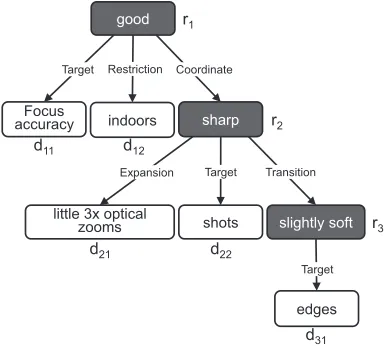
(“sharp”, “little 3x optical zooms”) is an opinion ex-pansion because the “sharp” opinion on “shot” im-plies a positive opinion on “little 3x optical zooms”. It is worth to remark that: 1) a modifierdkcan
re-late to more than one opinion expression. For exam-ple, multiple opinion expressions may share a same condition; 2)dkitself can employ a set of relations,
although the case appears occasionally. The follow-ing is an example:
Example 5: The camera wisely get rid of many redundant buttons.
In the example, “redundant buttons” is the eval-uation target of opinion expression “wisely get rid of”, but itself is a relation between “redundant” and “buttons”. Such nested semantic structure is described by a path: “wisely get rid of”−−−−→target
[“redundant”−−−−→target “buttons”]nested target.
2.2 Relations between Individual Opinion Representation
Assume hrii are opinion expressions ordered by
their positions in sentence, and each of them has been represented by relations {(ri, dik)}
individu-ally (the nested relations fordik have also been
de-termined). Then we define two relations on adja-cent pairri,ri+1: coordinationwhen the polarities
ofri and ri+1 are consistent, and transition when
they are opposite. Those relations amongri form a
setB called opinion thread. In Figure 1, the opin-ion thread is:{(“good”, “sharp”), (“sharp”, “slightly soft”)}.
The whole sentiment representation for a sentence can be organized by a direct graphG= (V, E). Ver-tex setV includes all opinion expressions and mod-ifiers. Edge set E collects both relations of each individual opinion and relations in opinion thread. The edges are labeled with relation types in label set
L={“restriction”, “expansion”, “target”, “coordina-tion”, “transition”}3.
Compared with previous works, the advantages of using Gas sentiment representation are: 1) for in-dividual opinions, the modifiers will collect more information than using opinion expression alone. 3We don’t define any “label” on vertices: if two span of text
satisfy a relation inL, they are chosen to be vertices and an edge with proper label will appear inE. In other words, vertices
are identified by checking whether there exist relations among them.
Focus accuracy was good indoors, and although the
little 3x optical zooms produced sharp shots, the
edges were slightly soft on the Canon.
Focus accuracy
edges
slightly soft
shots
sharp
little 3x optical zooms
indoors
good
Expansion Target Coordinate
Transition
Target Target Restriction
r
1
r
2
r
3
d
11
d
12
d
21
d
22
d
[image:3.612.335.527.85.258.2]31
Figure 1: Sentiment representation for an example sen-tence
Thus G is a relatively complete and accurate rep-resentation; 2) the opinion thread can help to catch global sentiment information, for example the gen-eral polarity of a sentence, which is dropped when the opinions are separately represented.
3 System Description
To produce the representation graph G for a sen-tence, we need to extract candidate vertices and build the relations among them to get a graph struc-ture. For the first task, the experimental results in Section 4 demonstrate that the standard sequential labeling method with simple features can achieve reasonable performance. In this section, we focus on the second task, and assume the vertices in the graph have already been correctly collected in the following formulation of algorithm.
3.1 Preliminaries
In order to construct graph G, we use a structural learning method. The framework is from the first or-der discriminative dependency parsing model (Mc-donald and Pereira, 2005). A sentence is denoted by s;x are text spans which will be vertices of graph; xiis theith vertex inxordered by their positions in
s. For a set of verticesx,yis the graph of its sen-timent representation, and e = (xi, xj) ∈ yis the
virtual root node without inedge.G ={(xn,yn)}Nn
is training set.
Following the edge based factorization, the score of a graph is the sum of its edges’ scores,
score(x,y) = ∑
(xi,xj)∈y
score(xi, xj)
= ∑
(xi,xj)∈y
αTf(xi, xj), (1)
f(xi, xj)is a high dimensional feature vector of the
edge(xi, xj). The components offare either 0 or 1.
For example the k-th component could be
fk(xi, xj) =
1 ifxi.POS=JJ and xj.POS=NN
and label of(xi, xj)is restriction 0 otherwise
.
Then the score of an edge is the linear combination off’s components, and the coefficients are in vector α.
Algorithm 1 shows the parameter learning pro-cess. It aims to get parameterα which will assign the correct graphywith the highest score among all possible graphs ofx(denoted byY).
Algorithm 1 Online structural learning
Training Set:G={(xn,yn)}Nn
1: α0 = 0, r= 0, T =maximum iteration 2: fort= 0toT do
3: forn= 0toN do
4: ˆy= arg maxy∈Yscore(xn,y) BInference
5: ifˆy6=ynthen
6: updateαttoαt+1 BPA
7: r =r+αt+1 8: end if
9: end for 10: end for
11: return α =r/(N ∗T)
3.2 Inference
Like other structural learning tasks, the “arg max” operation in the algorithm (also called inference)
ˆ
y= arg max y∈Y
score(x,y) = arg max
y∈Y
∑
(xi,xj)∈y
αTf(xi, xj) (2)
is hard because all possible values ofyform a huge search space. In our case,Y is all possible directed
acyclic graphs of the given vertex set, which num-ber is exponential. Directly solving the problem of finding maximum weighted acyclic graph is equiva-lent to finding maximum feedback arc set, which is a NP-hard problem (Karp, 1972). We will use integer linear programming (ILP) as the framework for this inference problem.
3.2.1 Graph Properties
We first show some properties of graphGeither from the definition of relations or corpus statistics.
Property 1. The graph is connected and without directed cycle. From individual opinion represen-tation, each subgraph of Gwhich takes an opinion expression as root is connected and acyclic. Thus the connectedness is guaranteed for opinion expres-sions are connected in opinion thread; the acyclic is guaranteed by the fact that if a modifier is shared by different opinion expressions, the inedges from them always keep (directed) acyclic.
Property 2. Each vertex can have one outedge labeled with coordination or transition at most. The opinion threadB is a directed path in graph.
Property 3. The graph is sparse. The average in-degree of a vertex is 1.03 in our corpus, thus the graph is almost a rooted tree. In other words, the cases that a modifier connects to more than one opin-ion expressopin-ion rarely occur comparing with those vertices which have a single parent. An explaination for this sparseness is that opinions in online reviews always concentrate in local context and have local semantic connections.
3.2.2 ILP Formulation
Based on the property 3, we divide the inference algorithm into two steps: i) constructing G’s span-ning tree (arborescence) with property 1 and 2; ii) finding additional non-tree edges as a post process-ing task. The first step is close to the works on ILP formulations of dependency parsing (Riedel and Clarke, 2006; Martins et al., 2009). In the second step, we use a heuristic method which greedily adds non-tree edges. A similar approximation method is also used in (Mcdonald and Pereira, 2006) for acyclic dependency graphs.
flow formulation of maximum spanning tree (MST) problem in (Magnanti and Wolsey, 1994), the ILP for MST is:
max. ∑
i,j
yij ·score(xi, xj) (3)
s.t. ∑
i,j
yij =|V| −1 (4)
∑
i
fiju−∑
k
fjku =δuj,1≤u, j ≤ |V| (5)
∑
k
f0uk= 1, 1≤u≤ |V| (6)
fiju ≤yij, 1≤u, j ≤ |V|,
0≤i≤ |V| (7) fiju ≥0, 1≤u, j ≤ |V|,
0≤i≤ |V| (8) yij ∈ {0,1}, 0≤i, j≤ |V|. (9)
In this formulation,yij is an edge indicator
vari-able that(xi, xj)is a spanning tree edge whenyij =
1, (xi, xj)is a non-tree edge whenyij = 0. Then
outputyis represented by the set {yij,0 ≤ i, j ≤
|V|} 4. Eq(4) ensures that there will be exactly
|V| − 1 edges are chosen. Thus if the edges cor-responding to those non zeroyij is a connected
sub-graph,y is a well-formed spanning tree. Objective function just says the optimal solution ofyij have
the maximum weight.
The connectedness is guaranteed if for every ver-tex, there is exactly one path from root to it. It is for-mulated by using|V| −1flows{fu,1≤u≤ |V|}. fu starts from virtual root x
0 towards vertex xu.
Each flow fu = {fiju,0 ≤ i, j ≤ |V|}. fiju indi-cates whether flowfu is through edge (xi, xj). so
it should be 0 if edge (xi, xj) does not exist (by
(7)). The Kronecker’s deltaδjuin (5) guaranteesfu is only assumed by vertexxu, sofuis a well-formed
path from root toxu. (6) ensures there is only one
flow (path) from root toxu. Thus the subgraph is
connected. The following are our constraints:
c1: Constraint on edges in opinion thread (10)-(11).
From the definition of opinion thread, we impose a constraint on every vertex’s outedges in opinion thread, which are labeled with “coordination” or 4For simplicity, we overload symbolyfrom the graph of the
sentiment represetation to the MST of it.
“transition”. Let Iobbe a characteristic function on
edges:Iob((j, k)) = 1when edge(xj, xk)is labeled
with “coordination” or “transition”, otherwise0. We denoteqvariables for vertices:
qj =
∑
k
yjk·Iob((j, k)), 0≤j≤ |V|. (10)
Then following linear inequalities bound the number of outedges in opinion thread (≤1) on each vertex:
qj ≤1, 0≤j≤ |V|. (11)
c2: Constraint on target edge(12).
We also bound the number of evaluation targets for a vertex in a similar way. LetIt be
characteris-tic function on edges identifing whether it is labeled with “target”,
∑
k
yjk ·It((j, k))≤Ct, 0≤j ≤ |V|. (12)
The parameter Ct can be adjusted according to the
style of document. In online reviews, authors tend to use simple and short comments on individual tar-gets, soCtcould be set small.
c3: Constraint on opinion thread(13)-(18). From graph property 2, the opinion thread should be a directed path. It implies the number of con-nected components whose edges are “coordination” or “transition” should be less than 1. Two set of ad-ditional variables are needed: {cj,0≤j≤ |V|}and
{hj,0≤j≤ |V|}, where
cj =
{
1 if an opinion thread starts atxj
0 otherwise ,
and
hj =
∑
i
yij ·Iob((i, j)). (13)
Thencj =¬hj∧qj, which can be linearized by
cj≥qj−hj, (14)
cj≤1−hj, (15)
cj≤qj, (16)
cj≥0. (17)
If the sum ofcjis no more than1, the opinion thread
of graph is a directed path.
∑
j
1
2 3
4
5
6 7
(a) (b)
1
2 3
4 5
6 7
(c) 1
2 3
4
5
[image:6.612.347.522.40.322.2]6 7
Figure 2: The effects ofc1 andc3. Assume solid lines are edges labeled with “coordination” and “transition”, dot lines are edges labeled with other types. (a) is an arbitrary tree. (b) is a tree withc1constraints. (c) is a tree withc1 andc3. It shows c1 are not sufficient for graph property 2: the edges in opinion thread may not be connected.
Figure 2 illustrates the effects ofc1andc3.
Equations (10)-(18), together with basic multi-commodity flow model build up the inference algo-rithm. The entire ILP formulation involvesO(|V|3) variables and O(|V|2) constraints. Generally, ILP
falls into NPC, but as an important result, in the mul-ticommodity flow formulation of maximum span-ning tree problem, the integer constraints (9) onyij
can be dropped. So the problem reduces to a linear programming which is polynomial solvable (Mag-nanti and Wolsey, 1994). Unfortunately, with our additional constraints the LP relaxation is not valid.
Step 2. Adding non-tree edges. We examine the case that a modifier attaches to different opinion ex-pressions. That often occurs as the result of the sharing of modifiers among adjacent opinion expres-sions. We add those edges in the following heuristic way: If a vertexri in opinion thread does not have
any modifier, we search the modifiers of its adjacent vertices ri+1, ri−1 in the opinion thread, and add
edge (ri,d∗) where
d∗ = arg max
d∈S score(ri, d),
andSare the modifiers ofri−1andri+1.
3.3 Training
We use online passive aggressive algorithm (PA) with Hamming cost of two graphs in training (Cram-mer et al., 2006).
Unigram Feature Template
xi.text w0.text w1.text
w0.POS w1.POS
wk−1.text wk.text
Inside wk−1.POS wk.POS
Features xi.hasDigital
xi.isSingleWord
xi.hasSentimentWord
xi.hasParallelPhrase
w−1.text w−2.text
w−1.POS w−2.POS
wk+1.text wk+2.text
Outside wk+1.POS wk+2.POS
Features c−1.text c−2.text
c−1.POS c−2.POS
cl+1.text cl+2.text
cl+1.POS cl+2.POS
Other Features
distance between parent and child dependency parsing relations
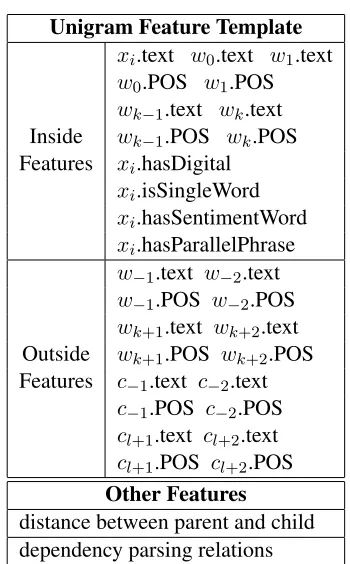
Table 1: Feature set
3.4 Feature Construction
For each vertex xi in graph, we use 2 sets of
fea-tures: inside features which are extracted inside the text span of xi; outside features which are outside
the text span ofxi. A vertexxi is described both in
word sequence (w0, w1,· · · , wk) and character
se-quence (c0, c1,· · · , cl), for the sentences are in
Chi-nese.
· · · , w−1, w0, w1, w2,· · · , wk−1, wk
| {z }
xi
, wk+1· · ·
· · ·, c−1, c0, c1, c2,· · · , cl−1, cl
| {z }
xi
, cl+1· · ·
For an edge(xi, xj), the high dimensional feature
vectorf(xi, xj)is generated by using unigram
fea-tures in Table 1 onxiandxj respectively. The
dis-tance between parent and child in sentence is also attached in features. In order to involve syntactic information, whether there is certain type of depen-dency relation between xi andxj is also used as a
[image:6.612.79.318.47.176.2]4 Experiments 4.1 Corpus
We constructed a Chinese online review corpus from Pcpop.com, Zol.com.cn, and It168.com, which have a large number of reviews about digital camera. The corpus contains 138 documents and 1735 sentences. Since some sentences do not contain any opinion, 1390 subjective sentences were finally chosen and manually labeled.
Two annotators labeled the corpus independently. The annotators started from locating opinion expres-sions, and for each of them, they annotated other modifiers related to it. In order to keep the relia-bility of annotations, another annotator was asked to check the corpus and determine the conflicts. Fi-nally, we extracted 6103 elements, which are con-nected by 6284 relations.
Relation Number
Target 2479
Coordinate 1173
Transition 154
Restriction 693
[image:7.612.101.287.302.387.2]Expansion 386
Table 2: Statistics of relation types
Table 2 shows the number of various relation types appearing in the labeled corpus. We observe 60.5% of sentences and 32.1% of opinion expres-sions contain other modifiers besides “target”. Thus only mining the relations between opinion expres-sions and evaluation target is actually at risk of inac-curate and incomplete results.
4.2 Experiments Configurations
In all the experiments below, we take 90% of the cor-pus as training set, 10% as test set and run 10 folder cross validation. In feature construction, we use an external Chinese sentiment lexicon which con-tains 4566 positive opinion words and 4370 nega-tive opinion words. For Chinese word segment, we use ctbparser5. Stanford parser (Klein and
Man-ning, 2003) is used for dependency parsing. In the settings of PA, the maximum iteration number is
5http://code.google.com/p/ctbparser/
set to 2, which is chosen by maximizing the test-ing performances, aggressiveness parameter C is set to 0.00001. For parameters in inference algorithm, Ct= 2, the solver of ILP is lpsolve6.
We evaluate the system from the following as-pects: 1) whether the structural information helps to mining opinion relations. 2) How the proposed inference algorithm performs with different con-straints. 3) How the various features affect the sys-tem. Except for the last one, the feature set used for different experiments are the same (“In+Out+Dep” in Table 5). The criteria for evaluation are simi-lar to the unlabeled attachment score in parser eval-uations, but due to the equation |E| = |V| − 1 is not valid if G is not a tree, we evaluate pre-cision P = #true edges in result graph#edges in result graph , recall R = #true edges in result graph#edges in true graph , and F-score F = 2PP+·RR.
4.3 Results
1. The effects of structural information. An alter-native method to extract relations is directly using a classifier to judge whether there is a relation be-tween any two elements. Those kinds of methods were used in previous opinion mining works (Wu et al., 2009; Kobayashi et al., 2007). To show the entire structural information is important for min-ing relations, we use SVM for binary classification on candidate pairs. The data point representing a pair(xi, xj)is the same as the high dimensional
fea-ture vectorsf(xi, xj). The setting of our algorithm
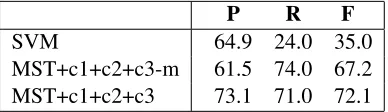
“MST+c1+c2+c3” is the basic MST with all the con-straints. The results are shown in the Table 3.
P R F
SVM 64.9 24.0 35.0
MST+c1+c2+c3-m 61.5 74.0 67.2
[image:7.612.339.533.512.568.2]MST+c1+c2+c3 73.1 71.0 72.1
Table 3: Binary classifier and structural learning
From the results, the performance of SVM (espe-cially recall) is relatively poor. A possible reason is that the huge imbalance of positive and negative training samples (only Θ(n) positive pairs among all n2 pairs). And the absence of global structural
knowledge makes binary classifier unable to use the information provided by classification results of other pairs.
[image:8.612.350.519.235.320.2]In order to examine whether the complicated sen-timent representation would disturb the classifier in finding relations between opinion expressions and its target, we evaluate the system by discarding the modifiers of opinion restriction and expansion from the corpus. The result is shown in the second row of Table 3. We observe that “MST+c1+c2+c3” is still better which means at least on overall performance the additional modifiers do not harm.
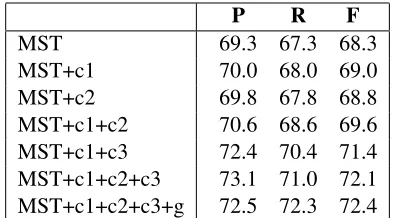
2. The effect of constraints on inference algo-rithm. In the inference algorithm, we utilized the properties of graphGand adapted the basic multi-commodity flow ILP to our specific task. To evaluate how the constraints affect the system, we decompose the algorithm and combine them in different ways.
P R F
MST 69.3 67.3 68.3
MST+c1 70.0 68.0 69.0
MST+c2 69.8 67.8 68.8
MST+c1+c2 70.6 68.6 69.6
MST+c1+c3 72.4 70.4 71.4
MST+c1+c2+c3 73.1 71.0 72.1
MST+c1+c2+c3+g 72.5 72.3 72.4
Table 4: Results on inference methods. “MST” is the ba-sic multicommodity flow formulation of maximum span-ning tree; c1, c2, c3 are groups of constraint from Section 3.2.2; “g” is our heuristic method for additional non span-ning tree edges.
From Table 4, we observe that with any additional constraints the inference algorithm outperforms the basic maximum spanning tree method. It implies al-though we did not use high order model (e.g. involv-ing grandparent and siblinvolv-ing features), prior struc-tural constraints can also help to get a better out-put graph. By comparing with different constraint combinations, the constraints on opinion thread (c1, c3) are more effective than constraints on evaluation targets (c2). It is because opinion expressions are more important in the entire sentiment representa-tion. The main structure of a graph is clear once the relations between opinion expressions are correctly determined.
3.The effects of various features. We evaluate the
performances of different feature configurations in Table 5. From the results, the outside feature set is more effective than inside feature set, even if it does not use any external resource. A possible reason is that the content of a vertex can be very complicated (a vertex even can be a clause), but the features sur-rounding the vertex are relatively simple and easy to identify (for example, a single preposition can identify a complex condition). The dependency fea-ture has limited effect, due to that lots of online view sentences are ungrammatical and parsing re-sults are unreliable. And the complexity of vertices also messes the dependency feature.
P R F
In-s 66.3 66.3 66.3
In 66.7 66.4 66.6
Out 67.8 67.4 67.6
In+Out 72.0 70.5 71.0
[image:8.612.95.293.300.409.2]In+Out+Dep 72.5 72.3 72.4
Table 5: Results with different features. “In” repre-sents the result of inside feature set; “In-s” is “In” with-out the external opinion lexicon feature; “Out” uses the outside feature set; “In+Out” uses both “In” and “Out”, “In+Out+Dep” adds the dependency feature. The infer-ence algorithm is “MST+c1+c2+c3+g” in Table 4.
We analyze the errors in test results. A main source of errors is the confusion of classifier be-tween “target” relations and “coordination”, “tran-sition” relations. The reason may be that for a mod-ification on opinion expression (r, dk), we allow
dk recursively has its own modifiers (Example 5).
Thus an opinion expression can be a modifier which brings difficulties to classifier.
4. Extraction of vertices. Finally we conduct an experiment on vertex extraction using standard se-quential labeling method. The tag set is simply{B,
I, O}which are signs of begin, inside, outside of a
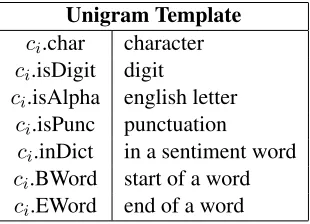
vertex. The underlying model is conditional random field 7. Feature templates involved are in Table 6.
We only use basic features in the experiment. 10 folder cross validation results are in table 7. We sus-pect that the performances (especially recall) could be improved if some external resources(i.e. ontol-ogy, domain related lexicon, etc.) are involved.
Unigram Template
ci.char character
ci.isDigit digit
ci.isAlpha english letter
ci.isPunc punctuation
ci.inDict in a sentiment word
ci.BWord start of a word
[image:9.612.117.272.46.158.2]ci.EWord end of a word
Table 6: Features for vertex extraction. The sequential labeling is conducted on character level (ci). The
senti-ment lexicon used inci.inDict is the same as Table1. We
also use bigram feature templates onci.char,ci.isAlpha,
ci.inDict with respect toci−1andci+1.
P R F
E+Unigram 56.8 45.1 50.3
E+Unigram+Bigram 57.3 47.9 52.1
O+Unigram 71.9 57.2 63.7
O+Unigram+Bigram 72.3 60.2 65.6
Table 7: Results on vertices extraction with 10 folder cross validation. We use two criterion: 1) the vertex is correct if it is exactly same as ground truth(“E”), 2) the vertex is correct if it overlaps with ground truth(“O”).
5 Related Work
Opinion mining has recently received considerable attentions. Large amount of work has been done on sentimental classification in different levels and sen-timent related information extraction. Researches on different types of sentences such as comparative tences (Jindal and Liu, 2006) and conditional sen-tences (Narayanan et al., 2009) have also been pro-posed.
Kobayashi et al. (2007) presented their work on extracting opinion units including: opinion holder, subject, aspect and evaluation. They used slots to represent evaluations, converted the task to two kinds of relation extraction tasks and proposed a ma-chine learning-based method which used both con-textual and statistical clues.
Jindal and Liu (2006) studied the problem of iden-tifying comparative sentences. They analyzed dif-ferent types of comparative sentences and proposed learning approaches to identify them.
Sentiment analysis of conditional sentences were studied by Narayanan et al. (2009). They aimed
to determine whether opinions expressed on dif-ferent topics in a conditional sentence are posi-tive, negative or neutral. They analyzed the con-ditional sentences in both linguistic and computi-tional perspectives and used learning method to do it. They followed thefeature-based sentiment anal-ysismodel (Hu and Liu, 2004), which also use flat frames to represent evaluations.
Integer linear programming was used in many NLP tasks (Denis and Baldridge, 2007), for its power in both expressing and approximating various inference problems, especially in parsing (Riedel and Clarke, 2006; Martins et al., 2009). Martins etc. (2009) also applied ILP with flow formulation for maximum spanning tree, besides, they also han-dled dependency parse trees involving high order features(sibling, grandparent), and with projective constraint.
6 Conclusions
This paper introduces a representation method for opinions in online reviews. Inspections on corpus show that the information ignored in previous sen-timent representation can cause incorrect or incom-plete mining results. We consider opinion restric-tion, opinion expansions, relations between opin-ion expressopin-ions, and represent them with a directed graph. Structural learning method is used to produce the graph for a sentence. An inference algorithm is proposed based on the properties of the graph. Ex-perimental evaluations with a manually labeled cor-pus are given to show the importance of structural information and effectiveness of proposed inference algorithm.
7 Acknowledgement
[image:9.612.92.297.241.310.2]Pro-gram(2009BAH40B04).
References
Koby Crammer, Ofer Dekel, Joseph Keshet, Shai Shalev-Shwartz, and Yoram Singer. 2006. Online passive-aggressive algorithms. Journal of Machine Learning Research, 7:551–585.
Sajib Dasgupta and Vincent Ng. 2009. Mine the easy, classify the hard: A semi-supervised approach to auto-matic sentiment classification. InProceedings of ACL-IJCNLP.
Kushal Dave, Steve Lawrence, and David M. Pennock. 2003. Mining the peanut gallery: opinion extraction and semantic classification of product reviews. In Pro-ceedings of WWW.
Pascal Denis and Jason Baldridge. 2007. Joint determi-nation of anaphoricity and coreference resolution us-ing integer programmus-ing. InProceedings of NAACL-HLT.
Ahmed Hassan and Dragomir R. Radev. 2010. Identify-ing text polarity usIdentify-ing random walks. InProceedings of ACL, pages 395–403, Uppsala, Sweden, July. Asso-ciation for Computational Linguistics.
Minqing Hu and Bing Liu. 2004. Mining and summariz-ing customer reviews. InProceedings of SIGKDD. Nitin Jindal and Bing Liu. 2006. Identifying comparative
sentences in text documents. InProceedings of SIGIR. R. Karp. 1972. Reducibility among combinatorial prob-lems. In R. Miller and J. Thatcher, editors, Complex-ity of Computer Computations, pages 85–103. Plenum Press.
Soo-Min Kim and Eduard Hovy. 2006. Automatic iden-tification of pro and con reasons in online reviews. In
Proceedings of the COLING-ACL.
Dan Klein and Christopher D. Manning. 2003. Fast exact inference with a factored model for natural language parsing. InIn Advances in Neural Information Pro-cessing Systems 15 (NIPS, pages 3–10. MIT Press. Nozomi Kobayashi, Kentaro Inui, and Yuji Matsumoto.
2007. Extracting aspect-evaluation and aspect-of rela-tions in opinion mining. InProceedings of EMNLP-CoNLL.
Thomas L. Magnanti and Laurence A. Wolsey. 1994. Optimal trees.
Andre Martins, Noah Smith, and Eric Xing. 2009. Con-cise integer linear programming formulations for de-pendency parsing. InProceedings of ACL-IJCNLP. R. Mcdonald and F. Pereira. 2005. Identifying gene
and protein mentions in text using conditional random fields.BMC Bioinformatics.
Ryan Mcdonald and Fernando Pereira. 2006. On-line learning of approximate dependency parsing al-gorithms. InProc. of EACL, pages 81–88.
Ramanathan Narayanan, Bing Liu, and Alok Choudhary. 2009. Sentiment analysis of conditional sentences. In
Proceedings of EMNLP.
Bo Pang, Lillian Lee, and Shivakumar Vaithyanathan. 2002. Thumbs up? Sentiment classification using ma-chine learning techniques. InProc. of EMNLP 2002. Sebastian Riedel and James Clarke. 2006. Incremental
integer linear programming for non-projective depen-dency parsing. InProceedings of EMNLP.
Ellen Riloff, Janyce Wiebe, and Theresa Wilson. 2003. Learning subjective nouns using extraction pattern bootstrapping. InProceedings of the seventh confer-ence on Natural language learning at HLT-NAACL. Swapna Somasundaran, Janyce Wiebe, and Josef
Rup-penhofer. 2008. Discourse level opinion interpreta-tion. InProceedings of COLING.
Hiroya Takamura, Takashi Inui, and Manabu Okumura. 2005. Extracting semantic orientations of words using spin model. InProceedings of ACL.