Latent-Variable Modeling of String Transductions
with Finite-State Methods
∗Markus Dreyer and Jason R. Smith and Jason Eisner
Department of Computer Science Johns Hopkins University Baltimore, MD 21218, USA
{markus,jsmith,jason}@cs.jhu.edu
Abstract
String-to-string transduction is a central prob-lem in computational linguistics and natural language processing. It occurs in tasks as di-verse as name transliteration, spelling correc-tion, pronunciation modeling and inflectional morphology. We present a conditional log-linear model for string-to-string transduction, which employs overlapping features over tent alignment sequences, and which learns la-tent classes and lala-tent string pair regions from incomplete training data. We evaluate our ap-proach on morphological tasks and demon-strate that latent variables can dramatically improve results, even when trained on small data sets. On the task of generating mor-phological forms, we outperform a baseline method reducing the error rate by up to 48%. On a lemmatization task, we reduce the error rates in Wicentowski (2002) by 38–92%.
1 Introduction
A recurring problem in computational linguistics and language processing is transduction of charac-ter strings, e.g., words. That is, one wishes to model some systematic mapping from an input stringxto an output stringy. Applications include:
• phonology: underlying representation ↔ surface representation
• orthography: pronunciation↔spelling
• morphology: inflected form ↔lemma, or differ-ently inflected form
• fuzzy name matching (duplicate detection) and spelling correction: spelling↔variant spelling
∗
This work was supported by the Human Language Tech-nology Center of Excellence and by National Science Founda-tion grant No. 0347822 to the final author. We would also like to thank Richard Wicentowski for providing us with datasets for lemmatization, and the anonymous reviewers for their valuable feedback.
• lexical translation(cognates, loanwords, translit-erated names): English word↔foreign word
We present a configurable and robust framework for solving such word transduction problems. Our results in morphology generation show that the pre-sented approach improves upon the state of the art.
2 Model Structure
A weighted edit distance model (Ristad and Yian-ilos, 1998) would consider each character in isola-tion. To consider more context, we pursue a very natural generalization. Given an inputx, we evalu-ate a candidevalu-ate outputyby moving a sliding window over the aligned (x, y) pair. More precisely, since many alignments are possible, we sum over all these possibilities, evaluating each alignmentseparately.1 At each window position, we accumulate log-probability based on the material that appears within the current window. The window is a few charac-ters wide, and successive window positions over-lap. This stands in contrast to a competing approach (Sherif and Kondrak, 2007; Zhao et al., 2007) that is inspired by phrase-based machine translation (Koehn et al., 2007), whichsegmentsthe input string into substrings that are transducedindependently, ig-noring context.2
1
At the other extreme, Freitag and Khadivi (2007) use no alignment; each feature takes its own view of how(x, y)relate.
2We feel that this independence is inappropriate. By
anal-ogy, it would be a poor idea for a language model to score a string highly if it could besegmentedinto independently fre-quentn-grams. Rather, language models use overlappingn -grams (indeed, it is the language model that rescues phrase-based MT from producing disjointed translations). We believe phrase-based MT avoids overlapping phrases in thechannel model only because these would complicate the modeling of reordering (though see, e.g., Schwenk et al. (2007) and Casacu-berta (2000)). But in the problems of section 1, letter reordering is rare and we may assume it is local to a window.
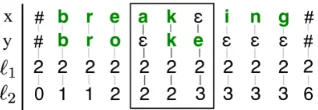
Figure 1: One of many possible alignment stringsAfor the observed pair breaking/broke, enriched with latent strings`1and`2. Observed letters are shown in bold. The box marks a trigram to be scored. See Fig. 2 for features that fire on this trigram.
Jointn-gram models over the input and output di-mensions have been used before, but not for mor-phology, where we will apply them.3 Most notable is the local log-linear grapheme-to-phoneme model of Chen (2003), as well as generative models for that task (Deligne et al. (1995), Galescu and Allen (2001), Bisani and Ney (2002)).
We advance that approach by adding new latent dimensions to the (input, output) tuples (see Fig. 1).4 This enables us to use certain linguistically inspired features and discover unannotated information. Our features considerlessormorethan a literaln-gram. On the one hand, we generalize with features that abstract away from then-gram window contents; on the other, we specialize then-gram with features that make use of the added latent linguistic structure.
In section 5, we briefly sketch our framework for concisely expressing and efficiently implementing models of this form. Our framework uses familiar log-linear techniques for stochastic modeling, and weighted finite-state methods both for implementa-tion and for specifying features. It appears general enough to cover most prior work on word transduc-tion. We imagine that it will be useful for future work as well: one might easily add new, linguisti-cally interesting classes of features, each class de-fined by a regular expression.
2.1 Basic notation
We use aninput alphabetΣxandoutput alphabet Σy. We conventionally use x ∈ Σ∗x to denote the input string andy∈Σ∗yto denote the output string.
3
Clark (2001) does use pair HMMs for morphology.
4Demberg et al. (2007) similarly added extra dimensions.
However, their added dimensions were supervised, not latent, and their model was a standard generativen-gram model whose generalization was limited to standardn-gram smoothing.
There are many possible alignments between x
andy. We represent each as an alignment string
A ∈ Σ∗xy, over an alignment alphabet of ordered pairs,Σxy = ((Σdef x∪ {})×(Σy∪ {}))− {(, )}.
For example, one alignment ofx = breaking
with y = broke is the 9-character string A = (b,b)(r,r)(e,o)(a, )(k,k)(,e)(i, )(n, )(g, ). It is pictured in the first two lines of Fig. 1.
The remainder of Fig. 1 shows how we intro-duce latent variables, by enriching the alignment characters to be tuples rather than pairs. Let Σ =def (Σxy ×Σ`1 ×Σ`2 × · · · ×Σ`K), whereΣ`i are al-phabets used for the latent variables`i.
FSAandFSTstand for “finite-state acceptor” and “finite-state transducer,” while WFSA and WFST are their weighted variants. The◦symbol denotes composition.
LetT be a relation andwa string. We writeT[w]
to denote the image ofw under T (i.e., range(w◦
T)), a set of 0 or more strings. Similarly, ifW is a weighted language (typically encoded by a WFSA), we writeW[w]to denote the weight ofwinW.
Letπx ⊆ Σ∗ ×Σ∗x denote the deterministic reg-ular relation that projects an alignment string to its corresponding input string, so thatπx[A] =x. Sim-ilarly, defineπy ⊆Σ∗×Σy∗so thatπy[A] = y. Let Axy be the set of alignment strings A compatible withxandy; formally,Axy
def
={A∈Σ∗ :πx[A] =
x∧πy[A] =y}. This set will range over all possible alignments between x andy, and also all possible configurations of the latent variables.
2.2 Log-linear modeling
We use a standard log-linear model whose features are defined on alignment stringsA ∈ Axy, allow-ing them to be sensitive to the alignment ofxandy. Given a collection of featuresfi : Σ∗ →Rwith as-sociated weightsθi ∈ R, the conditional likelihood of the training data is
pθ(y|x) =
P
A∈Axyexp P
iθifi(A)
P
y0
P
A∈Axy0exp
P
iθifi(A)
(1)
Given a parameter vector θ, we compute equa-tion (1) using a finite-state machine. We define a WFSA,Uθ, such thatUθ[A]yields the unnormalized probabilityuθ(A)
def
= expP
iθifi(A) for anyA ∈
the numerator of equation (1), with itsP
A∈Axy, we sum over all paths inUθ that are compatible withx andy. That is, we buildx◦π−1
x ◦Uθ◦πy◦yand sum over all paths. For the denominator we build the larger machinex◦π−x1◦Uθand again compute the pathsum. We use standard algorithms (Eisner, 2002) to compute the pathsums as well as their gradients with respect toθfor optimization (section 4.1).
Below, we will restrict our notion ofvalid align-ment strings inΣ∗. Uθ is constructed not to accept invalidones, thus assigning them probability 0.
Note that the possible output stringsy0 in the de-nominator in equation (1) may have arbitrary length, leading to an infinite summation over alignment strings. Thus, for some values of θ, the sum in the denominator diverges and the probability dis-tribution is undefined. There exist principled ways to avoid such θ during training. However, in our current work, we simply restrict to finitely many alignment strings (givenx), by prohibiting as invalid those with> kconsecutiveinsertions (i.e., charac-ters like(,a)).5Finkel et al. (2008) and others have similarly bounded unary rule cycles in PCFGs.
2.3 Latent variables
The alignment between x and y is a latent ex-planatory variable that helps model the distribution
p(y | x)but is not observed in training. Other latent variables can also be useful. Morphophonological changes are often sensitive tophonemes(whereasx
andy may consist of graphemes); syllable bound-aries; a conjugation class; morpheme boundaries; and thepositionof the change within the form.
Thus, as mentioned in section 2.1, we enrich the alignment stringAso that it specifies additional la-tent variables to which features may wish to refer. In Fig. 1, two latent strings are added, enabling the features in Fig. 2(a)–(h). The first character is not
5We setkto a value between 1 and 3, depending on the tasks,
[image:3.612.327.519.55.200.2]always ensuring that no input/output pairs observed in training are excluded. The insertion restriction does slightly enlarge the FSAUθ: a state must keep track of the number of consecutive symbols in the immediately precedingxinput, and for a few states, this cannot be determined just from the immediately pre-ceding(n−1)-gram. Despite this, we found empirically that our approximation is at least as fast as the exact method of Eis-ner (2002), who sums around cyclic subnetworks to numerical convergence. Furthermore, our approximation does not require us to detect divergence during training.
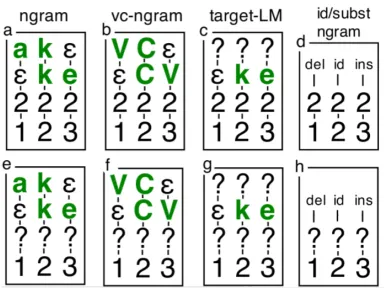
Figure 2: The boxes (a)-(h) represent some of the features that fire on the trigram shown in Fig. 1. These features are explained in detail in section 3.
just an input/output pair, but the 4-tuple(b,b,2,1). Here,`1 indicates that this form pair (breaking / broke) as a whole is in a particular cluster, orword class, labeled with the arbitrary number2. Notice in Fig. 1 that the class2is visible in all local windows throughout the string. It allows us to model how cer-tain phenomena, e.g. the vowel change fromeato
o, are more likely in one class than in another. Form pairs in the same class as thebreaking / broke ex-ample might include the following Germanic verbs: speak,break,steal,tear, andbear.
Of course, word classes are latent (not labeled in our training data). Givenxandy,Axy will include alignment strings that specify class 1, and others that are identical except that they specify class 2; equation (1) sums over both possibilities.6 In a valid alignment stringA,`1must be a constant string such as111...or222..., as in Fig. 1, so that it spec-ifies a single class for the entire form pair. See sec-tions 4.2 and 4.3 for examples of what classes were learned in our experiments.
The latent string`2splits the string pair into
num-bered regions. In a valid alignment string, the re-gion numbers must increase throughout`2, although
numbers may be skipped to permit omitted regions. To guide the model to make a useful division into regions, we also require that identity characters such as(b,b) fall in even regions while change charac-ters such as(e,o)(substitutions, deletions, or
inser-6The latent class is comparable to the latent variable on the
tions) fall in odd regions.7Region numbers must not increase within a sequence of consecutive changes or consecutive identities.8 In Fig. 1, the start of re-gion1is triggered bye:o, the start of region2 by the identityk:k, region3by:e.
Allowing region numbers to be skipped makes it possible to consistently assign similar labels to sim-ilar regions across different training examples. Ta-ble 2, for example, shows pairs that contain a vowel change in the middle, some of which contain an ad-ditional insertion ofge in the begining (verbinden / verbunden,reibt / gerieben). We expect the model to learn to label thegeinsertion with a1and vowel change with a3, skipping region1in the examples where the ge insertion is not present (see section 4.2, Analysis).
In the next section we describe features over these enriched alignment strings.
3 Features
One of the simplest ways of scoring a string is ann -gram model. In our log-linear model (1), we include ngram featuresfi(A), each of which counts the
oc-currences inA of a particularn-gram of alignment characters. The log-linear framework lets us include ngram features of different lengths, a form of back-off smoothing (Wu and Khudanpur, 2000).
We use additional backoff features on alignment strings to capture phonological, morphological, and orthographic generalizations. Examples are found in features (b)-(h) in Fig. 2. Feature (b) matchesvowel and consonant character classes in the input and output dimensions. In the id/subst ngram feature, we have a similar abstraction, where the character classes ins, del, id, andsubst are defined over in-put/output pairs, to match insertions, deletions, iden-tities (matches), and substitutions.
In string transduction tasks, it is helpful to in-clude a language model of the target. While this can be done by mixing the transduction model with a separate language model, it is desirable to in-clude a target language model within the
transduc-7
This strict requirement means, perhaps unfortunately, that a single region cannot accommodate the changeayc:xyzunless the twoy’s are not aligned to each other. It could be relaxed, however, to a prior or an initialization or learning bias.
8The two boundary characters #, numbered 0 and max
(max=6 in our experiments), are neither changes nor identities.
tion model. We accomplish this by creating target language model features, such as (c) and (g) from Fig. 2, which ignore the input dimension. We also have features which mirror features (a)-(d) but ig-nore the latent classes and/or regions (e.g. features (e)-(h)).
Notice that our choice ofΣ only permits mono-tonic, 1-to-1 alignments, following Chen (2003). We may nonetheless favor the 2-to-1 alignment (ea,o) with bigram features such as (e,o)(a,). A “collapsed” version of a feature will back off from the specific alignment of the characters within a win-dow: thus, (ea,o) is itself a feature. Currently, we only include collapsed target language model fea-tures. These ignore epsilons introduced by deletions in the alignment, so that collapsedokfires in a win-dow that containsok.
4 Experiments
We evaluate our model on two tasks of morphol-ogy generation. Predicting morphological forms has been shown to be useful for machine translation and other tasks.9 Here we describe two sets of exper-iments: an inflectional morphology task in which models are trained to transduce verbs from one form into another (section 4.2), and a lemmatization task (section 4.3), in whichanyinflected verb is to be re-duced to its root form.
4.1 Training and decoding
We trainθto maximize the regularized10conditional log-likelihood11
X
(x,y∗)∈C
logpθ(y∗|x) +||θ||2/2σ2, (2)
where C is a supervised training corpus. To max-imize (2) during training, we apply the gradient-based optimization method L-BFGS (Liu and No-cedal, 1989).12
9
E.g., Toutanova et al. (2008) improve MT performance by selecting correct morphological forms from a knowledge source. We instead focus on generalizing from observed forms andgeneratingnew forms (but seewith rootlistin Table 3).
10The varianceσ2
of theL2prior is chosen by optimizing on development data. We are also interested in trying anL1prior.
11Alternatives would include faster error-driven methods
(perceptron, MIRA) and slower max-margin Markov networks.
12
To decode a test example x, we wish to find
ˆ
y= argmaxy∈Σ∗
y pθ(y|x). Constructively,yˆis the
highest-probability string in the WFSAT[x], where
T =π−x1◦Uθ◦πyis the trained transducer that maps
x nondeterministically toy. Alas, it is NP-hard to find the highest-probability string in a WFSA, even an acyclic one (Casacuberta and Higuera, 2000). The problem is that the probability of each stringy
is a sum over many paths inT[x]that reflect differ-ent alignmdiffer-ents ofy tox. Although it is straightfor-ward to use a determinization construction (Mohri, 1997)13 to collapse these down to a single path per
y (so thatyˆis easily read off the single best path), determinization can increase the WFSA’s size expo-nentially. We approximate by pruningT[x]back to its 1000-best paths before we determinize.14
Since the alignments, classes and regions are not observed in C, we do not enjoy the convex objec-tive function of fully-supervised log-linear models. Training equation (2) therefore converges only to somelocal maximum that depends on the starting point in parameter space. To find a good starting point we employ staged training, a technique in which several models of ascending complexity are trained consecutively. The parameters of each more complex model are initialized with the trained pa-rameters of the previous simpler model.
Our training is done in four stages. All weights are initialized to zero. ¬ We first train only fea-tures that fire on unigrams of alignment charac-ters, ignoring features that examine the latent strings or backed-off versions of the alignment characters (such as vowel/consonant or target language model features). The resulting model is equivalent to weighted edit distance (Ristad and Yianilos, 1998).
Next,15we train alln-grams of alignment charac-ters, including higher-ordern-grams, but no backed-off features or features that refer to latent strings.
13
Weighted determinization is not always possible, but it is in our case because our limit tokconsecutive insertions guar-antees thatT[x]is acyclic.
14This value is high enough; we see no degradations in
per-formance if we use only 100 or even 10 best paths. Below that, performance starts to drop slightly. In both of our tasks, our conditional distributions are usually peaked: the 5 best output candidates amass>99%of the probability mass on average. Entropy is reduced by latent classes and/or regions.
15When unclamping a feature at the start of stages
–¯, we initialize it to a random value from[−0.01,0.01].
13SIA.liebte, pickte, redete, rieb, trieb, zuzog 13SKE.liebe, picke, rede, reibe, treibe, zuziehe 2PIE. liebt, pickt, redet, reibt, treibt, zuzieht 13PKE.lieben, picken, reden, reiben, treiben, zuziehen 2PKE.abbrechet, entgegentretet, zuziehet
z. abzubrechen, entgegenzutreten, zuzuziehen rP. redet, reibt, treibt, verbindet, ¨uberfischt
pA.geredet,gerieben,getrieben, verbunden, ¨uberfischt Table 2: CELEX forms used in our experiments. Changes from one form to the other are in bold (information not given in training). The changes fromrPtopAare very complex. Note also the differing positions ofzuinz.
® Next, we add backed-off features as well as all collapsed features. ¯Finally, we train all features. In our experiments, we permitted latent classes1–
2 and, where regions are used, regions 0–6. For speed, stages –¯ used a pruned Σ that included only “plausible” alignment characters: a may not align to b unless it did so in the trained stage-(1) model’s optimal alignment ofat least one training pair(x, y∗).
4.2 Inflectional morphology
We conducted several experiments on the CELEX morphological database. We arbitrarily consid-ered mapping the following German verb forms:16 13SIA→ 13SKE, 2PIE → 13PKE, 2PKE→ z, andrP→ pA.17 We refer to these tasks as13SIA, 2PIE,2PKEandrP. Table 2 shows some examples of regular and irregular forms. Common phenomena include stem changes (ei:ie), prefixes inserted af-ter other morphemes (abzubrechen) and circumfixes (gerieben).
We compile lists of form pairs from CELEX. For each task, we sample 2500 data pairs without re-placement, of which 500 are used for training, 1000 as development and the remaining 1000 as test data. We train and evaluate models on this data and repeat
16From the available languages in CELEX (German, Dutch,
and English), we selected German as the language with the most interesting morphological phenomena, leaving the mul-tilingual comparison for the lemmatization task (section 4.3), where there were previous results to compare with. The 4 Ger-man datasets were picked arbitrarily.
17A key to these names: 13SIA=1st/3rd sg. ind. past;
Features Task
ng vc tlm tlm-coll id lat.cl. lat.reg. 13SIA 2PIE 2PKE rP
ngrams x 82.3(.23) 88.6(.11) 74.1(.52) 70.1(.66)
ngrams+x
x x 82.8(.21) 88.9(.11) 74.3(.52) 70.0(.68)
x x 82.0(.23) 88.7(.11) 74.8(.50) 69.8(.67)
x x x 82.5(.22) 88.6(.11) 74.9(.50) 70.0(.67)
x x x 81.2(.24) 88.7(.11) 74.5(.50) 68.6(.69)
x x x x 82.5(.22) 88.8(.11) 74.5(.50) 69.2(.69)
x x 82.4(.22) 88.9(.11) 74.8(.51) 69.9(.68)
x x x 83.0(.21) 88.9(.11) 74.9(.50) 70.3(.67)
x x x 82.2(.22) 88.8(.11) 74.8(.50) 70.0(.67)
x x x x 82.9(.21) 88.6(.11) 75.2(.50) 69.7(.68)
x x x x 81.9(.23) 88.6(.11) 74.4(.51) 69.1(.68)
x x x x x 82.8(.21) 88.7(.11) 74.7(.50) 69.9(.67)
ngrams+x +latent
x x x x x x 84.8(.19) 93.6(.06) 75.7(.48) 81.8(.43)
x x x x x x 87.4(.16) 93.8(.06) 88.0(.28) 83.7(.42)
x x x x x x x 87.5(.16) 93.4(.07) 87.4(.28) 84.9(.39)
Moses3 73.9(.40) 92.0(.09) 67.1(.70) 67.6(.77)
Moses9 85.0(.21) 94.0(.06) 82.3(.31) 70.8(.67)
[image:6.612.70.538.54.283.2]Moses15 85.3(.21) 94.0(.06) 82.8(.30) 70.8(.67)
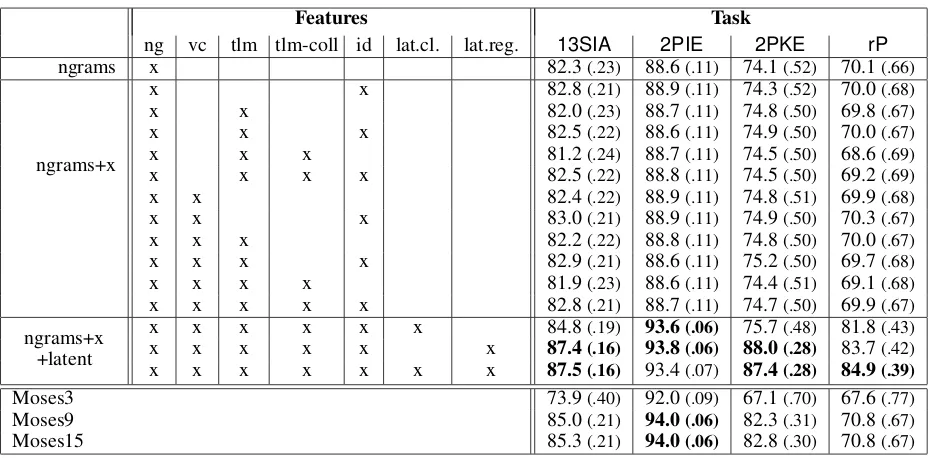
Table 1: Exact-match accuracy and average edit distance (the latter in parentheses) versus the correct answer on the German inflection task, using different combinations of feature classes. The labelngramscorresponds to the second stage of training,ngrams+xto the third where backoff features may fire (vc = vowel/consonant, tlm = target LM, tlm-coll = tlm-collapsed tlm, id = identity/substitution/deletion features), andngrams+x+latentto the fourth where features sensitive to latent classes and latent regions are allowed to fire. The highestn-gram order used is 3, except forMoses9
andMoses15which examine windows of up to 9 and 15 characters, respectively. We mark inboldthe best result for each dataset, along with all results that are statistically indistinguishable (paired permutation test,p <0.05).
the process 5 times. All results are averaged over these 5 runs.
Table 1 and Fig. 3 report separate results after stages,®, and¯of training, which include suc-cessively larger feature sets. These are respectively labeled ngrams, ngrams+x, and ngrams+x+latent. In Table 1, the last row in each section shows the full feature set at that stage (cf. Fig. 3), while earlier rows test feature subsets.18
Our baseline is the SMT toolkit Moses (Koehn et al., 2007) run over letter strings rather than word strings. It is trained (on the same data splits) to find substring-to-substring phrase pairs and translate from one form into another (with phrase reordering turned off). Results reported asmoses3are obtained from Moses runs that are constrained to the same context windows that our models use, so the maxi-mum phrase length and the order of the target lan-guage model were set to 3. We also report results using much larger windows,moses9andmoses15.
18
The numberkof consecutive insertions was set to 3.
Results. The results in Table 1 show that including latent classes and/or regions improves the results dramatically. Compare the last line in ngrams+x to the last line inngrams+x+latent. The accuracy numbers improve from 82.8 to 87.5 (13SIA), from 88.7 to 93.4 (2PIE), from 74.7 to 87.4 (2PKE), and from 69.9 to 84.9 (rP).19 This shows that error re-ductions between 27% and 50% were reached. On 3 of 4 tasks, even our simplestngramsmethod beats themoses3method that looks at the same amount of context.20 With our full model, in particular using latent features, we always outperformmoses3—and even outperformmoses15on 3 of the 4 datasets, re-ducing the error rate by up to 48.3% (rP). On the fourth task (2PIE), our method andmoses15are sta-tistically tied. Moses15has access to context win-dows of five times the size than we allowed our methods in our experiments.
19
All claims in the text are statistically significant under a paired permutation test (p < .05).
20
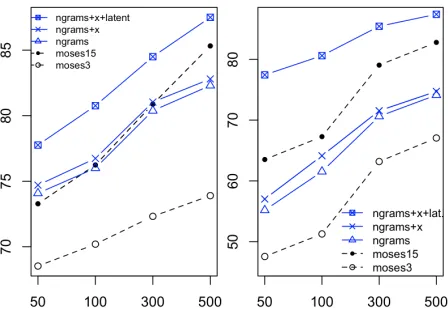
While the gains frombackoff featuresin Table 1 were modest (significant gains only on13SIA), the learning curve in Fig. 3 suggests that they were help-ful for smaller training sets on2PKE(seengramsvs ngrams+x on 50 and 100) and helped consistently over different amounts of training data for13SIA.
Analysis. The types of errors that our system (and the moses baseline) make differ from task to task. Due to lack of space, we mainly focus on the com-plexrPtask. Here, most errors come from wrongly copying the input to the output, without making a change (40-50% of the errors in all models, except for our model with latent classes and no regions, where it accounts for only 30% of the errors). This is so common because about half of the training ex-amples contain identical inputs and outputs (as in the imperativeberechnetand the participle(ihr habt) berechnet). Another common error is to wrongly as-sume a regular conjugation (just insert the prefix ge-at the beginning). Interestingly, this error by sim-plification is more common in the Moses models (44% of moses3 errors, down to 40% for moses15) than in our models, where it accounts for 37% of the errors of ourngramsmodel and only 19% if la-tent classes orlatent regions are used; however, it goes up to 27% if both latent classes and regions are used.21 All models forrP contain errors where wrong analogies to observed words are made ( ver-schweisst/verschwissen in analogy to the observed durchweicht/durchwichen, orbebt/gebobenin anal-ogy tohebt/gehoben). In the2PKEtask, most errors result from inserting the zu morpheme at a wrong place or inserting two of them, which is always wrong. This error type was greatly reduced by la-tent regions, which can discover different parame-ters for different positions, making it easier to iden-tify where to insert thezu.
Analysis of the 2 latent classes (when used) shows that a split into regular and irregular conjugations has been learned. For the rP task we compute, for each data pair in development data, the poste-rior probabilities of membership in one or the other class. 98%of the regular forms, in which the past participle is built withge- . . . -t, fall into one class,
21
[image:7.612.312.536.66.221.2]We suspect that training of the models that use classes and regions together was hurt by the increased non-convexity; an-nealing or better initialization might help.
Figure 3: Learning curves for German inflection tasks,
13SIA(left) and2PKE(right), as a function of the num-ber of training pairs. ngrams+xmeans all backoff fea-tures were used,ngrams+x+latent means all latent fea-tures were used in addition.Moses15examines windows of up to 15 characters.
which in turn consists nearly exclusively (96%) of these forms. Different irregular forms are lumped into the other class.
The learned regions are consistent across different pairs. On development data for therPtask, 94.3%
of all regions that are labeled 1 are the insertion se-quence (,ge), region 3 consists of vowel changes
93.7% of the time; region 5 represents the typical suffixes (t,en), (et,en), (t,n) (92.7%). In the 2PKEtask, region0contains different prefixes (e.g. entgegen inentgegenzutreten), regions 1 and 2 are empty, region3 contains the zuaffix, region 4 the stem, and region5contains the suffix.
The pruned alignment alphabet excluded a few gold standard outputs so that the model contains paths for 98.9%–99.9% of the test examples. We verified that the insertion limit did not hurt oracle accuracy.
4.3 Lemmatization
Without rootlist (generation) With rootlist (selection)
Wicentowski (2002) This paper Wicentowski (2002) This paper
Lang. Base Af. WFA. n n+x n+x+l Base Af. WFA. n n+x n+x+l
Basque 85.3 81.2 80.1 91.0(.20) 91.1(.20) 93.6(.14) 94.5 94.0 95.0 90.9(.29) 90.8(.31) 90.9(.30)
English 91.0 94.7 93.1 92.4(.09) 93.4(.08) 96.9(.05) 98.3 98.6 98.6 98.7(.04) 98.7(.04) 98.7(.04)
Irish 43.3 - 70.8 96.8(.07) 97.0(.06) 97.8(.04) 43.9 - 89.1 99.6(.02) 99.6(.02) 99.5(.03)
[image:8.612.64.539.55.136.2]Tagalog 0.3 80.3 81.7 80.5(.32) 83.0(.29) 88.6(.19) 0.8 91.8 96.0 97.0(.07) 97.2(.07) 97.7(.05)
Table 3: Exact-match accuracy and average edit distance (the latter in parentheses) on the 8 lemmatization tasks (2 tasks×4 languages). The numbers from Wicentowski (2002) are for his Base, Affix and WFAffix models. The numbers for our models are for the feature setsngrams,ngrams+x,ngrams+x+latent. The best result per task is in
bold(as are statistically indistinguishable results when we can do the comparison, i.e., for our own models). Corpus sizes: Basque 5,842, English 4,915, Irish 1,376, Tagalog 9,479.
finalncharacters (interpolating across different val-ues of n). His Affix model essentially applies the Base model after stripping canonical prefixes and suffixes (given by a user-supplied list) from the input and output. Finally, hisWFAffix uses similar meth-ods to also learn substring replacements for a stem vowel cluster and other linguistically significant re-gions in the form (identified by adeterministic align-ment and segalign-mentation of training pairs). This ap-proach is a bit like our change regions combined with Moses’s region-independent phrase pairs.
We compare against all three models. Note that AffixandWFAffix have an advantage that our mod-els do not, namely, user-supplied lists of canonical affixes for each language. It is interesting to see how our models with their more non-committal tri-gram structure compare to this. Table 3 reports re-sults on the data sets used in Wicentowski (2002), for Basque, English, Irish, and Tagalog. Follow-ing Wicentowski, 10-fold cross-validation was used. The columns n+x and n+x+l mean ngram+x and ngram+x+latent, respectively. As latent variables, we include 2 word classes but no change regions.22
For completeness, Table 3 also compares with Wi-centowski (2002) on aselection(rather than genera-tion) task. Here, at test time, the lemma is selected from a candidate list of known lemmas, namely, all the output forms that appeared in training data.23 These additional results are labeledwith rootlist in the right half of Table 3.
On the supervised generation taskwithout rootlist,
22
The insertion limitkwas set to 2 for Basque and 1 for the other languages.
23
Though test data contained no (input, output) pairs from training data, it reused many of the output forms, since many inflected inputs are to be mapped to the same output lemma.
our models outperform Wicentowski (2002) by a large margin. Comparing our results that use la-tent classes (n+x+l) with Wicentowski’s best mod-els we observe error reductions ranging from about 38% (Tagalog) to 92% (Irish). On the selection task with rootlist, we outperform Wicentowski (2002) in English, Irish, and Tagalog.
Analysis. We examined the classes learned on En-glish lemmatization by ourngrams+x+latentmodel. For each of the input/output pairs in development data, we found the most probable latent class. For the most part, the 2 classes are separated based on whether or not the correct output ends in e. This use of latent classes helped address many errors like wronging / wrongeorowed / ow). Such missing or surplus finale’s account for72.5%of the errors for ngramsand70.6% of the errors forngrams+x, but only34.0%of the errors forngrams+x+latent.
The test oracles are between 99.8% – 99.9%, due to the pruned alignment alphabet. As on the inflec-tion task, the inserinflec-tion limit does not exclude any gold standard paths.
5 Finite-State Feature Implementation
We used the OpenFST library (Allauzen et al., 2007) to implement all finite-state computations, using the expectation semiring (Eisner, 2002) for training.
Our model is defined by the WFSAUθ, which is used to score alignment strings inΣ∗ (section 2.2). We now sketch how to constructUθfrom features.
model overΣ∗. Each of the |Σ|2 states remembers
two previous alignment charactersabof history; for eachc∈Σ, it has an outgoing arc that acceptsc(and leads to statebc). The weight of this arc is the total weight (fromθ) of the small set of features that fire when the trigram window includesabc. By conven-tion, these also include features onbcandc(which may be regarded as backoff features ?bc and ??c). Since each character inΣis actually a 4-tuple, this trigram machine is fairly large. We build it lazily (“on the fly”), constructing arcs only as needed to deal with training or test data.
Feature templates Our experiments use over 50,000 features. How do wespecify these features to the above construction? Rather than writing ordi-nary code to extract features from a window, we find it convenient to harness FSTs as a “little language” (Bentley, 1986) for specifying entire sets of features. Afeature templateT is an nondeterministic FST that maps the contents of the sliding window, such as abc, to one or more features, which are also described as strings.24 The n-gram machine de-scribed above can compute T[((a?b)?c)?] to find out what features fire onabc and its suffixes. One simple feature template performs “vowel/consonant backoff”; e.g., it maps abc to the feature named
VCC. Fig. 2 showed the result of applying several actual feature templates to the window shown in Fig. 1. The extended regular expression calculus provides a flexible and concise notation for writ-ing down these FSTs. As a trivial example, the tri-gram “vowel/consonant backoff” transducer can be described as T = V V V, where V is a transducer that performs backoff on asinglealignment charac-ter. Feature templates should make it easy to experi-ment with adding various kinds of linguistic knowl-edge. We have additional algorithms for compiling
Uθ from a set of arbitrary feature templates,25 in-cluding templates whose features consider windows of variable or even unbounded width. The details are beyond the scope of this paper, but it is worth point-ing out that they exploit the fact that feature tem-plates are FSTs and not arbitrary code.
24
Formally, if i is a string naming a feature, then fi(A)
counts the number of positions inAthat are immediately pre-ceded by some string inT−1[i].
25
Provided that the total number of features is finite.
6 Conclusions
The modeling framework we have presented here is, we believe, an attractive solution to most string transduction problems in NLP. Rather than learn the topology of an arbitrary WFST, one specifies the topology using a small set of feature templates, and simply trains the weights.
We evaluated on two morphology generation tasks. When inflecting German verbs we, even with the simplest features, outperform the moses3 base-line on 3 out of 4 tasks, which uses the same amount of context as our models. Introducing more sophis-ticated features that have access to latent classes and regions improves our results dramatically, even on small training data sizes. Using these we outper-formmoses9andmoses15, which use long context windows, reducing error rates by up to 48%. On the lemmatization task we were able to improve the re-sults reported in Wicentowski (2002) on three out of four tested languages and reduce the error rates by 38% to 92%. The model’s errors are often reason-able misgeneralizations (e.g., assume regular con-jugation where irregular would have been correct), and it is able to use even a small number of latent variables (including the latent alignment) to capture useful linguistic properties.
References
Cyril Allauzen, Michael Riley, Johan Schalkwyk, Woj-ciech Skut, and Mehryar Mohri. 2007. OpenFst: A general and efficient weighted finite-state transducer library. InProc. of CIAA, volume 4783.
Jon Bentley. 1986. Programming pearls [column]. Com-munications of the ACM, 29(8), August.
Maximilian Bisani and Hermann Ney. 2002. Inves-tigations on jointmultigram models for grapheme-to-phoneme conversion.
Francisco Casacuberta and Colin De La Higuera. 2000. Computational complexity of problems on probabilis-tic grammars and transducers. InProc. of the 5th Inter-national Colloquium on Grammatical Inference: Al-gorithms and Applications, volume 1891.
Francisco Casacuberta. 2000. Inference of finite-state transducers by using regular grammars and mor-phisms. In A.L. Oliveira, editor, Grammatical Infer-ence: Algorithms and Applications, volume 1891. Stanley F. Chen. 2003. Conditional and joint models for
grapheme-to-phoneme conversion. InProc. of Inter-speech.
Alexander Clark. 2001. Learning morphology with Pair Hidden Markov Models. InProc. of the Student Work-shop at the 39th Annual Meeting of the Association for Computational Linguistics, Toulouse, France, July. Sabine Deligne, Francois Yvon, and Fr´ed´eric Bimbot.
1995. Variable-length sequence matching for phonetic transcription using joint multigrams. InEurospeech. Vera Demberg, Helmut Schmid, and Gregor M¨ohler.
2007. Phonological constraints and morphological preprocessing for grapheme-to-phoneme conversion. InProc. of ACL, Prague, Czech Republic, June. Jason Eisner. 1997. Efficient generation in primitive
Op-timality Theory. InProc. of ACL-EACL, Madrid, July. Jason Eisner. 2002. Parameter estimation for
probabilis-tic finite-state transducers. InProc. of ACL.
Jenny Rose Finkel, Alex Kleeman, and Christopher D. Manning. 2008. Efficient, feature-based, conditional random field parsing. In Proceedings of ACL-08: HLT, pages 959–967, Columbus, Ohio, June. Associa-tion for ComputaAssocia-tional Linguistics.
Dayne Freitag and Shahram Khadivi. 2007. A sequence alignment model based on the averaged perceptron. In
Proc. of EMNLP-CoNLL.
Lucian Galescu and James F. Allen. 2001. Bi-directional conversion between graphemes and phonemes using a joint N-gram model.
Sittichai Jiampojamarn, Grzegorz Kondrak, and Tarek Sherif. 2007. Applying many-to-many alignments and hidden markov models to letter-to-phoneme con-version. In Proc. of NAACL-HLT, Rochester, New York, April.
Philipp Koehn, Hieu Hoang, Alexandra Birch, Chris Callison-Burch, Marcello Federico, Nicola Bertoldi,
Brooke Cowan, Wade Shen, Christine Moran, Richard Zens, Chris Dyer, Ondrej Bojar, Alexandra Con-stantin, and Evan Herbst. 2007. Moses: Open source toolkit for statistical machine translation. In Proc. of ACL, Companion Volume, Prague, Czech Republic, June.
Dong C. Liu and Jorge Nocedal. 1989. On the limited memory BFGS method for large scale optimization.
Math. Programming, 45(3, (Ser. B)):503–528. Takuya Matsuzaki, Yusuke Miyao, and Jun’ichi Tsujii.
2005. Probabilistic CFG with latent annotations. In
Proc. of ACL, Ann Arbor, Michigan, June.
Mehryar Mohri. 1997. Finite-state transducers in lan-guage and speech processing.Computational Linguis-tics, 23(2).
Slav Petrov, Adam Pauls, and Dan Klein. 2007. Learning structured models for phone recognition. InProc. of EMNLP-CoNLL.
Eric Sven Ristad and Peter N. Yianilos. 1998. Learn-ing strLearn-ing-edit distance.IEEE Transactions on Pattern Analysis and Machine Intelligence, 20(5).
Holger Schwenk, Marta R. Costa-jussa, and Jose A. R. Fonollosa. 2007. Smooth bilingualn-gram transla-tion. InProc. of EMNLP-CoNLL, pages 430–438. Tarek Sherif and Grzegorz Kondrak. 2007.
Substring-based transliteration. InProc. of ACL, Prague, Czech Republic, June.
Kristina Toutanova, Hisami Suzuki, and Achim Ruopp. 2008. Applying morphology generation models to machine translation. InProceedings of ACL-08: HLT, Columbus, Ohio, June.
Richard Wicentowski. 2002. Modeling and Learning Multilingual Inflectional Morphology in a Minimally Supervised Framework. Ph.D. thesis, Johns-Hopkins University.
Jun Wu and Sanjeev Khudanpur. 2000. Efficient training methods for maximum entropy language modeling. In
Proc. of ICSLP, volume 3, Beijing, October.