Noise Mitigation for Neural Entity Typing and Relation Extraction
Yadollah Yaghoobzadeh* and Heike Adel* and Hinrich Sch¨utze
*These authors contributed equally to this work
Center for Information and Language Processing LMU Munich, Germany
yadollah|[email protected]
Abstract
In this paper, we address two different types of noise in information extraction models: noise from distant supervision and noise from pipeline input features. Our target tasks are entity typing and rela-tion extracrela-tion. For the first noise type, we introduce multi-instance multi-label learn-ing algorithms uslearn-ing neural network mod-els, and apply them to fine-grained entity typing for the first time. Our model outper-forms the state-of-the-art supervised ap-proach which uses global embeddings of entities. For the second noise type, we propose ways to improve the integration of noisy entity type predictions into re-lation extraction. Our experiments show that probabilistic predictions are more ro-bust than discrete predictions and that joint training of the two tasks performs best.
1 Introduction
Knowledge bases (KBs) are important resources for natural language processing tasks like ques-tion answering and entity linking. However, KBs are far from complete (e.g., Socher et al. (2013)). Therefore, methods for automatic knowledge base completion (KBC) are beneficial. Two subtasks of KBC areentity typing (ET)andrelation extraction (RE). We address both tasks in this paper.
As in other information extraction tasks, obtain-ing labeled trainobtain-ing data for ET and RE is chal-lenging. The challenge grows as labels become more fine-grained. Therefore, distant supervision (Mintz et al., 2009) is widely used. It reduces the need for manually created resources. Distant su-pervision assumes that if an entity has a type (resp. two entities have a relationship) in a KB, then all sentences mentioning that entity (resp. those
two entities) express that type (resp. that relation-ship). However, that assumption is too strong and gives rise to many noisy labels. Different tech-niques to deal with that problem have been in-vestigated. The main technique is multi-instance (MI) learning (Riedel et al., 2010). It relaxes the distant supervision assumption to the assumption that at least one instance of a bag (collection of all sentences containing the given entity/entity pair) expresses the type/relationship given in the KB. Multi-instance multi-label (MIML) learning is a generalization of MI in which one bag can have several labels (Surdeanu et al., 2012).
Most MI and MIML methods are based on hand crafted features. Recently, Zeng et al. (2015) in-troduced an end-to-end approach to MI learning based on neural networks. Their MI method takes the most confident instance as the prediction of the bag. Lin et al. (2016) further improved that method by taking other instances into account as well; they proposed MI learning based on selective attention as an alternative way of relaxing the im-pact of noisy labels on RE. In selective attention, a weighted average of instance representations is calculated first and then used to compute the pre-diction of a bag.
In this paper, we introduce two multi-label ver-sions of MI. (i)MIML-MAX takes the maximum instance for each label. (ii) MIML-ATT applies, for each label, selective attention to the instances. We apply MIML-MAX and MIML-ATT to fine-grained ET. In contrast to RE, the ET task we con-sider contains a larger set of labels, with a variety of different granularities and hierarchical relation-ships. We show that MIML-ATT deals well with noise in corpus-level ET and improves or matches the results of a supervised model based on global embeddings of entities.
The second type of noise we address in this pa-per influences the integration of ET into RE. It has
been shown that adding entity types as features im-proves RE models (cf. Ling and Weld (2012), Liu et al. (2014)). However, noisy training data and difficulties of classification often cause wrong pre-dictions of ET and, as a result, noisy inputs to RE. To address this, we propose a joint model of ET and RE and compare it with methods that integrate ET results in a strict pipeline. The joint model per-forms best. Among the pipeline models, we show that using probabilities instead of binary decisions better deals with noise (i.e., possible ET errors).
To sum up, our contributions are as follows. (i) We introduce new algorithms for MIML us-ing neural networks. (ii) We apply MIML to fine-grained entity typing for the first time and show that it outperforms the state-of-the-art supervised method based on entity embeddings. (iii) We show that a novel way of integrating noisy entity type predictions into a relation extraction model and joint training of the two tasks lead to large im-provements of RE performance.
We release code and data for future research.1
2 Related Work
Noise mitigation for distant supervision.Distant
supervision can be used to train information ex-traction systems, e.g., in relation exex-traction (e.g., Mintz et al. (2009), Riedel et al. (2010), Hoffmann et al. (2011), Zeng et al. (2015)) and entity typ-ing (e.g., Ltyp-ing and Weld (2012), Yogatama et al. (2015), Dong et al. (2015)). To mitigate the noisy label problem, multi-instance (MI) learning has been introduced and applied in relation extraction (Riedel et al., 2010; Ritter et al., 2013). Surdeanu et al. (2012) introduced multi-instance multi-label (MIML) learning to extend MI learning for multi-label relation extraction. Those models are based on manually designed features. Zeng et al. (2015) and Lin et al. (2016) introduced MI learning meth-ods for neural networks. We introduce MIML al-gorithms for neural networks. In contrast to most MI/MIML methods, which are applied in relation extraction, we apply MIML to the task of fine-grained entity typing. Ritter et al. (2013) applied MI on a Twitter dataset with ten types. Our dataset has a larger number of classes or types (namely 102) and input examples, compared to that Twitter dataset and also to the most widely used datasets for evaluating MI (cf. Riedel et al. (2010)). This makes our setup more challenging because of
dif-1cistern.cis.lmu.de
ferent dependencies and the multi-label nature of the problem. Also, there seems to be a difference between how entity relations and entity types are expressed in text. Our experiments support that hypothesis.
Knowledge base completion (KBC). Most
KBC systems focus on identifying triples
R(e1, r, e2) missing from a KB (Nickel et al., 2012; Bordes et al., 2013; Weston et al., 2013; Socher et al., 2013; Jiang et al., 2012; Riedel et al., 2013; Wang et al., 2014). Work on entity typing or unary relations for KBC is more recent (Yao et al., 2013; Neelakantan and Chang, 2015; Yaghoobzadeh and Sch¨utze, 2015; Yaghoobzadeh et al., 2017). In this paper, we build a KBC system for unary and binary relations using contextual information of words and entities.
Named entity recognition (NER) and typing.
NER systems (e.g., Finkel et al. (2005), Collobert et al. (2011)) used to consider only a small set of entity types. Recent work also addresses fine-grained NER (Yosef et al., 2012; Ling and Weld, 2012; Yogatama et al., 2015; Dong et al., 2015; Del Corro et al., 2015; Ren et al., 2016a; Ren et al., 2016b; Shimaoka et al., 2016). Some of this work (cf. Yogatama et al. (2015), Dong et al. (2015)) treats entity segment boundaries as given and classifies mentions into fine-grained types. We make a similar assumption, but in contrast to NER, we evaluate on the corpus-level entity typ-ing task of Yaghoobzadeh and Sch¨utze (2015); thus, we do not need test sentences annotated with context dependent entity types. This task was also used to evaluate embedding learning methods (Yaghoobzadeh and Sch¨utze, 2016).
Entity types for relation extraction.
model; we show that this result also holds for neu-ral network models and when the number of entity types is large.
3 MIML Learning for Entity Typing
Entity typing (ET) is the task of finding, for each named entity, a set of types or classes that it belongs to, e.g., “author” and “politician” for “Obama”. Our goal is corpus-level prediction of entity types. We use the entity-type information from a KB and annotated contexts of entities in a corpus to estimateP(t|e), the probability that en-tityehas typet.
More specifically, consider an entityeandB = {c1, c2, ..., cq}, the set of q contexts of e in the corpus. Each ci is an instance of e and since
e can have several labels, it is a multi-instance multi-label (MIML) learning problem. We address MIML using neural networks by representing each context as a vector~ci∈Rh, and learnP(t|e)from the set of contexts of entitye. In the following, we first describe our MIML algorithms and then explain how~ciis computed.
Notations and definitions. Lowercase letters
(e.g.,e) refer to variables. Lowercase letters with an upper arrow (e.g., ~e) are vectors. We define BCE, binary cross entropy, as follows whereyis a binary variable and yˆis a real valued variable between 0 and 1.
BCE(y,yˆ) =−ylog(ˆy)+(1−y)(1−log(ˆy))
3.1 Algorithms
Distant supervision. The basic way to estimate
P(t|e)is based on distant supervision with learn-ing the type probability of eachciindividually, by making the assumption that eachci expresses all labels ofe. Therefore, we define the context-level probability function as:
P(t|ci) =σ(w~t~ci+bt) (1)
wherew~t ∈Rh is the output weight vector andbt is the bias scalar for typet. The cost function is defined based on binary cross entropy:
(2)
L(θ) =X
c
X
t
BCE(yt, P(t|c))
whereytis 1 if entityehas typetotherwise 0. To computeP(t|e)at prediction time, i.e.,Ppred(t|e),
the context-level probabilities must be aggregated. Average is the usual way of doing that:
Ppred(t|e) = 1q
q
X
i=1
P(t|ci) (3)
Multi-instance multi-label. The distant
super-vision assumption is that all contexts of an en-tity with type t are contexts of t; e.g., we la-bel all contexts mentioning “Barack Obama” with all of his types. Obviously, the labels are incor-rect or noisy for some contexts. Multi-instance multi-label (MIML) learning addresses this prob-lem. We apply MIML to fine-grained ET for the first time. Our assumption is: if entityehas type
t, then there is at least one context ofein the cor-pus in whicheoccurs as typet. So, we apply this assumption during training with the following es-timation of the type probability of an entity:
P(t|e) = max
1≤i≤qP(t|ci) (4) which means we take themaximumprobability of typetover all contexts of entityeasP(t|e). We call this approachMIML-MAX.
MIML-MAX picks the most confident context fort, ignoring the probabilities of all the other con-texts. Apart from missing information, this can be especially harmful if the entity annotations in the corpus are the result of an entity linking system. In that case, the most confident context might be wrongly linked to the entity. So, it can be bene-ficial to leverage all contexts into the final predic-tion, e.g., by averagingthe type probabilities of all contexts of entitye:
P(t|e) = 1
q
q
X
i=1
P(t|ci) (5)
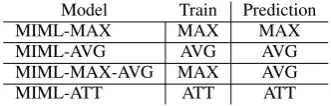
We call this approachMIML-AVG. We also pro-pose a combination of the maximum and average, which uses MIML-MAX (Eq. 4) in training and MIML-AVG (Eq. 5) in prediction. We call this ap-proachMIML-MAX-AVG.
MIML-AVG treats every context equally which might be problematic since many contexts are ir-relevant for a particular type. A better way is to weight the contexts according to their similarity to the types. Therefore, we propose using selective
attention over contexts as follows and call this
Model Train Prediction
MIML-MAX MAX MAX
MIML-AVG AVG AVG
MIML-MAX-AVG MAX AVG
[image:4.595.98.264.62.115.2]MIML-ATT ATT ATT
Table 1: Different MIML algorithms for entity typing, and the aggregation function they use to get corpus-level probabilities.
probability fore, we define:
P(t|e) =σ(w~t~at+bt) (6)
where w~t ∈ Rh is the output weight vector and
bt the bias scalar for typet, and ~at is the aggre-gated representation of all contextsciofefor type
t, computed as follows:
~at=
X
i
αi,t~ci (7)
whereαi,t is the attention score of context ci for typetand~at∈Rhcan be interpreted as the repre-sentation of entityefor typet.
αi,tis defined as:
αi,t = Pqexp(~ciM~t)
j=1exp(~cjM~t) (8)
where M ∈ Rh×dt is a weight matrix that
mea-sures the similarity of~cand~t. ~t∈Rdt is the
rep-resentation of typet.
Table 1 summarizes the differences of our MIML methods with respect to the aggregation function they use to get corpus-level probabilities. For optimization of all MIML methods, we use the binary cross entropy loss function,
L(θ) =X
e
X
t
BCE(yt, P(t|e)) (9)
In contrast to the loss function of distant supervi-sion in Eq. 2, which iterates over allcontexts, we iterate over allentitieshere.
3.2 Context Representation
To produce a high-quality context representation
~c, we use convolutional neural networks (CNNs). The first layer of the CNN is alookup tablethat maps each word in cto an embedding of size d. The output of the lookup layer is a matrix E ∈
Rd×s(the embedding layer), wheresis the context size (a fixed number of words).
The CNN uses n filters of different window widthswto narrowly convolveE. For each of the
nfilters H ∈ Rd×w, the result of applyingH to matrixEis a feature map ~m∈Rs−w+1:
m[i] =g(E:,i:i+w−1H) (10) whereg is the relu function, is the Frobenius product,E:,i:i+w−1 are the columnsitoi+w−1 ofE and1 ≤ w ≤ kare the window widths we consider. Max pooling then gives us one feature for each filter and the concatenation of those fea-tures is the CNN representation ofc.
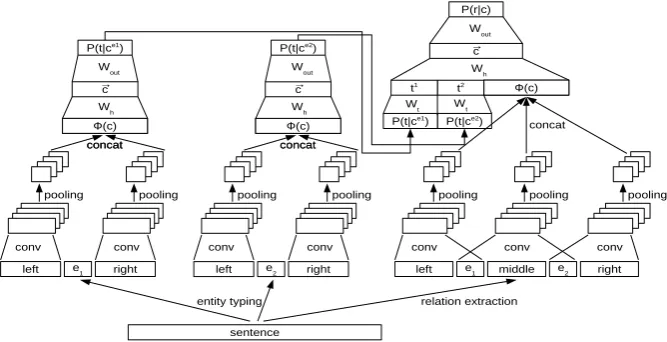
As it is shown in the entity typing part of Fig-ure 1, we apply the CNN to the left and right context of the entity mention and the concatena-tion ~φ(c) ∈ R2nis fed into a multi-layer percep-tron (MLP) to get the final context representation
~c∈Rh:
~c= tanhWh~φ(c)
(11)
4 Type-aware Relation Extraction
Relation extraction (RE) is mostly defined as find-ing relations between pairs of entities, for in-stance, finding the relation “president-of” between “Obama” and “USA”. Given a set ofqcontexts for an entity pair z, B = {c1, c2, ..., cq} in the cor-pus, we learnP(r|z), which is the probability of relation r for z. We assume that eachz has one relation r(z). Each ci is represented by a vector
~ci ∈ Rh, which is our type-aware representation of context described in Section 4.1.
To learnP(r|z), we use the multi-instance (MI) learning method of Zeng et al. (2015):
P(r|ci) =softmax
Wout~ci
,
P(r|z) = max
1≤i≤qP(r|ci)
(12)
whereP(r|ci) is the probability of relation r for contextci. The cost function we optimize is:
L(θ) =−X
z
logP(r(z)|z)
4.1 Context Representation
sentence
left e1 right left e1 middle e2 right
conv conv conv conv conv
pooling pooling pooling pooling pooling
entity typing relation extraction
Ф(c) concat
Ф(c) concat
Ф(c) Ф(c)
concat c
c
Wh
Wh
P(t|ce1)
Wout
t2
t1
P(r|c) Wout
P(t|ce2)
P(t|ce1)
Wt Wt
left e2 right
conv conv
pooling pooling
Ф(c) concat
Ф(c) concat
c Wh P(t|ce2)
Wout
→ →
[image:5.595.132.466.62.233.2]→
Figure 1: Our architecture for joint entity typing and relation extraction
and right of the relation arguments. The parts “overlap”, i.e., the left (resp. right) argument is in-cluded in both left (resp. right) and middle parts. For each of the three parts, convolution and 3-max pooling (Kalchbrenner et al., 2014) is performed. The context representation ~φ(c) ∈ R3·3·n is the concatenation of the pooling results.
4.1.1 Integration of Entity Types
We concatenate the entity type representations
~t1 ∈ Rτ and ~t2 ∈ Rτ of the relation arguments to the CNN representation of the context,~φ(c):
~φ(c)0 = [~φ(c) : ~t1 :~t2] (13) Our context representation~cis then:
~c= tanhWh~φ(c)0
(14)
whereWh ∈ Rh×(3·3·n+2τ)is the weight matrix. This is also depicted in Figure 1, right column, third layer from the top: ~t1,~t2,Φ(~ c). We calculate
~t1 and~t2from the predictions of the entity typing model with the following transformation:
~tk=fWt[P(t1|cek). . . P(tT|cek)] (15)
where cek is the context of ek, Wt ∈ Rτ×T is
a weight matrix (learned from corpus or during training) and f is a function (identity or tanh). With the transformationWt, the model can com-bine predictions for different types to learn better internal representationst1 andt2. The choices of
Wt andf depend on the different representations we investigate and describe in the following.
(1) Pipeline: We integrate entity types into the
RE model, using the output of ET in a pipeline
model (see Eq. 15). We test the following rep-resentations of ~tk, k ∈ {1,2}.
PREDICTED-HIDDEN: Wt from Eq. 15 is learned during
training and f is tanh. That means that a hid-den layer learns representations based on the predictions P(t1|cek). . . P(tT|cek).
BINARY-HIDDEN: This is the binarization of the input of
PREDICTED-HIDDEN, i.e., each probability es-timate is converted to 0 or 1 (with a threshold of 0.5).BINARY:~tkis the binary vector itself (used by Ling and Weld (2012)). WEIGHTED: The columns of matrixWtfrom Eq. 15 are the distribu-tional embeddings of types trained on the corpus (see Section 5.1).fis the identity function.
(2) Joint model: As an alternative to the
pipeline model, we investigate integrating entity typing into RE by jointly training both mod-els. We use the architecture depicted in Fig-ure 1. The key difference to the pipeline model PREDICTED-HIDDEN is that we learn P(t|c)
and P(r|c) jointly, called JOINT-TRAIN. We compare JOINT-TRAIN to other models, includ-ing the pipeline models.
During training of JOINT-TRAIN, we compute the cost of the ET model for typing the first en-tityL1(θT), the cost for typing the second entity
L2(θT) and the cost of the RE model for assign-ing a relation to the two entities L(θR). Then, we combine those costs with a weightγ which is tuned on the development set:
L(θ) =X
z
L1(θT) +L2(θT) +γ·L(θR)
,
Li(θT) =
X
t
BCE(yei
t , P(t|cei)),
GOV.GOV agency.jurisdiction PPL.PER.children GOV.us president.vice president PPL.PER.nationality PPL.deceased PER.place of death PPL.PER.religion ORG.ORG.place founded PPL.PER.place of birth ORG.ORG founder.ORGs founded NA (no relation) LOC.LOC.containedby
Table 2: Selected relations for relation extraction; PPL = people, GOV = governement
P(r|z)is computed based on Eq. 12.
Note that based on this equation, the ET param-eters are optimized on the contexts of the RE ex-amples, which are a subset of all training exam-ples of ET. However in the pipeline models, ET is trained on the whole training set used for typ-ing. Also note that in JOINT-TRAIN we do not use MIML for the ET part but a distant supervised cost function.
5 Experimental Data, Setup and Results
For entity typing, we use CF-FIGMENT (URL, 2016b), a dataset published by Yaghoobzadeh and Sch¨utze (2015). CF-FIGMENT is derived from a version of ClueWeb (URL, 2016c) in which Freebase entities are annotated using FACC1 (URL, 2016d; Gabrilovich et al., 2013). CF-FIGMENT contains 200,000 Freebase entities that were mapped to 102 FIGER types (Ling and Weld, 2012), divided into train (50%), dev (20%) and test (30%); and a set of 4,300,000 sentences (contexts) containing those entities.
For relation extraction, we first select the ten most frequent relations (plus NA for no rela-tion according to Freebase) of entity pairs in CF-FIGMENT. We ensure that the entity pairs have at least one context in CF-FIGMENT. This results in 5815, 3054 and 6889 unique entity pairs for train, dev and test.2 Dev and test set sizes are 124,462 and 556,847 instances. For the train set, we take a subsample of 135,171 sentences. The entity and sentence sets of CF-FIGMENT were constructed to ensure that entities in the entity test set do not occur in the sentence train and dev sets; that is, a sentence was assigned to the train set only if all entities it contains are train entities.1
5.1 Word, Entity and Type Embeddings
We use 100-dimensional word embeddings to ini-tialize the input layer of ET and RE. Embeddings
2We only assign those entity pairs to test (resp. dev, resp.
train) for which both constituting entities are in the ET test (resp. dev, resp. train) set.
are kept fixed during training. Since we need em-beddings for words, entities and types in the same space, we process ClueWeb+FACC1 (corpus with entity information) as follows. For each sentence
s, we add two copies:sitself, and a copy in which each entity is replaced with its notable type, the most important type according to Freebase. We process train, dev and test this way, but do not re-place test entities with their notable type because the types of test entities are unknown in our ap-plication scenario. We run word2vec (Mikolov et al., 2013) on the resulting corpus to learn embed-dings for words, entities and types. Note that our application scenario is that we are given an unan-notated input corpus and our system then extracts entity types and relations from this input corpus to enhance the KB.
5.2 Entity Typing Experiments
Entity context setup. We use a window size of
5 on each side of the entity mentions. Follow-ing Yaghoobzadeh and Sch¨utze (2015), we replace other entities occurring in the context with their Freebase notable type mapped to FIGER.
Models.Yaghoobzadeh and Sch¨utze (2015)
ap-plied a multi-layer perceptron (MLP) architecture to create context representations. Therefore, we use an MLP baseline to compute the context rep-resentation~φ(c). The input to the MLP model is a concatenation of context word embeddings. As an alternative to MLP, we also train aCNN(see Sec-tion 3.2) to compute context representaSec-tions. We run experiments with MLP and CNN, each trained with standard distant supervision and with MIML.
EntEmb and FIGMENT baselines.
Follow-ing Yaghoobzadeh and Sch¨utze (2015), we also learn entity embeddings and classify those embed-dings to types, i.e., instead of distant supervision, we classify entities based on aggregated informa-tion represented in entity embeddings. An MLP with one hidden layer is used as classifier. We call that model EntEmb. We join the results of EntEmb with our best model (line 13 in Table 3), similar to the joint model (FIGMENT) in Yaghoobzadeh and Sch¨utze (2015).
P@1 F1 F1 F1 MAP all all head tail
1 MLP 74.3 69.1 74.8 52.5 42.1
2 MLP+MIML-MAX 74.7 59.2 50.7 46.8 41.3 3 MLP+MIML-AVG 77.2 70.6 74.9 56.2 45.0 4 MLP+MIML-MAX-AVG 75.2 71.2 76.4 56.0 47.1 5 MLP+MIML-ATT 81.0 72.0 76.9 59.1 48.8
6 CNN 78.4 72.2 77.3 56.3 47.6
[image:7.595.311.512.62.205.2]7 CNN+MIML-MAX 78.6 62.2 53.5 49.7 46.6 8 CNN+MIML-AVG 80.8 73.5 77.7 59.2 50.4 9 CNN+MIML-MAX-AVG 79.9 74.3 79.2 59.8 53.3 10 CNN+MIML-ATT 83.4 75.1 79.4 62.2 55.2 11 EntEmb 80.8 73.3 79.9 57.4 56.6 12 FIGMENT 81.6 74.3 80.3 60.1 57.0 13 CNN+MIML-ATT+EntEmb 85.4 78.2 83.3 66.2 64.8
Table 3: P@1, MicroF1 for all, head and tail en-tities and MAP results for entity typing.
assignments and mean average precision (MAP) over types. We could make assignment decisions based on the standard criterionp > θ,θ= 0.5, but we found that tuningθimproves results. For each probabilistic classifier and each type, we setθ to the value that maximizes performance on dev.
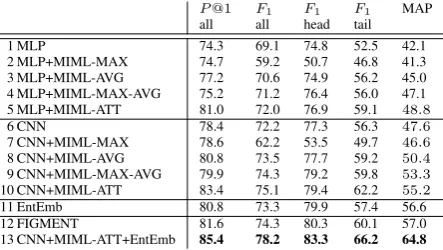
Results. Table 3 shows results forP@1, micro
F1 and MAP. For F1, we report separate results for all, head (frequency higher than 100) and tail (frequency less than 5) entities.
Discussion. The improvement of CNN (6)
compared to MLP (1) is not surprising consider-ing the effectiveness of CNNs in findconsider-ing position independent local features, compared to the flat representation of MLP. Lines 2-5 and 7-10 show the results of different MIML algorithms for MLP and CNN, respectively. Considering micro F1 for all entities as the most importance measure, the trend is similar in both MLP and CNN for MIML methods: ATT>MAX-AVG>AVG>MAX.
MAX is worse than even basic distant super-vised models, especially for micro F1. MAX pre-dictions are based on only one context of each en-tity (for each type), and the results suggest that this is harmful for entity typing. This is in contradic-tion with the previous results in RE (cf. Zeng et al. (2015)) and suggests that there might be a signif-icant difference between expressing types of enti-ties and relations between them in text. Related to this, MAX-AVG which averages the type prob-abilities at prediction time improves MAX by a large margin. Averaging the context probabilities seems to be a way to smooth the entity type prob-abilities. MAX-AVG models are also better than the corresponding models with AVG that train and predict with averaging. This is due to the fact that AVG gives equal weights to all context probabil-ities both in training and prediction. ATT uses
… /m/024g5w , and DOCTOR into disease will be ... … whooping cough , and kidney disease ( /m/024g5w ‘s disease ...
In 7 , DOCTOR and /m/024g5w write Elements of the ... book but his catarrhal bronchitis turned to /m/024g5w ‘s disease and ...
It has cured /m/024g5w ‘s disease that could be traced to ... two clinical wards so /m/024g5w can carry on intensive study ...
/m/024g5w , who once explored LOCATION-COUNTRY and wrote up his ...
... is /m/024g5w , who is collecting and painstakingly recording ...
pe
rs
on
au
th
or
do
ct
or
pe
rs
on
au
th
or
do
ct
or
ATT MAX
Figure 2: MIML-ATT and MIML-MAX scores for the example entity /m/024g5w.
weighted contexts in both training and prediction and that is probably the reason for its effectiveness over all other MIML algorithms. Overall, using at-tention (ATT) significantly improves the results of both MLP and CNN models.
CNN+MIML-ATT (10) performs comparable to EntEmb (11), with better micro F1 on all and tail entities and worse MAP and micro F1 on head entities. These two models have different proper-ties, e.g., MIML is also able to type each mention of entities while EntEmb works only for corpus-level typing of entities. (See Yaghoobzadeh and Sch¨utze (2015) for more differences) It is impor-tant to note that MIML can also be applied to any entity typing architecture or model that is trained by distant supervision. Due to the lack of large annotated corpora, distant supervision is currently the only viable approach to fine-grained entity typ-ing; thus, our demonstration of the effectiveness of MIML is an important finding for entity typing.
Joining the results of CNN+MIML-ATT with EntEmb (line 13) gives large improvements over each of the single models. It is also consistently better (by more than 3% in all measures) than our baseline FIGMENT (12), which is basically MLP+EntEmb. This improvement is achieved by using CNN instead of MLP for context represen-tation and integrating MIML-ATT. EntEmb is im-proved by Yaghoobzadeh et al. (2017) by using en-tity names. We leave the integration of that model to future work.
Example. To show the behavior of
[image:7.595.72.294.63.188.2]that the weights from MIML-ATT (Eq. 8) sum to 1 for each label because of the applied softmax func-tion while the scores from MIML-MAX (Eq. 1) do not. For both methods, the scores for the type PERSON are more equally distributed than for the other types which makes sense since the entity has thePERSONcharacteristics in every sentence. For the other types, both models seem to be influenced by other entities occurring in the context (e.g., an occurrence with another DOCTOR could indicate that the entity is also aDOCTOR) but also by trig-ger words such as “write” or “book” for the type AUTHORor “disease” for the typeDOCTOR.
5.3 Relation Extraction Experiments
Models. In our experiments, we compare two
state-of-the-art RE architectures: piecewise CNN (Zeng et al., 2015) and contextwise CNN (Adel et al., 2016). We use the publicly available imple-mentation for the piecewise CNN (URL, 2016a) and our own implementation for the contextwise CNN. Both CNNs represent the input words with embeddings and split the contexts based on the positions of the relation arguments. The context-wise CNN splits the input before convolution, the piecewise CNN after convolution. Also, while the piecewise CNN applies a softmax layer di-rectly after pooling, the contextwise CNN feeds the pooling results into a fully-connected hidden layer first. For both models, we use MI learning to mitigate the noise from distant supervision.
Results. The precision recall (PR) curves in
Figure 3 show that the contextwise CNN outper-forms the piecewise CNN on our RE dataset. We also compare them to a baseline model that does not learn context features but uses only the em-beddings of the relation arguments as an input and feeds them into an MLP (similar to the EntEmb baseline for ET). The results confirm that the con-text features which the CNNs extract are very im-portant, not only for ET but also for RE. Note that the PR curves are calculated on the corpus level and not on the sentence-level, i.e., after aggregat-ing the predictions for each entity pair. Followaggregat-ing Ritter et al. (2013), we compute the areaAunder the PR curves which supports this trend (EntEmb:
A = 0.34, piecewise CNN: A = 0.48, context-wise CNN:A= 0.50).
Pipeline vs. joint training. Since the
con-textwise CNN outperforms the piecewise CNN, we use the contextwise CNN for integrating
0.4 0.5 0.6 0.7 0.8 0.9 1
0 0.1 0.2 0.3 0.4 0.5 0.6 0.7 0.8
Precision
Recall
[image:8.595.311.528.65.198.2]RE = entEmb RE = piecewise CNN RE = contextwise CNN
Figure 3: PR curves: relation extraction models
0.4 0.5 0.6 0.7 0.8 0.9 1
0 0.1 0.2 0.3 0.4 0.5 0.6 0.7 0.8
Precision
Recall
contextwise CNN + BINARY + BINARY-HIDDEN + PREDICTED-HIDDEN + WEIGHTED + JOINT
Figure 4: PR curves: type-aware relation extrac-tion models
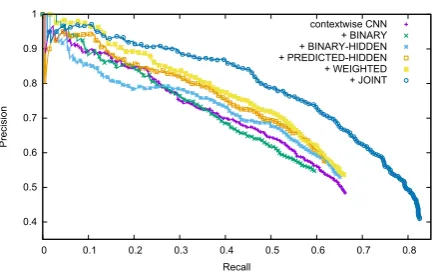
tity types. Figure 4 shows that the performance on the RE dataset increases when we integrate entity type information into the CNN. The main trend of the PR curves and the areas under them shows the following order of model performances: JOINT-TRAIN>WEIGHTED > PREDICTED-HIDDEN>BINARY-HIDDEN>BINARY.
Discussion. The better performance of our
approaches of integrating type predictions into the contextwise CNN (PREDICTED-HIDDEN, WEIGHTED) compared to baseline type integra-tions (BINARY, BINARY-HIDDEN) shows that probabilistic predictions of an entity typing sys-tem can be a valuable resource for RE. With bi-nary types, it is not possible to tell whether one of the selected types had a higher probability than another or whether a type whose binary value is 0 just barely missed the threshold. Probabilistic representations preserve this information. Thus, using probabilistic representations, the RE system can compensate for noise in ET predictions.
[image:8.595.310.527.239.376.2]that our type embeddings can be valuable for RE. JOINT-TRAIN performs better than all pipeline models, even though the ET part in the pipelines is trained on more data. The area of JOINT-TRAIN under the PR curve isA= 0.66. A plausible rea-son is the mutual dependencies of those two tasks which a joint model can better learn than a pipeline model. We can also relate it to better noise mitiga-tion of jointed ET, compared to isolated models.3
Analysis of joint training. In this paragraph,
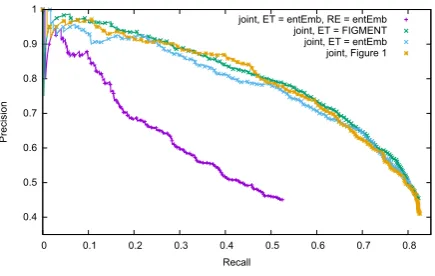
we investigate the joint training in more detail. In particular, we evaluate different variants of it by combining relation extraction with other en-tity typing approaches: EntEmb and FIGMENT. For joint training with ET-EntEmb, we do not use the context for predicting the types of the relation arguments but only their embeddings. Then, we feed those embeddings into an MLP which com-putes a representation that we use for the type pre-diction. This corresponds to the EntEmb model presented in Table 3 (line 11). For joint train-ing with ET-FIGMENT, we compute two differ-ent cost functions for differ-entity typing: one for typ-ing based on entity embeddtyp-ings (see ET-EntEmb above) and one for typing based on an MLP con-text model. This does not correspond exactly to the FIGMENT model from Table 3 (line 12) which combines an entity embedding and MLP context model as a postprocessing step but comes close. In addition to those two baseline ET models, we also train a version in which both entity typing and relation extraction use EntEmb as their only input features. Figure 5 shows the PR curves for those models. The curve for the model that uses only entity embedding features for both entity typ-ing and relation extraction is much worse than the other curves. This emphasizes the importance of our context model for RE (see also Figure 3), also in combination with joint training. Similarly, the curve for the model with EntEmb as entity typ-ing component has more precision variations than the curves for the other models which use context features for ET. Thus, joint training does not help per se but it is important which models are trained together. The areas under the PR curves show the following model trends: joint with ET-FIGMENT
≈joint as in Figure 1>joint with ET-EntEmb>
joint with ET-EntEmb and RE-EntEmb.
Most improved relations. To identify which
3On the joint dataset, joint training improves MAP for
en-tity typing by about 20% compared to the best isolated model.
0.4 0.5 0.6 0.7 0.8 0.9 1
0 0.1 0.2 0.3 0.4 0.5 0.6 0.7 0.8
Precision
Recall
[image:9.595.310.528.64.202.2]joint, ET = entEmb, RE = entEmb joint, ET = FIGMENT joint, ET = entEmb joint, Figure 1
Figure 5: Variants of joint training
relations are improved the most when entity types are integrated, we compare the relation specific F1 scores of CNN, CNN+WEIGHTED and CNN+JOINT-TRAIN. With WEIGHTED, the relations PPL.deceased PER.place of death and LOC.LOC.containedby are improved the most (from 36.13 to 53.73 and 49.04 to 64.19 F1, resp.). JOINT-TRAIN has the most posi-tive impact on PPL.deceased PER.place of death, ORG.ORG.place founded and GOV.GOV agen-cy.jurisdiction (from 36.13 to 67.10, 42.38 to 58.51 and 62.26 to 70.41 resp.).
6 Conclusion
In this paper, we addressed different types of noise in two information extraction tasks: entity typ-ing and relation extraction. We presented the first multi-instance multi-label methods for entity typ-ing and showed that it helped to alleviate the noise from distant supervised labels. This is an impor-tant contribution because most of the current fine-grained entity typing systems are trained by distant supervision. Our best model sets a new state of the art in corpus-level entity typing. For relation ex-traction, we mitigated noise from using predicted entity types as features. We compared different pipeline approaches with each other and with our proposed joint type-relation extraction model. We observed that using type probabilities is more ro-bust than binary predictions of types, and joint training gives the best results.
Acknowledgments
References
Heike Adel, Benjamin Roth, and Hinrich Sch¨utze. 2016. Comparing convolutional neural networks to traditional models for slot filling. InProceedings of the 2016 Conference of the North American Chap-ter of the Association for Computational Linguis-tics: Human Language Technologies, pages 828– 838, San Diego, California, June. Association for Computational Linguistics.
Isabelle Augenstein, Andreas Vlachos, and Diana
Maynard. 2015. Extracting relations between
non-standard entities using distant supervision and
imitation learning. In Proceedings of the 2015
Conference on Empirical Methods in Natural Lan-guage Processing, pages 747–757, Lisbon, Portugal, September. Association for Computational Linguis-tics.
Antoine Bordes, Nicolas Usunier, Alberto Garc´ıa-Dur´an, Jason Weston, and Oksana Yakhnenko. 2013. Irreflexive and hierarchical relations as
trans-lations. In ICML 2013 Workshop on Structured
Learning: Inferring Graphs from Structured and Unstructured Inputs.
Ronan Collobert, Jason Weston, L´eon Bottou, Michael Karlen, Koray Kavukcuoglu, and Pavel P. Kuksa. 2011. Natural language processing (almost) from
scratch. Journal of Machine Learning Research,
12:2493–2537.
Luciano Del Corro, Abdalghani Abujabal, Rainer Gemulla, and Gerhard Weikum. 2015. Finet: Context-aware fine-grained named entity typing. In Proceedings of the 2015 Conference on Empirical Methods in Natural Language Processing, pages 868–878, Lisbon, Portugal, September. Association for Computational Linguistics.
Li Dong, Furu Wei, Hong Sun, Ming Zhou, and Ke Xu. 2015. A hybrid neural model for type classification
of entity mentions. InProceedings of the
Twenty-Fourth International Joint Conference on Artificial Intelligence, IJCAI 2015, Buenos Aires, Argentina, July 25-31, 2015, pages 1243–1249.
Lan Du, Anish Kumar, Mark Johnson, and Massim-iliano Ciaramita. 2015. Using entity information from a knowledge base to improve relation
extrac-tion. InAustralasian Language Technology
Associ-ation Workshop 2015, pages 31–38.
Jenny Rose Finkel, Trond Grenager, and Christopher Manning. 2005. Incorporating non-local informa-tion into informainforma-tion extracinforma-tion systems by gibbs
sampling. InProceedings of the 43rd Annual
Meet-ing of the Association for Computational LMeet-inguis- Linguis-tics (ACL’05), pages 363–370, Ann Arbor, Michi-gan, June. Association for Computational Linguis-tics.
Evgeniy Gabrilovich, Michael Ringgaard, and Amar-nag Subramanya. 2013. Facc1: Freebase annotation of clueweb corpora.
Raphael Hoffmann, Congle Zhang, Xiao Ling,
Luke Zettlemoyer, and Daniel S. Weld. 2011.
Knowledge-based weak supervision for information extraction of overlapping relations. InProceedings of the 49th Annual Meeting of the Association for Computational Linguistics: Human Language Tech-nologies, pages 541–550, Portland, Oregon, USA, June. Association for Computational Linguistics.
Xueyan Jiang, Volker Tresp, Yi Huang, and Maxi-milian Nickel. 2012. Link prediction in
multi-relational graphs using additive models. In
Pro-ceedings of the International Workshop on Seman-tic Technologies meet Recommender Systems & Big Data, Boston, USA, November 11, 2012, pages 1– 12.
Nal Kalchbrenner, Edward Grefenstette, and Phil Blun-som. 2014. A convolutional neural network for
modelling sentences. In Proceedings of the 52nd
Annual Meeting of the Association for Computa-tional Linguistics (Volume 1: Long Papers), pages 655–665, Baltimore, Maryland, June. Association for Computational Linguistics.
Yankai Lin, Shiqi Shen, Zhiyuan Liu, Huanbo Luan, and Maosong Sun. 2016. Neural relation extraction with selective attention over instances. In Proceed-ings of the 54th Annual Meeting of the Association for Computational Linguistics (Volume 1: Long Pa-pers), pages 2124–2133, Berlin, Germany, August. Association for Computational Linguistics.
Xiao Ling and Daniel S. Weld. 2012. Fine-grained en-tity recognition. InProceedings of the Twenty-Sixth AAAI Conference on Artificial Intelligence, Toronto, Ontario, Canada., July.
Yang Liu, Kang Liu, Liheng Xu, and Jun Zhao. 2014. Exploring fine-grained entity type constraints for distantly supervised relation extraction. In Proceed-ings of COLING 2014, the 25th International Con-ference on Computational Linguistics: Technical Papers, pages 2107–2116, Dublin, Ireland, August. Dublin City University and Association for Compu-tational Linguistics.
Tomas Mikolov, Kai Chen, Greg Corrado, and Jeffrey Dean. 2013. Efficient estimation of word represen-tations in vector space. InProceedings of Workshop at 1st International Conference on Learning Repre-sentations (ICLR), Scottsdale, Arizona, USA, May.
Mike Mintz, Steven Bills, Rion Snow, and Daniel Ju-rafsky. 2009. Distant supervision for relation ex-traction without labeled data. InProceedings of the Joint Conference of the 47th Annual Meeting of the ACL and the 4th International Joint Conference on Natural Language Processing of the AFNLP, pages 1003–1011, Suntec, Singapore, August. Association for Computational Linguistics.
base completion: New dataset and methods. In Pro-ceedings of the 2015 Conference of the North Amer-ican Chapter of the Association for Computational Linguistics: Human Language Technologies, pages 515–525, Denver, Colorado, May–June. Association for Computational Linguistics.
Maximilian Nickel, Volker Tresp, and Hans-Peter Kriegel. 2012. Factorizing YAGO: scalable
ma-chine learning for linked data. In World Wide Web
Conference, pages 271–280.
Xiang Ren, Wenqi He, Meng Qu, Lifu Huang, Heng Ji, and Jiawei Han. 2016a. Afet: Automatic fine-grained entity typing by hierarchical partial-label
embedding. InProceedings of the 2016 Conference
on Empirical Methods in Natural Language Pro-cessing, pages 1369–1378, Austin, Texas, Novem-ber. Association for Computational Linguistics. Xiang Ren, Wenqi He, Meng Qu, Clare R. Voss, Heng
Ji, and Jiawei Han. 2016b. Label noise reduction in entity typing by heterogeneous partial-label
em-bedding. InProceedings of the 22nd ACM SIGKDD
International Conference on Knowledge Discovery and Data Mining, San Francisco, CA, USA, August 13-17, 2016, pages 1825–1834.
Sebastian Riedel, Limin Yao, and Andrew McCal-lum. 2010. Modeling relations and their men-tions without labeled text. InMachine Learning and Knowledge Discovery in Databases, pages 148–163. Springer.
Sebastian Riedel, Limin Yao, Andrew McCallum, and Benjamin M. Marlin. 2013. Relation extraction with matrix factorization and universal schemas. In Proceedings of the 2013 Conference of the North American Chapter of the Association for Computa-tional Linguistics: Human Language Technologies, pages 74–84, Atlanta, Georgia, June. Association for Computational Linguistics.
Alan Ritter, Luke Zettlemoyer, Mausam, and Oren Et-zioni. 2013. Modeling missing data in distant super-vision for information extraction. TACL, 1:367–378. Sonse Shimaoka, Pontus Stenetorp, Kentaro Inui, and Sebastian Riedel. 2016. An attentive neural ar-chitecture for fine-grained entity type classification. In Proceedings of the 5th Workshop on Automated Knowledge Base Construction, pages 69–74, San Diego, CA, June. Association for Computational Linguistics.
Richard Socher, Danqi Chen, Christopher D. Manning, and Andrew Y. Ng. 2013. Reasoning with neural tensor networks for knowledge base completion. In Advances in Neural Information Processing Systems 26: 27th Annual Conference on Neural Informa-tion Processing Systems 2013, pages 926–934, Lake Tahoe, Nevada, United States., December.
Mihai Surdeanu, Julie Tibshirani, Ramesh Nallapati, and Christopher D. Manning. 2012. Multi-instance
multi-label learning for relation extraction. In Pro-ceedings of the 2012 Joint Conference on Empirical Methods in Natural Language Processing and Com-putational Natural Language Learning, pages 455– 465, Jeju Island, Korea, July. Association for Com-putational Linguistics.
URL. 2016a. Ds pcnns (piecewise cnn) code (kang
liu). http://www.nlpr.ia.ac.cn/cip/
˜liukang/liukangPageFile/code/ds_
pcnns-master.zip.
URL. 2016b. Figment data set.http://cistern.
cis.lmu.de/figment.
URL. 2016c. Lemur project: Clueweb. http://
lemurproject.org/clueweb12.
URL. 2016d. Lemur project: Facc1. http://
lemurproject.org/clueweb12/FACC1.
Andreas Vlachos and Stephen Clark. 2014.
Application-driven relation extraction with limited
distant supervision. In Proceedings of the AHA!
Workshop on Information Discovery in Text, Dublin, Ireland, August 23 2014, pages 1–6.
Zhen Wang, Jianwen Zhang, Jianlin Feng, and Zheng Chen. 2014. Knowledge graph and text jointly
em-bedding. InProceedings of the 2014 Conference on
Empirical Methods in Natural Language Processing (EMNLP), pages 1591–1601, Doha, Qatar, October. Association for Computational Linguistics.
Jason Weston, Antoine Bordes, Oksana Yakhnenko, and Nicolas Usunier. 2013. Connecting language and knowledge bases with embedding models for
re-lation extraction. InProceedings of the 2013
Con-ference on Empirical Methods in Natural Language Processing, pages 1366–1371, Seattle, Washington, USA, October. Association for Computational Lin-guistics.
Yadollah Yaghoobzadeh and Hinrich Sch¨utze. 2015. Corpus-level fine-grained entity typing using
con-textual information. In Proceedings of the 2015
Conference on Empirical Methods in Natural Lan-guage Processing, pages 715–725, Lisbon, Portugal, September. Association for Computational Linguis-tics.
Yadollah Yaghoobzadeh and Hinrich Sch¨utze. 2016. Intrinsic subspace evaluation of word embedding
representations. InProceedings of the 54th Annual
Meeting of the Association for Computational Lin-guistics (Volume 1: Long Papers), pages 236–246, Berlin, Germany, August. Association for Computa-tional Linguistics.
Yadollah Yaghoobzadeh, , and Hinrich Sch¨utze. 2017. Multi-level representations for fine-grained typing
of knowledge base entities. In EACL, Valencia,
Limin Yao, Sebastian Riedel, and Andrew McCallum. 2010. Collective cross-document relation extraction
without labelled data. InProceedings of the 2010
Conference on Empirical Methods in Natural Lan-guage Processing, pages 1013–1023, Cambridge, MA, October. Association for Computational Lin-guistics.
Limin Yao, Sebastian Riedel, and Andrew McCallum. 2013. Universal schema for entity type prediction. InProceedings of the 2013 Workshop on Automated Knowledge Base Construction, AKBC ’13, pages 79–84, San Francisco, California, USA, October. Dani Yogatama, Daniel Gillick, and Nevena Lazic.
2015. Embedding methods for fine grained entity type classification. InProceedings of the 53rd An-nual Meeting of the Association for Computational Linguistics and the 7th International Joint Confer-ence on Natural Language Processing (Volume 2: Short Papers), pages 291–296, Beijing, China, July. Association for Computational Linguistics.
Mohamed Amir Yosef, Sandro Bauer, Johannes Hof-fart, Marc Spaniol, and Gerhard Weikum. 2012. HYENA: Hierarchical type classification for entity
names. InProceedings of COLING 2012: Posters,
pages 1361–1370, Mumbai, India, December. The COLING 2012 Organizing Committee.
Daojian Zeng, Kang Liu, Yubo Chen, and Jun Zhao. 2015. Distant supervision for relation extraction via
piecewise convolutional neural networks. In
Pro-ceedings of the 2015 Conference on Empirical Meth-ods in Natural Language Processing, pages 1753– 1762, Lisbon, Portugal, September. Association for Computational Linguistics.
GuoDong Zhou, Jian Su, Jie Zhang, and Min Zhang. 2005. Exploring various knowledge in relation
ex-traction. In Proceedings of the 43rd Annual