Replication issues in syntax-based aspect extraction for opinion mining
Edison Marrese-Taylor, Yutaka Matsuo
Department of Technology Management for Innovation The University of Tokyo
7-3-1 Hongo, Bunkyo-ku, Tokyo 113-8656, Japan
emarrese,[email protected]
Abstract
Reproducing experiments is an important instrument to validate previous work and build upon existing approaches. It has been tackled numerous times in different areas of science. In this paper, we in-troduce an empirical replicability study of three well-known algorithms for syntac-tic centric aspect-based opinion mining. We show that reproducing results contin-ues to be a difficult endeavor, mainly due to the lack of details regarding preprocess-ing and parameter settpreprocess-ing, as well as due to the absence of available implementa-tions that clarify these details. We con-sider these are important threats to valid-ity of the research on the field, specifically when compared to other problems in NLP where public datasets and code availabil-ity are critical validavailabil-ity components. We conclude by encouraging code-based re-search, which we think has a key role in helping researchers to understand the meaning of the state-of-the-art better and to generate continuous advances.
1 Introduction
Aspect-based opinion mining is one of the main frameworks for sentiment analysis. It aims to extract fine-grained opinion targets from opinion texts and its importance resides in the fact that without knowing the aspects, opinion analyses are of limited use (Liu, 2012). The concept origi-nated more than 10 years ago as a specific case of sentiment analysis and has gradually gained rele-vance as a concrete and complete problem in opin-ion mining. The key task in aspect-based senti-ment analysis is to extract the aspects or targets that have been commented in opinion documents.
Sentiment orientation can be obtained later based on the extracted terms using or adapting any of the generic approaches for sentiment classifica-tion. Therefore, an important amount of focus has been posed on the problem of aspect extraction.
Researchers have proposed several methods for aspect extraction so far, and many authors consider that these approaches largely fall into three main categories. On the one hand, we find syntactical or linguistic methods, which are generally based on other basic NLP tasks, such as POS-tagging and parsing, plus some fixed rules or rankings mecha-nisms. On the other hand, we find purely statisti-cal approaches, which are mainly based on topic modeling. Finally, we also find extensive work on supervised learning methods, in which case the problem is approached as sequence labeling. Ex-periments with both Neural Networks and Graphi-cal Models have reported fairly good results so far. A review of the literature in syntactical ap-proaches showed us that most of the proposed ideas are inspired by or directly built on top of pre-vious methods. Papers generally include detailed comparisons of the approaches, but we found very few publications accompanied by code releases that make it easier to effectively compare and con-trast methods. We believe the lack of code avail-ability is increasingly becoming a threat to valid-ity in the field by adding layers of obscurvalid-ity to new approaches, specially to those that are built on top of previous ideas.
Given the current state in the field, in this paper we study replicability issues in aspect-based opin-ion mining. We focus on syntactic methods, which tend to show a lower degree of transparency due to the increasing level of model complexity and the lack of code availability. In that sense, in this work we want to encourage discussion on this topic by addressing some key questions.
1. Are the explanations given in the papers generally sufficient to replicate the proposed models?
2. Do differences in preprocessing have a big impact on performance?
3. Do parameters need to be heavily tuned in or-der to achieve the reported performance?
Our goal throughout this paper is to start explor-ing possible answers to these questions and pro-vide an environment for further discussions and improvements. We will try to tackle the questions keeping in mind that reproducibility of an experi-mental result is a fundaexperi-mental assumption in sci-ence. As we will see in the next section, the inabil-ity to replicate the experimental results published in a paper is an issue that has been considered in various other machine learning and computer sci-ence confersci-ences. There have been several discus-sions arising from this issue and there seems to be a widespread view that we need to do something to address this problem. We would like to join this quest too.
2 Related Work
Aspect-based opinion mining aims to identify the aspects of entities being reviewed in an text and to determine the sentiment reviewers express for each aspect. Aspects usually correspond to arbi-trary topics considered important or representative of the text that is being analyzed.
The aspect-based approach has become fairly popular. Since its conception, arguably after Hu and Liu (2004b), many unsupervised approaches based on statistical and syntax analysis such as Qiu et al. (2011) and Liu et al. (2012) have been developed. While here we specifically tackle these kind of models, other popular unsupervised tech-niques such as Mukherjee and Liu (2012) are based on LDA.
On the other hand, existing supervised ap-proaches in the field are mainly based on sequence labeling. Since 2014 the SemEval workshop in-cluded a shared task on the topic (Pontiki et al., 2014), which has also encouraged the develop-ment of new supervised methods. We find ap-proaches based on CRFs such as Mitchell et al. (2013) and deep learning (Irsoy and Cardie, 2014) (Liu et al., 2015a), (Zhang et al., 2015).
The replicability issue has been tackled numer-ous times in different areas of science. For ex-ample, Casadevall and Fang (2010) explore the importance and limits of reproducibility in scien-tific manuscripts in the field of Microbiology. In the field of Machine Learning, Drummond (2009) discusses issues arising from the inability to repli-cate the experimental results published in a paper. Also, Raeder et al. (2010) show that when compar-ing the performance of different techniques some methodological choices can have a significant im-pact on the conclusions of any study.
Furthermore, we also find studies in Software Engineering. For example, Monperrus (2014) aimed to contribute to the field with a clarification of the essential ideas behind automatic software repair and included an in-depth critical analysis of Kim et al. (2013), an approach that had been pub-lished the year before in the same conference.
It is also possible to find work on replicabil-ity in Natural Language Processing. Conferences such as CICLing have undertaken maximum ef-fort —though so far rather fruitless— in order to address the topic, giving a special prize every year to the best replicable paper1. In addition, the proceedings of the ACL conference have in-cluded words on this topic on several occasions. For example, Kilgarriff (2007) introduces the is-sues of data cleaning and pre-processing, specially for those cases that involve crawling and/or down-loading linguistic data. The paper claims that even though expertise and tools are available for most of these preprocessing steps, such as lemmatizers and POS-taggers for many languages, in the mid-dle there is a logjam and questions always arise. The authors indicate that it seems to be undeniable that even though cleaning is a low-level, unglam-orous task, it is yet crucial: the better it is done, the better the outcomes. All further layers of lin-guistic processing depend on the cleanliness of the data.
On the other hand, Pedersen (2008) presents the sad tale of the Zigglebottom tagger, a fictional tag-ger with spectacular results. However, the code is not available and a new implementation does not yield the same results. In the end, the newly implemented Zigglebottom tagger is not used, be-cause it does not lead to the promised results and all effort went to waste. Fokkens et al. (2013) go further and actually experiment with what they
think may be a real-world case of the Zigglebot-tom tagger, particularly, with the NER approach by Freire et al. (2012). The reimplementation process involved choices about seemingly small details such as rounding to how many decimals, how to tokenize or how much data cleanup to per-form. They also tried different parameter combi-nations for feature generation, but the algorithm never yielded the exact same results. Particularly, their best run of their first reproduction attempt achieved nearly a 20% drop in F-measure on aver-age. Other authors such as Dashtipour et al. (2016) have worked on the same issue but for the task of sentiment classification, being unable to replicate the results of several papers. Our work is directly related to these since here we also attempt to re-implement other approaches.
3 Empirical Replication Study
As a first step, we first devoted ourselves to cre-ating a friendly environment for experimentation. The goals of developing this framework were the following. (a) To provide a public Python imple-mentation of notable algorithms for aspect extrac-tion in aspect-based opinion mining that to date lack available implementations, (b) To provide an implementation that is easy to extend and thus to allow researchers to build novel approaches based on the routines we provide, and (c) To increase transparency in the field by providing full details about preprocessing steps, parameter setting and model evaluation. We are publicly releasing our code in GitHub2, so it will welcome bug fixes, ex-tensions and peer validation of its contents.
Our framework is an object-oriented package that is centered on the representation of a sentence as a property-rich object. Likewise, sentences are composed of tokens, which represent words and other punctuation marks with their respective properties such as stems, POS-tags, IOB-tags for chunks and dependency relation tags, among oth-ers. We have also developed wrappers for some popular packages for NLP, concretely the Stanford CoreNLP and Senna. This allows us to easily ex-periment with different tokenizers, stemmers, POS taggers, chunkers and parsers.
Our package also includes a module for cor-pora management, which provides easy access to the set of linguistic resources needed. We include parsers for word lists such as stopwords, opinion
2github.com/epochx/opminreplicability
lexicons and also for more complex data structures regarding aspect-based opinion mining. In par-ticular, we work with the well-known Customer Review Dataset(Hu and Liu, 2004a; Hu and Liu, 2004b) which became the de facto benchmark for evaluation in syntax-based aspect-based opinion mining. This is also a very important part of our environment.
We also include a simple module devoted to model evaluation, which makes the evaluation process transparent. We see aspect extraction as an information retrieval problem and thus the evalua-tion is based on precision, recall and F1-score, us-ing exact matchus-ing to define a correctly extracted aspect.
On top of the framework we built our im-plementations of three different aspect extraction techniques, which we selected based on the ap-proach they are based on, their novelty and their importance in the community. As we mentioned earlier, since we limit our study to syntactic ap-proaches, here we explicitly omit algorithms that are intensively based on Web sources —or other private sources or datasets— and also approaches that use topic models or supervised learning mod-els for sequence labeling. We selected three differ-ent papers, Hu and Liu (2004b), Qiu et al. (2011), Liu et al. (2012). In the subsections below, we pro-ceed to comment on the reasons for each choice and give details on our implementations.
3.1 Frequency-Based Algorithm (FBA)
We first consider the aspect extraction algorithm by Hu and Liu (2004b), which pioneered on the problem of aspect-based opinion mining. This work is still being considered as a baseline for comparison and contrast with new approaches by most of the work on syntactic approaches in the literature. Despite this, there seems to be no avail-able implementation of this technique to the best of our knowledge. These were our main motiva-tions to work with this technique.
and fuzzy matching are applied to the transactions in order to reduce the term dimensionality and to deal with word misspellings. Authors do not men-tion which stemming algorithm they use, so we re-sort both the well-known Porter stemmer and the Stanford lemmatizer, which can be regarded as the standard choices.
Regarding fuzzy matching, the approach uses Jokinen and Ukkonen (1991), but authors simply state that [... all the occurrences of “autofocus” are replaced with “auto-focus”]. This description was insufficient to give us a full notion of how the process is carried out, specially since arbitrary word replacements can have an important impact when extracting aspects based on their frequency.
Similarly to de Amorim and Zampieri (2013), who proposed a clustering method for spell check-ing, here we use clustering with the Levenshtein distance ratio as similarity metric to group terms. We tried with different strategies of hierarchical clustering and, based on our exploratory experi-ments, we decided to usecomplete linkageto ex-tract flat clusters so that the original observations in each flat cluster have a maximum cophenetic distance given by a parameter minsim. Finally, we represent each stem as a fixed single stem in its cluster, keeping an index back from each of the original unstemmed words to its cluster, so we are later able to recover the terms as they appeared originally.
Authors later proceeded to minefrequent occur-ring phrases by running the association rule miner CBA (Liu et al., 1998), which is based on the Apri-ori algApri-orithm. The paper indicates that the ApriApri-ori algorithm works in two steps, first finding all fre-quent itemsets to later generate association rules from the discovered itemsets, so authors state they only needed the first step and use the CBA library for this part. This seems reasonable since it is a known fact that it is very efficient to use frequent itemsets to generate association rules (Agrawal et al., 1993). They limited itemsets to have a maxi-mum of three words as they believed that a prod-uct feature contained no more than that number of terms. For minimum support, they defined an itemset asfrequentif it appeared in more than 1% of the review sentences. In our case, since the CBA library was never released, we resort to an open-source implementation of the Apriori algo-rithm for frequent itemset mining (Borgelt, 2012; Pudi and Haritsa, 2002; Pudi and Haritsa, 2003).
After itemset mining, two pruning steps are ap-plied in order to get rid of the incorrect, uninter-esting and redundant features. We implemented these pruning techniques closely following the de-tails given in the paper.
Finally, extracted aspects are used to extract in-frequent features that might also be important. In order to do so, they used terms in a lexicon as piv-ots to extract those nearby nouns that the terms modify. To generate the list of opinion words, they extracted the nearby adjective that modifies each feature on each of the sentences in which it ap-pears, using stemming and fuzzy matching to take care of word variants and misspellings. The paper states that“a nearby adjective refers to the adja-cent adjective that modifies the noun/noun phrase that is a frequent feature”. However, it is not clear how they really find these adjectives. In our implementation, we defined a distance win-dow from the aspect position and extract all ad-jectives that appear within this window. The size of this window became another parameter of the model. Finally, to extract infrequent features, au-thors checked those sentences that contain no fre-quent features but one or more opinion words and then extracted the nearest noun/noun phrase.
We try to keep parameter setting as close as pos-sible to the values reported by the original paper, but for POS-tagging we use CoreNLP or Senna in-stead of NLProcessor 2000. To obtain flat noun phrases, we use the Penn Treebank II output gen-erated by the Stanford Constituency Parser and ap-ply the same Perl script3used to generate the data for the CoNLL-2000 Shared Task.
3.2 Dependency-Based Algorithm (DBA)
Our second implemented model is Double Propa-gation (Qiu et al., 2011), an approach that is funda-mentally based on dependency relations between words for both aspect/target and opinion word ex-traction. This paper pioneered on the usage of de-pendency grammars to extract terms by iteratively using a set of eight rules based on dep-relations and POS-tags. Basically, the process starts with a set of seed opinion words whose orientation is already known. In general, this is a reasonable assumption since several opinion lexicons already exist in the literature. The seeds are firstly used to extract aspects, which are defined as nouns that
are modified by the seeds. Aspects are later used to extract more opinion words indicated by adjec-tives, other aspects and so on. This iterative pro-cess that propagates the knowledge with the help of the rules ends when no more opinion words or aspects are extracted.
In the original paper, the set of dependency re-lationships given by the MINIPAR parser (Lin, 2003) is used to develop the word extraction rules. We actually could not find the binaries on-line since the official website4 is down; other bina-ries found on the Web were corrupted and unus-able. This convinced us that MINIPAR can be re-garded as a rather outdated model, so we decided to use the Stanford Parser Manning et al. (2014) instead, which is among state-of-the-art models in the field. Our choice is supported by the results of Liu et al. (2015b), who successfully work with Double Propagation based on the Stanford depen-dency parser. Since the Stanford dep-tags differ from the tagset used by MINIPAR, we use the equivalences defined in the aforementioned paper. After the extraction steps, the approach pro-ceeds to apply a clause pruning phase. For each clause on each sentence, if it has more than one as-pect and these are not connected by a conjunction, only the most frequent one is kept. In the paper, authors simply state that they [“identify the bound-ary of a clause using MINIPAR”]and do not ex-plain how to determine if the aspects are connected by the conjunction. We identify clauses by finding the set of non-overlapping parse sub-trees with la-bel “S”. To determine if the aspects are connected by any existing conjunction in a sentence, we sim-ply check if the conjunction appears between the aspects in the same clause.
The next step was to prune aspects that may be names of other products or names of product deal-ers, which may appear due to comparisons. In this case, the procedure is based on pre-defined pat-terns which are first matched in the text to later check if nearby nouns had previously been ex-tracted as aspects. These are removed. The def-inition of nearby noun is not given in the paper, so we add it as another parameter for the model, again using the notion of distance windows.
Finally, a rule is proposed to identify aspect phrases by combining each aspect withQ consec-utive nouns right before and after the aspect and
4https://webdocs.cs.ualberta.ca/ ˜lindek/minipar.htm
K adjectives before it. After obtaining the aspect phrases, another frequency-based pruning is con-ducted, removing aspects that appear only once in the dataset. Again, here we tried to set all the parameters as reported by the authors. Based on preliminary experiments, we decided to also elim-inate those terms that were extracted by leveraging on aspects that were later pruned, since they may introduce noise.
3.3 Translation-based Algorithm (TBA)
The work of Liu et al. (2012) is a novel application of classic statistical translation models and Graph Theory to extract opinion targets. Novelty and the good results obtained by the approach were our main motivations to work with this paper.
For target extraction, the authors proposed a technique based on statistical word alignment. Specifically, they used a constrained version of the well-known IBM statistical alignment models (Brown et al., 1993). The proposal is directly re-lated to monolingual alignment, as proposed by Liu et al. (2009). For monolingual alignment, the parallel corpora fed to the model is simply two copies of the same corpus. At the same time, the condition that words cannot be aligned to them-selves is added. Liu et al. (2012) still use a mono-lingual parallel corpus but set the constraint that nouns and noun phrases can only be aligned to ad-jectives or vice-versa, meanwhile the rest of the words can be aligned freely. As a result, authors are able to capture noun/noun phrase-adjective re-lations that have longer spans that direct depen-dency relations in a sentence.
Since the IBM alignment models work at word granularity and then need to receive tokenized sen-tences as input, here we assume that authors first proceeded to group noun phrases in single tokens. According to the paper, they resorted to the C-value technique (Frantzi et al., 2000) for multi-word term extraction, which was originally devel-oped to detect technical terminology in medical documents, but was also previously used in the domain of opinion mining by Zhu et al. (2009). The method firstly generates a list of all possi-ble multi-word terms and later ranks them using statistical features from the corpus. Even though in the original paper candidate multi-word terms are extracted using fixed patterns, authors decided to generate all candidates as simple n-grams (with
with both fixed pattern and the n-gram versions for the C-valuetechnique. We also added a sim-ple heuristic that works without ranking, grouping sets of nouns and other related figures that appear on the same parse NP sub-tree.
After the most likely constrained alignments are obtained for each sentence, authors estimated noun/noun phrase-adjective pair associations as the harmonic mean between the mutual translation probabilities. Finally, they built a bipartite graph with the words and estimate the confidence of each target candidate being a real target using the mined associations and applying a graph-based algorithm based on random walking. This is basically an iter-ative algorithm that exploits the mutual reinforce-ment between terms as given by the associations. Authors set the relevance of each target as the ini-tial value of confidence, defining relevance as the normalizedtf-idfscores of the candidates, wheretf
is the frequency on each term in the corpus andidf
is the inverse document frequency obtained using the Google N-gram Corpus.
In the paper, authors experimented with IBM1-3 models and showed that fertility parameters in-troduced by the third model help to improve the performance by a small margin. The estimation of this model is rather complicated, in this case specially since it also includes a constrained ver-sion of the hill-climbing heuristic, so in our im-plementation we only include our versions of the IBM1-2 models. Regarding parameters, we set the proportion of candidate importance λ = 0.3 and the maximum series power parameterk= 100, as given by the original paper. To compute the ini-tial relevance of each candidate, authors use the Google Ngram corpus to obtain theidf of a term. Due to the lack of explanations on what they con-sider as a document, we resorted to the the English Wikipedia. To calculate the idf score of a term, we count the number of articles that contain the queried term and compare it to the total number of articles. When we find no articles for a given term, we simple use a minimum article count of 1.
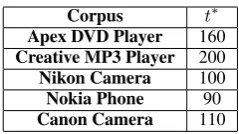
Finally, the authors stated that the targets with higher confidence scores than a certain threshold
tare extracted as the opinion targets, but they do not specify the value they use. We let our imple-mentation output the unfiltered list of candidates and their confidences and find the best value of the threshold later.
4 Preliminary Results
As we have shown, the implementation process in-volved choices about several details that were not clear or not mentioned on the papers. In our ex-periments we have found that even when trying different parameter combinations we remain un-able to yield the exact same results in the original papers. Below we summarize our best results and findings for each algorithm.
Corpus POriginalR POursR
Apex DVD Player 0.797 0.743 0.389 0.355
Creative MP3 Player 0.818 0.692 0.293 0.319
Nikon Camera 0.792 0.710 0.265 0.457
Nokia Phone 0.761 0.718 0.328 0.489
Canon Camera 0.822 0.747 0.352 0.286
[image:6.595.307.531.203.288.2]Average 0.8 0.72 0.325 0.381
Table 1: Performance comparison for FBA.
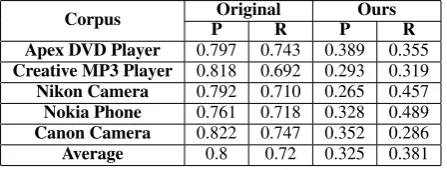
Table 1 compares our implementation’s best re-sults so far with the values reported by Hu and Liu (2004b). We remain unable to replicate the perfor-mance reported by the authors and see a big drop for both precision and recall in all the datasets. In our experiments, we noted that the most sen-sitive parameter was minsup for itemset mining. We also experimented omitting the pruning steps and observed that precision and recall were not too different from the results we obtained with prun-ing.
We also observed that several parameters con-figurations conveyed the same final performance for each corpus. Among the 1470 per-corpus pa-rameter configurations we tried, we found 18 op-timal settings for both the Apex DVD Player and Canon Camera corpora, 16 for Nikon Camera, 6 for Creative MP3 Player and 3 for Nokia Phone.
Differences in preprocessing did not offer con-sistent differences in performance. For the Apex DVD Player, Creative MP3 Player and Canon Camera corpora we found that processing with SennaConstParser + CoreNLPDepParser conveys the best results. For the Nikon Camera corpus, adding the PorterStemmer to the latter gave us the best performance. For the case of the Nokia Phone corpus, the pipeline CoreNLPDepParser + CoNLL2000Chunker gave us the best results.
not even replicate these results, specially consid-ering that only two parameters are at play at this level. As shown by the original paper, the final performance achieved is actually mainly due to the output of the itemset mining phase. We believe this is the reason why we observed some param-eters have minimum impact on the performance. This means that no matter how good the pruning strategies are, results will not be as good as the original if we remain unable to replicate the out-put of the itemset mining phase.
Corpus OriginalP R P OursR
Apex DVD Player 0.90 0.86 0.239 0.328
Creative MP3 Player 0.81 0.84 0.180 0.319
Nikon Camera 0.87 0.81 0.194 0.287
Nokia Phone 0.92 0.86 0.287 0.359
Canon Camera 0.90 0.81 0.201 0.356
Average 0.88 0.83 0.220 0.330
Table 2: Performance comparison for DBA.
Regarding DBA, Table 2 summarizes the results we obtained. Again, we see huge differences be-tween our results and the ones reported by the original paper. Moreover, in this case we observe particularly low values for precision. A detailed review of the extracted aspects showed us that in fact many of the extracted terms do not correspond to aspects but rather to common nouns that are not related to the product.
During experimentation, we also added support for different matching strategies —for example, using word stems and including fuzzy matching as in FBA— and although we observed improve-ments on the results, these were marginal. We used different opinion word seeds, firstly based only on the words “good” and “bad” and later us-ing 9 same-size subsets of the opinion lexicon pro-vided by Liu5. In all cases, our best performing model uses one of these subsets.
As in the previous case, different parameter configurations led to the same performance for each corpus. In this case, among 240 parame-ter settings for each corpus, we found 12 optimal configurations for the Apex DVD Player corpus and 24 for each the other corpora. Regarding pre-processing, we could not use CoreNLP to trans-form the constituent trees given by Senna into dep-trees. Constituency trees seemed to be malformed and raised grammar parsing errors, therefore we
5
http://www.cs.uic.edu/∼liub/FBS/opinion-lexicon-English.rar
only experimented using the CoreNLPDepParser + CoNLL2000Chunker pipeline.
Corpus t∗
Apex DVD Player 160
Creative MP3 Player 200
Nikon Camera 100
Nokia Phone 90
[image:7.595.356.476.98.165.2]Canon Camera 110
[image:7.595.74.290.224.310.2]Table 3: Optimal value oftfor each corpus.
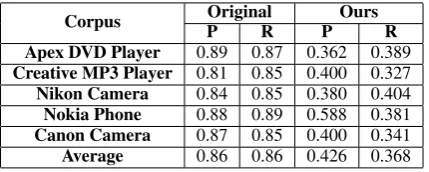
Table 4 shows a comparison of the results we have obtained so far using our implementation of TBA and the values provided by Liu et al. (2012). Once more, we remain unable to replicate the per-formance reported by the paper.
On our experiments we tried with all three grouping strategies to generate multi-word terms; namely, our simple heuristic and C-value using both n-grams and fixed patterns. We also tried adding a limit for the number of groups gener-ated by theC-valuetechnique and used stemming to improve frequency counts. The “ngram” tech-nique turned out to be the best performing on each corpus, although the limit parameter varies from case to case.
have observed.
Corpus OriginalP R P OursR
Apex DVD Player 0.89 0.87 0.362 0.389
Creative MP3 Player 0.81 0.85 0.400 0.327
Nikon Camera 0.84 0.85 0.380 0.404
Nokia Phone 0.88 0.89 0.588 0.381
Canon Camera 0.87 0.85 0.400 0.341
[image:8.595.75.290.85.171.2]Average 0.86 0.86 0.426 0.368
Table 4: Performance comparison for TBA.
5 Discussion and further directions
The ongoing empirical study we introduce in this paper has provided concrete cases to help us an-swer the questions that motivate this paper. As seen, we have so far failed to reproduce the origi-nal results in the three studied cases. Even though several reasons may be the cause for this failure, we think further experimentation can allow us to determine the key elements that would explain the differences. In fact, our preliminary experiments have already helped us isolate specific parameters for each model that seem to more strongly improve the performance. Our results show that parameters that are closely related to the core of the extraction methods, such asminsupfor FBA and the confi-dence thresholdtfor TBA seem in fact to be play-ing these key roles.
We are planning to run controlled experiments in order to isolate as much as possible the effect of each parameter or processing step and under-stand their interplay. This will enable us to tell where important implementation differences be-tween our version and the original version may be. Given that we do not have access to the original codes, it is only by means of these inferred differ-ences that we can gain real insights on where the keys for replicability lay.
We believe the results in this paper already prove that explanations given in the original pa-pers were generally insufficient to correctly repli-cate the models. The lack of resources —except for the evaluation datasets— caused us to navi-gate in the dark as we could not reverse-engineer many intermediate steps. Certain details of pre-processing and parameter setting are only men-tioned superficially or not at all in the original pa-pers. However, many of these seemingly small de-tails did make a big difference in our results. We understand there is often not enough space in the manuscripts to capture all details, specially since
they are generally not the core of the research de-scribed. However, code releases play a critical role in uncovering these details and making research at least replicable.
Regarding pre-processing, in our experiments so far with both Senna and CoreNLP we saw per-formance differences that are however not consis-tent, which seems to indicate that there is no op-timal preprocessing pipeline for each algorithm. On the other hand, model parameters do not seem to be correlated with pre-processing choices, al-though we did find a single case in which a special pre-processing step lead to better results in a single corpus.
Though we could not replicate the results pub-lished in the original papers, we have shown that parameter values as reported by these papers do not necessarily yield the best results. Moreover, parameters that may seem unimportant turned out to cause important performance differences for us. Most parameters indeed had to be heavily tuned in order to achieve the best performance.
Finally, the poor results obtained by our imple-mentations also leave us puzzled about how the evaluation is really performed on the original pa-pers. Authors do not give much details on this topic. For example, (Hu and Liu, 2004b) use stem-ming and simply eliminate some words from the text based on their fuzzy matching approach. This means their extracted terms are word stems only. However, we do not know if stemming is also ap-plied to the gold standard to evaluate. We manu-ally examined the Customer Review Dataset and discovered that the manually extracted aspects do not seem to be stemmed. Moreover, we noted sev-eral inconsistencies in the annotation. This issue raises more questions for our research.
6 Conclusions
We have presented three replication cases in the domain of aspect-based opinion mining and shown that repeating experiments in the field is a complex issue. The experiments we designed and carried out have helped us answer our research questions, also raising some new ones. These answers seem to indicate that explanations on pre-processing, models specifications and parameter setting are generally insufficient to successfully replicate pa-pers in the field.
completely understand how methods work. Shar-ing is key to facilitatShar-ing reuse, even if the code is imperfect and contains hacks and possibly bugs. Having access to such a set-up allows other re-searchers to validate research and to systemati-cally test the approach in order to learn its limi-tations and strengths, ultimately allowing to im-prove on it.
References
Rakesh Agrawal, Tomasz Imieli´nski, and Arun Swami. 1993. Mining association rules between sets of items in large databases. InProceedings of the 1993 ACM SIGMOD International Conference on Man-agement of Data, SIGMOD ’93, pages 207–216, New York, NY, USA. ACM.
Christian Borgelt. 2012. Frequent item set mining.
Wiley Interdisciplinary Reviews: Data Mining and Knowledge Discovery, 2(6):437–456.
Peter F. Brown, Vincent J. Della Pietra, Stephen A. Della Pietra, and Robert L. Mercer. 1993. The mathematics of statistical machine translation: Parameter estimation. Computational linguistics, 19(2):263–311.
A. Casadevall and F. C. Fang. 2010. Reproducible Sci-ence. Infection and Immunity, 78(12):4972–4975, December.
Kia Dashtipour, Soujanya Poria, Amir Hussain, Erik Cambria, Ahmad Y. A. Hawalah, Alexander Gel-bukh, and Qiang Zhou. 2016. Multilingual Sen-timent Analysis: State of the Art and Independent Comparison of Techniques. Cognitive Computation, 8(4):757–771.
Renato Cordeiro de Amorim and Marcos Zampieri. 2013. Effective Spell Checking Methods Using Clustering Algorithms. In Proceedings of the In-ternational Conference Recent Advances in Natu-ral Language Processing RANLP 2013, pages 172– 178, Hissar, Bulgaria, September. INCOMA Ltd. Shoumen, BULGARIA.
Chris Drummond. 2009. Replicability is not repro-ducibility: nor is it good science. In Proceedings of the Evaluation Methods for Machine Learning Workshop, Montreal, Canada.
Antske Fokkens, Marieke van Erp, Marten Postma, Ted Pedersen, Piek Vossen, and Nuno Freire. 2013. Off-spring from Reproduction Problems: What Repli-cation Failure Teaches Us. In Proceedings of the 51st Annual Meeting of the Association for Compu-tational Linguistics (Volume 1: Long Papers), pages 1691–1701, Sofia, Bulgaria, August. Association for Computational Linguistics.
Katerina Frantzi, Sophia Ananiadou, and Hideki Mima. 2000. Automatic recognition of multi-word
terms:. the C-value/NC-value method.International Journal on Digital Libraries, 3(2):115–130. Nuno Freire, Jos´e Borbinha, and P´avel Calado, 2012.
The Semantic Web: Research and Applications: 9th Extended Semantic Web Conference, ESWC 2012, Heraklion, Crete, Greece, May 27-31, 2012. Pro-ceedings, chapter An Approach for Named Entity Recognition in Poorly Structured Data, pages 718– 732. Springer Berlin Heidelberg, Berlin, Heidel-berg.
Minqing Hu and Bing Liu. 2004a. Mining and Sum-marizing Customer Reviews. InProceedings of the Tenth ACM SIGKDD International Conference on Knowledge Discovery and Data Mining, KDD ’04, pages 168–177, New York, NY, USA. ACM. Minqing Hu and Bing Liu. 2004b. Mining
Opin-ion Features in Customer Reviews. InProceedings of the 19th National Conference on Artifical Intelli-gence, AAAI’04, pages 755–760, San Jose, Califor-nia. AAAI Press.
Ozan Irsoy and Claire Cardie. 2014. Opinion Mining with Deep Recurrent Neural Networks. In Proceed-ings of the 2014 Conference on Empirical Methods in Natural Language Processing (EMNLP), pages 720–728, Doha, Qatar, October. Association for Computational Linguistics.
Petteri Jokinen and Esko Ukkonen. 1991. Two al-gorithms for approxmate string matching in static texts. InInternational Symposium on Mathematical Foundations of Computer Science, pages 240–248. Springer.
Adam Kilgarriff. 2007. Googleology is bad science.
Computational linguistics, 33(1):147–151.
Dongsun Kim, Jaechang Nam, Jaewoo Song, and Sunghun Kim. 2013. Automatic patch generation learned from human-written patches. In Proceed-ings of the 2013 International Conference on Soft-ware Engineering, pages 802–811. IEEE Press. Dekang Lin. 2003. Dependency-Based Evaluation of
Minipar. In Anne Abeill, editor, Treebanks, vol-ume 20 ofText, Speech and Language Technology, pages 317–329. Springer Netherlands.
Bing Liu, Wynne Hsu, and Yiming Ma. 1998. Inte-grating classification and association rule mining. In
Proceedings of the Fourth International Conference on Knowledge Discovery and Data Mining. Zhanyi Liu, Haifeng Wang, Hua Wu, and Sheng Li.
2009. Collocation extraction using monolingual word alignment method. InProceedings of the 2009 Conference on Empirical Methods in Natural Lan-guage Processing: Volume 2-Volume 2, pages 487– 495. Association for Computational Linguistics. Kang Liu, Liheng Xu, and Jun Zhao. 2012.
Processing and Computational Natural Language Learning, pages 1346–1356, Jeju Island, Korea, July. Association for Computational Linguistics.
Pengfei Liu, Shafiq Joty, and Helen Meng. 2015a. Fine-grained Opinion Mining with Recurrent Neural Networks and Word Embeddings. InProceedings of the 2015 Conference on Empirical Methods in Natu-ral Language Processing, pages 1433–1443, Lisbon, Portugal, September. Association for Computational Linguistics.
Qian Liu, Zhiqiang Gao, Bing Liu, and Yuanlin Zhang. 2015b. Automated Rule Selection for Aspect Ex-traction in Opinion Mining. InProceedings of the 24th International Conference on Artificial Intelli-gence, IJCAI’15, pages 1291–1297, Buenos Aires, Argentina. AAAI Press.
Bing Liu. 2012. Sentiment Analysis and Opinion Min-ing. Synthesis Lectures on Human Language Tech-nologies, 5(1):1–167.
Christopher D. Manning, Mihai Surdeanu, John Bauer, Jenny Finkel, Steven J. Bethard, and David Mc-Closky. 2014. The Stanford CoreNLP Natural Language Processing Toolkit. In Association for Computational Linguistics (ACL) System Demon-strations, pages 55–60.
Margaret Mitchell, Jacqui Aguilar, Theresa Wilson, and Benjamin Van Durme. 2013. Open Domain Targeted Sentiment. In Proceedings of the 2013 Conference on Empirical Methods in Natural Lan-guage Processing, pages 1643–1654, Seattle, Wash-ington, USA, October. Association for Computa-tional Linguistics.
Martin Monperrus. 2014. A critical review of auto-matic patch generation learned from human-written patches: essay on the problem statement and the evaluation of automatic software repair. In Proceed-ings of the 36th International Conference on Soft-ware Engineering, pages 234–242. ACM.
Arjun Mukherjee and Bing Liu. 2012. Aspect Extrac-tion Through Semi-supervised Modeling. In Pro-ceedings of the 50th Annual Meeting of the Associ-ation for ComputAssoci-ational Linguistics: Long Papers - Volume 1, ACL ’12, pages 339–348, Stroudsburg, PA, USA. Association for Computational Linguis-tics.
Ted Pedersen. 2008. Empiricism is not a matter of faith. Computational Linguistics, 34(3):465–470.
Maria Pontiki, Dimitris Galanis, John Pavlopoulos, Harris Papageorgiou, Ion Androutsopoulos, and Suresh Manandhar. 2014. SemEval-2014 Task 4: Aspect Based Sentiment Analysis. InProceedings of the 8th International Workshop on Semantic Eval-uation (SemEval 2014), pages 27–35, Dublin, Ire-land, August. Association for Computational Lin-guistics and Dublin City University.
Vikram Pudi and Jayant R. Haritsa. 2002. On the Ef-ficiency of Association-Rule Mining Algorithms. In
Proceedings of the 6th Pacific-Asia Conference on Advances in Knowledge Discovery and Data Min-ing, PAKDD ’02, pages 80–91, London, UK, UK. Springer-Verlag.
Vikram Pudi and Jayant R. Haritsa. 2003. AR-MOR: Association Rule Mining based on ORacle. InProceedings of the IEEE ICDM Workshop on Fre-quent Itemset Mining Implementations (FIMI-03), volume 90, Melbourne, Florida, USA, November. CEUR Workshop Proceedings.
Guang Qiu, Bing Liu, Jiajun Bu, and Chun Chen. 2011. Opinion Word Expansion and Target Extrac-tion Through Double PropagaExtrac-tion. Computational Linguistics, 37(1):9–27, March.
T. Raeder, T. R. Hoens, and N. V. Chawla. 2010. Con-sequences of Variability in Classifier Performance Estimates. In2010 IEEE International Conference on Data Mining, pages 421–430.
Meishan Zhang, Yue Zhang, and Duy Tin Vo. 2015. Neural Networks for Open Domain Targeted Senti-ment. In Proceedings of the 2015 Conference on Empirical Methods in Natural Language Process-ing, pages 612–621, Lisbon, Portugal, September. Association for Computational Linguistics.