Proceedings of the Third Conference on Machine Translation (WMT), Volume 1: Research Papers, pages 253–260
Input Combination Strategies for Multi-Source Transformer Decoder
Jindˇrich Libovick´y and Jindˇrich Helcl and David Mareˇcek
Charles University, Faculty of Mathematics and Physics Institute of Formal and Applied Linguistics
Malostransk´e n´amˇest´ı 25, 118 00 Prague, Czech Republic
{libovicky, helcl, marecek}@ufal.mff.cuni.cz
Abstract
In multi-source sequence-to-sequence tasks, the attention mechanism can be modeled in several ways. This topic has been thoroughly studied on recurrent architectures. In this paper, we extend the previous work to the encoder-decoder attention in the Transformer architecture. We propose four different in-put combination strategies for the encoder-decoder attention: serial, parallel, flat, and hi-erarchical. We evaluate our methods on tasks of multimodal translation and translation with multiple source languages. The experiments show that the models are able to use multiple sources and improve over single source base-lines.
1 Introduction
The Transformer model (Vaswani et al.,2017) re-cently demonstrated superior performance in neu-ral machine translation (NMT) and other sequence generation tasks such as text summarization or im-age captioning (Kaiser et al.,2017). However, all of these setups consider only a single input to the decoder part of the model.
In the Transformer architecture, the represen-tation of the source sequence is supplied to the decoder through the encoder-decoder attention. This attention sub-layer is applied between the self-attention and feed-forward sub-layers in each Transformer layer. Such arrangement leaves many options for the incorporation of multiple encoders. So far, attention in sequence-to-sequence learn-ing with multiple source sequences was mostly studied in the context of recurrent neural networks (RNNs). Libovick´y and Helcl (2017) explicitly capture the distribution over multiple inputs by projecting the input representations to a shared vector space and either computing the attention over all hidden states at once, or hierarchically, us-ing another level of attention applied on the
con-text vectors. Zoph and Knight (2016) employ a gating mechanism for combining the context vec-tors. Voita et al.(2018) adapted the gating mech-anism for use within the Transformer model for context-aware MT. The other aproaches are how-ever not directly usable in the Transformer model. We propose a number of strategies of com-bining the different sources in the Transformer model. Some of the strategies described in this work are an adaptation of the strategies previously used with recurrent neural networks (Libovick´y and Helcl, 2017), whereas the rest of them is a novel contribution devised for the Transformer ar-chitecture. We test these strategies on multimodal machine translation (MMT) and multi-source ma-chine translation (MSMT) tasks.
This paper is organized as follows. In Sec-tion 2, we briefly describe the decoder part of the Transformer model. We propose a number of input combination strategies for the multi-source Transformer model in Section 3. Section 4 de-scribes the experiments we performed, and Sec-tion 5shows the results of quantitative evaluation. An overview of the related work is given in Sec-tion 6. We discuss the results and conclude in Section 7.
2 Transformer Decoder
The Transformer architecture is based on the use of attention. Attention, as conceptualized by Vaswani et al. (2017), can be viewed as a soft-lookup function operating on an associative mem-ory. For each query vector in query setQ, the at-tention computes a set of weighted sums of values V associated with a set of keysK, based on their similarity to the query.
The variant of the attention function used in the Transformer architecture is calledmulti-head scaled dot-product attention. Scaled dot-product
of queries and keys is used as the similarity mea-sure. Given the dimension of the input vectorsd, the attention is computed as follows:
A(Q, K, V) = softmax
QK> √
d
V. (1)
In the multi-head variant, the vectors that represent the queries, keys, and values are linearly trans-formed to a number of projections (usually with smaller dimension), called attention heads. The attention is computed in each head independently and the outputs are concatenated and projected back to the original dimension:
Ah(Q, K, V) =
h
X
i=1
CiWiO (2)
whereWO
i ∈ Rdh×dare trainable parameter
ma-trices used as projections of the attention head out-puts of dimension dh to the model dimension d,
and
Ci=A(QWiQ, KWiK, V WiV) (3)
whereWQ,WK, andWV ∈Rd×dh, are trainable
projection matrices used to project the attention in-puts to the attention heads.
The model itself consists of a number of lay-ers, each of which is divided in three sub-layers: self-attention, encoder-decoder (or cross) atten-tion, and a feed-forward layer. Both of the at-tention types use identical sets for keys and val-ues. The states of the previous layer are used as the query set. The self-attention sub-layer at-tends to the previous decoder layer (i.e. the sets of queries and keys are identical). Since the decoder works autoregressively from left to right, during training, the self-attention is masked to prevent attending to the future positions in the sequence. The encoder-decoder attention sub-layer attends to the final layer of the encoder. The feed-forward sub-layer consists of a single non-linear projec-tion (usually to a space with larger dimension), followed by a linear projection back to the vec-tor space with the original dimension. The input of each sub-layer is summed with the output, cre-ating a residual connection chain throughout the whole layer stack.
3 Proposed Strategies
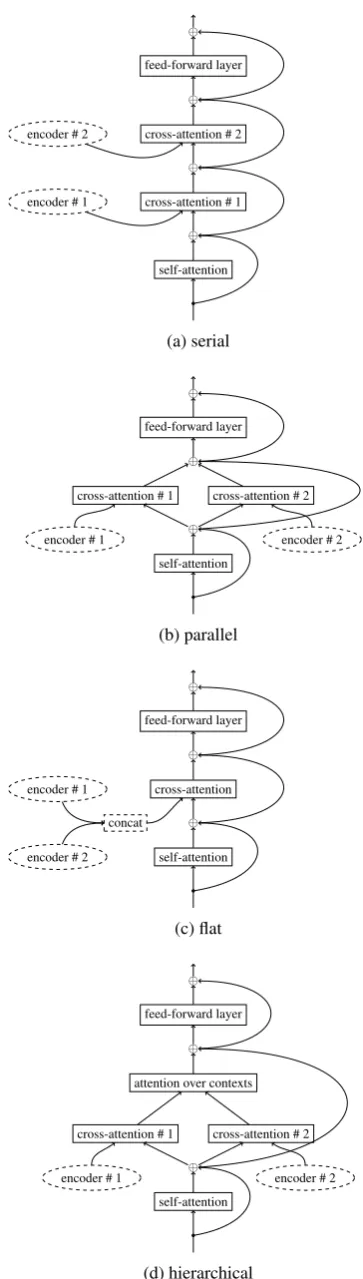
We propose four input combination strategies for multi-source variant of the Transformer network,
self-attention
⊕
cross-attention # 1 encoder # 1
⊕
cross-attention # 2 encoder # 2
⊕
feed-forward layer
⊕
(a) serial
self-attention
⊕
cross-attention # 1
encoder # 1
⊕
cross-attention # 2
encoder # 2 feed-forward layer
⊕
(b) parallel
self-attention
⊕
encoder # 1
encoder # 2 concat
cross-attention
⊕
feed-forward layer
⊕
(c) flat
self-attention
⊕
cross-attention # 1
encoder # 1
cross-attention # 2
encoder # 2 attention over contexts
⊕
feed-forward layer
⊕
[image:2.595.317.499.62.703.2](d) hierarchical
Figure 1: Schemes of computational steps for
as illustrated in Figure 1. Two of them, serial and parallel, model the encoder-decoder attentions independently and are a natural extension of the sub-layer scheme in the transformer decoder. The other two versions, flat and hierarchical, are in-spired by approaches proposed for RNNs by Li-bovick´y and Helcl(2017) and model joint distri-butions over the inputs.
Serial. The serial strategy (Figure1a) computes the encoder-decoder attention one by one for each input encoder. The query set of the first cross-attention is the set of the context vectors computed by the preceding self-attention. The query set of each subsequent cross-attention is the output of the preceding sub-layer. All of these sub-layers are in-terconnected with residual connections.
Parallel. In the parallel combination strategy (Figure1b), the model attends to each encoder in-dependently and then sums up the context vectors. Each encoder is attended using the same set of queries, i.e. the output of the self-attention sub-layer. Residual connection link is used between the queries and the summed context vectors from the parallel attention.
Ahpara(Q, K1:n, V1:n) = n
X
i=1
Ah(Q, Ki, Vi) (4)
Flat. The encoder-decoder attention in the flat combination strategy (Figure1c) uses all the states of all input encoders as a single set of keys and val-ues. Thus, the attention models a joint distribution over a flattened set of all encoder states. Unlike the approach taken in the recurrent setup (Libovick´y and Helcl,2017), where the flat combination strat-egy requires an explicit projection of the encoder states to a shared vector space, in the Transformer models, the vector spaces of all layers are tied with residual connections. Therefore, the intermediate projection of the states of each encoder is not nec-essary.
Kflat =Vflat = concati(Ki) (5)
Ahflat(Q, K1:n, V1:n) =Ah(Q, Kflat, Vflat) (6)
Hierarchical. In the hierarchical combination (Figure 1d), we first compute the attention inde-pendently over each input. The resulting contexts are then treated as states of another input and the
attention is computed once again over these states.
Khier =Vhier = concati(Ah(Q, Ki, Vi)) (7)
Ahhier(Q, K1:n, V1:n) =Ah(Q, Khier, Vhier) (8)
4 Experiments
We conduct our experiments on two different tasks: multimodal translation and multi-source machine translation. We use Neural Monkey (Helcl and Libovick´y,2017)1for design, training,
and evaluation of the experiments.
In all experiments, the encoder part of the net-work follows the Transformer architecture as de-scribed byVaswani et al.(2017).
We optimize the model parameters using Adam optimizer (Kingma and Ba, 2014) with initial learning rate 0.2, and Noam learning rate decay (Vaswani et al.,2017) withβ1 = 0.9, β2 = 0.98,
= 10−9, and 4,000 warm-up steps. The size of a
mini-batch size of 32 for MMT, and 24 for multi-source MT experiments.
During decoding, we use beam search of width 10 and length normalization of 1.0 (Wu et al., 2016).
4.1 Multimodal Translation
The goal of MMT (Specia et al., 2016) is trans-lating image captions from one language into an-other given both the source and image as the in-put. We use Multi30k dataset (Elliott et al.,2016) containing triplets of images, English captions and their English translations into German, French and Czech. The dataset contains 29k triplets for train-ing, 1,014 for validation and a test set of 1,000. We experiment with all language pairs available in this dataset.
We extract image feature using the last convo-lutional layer of the ResNet network (He et al., 2016) trained for ImageNet classification. We ap-ply a linear projection into 512 dimensions on the image representation, so it has the same dimen-sion as the rest of the model. For each language pair, we create a shared wordpiece-based vocabu-lary of approximately 40k subwords. We share the embedding matrices across the languages and we use the transposed embedding matrix as the output projection matrix as proposed byPress and Wolf (2017).
We use 6 layers in the textual encoder and de-coder, and set the model dimension to 512. We
set the dimension of the hidden layers in the feed-forward sub-layers to 4096. We use 16 heads in the attention layers.
During the evaluation, we follow the prepro-cessing used in WMT Multimodal Translation Shared Task (Specia et al.,2016).
Conclusions of previous work show (Elliott and K´ad´ar, 2017) that the improved performance of the multimodal models compared to textual mod-els can come from improving the input representa-tion. In order to test whether it is also the case with our models or the models explicitly use the visual input, we perform an adversarial evaluation simi-lar toElliott(2018). We evaluate the model while providinng a random image and observe how it af-fects the score and observe whether their quality drops.
4.2 Multi-Source MT
In this set of experiment, we attempt to generate a sentence in a target language, given equivalent sentences in multiple source languages.
We use the Europarl corpus (Tiedemann,2012) for training and testing the MSMT. We use Span-ish, French, German, and English as source lan-guages and Czech as a target language. We se-lected an intersection of the bilingual sub-corpora using English as a pivot language. Our dataset contains 511k 5-tuples of sentences for training, 1k for validation and another 1k for testing.
Due of the memory demands of having four en-coders, we use a smaller model than in the previ-ous experiment. The encoders only have 4 layers and the decoder has 6 layers with embeddings size 256, feed-forward layers dimension 2048, and 8 attention heads. We use a shared word-piece vo-cabulary of 48k subwords. As in the MMT exper-iments, the transposition of the embedding matrix is reused as the parameters of the output projection layer (Press and Wolf,2017).
We use bilingual English-to-Czech translation as a single source baseline. The baseline uses vo-cabulary of 42k subwords from Czech and English only.
Similarly to the MMT, we also perform adver-sarial evaluation. To evaluate the importance of the source languages for the translation quality, when randomizing one of the source languages.
5 Results
We evaluate the results using BLEU (Papineni et al.,2002) and METEOR (Denkowski and Lavie, 2011) as implemented in MultEval. 2 The results
of the MMT task are tabulated in Table1. The re-sults of the multi-source MT are shown in Table2.
In MMT, the input combination significantly surpassed the text-only baseline in English-to-French translation. The performance in other tar-get languages is only slightly better than the tex-tual baseline.
The only worse score was achieved by the flat combination strategy. We hypothesize this might be because the optimization failed to find a com-mon representation of the input modalities that could be used to compute the joint distribution.
The adversarial evaluation with randomly se-lected input images shows that all our models rely on both inputs while generating the target sentence and that providing incorrect visual input harms the model performance. The modality gating in the hierarchical attention combination seems to make the models more robust to noisy visual input.
In the multi-source translation task, all the pro-posed strategies perform better than single-source translation from English to Czech. Among the combination strategies, the best-scoring is the se-rial stacking of the attentions. In multimodal translation, the flat combination has shown to be the best-performing strategy.
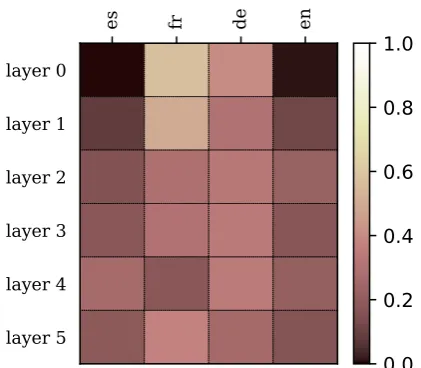
Analysis of the attention distribution shows that the serial strategy use information from all source languages. The parallel strategy almost does not use the Spanish source and the flat strategy prefers the English source. The hierarchical strategy uses information from all source languages, however the attentions are sometimes more fuzzy than in the previous strategies. Figure 2 shows what source languages were attended on different lay-ers of the encoder. Other examples of the attention visualization are shown in AppendixA.
MMT: en)de MMT: en)fr MMT: en)cs
BLEU METEOR adv.BLEU BLEU METEOR adv.BLEU BLEU METEOR adv.BLEU
baseline 38.3±.8 56.7±.7 — 59.6±.9 72.7±.7 — 30.9±.8 29.5±.4 —
serial 38.7±.9 57.2±.6 37.3±.6 60.8±.9 75.1±.6 58.9±.9 31.0±.8 29.9±.4 29.7±.8
parallel 38.6±.9 57.4±.7 38.2±.8 60.2±.9 74.9±.6 58.9±.9 31.1±.9 30.0±.4 30.4±.8
flat 37.1±.8 56.5±.6 35.7±.8 58.0±.9 73.3±.7 57.0±.9 29.9±.8 29.0±.4 28.2±.8
[image:5.595.80.520.61.147.2]hierarchical 38.5±.8 56.5±.6 38.1±.8 60.8±.9 75.1±.6 60.2±.9 31.3±.9 30.0±.4 31.0±.8
Table 1: Quantitative results of the MMT experiments on the 2016 test set. Column ‘adv. BLEU’ is an
adversarial evaluation with randomized image input.
MSMT Adversarial evaluation (BLEU)
BLEU METEOR en de fr es
baseline 16.5±.5 20.5±.3 — — — —
serial 20.5±.6 23.5±.5 8.1±.4 19.7±.5 19.5±.6 18.4±.5
parallel 20.5±.6 23.3±.3 1.4±.2 18.7±.5 17.9±.5 20.3±.5
flat 20.4±.6 23.3±.3 0.2±.1 19.9±.6 20.0±.6 19.6±.5
[image:5.595.149.451.199.283.2]hierarchical 19.4±.5 22.7±.3 4.2±.3 18.3±.5 18.3±.5 15.3±.5
Table 2: Quantitative results of the MMT experiment. The adversarial evaluation shows the BLEU score
when one input language was changed randomly.
es
fr
de
en
layer 0
layer 1
layer 2
layer 3
layer 4
layer 5
0.0
0.2
0.4
0.6
0.8
1.0
Figure 2: Attention over contexts in the hiearchical strategy over the decoder layers.
6 Related Work
MMT was so far solved only within the RNN-based architectures.Elliott et al.(2015) report sig-nificant improvements with a non-attentive model. With attentive models (Bahdanau et al.,2014), the additional visual information usually did not im-prove the models significantly (Caglayan et al., 2016; Helcl and Libovick´y, 2017) in terms of BLEU score. Our models slightly outperform these models in the single model setup.
2https://github.com/jhclark/multeval
Except for using the image features direct in-put to the model, they can be used as an auxil-iary objective (Elliott and K´ad´ar, 2017). In this setup, the visually grounded representation, im-proves the MMT significantly, achieving similar results that our models achieved using only the Multi30k dataset.
To our knowledge, multi-source MT has also been studied only using the RNN-based models. Dabre et al. (2017) use simple concatenation of source sentences in various languages and process them with a single multilingual encoder.
Zoph and Knight (2016) try context concate-nation and hierarchical gating method for com-bining context vectors in attention models with multiple inputs encoded by separate encoders. In all of their experiments, the multi-source meth-ods significantly surpass the single-source base-line.Nishimura et al.(2018) extend the former ap-proach for situations when of the source languages is missing, so that the translation system does not overly rely on a single source language like some of the models presented in this work.
7 Conclusions
[image:5.595.76.287.348.532.2]Trans-former model: the cross-attentions are combined either serially interleaved by residual connections or in parallel. The two remaining strategies are an adaptation of the flat and the hierarchical at-tention combination strategies introduced by Li-bovick´y and Helcl(2017) in context of recurrent sequence-to-sequence models.
The results on the MMT task show similar properties an in RNN-based models (Caglayan et al.,2017;Libovick´y and Helcl,2017). Adding visual features significantly improves translation into French and brings minor improvements on other language pairs. All the attention combina-tions perform similarly with the exception of the flat strategy which probably struggles with learn-ing a shared representation of the input tokens and the image representation.
Evaluation on multi-source MT shows signif-icant improvements over the single-source base-line. However, the adversarial evaluation suggests that the model relies heavily on the English input and only uses the additional source languages for minor modifications of the output. All attention combinations performed similarly.
Acknowledgments
This research received support from the grant No. 18-02196S and No. P103/12/G084 of the Grant Agency of the Czech Republic, and the grant No. 976518 of the Grant Agency of the Charles Uni-versity. This research was partially supported by SVV project number 260 453.
References
Dzmitry Bahdanau, Kyunghyun Cho, and Yoshua
Bengio. 2014. Neural machine translation by
jointly learning to align and translate. CoRR, abs/1409.0473.
Ozan Caglayan, Walid Aransa, Adrien Bardet, Mer-cedes Garc´ıa-Mart´ınez, Fethi Bougares, Lo¨ıc Bar-rault, Marc Masana, Luis Herranz, and Joost van de Weijer. 2017. Lium-cvc submissions for wmt17 multimodal translation task. InProceedings of the Second Conference on Machine Translation, Vol-ume 2: Shared Task Papers, pages 432–439, Copen-hagen, Denmark. Association for Computational Linguistics.
Ozan Caglayan, Walid Aransa, Yaxing Wang, Marc Masana, Mercedes Garc´ıa-Mart´ınez, Fethi Bougares, Lo¨ıc Barrault, and Joost van de Weijer. 2016. Does multimodality help human and
ma-chine for translation and image captioning? In
Proceedings of the First Conference on Machine Translation, pages 627–633, Berlin, Germany. Association for Computational Linguistics.
Raj Dabre, Fabien Cromier`es, and Sadao Kurohashi. 2017. Enabling multi-source neural machine trans-lation by concatenating source sentences in multiple languages. CoRR, abs/1702.06135.
Michael Denkowski and Alon Lavie. 2011. Meteor 1.3: Automatic metric for reliable optimization and evaluation of machine translation systems. In Pro-ceedings of the Sixth Workshop on Statistical Ma-chine Translation, pages 85–91, Edinburgh, United Kingdom. Association for Computational Linguis-tics.
Desmond Elliott. 2018. Adversarial evaluation of mul-timodal machine translation. InProceedings of the 2018 Conference on Empirical Methods in Natural Language Processing, Brussels, Belgium. Associa-tion for ComputaAssocia-tional Linguistics.
Desmond Elliott, Stella Frank, and Eva Hasler. 2015. Multi-language image description with neural se-quence models. CoRR, abs/1510.04709.
Desmond Elliott, Stella Frank, Khalil Sima’an, and Lu-cia SpeLu-cia. 2016. Multi30k: Multilingual english-german image descriptions. In Proceedings of the 5th Workshop on Vision and Language, pages 70– 74, Berlin, Germany. Association for Computational Linguistics.
Desmond Elliott and ´Akos K´ad´ar. 2017. Imagination improves multimodal translation. InProceedings of the Eighth International Joint Conference on Natu-ral Language Processing (Volume 1: Long Papers), pages 130–141, Taipei, Taiwan. Asian Federation of Natural Language Processing.
Kaiming He, Xiangyu Zhang, Shaoqing Ren, and Jian Sun. 2016. Deep residual learning for image recog-nition. In Proceedings of the IEEE conference on computer vision and pattern recognition, pages 770– 778. IEEE Computer Society.
Jindˇrich Helcl and Jindˇrich Libovick´y. 2017. Neural Monkey: An open-source tool for sequence learn-ing. The Prague Bulletin of Mathematical Linguis-tics, 107:5–17.
Jindˇrich Helcl and Jindˇrich Libovick´y. 2017. CUNI system for the WMT17 multimodal translation task. In Proceedings of the Second Conference on Ma-chine Translation, Volume 2: Shared Task Papers, pages 450–457, Copenhagen, Denmark. Association for Computational Linguistics.
Lukasz Kaiser, Aidan N. Gomez, Noam Shazeer, Ashish Vaswani, Niki Parmar, Llion Jones, and Jakob Uszkoreit. 2017. One model to learn them all.CoRR, abs/1706.05137.
Diederik P. Kingma and Jimmy Ba. 2014. Adam:
A method for stochastic optimization. CoRR,
Jindˇrich Libovick´y and Jindˇrich Helcl. 2017. Attention strategies for multi-source sequence-to-sequence learning. InProceedings of the 55th Annual Meet-ing of the Association for Computational LMeet-inguis- Linguis-tics (Volume 2: Short Papers), pages 196–202, Van-couver, Canada. Association for Computational Lin-guistics.
Yuta Nishimura, Katsuhito Sudoh, Graham Neubig, and Satoshi Nakamura. 2018. Multi-source neural machine translation with missing data. InThe Sec-ond Workshop on Neural Machine Translation and Generation (WNMT), Melbourne, Australia.
Kishore Papineni, Salim Roukos, Todd Ward, and Wei-Jing Zhu. 2002. Bleu: a method for automatic eval-uation of machine translation. In Proceedings of 40th Annual Meeting of the Association for Com-putational Linguistics, pages 311–318, Philadelphia, Pennsylvania, USA. Association for Computational Linguistics.
Ofir Press and Lior Wolf. 2017. Using the output em-bedding to improve language models. In Proceed-ings of the 15th Conference of the European Chap-ter of the Association for Computational Linguistics: Volume 2, Short Papers, pages 157–163. Association for Computational Linguistics.
Lucia Specia, Stella Frank, Khalil Sima’an, and Desmond Elliott. 2016. A shared task on multi-modal machine translation and crosslingual image description. InProceedings of the First Conference on Machine Translation, pages 543–553, Berlin, Germany. Association for Computational Linguis-tics.
J¨org Tiedemann. 2012. Parallel data, tools and inter-faces in opus. InProceedings of the Eight Interna-tional Conference on Language Resources and Eval-uation (LREC’12), Istanbul, Turkey. European Lan-guage Resources Association (ELRA).
Ashish Vaswani, Noam Shazeer, Niki Parmar, Jakob Uszkoreit, Llion Jones, Aidan N Gomez, Lukasz Kaiser, and Illia Polosukhin. 2017. Attention is all you need. In I. Guyon, U. V. Luxburg, S. Bengio, H. Wallach, R. Fergus, S. Vishwanathan, and R. Gar-nett, editors, Advances in Neural Information Pro-cessing Systems 30, pages 6000–6010. Curran As-sociates, Inc.
Elena Voita, Pavel Serdyukov, Rico Sennrich, and Ivan Titov. 2018. Context-aware neural machine trans-lation learns anaphora resolution. InProceedings of the 56th Annual Meeting of the Association for Com-putational Linguistics (Volume 1: Long Papers), pages 1264–1274, Melbourne, Australia. Associa-tion for ComputaAssocia-tional Linguistics.
Yonghui Wu, Mike Schuster, Zhifeng Chen, Quoc V. Le, Mohammad Norouzi, Wolfgang Macherey, Maxim Krikun, Yuan Cao, Qin Gao, Klaus Macherey, Jeff Klingner, Apurva Shah, Melvin Johnson, Xiaobing Liu, Łukasz Kaiser, Stephan
Gouws, Yoshikiyo Kato, Taku Kudo, Hideto Kazawa, Keith Stevens, George Kurian, Nishant Patil, Wei Wang, Cliff Young, Jason Smith, Jason Riesa, Alex Rudnick, Oriol Vinyals, Greg Corrado, Macduff Hughes, and Jeffrey Dean. 2016. Google’s neural machine translation system: Bridging the gap
between human and machine translation. CoRR,
abs/1609.08144.
A Attention Visualizations
We show cross-attention visualizations for the four proposed combination strategies on Multi-source MT. The Czech target wordpieces are in rows, the source Spanish, French, German, and En-glish wordpieces are concatenated and shown in columns. These attentions were taken form the
decoder’s fourth layer and were averaged across the individual heads. For serial and parallel strat-egy the cross-attention weights sum to one for each language separately, the flat strategy has only one common cross-attention, and for the hier-archical strategy visualization the cross-attention weights for individual languages are multiplied by the weights of the attention over contexts.
también_ la_ región_ del_ Mar_ Negro_ tiene_ una_ gran_ importancia_ ._ la_ région_ de_ la_ mer_ Noire_ revêt_ ,_ elle_ aussi_ ,_ une_ grande_ importance_ ._ auch_ die_ Schwarzmeerr egion _ hat_ eine_ große_ Bedeutung_ ._ the_ Black_ Sea_ Region_ ,_ too_ ,_ is_ of_ great_ importance_ ._
ernomo sk ý_ region_ má_ také_ mimo ádný _ význam_ ._
a) serial
también_ la_ región_ del_ Mar_ Negro_ tiene_ una_ gran_ importancia_ ._ la_ région_ de_ la_ mer_ Noire_ revêt_ ,_ elle_ aussi_ ,_ une_ grande_ importance_ ._ auch_ die_ Schwarzmeerr egion _ hat_ eine_ große_ Bedeutung_ ._ the_ Black_ Sea_ Region_ ,_ too_ ,_ is_ of_ great_ importance_ ._
ernomo sk ý_ region_ má_ také_ mimo ádný _ význam_ ._
b) parallel
también_ la_ región_ del_ Mar_ Negro_ tiene_ una_ gran_ importancia_ ._ la_ région_ de_ la_ mer_ Noire_ revêt_ ,_ elle_ aussi_ ,_ une_ grande_ importance_ ._ auch_ die_ Schwarzmeerr egion _ hat_ eine_ große_ Bedeutung_ ._ the_ Black_ Sea_ Region_ ,_ too_ ,_ is_ of_ great_ importance_ ._
ernomo sk ý_ region_ má_ také_ mimo ádný _ význam_ ._
c) flat
también_ la_ región_ del_ Mar_ Negro_ tiene_ una_ gran_ importancia_ ._ la_ région_ de_ la_ mer_ Noire_ revêt_ ,_ elle_ aussi_ ,_ une_ grande_ importance_ ._ auch_ die_ Schwarzmeerr egion _ hat_ eine_ große_ Bedeutung_ ._ the_ Black_ Sea_ Region_ ,_ too_ ,_ is_ of_ great_ importance_ ._
ernomo sk ý_ region_ má_ také_ mimo ádný _ význam_ ._