552
JHU 2019 Robustness Task System Description
Matt Post and Kevin Duh Johns Hopkins University
Baltimore, Maryland USA
Abstract
We describe the JHU submissions to the French–English, Japanese–English, and English–Japanese Robustness Task at WMT 2019. Our goal was to evaluate the per-formance of baseline systems on both the official noisy test set as well as news data, in order to ensure that performance gains in the latter did not come at the expense of general-domain performance. To this end, we built straightforward 6-layer Transformer models and experimented with a handful of variables including subword processing (FR–EN) and a handful of hyperparameters settings (JA↔EN). As expected, our systems performed reasonably.
1 Introduction
The team at JHU submitted three systems to the WMT19 Robustness task: French–English, Japanese–English, and English–Japanese. Our goal was to evaluate the performance of reason-able state-of-the-art systems against both the ro-bustness test set as well as more standard “general domain” test sets. We believe this is an important component of evaluating for actual robustness. In this way, we ensure that performance gains on ro-bustness data are not purchased at the expense of this general-domain performance. Our systems used no monolingual data and relatively straight-forward state-of-the-art techniques, and produced systems of roughly average performance.
2 French-English Systems
2.1 Training Data
We constrained our data use to the officially supplied data, comprising the WMT15 English– French parallel data (Bojar et al., 2015). For French, we experimented with three data settings:
• all of Europarl and News Commentary;
• the best million lines each of CommonCrawl, Gigaword, and the UN corpus; and
• the MTNT training data.
Data sizes are indicated in Table1.
dataset segments words
Europarl 2.0m 50.2m
News Commentary 200k 4.4m
Common Crawl 820k 17.4m FR–EN Gigaword 1m 26.1m
UN Doc 106k 1.1m
[image:1.595.319.512.310.443.2]MTNTEN→F R 36k 841k MTNTF R→EN 19k 634k
Table 1: Training datasets for French–English systems. Common Crawl, Gigaword, and the UN data are post-filtering.
To filter the data, we applied dual cross-entropy filtering (Junczys-Dowmunt, 2018). We trained two smaller 4-layer Transformer models, one each for EN–FR and FR–EN, and used them to score the data according to the formula:
exp(−(|s1−s2|+ 0.5∗(s1+s2)))
wheres1is the score (a negative logprob) from the forward FR–EN model ands2 the score from the reverse EN–FR model. We then uniqued this data, sorted by score, and took a random sample of one million lines from the set of all sentence pairs with a score greater than 0.1.1 For all but FR–EN Giga-word, what remained was well less than a million lines. We did this both because prior work has indicated the utility of filtering, and to make our
1We determined this threshold by eyeballing where in the
training data sizes more manageable. We there-fore did not compare against a model trained on all of the filtered data.
We experimented with two preprocessing regimes. In the first, we applied standard pre-processing techniques from the Moses pipeline2 (Koehn et al., 2007), followed by subword split-ting with BPE (Sennrich et al., 2016) using 32k merge operations. In the second scenario, we did not use any data preparation, instead applying sentencepiece(Kudo and Richardson,2018) with subword regularization (Kudo,2018) directly to the raw text. In this latter setting, we varied the size of the learned subword models, experiment-ing with 8k, 16k, 24k, and 32k.
2.2 Models
We used Sockeye (Hieber et al., 2017), a se-quence to sese-quence transduction framework writ-ten in Python and based on MXNet. Our mod-els were variations of the Transformer architecture (Vaswani et al., 2017), mostly using default set-tings supplied with Sockeye: an embedding and model size of 512, a feed-forward layer size of 2048, 8 attention heads, and three-way tied em-beddings. We used batch sizes of 4,096 words, checkpointed every 5,000 updates, and stopped training with the best-perplexity checkpoint when validation perplexity had failed to improve for 10 consecutive checkpoints. The initial learning rate was set to 0.0002, the Sockeye default.
2.3 Scoring
At test time, we decoded with beam search using a beam of size 12.
We scored with sacreBLEU (Post,2018), with international tokenization.3 In the spirit of the robustness task, we measure BLEU not just on the reddit dataset, but also on the WMT15 new-stest dataset, in order to examine how experimen-tal variables vary in both in- and out-of-domain settings. We believe that testing both in- and out-of-domain data is essential to measuring robust-ness.
2.4 Results & Discussion
Table2contains BLEU scores.
2
Calling normalize-punctuation.perl, remove-non-printing-char.perl, and tokenizer.perlwith flags-no-escape.
3BLEU+case.mixed+refs.1+smooth.exp+tok.intl+v1.2.20
WMT15 MTNT18
4 layers (BPE) 31.6 27.9
6 layers (BPE) 32.7 27.9
+ MTNT 32.6 32.9
+ filter 36.4 33.7
+ both 37.2 39.9
[image:2.595.325.507.61.189.2]sp24k+ filter 36.5 34.5 sp24k+ both 37.2 40.0
Table 2: French–English translation results.
WMT15 MTNT18 size filter both filter both
8k 36.0 36.5 33.9 38.7 16k 36.2 36.9 33.9 39.7 24k 36.5 37.2 34.5 40.0
Table 3: BLEU scores with the sentencepiece models and no other preprocessing.
Observation 1 Improvements are to be had both from more data and from better (in-domain) data.
Adding the large filtered dataset to the 6 layer model improved BLEU more (27.9→33.7, +5.8) than adding the MTNT training data (27.9 →
32.9, +5), but the gains from both were even greater (+12).
Observation 2 In order to ensure that our mod-els did not increase accuracy on the MTNT data at the expense of in-domain data, we report scores on both WMT and MTNT test sets. In only one situ-ation was there a problem: For the 6-layer Trans-former, adding the MTNT data alone (without the large amount of filtered bitext) helped on MTNT18 (+5) but caused a small drop on WMT15 (-0.1).
Observation 3 In all situations, the sentence-piece model (with no other preprocessing) was just as good as the BPE model (with the Moses pre-processing pipeline). In one situation (adding the filtered data alone), it caused a gain of 0.8 over its BPE counterpart.
We further conducted a small experiment vary-ing the sentencepiece model size (Table3). Larger sentencepiece models were consistently better in this relatively large-data setting.
3 Japanese-English Systems
3.1 Training Data
We trained systems using only the bitext data al-lowed in the shared task constrained setting:
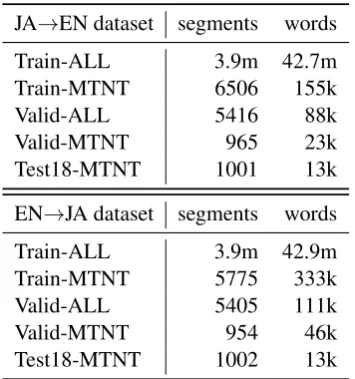
• The in-domain Reddit dataset–MTNT ver-sion 1.1 (Michel and Neubig, 2018)4– consists of approximately 6k segments for training (which we label Train-MTNT) and 900 segments for validation (Valid-MTNT) in both JA→EN and EN→JA language direc-tions. Additionally we use the included ”test set” (which we label Test18-MTNT) for in-ternal BLEU benchmarks prior to submitting results for the official 2019 blindtest. We did not use the monolingual part of MTNT.
• The out-of-domain data consists of KFTT (Wikipedia articles), TED Talks, and JESC Subtitles.5 We concatenate these out-of-domain training data with Train-MTNT to create Train-ALL; similarly we concatenate the out-of-domain validation data with Valid-MTNT to create Valid-ALL.
Dataset sizes are shown in Table4.
JA→EN dataset segments words
Train-ALL 3.9m 42.7m Train-MTNT 6506 155k
Valid-ALL 5416 88k
Valid-MTNT 965 23k
Test18-MTNT 1001 13k
EN→JA dataset segments words
Train-ALL 3.9m 42.9m Train-MTNT 5775 333k Valid-ALL 5405 111k
Valid-MTNT 954 46k
[image:3.595.93.271.428.618.2]Test18-MTNT 1002 13k
Table 4: Datasets for English–Japanese systems. Word counts are source side only.
For preprocessing on the English side, we apply the standard Moses pipeline in the same fashion
4
http://www.cs.cmu.edu/˜pmichel1/mtnt/
5
The data is also downloaded in pre-packaged form from the MTNT website via https://github.com/ pmichel31415/mtnt/releases/download/v1.
1/clean-data-en-ja.tar.gz, but do not confuse
these with the MTNT data, which is in the Reddit domain.
as the French–English system. For preprocessing on the Japanese side, we first performed word seg-mentation by Kytea (Neubig et al., 2011)6, then ran the English Moses preprocessing pipeline to handle potential code-switched English/Japanese in the data. Finally, we induced BPE sub-word units with 10k, 30k, and 50k merge opera-tions, independently for each side on the bitexts (JA→EN Train-ALL and EN→JA Train-ALL). Unlike the French-English systems, the Japanese-English systems do not use shared BPE and em-beddings.
3.2 Models
We use the Sockeye Transformer models for both JA→EN and EN→JA directions, similar to our French-English systems. The hyperparameter set-tings are different, however. We performed ran-dom search in the following hyperparameter space (see Table5):
• Initial learning rate (LR) for the ADAM op-timizer: 0.001, 0.0003, 0.0006
• Number of attention heads (head): 8, 16
• Number of layers (layer): 2, 4
• Feed-forward layer size (ffsize): 1024, 2048
• Embedding and model size (embedding): 256, 518, 1024
The training process follows a continued-training procedure (c.f. Koehn et al. (2018);
Khayrallah et al. (2018)): In Stage 1, we train systems from scratch on Train-ALL, and per-form early stopping on Valid-ALL. This repre-sents a mixed corpus with both in-domain and out-of-domain bitexts. For all models, we used batch sizes of 4,096 words, checkpointed every 2,000 updates, and stopped training with the best-perplexity checkpoint when validation best-perplexity on Valid-ALL had failed to improve for 16 con-secutive checkpoints.
In Stage 2, we fine-tuned the above systems by training on Train-MTNT, and perform early stop-ping on Valid-MTNT. Effectively, we initialize a new model with Stage 1 model weights, reset the optimizer’s learning rate schedule, and train on only in-domain data. To prevent overfitting to the small Train-MTNT bitext, we now checkpoint
more frequently, saving a checkpoint after every 50 updates, and stopped training either when the perplexity on Valid-MTNT fails to improve for 16 consecutive checkpoints or when we reached 30 checkpoints (i.e., 30×50 = 1500 updates of 4,096 word batches), to prevent fitting excessively on the Train-MTNT bitext.
3.3 Scoring
At test time, we decoded with beam search using a beam of size 5. We scored with sacreBLEU (Post,
2018), with international tokenization.7 Per or-ganizer suggestion, we applied Kytea to Japanese output prior to scoring. We measure BLEU on both VALID-ALL and Test18-MTNT in order to compare the results on mixed and in-domain cor-pora.
3.4 Results & Discussion
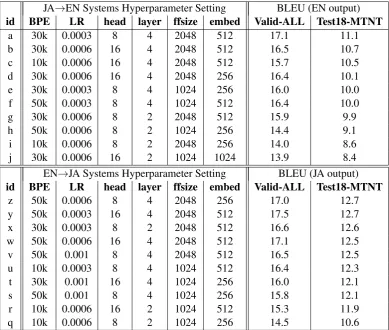
The BLEU results for Stage 1 models are shown in Table5. We performed random search in hyper-parameter space, training approximately 40 mod-els in each language-pair. The table is sorted by Test18-MTNT BLEU score and shows the top 5 models in terms of BLEU (id=a,b,c,d,e; id=z,y,x,w,v) as well as another 5 randomly se-lected model (id=e,f,g,h,i,j; id=u,t,s,r,q).
Observation 1: Despite the relatively narrow range of hyperparameter settings, there is a com-paratively large range of BLEU scores in the table. For example in JA→EN, the best Test18-MTNT BLEU is 11.1, 2.7 points better than the worst BLEU (8.4) in the table; there are other poorer per-forming systems, not sampled for the table. This suggests that hyperparameter search is important in practice, even for relatively standard hyperpa-rameters.
Additionally, we note it is difficult to make post-hoc recommendations on the “best” hyperparam-eter settings, as there are no clear trends in the data. For example, from the top 5 JA→EN mod-els, it appears that 30k BPE merge operations is good, but there is an competitive outlier with 10k BPE (id=c). In the results (not all shown in the ta-ble), most 10k BPE models achieve Test18-MTNT BLEU in the 8-10 range, so it is difficult to ex-plain the strong BLEU score of id=c. Also, it does appear that layer=4 is consistently better than layer=2 in the JA→EN results, but the results are more mixed in the EN→JA direction.
7BLEU+case.mixed+refs.1+smooth.exp+tok.intl+v1.2.14
Observation 2: There is some correlation be-tween the BLEU scores of Valid-ALL and Test18-MTNT; the system rankings are relatively simi-lar. But we note that there are a few outliers, e.g. the top 5 models in EN→JA perform similarly on Test18-MTNT, but there are noticeable degrada-tions for id=x and id=v on Valid-ALL. Similarly, id=b and id=c perform close on Test18-MTNT but not on Valid-ALL. With the goal of robustness, we think these kinds of BLEU gaps due to domain dif-ferences deserve more investigation.
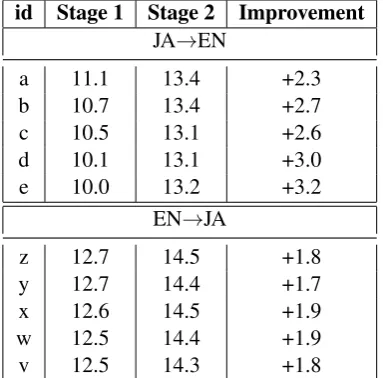
Continued Training: Next, we perform contin-ued training on the top 5 models. The results on Test18-MTNT are shown in Table6. We ob-serve consistent BLEU gains in these Stage 2 mod-els, close to 2 or 3 points across all systems. This re-affirms the surprising effectiveness of a simple procedure such as continued training; but we should also note that preliminary efforts on English-French did not yield similar gains.
Note that we do not measure Valid-ALL in this case since we now expect the models to be opti-mized specifically for MTNT; it is likely Valid-ALL scores will degrade due to catastrophic for-getting (Thompson et al.,2019).
Final Submission: In the final official sub-mission, we performed an 4-ensemble of the Stage 2 Continued Training models of id=a,b,d,e for JA→EN and id=z,y,w,v for EN→JA. Note that the ensemble method in Sockeye currently as-sumes the same vocabulary, so BPE needs to be the same for all models in the ensemble. This is a reasonable assumption, but in the spirit of subword regularization (Kudo,2018), we think it may be in-teresting to explore whether ensembles of systems with diverse BPE will lead to more robust outputs. For JA→EN, the ensemble achieved 14.6 BLEU on Test18-MTNT (N-gram precisions: 43.9/19.3/10.1/5.5, Brevity Penality: 0.991, Length ratio: 0.991). The official MTNT2019 blindtest cased-BLEU is 11.4.
For EN→JA, the ensemble achieved 15.0 BLEU on Test18-MTNT (N-gram precisions: 45.2/19.2/10.3/5.7, Brevity Penality: 1.0, Length ratio: 1.122). The official MTNT2019 blindtest case-BLEU is 14.8.
4 Conclusion
JA→EN Systems Hyperparameter Setting BLEU (EN output) id BPE LR head layer ffsize embed Valid-ALL Test18-MTNT
a 30k 0.0003 8 4 2048 512 17.1 11.1
b 30k 0.0006 16 4 2048 512 16.5 10.7
c 10k 0.0006 16 4 2048 512 15.7 10.5
d 30k 0.0006 16 4 2048 256 16.4 10.1
e 30k 0.0003 8 4 1024 256 16.0 10.0
f 50k 0.0003 8 4 1024 512 16.4 10.0
g 30k 0.0006 8 2 2048 512 15.9 9.9
h 50k 0.0006 8 2 1024 256 14.4 9.1
i 10k 0.0006 8 2 2048 256 14.0 8.6
j 30k 0.0006 16 2 1024 1024 13.9 8.4
EN→JA Systems Hyperparameter Setting BLEU (JA output) id BPE LR head layer ffsize embed Valid-ALL Test18-MTNT
z 50k 0.0006 8 4 2048 256 17.0 12.7
y 50k 0.0003 16 4 2048 512 17.5 12.7
x 30k 0.0003 8 2 2048 512 16.6 12.6
w 50k 0.0006 16 4 2048 512 17.1 12.5
v 50k 0.001 8 4 2048 512 16.5 12.5
u 10k 0.0003 8 4 1024 512 16.4 12.3
t 30k 0.001 16 4 1024 256 16.0 12.1
s 50k 0.001 8 4 1024 256 15.8 12.1
r 10k 0.0006 16 2 1024 512 15.3 11.9
[image:5.595.104.494.230.560.2]q 10k 0.0006 8 2 1024 256 14.5 10.6
id Stage 1 Stage 2 Improvement JA→EN
a 11.1 13.4 +2.3
b 10.7 13.4 +2.7
c 10.5 13.1 +2.6
d 10.1 13.1 +3.0
e 10.0 13.2 +3.2
EN→JA
z 12.7 14.5 +1.8
y 12.7 14.4 +1.7
x 12.6 14.5 +1.9
w 12.5 14.4 +1.9
[image:6.595.86.278.63.252.2]v 12.5 14.3 +1.8
Table 6: Continued Training BLEU results on Test18-MTNT. Stage 1 results are from Table 5. Continued Training (Stage 2) consistently improves BLEU.
scores fell into roughly the middle tier among those reported onmatrix.statmt.org. It is certain that much higher gains could be had by adding even known techniques to our pipeline, such as backtranslating monolingual data ( Sen-nrich et al.,2016).
We also believe that our approach of evaluat-ing on multiple test sets is essential to the robust-ness task. Without this, the task reduces to do-main adaptation, and one has no assurance that high scores on the out-of-domain data do not come at the expense of general-domain performance.
References
Ondˇrej Bojar, Rajen Chatterjee, Christian Federmann, Barry Haddow, Matthias Huck, Chris Hokamp, Philipp Koehn, Varvara Logacheva, Christof Monz, Matteo Negri, Matt Post, Carolina Scarton, Lucia Specia, and Marco Turchi. 2015. Findings of the 2015 workshop on statistical machine translation. InProceedings of the Tenth Workshop on Statistical Machine Translation, pages 1–46, Lisbon, Portugal. Association for Computational Linguistics.
Felix Hieber, Tobias Domhan, Michael Denkowski, David Vilar, Artem Sokolov, Ann Clifton, and Matt Post. 2017. Sockeye: A toolkit for neural machine translation. CoRR, abs/1712.05690.
Marcin Junczys-Dowmunt. 2018. Dual conditional cross-entropy filtering of noisy parallel corpora. In Proceedings of the Third Conference on Machine Translation: Shared Task Papers, pages 888–895, Belgium, Brussels. Association for Computational Linguistics.
Huda Khayrallah, Brian Thompson, Kevin Duh, and Philipp Koehn. 2018. Regularized training objec-tive for continued training for domain adaptation in neural machine translation. InProceedings of the 2nd Workshop on Neural Machine Translation and Generation, pages 36–44. Association for Computa-tional Linguistics.
Philipp Koehn, Kevin Duh, and Brian Thompson. 2018. The jhu machine translation systems for wmt 2018. InProceedings of the Third Conference on Machine Translation, Volume 2: Shared Task Pa-pers, pages 442–448, Belgium, Brussels. Associa-tion for ComputaAssocia-tional Linguistics.
Philipp Koehn, Hieu Hoang, Alexandra Birch, Chris Callison-Burch, Marcello Federico, Nicola Bertoldi, Brooke Cowan, Wade Shen, Christine Moran, Richard Zens, Chris Dyer, Ondrej Bojar, Alexandra Constantin, and Evan Herbst. 2007. Moses: Open source toolkit for statistical machine translation. In Proceedings of the 45th Annual Meeting of the As-sociation for Computational Linguistics Companion Volume Proceedings of the Demo and Poster Ses-sions, pages 177–180, Prague, Czech Republic. As-sociation for Computational Linguistics.
Taku Kudo. 2018. Subword regularization: Improv-ing neural network translation models with multiple subword candidates. InProceedings of the 56th An-nual Meeting of the Association for Computational Linguistics (Volume 1: Long Papers), pages 66– 75, Melbourne, Australia. Association for Compu-tational Linguistics.
Taku Kudo and John Richardson. 2018. Sentence-Piece: A simple and language independent subword tokenizer and detokenizer for neural text processing. InProceedings of the 2018 Conference on Empirical Methods in Natural Language Processing: System Demonstrations, pages 66–71, Brussels, Belgium. Association for Computational Linguistics.
Paul Michel and Graham Neubig. 2018. MTNT: A testbed for machine translation of noisy text. In Pro-ceedings of the 2018 Conference on Empirical Meth-ods in Natural Language Processing, pages 543– 553, Brussels, Belgium. Association for Computa-tional Linguistics.
Graham Neubig, Yosuke Nakata, and Shinsuke Mori. 2011. Pointwise prediction for robust, adaptable Japanese morphological analysis. In Proceedings of the 49th Annual Meeting of the Association for Computational Linguistics: Human Language Tech-nologies, pages 529–533, Portland, Oregon, USA. Association for Computational Linguistics.
Matt Post. 2018. A call for clarity in reporting BLEU scores. InProceedings of the Third Conference on Machine Translation: Research Papers, pages 186– 191, Belgium, Brussels. Association for Computa-tional Linguistics.
with subword units. InProceedings of the 54th An-nual Meeting of the Association for Computational Linguistics (Volume 1: Long Papers), pages 1715– 1725, Berlin, Germany. Association for Computa-tional Linguistics.
Brian Thompson, Huda Khayrallah Jeremy Gwinnup, Kevin Duh, and Philipp Koehn. 2019. Overcoming catastrophic forgetting during domain adaptation of neural machine translation. In Proceedings of the 2019 Conference of the North American Chapter of the Association for Computational Linguistics: Hu-man Language Technologies, Volume 2 (Short Pa-pers). Association for Computational Linguistics.