Performance of AODV Routing Protocol using
Group and Entity Mobility Models in Wireless
Sensor Networks
S H Manjula
1, C N Abhilash
1, Shaila K
1, K R Venugopal
1, L M Patnaik
2 ∗†Abstract—Wireless Sensor Network is Multihop Self-configuring Wireless Network consisting of sen-sor nodes. The patterns of movement of nodes can be classified into different mobility models and each is characterized by their own distinctive features. The significance of this study is that there has been very limited investigations of the effect of mobility mod-els on routing protocol performance such as Packet Delivery Ratio, Throughput and Latency in Wire-less Sensor Network. In this paper, we have con-sidered the influence of pursue group and random based entity mobility models on the performance of Ad Hoc On-Demand Distance Vector Routing Pro-tocol (AODV) routing proPro-tocol. The simulation re-sults show that Pursue Group Mobility model is bet-ter than Random Based Entity model.
Keywords: Wireless Sensor Network, Mobility models, AODV, Packet Delivery Ratio, Latency, Throughput.
1
Introduction
A Wireless Sensor Network (WSN) is multihop self con-figuring, dynamic routing, distributed autonomous wire-less network. It is used for gathering information, per-forming data-intensive tasks such as habitat monitoring, seismic monitoring, terrain, surveillance etc. It consist of many small, light weight sensor nodes (SNs) calledmotes, deployed on the fly in large numbers to monitor the envi-ronment or a system by the measurement of physical pa-rameters such as temperature, pressure or relative humid-ity. Important characteristics of a WSN are: (i)Mobility of nodes (ii) Node failures (iii) Scalability (iv) Dynamic network topology (v) Communication failures (vi) Het-erogenity of nodes (vii) Large scale of deployment and Unattended operation.
Mobility of sensor nodes specifies the dynamic character-istics of node movement and is one of the characteristic of wireless sensor network. Its potential use found in va-riety of applications ranging from vehicular networks and
∗ 1,Department of Computer Science and Engineering,
Uni-versity Visvesvaraya College of Engineering, Bangalore UniUni-versity, Bangalore 560 001. (e-mail:[email protected])
† 2Microprocessor Applications Laboratory, Indian Institute of
Science, Bangalore.
military missions to reconnaissance. The relative move-ment between nodes creates or breaks wireless connec-tions and changing the network topology. This affects the performance of the network and plays a vital role in the evaluation of sensor networking protocol. The pat-terns of movement of nodes can be classified into different mobility models and each is characterised by their own distinctive features. The traditional mobility models in-cludes (i) Random Walk Model (ii) Random Waypoint Model (iii) Random Direction Model which attempt to mimic the movements of mobile objects. Such models are simple to implement and analyze. On the otherhand, in all these randomized models, nodes choose their velocity and direction independently, with no restrictions. Hence, these models do not capture correlation between node movements. Recent work on mobility models attempts to identify common mobility movements. For example, group mobility may exist in battle fields, disaster relief, or crowd migration. In the case of group mobility, lit-tle information is available on how real group mobility patterns look like and sometimes patterns are caused by physical process. The drawbacks of mobility are: it relies on homogeneous velocity and acceleration bounds, which is not at all realistic. The implications for wireless net-works are rather weak, for that, the performance of the network depends very much on the density of the nodes in the underlying mobility pattern.
Motivation: The hosts in an Wireless Sensor Network move according to various patterns. Realistic models for the motion patterns are needed in simulation in order to evaluate system and protocol performance. Most of the earlier research on mobility patterns was based on cellu-lar networks. Mobility patterns have been used to derive traffic and mobility prediction models in the study of var-ious problems in cellular systems, such as hand-off, loca-tion management, paging, registraloca-tion, calling time, traf-fic load. While in cellular networks, mobility models are mainly focused on individual movements since communi-cations are point-to-point rather than among groups.
protocol. This work evaluates existing entity mobility model namely Random Walk, Random Waypoint, Ran-dom Direction and Pursue group mobility models. Exist-ing reactive AODV routExist-ing protocol is used to verify the result.
Organization: The rest of the paper is organized as fol-lows. Section II presents the Related Work. An overview of AODV Routing Protocol, Communication Model and Mobility Model is presented in Section III. Algorithm and Performance Evaluation is discussed in Section IV. In Section V, we present conclusions.
2
Related Work
A brief survey of performance metrics, mobility metrics and routing in WSNs is presented in this section. Ian et al., [1] present a comprehensive survey of design is-sues and techniques for sensor networks describing the physical constraints on sensor nodes and the protocols proposed in all layers of network stack. Taxonomy of the different architectural attributes of sensor networks is de-veloped in [2]. This work gives a high-level description of typical sensor network architecture along with compo-nents. Sensor network are classified by considering sev-eral architectural factors such as network dynamics and the data delivery model.
Sohrabi et al., [3] have proposed Sequential Assignment Routing algorithm which performs organization and mo-bility management in sensor networks. An enhanced ver-sion to identify the nodes using Global Positioning Sys-tem is proposed in order to locate the position of nodes. A QoS routing protocol for sensor networks that provides soft-real time end-to-end guarantees is described in [4]. The protocol requires each node to maintain information about its neighbors and uses geographic forwarding to find paths. Ali et al., [5] proposed a Mobility adaptive, collision-free Medium Access Control for sensor networks. It assumes that the sensor nodes are aware of their loca-tion. This location information is used to predict the mobility pattern of the nodes.
Royer et al., [6] proposed Random direction model to ad-dress the non-uniform node distribution problem in the random waypoint model. This model suffers from the same vanishing average speed problem, the reason be-hind speed decay also applies random direction model and it is observed that the average nodes speed under this model decayed in much the same way as in the Ran-dom Waypoint model. Guolong Lin et al., [7] analyzed the steady state distribution function of the random way point model. In addition to confirming the drawbacks of the random waypoint model and theoritical solution for the speed decay problem was determined and provides a general framework for analyzing other mobility models.
Bai et al., [8] used the metrics of relative motion and
average degree of spatial dependence to characterize the different mobility models used in their study. They also proposed the connectivity graph metrics as a bridge re-lating the mobility metrics to the protocol performance. They found that average link duration at the graph level could explain this relationship. Broch et al., [9] evaluates that on-demand protocol such as Dynamic Source Rout-ing and AODV perform better than table-driven ones such as Destination Sequenced Distance Vector (DSDV) routing protocol at high mobility rates, while DSDV per-form quite well at low mobility rates. C. Perkins [10] evaluated Ad Hoc On-Demand Distance Vector Routing Protocol is based on the metrics like packet delivery ratio and routing overhead.
3
Background
3.1
AODV
Ad Hoc On-Demand Distance Vector Routing Protocol (AODV) is one of the most famous reactive routing proto-cols. In AODV, a source that intends to reach destination floods the whole network with a route request (RREQ) packet to search for all possible routes leading to the des-tination. Upon receiving the RREQ, each intermediate node creates a reverse routing entry for the source if it does not have a fresh one. The intermediate node also checks whether it has an existing entry for the destina-tion. If it has, aroute reply(RREP) packet is generated and unicast back to the source along the reverse route re-quest route. Otherwise, it rebroadcasts the first received route request and suppresses the duplicated ones. When the destination receives the first route request or a route request coming from a shorter route, it sends a route reply back to the source. The nodes along the newly discovered routes create forward routing entries for the destination when receiving the RREPs. Source and destination se-quence numbers are included in the control packets and routing entries to prevent loop problems. When a route entry is not used for a long time, it is deleted from the routing table to leave space to active entries. This pro-tocol requires all nodes to reserve big enough memory spaces to store possible routing entries for active sources and destinations. As most routes are formed on demand, network latency is quite high.
3.2
Communication Model
application software can be built and used on the applica-tion layer. The transport layer helps to maintain the flow of data if the sensor networks application requires it. The network layer takes care of routing the data supplied by the transport layer. Since the environment is noisy and sensor nodes can be mobile, the MAC protocol must be power aware and able to minimize collision with neigh-bors broadcast. The physical layer addresses the needs of a simple but robust modulation, transmission and receiv-ing techniques. In addition, the power, mobility, and task management planes monitor the power, movement, and task distribution among the sensor nodes. These planes help the sensor nodes coordinate the sensing task and lower the overall power consumption.
The power management plane manages how a sensor node uses its power. For example, the sensor node may turn off its receiver after receiving a message from one of its neighbors. This is to avoid getting duplicated messages. Also, when the power level of the sensor node is low, the sensor node broadcasts to its neighbors that it is low in power and cannot participate in routing messages. The remaining power is reserved for sensing. The mobility management plane detects and registers the movement of sensor nodes, so a route back to the user is always main-tained, and sensor nodes can keep track of their neigh-bor sensor nodes. By knowing the neighneigh-boring sensor nodes, they can balance their power and task usage. The task management plane balances and schedules the sens-ing tasks given to a specific region. Not all sensor nodes in that region are required to perform the sensing task at the same time. As a result, some sensor nodes per-form the task more than the others depending on their power level. These management planes are needed, so that sensor nodes can work together in a power efficient way, route data in a mobile sensor network, and share resources between sensor nodes.
3.3
Mobility Model
Mobility models play a key role during the simulation of Wireless Sensor Networks. We discuss (i) Random based Entity mobility model (ii) Group mobility model, and (iii) Movement model below:
(i) Random based M obility M odels: In random based
mobility models, the mobile nodes move randomly and freely without restrictions. To be more specific, the des-tination, speed and direction are all chosen randomly and independently of other nodes. This kind of model has been used in many simulation studies. The different types are discussed below:
(a) Random W alk M obility M odel: In nature, many
entities move in extremely unpredictable ways, the Ran-dom Walk model was developed to mimic this erratic movement. This model was originally proposed to em-ulate the unpredictable movement of particles in physics.
The Random Walk mobility model is a widely used mobil-ity model and it is sometimes referred to as theBrownian Motion. A mobility node (MN) moves from its current location to a new location by randomly choosing a di-rection and speed to travel. The new speed and direc-tion are both chosen from pre-defined ranges [speedmin, speedmax] and [2,π] respectively. Each movement in the Random Walk mobility model occurs in either a constant time interval t or a constant distance traveledd, at the end of which a new direction and speed are calculated. If an MN moving according to this model reaches a bound-ary area, it bounces off the boundbound-ary border with an angle determined by the incoming direction. The MN then continues along this new path. The Random Walk mobility model is a memoryless mobility pattern because it doesnot retain knowledge concerning its past locations and speed values.
(b) Random W ay P oint M obility M odel: The
Ran-dom Waypoint mobility model includes pause times tween changes in direction and/or speed. An MN be-gins by staying in one location for a certain period of time(i.e., a pause time). Once this time expires, the MN chooses a random destination in the simulation area and a speed that is uniformly distributed between [minspeed, maxspeed]. The MN then travels toward the newly cho-sen destination at the selected speed. Upon arrival, the MN pauses for a specified time period before starting the process again. The movement pattern of an MN using the Random Waypoint mobility model is similar to Random Walk mobility model if pause time is zero.
(c) Random Direction M obility M odel: This mobility
model was created to overcome density waves in the aver-age number of neighbors produced by the Random Way Point mobility model. A density wave is the clustering of nodes in one part of the simulation area. In this model, MNs choose a random direction to travel similar to the Random Walk mobility model. A MN then travels to the border of the simulation area in that direction. Once the simulation boundary is reached, the MN pauses for a specified time, and chooses another angular direction [0, 2π] and continues the process.
(ii)Group M obility M odel: Group mobility model
(iii) M ovement M odel: This model defines a mobility metric referred to asmobility. The mobility metric which is geometric in the sense that the speed of a node in rela-tion to other nodes is measured, while it is independent of any links formed between nodes in the network. The mobility metric describes the mobility of a scenario with a single value M which is a function of the relative mo-tion of the nodes taking part in a scenario. Ifl(n,t)is the position of nodenat timet, the relative velocityv(x,y,t)
between nodesxandyat timetis
v(x, y, t) = d
dt(l(x, t)−l(y, t)) (1)
The mobility measure Mxy, between any pair (x,y) of
nodes is defined as their absolute relative speed taken as an average over the time, T, the mobility is measured. The formula for obtainingMxyis given below.
Mxy=
1
T
Z
t0≤t≤t0+T
|v(x, y, t)| dt (2)
In order to arrive total mobility metric,M, for a scenario, the mobility measure in Equation 2 is averaged over all node pairs, resulting in the following definition
M = 1
|x, y| X
x,y
Mxy=
2
n(n−1)
1
X
x=1
n X
y=x+1
Mxy (3)
where| x, y | is the number of distinct node pairs (x,y)
and n is the number of nodes in the scenario. (Note that the second relation in Equation 3 assumes nodes being numbered from 1 ton). The mobility expresses the average relative speed between all nodes in the network. Consequently, the mobility for a group of nodes standing still, or moving in parallel at the same speed, is zero.
4
Algorithm
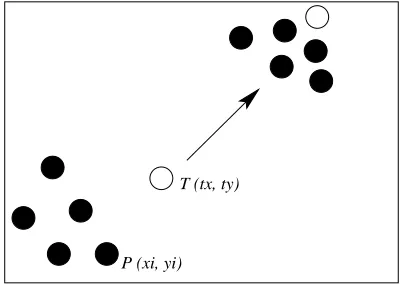
Pursue mobility model and its algorithm is presented in this section. The pursue mobility model attempts to represent MNs tracking a particular target. For exam-ple, this model could represent the scenario where po-lice officers attempt to catch a escaped criminal. The Pursue mobility model consists of an update equation for the new position of each mobile node: new position = old position+ acceleration(target old position) + ran-dom vector. The current position of a MN, a random vector, and an acceleration function are combined to calculate the next position of the MN. Where accelera-tion(target old position) is information on the movement of the MN being pursued andrandom vectoris a random offset for each MN. The random vector value is obtained via an entity mobility model. The amount of random-ness for each MN is limited in order to maintain effective tracking of the MN being pursued. Figure 1 illustrates the movements of mobility nodes using the pursue mo-bility model. The white nodes represent the node be-ing pursued and the black nodes represent the pursube-ing nodes.
P (xi, yi) T (tx, ty)
[image:4.612.303.503.70.213.2]Figure 1: Pursue Mobility Model
Table 1: Algorithm for Pursue Mobility Model
1. Register the location of target nodeT(tx, ty). 2. Iteratei = 1,2...,nnodes.
3. Register the location of pursuing nodeP(xi, yi). 4. If distanceP(xi, yi)<distanceT(tx, ty).
5. Set the new position ofP(xi, yi) by updating cur-rent pursuing nodeP(xi, yi) by acceleration and di-rection of previous target node position and random offset value.
6. UntilP(xi, yi) catches the target nodeT(tx, ty).
The main objective of this algorithm is target tracking, that is collection of nodes P(xi, yi), trying to chase a
single target node T(tx, ty) as developed and is shown
in Table I. Initially, register the location of the target node and individual pursuing node. If the distance be-tween target node and pursuing node is more, then new position of the pursuing nodeP(xi, yi) is updated by
ac-celeration and direction of previous target node position and random offset value until it traces the target node.
4.1
Performance Evaluation
This section describes the simulation and experimental results of impact of mobility models on the performance of Ad Hoc On-Demand Distance Vector routing protocol. We have selected packet delivery ratio, latency, through-put as metrics during the simulation in order to evaluate the performance of AODV routing protocol.
P acket Delivery Ratio: This is defined as the ratio of the
number of packets received by the destinations to those sent by the CBR sources.
Latency: This is defined as the delay between the time
route discovery, queuing, propagation and transfer time are included in the delay metric.
T hroughput: The throughput data reflects the effective
network capacity. It is defined as the total number of bits successfully delivered at the destination in a given period of time.
4.2
Simulation Setup
We carry out the simulation in the customized event driven simulator, OMNET++ [12], which is an object modular network test-bed in C++. The mobility scenar-ios are obtained through mobility framework which is a part of OMNET++ distribution. The scenario generator produces the different mobility patterns such as Pursue group mobility model and Random Walk, Random Di-rection, Random Waypoint entity mobility models. In all these patterns 25 hosts with 5 enabled nodes deployed in a simulation area of 700m * 700m rectangular region for 900s simulation time. For our study, we considered a scenario with three random based (i.e., Random Walk, Random Waypoint, Random Direction) entity mobility model, Pursue group mobility model and AODV routing protocol.
[image:5.612.307.524.76.244.2]The scenario is chosen in such a way that, each mobility node speed is varied from 1m/s to 20m/s. From this scenario we compare the performance of AODV routing protocol using entity and group mobility models. The MAC layer protocol IEEE 802.11 is used in simulation with the data rate 11Mbps. The data traffic source to be a Constant Bit Rate (CBR) source. The sending rate is set to three packets per second, the network contains one source and one destination, each message packet size of 512 bytes is defined. The Table II provides all the simulation parameter values.
Table 2: Summary of the communication parameter val-ues for Simulation scenarios
Map Size 700m * 700m Channel Bandwidth 11Mbps
Channel Delay 10µsec
Simulation Time 900s No. of Enabled Nodes 5
Number of Hosts 25 Packet Rate 3packets/sec Burst length 64packets Message Packet Size 512byte
Input Buffer Size 1MB
4.3
Results and Analysis
From the simulation results, we compare random based entity models and pursue group model which significantly
0.4 0.5 0.6 0.7 0.8 0.9 1
0 5 10 15 20
Packet Delivery Ratio (%)
[image:5.612.310.525.307.480.2]Speed (m/s) RW RWP RDIR PURSUE
Figure 2: Packet Delivery Ratio and Speed
0 1 2 3 4 5
0 5 10 15 20
Latency
Speed (m/s)
[image:5.612.307.525.322.697.2]RW RWP RDIR PURSUE
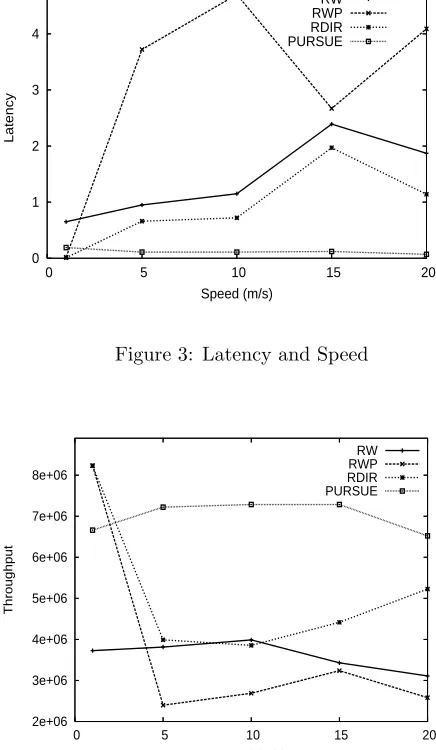
Figure 3: Latency and Speed
2e+06 3e+06 4e+06 5e+06 6e+06 7e+06 8e+06
0 5 10 15 20
Throughput
Speed (m/s)
RW RWP RDIR PURSUE
[image:5.612.81.262.552.679.2]influences the performance metrics such as Packet Deliv-ery Ratio, Latency, and Throughput of AODV reactive routing protocol. The results obtained from the scenario is discussed below.
The scenario is based on speeds of nodes varying from 1m/s, 5m/s, 10m/s, 15m/s, 20m/s of mobility models. Figure 2 describes the variation of Packet Delivery Ra-tio with the speed. As the speed increased from 1m/s to 5m/s Random Waypoint model decreases drastically because of packet loss. By comparing all random based mobility models, the pursue group mobility model shows consistent packet delivery ratio as node speed increased from 1m/s to 20m/s.
Figure 3 gives the variation of Latency with speed. Ran-dom Waypoint model takes 40% more time to trans-mit packets as the speed increases upto 10m/s. At a node speed 20m/s, Random Direction model and Pursue mobility model shows better performance than Random Waypoint mobility model. Pursue mobility model expe-riences 0.1% of consistent time delay as the node speed is increased from 1m/s to 20m/s. This infers pursue mobil-ity model takes less duration to transmit the data among all mobility models.
Figure 4 shows the variation of Throughput with speed. The throughput of Random Direction model and Ran-dom Waypoint mobility model decreases drastically at node speed 5m/s. It is noticed that, Random Direction model and Pursue group mobility model starts converging as the node speed increases from 10m/s, shows that im-provement in Random Direction model in data through-put. From the simulation result, pursue mobility model results in consistent data throughput with variation of speed.
5
Conclusions and Future Work
WSN is gaining importance in the real world because of its applications. In this paper, the simulation re-sults demonstrates the evaluation of performance of AODV routing protocol with random based entity mo-bility model and pursue group momo-bility model. The per-formance metrics are Packet Delivery Ratio, Latency, and Throughput. We intend to show that the choice of mobil-ity models makes the difference with respect to network performance. We have considered a scenario by vary-ing the speed of the individual nodes. The pursue group mobility model performs better than random based en-tity mobility models. Other mobility patterns such as Freeway, Manhattan, Column group mobility model, City Section models will be used to illustrate realistic situa-tions, in the future works.
References
[1] Ian F. Akylidiz, Weilian Su, Yogesh Sankarasubra-maniam, and E. Cayirci. “Wireless Sensor Network: A Survey on Sensor Networks,”IEEE Communica-tion Magazine, V40, N8, pp. 102-114 8/02.
[2] S. Tilak, Nael B. Abu-Ghazaleh, Wendi Heinzel-man. “A Taxonomy of Wireless Microsensor Net-work Models,”Mobile Computing and Communica-tions Review, V6, N2, pp. 28-36, 2002.
[3] K. Sohrabi, J. Gao, V. Ailawadhi and G. J. Pot-tie. “Protocols for Self-Organization of Wireless Sen-sor Network,”IEEE Personal Communication Mag-azine, V7, N5, pp.16-27, 10/00.
[4] T. He, John Stankovic, Chenyang Lu, Tarek Ab-delzaher. “SPEED: A stateless protocol for Real-Time Communication in Sensor Networks,” Proceed-ings of Int Conf on Distributed Computed Systems, Providence, RI, 5/03.
[5] M. Ali, T. Suleman, and Z. A. Uzmi. “MMAC: A Mobility-adaptive, Collision-free MAC Protocol for Wireless Sensor Networks,” Proceedings of 24th
IEEE IPCCC, 2005.
[6] E. Royer and P. Melliar-Smith and L. Moser. “An Analysis of the Optimum Node Density for Ad hoc Mobile Networks,”Proceedings of IEEE Int Conf on Communications (ICC), Helsinki, Finland, 6/01. [7] Guolong Lin, Guevara Noubir, and Rajmohan
Raja-maran. “Mobility Models for Ad-hoc Network Sim-ulation,”Proceedings of INFOCOM, 2004.
[8] F. Bai, N. Sadagopan, and Ahmed Helmy. “The IM-PORTANT Framework for Analyzing the Impact of Mobility on Performance of Routing Protocols for Ad hoc Networks,”IEEE Information Communica-tions Conference, INFOCOM, pp. 825-835, 4/03. [9] J. Broch, D. Maltz, D. Johnson, Y. Hu, and J.
Jetcheva. “A Performance Comparison of Multi-Hop Wireless Ad Hoc Netowrk Routing Protocols,”
Proceedings of the Fourth Annual ACM/IEEE Int Conf on Mobile Computing and Networking (MO-BICOM), pp. 85-97, 10/98.
[10] C. Perkins. “Ad Hoc on Demand Distance Vector (AODV) Routing IETF,”Internet Draft: draft-ietf-manet-aodv-00.txt, 11/97.
[11] M. Sanchez. “Mobility Models,” URL: www.disca.upv.es/misan/mobmodel, 2000.