Type-Aware Distantly Supervised Relation Extraction
with Linked Arguments
Mitchell Koch John Gilmer Stephen Soderland Daniel S. Weld Department of Computer Science & Engineering
University of Washington Seattle, WA 98195, USA
{mkoch,jgilme1,soderlan,weld}@cs.washington.edu
Abstract
Distant supervision has become the lead-ing method for trainlead-ing large-scale rela-tion extractors, with nearly universal adop-tion in recent TAC knowledge-base pop-ulation competitions. However, there are still many questions about the best way to learn such extractors. In this paper we investigate four orthogonal improvements: integrating named entity linking (NEL) and coreference resolution into argument identification for training and extraction, enforcing type constraints of linked argu-ments, and partitioning the model by rela-tion type signature.
We evaluate sentential extraction perfor-mance on two datasets: the popular set of NY Times articles partially annotated by Hoffmann et al. (2011) and a new dataset, called GORECO, that is comprehensively
annotated for 48 common relations. We find that using NEL for argument identi-fication boosts performance over the tra-ditional approach (named entity recogni-tion with string match), and there is further improvement from using argument types. Our best system boosts precision by 44% and recall by 70%.
1 Introduction
Relation extractors are commonly trained by dis-tant supervision (also known as knowledge-based weak supervision (Hoffmann et al., 2011)), an au-tonomous technique that creates a labeled train-ing set by heuristically matchtrain-ing the contents of a knowledge base (KB) tomentions(substrings) in a textual corpus. For example, if a KB contained the ground tupleBornIn(Albert Einstein, Ulm)then
Training Extraction
KB
Argument Identification
Matching
[image:1.595.309.525.221.319.2]Train Extractor Extractor Argument Identification
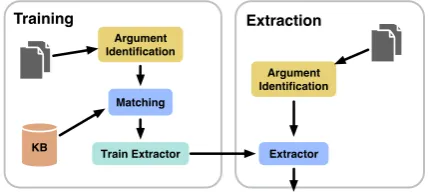
Figure 1: Distantly supervised extraction pipeline.
a distant supervision system might label the sen-tence “While [Einstein]1 was born in [Ulm]2, he
moved to Munich at an early age.” as a positive training instance of theBornInrelation. Although distant supervision is a simple idea and often cre-ates data with false positives, it has become ubiq-uitous; for example, all top-performing systems in recent TAC-KBP slot filling competitions used the method.
Surprisingly, however, many aspects of distant supervision are poorly studied. In response we perform an extensive search of ways to improve distant supervision and the extraction process, in-cluding using named entity linking (NEL) and coreference to identify arguments for distant su-pervision and extraction, as well as using type con-straints and partitioning the trained model by rela-tion type signatures.
The first step in the distant supervision process is argument identification (Figure 1) — finding textual mentions referring to entities that might be in some relation. Next comesmatching, where KB facts, e.g. tuples such asR(e1, e2), are associated
with sentences mentioning entities e1 and e2 in
the assumption that many of these sentences de-scribe the relationR. Most previous systems per-form these steps by first using named entity recog-nition (NER) to identify possible arguments and then using a simple string match, but this crude
approach misses many possible instances. Since the separately-studied task of named entity linking (NEL) is precisely what is needed to perform dis-tant supervision, it is interesting to see if today’s optimized linkers lead to improved performance when used to train extractors.
Coreference, the task of clustering mentions that describe the same entity, may also be use-ful for increasing the number of candidate argu-ments. Consider the following variant of our pre-vious example: “While [he]1 was born in [Ulm]2,
[Einstein]3 moved to Munich at an early age.”
Since mentions 1 and 3 corefer, one could con-sider using either the pairh1,2iorh3,2i(or both) for training. Intuitively, it seems thath1,2iis more representative ofBornInand might generalize bet-ter, so we consider the use of coreference at both training and extraction time.
Semantic relations often have selectional prefer-ences (also known as type signatures); for exam-ple, BornIn holds between people and locations. Therefore, it seems promising to include entity types, whether coarse or fine grained in the dis-tantly supervised relation extraction process. We consider two ways of adding this information. By using NEL to get linked entities, we can impose type constraints on the relation extraction system to only allow relations over appropriately typed mentions. We also investigate using coarse types from NER to learn separate models for different relation type signatures in order to make the mod-els more effective.
In summary, this paper represents the following contributions:
• We explore several dimensions for improv-ing distantly supervised relation extraction, including better argument identification dur-ing traindur-ing and extraction usdur-ing both NEL and coreference, partitioning the model by relation type signatures, and enforcing type constraints of linked arguments as a post-processing step. While some of these ideas may seem straightforward, to our knowledge they have not been systematically studied. And, as we show, they lead to dramatic im-provements.
• Since previous datasets are incapable of mea-suring an extractor’s true recall, we intro-duce GORECO, a new exhaustively-labeled
dataset with gold annotations for sentential
instances of 48 relations across 128 newswire documents from the ACE 2004 corpus (Dod-dington et al., 2004).
• We demonstrate that NEL argument identifi-cation boosts both precision and recall, and using type constraints with linked arguments further boosts precision, yielding a 43% in-crease in precision and 27% boost to re-call. Using coreference during training ar-gument identification gives an additional 7% improvement to precision and further boosts recall by 9%. Partitioning the model by rela-tion type signature offers further benefits, so our best system yields a total boost of 44% to precision and 70% to recall.
2 Distantly Supervised Extraction
At a sentence-level, the goal for relation extrac-tion is to determine for each sentence, what facts are expressed. We describe these as relation an-notationsof the form s→R(m1, m2), wheresis
a sentence, R ∈ R is a relation name, R is our finite set of target relations, and m1 and m2 are
grounded entity mentionsof the form(s, t1, t2, e),
wheret1andt2delimit a text span in the sentence,
andeis a grounded entity.
2.1 Training
During training, the contents of the KB are heuris-tically matched to the training corpus according to thedistant supervision hypothesis: if a relation holds between two entities, any sentence contain-ing those two entities is likely to express that rela-tion.
The training KB∆containsfact tuplesof form
R(e1, e2), whereR ∈ Ris a relation name, Ris
our finite set of target relations, ande1 ande2are
ground entities. The training text corpus Σ con-tains documents, which contain sentences. Argu-ment identificationis performed over the text cor-pus to get grounded mentionsm. Then during sen-tential instance generation,sentential instancesof the form (s, m1, m2) are generated representing
a sentence with two grounded mentions. At this point, these sentential instances can be matched to the seed KB, yieldingcandidate relation anno-tationsof the forms→R(m1, m2) by finding all
negative examples of the forms→NA(m1, m2)
in-dicating that no relation holds between m1 and m2. There are several heuristics for generating
negative instances, and the number of negative ex-amples and how they are treated can greatly affect performance (Min et al., 2013).
Because the distant supervision hypothesis of-ten does not hold, this training data is noisy. That a fact is in the KB does not imply that the sen-tence in question is expressing the relation. There has been much work in combating noise in dis-tant supervision training data, but one of the most successful ideas is to train a multi-instance classi-fier which assumes at-least-one relation holds for positive bags. We use Hoffmann et al. (2011)’s MULTIR system, which uses a probabilistic
graph-ical model to jointly reason at the corpus-level and sentence-level, handles overlapping relations in the KB so that multiple relations can hold over an entity pair, and scales to large datasets.
2.2 Extraction
The trained relation extractor can assign a most likely relation and a confidence score to a senten-tial instance (s, m1, m2). To get these sentential
instances, argument identification and sentential instance generation are applied to new documents. Then the relation extractor potentially yields a re-lation annotation of the form s→R(m1, m2), or
potentially no relation. At extraction time a men-tion m might have a NIL link if a
correspond-ing ground entity was not found durcorrespond-ing argument identification (meaning the entity is not in the KB). The relation annotations have associated confi-dence scores, so a threshold can be chosen to only use high-confidence relation annotations.
3 Argument Identification
An important piece of relation extraction is deter-mining what can be an argument, and how to form a semantic representation of it. We define an argu-ment identification functionArgIdent∆(D), which takes a document D, finds potential arguments, and links them to entities in∆if possible, yield-ing m, a set of grounded mentions in D. Pre-vious relation extraction systems have based this on NER. We evaluate NER-based argument iden-tification against argument ideniden-tification based on NEL, as well as NEL with coreference.
3.1 Named Entity Recognition
Named entity recognition (NER) tags spans of to-kens with basic types such asPERSON, ORGANI -ZATION, LOCATION, and MISC. This is a high
accuracy tagging task often performed using a sequence classifier (Finkel et al., 2005). Rela-tion extracRela-tion systems can base their argument identification on NER, by using NER to identify text spans indicating entities and then find corre-sponding entities in the KB through exact string match (Riedel et al., 2010). Some downsides of using NER with exact string match for relation ex-traction is that it does not allow for overlapping mentions, it can only capture arguments with full names, and it can only capture arguments with types of the NER system, e.g., “politician” might not be captured.
3.2 Named Entity Linking
Named entity linking (NEL) is the task of ground-ing textual mentions to entities in a KB, such as Wikipedia. Thus “named entity” here, has a some-what broader definition than in NER — these are any entities in the KB, not just those expressed with proper names. Hachey et al. (2013) define three stages that NEL systems take to perform this task: extraction (mention detection), search (generating candidate KB entities for a mention), and disambiguation (selecting the best entity for a mention). There has been much work on the task of NEL in recent years (Milne and Witten, 2008; Kulkarni et al., 2009; Ratinov et al., 2011; Cheng and Roth, 2013).
Our definition of a function ArgIdent(D) is completely served by an NEL system. It can find any entity in the KB, and those entities are grounded. Additionally, NEL can have overlap-ping mentions as well as support for abbreviated mentions like “Obama”, or acronyms like “US”. NEL does not seek to capture anaphoric mentions, however.
3.3 Coreference Resolution
Tak-ing in arguments from NEL argument identifica-tion and coreference clusters, we ground the clus-ters by picking the most common grounded entity from NEL mentions that occur in a coreference cluster. A difficulty is that mentions from NEL and coreference can have small differences in text spans, such as whether determiners are included. We try to assign each NEL argument to a corefer-ence cluster, first looking for an exact span match, then by looking for the shortest coreference men-tion that contains it. If the coreference cluster al-ready has matched an NEL argument through ex-act span match that is different from the one found by looking for the shortest containing coreference mention, the new NEL argument is not added. This gives for each coreference cluster a possible grounding to an entity in the KB. What is provided as final arguments for NEL+Coref argument iden-tification are, in order, grounded NEL arguments, grounded coreference arguments that do not over-lap with previous arguments,NILarguments from
NEL that do not overlap with previous arguments, and NIL arguments from coreference that do not
overlap with previous arguments.
4 Type-Awareness
Relations have expected types for each argument. Entity types, whether coarse-grained, such as from NER, or fine-grained, such as from Freebase enti-ties, are an important source of information that can be useful for making decisions in relation ex-traction. We bring type-awareness into the system through partitioning the model, as well as by en-forcing type constraints on output relation annota-tions.
Model Partitioning Instead of building a single
relation extractor that can generate sentential in-stances and then relation annotations with argu-ments of any type, we can instead build separate relation extractors for each possible coarse type signature, e.g., (PERSON,PERSON), (PERSON,LO -CATION), etc., and combine the extractions from
the extractor for each type signature. This modi-fication allows each trained model to only handle instances of specific types, and thus relations of that type signature, allowing each to do a better job of choosing relations within the type signature.
Type Constraints We can additionally reject
re-lation annotations where the types of the argu-ments do not agree with the expected types of the
relation. That is, we only accept a relation annota-tions→R(m1, m2)whenEntityTypes(e1)∩τ1 6= ∅andEntityTypes(e2)∩τ2 6=∅, wherem1is linked
toe1,m2is linked toe2,EntityTypesprovides the
set of valid types for an entity,τ1 is the set of
al-lowed types for the first argument of target relation
r, andτ2for the second argument.
5 Evaluation Setups
Relation extraction is often evaluated from a macro-reading perspective (Mitchell et al., 2009), in which the extracted facts,R(e1, e2), are judged
true or false independent of any supporting sen-tence. For these experiments, however, we take a micro-reading approach in order to strictly eval-uate whether a relation extractor is able to extract every fact expressed by a sentences→R(m1, m2).
Micro-reading is more difficult, but it provides fully semantic information at the sentence and document level allowing detailed justifications, and, for our purposes, allows us to better under-stand the effects of our modifications. In order to fairly evaluate different systems, even those us-ing different methods of argument identification, we want to use gold evaluation data allowing for varying mention types. We additionally use Hoff-mann et al. (2011)’s sentential evaluation as-is in order to better compare with prior work. For our training corpus, we use the TAC-KBP 2009 (Mc-Namee and Dang, 2009) English newswire corpus containing one million documents with 27 million sentences.
5.1 Hoffmann et al. Sentential Evaluation
coreference confers any benefit.
Finally, it does not allow for the possibility that there may be multiple relations that should be ex-tracted for a pair of arguments. For example, a CeoOfrelation, and anEmployedByrelation might both be present for(Larry Page, Google). To ad-dress these issues, we manually annotate a full set of documents with relation annotations. Because we are evaluating changing various aspects of the distant supervision process, we cannot use Riedel et al. (2010)’s distant supervision data as-is as oth-ers did on the Hoffmann et al. (2011) sentential evaluation. Instead, we use the TAC-KBP data de-scribed above.
5.2 GoReCo Evaluation
In order to allow for variations on mentions (NER, NEL, and coreference each has its own definition of what a mention boundary should be), we want gold relation annotations over coreference clus-ters broadly defined to allow mentions obtained from NER and NEL, as well as gold coreference mentions. So as long as a relation extraction sys-tem extracts a relation annotations→R(m1, m2)
wherem1 andm2 are allowed options (based on
text spans), it will get credit for extracting the relation annotation. We introduce the GORECO
(gold relations and coreference) evaluation to sat-isfy these constraints.
We start with an existing gold coreference dataset, ACE 2004 (Doddington et al., 2004) newswire, consisting of 128 documents. To get relation annotations over coreference clusters, we define two human annotation tasks and use the
BRAT(Stenetorp et al., 2012) tool for visualization
and relation and coreference annotations.
Relation Annotation The annotator is
pre-sented with a document with gold mentions indi-cated and asked to determine for each sentence, what facts involving target relations are expressed by the sentence. They draw an arrow for each fact and label it with the relation. They also have the ability to add mentions not present (ReAnn men-tions).
Supplemental Coreference Mentions from
NER and NEL are displayed along with ACE and ReAnn mentions from the previous task. The annotator draws coreference links from NER or NEL mentions to an ACE or ReAnn mention if they are coreferent.
We randomly shuffle the 128 ACE 2004 newswire documents and use 64 as a development set and 64 as a test set. To complete annotations of these documents, we only used one original hu-man annotator (hired using the oDesk crowdsourc-ing platform) and found mistakes by havcrowdsourc-ing others check the work, as well as checking false positives of relation extractors on the development set to find patterns of annotation mistakes. On average, there are 7 relation annotations per document.
For the GORECO evaluation, we define our
train/test split (with the separate TAC-KBP corpus used for training) such that each has a different set of documents and entities, in order to evaluate how well the system performs on unseen entities. To do this, we remove entities found in the gold evalua-tion set from the training KB. (We do not remove entities for the Hoffmann et al. (2011) evaluation, since they do not.) We choose the threshold con-fidence score for each system using the develop-ment set to optimize for F1 and report results on the test set.
5.2.1 Target Relations
Since we use a different evaluation, we also seek to choose a more comprehensive and interesting set of relations than prior work. Riedel et al. (2010), whose train and test data is also used by Hoff-mann et al. (2011) and Surdeanu et al. (2012), use Freebase properties under domains/people, /busi-ness, and/location. Since/locationrelations such as/location/location/containsdominate the results (and are relatively uninteresting in that they rarely change), we do not use any/locationrelations, and instead use the domains /people, /business, and /organization(Google, 2012).
Since many Freebase properties are between an entity and a table instead of another entity, we also use joined relations, such as /people/person/employment_history ./ /busi-ness/employment_tenure/company , in this case representing employment. We bring in an addi-tional 20 relations of this form, also under/person, /business, and/organization. Additionally we use NELL (Carlson et al., 2010a) relations mapped to Freebase by Zhang et al. (2012).
Rof 105 target relations based on joins and unions of Freebase properties. Of the 105 target relations, 48 were used at least once in the GORECOdata.
6 Experiments and Results
We conduct experiments to determine how chang-ing distantly supervised relation extraction along various dimensions affects performance. We ex-amine the choice of argument identification dur-ing traindur-ing and extraction, as well as the effects of model type partitioning, and type constraints. We consider the space of all combinations of these dimensions, but focus on specific combinations where we find improvements.
6.1 Relation Extraction Setup
We use and modify Hoffmann et al. (2011)’s sys-tem MULTIR to control our experiments and as
a baseline. For NER argument identification as well as for the use of NER in the features, we use use Stanford NER (Finkel et al., 2005). For NEL argument identification we use Wikipedia Miner with the default threshold 0.5, and allowing re-peated mentions (Milne and Witten, 2008). Since Wikipedia Miner does not support NIL links, we
use non-overlapping NER mentions asNIL links.
For coreference, we use Stanford’s sieve-based de-terministic coreference system (Lee et al., 2013). For sentential instance generation, we take all pairs of non-overlapping arguments in a sentence (in either order). If the arguments have KB links, we do not allow sentential instances where both arguments represent the same entity. We use the same lexical and syntactic features as MULTIR,
based on the features of Mintz et al. (2009). As required for features, we use Stanford CoreNLP’s tokenizer, part of speech tagger (Toutanova et al., 2003), and dependency parser (de Marneffe and Manning, 2008), and use the Charniak Johnson constiuent parser (Charniak and Johnson, 2005). For negative training generation, we take a simi-lar approach to Riedel et al. (2010) and define a percentage parameter n of the number of nega-tive instances divided by the number of total in-stances. Experimenting withn∈ {0,20%,80%}, we find thatn = 20%works best for our evalua-tions, optimizing for F1, although using 80% neg-ative training gives high precision at lower recall. We use frequency-based feature selection to elimi-nate features that appear less than 10 times, which is helpful both for reducing overfitting as well as
0.6 0 0.1 0.2 0.3 0.4 0.5 1
0.7 0.8 0.9
Relative Recall
Pre
ci
si
o
n
Hoffmann et al. (2011) NER+LT
NER
[image:6.595.312.523.67.159.2]NER+LT+CT
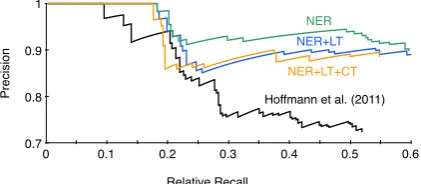
Figure 2: Methods evaluated in the context of Hoffmann et al. (2011)’s sentential extraction evaluation. NER: our NER baseline used for training and extraction, LT: use NEL for train-ing only, CT: use coreference for training only. (NER+LT+CT means we use NER for extraction, and NEL+Coref for training.)
constraining memory usage. Since the perceptron learning of MULTIR is sensitive to instance
order-ing, we perform 10 random shuffles and average the models.
For model type partitioning, when training with NER, we ensure that the NER types match the coarse relation type signatures. For NEL, we at-tempt to use NER for coarse types of arguments, but if an NER type is not present, we map the Free-base type to its FIGER type (Ling and Weld, 2012) to its coarse type. For type constraints, we use Freebase’s expected input and output types for re-lations. For NIL links, we use the NER type of PERSON,ORGANIZATION, orLOCATION, if
avail-able, mapping it to appropriate Freebase types.
6.2 NER Baseline
As a result of a larger training set, as well as model averaging, our baseline, which is otherwise equiv-alent to the methods of Hoffmann et al. (2011) and uses their MULTIR system, has slightly higher
precision as shown in Figure 2, curve NER. It is also higher than that of Xu et al. (2013), who achieved higher performance than Hoffmann et al. (2011); our baseline gets 89.9% precision and 59.6% relative recall, while Xu et al. (2013)’s sys-tem gets 84.6% precision and 56.1% relative re-call. See Figure 3 and Table 1 for results on GORECO.
6.3 NEL and Type Constraints
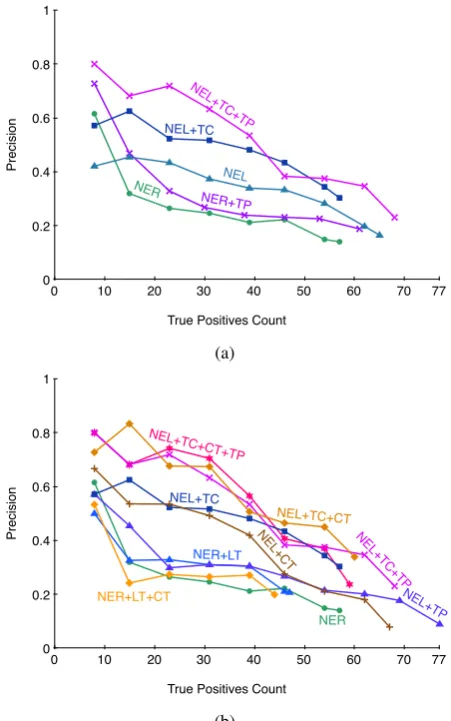
On GORECO, using NEL argument identification
pre-cision at a small cost to recall. Note the increase in performance fromNER toNEL toNEL+TC in Figure 3a, as well as in Table 1. Using NEL gives more recall, since it is able to capture arguments that NER cannot, such as professions like “pa-leontologist”. The decrease in recall from type constraints comes from false positives in the type constraints process including from non-ideal links, e.g., “paleontologist” might get linked to the entity Paleontology, so will not have the type required for theProfessionrelation.
On the Hoffmann et al. (2011) sentential evalu-ation, we were not able to use NEL argument iden-tification at extraction time, because the instances in the test set are from NER argument identifica-tion. We tried using NEL only at training time and found that it got similar performance to using NER (Figure 2, curve NER+LT). Doing the same on GORECOyielded slightly lower recall, because
of the mismatch of features learned from NEL ar-guments (Figure 3b, curveNER+LT).
6.4 NEL+Coref Argument Identification
Using NEL+Coref for both training and extrac-tion (see Table 1) introduces noise from arguments not encountered during training time, but using NEL+Coref just for training results in a decrease in recall but similar precision (Figures 2 and 3b).
We found using NEL+Coref at test time unhelp-ful for this dataset, because there were no exam-ples we could find where coreference could re-cover arguments that NEL could not. There were three true positives from NEL+Coref involving pronouns in the GORECO development set, but
there were also proper name versions of the ar-guments nearby in the same sentences, making coreference unnecessary. Additionally, corefer-ence brings in many mentions such as times like “Friday” or “1954” that do not have corresponding KB matches during training time. These sentential instances have similar features to others involv-ing coreference mentions, and there are not neg-ative instances to weigh against these, since these types do not appear in the training data. Better fea-tures more suited to coreference mentions could be helpful here.
At both training and extraction time, corefer-ence can cluster together mentions that can be con-sidered to be separate, such as in “Brian Kain, a 33-year-old accountant”, “Brian Kain” and “ac-countant” are coreferent in the gold ACE 2004
77 0 10 20 30 40 50 60 70 1
0 0.2 0.4 0.6 0.8
True Positives Count
Pre
ci
si
o
n
NER NEL+TC
NEL NER+TP NEL
+T C+T
P
(a)
77
0 10 20 30 40 50 60 70
1
0 0.2 0.4 0.6 0.8
True Positives Count
Pre
ci
si
o
n
NER NER+LT
NER+LT+CT NEL+T
C+CT+TP
NEL +T
P NEL+TC
NEL +T
C+T P NEL
+C T NEL+TC+CT
(b)
Figure 3: Precision versus true positives count curves for different versions of the system evalu-ated on the GORECOtest set, containing 470 gold
instances.NER/NEL: argument identification used in training and extraction, LT: use NEL for train-ing only,CT: use coreference for training only,TC: type constraints,TP: model type partitioning.
dataset. This means that type constraints will disregard a Profession annotation between these when it should not, because “Brian Kain” (which would have been a NIL link) gets the link of
“ac-countant”. This effect contributes to the decrease in recall.
6.5 Model Type Partitioning
Single Partitioned
R P F1 R P F1
NER training
NER extraction 7.9 21.8 11.6 11.3 21.0 14.7 NEL extraction 8.5 21.4 12.2 9.8 19.7 13.1 NEL training
NER extraction 9.6 21.1 13.2 8.9 25.1 13.2 NEL extraction 10.0 30.5 15.1 15.3 16.7 16.0 NEL w/TC extraction 11.7 31.1 17.0 13.4 31.3 18.8
NEL+Coref training
[image:8.595.152.448.62.229.2]NER extraction 9.4 19.2 12.6 6.8 28.3 11.0 NEL extraction 12.1 27.5 16.8 11.1 21.6 14.6 NEL w/TC extraction 12.8 33.3 18.5 12.1 34.1 17.9 NEL+Coref extraction 10.6 20.4 14.0 10.0 12.9 11.3 NEL+Coref w/TC extraction 9.4 22.7 13.3 7.9 19.1 11.1
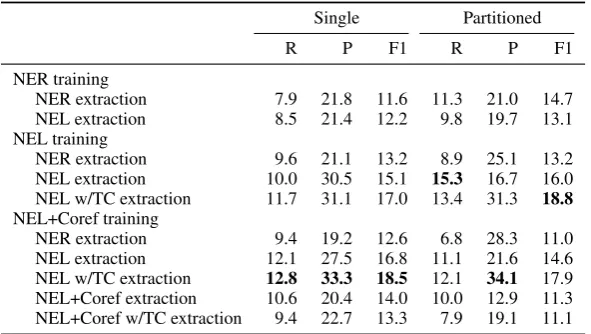
Table 1: Evaluation of different versions of the relation extraction system on the GORECOtest set. For
nearly all systems, partitioning the model by argument types boosts F1, as does using NEL at either training or extraction time, and using coreference at training time with type constraints (w/TC) raises F1 except with coreference at extraction time and when combined with type partitioning.
[image:8.595.315.517.427.528.2]and extraction, with type constraints, Partitioned) results in a decrease in F1 from 18.8% to 17.0%. Table 2 shows by-relation performance results for the best system (curveNEL+TC+TPin Figure 3a).
6.6 Other Dimensions Explored
We also experimented with adding generalized features that replaced lexemes with WordNet classes (Fellbaum, 1998), which had uneven re-sults. We observed a small but consistent improve-ment on the NER baseline (11.6% F1 to 12.7% F1 on GORECO), but after introducing NEL
argu-ment identification and partitioning, we no longer observed the improvement. For some relations, there was a small gain in recall that was offset by a loss in precision, but for others, the gain in recall outweighed the loss of precision.
We experimented with a negative instance feed-back loop that ran a trained extractor over the training corpus and tested whether each extrac-tion made was in fact a negative example. Even though the training corpus contains one million documents, this method only yielded a few thou-sand new negative instances due to the difficulty of being certain an extraction should be negative. A naïve approach would simply ensure that both entities participate in a relation in the KB; this is troublesome, because of KB incompleteness and because of type errors. For example Freebase con-tainsBornIn(Barack Obama, Honolulu), but our ex-tractor extracted BornIn(Barack Obama, Hawaii). To avoid labeling this true extraction as a nega-tive instance we have to be robust about location
semantics. We selected new negative instances
NA(e1, e2) from our initial extractor that had e1
in the knowledge base, withe1participating as the
first argument in the extracted relation but with-oute2 as the second argument. The results were
promising for some relations but overall inconclu-sive as identifying true negatives is quite difficult.
Relation #Extractions #TP #FP
Nationality 50 11 38
Profession 43 23 20
EmployedBy 27 17 10
Spouse 22 2 20
LivedIn 6 4 2
OrgInCitytown 4 3 1
AthletePlaysForTeam 2 2 0
OrgType 1 1 0
Table 2: By-relation evaluation of the best system (NEL with type constraints and type partitioning) on the GORECO test set. The true positives (TP)
are the number of gold relations over coreference clusters that matched, so multiple extractions can match a single true positive.
7 Related Work
learning and extract over newswire text using Freebase relations. Surdeanu et al. (2012) take a similar approach and use soft constraints and lo-gistic regression. Riedel et al. (2013) integrate open information extraction with schema-based, proposing a universal schema approach, including using features based on latent types. There has also been recent work on reducing noise in dis-tantly supervised relation extraction (Nguyen and Moschitti, 2011; Takamatsu et al., 2012; Roth et al., 2013; Ritter et al., 2013). Xu et al. (2013) and Min et al. (2013) improve the quality of distant su-pervision training data by reducing false negative examples.
Distant supervision is related to semi-supervised bootstrap learning work such as Carlson et al. (2010b) and many others. Note that distant supervision can be viewed as a subroutine of bootstrap learning; bootstrap learning can continue the process of distant supervision by taking the new tuples found and then training on those again, and repeating the process.
There has also been work on performing NEL and coreference jointly (Cucerzan, 2007; Ha-jishirzi et al., 2013), however these systems do not perform relation extraction. Singh et al. (2013) performs joint relation extraction, NER, and coref-erence in a fully-supervised manner. They get slight improvement by adding coreference, but do not use NEL. Ling and Weld (2013) extend MUL -TIR to find meronym relations in a biology
text-book. They get slight improvement over NER by using coreference to pick the best mention of an entity in the sentence for the meronym relation at training and extraction time.
8 Conclusions and Future Work
Given the growing importance of distant supervi-sion, a comprehensive understanding of its vari-ants is crucial. While some of the optimizations we propose may seem intuitive, they have not pre-viously been systematically explored. Our experi-ments show that NEL, type constraints, and type partitioning are extremely important in order to best take advantage of the seed KB during training as well as known information at extraction time. Our best system results in a 44% increase in pre-cision, and a 70% increase in recall over our NER baseline using GORECO. While we were not able
to evaluate all our methods on Hoffmann et al. (2011)’s sentential evaluation, our baseline
per-forms significantly better than previous methods, especially in precision, and training-only modifi-cations perform similarly in both evaluations.
Future work will explore the use of NEL in dis-tantly supervised relation extraction further, tun-ing a confidence parameter for the NEL system, and determining whether different confidence pa-rameters should be used for training and extrac-tion. Another possible direction is interleaving NEL with relation extraction by using newly ex-tracted facts to try to improve NEL performance.
We freely distribute GORECO a new gold
stan-dard evaluation for relation extraction consisting of exhaustive annotations of the 128 documents from ACE 2004 newswire for 48 relations. The source code of our system, its output, as well as our gold data are available at
http://cs.uw.edu/homes/mkoch/re.
Acknowledgements
We thank Raphael Hoffmann, Luke Zettlemoyer, Mausam, Xiao Ling, Congle Zhang, Hannaneh Hajishirzi, Leila Zilles, and the anonymous re-viewers for helpful feedback. Additionally, we thank Anand Mohan and Graeme Britz for annota-tions and revisions of the GORECO dataset. This
work was supported by Defense Advanced Re-search Projects Agency (DARPA) Machine Read-ing Program under Air Force Research Labora-tory (AFRL) prime contract no. FA8750-09-C-0181, ONR grant N00014-12-1-0211, a gift from Google, a grant from Vulcan, and the WRF / TJ Cable Professorship. This material is based upon work supported by the National Science Founda-tion Graduate Research Fellowship under Grant No. DGE-1256082.
References
Andrew Carlson, Justin Betteridge, Bryan Kisiel, Burr Settles, Estevam R. Hruschka Jr., and Tom M. Mitchell. 2010a. Toward an architecture for never-ending language learning. In Proceedings of the AAAI Conference on Artificial Intelligence (AAAI-10).
Eugene Charniak and Mark Johnson. 2005. Coarse-to-fine n-best parsing and maxent discriminative reranking. InProceedings of the 43rd Annual Meet-ing on Association for Computational LMeet-inguistics, ACL ’05, pages 173–180, Stroudsburg, PA, USA. Association for Computational Linguistics.
Xiao Cheng and Dan Roth. 2013. Relational inference for wikification. InEMNLP.
Silviu Cucerzan. 2007. Large-scale named entity dis-ambiguation based on wikipedia data. In EMNLP-CoNLL, pages 708–716.
Marie-Catherine de Marneffe and Christopher D. Man-ning. 2008. The stanford typed dependencies rep-resentation. In Coling 2008: Proceedings of the Workshop on Cross-Framework and Cross-Domain Parser Evaluation, CrossParser ’08, pages 1–8, Stroudsburg, PA, USA. Association for Computa-tional Linguistics.
George R. Doddington, Alexis Mitchell, Mark A. Przy-bocki, Lance A. Ramshaw, Stephanie Strassel, and Ralph M. Weischedel. 2004. The automatic content extraction (ace) program-tasks, data, and evaluation. InLREC.
Christiane Fellbaum, editor. 1998. WordNet: an elec-tronic lexical database. MIT Press.
Jenny Rose Finkel, Trond Grenager, and Christopher Manning. 2005. Incorporating non-local informa-tion into informainforma-tion extracinforma-tion systems by gibbs sampling. InProceedings of the 43rd Annual Meet-ing on Association for Computational LMeet-inguistics, ACL ’05, pages 363–370, Stroudsburg, PA, USA. Association for Computational Linguistics.
Google. 2012. Freebase data dumps.
https://developers.google.com/
freebase/data.
Ben Hachey, Will Radford, Joel Nothman, Matthew Honnibal, and James R. Curran. 2013. Evalu-ating entity linking with wikipedia. Artif. Intell., 194:130–150, January.
Hannaneh Hajishirzi, Leila Zilles, Daniel S. Weld, and Luke S. Zettlemoyer. 2013. Joint coreference res-olution and named-entity linking with multi-pass sieves. InEMNLP, pages 289–299. ACL.
Raphael Hoffmann, Congle Zhang, Xiao Ling, Luke Zettlemoyer, and Daniel S. Weld. 2011. Knowledge-based weak supervision for information extraction of overlapping relations. In ACL-HLT, pages 541–550.
Sayali Kulkarni, Amit Singh, Ganesh Ramakrishnan, and Soumen Chakrabarti. 2009. Collective annota-tion of wikipedia entities in web text. In Proceed-ings of the 15th ACM SIGKDD International Con-ference on Knowledge Discovery and Data Mining, KDD ’09, pages 457–466, New York, NY, USA. ACM.
Heeyoung Lee, Angel Chang, Yves Peirsman, Nathanael Chambers, Mihai Surdeanu, and Dan Ju-rafsky. 2013. Deterministic coreference resolu-tion based on entity-centric, precision-ranked rules. Comput. Linguist., 39(4):885–916, December. Xiao Ling and Daniel S. Weld. 2012. Fine-grained
entity recognition. InProceedings of the 26th Con-ference on Artificial Intelligence (AAAI).
Xiao Ling and Daniel S. Weld. 2013. Extracting meronyms for a biology knowledge base using dis-tant supervision. In Automated Knowledge Base Construction (AKBC) 2013: The 3rd Workshop on Knowledge Extraction at CIKM.
Paul McNamee and Hoa Trang Dang. 2009. Overview of the tac 2009 knowledge base population track. In Text Analysis Conference (TAC), volume 17, pages 111–113.
David Milne and Ian H. Witten. 2008. Learning to link with wikipedia. In Proceedings of the 17th ACM Conference on Information and Knowledge Man-agement, CIKM ’08, pages 509–518, New York, NY, USA. ACM.
Bonan Min, Ralph Grishman, Li Wan, Chang Wang, and David Gondek. 2013. Distant supervision for relation extraction with an incomplete knowledge base. In Proceedings of NAACL-HLT, pages 777– 782.
Mike Mintz, Steven Bills, Rion Snow, and Daniel Ju-rafsky. 2009. Distant supervision for relation ex-traction without labeled data. InProceedings of the 47th Annual Meeting of the Association for Compu-tational Linguistics (ACL-2009), pages 1003–1011. Tom M. Mitchell, Justin Betteridge, Andrew Carlson,
Estevam Hruschka, and Richard Wang. 2009. Pop-ulating the semantic web by macro-reading internet text. InThe Semantic Web-ISWC 2009, pages 998– 1002. Springer.
Truc-Vien T. Nguyen and Alessandro Moschitti. 2011. End-to-end relation extraction using distant super-vision from external semantic repositories. In Pro-ceedings of the 49th Annual Meeting of the Associ-ation for ComputAssoci-ational Linguistics: Human Lan-guage Technologies: Short Papers - Volume 2, HLT ’11, pages 277–282, Stroudsburg, PA, USA. Associ-ation for ComputAssoci-ational Linguistics.
Lev Ratinov, Dan Roth, Doug Downey, and Mike Anderson. 2011. Local and global algorithms for disambiguation to wikipedia. In Proceedings of the 49th Annual Meeting of the Association for Computational Linguistics: Human Language Tech-nologies - Volume 1, HLT ’11, pages 1375–1384, Stroudsburg, PA, USA. Association for Computa-tional Linguistics.
Sebastian Riedel, Limin Yao, Benjamin M. Marlin, and Andrew McCallum. 2013. Relation extraction with matrix factorization and universal schemas. InJoint Human Language Technology Conference/Annual Meeting of the North American Chapter of the Asso-ciation for Computational Linguistics (HLT-NAACL ’13), June.
Alan Ritter, Luke Zettlemoyer, Mausam, and Oren Et-zioni. 2013. Modeling missing data in distant super-vision for information extraction. TACL, 1:367–378.
Benjamin Roth, Tassilo Barth, Michael Wiegand, and Dietrich Klakow. 2013. A survey of noise reduction methods for distant supervision. InProceedings of the 2013 Workshop on Automated Knowledge Base Construction, AKBC ’13, pages 73–78, New York, NY, USA. ACM.
Sameer Singh, Sebastian Riedel, Brian Martin, Jiaping Zheng, and Andrew McCallum. 2013. Joint infer-ence of entities, relations, and coreferinfer-ence. InCIKM Workshop on Automated Knowledge Base Construc-tion (AKBC).
Pontus Stenetorp, Sampo Pyysalo, Goran Topi´c, Tomoko Ohta, Sophia Ananiadou, and Jun’ichi Tsu-jii. 2012. brat: a Web-based Tool for NLP-Assisted Text Annotation. InProceedings of the Demonstra-tions at the 13th Conference of the European Chap-ter of the Association for Computational Linguistics, Stroudsburg, PA, USA, April. Association for Com-putational Linguistics.
Mihai Surdeanu, Julie Tibshirani, Ramesh Nallapati, and Christopher D. Manning. 2012. Multi-instance multi-label learning for relation extraction. In Pro-ceedings of the 2012 Joint Conference on Empirical Methods in Natural Language Processing and Com-putational Natural Language Learning, pages 455– 465. Association for Computational Linguistics.
Shingo Takamatsu, Issei Sato, and Hiroshi Nakagawa. 2012. Reducing wrong labels in distant supervi-sion for relation extraction. In Proceedings of the 50th Annual Meeting of the Association for Compu-tational Linguistics: Long Papers - Volume 1, ACL ’12, pages 721–729, Stroudsburg, PA, USA. Associ-ation for ComputAssoci-ational Linguistics.
Kristina Toutanova, Dan Klein, Christopher D. Man-ning, and Yoram Singer. 2003. Feature-rich part-of-speech tagging with a cyclic dependency network. InProceedings of the 2003 Conference of the North American Chapter of the Association for Computa-tional Linguistics on Human Language Technology - Volume 1, NAACL ’03, pages 173–180, Strouds-burg, PA, USA. Association for Computational Lin-guistics.
Wei Xu, Zhao Le, Raphael Hoffmann, and Ralph Gr-ishman. 2013. Filling knowledge base gaps for dis-tant supervision of relation extraction. In Proceed-ings of the 2013 Conference of the Association for
Computational Linguistics (ACL 2013), Sofia, Bul-garia, July. Association for Computational Linguis-tics.