IDIOT - Users Guide.
Mark Crosbie [email protected]
Bryn Dole [email protected]
Todd Ellis [email protected]
Ivan Krsul [email protected]
Eugene Spafford [email protected]
Technical Report TR-96-050
Abstract
Chapter 1
Introduction
This document is the users guide for the IDIOT intrusion detection system developed at the COAST Laboratory.
This section will remain short because a much better description of what IDIOT is, the design goals and the model it works under can be found in the documents included in thedoc/IDIOTdirectory in the IDIOT distribution.
The files in that directory are:
kumar-spaf-overview.ps [KS94] This report examines and classifies the characteristics of signatures used in misuse intrusion detection. The document describes a generalized model for matching intrusion signatures based on Colored Petri Nets. This is the first document you should read. We recommend that you stop reading this guide now and return here when you have finished reading that document.
kumar-intdet-phddiss.ps [Kum95] Sandeep Kumar’s original Ph.D. thesis. An in-depth description of intrusion detection, the theoretical considerations behind IDIOT, and a description of the model that was used to implement IDIOT.
taxonomy.ps [KS95] This report classifies UNIX vulnerabilities based on the signatures required to detect them, and gives the best overview on how to write IDIOT patterns with examples from real UNIX vulnerabilities. We recommend that you read this document last before you start writing patterns of your own.
IDIOT work.ps [ES96b] This report outlines the structure of IDIOT, explaining how the components fit and work together. It also describes results from profiling IDIOT against two audit trails and suggests possible approaches to optimizing the program.
Chapter 2
Quick Start
The information in this chapter will help you get IDIOT running as fast as possible. However, we suggest that you read the rest of the material in this document before you attempt to use IDIOT.
The following steps must be executed to install IDIOT correctly:
Read this document at least once
Edit the Makefile to set the appropriate values for your site Give the command “make C2 appl”
Make sure thatprauditis in your path Run IDIOT
For the rest of this section we give an example of how to install and run IDIOT for the first time.
We start in a directory that contains only the IDIOT tar file:
solaria 51 % pwd
/.mordor/home/gollum/IDIOT
solaria 52 % ls idiot.tar
Extract the files from thetarfile: solaria 53 % tar xfv idiot.tar
x doc, 0 bytes, 0 tape blocks x doc/manual, 0 bytes, 0 tape blocks
x doc/manual/docs.ps, 135856 bytes, 266 tape blocks x doc/IDIOT, 0 bytes, 0 tape blocks
x doc/IDIOT/kumar-intdet-phddiss.ps, 903856 bytes, 1766 tape blocks x doc/IDIOT/kumar-spaf-overview.ps, 673780 bytes, 1316 tape blocks x doc/IDIOT/taxonomy.ps, 645109 bytes, 1260 tape blocks
x C2_patterns, 0 bytes, 0 tape blocks
x C2_patterns/creating-setid-scripts, 440 bytes, 1 tape blocks x C2_patterns/executing-progs, 1618 bytes, 4 tape blocks x C2_patterns/lpr_copy_files, 1295 bytes, 3 tape blocks x C2_patterns/print-mknods, 918 bytes, 2 tape blocks x C2_patterns/setuid-writes-setuid, 3026 bytes, 6 tape blocks x C2_patterns/writing-to-executable-files, 2671 bytes, 6 tape blocks x C2_patterns/writing-to-nonowned-files, 1711 bytes, 4 tape blocks x apps, 0 bytes, 0 tape blocks
x other_C2_patterns/clarke-wilson, 2813 bytes, 6 tape blocks x other_C2_patterns/dir-browser, 1266 bytes, 3 tape blocks
x other_C2_patterns/dont-follow-sym-links, 2938 bytes, 6 tape blocks x other_C2_patterns/failed-su, 307 bytes, 1 tape blocks
x other_C2_patterns/finger, 1041 bytes, 3 tape blocks x other_C2_patterns/le, 1525 bytes, 3 tape blocks
x other_C2_patterns/passwd-Fattack, 1593 bytes, 4 tape blocks x other_C2_patterns/priv-pgm-in-userspace, 575 bytes, 2 tape blocks x other_C2_patterns/rcw, 2185 bytes, 5 tape blocks
x other_C2_patterns/setid-pgms-cant-spawn-shell, 1076 bytes, 3 tape blocks x other_C2_patterns/shell-script-attack, 532 bytes, 2 tape blocks x other_C2_patterns/tftp, 1239 bytes, 3 tape blocks
x other_C2_patterns/timing-attack, 1122 bytes, 3 tape blocks
x other_C2_patterns/writing-to-nonowned-dot-files, 1057 bytes, 3 tape blocks x audit_trails, 0 bytes, 0 tape blocks
x audit_trails/creating-setid-scripts.audit_trail, 42632 bytes, 84 tape blocks x audit_trails/executing-progs.audit_trail, 20389 bytes, 40 tape blocks x audit_trails/lpr_copy_files.audit_trail, 1125555 bytes, 2199 tape blocks x audit_trails/print-mknods.audit_trail, 23070 bytes, 46 tape blocks x audit_trails/setuid-writes-setuid.audit_trail, 15496 bytes, 31 tape blocks x audit_trails/writing-to-executable-files.audit_trail, 8975 bytes, 18 tape blocks x audit_trails/writing-to-nonowned-files.audit_trail, 8376 bytes, 17 tape blocks x C2_Server.C, 15997 bytes, 32 tape blocks
x DL_list.h, 2807 bytes, 6 tape blocks x pattern.l, 8072 bytes, 16 tape blocks x C2_Server.h, 3425 bytes, 7 tape blocks x Expr.C, 14448 bytes, 29 tape blocks x praudit.h, 3174 bytes, 7 tape blocks x C2_appl.C, 5500 bytes, 11 tape blocks x IP_Server.C, 47532 bytes, 93 tape blocks x C2_events.h, 12287 bytes, 24 tape blocks x showaudit.pl, 16986 bytes, 34 tape blocks x utilities.C, 4086 bytes, 8 tape blocks x utils.h, 3248 bytes, 7 tape blocks x Makefile, 9519 bytes, 19 tape blocks x DL_Ilist.C, 1087 bytes, 3 tape blocks x abs_class.h, 1282 bytes, 3 tape blocks x pat.y, 74752 bytes, 146 tape blocks x DL_Ilist.h, 1445 bytes, 3 tape blocks x pattern.h, 14607 bytes, 29 tape blocks x README, 24 bytes, 1 tape blocks
solaria 54 % ls
C2_Server.C DL_list.h audit_trails/ praudit.h
C2_Server.h Expr.C doc/ showaudit.pl*
C2_appl.C IP_Server.C idiot.tar utilities.C C2_events.h Makefile other_C2_patterns/ utils.h C2_patterns/ README pat.y
DL_Ilist.C abs_class.h pattern.h DL_Ilist.h apps/ pattern.l
Make theC2 applapplication: solaria 56 % /usr/local/gnu/make C2_appl /opt/SUNWspro/bin/CC -xpg +d -c C2_appl.C
"C2_appl.C", line 138: Warning (Anachronism): Formal argument patternfile of type char* in call to C2_Server::parse_file(char*) is being passed const char*.
"C2_appl.C", line 138: Note: Type "CC -migration" for more on anachronisms.
"C2_appl.C", line 144: Warning (Anachronism): Formal argument file of type char* in call to C2_Server::dllink_file(char*) is being passed const char*.
2 Warning(s) detected.
/opt/SUNWspro/bin/CC -xpg +d -c C2_Server.C
"/usr/include/sys/sysmacros.h", line 104: Warning (Anachronism): Attempt to redefine major without using #undef.
"/usr/include/sys/sysmacros.h", line 104: Note: Type "CC -migration" for more on anachronisms.
"/usr/include/sys/sysmacros.h", line 109: Warning (Anachronism): Attempt to redefine minor without using #undef.
"/usr/include/sys/sysmacros.h", line 115: Warning (Anachronism): Attempt to redefine makedev without using #undef.
3 Warning(s) detected. yacc -d -v pat.y 2 rules never reduced
conflicts: 11 shift/reduce, 2 reduce/reduce
/opt/SUNWspro/bin/CC -xpg +d -c -o yacc.o y.tab.c
"pattern.h", line 432: Warning (Anachronism): Temporary created for argument newt in call to Table<int>::push(int&).
"pattern.h", line 432: Note: Type "CC -migration" for more on anachronisms. 1 Warning(s) detected.
lex pattern.l
/opt/SUNWspro/bin/CC -xpg +d -c -o lex.o lex.yy.c
"pattern.h", line 432: Note: Type "CC -migration" for more on anachronisms. 1 Warning(s) detected.
/opt/SUNWspro/bin/CC -c -xpg +d Expr.C -o Expr.o
"pattern.h", line 432: Warning (Anachronism): Temporary created for argument newt in call to Table<int>::push(int&).
"pattern.h", line 432: Note: Type "CC -migration" for more on anachronisms. 1 Warning(s) detected.
/opt/SUNWspro/bin/CC -xpg +d -c utilities.C
/opt/SUNWspro/bin/CC -xpg +d C2_appl.o C2_Server.o yacc.o lex.o Expr.o \ utilities.o -ldl -lrwtool -lgen -o C2_appl
Make sure that theprauditcommand in in the execution path. solaria % which praudit
/usr/sbin/praudit
solaria 65 % set path=($path /usr/sbin)
Run theC2 applaplication to test the program. In this case we will compile, link and run a sample pattern and audit trail shipped with IDIOT. Parse the pattern:
solaria 57 % ./C2_appl
tini> parse C2_patterns/creating-setid-scripts Parsing file C2_patterns/creating-setid-scripts
---Inside stmt reduced expr: printf("User id %d has successfully setid’ed %file %s\n", unified_tok->get_RUID(), unified_tok->get_FULL_NAME())
---Inside stmt reduced expr: ((((eve->ERR() == 0) && unified_tok->assign_RUID(eve->RUID())) && unified_tok->assign_FULL_NAME(eve->OBJ())) && eve->OBJ_NEWMODS() > 511)
---Parsing transition chmod
---start -> chmod
<-after_chmod ->
<- chmod
---CC -pic -G -g -o cr_setid_pgms.so cr_setid_pgms.C
"cr_setid_pgms.C", line 290: Warning (Anachronism): Formal argument val of type char* in call to C2_cr_setid_pgms_Token::assign_FULL_NAME(char*) is being passed const char*. "cr_setid_pgms.C", line 290: Note: Type "CC -migration" for more on anachronisms. 1 Warning(s) detected.
Done compiling cr_setid_pgms.C Inside create pattern.
Instantiated new pattern instance for cr_setid_pgms
Link the resulting compiled pattern:
tini> dlink /homes/gollum/IDIOT/cr_setid_pgms.so Linking file /homes/gollum/IDIOT/cr_setid_pgms.so Inside create pattern.
Run the pattern with the corresponding audit trail.
tini> run audit_trails/creating-setid-scripts.audit_trail
Showaudit: will execute the following command: tail +0 audit_trails/creating-setid-scripts.audit_trail | praudit -r | User id 833 has successfully setid’ed file /.mordor/home/gollum/aaa.aaa
User id 833 has successfully setid’ed file /.mordor/home/gollum/bbb.bbb User id 833 has successfully setid’ed file /.mordor/home/gollum/ccc.ccc User id 833 has successfully setid’ed file /.mordor/home/gollum/ddd.ddd Showaudit: No of dropped events = 147
Chapter 3
IDIOT Patterns
There are currently three classes of pattern being shipped with IDIOT. They are:
1. Written and tested patterns. These are patterns that we have written and tested and can present audit trails known to trigger the patterns.
2. Written but not tested. These patterns were written but could not be tested either through lack of time or limitations in the underlying audit trail.
3. Theoretical patterns. These patterns are written to demonstrate a particular point, but cannot be handled by the IDIOT system currently.
Each of the following sections describes the different pattern types.
3.1
Written and Tested patterns
These patterns have been written and tested. They are shipped as working patterns to demonstrate IDIOT’s capabilities, and to be used in a real environment.
These patterns can be found in theC2 patternsdirectory. The audit trails to exercise these patterns are in a directory audit trails under the main IDIOT distribution directory. Each pattern has an associated audit file named<pattern name> audit filein theaudit trailsdirectory.
3.1.1
Detecting when programs create setuid programs. PATTERN:creating-setid-scripts
Very few programs should create setuid files and system administrators often run programs that search the file system looking for unauthorized setuid files. This pattern will warn when a program creates a seuid file.
Vulnerabilities detected
State machine
Figure 3.1 illustrates the pattern.
Start After_chmod CHMOD
Figure 3.1: State machine
Pattern being used
pattern cr_setid_pgms "Monitor creation of setid programs." priority 7 state start, after_chmod;
str FULL_NAME; int RUID; post_action {
printf("User id %d has successfully setid’ed file %s\n", RUID, FULL_NAME); }
trans chmod(CHMOD) <- start; -> after_chmod; |_ {
this[ERR] = 0 && RUID = this[RUID] && FULL_NAME = this[OBJ] && this[OBJ_NEWMODS] > 511;
} end chmod; end cr_setid_pgms;
Note: the final clause in this guard would be best written as:
(this[OBJ_NEWMODS] & 06000) && (this[OBJ_NEWMODS] & 0111)
Discussion
The pattern described in this document was tested under Solaris 2.4 using the BSM C2 audit trail generated by theauditddaemon.
An attacker, a user called gollum, ran the following exploit script.
#!/bin/sh
touch aaa.aaa touch bbb.bbb touch ccc.ccc touch ddd.ddd
chmod 2750 aaa.aaa # setgid chmod 4755 bbb.bbb # setuid
chmod ugo+xs ccc.ccc # setuid and setgid
The execution of IDIOT server with the audit trail generated for user gollum produces the following output:
User id 833 has successfully setid’ed file /.mordor/home/gollum/aaa.aaa User id 833 has successfully setid’ed file /.mordor/home/gollum/bbb.bbb User id 833 has successfully setid’ed file /.mordor/home/gollum/ccc.ccc User id 833 has successfully setid’ed file /.mordor/home/gollum/ddd.ddd
3.1.2
Detecting the execution of attack programs. PATTERN: executing-progs
Sometimes users import attack scripts and run them with little or no modifications. We can detect the execution of well known attack scripts and programs by searching for well-known program names.
Vulnerabilities detected
CA-93:14 Internet Security Scanner will scan sites for potential security holes.
CA*** Crack tool for obtaining passwords.
State machine
Figure 3.2 illustrates the pattern.
Start After_exec
EXECVE
Figure 3.2: State machine
Pattern being used
extern str Basename(str);
pattern ex_prt_pgms "Watch for executions of cops/gimme etc." priority 7 state start, after_exec;
str FULL_PROG, PROG; int RUID;
post_action {
printf("User id %d has successfully executed %s\n", RUID, FULL_PROG); }
/*
* The routine Basename is defined as a call to the system function * basename. Given a pointer to a null-terminated character string that * contains a path name, basename() returns a pointer to the last element * of the path. Trailing "/" characters are deleted.
*/
trans exec(EXECVE) <- start; -> after_exec;
FULL_PROG = this[PROG] &&
(PROG =˜ "cops" || PROG =˜ "gimme" || PROG =˜ "crack"); } end exec;
end execute_particular_pgms;
Note: this pattern can also detect the [CA-95:06] advisory on the SATAN tool. This can be done by addingPROG =˜"satan"to the last clause in the guard.
Discussion
How does this pattern work? It is composed of essentially one transition — when an EXECVE occurs, it checks to see if the executed program is one of the prohibited list. If it is, then the pattern has terminated, and the post action is taken. This prints out a friendly informational message.
We need to know two things while executing this pattern; the name of the program being exec’d and the user id of the user executing the program. When theexecvesystem call is executed, the name of the program to execute is specified. This is recorded in the audit file. We can access this program name using thethis[PROG]construct, which returns the program name from this audit record. We record the full program name in the variableFULL PROGso it can be displayed in the post action. This variable is of type str, which is a string class from the Rogue Wave library.
The user id is returned using thethis[RUID]construct. It extracts the uid field of the audit record. We assign it to a local variable so it can be displayed later in the post action.
To actually detect running a specific program, we use the pattern matching operator=˜. This works as in PERL. In this case, we are only interested in exactly the filename specified.
The pattern described in this document was tested under Solaris 2.4 using the BSM C2 audit trail generated by theauditddaemon. An attacker, a user called gollum, has the following files in his home directory:
gollum % ls -l
-rwxrw-r-- 2 gollum gollum 10 Nov 26 18:13 crack* -rwxrw-r-- 1 gollum gollum 45 Nov 26 18:14 exploit* -rwxrw-r-- 2 gollum gollum 10 Nov 26 18:13 hidden_hard* lrwxrwxrwx 1 gollum gollum 5 Nov 26 18:14 hidden_sym -> crack*
Theexploitscript executed contains the commands: #!/bin/sh
./crack ./hidden_sym ./hidden_hard
The execution of IDIOT on the audit trail generated for user gollum on produces the following output:
User id 833 has successfully executed /.mordor/home/gollum/crack User id 833 has successfully executed /.mordor/home/gollum/crack
header,118,2,execve(2),,Sun Nov 26 18:16:12 1995, + 258009000 msec path,/.mordor/home/gollum/crack
attribute,100764,gollum,gollum,38535233,40582,0
subject,gollum,gollum,gollum,gollum,gollum,17720,18887,0 5 solaria return,success,0
header,119,2,execve(2),,Sun Nov 26 18:16:12 1995, + 348002000 msec path,/.mordor/home/gollum/crack
attribute,100764,gollum,gollum,38535233,40582,0
subject,gollum,gollum,gollum,gollum,gollum,17721,18887,0 5 solaria return,success,0
3.1.3
lpr can copy a file over any arbitrary file: PATTERN: lpr copy files
The line printer program can be made to overwrite arbitrary files on the system.lpris a setuid root program that copies files to print into the spooler directory. The files are then printed from the spooler directory. If the-soption is used, thelprprogram creates a link to the file in the spool directory. However, the temporary names created in the spool directory will wrap around after 1000 print jobs.
By forcing these names to wrap around, thelprprogram can copy an arbitrary file over a link which points to a destination file. This will cause the destination file to be overwritten, even if the user did not have permission to access that file.
Vulnerabilities detected
8lgm -Advisory-3.UNIX.lpr.19-Aug-1991lprcan overwrite any arbitrary file.
[image:11.612.213.404.476.524.2]State machine
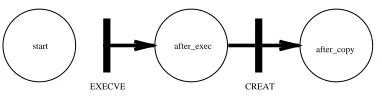
Figure 3.3 illustrates the pattern.
after_exec after_copy start
CREAT EXECVE
Figure 3.3: Detect lpr copying arbitrary files
Pattern being used
/*
* lpr_copy_files *
* Detects if lpr tries to overwrite a file outside of /usr/spool *
* [8lgm]-Advisory-3.UNIX.lpr.19-Aug-1991 *
* Mark Crosbie February 1996 */
extern int strmatch(str, str);
pattern lpr_copy_files "lpr copies files not in spool dir" priority 7
state start, after_lpr_exec, after_copy; str PROG, FILE;
int RUID, PID;
post_action {
printf("User %d attempted to copy over file %s\n", RUID, FILE); }
/* the invariant states that we will delete tokens in the state * machine once the process exits. If lpr exits, there’s no point * continuing to try to match for the attack.
*/
neg invariant first_inv /* negative invariant */ state start_inv, final;
trans exit(EXIT) <- start_inv; -> final;
|_ { PID = this[PID]; } end exit;
end first_inv;
trans exec_lpr(EXECVE) <- start;
-> after_lpr_exec; |_ {
this[ERR] = 0 && PID = this[PID] && PROG = this[PROG] && RUID = this[RUID] &&
(strmatch(".*lpr", this[PROG]) = 1) && this[EUID] = 0; }
end exec_lpr;
trans do_copy(CREAT) <- after_lpr_exec; -> after_copy; |_ {
this[ERR] = 0 && this[PID] = PID && FILE = this[OBJ] && (inTree("ˆ/var/spool/", this[OBJ]) = 0);
} end do_copy;
end lpr_copy_files;
Discussion
The lpr command is a setuid root program that places files in the spool directory on behalf of users. Typically it places a copy of the file in the spool directory, but if given the-s option, it will create a symbolic link to the file in the spool directory. If given the-qoption, it will place the file in the directory, but not enqueue it for printing.
The files in the spool directory have a very predictable name. The name of a spool file starts withcffor a control file anddffor its associated data file. For example, executing the commandlpr -Poz -q -s .aliases(where oz is the name of our local printer), creates the two files in the/var/spool/lpq/oz directory:
-rw-rw---- 1 daemon daemon 152 Feb 19 17:54 cfA278yavin.cs.purdue.edu
lrwxrwxrwx 1 root daemon 23 Feb 19 17:54 dfA278yavin.cs.purdue.edu -> /home/mcrosbie/.aliases
The number after thecfAanddfApart of the file names will increment after every print command. Thus, after a thousand print commands, the filedfA278yavin.cs.purdue.eduwill be reused.
you want to overwrite with. Thelprprogram will write over the existing link, and as it is setuid root, it can overwrite whatever that link pointed to.
The IDIOT pattern presented above detects this attack by seeing if thelprprogram overwrites any files outside of the/var/spooldirectory tree. If so, it prints a warning. The audit trail in Solaris encodes the final destination filename when accessing a link, so this is available to the pattern.
A sample run is shown below:
tini> run audit_data/lpr_copy_files.audit_data
Showaudit: will execute the following command: tail +0 audit_data/lpr_copy_files.audit_data | praudit -r | Showaudit: No of dropped events = 123
User 727 attempted to copy over file /home/mcrosbie/tmp/overwriteme User 727 attempted to copy over file /home/mcrosbie/tmp/overwriteme tini> Program ended
3.1.4
Print all executions of
mknod
. PATTERN: print-mknods
If a user creates a device, it is possible to access the disk or other system resources without proper authorization. For example, if a user created a device in a local directory with the same device numbers as the root disk, then that user could access and change any information on the disk.
Pattern State Machine
The state machine is very simple and is shown in Figure 3.4.
start
MKNOD
[image:13.612.246.371.425.466.2]after_mknod
Figure 3.4: State machine for detecting mknods
Pattern code
/*
* print-mknods *
* Print all successful mknods *
* Mark Crosbie November 1995 */
/* returns TRUE if the mode of the file corresponds to a block special * or char special file - is it a device?
*/
extern int isdev(int);
pattern mknod "Print all successful mknods" priority 7 state start, after_mknod;
int RUID, DEV;
/* path of the device the user created */ str PATH;
post_action {
printf("User id %d successfully created a device in %s.\n", RUID, PATH); }
/* only one transition needed - if we see a MKNOD event then see if * the user has successfully created a device
*/
trans makenode(MKNOD) <- start;
-> after_mknod; |_ {
/* isdev() returns TRUE if the device mode used in the mknod() * indicates a device type (either char or block special) */
this[ERR] = 0 && isdev(this[DEV_MODE]) = 1 && RUID = this[RUID] && PATH = this[OBJ]; }
end makenode; end mknod;
Discussion
When a device is created, themknodcommand is used. A parameter specifies the mode used to create the device. If this mode indicates that this is a block special or character special file, then the message is printed.
A utility routineisdev()is used to check the mode of the device being created. If this is special file (i.e. a device),isdev()returns TRUE. If this occurs, and the MKNOD succeeded, then the user ID and path of the device are recorded and displayed.
Output from IDIOT
IDIOT produces the following output when presented with the attack audit trail:
tini> run audit_data/mknod.audit_data
Showaudit: will execute the following command: tail +0 audit_data/mknod.audit_data | praudit -r |
User id 0 successfully created a device in /home/mcrosbie/myIDIOT/audit_data/xxx. Showaudit: No of dropped events = 79
3.1.5
Detecting when setuid programs write to setuid or executable programs. PATTERN:
setuid-writes-setuid
Very few setuid programs should write to other setuid or executable files, and many attack scenarios share these characteristics. Rogue setuid programs will often create setuid shells or alter system owned executable programs to alter their behavior. Hence, it is desirable to detect whenever such behavior and report it as suspicious.
This pattern will warn when a setuid program creates or opens a seuid file (or executable program) for write. It will also report when a setuid program opens a setuid or executable file for read only, using the opensystem call, and specifies that the file should be created if it does not already exist.
8lgm-Advisory-3.UNIX.lpr.19-Aug-1991 Any user with access tolpr can alter system files and thus become root. We can only detect the vulnerability if lprcreates or opens for write a setuid or executable file.
8lgm-Advisory-11.UNIX.sadc.07-Jan-1992 sadccan be used to create files in normally unwritable di-rectories. sadc normally runs egid sys, and therefore can be used to create files in group sys writeable directories. We can only detect the vulnerability ifsadccreates or opens for write a setuid or executable file.
8lgm-Advisory-5.UNIX.mail.24-Jan-1992 A race condition exists in binmail, which allows files to be created in arbitrary places on the filesystem. These files can be owned by arbitrary (usually system) users. We can only detect the vulnerability ifbinmailcreates or opens for write a setuid or executable file.
8lgm-Advisory-6.UNIX.mail2.2-May-1994 The old race condition still exists in the patched binmail, which allows files to be created in arbitrary places on the filesystem. These files can be owned by arbitrary (usually system) users. We can only detect the vulnerability ifbinmailcreates or opens for write a setuid or executable file.
8lgm-Advisory-15.UNIX.mail3.28-Nov-1994 A hole inbinmailallows files to be created as root. We can only detect the vulnerability ifbinmailcreates or opens for write a setuid or executable file. CA-95:05 Sendmail Vulnerabilities February 22, 1995. This advisory supersedes all previous CERT
advisories onsendmail. The CERT Coordination Center has received reports of several problems withsendmail, one of which is widely known. The problems occur in many versions ofsendmail. We can only detect the vulnerability ifsendmailcreates or opens for write a setuid or executable file.
CA-95:08 Sendmail v.5 Vulnerability August 17, 1995. Insendmailversion 5, there is a vulnerability that intruders can exploit to create files, append to existing files, or execute programs. We can only detect the vulnerability ifsendmailcreates or opens for write a setuid or executable file.
State machine
Figure 3.5 illustrates the pattern.
Pattern being used
extern int isexec(int), issid(int);
/*
* Very few setuid programs should write to other setuid or executable * files. This pattern will warn when a setuid program creates or * opens a seuid file (or executable program) for write.
*/
pattern setuidwritessetuid "setuid program writes to a setuid or executable file" priority 10 int PID;
str FILE; str PROGNAME;
state start, after_exec, violation; post_action {
printf("setuid program %s created/opened for write the setuid or executable file %s.\n", PROGNAME, FILE);
Start After_exec EXECVE
Violation
CREAT OPEN_RWTC
OPEN_RWC OPEN_RW
OPEN
OPEN_WTC OPEN_WC
OPEN_W OPEN_RWT
[image:16.612.155.463.257.523.2]OPEN_RC
neg invariant first_inv /* negative invariant */ state start_inv, final;
trans exit(EXIT) <- start_inv; -> final;
|_ { PID = this[PID]; } end exit;
end first_inv;
trans exec(EXECVE) <- start; -> after_exec;
|_ { this[ERR] = 0 && PID = this[PID] && issid(this[OBJ_MODS]) = 1 && PROGNAME = this[PROG]; }
end exec;
trans mod3(CREAT) <- after_exec; -> violation;
|_ { this[ERR] = 0 && PID = this[PID] && FILE = this[OBJ] && (isexec(this[OBJ_MODS]) = 1 || issid(this[OBJ_MODS]) = 1); } end mod3;
trans mod4(OPEN_RW) <- after_exec; -> violation;
|_ { this[ERR] = 0 && PID = this[PID] && FILE = this[OBJ] && (isexec(this[OBJ_MODS]) = 1 || issid(this[OBJ_MODS]) = 1); } end mod4;
trans mod5(OPEN_RWC) <- after_exec; -> violation;
|_ { this[ERR] = 0 && PID = this[PID] && FILE = this[OBJ] && (isexec(this[OBJ_MODS]) = 1 || issid(this[OBJ_MODS]) = 1); } end mod5;
trans mod6(OPEN_RWTC) <- after_exec; -> violation;
|_ { this[ERR] = 0 && PID = this[PID] && FILE = this[OBJ] && (isexec(this[OBJ_MODS]) = 1 || issid(this[OBJ_MODS]) = 1); } end mod6;
trans mod7(OPEN_RWT) <- after_exec; -> violation;
|_ { this[ERR] = 0 && PID = this[PID] && FILE = this[OBJ] && (isexec(this[OBJ_MODS]) = 1 || issid(this[OBJ_MODS]) = 1); } end mod7;
trans mod8(OPEN_W) <- after_exec; -> violation;
|_ { this[ERR] = 0 && PID = this[PID] && FILE = this[OBJ] && (isexec(this[OBJ_MODS]) = 1 || issid(this[OBJ_MODS]) = 1); } end mod8;
trans mod9(OPEN_WC) <- after_exec; -> violation;
|_ { this[ERR] = 0 && PID = this[PID] && FILE = this[OBJ] && (isexec(this[OBJ_MODS]) = 1 || issid(this[OBJ_MODS]) = 1); } end mod9;
trans mod10(OPEN_WTC) <- after_exec; -> violation;
|_ { this[ERR] = 0 && PID = this[PID] && FILE = this[OBJ] && (isexec(this[OBJ_MODS]) = 1 || issid(this[OBJ_MODS]) = 1); } end mod10;
trans mod11(OPEN_WT) <- after_exec; -> violation;
|_ { this[ERR] = 0 && PID = this[PID] && FILE = this[OBJ] && (isexec(this[OBJ_MODS]) = 1 || issid(this[OBJ_MODS]) = 1); } end mod11;
trans mod12(OPEN_RC) <- after_exec; -> violation;
end setuidwritessetuid;
Discussion
The pattern described in this document was tested under Solaris 2.4 using the BSM C2 audit trail generated by theauditddaemon. The following setuid programs were created:
/* Program: test1 */ #include <stdio.h> #include <sys/types.h> #include <sys/stat.h> #include <fcntl.h>
main() {
/* create a setuid executable file */
creat("test1.c1", S_ISUID | S_IRWXU | S_IWGRP ); }
/* Program: test2 */ #include <stdio.h> #include <sys/types.h> #include <sys/stat.h> #include <fcntl.h>
main() {
/* Create a setuid program */
open("test2.c1", O_CREAT, S_ISUID | S_IRWXU | S_IWGRP ); /* Open the setuid program created by program test1 */ open("test1.c1", O_RDWR);
}
An attacker, a user calledgollum, ran these two program in order.
The execution of the IDIOT server on the audit trail generated for usergollum on produces the following output:
setuid program /home/krsul/test1 created/opened for write the setuid or executable file /.mordor/home/gollum/test1.c1. setuid program /home/krsul/test2 created/opened for write the
setuid or executable file /.mordor/home/gollum/test2.c1. setuid program /home/krsul/test2 created/opened for write the
setuid or executable file /.mordor/home/gollum/test1.c1.
3.1.6
Writing to Executable Files. PATTERN: writing-to-executable-files
Writing to an executable file is often evidence of viral behaviour. A virus may attempt to affect a program by inserting code at the start of the file which will be executed before the program contained in the code. This is very common on MSDOS machines. However, a UNIX system may still be vulnerable to this type of attack if executable files are left in place with write permission for users or groups.
Vulnerabilities detected
Pattern State Machine
The pattern is very simple. For each process that is EXECed, the pattern detects writes to a file by that process that has the execute permission bits set. If such a write is detected, the pattern has fired. Figure 3.6 shows this.
OPEN_RW
OPEN_RWC
OPEN_RWTC
OPEN_RWT OPEN_WT
OPEN_WTC
OPEN_WC
OPEN_W
EXECVE
after_exec
start
[image:19.612.176.439.197.406.2]violation
Figure 3.6: State machine for pattern to detect viral be-haviour
Pattern code
/*
* writing-to-executable-files *
* Detect programs writing to executable files which may be an * indication of viral behaviour
*
* Mark Crosbie February, 1996 */
extern int isexec(int); extern int true_print(str);
pattern virus "Programs writing to executable files (viral behavior)" priority 10 int PID, EUID; /* pattern local variables. may be initialized. */
str FILE, PROG;
state start, after_exec, violation;
/* post action simply reports on attack */ post_action {
printf("Program %s running as EUID %d wrote to the executable file %s.\n", PROG, EUID, FILE);
}
/* this invariant kills a token if its corresponding parent exits */ neg invariant first_inv /* negative invariant */
state start_inv, final;
trans exit(EXIT) <- start_inv; -> final;
|_ { PID = this[PID]; } end exit;
end first_inv;
/* pattern description follows */
/* EXECVE is the event type of the transition - executing a process */ trans exec(EXECVE)
<- start; -> after_exec;
|_ { this[ERR] = 0 && PID = this[PID] && PROG = this[PROG] && EUID = this[EUID]; }
end exec;
/* OPEN_RW - open a file for read or write */ trans mod4(OPEN_RW)
<- after_exec; -> violation;
|_ { this[ERR] = 0 && PID = this[PID] && FILE = this[OBJ] && isexec(this[OBJ_MODS]); }
end mod4;
trans mod5(OPEN_RWC) <- after_exec; -> violation;
|_ { this[ERR] = 0 && PID = this[PID] && FILE = this[OBJ] && isexec(this[OBJ_MODS]); }
end mod5;
trans mod6(OPEN_RWTC) <- after_exec; -> violation;
|_ { this[ERR] = 0 && PID = this[PID] && FILE = this[OBJ] && isexec(this[OBJ_MODS]); }
end mod6;
trans mod7(OPEN_RWT) <- after_exec; -> violation;
|_ { this[ERR] = 0 && PID = this[PID] && FILE = this[OBJ] && isexec(this[OBJ_MODS]); }
end mod7; trans mod8(OPEN_W)
<- after_exec; -> violation;
|_ { this[ERR] = 0 && /* if this operation succeeded */
PID = this[PID] && /* and this PID matches that of the exec */ FILE = this[OBJ] && /* remember this filename */
isexec(this[OBJ_MODS]); } /* if this file is executable */ end mod8;
trans mod9(OPEN_WC) <- after_exec; -> violation;
|_ { this[ERR] = 0 && PID = this[PID] && FILE = this[OBJ] && isexec(this[OBJ_MODS]); }
end mod9;
trans mod10(OPEN_WTC) <- after_exec; -> violation;
|_ { this[ERR] = 0 && PID = this[PID] && FILE = this[OBJ] && isexec(this[OBJ_MODS]); }
end mod10;
trans mod11(OPEN_WT) <- after_exec; -> violation;
|_ { this[ERR] = 0 && PID = this[PID] && FILE = this[OBJ] && isexec(this[OBJ_MODS]); }
end mod11;
The pattern seems complex, but is essentially very simple. The pattern starts by detecting the execution of a new process using theEXECVEtransition. From thisafter execstate, it detects any open calls that could potentially write over a file which has its execute permission bits set. Theisexec function is in utilities.Cand returns TRUE if a file is executable. This can be computed by information about the opened file stored in the audit trail. The types ofopencall detected are:
OPEN Wopen for write.
OPEN WCopen for write and create if not present.
OPEN WTopen for write and truncate to zero size if present. OPEN WTCopen for write and create and truncate to zero size. OPEN RWopen for read or write.
OPEN RWCopen for read or write and create if not present. OPEN RWTopen for read or write and truncate to zero length.
OPEN RWTCopen for read or write and create if not present and truncate to zero size.
If any of these occur and the file is executable, we could have potential viral activity on the system. It could also indicate a attempt to install a trojan horse on the system. This would be a version of a program that had similar functionality but installed a malicious piece of code.
Discussion
The pattern will only detect a process being executed that overwrites executables. A series of shell commands to overwrite an executable won’t be detected, because each shell command results in a new process with a new PID. The PID attribute of the tokens won’t be unifiable.
Why does this pattern not detectWRITEevents? In the Solaris BSM audit trail the write events are subsumed under theOPENevent. So the audit trail for a write looks as follows (output ofpraudit): header,136,2,open(2) - read,write,,Tue Feb 20 18:53:34 1996, + 846005000 msec
path,/home/mcrosbie/myIDIOT/audit_data/executable
attribute,100711,mcrosbie,mcrosbie,8388638,193085,0
subject,-2,mcrosbie,mcrosbie,mcrosbie,mcrosbie,20085,0,0 0 0.0.0.0
return,success,4
The audit trail was gathered with thefwaudit mask flag. This gathers data about file writes. Theopen call is recorded, but thewritecall is not. The above audit trail corresponds to the following code fragment fromexploit-write.c:
if( (fd=open("./executable", O_RDWR)) < 0) { perror(" open: ");
exit(1); }
printf("Exploit: writing to executable...\n"); if( write(fd, "abcdef", 6) < 6) {
perror(" write: "); exit(1);
Thus, we are forced to detect writes to executable files by detecting the opening of the file, and not the actual write.
This pattern can also be written without theEXECVE transition. In effect it would then check every write on the system to see if it overwrites an executable file.
3.1.7
Writing to nonowned files. PATTERN: writing-to-nonowned-files
Users often create files in their home directories that are world writable. This is often because of aumask setting that does not disable the world write bits. Or, users may be sharing information via world writable files. Either way, this is a potential avenue for attack, as any information can be written into a non-owned file for later retrieval. This may allow an attacker to hide stolen information or plant a trojan horse in another user’s directory. In the worst case, an attacker could place a ++ into a world-writable.rhostsfile owned by another user, leaving that user’s account open to abuse.
Pattern State Machine
The state machine for this pattern is presented in Figure 3.7.
OPEN_RW
OPEN_RWC
OPEN_RWTC
OPEN_RWT OPEN_WT
OPEN_WTC
OPEN_WC
OPEN_W
[image:22.612.186.427.376.587.2]start final
Figure 3.7: State machine for pattern to detect writing to nonowned files
/*
* writing-to-nonowned-files *
* Check a if a process is writing to files which it doesn’t * own.
*
* This could indicate potential viral activity *
* Mark Crosbie February 1996 */
extern int true_print(str);
pattern unwanted_writes "Writing to nonowned files" priority 7
nodup state start, final; /* only two states needed */
int PID, EUID; /* record pertinent information about process */
str PATH;
post_action {
printf("Pid %d, user id %d wrote %s, a nonowned file.\n", PID, EUID, PATH); }
/* for each type of write event recorded in the audit trail, see if * the owner of the file and EUID of the process doing the write * differ. If so, this indicates overwriting a non-owned file. */
trans write1(OPEN_W) <- start; -> final;
|_ { this[ERR] = 0 && /* the action succeeded */
this[OBJ_OWNER] != this[EUID] && /* ownderships don’t match */ PID = this[PID] && /* remember PID of this process */ EUID = this[EUID] && /* remember EUID of user */
PATH = this[OBJ]; /* remember path to file being overwritten */ }
end write1;
trans write2(OPEN_WC) <- start;
-> final;
|_ { this[ERR] = 0 && this[OBJ_OWNER] != this[EUID] && PID = this[PID] && EUID = this[EUID] && PATH = this[OBJ];
} end write2;
trans write3(OPEN_WT) <- start;
-> final;
|_ { this[ERR] = 0 && this[OBJ_OWNER] != this[EUID] && PID = this[PID] && EUID = this[EUID] && PATH = this[OBJ];
} end write3;
trans write4(OPEN_WTC) <- start;
-> final;
|_ { this[ERR] = 0 && this[OBJ_OWNER] != this[EUID] && PID = this[PID] && EUID = this[EUID] && PATH = this[OBJ];
} end write4;
end unwanted_writes;
The pattern looks complex, but is essentially very simple. It detects any writes to a file that has an owner field (OBJ OWNER) that differs from the current effective user ID (EUID). If so, then the pattern reports the write as being suspicious.
Discussion
3.2
Written but untested patterns
This section describes patterns that are written but untested. These patterns can be tested in the current IDIOT implementation, but they are being shipped “as is” without any testing.
These patterns can be found in theother C2 patternsdirectory under the main IDIOT distribution.
3.2.1
PATTERN: lpd delete files
This pattern attempted to detect the CERT vulnerability outlined in CERT Advisory CA91:10.a. Thelpd line printer daemon can be made to delete files outside of the usual/var/spooldirectory by exploiting a race condition. The race condition exists between the time the file is copied into the spool directory and the time the file is removed from the directory. By changing the file to a link, it was possible to remove any file on the system (aslpdran as root).
This pattern cannot be tested on our machines, because ourlpddaemon has the fix in place and we cannot replace it without seriously disrupting the local printing environment in COAST.
However, the core transition in the pattern detects a delete (anUNLINKevent) occuring with a destination outside of a specified directory tree. It uses theinTree()external function (found inutilities.Cto match the file being deleted with the path prefix/usr/spool. If no match is found, then we conclude thatlpdis trying to delete a file outside of the print spool directory.
trans delete(UNLINK) <- after_lpd_exec; -> after_delete; |_ {
this[ERR] = 0 && this[PID] = PID && FILE = this[OBJ] && (inTree("/usr/spool", FILE) = 0);
} end delete;
3.2.2
PATTERN: failed su
This is a very simple pattern that reports all failedsuattempts. Most system consoles also report similar information. The pattern simply looks for SU events in the audit trail that have an err attribute of 1, indicating that they have failed.
3.2.3
PATTERN: finger
This pattern attempts to detect the finger program spawning a program other than finger. This was motivated by the Internet worm attack where the stack for thefingerdaemon was overwritten and caused a new program to be spawned.
3.2.4
PATTERN: priv-pgm-in-userspace
This pattern attempts to detect a privileged program executing in user space. It does this using the inUserSpace()external function.
3.2.5
PATTERN: rcw
This pattern attempts to verify integrity using Clarke-Wilson triples. More information on this pattern and Clarke-Wilson integrity triples can be found in Section 4.8.9 of thetaxonomy.psfile in thedoc/IDIOT directory of the distribution.
3.2.6
PATTERN: shell-script-attack
Certain classes of attack make a shell execute and pass it strange command line arguments. A favourite attack is to run a shell with a command line argument of-i. This gives an interactive shell. If, somehow, a root shell can be spawned from a program with the-ioption, an intruder has an interactive root shell on the system.
The key to this pattern is this transition:
trans exec(EXECVE) <- start; -> after_exec; |_ {
this[ERR] = 0 && RUID = this[RUID] && PROG = this[PROG] && islink(this[PROG]) && shell_script(this[PROG]) && (Basename(this[PROG]) =˜ "ˆ-");
} end exec;
TheBasename() external function gets the actual name of the program being executed, with the leading path component stripped off. If this name starts with a - symbol, the pattern indicates that something suspicious has occured.
3.2.7
PATTERN: tftp
This pattern attempts to detect thetftpprogram accessing files outside of thetftpboot/directory. This could indicate an attacker using the TFTP protocol as an attack vector.
This pattern has too many hardcoded constants to be useful in its current form. It hardcodes the inode numbers for the tftp program into the pattern. This should be changed to a more natural way of specifying the name of the program.
3.2.8
PATTERN: bin-mail
It then checks to see if that program opens any files for writing that have their execute bit set (using the isexec()utility function) or have their setid bit set (using theissid()function). In either case, the pattern triggers, indicating that the mail program probably has been subverted.
The invariant deletes any tokens associated with a process when that process exits. Thus, as a mail program runs it generates a token in the machine, and once that program exits, all tokens associated with it are deleted.
3.2.9
PATTERN: setid-pgms-cant-spawn-shell
A setuid program is not allowed to spawn a program with the effective user id unchanged. This would allow attackers to subvert (say) the mail program, and make it spawn a shell with an effective user id of root.
This pattern is conceptually simple — if anEXECVEoccurs of a shell program and the EUID changes after the call, then trigger the pattern. However, because of a weakness in Sun BSM auditing, this information is not available. Instead, the pattern must monitor on a per-user basis — if a user executes a setid program that then spawns a shell with a user id different from the user’s, it triggers the pattern. This is less flexible than the generic pattern, but is workable under Sun BSM auditing.
3.3
Theoretical patterns
This section describes theoretical patterns. These patterns cannot be tested in the current IDIOT implemen-tation, and are written for instructive purposes only.
These patterns can be found in theother C2 patternsdirectory under the main IDIOT distribution.
3.3.1
PATTERN: access-open-to-same-path-diff-inodes
The general problem that this pattern tries to detect is that of an attacker to exploit the small window of opportunity that exists between programs checking the validity of the files and the actual opening of the file for writing. If an attacker can slow down the system, by running the program with a very high nice value, for example, he can replace the file that has been validated with another of his choosing.
passwd -FAttack In SunOS
xtermLogging Attack
xtermneeds to run as root because it needs to chown the tty it allocates to interact with the user. Logging is a security hole because of the race condition between access check permissions to the logging file and the logging itself. When given the-lfoption, xtermcreates a file by calling thecreatsystem call and immediately changes the uid and gid of the file to match that of the user running the program and start logging.
The problem appears when a user gives the following sequence of commands:
mknod foo p # foo is the FIFO named pipe
xterm -lf foo # creat will open the FIFO and block because there # is no process reading the other end of the pipe mv foo junk
ln -s /etc/passwd foo
cat junk # Now that there is a reader at the other side of the # named pipe, the creat system call returns and # the next statement executed is the chmod system # call that will change the permission of the /etc/passwd # file so that the user can add and delete entries.
Although more difficult to exploit, the patched version ofxtermcontinues to have a similar problem. The code described above got replaced by:
1 if(access(screen->logfile, F_OK) ! = 0) { 2 if (errno == ENOENT)
3 creat_as(screen->uid,screen->gid,screen->logfile,0644); 4 else
5 return; 6 }
7
8 if(access(screen->logfile,F_OK) != 0 9 || access(screen->logfile,W_OK) != 0) 10 return;
11
12 if((screen->logfd=open(screen->logfile,O_WRONLY|O_APPEND,0644))<0) 13 return;
Thecreatsystem call was replaced by thecreat asroutine. This routine forks a child process that changes its permissions to that of the user before it attempts to create the file, effectively eliminating the previous race condition. Unfortunately, a race condition, although much harder to exploit, still exists between theaccesscall in line 8 and the opencall in line 12. If a user can slow down this program and time things right, after theaccess call succeeds, the log file can be replaced by a link to the real /etc/passwdfile. Thextermprocess will open the/etc/passwdfor writing, and append to it the information that it is supposed to log.
Vulnerabilities detected
CA-93:17 xtermLogging Vulnerability.
8lgm 5/11/1994 Thepasswdcommand takes a-Foption in SunOS. Pattern State Machine
Start State
After Exec
After Access
After Create
Violation EXECVE
ACCESS
STAT
CREAT OPEN_WTC
OPEN_WC
CHOWN
CHMOD OPEN_W
OPEN_WT OPEN_WC
OPEN_WTC
EXEC
After
[image:28.612.134.485.281.509.2]Open CLOSE
Pattern code
/*
* passwd 8lgm advisory, xterm CA-93:17 advisory *
* Detects the classic "window-of-opportunity" exploitation. Used in * passwd program and xterm logging bug.
*
* Mark Crosbie Nov. 1995 * Ivan Krsul Nov. 1995 *
*/
extern int inode(str); /* returns the inode for this particular file */ pattern aotspdi "access-open-to-same-path-diff-inodes" priority 7
state start;
nodup state after_access; nodup state after_create; nodup state after_open; state after_exec; state violation;
int PID, INODE, EUID, RUID; str FILE, PROG;
post_action {
printf("Violation\n"); }
/*
* this invariant states that the patterns are matched as long as this * process is running
*/
neg invariant inv /* negative invariant */ state start_inv, final_inv;
trans proc_exit(EXIT) <- start_inv; -> final_inv;
|_ { this[PID] = PID; } end proc_exit;
end inv;
/*
* This transition is taken if the execve does not result in an error and the * program executing is setuid root. Well... not quite. We are testing this * program but don’t want to introduce a vulnerability... or at least not a big * one, so we will check for those programs whose efective user id is not the * same as the real user id.
*/
trans exec1(EXECVE) <- start; -> after_exec;
|_ { this[ERR] = 0 && PID = this[PID] && PROG = this[PROG] && EUID = this[EUID] && RUID = this[RUID] && EUID != RUID ; } end exec1;
trans exec2(EXEC) <- start; -> after_exec;
|_ { this[ERR] = 0 && PID = this[PID] && PROG = this[PROG] && EUID = this[EUID] && RUID = this[RUID] && EUID != RUID ; } end exec2;
/*
* This transition is taken when a program creates a file calling the create * system call
*/
trans create(CREAT) <- after_exec; -> after_create;
|_ { this[ERR] = 0 && PID = this[PID] && INODE = this[OBJ_INODE] && FILE = this[OBJ]; }
end create;
/*
* Programs can also create files by calling the OPEN_WC or OPEN_WTC call and * closing them. The next three tansitions are designed to catch this. */
trans opencreate1(OPEN_WC) <- after_exec;
-> after_open;
|_ { this[ERR] = 0 && PID = this[PID] && INODE = this[OBJ_INODE] && FILE = this[OBJ]; }
trans opencreate2(OPEN_WC) <- after_exec;
-> after_open;
|_ { this[ERR] = 0 && PID = this[PID] && INODE = this[OBJ_INODE] && FILE = this[OBJ]; }
end opencreate2;
trans close(CLOSE) <- after_open; -> after_create;
|_ { this[ERR] = 0 && PID = this[PID] && INODE = this[OBJ_INODE]; } end close;
/*
* After a file has been created, if the same file path was used as a * parameter to the chown or chmod routine but the inode is different * then we have a violation!
*/
trans chmod(CHMOD) <- after_create; -> violation;
|_ { this[ERR] = 0 && PID = this[PID] &&
INODE != this[OBJ_INODE] && FILE = this[OBJ]; } end chmod;
trans chown(CHOWN) <- after_create; -> violation;
|_ { this[ERR] = 0 && PID = this[PID] &&
INODE != this[OBJ_INODE] && FILE = this[OBJ]; } end chown;
/*
* The folling transitions are taken after a successful exec if a file is tested * for existence with the stat or access call
*/
trans access(ACCESS) <- after_exec; -> after_access;
|_ { this[ERR] = 0 && PID = this[PID] && INODE = this[OBJ_INODE] && FILE = this[OBJ]; }
end access;
trans stat(STAT) <- after_exec; -> after_access;
|_ { this[ERR] = 0 && PID = this[PID] && INODE = this[OBJ_INODE] && FILE = this[OBJ]; }
end stat; /*
* If the same file that was opened for read is now opened for write * and the inode number has changed then we have a problem
*/
trans write1(OPEN_W) <- after_access; -> violation;
|_ { this[ERR] = 0 && PID = this[PID] && INODE != this[OBJ_INODE] && FILE = this[OBJ]; }
end write1;
trans write2(OPEN_WC) <- after_access; -> violation;
|_ { this[ERR] = 0 && PID = this[PID] && INODE != this[OBJ_INODE] && FILE = this[OBJ]; }
end write2;
trans write3(OPEN_WT) <- after_access; -> violation;
|_ { this[ERR] = 0 && PID = this[PID] && INODE != this[OBJ_INODE] && FILE = this[OBJ]; }
end write3;
trans write4(OPEN_WTC) <- after_access; -> violation;
|_ { this[ERR] = 0 && PID = this[PID] && INODE != this[OBJ_INODE] && FILE = this[OBJ]; }
Discussion
This pattern can detect the attack by seeing if the inode for the file has changed. How does this happen? When the file is first opened, it will have an inode given by the destination of the link. If an attacker moves the original file and creates in its place a link that to points to to another file, this inode will change. Thus, by detecting this change in inode value, the attack can be detected.
Unfortunately, this pattern cannot be used as is with the Basic Security Module C2 logging provided by Sun with Solaris 2.4. For this pattern to work, the audit trail would need to provide, at least, the following information:
1. execve: ERROR, EUID, RUID, PID, and program name
2. creat: ERROR, PID, initial file name, final file name, and inode number 3. open: ERROR, PID, initial file name, final filename, and inode number 4. close: ERROR, PID, inode, initial file name, and final file name 5. chown: ERROR, PID, inode, initial file name, and final file name 6. chomod: ERROR, PID, inode, initial file name, and final file name 7. access: ERROR, PID, inode, initial file name, and final file name 8. stat: ERROR, PID, inode, initial file name, and final file name
The only items that require explanation are the file names. If we have a symbolic linksym1that points to a filefil1then a call tochmod("sym1",mode)would require an audit trail record that would indicate that thechmodsystem call was executed on the initial file namesym1and the final file namefil1. The inode should be the one corresponding to the final name.
The audit trail generated by the Basic Security Module provided with Solaris 2.4 violates the file names requirement. To see why this is important, consider the following fragment of a setuid C program called xtermbug:
/* Create a log file called xtermbug.log */ if( creat("xtermbug.log",0) > -1 ) {
/* The permisions of the created file were set to 0x00000. Change them to something more reasonable */
if( chmod("xtermbug.log",S_IRWXU|S_IRWXG|S_IRWXO) == -1 ) {
fprintf(stderr, "Could not change the permission of file xtermbug.log\n"); }
} else {
fprintf(stderr, "Could not create log file xtermbug.log\n"); }
and an attack script that will exploit the vulnerability described in this document is calledxtermbug.exploit: #!/bin/sh
mknod xtermbug.log p xtermbug &
sleep 1
mv xtermbug.log junk
ln -s /homes/krsul/break_me xtermbug.log cat junk
This attack can not be detected by the pattern described in this document if you are using the Basic Security Module logging in Solaris 2.4. The audit trail generated for this session, reformatted for clarity and brevity, with the attacker called gollum, and the victim called krsul, is:
1 execve(2) - path,/home/gollum/xtermbug.exploit - EUID gollum - RUID gollum 2 execve(2) - path,/usr/sbin/mknod - EUID gollum - RUID gollum
3 mknod(2) - argument,2,0x11b6,mode - argument,3,0x0,dev
4 path,/.mordor/home/gollum/xtermbug.log - EUID gollum - RUID gollum 5 chown(2) - argument,2,0x341,new file uid - argument,3,0x341,new file gid 6 path,/.mordor/home/gollum/xtermbug.log - EUID gollum - RUID gollum 7 execve(2) - path,/homes/krsul/bin/xtermbug - EUID krsul - RUID gollum 8 execve(2) - path,/usr/bin/sleep - EUID gollum - RUID gollum
9 execve(2) - path,/usr/local/bin/mv - EUID gollum - RUID gollum 10 rename(2) - path,/.mordor/home/gollum/xtermbug.log
11 path,/.mordor/home/gollum/junk - EUID gollum - RUID gollum 12 execve(2) - path,/usr/bin/ln - EUID gollum - RUID gollum
13 symlink(2) - text,/homes/krsul/break_me - path,/.mordor/home/gollum/xtermbug.log 14 EUID gollum - RUID gollum
15 execve(2) - path,/usr/bin/cat - EUID gollum - RUID gollum
16 creat(2) - path,/.mordor/home/gollum/xtermbug.log - argument,3,0x2,stropen: flag 17 EUID krsul - RUID gollum
18 chmod(2) - argument,2,0x1ff,new file mode - path,/homes/krsul/break_me 19 EUID krsul - RUID gollum
20 execve(2) - path,/usr/bin/cat - EUID gollum - RUID gollum
Notice that in line 20, the audit trail indicates that thechmod(2) system call was made to the file /homes/krsul/break me. While this is ultimately true, it does little to help detect the exploitation of the vulnerability. The pattern design specifically looks for achmodorchownto the same file name as the creatbut with different inode numbers. The audit trail should mention that the original call was made to filextermbug.log.
3.3.2
PATTERN: 3-failed-logins
This pattern attempts to detect failed login attempts. Specifically, it looks for more than 3 failed login attempts in a 3 minute time period. This could indicate that a password attack is occuring against a user account.
This pattern cannot be tested because IDIOT currently does not support aCLKevent. The idea behind aCLKevent is to allow timing information to be incorporated into the pattern. Consider the code for the pattern:
/* CLK has not been implemented yet */ neg invariant inv
state start_inv, final_inv;
trans clk(CLK) <- start; -> final;
|_ { this[TIME] - time > 180; } end clk;
end inv;
/* pattern description follows */ trans fail1(LOGIN)
<- start; -> after_fail1; |_ {
this[ERR] = 1 && ruid = this[RUID] && time = this[TIME]; }
end fail1;
trans fail2(LOGIN) <- after_fail1; -> after_fail2; |_ {
<- after_fail2; -> after_fail3; |_ {
this[ERR] = 1 && ruid = this[RUID] && this[TIME] - time < 180; }
end fail3;
The first failed login attempt sets thetimeattribute of the token. This is taken from the timestamp information in the audit trail. The third failed login attempt can use this to make a transition if less than 180 seconds (3 minutes) has passed. TheCLKevent occurs at predicatable time intervals (say every second). It is used in the invariant to delete any tokens that have been in the state machine for longer than 3 minutes.
TheCLKevent should to simple to add to IDIOT and would provide great flexibility in writing patterns to detect failed login, network access and other object creation attempts.
3.3.3
PATTERN: dir browser
This pattern detects a user browsing through directories. It does this by counting the number of change-directory events in the audit trail. Normally a user executes a fewchdircommands in a session, but an abnormally high number of these commands could indicate someone browsing where they shouldn’t be.
This pattern cannot be tested because it uses theCLKevent as described in the previous section. However, it illustrates a useful way of detecting if someone is browsing through sensitive directories. It uses the inode of a shell process to identify which process to monitor — most users browse using their shell. It then counts the number ofCHDIR(change directory) events in the audit trail. If this count exceeds a threshold, it triggers the pattern.
3.3.4
PATTERN: le
This pattern tests to see if an ethernet device was put into promiscuous mode. In the words of the comments to the pattern:
Establishing a hardlink to /dev/le and opening the hardlink is not possible because hard links cannot be established across devices. Don’t know how to test for promiscuity yet.
This pattern may not be possible to implement at all, but is included as an example.
3.3.5
PATTERN: port walk
This pattern attempts to detect a port walk attempt. It usesacceptevents in the audit trail to detect an intruder connecting to ports across the machine in an attempt to see what services are running. It cannot be tested or implemented as IDIOT does not support theacceptevent yet. If it were extended to handle such events, then a wide variety of network attack patterns could be detected. See the section on limitations of auditing for more information.
3.3.6
PATTERN: dont-follow-sym-links
program.
This pattern contains a subtle flaw. Consider the following code snippet:
trans open5(OPEN_R) <- start; -> after_open;
|_ { this[ERR] = 0 && this[EUID] = 0 && islink(this[OBJ]) && FILE = this[OBJ] && PID = this[PID]; }
end open5;
This code detects if a file was opened for reading by a process running with root prvileges. It uses the islink()call to test whether the file was a link. This is a mistake — the state of the file system may have changed between when the audit data was generated and the pattern is being run. This is explained in the section on External declarations in the technical documentation.
This pattern is an example of how not to use external functions to carry out computations. External functions should never query system state that may change between when the audit trail was generated and when the pattern is run.
3.3.7
PATTERN: timing-attack
This pattern also uses the CLK event, but to detect a race condition attack where a file is unlinked and relinked to a new destination before being accessed. This is a classic “time-to-check-to-time-to-use” attack.
The first transition records the time that shell script starts to execute a program pointed to by a link. The next transition is taken when the same file is unlinked within 1 second. The final transition is taken if that same file is relinked to a different location within 1 millisecond. This triggers the pattern — an attacker is attempting to relink a setuid link to point at a file he/she wishes to gain access to.
Chapter 4
Users Guide
4.1
The C2 appl Application
Testing a pattern is a straightforward procedure. It involves compiling the pattern, linking the pattern into a program that can process the pattern and running the pattern with an audit trail. In IDIOT the three steps are performed using the same program:C2 appl.
The patterns can be stored in arbitrary directories. The example shown here assumes that the pattern is stored in a directory called$IDIOT HOME/C2 patterns. Note that the descriptions of these patterns are normally not located in this directory.
To compile a pattern run the C2 appl application and type the command “parse <pattern name>”. The following figure is an example of compiling a pattern from the C2 appl application:
$ cd $IDIOT_HOME $ ./C2_appl
tini> parse C2_patterns/setuid-writes-setuid
tini> parse C2_patterns/setuid-writes-setuid ---Inside stmt reduced expr: printf("...\n")
---Pushing state "start_inv" into the invariant Pushing state "final" into the invariant The states in this invariant are 2, which are: start_inv
final
---Inside stmt reduced expr: unified_tok->assign_PID(eve->PID())
---Parsing invariant transition exit
. .
<some states deleted> .
.
Parsing transition mod11
---Inside stmt reduced expr: ((((eve->ERR() == 0) && unified_tok->assign_PID(eve->PID())) &&
---Parsing transition mod12
---start -> exec
<-after_exec -> mod3, mod4... <- exec
violation ->
<- mod3, mod4....
---CC -pic -G -g -o setuidwritessetuid.so setuidwritessetuid.C .
.
<some warnings deleted> .
.
11 Warning(s) detected.
Done compiling setuidwritessetuid.C Inside create pattern.
Instantiated new pattern instance for setuidwritessetuid tini>
After compilation of the pattern you should be able to see the C++ and relocatable files produced in the $IDIOT HOME directory. The files generated will have the name that was indicated in the first line of the pattern description. For example, in the following pattern the name given to the pat-tern is setuidwritessetuidand hence the resultant files will be setuidwritessetuid.Cand setuidwritessetuid.so.
pattern setuidwritessetuid "setuid writes to a setuid file" priority 10 int PID;
str FILE; str PROGNAME;
state start, after_exec, violation; .
.
<portion of the pattern deleted> .
.
trans mod12(OPEN_RC) <- after_exec; -> violation;
|_ { this[ERR] = 0 && PID = this[PID] && FILE = this[OBJ] && (isexec(this[OBJ_MODS]) = 1 || issid(this[OBJ_MODS]) = 1); } end mod12;
end setuidwritessetuid;
After you have compiled the pattern you must link it to theC2 applprogram by issuing the “dlink <pattern name>” command. Note that the pattern needs to be compiled only once and can be linked many times in many different runs. In the following example the pattern compiled earlier in this section is linked in a different session.
$ cd $IDIOT_HOME
$ pwd # where are we? /homes/gollum/IDIOT
$ ./C2_appl
tini> dlink /homes/gollum/IDIOT/setuidwritessetuid.so Inside create pattern.
tini>
$ pwd # where are we? /homes/gollum/IDIOT
$ ls -l /homes/gollum/trails/writes-setuid.audit_trail
-rw-rw---- 1 gollum 15496 Dec 2 16:34 trails/setuid-writes-setuid.audit_trail $ ./C2_appl
tini> dlink /homes/gollum/IDIOT/setuidwritessetuid.so Inside create pattern.
tini> run /homes/gollum/trails/writes-setuid.audit_trail Showaudit: will execute the following command:
tail +0 trails/setuid-writes-setuid.audit_trail | praudit -r | setuid program /home/gollum/vulner/test1 created/opened for write \
the setuid or executable file /.mordor/home/gollum/test1.c1. setuid program /home/gollum/vulner/test2 created/opened for write \
the setuid or executable file /.mordor/home/gollum/test2.c1. setuid program /home/gollum/vulner/test2 created/opened for write \
the setuid or executable file /.mordor/home/gollum/test1.c1. Showaudit: No of dropped events = 56
tini>
You can turn on debugging on theC2 serverthatC2 applapplication runs by issuing the command “server debug 1”. The following figure illustrates turning on debugging.
$ cd $IDIOT_HOME
$ pwd # where are we? /homes/gollum/IDIOT
$ ls -l /homes/gollum/trails/writes-setuid.audit_trail
-rw-rw---- 1 gollum 15496 Dec 2 16:34 trails/setuid-writes-setuid.audit_trail $ ./C2_appl
tini> dlink /homes/gollum/IDIOT/setuidwritessetuid.so Inside create pattern.
tini> server debug 1
tini> run /homes/gollum/trails/writes-setuid.audit_trail Showaudit: will execute the following command:
tail +0 trails/setuid-writes-setuid.audit_trail | praudit -r | FORK, TIME(817581176),RUID(833)... OBJ_INO = 0
CLOSE, TIME(817581177),RUID(833)... OBJ_INO = 0 CLOSE, TIME(817581177),RUID(833)... OBJ_INO = 0
. .
<debug information deleted> .
.
setuid program /home/gollum/vulner/test1 created/opened for write \ the setuid or executable file /.mordor/home/gollum/test1.c1. CLOSE, TIME(817581179),RUID(833)... OBJ_INO = 4113 CLOSE, TIME(817581179),RUID(833)... OBJ_INO = 4113 EXIT, TIME(817581179),RUID(833)... ERR(0),RET(0) Showaudit: No of dropped events = 56
tini>
4.2
Writing IDIOT Patterns
This section will take a step-by-step approach to writing a pattern. Along the way, each element of a pattern will be described. This will enable you to read an IDIOT pattern and understand what it is doing, and to write your own patterns.
As an example, we will use theother C2 patterns/lpr copy filespattern. We will explain each part of the pattern as it is developed.
4.2.1
Basic structure of a pattern
A pattern consists of four key components:
2. A post action which is executed when the pattern is matched.
3. An invariant which specifies when tokens are to be deleted.
4. A set of transitions between states, with associated guard expressions.
Of these, the post action and invariant are optional. A pattern without a post action doesn’t make much sense as it won’t be able to report to the outside world. A pattern need not have an invariant if it does not need to delete tokens.
The general structure for a pattern is as follows:
<external declarations>
pattern <pattern name> ["optional comment"] priority <priority value> <state declarations>
<token color declarations>
[post_action { <post action code> }]
[neg invariant <invariant name> /* optional invariant */ <invariant state declarations>
trans <transition name>(<event>) <- <transition from state name>; -> <transition to state name>; |_ { <guard expression>;} end <transition name>; end <invariant name>;]
/* actual pattern transitions start here */
trans <transition 1 name>(<event>) <- <transition from state name>; -> <transition to state name>; |_ { <guard expression>;} end <transition 1 name>;
trans <transition 2 name>(<event>) <- <transition from state name>; -> <transition to state name>; |_ { <guard expression>;} end <transition 2 name>;
...
end <pattern name>;
There can be more than one invariant. Each invariant is given a unique name. An invariant is specified like a real pattern — it can have multiple states.
The external declarations refer to functions that will be used to perform computations in the pattern. They are covered in detail in Section 5.2.
The pattern name follows thepattern keyword. This must agree with the name at the end of the pattern following theendkeyword. This will be the name of the pattern C++ code generated when this pattern is parsed. So in our case,lpr copy fileswill generatelpr copy files.C which will be compiled tolpr copy files.so. Note, the pattern name and the name of the file contai