© 2019, IRJET | Impact Factor value: 7.34 | ISO 9001:2008 Certified Journal
| Page 1317
Yadnesh Gulhane
1, Yash Ghayal
2, Ghanshyam Jorwar
3, Sagar Gondkar
41,2,3,4UG Student of Mechanical Engg, ZCOER, Pune, Maharashtra, India
---***---Abstract – Latent heat thermal energy storage (LHTES)with phase change materials (PCMs) earns attention as it anticipates high energy density and small temperature changes with melting/solidifying. Phase change materials (PCMs) are gaining attention in the fields of space cooling and heating in buildings, off-peak energy storage, solar applications and heat exchanger enhancement. Latent heat thermal energy storage (LHTES) offers a huge opportunity to reduce fuel dominance and habitat impact generated by consumption of fossil fuel. The use of phase change materials (PCM) is to store the sensible heat and latent heat, due to this large quantity of thermal energy is stored in smaller volumes. The popularity of Multi-criteria decision making (MCDM) methods is increasing in solving various PCM selection problems. This paper presents selection of Phase changing materials with the help of Vikor and Entropy methods.
Key Words: Phase Change Material, Latent heat thermal energy storage (LHTES), Vikor and Entropy Method.
1. INTRODUCTION
There is a widening interest in the heating due to the increasing demand for heating of water for different applications. However, the variable characteristic of heating system presents a challenge to applications that needs a constant energy supply. Recently, thermal Energy Storage (TES) has advantages of absorbing flowing heat and stores it. In recent comparison of TES systems, Latent Heat Thermal Energy Storage (LHTES) system charges and discharges the heat power by utilizing phase transformation of Phase Change Materials (PCMs). Being able to provide high storage density and constant temperature output, LHTES is regarded as a very promising energy storage technique.
This paper shows various heat storage materials and its selection procedure. Sensible heat storing devices are heavier in size and having less heat storing capacity as compared to latent heat storage devices.
1.1 Sensible heat storage systems
Sensible heat storage can be achieved by increasing the temperature. Materials used for an efficient sensible heat storage system should have high specific heat capacity and should be adaptable to the container material in which heat storage takes place. Number of materials are being
used today for sensible heat storage systems classified as liquid heat storage materials and solid heat storage materials . A list of different materials used for sensible heat storage materials include metals like aluminium, concrete, water, copper, steel, lead etc. These materials consists of high thermal conductivity and hence reduce charging and discharging time but they are having high density, low heat capacity, and are costly that make system expensive to use.
1.2. Latent heat storage systems
Latent heat storage materials undergo phase change from solid to liquid when they absorb heat. The requirements to store sufficient amount of latent heat in case of phase change materials is, they should have high latent heat of fusion, high specific heat, high thermal conductivity. The stability of the materials should be high for repeating thermal cycles. The materials should also have resistance to poison, corrosion and flame and should be available on bulk scale at lower price.
2. SELECTION OF PHASE CHANGE MATERIAL
The phase change material can be selected by following approach:
• Weighted sum method (WSM)
• VIKOR
2.1 Weighted sum method(WSM)
The weighted sum method, also called the simple additive weighted method, is one of the simplest and most widely used MCDM methods. In general, WSM deals with benefit criteria, for example, the thermal conductivity criteria are altered into benefit criteria. After the alteration, the lowest thermal conductivity criterion becomes the largest and the largest thermal conductivity becomes the lowest. Then, a normalized matrix can be created by dividing each criterion value by the sum of all criteria. Finally, the total score of each alternative is multiplied by its weight. The best option has the highest total score among all the options.
© 2019, IRJET | Impact Factor value: 7.34 | ISO 9001:2008 Certified Journal
| Page 1318
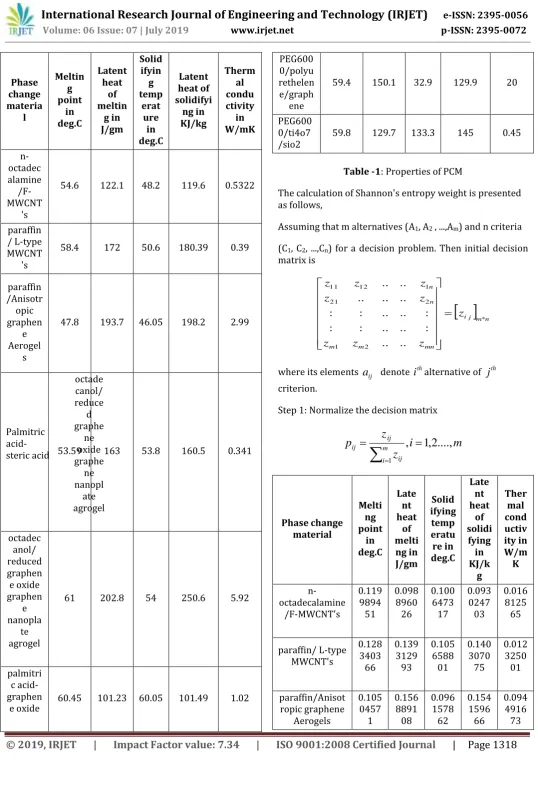
Phase change materia l Meltin g point in deg.C Latent heat of meltin g in J/gm Solid ifyin g temp erat ure in deg.C Latent heat of solidifyi ng in KJ/kg Therm al condu ctivity in W/mK n-octadec alamine /F-MWCNT 's54.6 122.1 48.2 119.6 0.5322
paraffin / L-type MWCNT
's
58.4 172 50.6 180.39 0.39
paraffin /Anisotr opic graphen e Aerogel s
47.8 193.7 46.05 198.2 2.99
Palmitric acid-steric acid octade canol/ reduce d graphe ne oxide graphe ne nanopl ate agrogel
53.59 163 53.8 160.5 0.341
octadec anol/ reduced graphen e oxide graphen e nanopla te agrogel
61 202.8 54 250.6 5.92
palmitri c acid-graphen
e oxide 60.45 101.23 60.05 101.49 1.02
PEG600 0/polyu rethelen e/graph
ene
59.4 150.1 32.9 129.9 20
PEG600 0/ti4o7
[image:2.595.30.569.41.843.2]/sio2 59.8 129.7 133.3 145 0.45
Table -1: Properties of PCM
The calculation of Shannon's entropy weight is presented as follows,
Assuming that m alternatives (A1, A2 , ...,Am) and n criteria
(C1, C2, ...,Cn) for a decision problem. Then initial decision
matrix is
ij mnmn m m n n z z z z z z z z z * 2 1 2 2 1 1 1 2 1 1 .. .. : .. .. : : : .. .. : : .. .. .. .. ..
where its elements
a
ij denote thi
alternative ofj
thcriterion.
Step 1: Normalize the decision matrix
m
i
z
z
p
m i ij ijij
,
1
,
2
....,
© 2019, IRJET | Impact Factor value: 7.34 | ISO 9001:2008 Certified Journal
| Page 1319
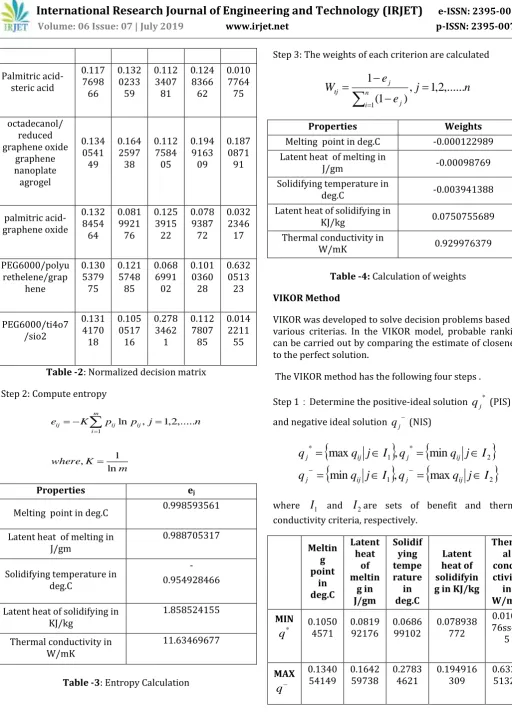
Palmitric acid-steric acid 0.117 7698 66 0.132 0233 59 0.112 3407 81 0.124 8366 62 0.010 7764 75 octadecanol/ reduced graphene oxide graphene nanoplate agrogel 0.134 0541 49 0.164 2597 38 0.112 7584 05 0.194 9163 09 0.187 0871 91 palmitric acid-graphene oxide 0.132 8454 64 0.081 9921 76 0.125 3915 22 0.078 9387 72 0.032 2346 17 PEG6000/polyu rethelene/grap hene 0.130 5379 75 0.121 5748 85 0.068 6991 02 0.101 0360 28 0.632 0513 23 PEG6000/ti4o7 /sio2 0.131 4170 18 0.105 0517 16 0.278 3462 1 0.112 7807 85 0.014 2211 55Table -2: Normalized decision matrix
Step 2: Compute entropy
m K where n j p p K e m i ij ij ij ln 1 , ,... 2 , 1 , ln 1
Properties ej
Melting point in deg.C 0.998593561
Latent heat of melting in J/gm
0.988705317
Solidifying temperature in deg.C
- 0.954928466
Latent heat of solidifying in KJ/kg
1.858524155
Thermal conductivity in W/mK
[image:3.595.35.548.45.770.2]11.63469677
Table -3: Entropy Calculation
Step 3: The weights of each criterion are calculated
n
j
e
e
W
n i j jtj
,
1
,
2
,...
)
1
(
1
1
Properties Weights
Melting point in deg.C -0.000122989 Latent heat of melting in
J/gm -0.00098769
Solidifying temperature in
deg.C -0.003941388 Latent heat of solidifying in
KJ/kg 0.0750755689 Thermal conductivity in
W/mK 0.929976379
Table -4: Calculation of weights
VIKOR Method
VIKOR was developed to solve decision problems based on various criterias. In the VIKOR model, probable ranking can be carried out by comparing the estimate of closeness to the perfect solution.
The VIKOR method has the following four steps .
Step 1:Determine the positive-ideal solution *
j
q
(PIS)and negative ideal solution
q
j (NIS)
1
2
2 * 1 *
max
,
min
min
,
max
I
j
q
q
I
j
q
q
I
j
q
q
I
j
q
q
ij j ij j ij j ij j
where
I
1 andI
2are sets of benefit and thermal conductivity criteria, respectively.Meltin g point in deg.C Latent heat of meltin g in J/gm Solidif ying tempe rature in deg.C Latent heat of solidifyin g in KJ/kg
Therm al condu ctivity in W/mK MIN *
q
0.10504571 0.081992176 0.068699102 0.078938772
0.0107 76ss47 5 MAX
q
0.1340© 2019, IRJET | Impact Factor value: 7.34 | ISO 9001:2008 Certified Journal
| Page 1320
Negative Min
0.1050
4571 0.081992176 0.068699102 0.078938772 0.010776475
Posi tive Max
0.1340
54149 0.164259738 0.27834621 0.194916309 0.632051323
Table-5: Determination of Positive and negative ideal solution
Step 2:Compute the values
a
iandb
i
( )/( )
max
) /(
) (
* *
* *
1
j j ij j j t i
j j ij j n
j j t i
q q q q W b
q q q q W a
where Wtj are the weights of criteria.
PCM
a
ib
in-octadecalamine/F-MWCNT's 0.017286634 0.00911824
paraffin/ L-type MWCNT's 0.040561686 0.03972552
paraffin/Anisotropic graphene
Aerogels 0.172589222 0.12531194
Palmitric acid-steric acid 0.02823598 0.02971106
octadecanol/ reduced graphene oxide graphene
nanoplate agrogel
0.3370533
8 0.26391669
palmitric acid-graphene oxide 0.030936662 0.03212035
PEG6000/polyurethelene/grap hene
0.9436972
81 0.92997638
PEG6000/ti4o7/sio2 0.022733177 0.02190694
Table-6: Determination of
a
i andb
iStep 3:Compute the value
R
i)
(
)
(
)
1
(
)
(
)
(
* * *
*
b
b
b
b
v
a
a
a
a
v
R
i ii
where *
a
= min ai, a−=maxa
i,b
*=minb
i ,b
−=maxb
iand v is identified as a weight for planning of maximum group utility and (1-v) is the weight of the individual concern. Usually, the value of v is considered to be 0.5. However, v can set any value from 0 to 1.
PCM
R
in-octadecalamine/F-MWCNT's -0.00936
paraffin/ L-type MWCNT's 0.007236
paraffin/Anisotropic graphene
Aerogels 0.05376
Palmitric acid-steric acid 0.001822
octadecanol/ reduced graphene
oxide graphene nanoplate agrogel 0.128952
palmitric acid-graphene oxide 0.003096
PEG6000/polyurethelene/graphene 0.490612
PEG6000/ti4o7/sio2 -0.00245
Table-7: Calculation of
R
iStep 4:Alternatives should be ranked as per the decreasing order of
R
iPCM Rank
n-octadecalamine/F-MWCNT's 7
paraffin/ L-type MWCNT's 4
paraffin/Anisotropic graphene Aerogels
3
Palmitric acid-steric acid 5
octadecanol/ reduced graphene oxide graphene nanoplate agrogel
© 2019, IRJET | Impact Factor value: 7.34 | ISO 9001:2008 Certified Journal
| Page 1321
palmitric acid-graphene oxide 8
PEG6000/polyurethelene/graphene 1
PEG6000/ti4o7/sio2 6
Table-8: Ranking
Chart -1: PCM v/s Rank
3. CONCLUSION
From the calculations of Shenon Entropy and VIKOR method, it is concluded that material having maximum thermal conductivity is selected for required application which is PEG6000/polyurethelene/grapheme. Also the material having highest rank is suitable for particular application.Proper selection of phase change material leads to efficient utilization of latent heat thermal energy storage system.
REFERENCES
[1] Hsing-Chen Lee, Ching-Ter Chang, “Comparative
analysis of MCDM methods for ranking renewable energy sources in Taiwan,”
[2] Abhay Dinker, Madhu Agarwal, G.D. Agarwal, ”Heat
storage materials ,geometry and applications: A review”, Department of Chemical Engineering, Malaviya National Institute of Technology, Jaipur, India., 6 October 2015.
[3] Sara Tahan Latibari, Sayed Mojtaba Sadrameli “Carbon
based material included-shaped stabilized phase change materials for sunlight-driven energy conversion and storage: An extensive review,” a Faculty of Engineering Technology, Laboratory of
Thermal Engineering, University of Twente, Enschede 7500 AE, The Netherlands.
BIOGRAPHIES
Sagar Gondkar 0
1 2 3 4 5 6 7 8 9
Ghanshyam Jorwar
“UG Student of Mechanical Engg, ZCOER ,Pune, Maharashtra, India “
“UG Student of Mechanical Engg, ZCOER, Pune, Maharashtra, India “
Yash Ghayal
“UG Student of Mechanical Engg, ZCOER ,Pune, Maharashtra, India “
Yadnesh Gulhane