ELEFTHERIOS KASTIS, DEREK KITSON, STEPHEN C. POWER
Dedicated in memory of Richard M. Timoney.
Abstract. We consider, from the point of view of operator theory, a class of
infinite matrices in which the matrix entries are determined by an underlying graph structure with accompanying geometric data. This class includes the rigidity matrices of infinite bar-joint frameworks as well as the incidence ma-trices of infinite directed graphs. We consider the following questions: When do these matrices give rise to bounded operators? Can we compute the oper-ator norm? When are these operoper-ators compact? And when are they bounded below?
1. Introduction
Graph rigidityis an interdisciplinary field in which the central aim is to develop theoretical and computational techniques for identifying and characterising forms of rigidity and flexibility in discrete geometric structures. The objects of study can be thought of as an assembly of rigid building blocks, with rotational connecting joints, and are typically categorized by the nature of these blocks and joints; eg. bar-and-joint, body-and-bar and plate-and-hinge frameworks. Constraint systems of these forms are ubiquitous in engineering (eg. trusses, mechanical linkages and deployable structures), in nature (eg. periodic and aperiodic bond-node structures in proteins and materials) and in technology (eg. formation control for autonomous multi-agent systems, sensor network localization, robotics and CAD software) (see for example [2, 3, 9, 10, 18]).
The origins of graph rigidity can be traced back to two seminal results of the 19th century: Cauchy’s proof in 1813 that a convex polyhedron in three-dimensional Eu-clidean space is a (continuously) rigid plate-and-hinge structure [6]; and Maxwell’s 1864 observation that the structure graph of a rigid bar-and-joint framework must obey certain counting rules [14]. Dehn’s subsequent proof of Cauchy’s theorem for simplicial polyhedra developed the now standard analytic and linear methods of
infinitesimal rigidity[7].
The aim of this article is to understand, from the perspective of operator theory, therigidity matriceswhich arise from the infinitesimal rigidity theory of infinite bar-joint frameworks. A fundamental issue in this regard is the nature of the null space of the rigidity matrix as a linear transformation on a particular domain of velocity fields. For infinite matrices, this domain can be a normed vector-valued sequence space, such as a Hilbert space of square-summable (finite energy) velocity fields. Moreover, the range of this transformation is a linear space of bar-joint framework
2010Mathematics Subject Classification. 47B37, 52C25, 05C63.
This work was supported by the Engineering and Physical Sciences Research Council [grant numbers EP/P01108X/1, EP/S00940X/1].
stresses and so it becomes relevant to determine boundedness properties of the rigidity matrix.
Determining whether an infinite matrix gives rise to a bounded linear operator and, in the affirmative case, computing the operator norm, are in general difficult problems. Schur and Toeplitz are credited with developing the classical theory. For example, Schur’s test provides sufficient conditions for `2-space together with an upper bound for the operator norm, and can be generalised to `p-space (see for
example [11, ch. 5]). Maddox [13] and others have extended some aspects of the classical theory to infinite matrices of operators and we have found these techniques to be particularly useful here. Also of relevance are a series of papers by Mohar and various co-authors in which similar problems are considered for the adjacency matrices of infinite graphsG= (V, E), regarding these infinite matrices as bounded operators on`2(V). See for example the survey article [15]. More recently, Agarwal et. al. [1] have extended these considerations to adjacency matrices on`p(V).
In Section 2, we introduce the notion of a framework (G, q) and a coboundary matrix C(G, q). These generalise respectively a directed graph and an incidence matrixcommonly used in graph theory and the notion of abar-joint frameworkand arigidity matrixused in Euclidean space rigidity theory. Also, thek-frame matrices of Whiteley [18] and the rigidity matrices of bar-joint frameworks in non-Euclidean spaces [12] are particular instances of coboundary matrices. We show that, under suitable conditions, coboundary matrices give rise to bounded operators and we either provide a formula for the operator norm, or provide upper and lower bounds for the operator norm. In Section 3, we provide conditions under which the operator norm can be computed by considering subframeworks of the given framework. We also provide necessary and sufficient conditions for coboundary operators to be compact. In Section 4, we provide necessary conditions for a coboundary operator
C(G, q) to be bounded below and in particular we show that the graph Gcannot be amenable (i.e. have isoperimetric constant 0). On the other hand, coboundary operators with a non-amenable graph structure can be bounded below and, in Section 5, we raise the interesting problem of whether there are natural classes of bar-joint frameworks for which the rigidity matrix gives rise to an operator which is bounded below on various spaces of velocity fields. We also present an example of a bar-joint framework with a non-amenable graph structure for which the associated rigidity matrix determines a bounded operator which is neither compact nor bounded below.
2. Coboundary operators
Throughout this article,G= (V, E) will denote a simple graph (i.e. no loops or multiple edges) with a countably infinite set of vertices. Denote byE(v) the set of edgese∈Ewhich are incident with a vertexv∈V and let ∆(G) = supv∈V |E(v)|. The graph G is said to be locally finiteif |E(v)| < ∞ for all v ∈ V and to have
bounded degreeif ∆(G)<∞.
LetX and Y be a pair of normed linear spaces over a field K(=R or C) and
denote by L(X, Y) the space of K-linear maps from X to Y. Let ϕ : V ×V → L(X, Y) be a map with the property that ϕ(v, w) = −ϕ(w, v) whenever vw ∈ E
Definition 2.1. Acoboundary matrixfor a framework (G, ϕ)is a matrixC(G, ϕ)
with rows indexed byE, columns indexed by V, and(e, v)-matrix entry,
ce,v=
ϕ(v, w) if e=vw,
0 if e /∈E(v).
Note that a coboundary matrixC(G, ϕ) has the following form,
v w
..
. ...
e=vw · · · 0 ϕ(v, w) 0 · · · 0 −ϕ(v, w) 0 · · · ..
. ...
.
Moreover,C(G, ϕ) determines in a natural way a linear map C(G, ϕ) :XV →YE,
whereby a vectorx= (xv)v∈V ∈XV is mapped to a vector C(G, ϕ)x∈YE with e-component,
(C(G, ϕ)x)e= X
˜
v∈V
ce,˜v(xv˜) =ϕ(v, w)(xv−xw),
for each edgee=vw∈E.
Example 2.2. Let Gbe a directed graph. Defineϕ:V ×V →L(R,R) by setting ϕ(v, w) = 1 if vw ∈ E is an edge directed from v to w, ϕ(v, w) = −1 if vw ∈E is an edge directed from w to v, and ϕ(v, w) = 0 if vw /∈ E. Note that the pair
(G, ϕ)satisfies the conditions of a framework and the associated coboundary matrix C(G, ϕ)is an incidence matrix forG.
Example 2.3. Abar-joint frameworkinRd is a pair(G, q)whereq:V →Rdand q(v)6=q(w)for all edgesvw ∈E. Given such a bar-joint framework, we would like to know if it is continuously flexible (i.e. admits a non-trivial continuous motion which preserves the Euclidean distance between pairs of pointsq(v)andq(w)for all edgesvw∈E) or continuously rigid(i.e. admits only isometric motions).
A (Euclidean) rigidity matrix for (G, q) is a matrix with rows indexed by E, columns indexed be V × {1, . . . , d} and matrix entries
re,(v,k)=
q(v)k−q(w)k ife=vw,
0 ife /∈E(v),
where we write q(v) = (q(v)1, . . . , q(v)d) ∈ Rd for each v ∈ V. Note that if the columns labelled (v,1), . . . ,(v, d) are grouped together for each vertex v ∈ V then the rigidity matrixR(G, q)has the following form,
(v,1) ···(v,d) (w,1) ··· (w,d)
..
. ...
e=vw · · · 0 q(v)−q(w) 0 · · · 0 q(w)−q(v) 0 · · · ..
. ...
.
If the set of points {q(v) :v ∈ V} affinely spans Rd then the null space of the linear transformation induced by R(G, q) has dimension at least d+1
2
. The bar-joint framework(G, q)is said to beinfinitesimally rigidif the dimension of the null space is exactly d+1
2
Define ϕ: V ×V →L(Rd,R) by setting ϕ(v, w)x= (q(v)−q(w))·x for each x∈Rd, if vw ∈E, and ϕ(v, w) = 0 otherwise. Note that the pair (G, ϕ)satisfies the conditions of a framework and the transformations induced by the associated coboundary matrix C(G, ϕ) and the (Euclidean) rigidity matrix R(G, q) are iso-morphically equivalent.
Example 2.4. LetX be a finite dimensional real normed linear space. Abar-joint framework in X is a pair (G, q) where q :V → X and q(v)6=q(w) for all edges vw∈E. As in Example 2.3, we would like to know if(G, q)is continuously flexible or continuously rigid with respect to the distance constraints imposed by the norm onX. To achieve this we can adopt the following more general approach.
Recall that a support functional for a pointx∈X\{0}is a linear functionalψon X which satisfies kψk=kxkandkψ(x)k=kxk2. Also recall that a point in X\{0}
is said to be smooth if it has a unique support functional. Supposeq(v)−q(w)is a smooth point inX for each edgevw∈E (note that this assumption is redundant in the Euclidean context). Then we can define ϕ : V ×V → L(X,R) by setting ϕ(v, w)to be the unique support functional forq(v)−q(w)ifvw∈Eandϕ(v, w) = 0
otherwise.
The pair(G, ϕ)satisfies the conditions of a framework. Moreover, the associated coboundary matrixC(G, ϕ)plays a similar role to the Euclidean rigidity matrix in Example 2.3. In particular,C(G, q)can be used to determine the infinitesimal rigid-ity and hence rigidrigid-ity properties of a bar-joint framework in X. (See for example
[12] which considers the special case whereX is a finite dimensional `p-space).
2.1. Coboundary operators on`p-spaces. In this section, we provide conditions under which a coboundary matrix will determine a bounded linear operator between two normed linear spaces. We also provide formulae, or upper and lower bounds, for the operator norm. The space of bounded linear operators from a normed space
Z to a normed spaceW will be denotedB(Z, W).
For a countable index setIand a normed spaceX, denote by`∞(I;X) the space of sequencesx= (xi)i∈I inX with supi∈Ikxik<∞and writekxk∞= supi∈Ikxik.
Denote byc00(I;X) the vector space of sequences inX with at most finitely many non-zero terms.
Proposition 2.5. Let C(G, ϕ)be a coboundary matrix and let Z be a subspace of `∞(V;X)which containsc00(V;X). The following statements are equivalent.
(i) ϕ:V ×V →L(X, Y)is a bounded function. (ii) C(G, ϕ)∈B(Z, `∞(E;Y)).
Moreover, when the above conditions hold, the induced operator norm satisfies,
kC(G, ϕ)kop= 2kϕk∞.
Proof. (i)⇒(ii). Letz= (zv)v∈V ∈Z. Then,
kC(G, ϕ)zk∞= sup
vw∈E
kϕ(v, w)(zv−zw)k ≤2kϕk∞kzk∞.
(ii)⇒(i). Suppose ϕis unbounded and let M >0. Then there exists an edge
e=vw∈E withkϕ(v, w)kop> M. Let >0 and choose a unit vectorx∈X with
kϕ(v, w)xk>kϕ(v, w)kop−. Consider the unit vector z= (z˜v)˜v∈V ∈Z with,
zv˜=
x if ˜v=v,
Then, kC(G, ϕ)zk∞ ≥ k(C(G, ϕ)z)ek = kϕ(v, w)xk > M −. Thus C(G, ϕ) is
unbounded.
Finally, suppose conditions (i) and (ii) hold. From the proof of (i)⇒ (ii) we have kC(G, ϕ)kop ≤2kϕk∞. To showkC(G, ϕ)kop= 2kϕk∞, let >0 and choose
an edge e=vw ∈E with kϕ(v, w)kop >kϕk∞− 4. Choose a unit vectorx∈X
such thatkϕ(v, w)xk>kϕ(v, w)kop−4. Consider the unit vectorz= (z˜v)˜v∈V ∈Z
with,
z˜v=
x if ˜v=v,
−x if ˜v=w,
0 otherwise.
ThenkC(G, ϕ)zk∞≥ k(C(G, ϕ)z)ek= 2kϕ(v, w)xk>2kϕ(v, w)kop−2>2kϕk∞−
. The result follows.
Let p ∈ [1,∞). For a countable index set I, denote by `p(I;X) the Banach
space of sequences x = (xi)i∈I in X with Pi∈Ikxikp < ∞ and write kxkp = P
i∈Ikxikp 1p.
Proposition 2.6. Let C(G, ϕ)be a coboundary matrix. The following statements are equivalent.
(i) ϕ:V ×V →L(X, Y)is a bounded function. (ii) C(G, ϕ)∈B(`1(V;X), `∞(E;Y)).
(iii) C(G, ϕ) maps`1(V;X)into`∞(E;Y).
Moreover, when the above conditions hold, the induced operator norm satisfies,
kC(G, ϕ)kop=kϕk∞.
Proof. (i)⇒(ii) Letz= (zv)v∈V ∈`1(V;X). Then,
kC(G, ϕ)zk∞= sup
vw∈E
kϕ(v, w)(zv−zw)k ≤ kϕk∞kzk1.
(ii)⇒(iii) This is immediate.
(iii)⇒(i) For each edgee=vw∈E, consider the linear map,
ψe:`1(V;X)→Y, z7→ϕ(v, w)(zv−zw).
Note that kϕ(v, w)kop ≤ kψekop for each edge e =vw ∈ E. SinceC(G, ϕ) maps `1(V;X) into`∞(E;Y), the set{kψ
e(z)k:e∈E}is bounded for eachz∈`1(V;X).
Thus, by the Banach-Steinhaus theorem, supe∈Ekψekop < ∞ and so the result
follows.
Finally, suppose conditions (i)-(iii) hold. To showkC(G, ϕ)kop =kϕk∞, apply
an argument similar to the proof of Proposition 2.5. Note that in this case z2 is a unit vector in`1(V;X) withkC(G, ϕ)zk∞>kϕk∞−.
Proposition 2.7. Let C(G, ϕ) be a coboundary matrix and let p∈[1,∞). If the graph Ghas bounded degree then the following statements are equivalent.
(i) ϕ:V ×V →L(X, Y)is a bounded function. (ii) C(G, ϕ)∈B(`p(V;X), `p(E;Y)).
(iii) C(G, ϕ) maps`p(V;X)into`p(E;Y).
Moreover, when the above conditions hold, the induced operator norm satisfies,
21−1pkϕk∞≤ kC(G, ϕ)kop≤21−
1
pkϕk∞∆(G)
1
Proof. (i) ⇒ (ii) Suppose p ∈ (1,∞) and choose p0 such that 1p + p10 = 1. Let
z= (zv)v∈V ∈`p(V;X). By Holder’s inequality, for each edge e∈E,
X
v∈V
kce,vkopkzvk = X
v∈V
kce,vk
1
p0
op
kce,vk
1
p
opkzvk
≤ X
v∈V
kce,vkop !p10
X
v∈V
kce,vkopkzvkp !1p
Thus, noting thatP
v∈V kce,vkop≤2kϕk∞for each edgee∈E,
kC(G, ϕ)zkp
p ≤
X
e∈E X
v∈V
kce,vkopkzvk !p
≤ (2kϕk∞)pp0 X
e∈E X
v∈V
kce,vkopkzvkp !
= (2kϕk∞)
p p0 X
v∈V X
e∈E
kce,vkopkzvkp !
≤ (2kϕk∞)
p p0kϕk
∞∆(G)
X
v∈V
kzvkp !
= 2pp0kϕkp
∞∆(G)kzkpp
It follows thatC(G, ϕ) maps `p(V;X) into`p(E;Y) and thatC(G, ϕ) is bounded withkC(G, ϕ)kop≤2
1
p0kϕk
∞∆(G) 1
p. For the casep= 1 a similar (and more direct)
argument can be applied. (ii)⇒(iii) This is immediate. (iii)⇒(i) Apply Proposition 2.6.
Finally, suppose conditions (i)-(iii) hold. The proof of (i)⇒ (ii) provides the upper bound for kC(G, ϕ)kop. To obtain the lower bound, let > 0 and choose e=vw∈E with kϕ(v, w)kop>kϕk∞−4. Choose a unit vectorx∈X such that
kϕ(v, w)xk>kϕ(v, w)kop−4. Letz∈`p(V;X) be the vector with components,
zv˜=
x if ˜v=v,
−x if ˜v=w,
0 otherwise.
Thenkzkp = 2
1
pkxk= 2
1
p. Note thatk(C(G, ϕ)z)ek= 2kϕ(v, w)xk >2kϕk∞−.
Thus, kC(G, ϕ)zkp > 2kϕk∞ − = 21− 1
pkϕk
∞kzkp − and so it follows that
kC(G, ϕ)kop≥21−
1
pkϕk
∞.
For a countable index setI, denote byc0(I;X) the vector space of null sequences
x= (xi)i∈I in X. i.e. x∈c0(I;X) if, given any >0, there exists a finite subset I0 ⊂ I such that supi∈I\I0kxik < . Note that c0(I;X) is a closed subspace of
`∞(I;X).
Proposition 2.8. Let C(G, ϕ) be a coboundary matrix. If Gis locally finite then the following statements are equivalent.
(iii) C(G, ϕ)∈B(c0(V;X), c0(E;Y)).
Moreover, when the above conditions hold, the induced operator norm satisfies,
kC(G, ϕ)kop= 2kϕk∞.
Proof. (i)⇒(ii) Let x= (xv)v∈V ∈c0(V;X) and let >0. Then there exists a
finite subsetV0⊂V such that supv∈V\V0kxvk<
2kϕk∞. Thus, for each e∈E,
k X
v∈V\V0
ce,v(xv)k ≤ X
v∈V\V0
kce,vkopkxvk<
X
v∈V\V0
kce,vkop
2kϕk∞ < .
Let E0 ⊂E denote the finite subset of edges which are incident with a vertex in
V0. Then, noting thatce,v= 0 whenevere∈E\E0andv∈V0,
sup
e∈E\E0 kX
v∈V
ce,v(xv)k= sup e∈E\E0
k X
v∈V\V0
ce,v(xv)k
≤.
ThusC(G, ϕ) mapsc0(V;X) intoc0(E;Y). (ii)⇒(i) Apply Proposition 2.6.
(ii)⇒(iii) Note that, by the above arguments, ϕis bounded. Thus, by Propo-sition 2.5,C(G, ϕ) :c0(V;X)→c0(E;Y) is bounded.
(iii)⇒(ii) This is immediate.
The formula for the operator norm follows from Proposition 2.5.
For ease of reference we note the following corollary.
Corollary 2.9. LetC(G, ϕ)be a coboundary matrix. IfGhas bounded degree then the following statements are equivalent.
(i) ϕ:V ×V →L(X, Y)is a bounded function. (ii) C(G, ϕ)∈B(c0(V;X), c0(E;Y)).
(iii) C(G, ϕ)∈B(`p(V;X), `p(E;Y)), for allp∈[1,∞]. (iv) C(G, ϕ)∈B(`p(V;X), `p(E;Y)), for somep∈[1,∞].
Proof. (i)⇒(ii) Apply Proposition 2.8. (ii)⇒(i) Apply Proposition 2.5.
(i)⇒(iii) Apply Proposition 2.5 forp=∞and Proposition 2.7 forp∈[1,∞). (iii)⇒(iv) This is immediate.
(iv) ⇒(i) Apply Proposition 2.5 when p =∞ and Proposition 2.6 when p ∈
[1,∞).
Remark 2.10. In the case whereX =Y =Kandp= 2, results on the boundedness and operator norm of coboundary operators C(G, ϕ) : `2(V;
K) → `2(E;K) can be found in [19, p. 15] and in [4, Section 5.2]. These results can be applied in particular to incidence matrices for directed graphs, as described in Example 2.2, and to rigidity matrices for one-dimensional bar-joint frameworks, as described in Example 2.3.
3. Norm approximation and compactness
Let (G, ϕ) be a framework and letG0= (V0, E0) be a subgraph ofG= (V, E). Denote by (G0, ϕ) thesubframeworkobtained by restrictingϕtoV0×V0. Denote byPE0 :Y
A sequence (Gk)k∈N of subgraphs of G converges to G if Gk is a subgraph of Gk+1 for eachk∈Nand, given anye∈E, there existsN ∈Nsuch thate∈E(Gk)
for allk≥N. In this case, we writeGk→Gas k→ ∞.
Theorem 3.1. Let C(G, ϕ) be a coboundary matrix where G has bounded degree andϕ:V ×V →L(X, Y)is a bounded function.
(i) IfGk →Gask→ ∞ then,
kC(G, ϕ)kop= lim
k→∞kC(Gk, ϕ)kop.
(ii) IfS andS0 denote respectively the set of all subgraphs ofGand the set of all
finite subgraphs ofGthen,
kC(G, ϕ)kop= sup G0∈S
kC(G0, ϕ)kop= sup G0∈S0
kC(G0, ϕ)kop.
The operator norms in (i)and(ii)refer to the following two cases:
(a) C(G, ϕ)∈B(c0(V;X), c0(E;Y))andC(Gk, ϕ)∈B(c0(Vk;X), c0(Ek;Y)). (b) C(G, ϕ)∈B(`p(V;X), `p(E;Y))andC(Gk, ϕ)∈B(`p(Vk;X), `p(Ek;Y)), where
p∈[1,∞).
Proof. We will prove the statements for case (a) (similar arguments apply for case (b)).
(i) Let >0. Note that the sequence (kC(Gk, ϕ)kop)k∈N is bounded above by
kC(G, ϕ)kop and thatkC(Gk, ϕ)kop=kPEk◦C(G, ϕ)kopfor eachk∈N. Also note
thatPEk∈B(c0(E;Y), c0(E;Y)) for eachk∈Nand, sinceGk→Gask→ ∞, the
sequence (PEk)k∈Nconverges strongly to the identity map inB(c0(E;Y), c0(E;Y)). Thus PEk ◦C(G, ϕ) → C(G, ϕ) strongly as k → ∞. Since the operator norm is
strongly lower semi-continuous, there existsN ∈Nsuch that,
|kC(G, ϕ)kop− kC(Gk, ϕ)kop|=kC(G, ϕ)kop− kPEk◦C(G, ϕ)kop< ,
for allk≥N. This proves (i).
(ii) Note thatkC(G, ϕ)kop is an upper bound for {kC(G0, ϕ)kop:G0 ∈ S}and so
kC(G, ϕ)kop≥ sup G0∈S
kC(G0, ϕ)kop≥ sup G0∈S0
kC(G0, ϕ)kop.
For the reverse inequalities, let >0. Choose a sequence (Gk)k∈N of finite
sub-graphs of G such thatGk → Gas k→ ∞. By (i), there exists k ∈N such that
kC(Gk, ϕ)kop>kC(G, ϕ)kop−. The result follows.
The set of compact operators T : Z → W between two Banach spaces Z and
W is denoted K(Z, W). Recall that the essential operator norm for an operator
T ∈B(Z, W) is given by,
kTke= inf K∈K(Z,W)
kT−Kkop.
Given a framework (G, ϕ) we define,
k(G, ϕ) = inf
E0finite
sup
vw∈E\E0
kϕ(v, w)kop !
,
where the infimum is taken over all finite subsetsE0⊆E.
Proposition 3.2. Let C(G, ϕ) be a coboundary matrix and supposeϕ:V ×V →
(i) If Z is a closed subspace of `∞(V;X) which contains c00(V;X) then the bounded operatorC(G, ϕ) :Z →`∞(E;Y)satisfies,
kC(G, ϕ)ke≤2k(G, ϕ).
(ii) If G has bounded degree and p∈[1,∞)then the bounded operator C(G, ϕ) :
`p(V;X)→`p(E;Y) satisfies,
kC(G, ϕ)ke≤21−
1
pk(G, ϕ)∆(G)p1.
Proof. (i) Let E0 be a finite subset of E. Define K : Z → `∞(E;Y) by setting (K(z))e=C(G, ϕ)zife∈E0and (K(z))e= 0 otherwise. SinceE0is finite, andX andY are finite dimensional,K is a finite rank operator. Note that C(G, ϕ)−K
is similar to a column operator,
0
C(G0, ϕ)
:Z→`∞(E0;Y)⊕`∞(E\E0;Y),
where G0 is the subgraph ofGwith vertex setV and edge set E\E0. (Note that
G0may contain vertices of degree zero). Sinceϕis bounded, by Proposition 2.5,
kC(G, ϕ)ke≤ kC(G, ϕ)−Kkop=kC(G0, ϕ)kop= 2 sup vw∈E\E0
kϕ(v, w)kop.
The proof of (ii) is similar and uses Proposition 2.7.
The functionϕ:V×V →L(X, Y) is said tovanish at infinityif given any >0, there exists a finite subsetE0⊂E such that supvw∈E\E0kϕ(v, w)kop< .
Corollary 3.3. Let C(G, ϕ) be a coboundary matrix and suppose ϕ : V ×V →
L(X, Y) vanishes at infinity.
(i) IfZis a closed subspace of`∞(V;X)which containsc00(V;X)thenC(G, ϕ)∈
K(Z, `∞(E;Y)).
(ii) IfGhas bounded degree andp∈[1,∞)thenC(G, ϕ)∈K(`p(V;X), `p(E;Y)).
Proof. (i) Sinceϕ:V ×V →L(X, Y) vanishes at infinity, k(G, ϕ) = 0. Thus, by Proposition 3.2(i), kC(G, ϕ)ke = 0 and so the result follows. A similar argument
applies for (ii).
Proposition 3.4. Let C(G, ϕ) be a coboundary matrix and suppose one of the following conditions holds.
(i) C(G, ϕ)∈K(c0(V;X), c0(E;Y)).
(ii) C(G, ϕ)∈K(`p(V;X), `p(E;Y)), wherep∈[1,∞). Then the function ϕ:V ×V →L(X, Y)vanishes at infinity.
Proof. Suppose (i) holds and suppose ϕ : V ×V → L(X, Y) does not vanish at infinity. Then there exists > 0 and a countably infinite subset E0 ⊂ E such that infe=vw∈E0kϕ(v, w)kop≥. For each edgee=vw ∈E0, choose a unit vector
xe ∈ X with kϕ(v, w)(xe)k > kϕ(v, w)kop− 2. Then let ze ∈ c00(V;X) be the vector with components,
ze˜v=
xe if ˜v=v,
0 otherwise.
converges in c0(E;Y). Lety = (ye)e∈E ∈c0(E;Y) be the limit of this sequence.
Note that,
k(C(G, ϕ)zek)
ekk=kϕ(vk, wk)xekk ≥ kϕ(vk, wk)kop−
2 ≥
2, for eachek =vkwk. On the other hand,
k(C(G, ϕ)zek)
ekk ≤ k(C(G, ϕ)z
ek)
ek−yekk+kyekk ≤ kC(G, ϕ)z
ek−yk∞+ky
ekk,
where the right-hand side tends to 0 ask→ ∞. This is a contradiction and so (i) is proved. A similar argument applies when (ii) holds.
Corollary 3.5. LetC(G, ϕ)be a coboundary matrix. IfGhas bounded degree then the following statements are equivalent.
(i) The function ϕ:V ×V →L(X, Y)vanishes at infinity. (ii) C(G, ϕ)∈K(c0(V;X), c0(E;Y)).
(iii) C(G, ϕ)∈K(`p(V;X), `p(E;Y)), wherep∈[1,∞).
Proof. For the implications (i)⇒(ii) and (i)⇒(iii), apply Corollary 3.3. For the implications (ii)⇒(i) and (iii)⇒(i), apply Proposition 3.4.
Proposition 3.6. Let C(G, ϕ) be a coboundary matrix and suppose ϕ ∈ `1(V ×
V, L(X, Y)).
(i) C(G, ϕ)∈B(`∞(V;X), `1(E;Y))and the induced operator norm satisfies, kC(G, ϕ)kop≤2
X
vw∈E
kϕ(v, w)kop.
(ii) C(G, ϕ)∈K(c0(V;X), `1(E;Y)).
Proof. (i) LetL=P
vw∈Ekϕ(v, w)kop. Ifx= (xv)v∈V ∈`
∞(V;X) then,
kC(G, ϕ)xk1=X
e∈E
kX
v∈V
ϕ(v, w)xvk ≤ X
e∈E X
v∈V
kϕ(v, w)kopkxvk !
≤2Lkxk∞.
Thus,C(G, ϕ)xlies in`1(E;Y) andkC(G, ϕ)k
op≤2L.
(ii) By (i), C(G, ϕ) ∈ B(c0(V;X), `1(E;Y)). Now apply Pitt’s theorem [8,
proposition 6.25].
4. The bounded below property
LetG= (V, E) be a simple graph. If V0 is a finite subset ofV then denote by
∂V0 the set of edges ofGwith exactly one vertex inV0. Theisoperimetric constant forGis the value,
i(G) = inf
V0finite |∂V0|
|V0| ,
where the infimum is taken over all finite subsetsV0ofV. (See [5] eg.)
Denote by χ(V;X) the set of finitely supported vectors in XV with constant
non-zero entries. i.e.z∈χ(V;X) ifz∈XV and there exists a finite subsetV
0⊂V and a non-zero vectorx∈X such thatzv =xfor allv∈V0 andzv= 0 otherwise.
Proposition 4.1. Let C(G, ϕ)be a coboundary matrix whereG= (V, E)is locally finite,ϕ:V ×V →L(X, Y)is a bounded function and p∈[1,∞).
(i)
inf{kC(G, ϕ)zkp:z∈χ(V;X),kzkp= 1} ≤i(G)
1
(ii) IfdimX = dimY = 1then,
i(G)1p
inf
vw∈Ekϕ(v, w)kop
≤ {kC(G, ϕ)zkp:z∈χ(V;K),kzkp= 1}.
In particular, ifkϕ(v, w)kop is constant on{(v, w) :vw∈E} then,
inf{kC(G, ϕ)zkp:z∈χ(V;K), kzkp= 1}=i(G)
1
pkϕk
∞.
Proof. (i) LetV0 be a finite subset ofV. Choose a unit vectorx∈X and define a unit vectorz∈`p(V;X) by setting,
zv =
1 |V0|
p1
x ifv∈V0,
0 otherwise.
Note thatz∈χ(V;X). Moreover,
kC(G, ϕ)zkpp =
1 |V0|
X
vw∈∂V0
kϕ(v, w)xkp≤ |∂V0| |V0| kϕk
p
∞.
The result follows.
(ii) Let z ∈ χ(V;K) with kzkp = 1 and let V0 be the support of z. Then
zv =xfor all v ∈V0, for some non-zero x∈K, and zv = 0 otherwise. Note that
|x|=|V10| 1
p
. Thus,
kC(G, ϕ)zkp p=
X
vw∈∂V0
kϕ(v, w)kp op|x|
p ≥
inf
vw∈Ekϕ(v, w)k p op
|∂V0|
|V0| .
The inequality now follows. For the final statement, combine this inequality with
(i).
Remark 4.2. Note that Proposition 4.1(ii) applies in the particular case where C(G, ϕ)is an incidence matrix for an infinite directed graphG. In this case, X=
Y =Randkϕ(v, w)kop= 1 for all edgesvw∈E.
Given a framework (G, ϕ) and a unit vectorx∈X we define,
i(G, ϕ;x) = inf
V0finite
sup
vw∈∂V0
kϕ(v, w)xk
,
where the infimum is taken over all finite subsetsV0ofV.
Proposition 4.3. LetC(G, ϕ)be a coboundary matrix, letp∈[1,∞)and letx∈X be a unit vector. If Ghas bounded degree then,
inf{kC(G, ϕ)zkp:z∈χ(V;Kd),kzkp= 1} ≤i(G, ϕ;x)∆(G)
1
p.
Proof. LetV0 be a finite subset ofV and construct a unit vectorz∈`p(V;X) as in the proof of Proposition 4.1(i). Then,
kC(G, ϕ)zkp p=
1 |V0|
X
vw∈∂V0
kϕ(v, w)xkp≤∆(G)
sup
vw∈∂V0
kϕ(v, w)xkp
.
The result follows.
Corollary 4.4. Let C(G, ϕ)be a coboundary matrix, whereϕ:V ×V →L(X, Y)
is a bounded function, and let p ∈ [1,∞). Suppose at least one of the following conditions holds.
(a) Gis locally finite andi(G) = 0.
(b) Ghas bounded degree andi(G, ϕ;x) = 0 for some unit vectorx∈X.
Then the operator C(G, ϕ) :`p(V;X)→`p(E;Y)is not bounded below.
Proof. Apply Proposition 4.1 in case (a) and Proposition 4.3 in case (b).
Remark 4.5. Note that if a graphGis periodic theni(G) = 0. (Recall that a graph G is periodic if the automorphism group of G contains a free abelian subgroup Γ
which acts on G freely and the set {Γv :v ∈ V} of vertex orbits is finite). Thus, for any framework(G, ϕ)withϕbounded, condition(a)of Corollary 4.4 is satisfied and soC(G, ϕ) :`p(V;X)→`p(E;Y)is not bounded below for allp∈[1,∞). This applies, in particular, to the rigidity matrices of periodic bar-joint structures ([10]).
Proposition 4.6. Let C(G, ϕ) be a coboundary matrix and let x ∈ X be a unit vector.
(i)
inf{kC(G, ϕ)zk∞:z∈χ(V;X),kzk∞= 1} ≤i(G, ϕ;x).
(ii) IfdimX = dimY = 1then,
inf{kC(G, ϕ)zk∞:z∈χ(V;K),kzk∞= 1}=i(G, ϕ;x).
Proof. (i) LetV0 be a finite subset ofV and define a unit vectorz∈`∞(V;X) by setting,
zv =
x ifv∈V0, 0 otherwise.
For each edgee=vw∈E(G),
k(C(G, ϕ)z)ek=
kϕ(v, w)xk ifvw∈∂V0, 0 otherwise.
Thus,
kC(G, ϕ)zk∞≤ sup
vw∈∂V0
kϕ(v, w)xk.
The result follows sincez∈χ(V;X) andkzk∞= 1.
(ii) Letz∈χ(V;K) withkzk∞= 1 and letV0be the support ofz. Thenzv =x
for allv∈V0 where|x|= 1. Thus,
kC(G, ϕ)zk∞= sup
vw∈∂V0
kϕ(v, w)kop|x| ≥i(G, ϕ;x).
For the reverse inequality apply (i).
Corollary 4.7. LetC(G, ϕ)be a coboundary matrix, whereϕ:V×V →L(X, Y)is a bounded function, and letZ be a subspace of`∞(V;X)which containsc00(V;X). If i(G, ϕ;x) = 0 for some unit vector x ∈ X then the operator C(G, ϕ) : Z →
`∞(E;Y)is not bounded below.
Proof. Note that Z contains χ(V;X) and so the result follows from Proposition
Let (G, ϕ) be a framework and, for eachv∈V, define
l(v) = sup
vw∈E(v)
kϕ(v, w)kop,
where the supremum is taken over all edges incident with v. The function ϕ :
V ×V →L(X, Y) is said to beweakly bounded away from zeroif infv∈Vl(v)>0.
Corollary 4.8. Let C(G, ϕ) be a coboundary matrix and suppose one of the fol-lowing conditions holds.
(a) C(G, ϕ)∈B(Z, `∞(E;Y)), where Z is a subspace of `∞(V;X)which contains
c00(V;X), and the operatorC(G, ϕ) :Z →`∞(E;Y)is bounded below.
(b) Ghas bounded degree,C(G, ϕ)∈B(`p(V;X), `p(E;Y))and the operatorC(G, ϕ) : `p(V;X)→`p(E;Y)is bounded below, where p∈[1,∞).
Then the function ϕ:V ×V →L(X, Y)is weakly bounded away from zero.
Proof. Note that in general, i(G, ϕ;x) ≤ infv∈V l(v) for each unit vector x∈ X.
Thus the results follow from Corollary 4.4 and Corollary 4.7.
Remark 4.9. By [17, Theorem 4.27], the incidence matrix of a directed graph G with bounded degree is bounded below if and only if i(G) > 0. In the next section, we present an example which suggests there is no simple variant of this result for general coboundary operators. In particular, we construct a bar-joint framework(G, q)in the Euclidean plane with the property that the rigidity matrix R(G, q) :`2(V;
R2)→`2(E;R)is not bounded below andi(G)>0.
5. An application to rigidity theory
In this section, we apply the results of the preceding sections to a countably infinite bar-joint framework (G, q) in the Euclidean plane. The associated rigidity matrix is denotedR(G, q). (See Example 2.3 for the relevant definitions.)
v0,1
v1,1
v1,2
v2,1
v2,2
v2,3
v2,4
v3,1
v3,8
v4,1
v4,16
v0,1
v1,1
v1,2
v2,1
v2,2
v2,3
v2,4
v3,1
v3,8
v4,1
[image:13.612.130.480.457.662.2]v4,16
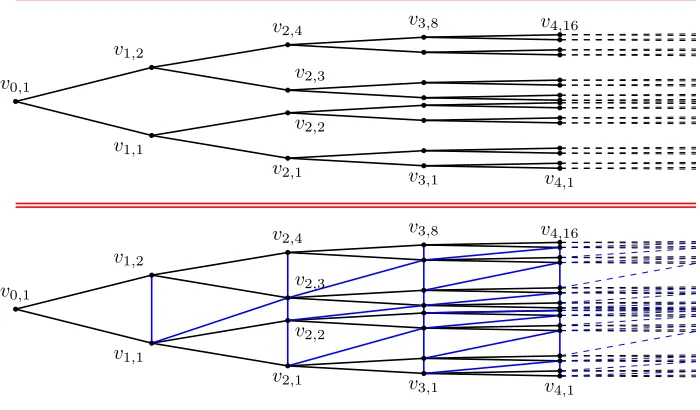
Example 5.1(Binary tree framework). Define inductively the following unbounded placementqof the full binary treeGinR2. Place the root nodev0,1at(0,12). Given
now a jointq(vn,k) = (x, y)that corresponds on a vertex lying on the nth-depth of G, we assign its two children at the points q(vn+1,2k−1) = (x+ 1, y−3n1+1) and
q(vn+1,2k) = (x+ 1, y+3n1+1)(see top of Figure 1).
Note that the vertices of the same depth of the tree share the same first coordinate. Moreover, each joint of the framework satisfiesq(vn,k) = (n, y)for somey∈(0,1). We insert extra bars on the flexible framework(G, q)to obtain an infinitesimally rigid framework on the plane. Namely, we add the set of vertical bars
{q(vn,k)q(vn,k+1) : 1≤k≤2n−1, n∈N},
and the sets of diagonal bars
{q(vn,k)q(vn+1,2k+1) : 1≤k≤2n−1, n∈N}.
Let (G0, q) be the resulting framework (see bottom of Figure 1). It is evident thatGis a spanning tree ofG0. Moreover,(G0, q)is infinitesimally rigid, since it is sequentially infinitesimally rigid (see[12]). Indeed, letGnbe the subgraph ofG0 that is determined by the restriction of(G0, q)on the half-planeH
n:={(x, y) :x≤n}. Observe that {(Gn, q
Hn)}n is a vertex-complete tower of infinitesimally rigid
bar-joint frameworks in(G0, q).
Note that by the full binary tree theorem we have i(G0) = 1. We claim that the rigidity operator R(G0, q) : c
0(V;R2) → c0(E;R) is not bounded below and that the rigidity operatorR(G0, q) :`p(V;
R2)→`p(E;R)is not bounded below for each p∈[1,∞). By Corollary 4.4 and Corollary 4.7, it suffices to show that given any n∈Nthere exists a finite set V0 and some direction specified by a unit vectorxin
R2, such that
sup
vw∈∂V0
|ϕ(v, w)x|= sup
vw∈∂V0
|(q(v)−q(w))·x| ≤ 1
n.
Let n∈N. Choose V0={vn,1, vn+1,1} and letxbe the unit vector (0,1). Check
that for every edgevw in ∂V0 we havesupvw∈∂V0|(q(v)−q(w))·x|= 2 3n ≤
1
n, so the proof of our claim is complete.
In light of Example 5.1 and the preceding results, we make the following conjec-ture.
Conjecture 5.2. Let (G, q) be a bar-joint framework in R2 with the following
properties:
(i) Ghas bounded degree,
(ii) q:V →R2 is a planar embedding ofG(i.e. no edge-crossings are allowed), (iii) (G, q)is bounded in R2 (i.e. supv∈V kq(v)k<∞).
Then the rigidity operator R(G, q) : c0(V;R2) → c0(E;R) is not bounded below and, for eachp∈[1,∞), the rigidity operatorR(G, q) :`p(V;R2)→`p(E;R)is not bounded below.
Problem 5.3. Let (G, q) be a bar-joint framework in Rd where G has bounded degree and supvw∈Ekq(v)−q(w)k2<∞.
(a) Find necessary and sufficient conditions on G and q for the rigidity operator R(G, q) :c0(V;Rd)→c0(E;R)to be bounded below.
(b) Given p∈ [1,∞), find necessary and sufficient conditions on Gand q for the rigidity operatorR(G, q) :`p(V;
Rd)→`p(E;R) to be bounded below.
Acknowledgements
We are very grateful to the anonymous referee for pointing us to the references [4, 19] cited in Remark 2.10 and the reference [17, Theorem 4.27] cited in Remark 4.9.
References
[1] A. Agrawal, A. Berge, S. Colbert-Pollack, R.A. Martinez-Avenano, E. Sliheet, Norms, kernels and eigenvalues of some infinite graphs. arXiv:1812.08276
[2] L. Asimow and B. Roth, The rigidity of graphs, Trans. Amer. Math. Soc., 245 (1978) 279-289. [3] L. Asimow and B. Roth, The rigidity of graphs. II. J. Math. Anal. Appl. 68 (1979), no. 1,
171–190.
[4] B. Bekka, P. de la Harpe, A. Valette, Kazhdan’s property (T). New Mathematical Mono-graphs, 11. Cambridge University Press, Cambridge, 2008.
[5] N.L. Biggs, B. Mohar, J. Shawe-Taylor, The spectral radius of infinite graphs. Bull. London Math. Soc. 20 (1988), no. 2, 116–120.
[6] A.L. Cauchy, Recherche sur les poly`edres - premier m´emoire, Journal de l’cole Polytechnique 9 (1813), 66–86.
[7] M. Dehn, ¨Uber die Starreit konvexer Polyeder, Math. Ann. 77 (1916), 466–473.
[8] M. Fabian, P. Habala, P. Hjek, V. Montesinos Santaluca, J. Pelant, V. Zizler, Functional analysis and infinite-dimensional geometry. CMS Books in Mathematics/Ouvrages de Math-matiques de la SMC, 8. Springer-Verlag, New York, 2001.
[9] H. Gluck.Almost all simply connected closed surfaces are rigid, Geometric topology (Proc. Conf., Park City, Utah, 1974), pp. 225–239. Lecture Notes in Math., Vol. 438, Springer, Berlin, 1975.
[10] S.D. Guest, P.W. Fowler, S.C. Power,Rigidity of periodic and symmetric structures in nature and engineering, Philos. Trans. R. Soc. Lond. Ser. A Math. Phys. Eng. Sci.372(2014), no. 2008, 20130358.
[11] P.R. Halmos, A Hilbert space problem book. Second edition. Graduate Texts in Mathematics, 19. Encyclopedia of Mathematics and its Applications, 17. Springer-Verlag, New York-Berlin, 1982. xvii+369 pp.
[12] D. Kitson, S.C. Power, The rigidity of infinite graphs. Discrete Comput. Geom. 60 (2018), no. 3, 531–557.
[13] I.J. Maddox, Infinite matrices of operators. Lecture Notes in Mathematics, 786. Springer, Berlin, 1980. v+122 pp.
[14] J.C. Maxwell, On the calculation of the equilibrium and stiffness of frames, Phil. Mag. 27, (1864) 294-299.
[15] B. Mohar, W. Woess, A survey on spectra of infinite graphs. Bull. London Math. Soc. 21 (1989), no. 3, 209–234.
[16] J.C. Owen, S.C Power, Infinite bar-joint frameworks, crystals and operator theory. New York J. Math. 17 (2011), 445–490.
[17] P.M. Soardi, Potential theory on infinite networks, Springer LNM 1590, 1994.
[18] W. Whiteley, The union of matroids and the rigidity of frameworks. SIAM J. on Discr. Math. 1 (1988), 237–255.
[19] W. Woess, Random walks on infinite graphs and groups. Cambridge Tracts in Mathematics, 138. Cambridge University Press, Cambridge, 2000.
E-mail address:[email protected], [email protected], [email protected]