© 2019, IRJET | Impact Factor value: 7.211 | ISO 9001:2008 Certified Journal
| Page 1650
EXPERIMENTAL STUDY ON CONCRETE PROPERTIES USING TREATED
WASTE FOUNDRY SAND
Mohammed Rafeeq NK
1, M Rajalingam
21
PG Scholar , Department of Civil Engineering, EASA College of Engineering and Technology (ECET),
Coimbatore, Tamil Nadu, India
2
Professor,
Department of Civil Engineering,
EASA College of Engineering and Technology (ECET)
,
Coimbatore,
Tamil Nadu, India
---***---
---Abstract
— Solid waste management is a prime worry as of late. High utilization of common sources, high sum generation of modern squanders and condition contamination are a portion of the variables which are in charge of acquiring new solutions for a sustainable development. The aim for this study is to evaluate the performance of concrete using supplementary alternative material. The expansion of advantageous elective material in cement has significantly expanded alongside the improvement of solid industry, because of the thought consideration of cost saving, energy saving, environmental protection and conservation of resources. Foundry sand is a by-product of ferrous (cast iron and steel) and non-ferrous (aluminum, copper, brass and bronze) metal casting industries. It is biologically treated with the use of fungal and used as fine aggregate in concrete by partial replacement. The trial work incorporates blend structure for M20 grade concrete with various rates of foundry sand 10%, 20% ,30%, 40% and half . Index Terms—male dominated sector, discrimination, poor career prospects.1. INTRODUCTION
Structural members plays major role in development of our world such as improvement of basic infrastructure, sanitation facilities, proper planned cities, waste management etc. Waste management is considered as a key factor in achieving urbanization. Reuse, recycle, reduce are factors to be considered for waste management. The main solid wastes which are dumped on ground are industrial by-products. Recycling of these wastes are very rare and not encouraged by many industries due to cost and time constraints. Major construction material of infrastructural facilities in the 21st century in concrete. The fundamental fixings are utilized in solid blend is bond, coarse total, fine total and water. However at this point a-days there has been an extraordinary interest for all these essential constituents, so that there has been an incredible climb in the cost of lodging industry. A possibly maintainable new type of cement has been as of late made that may make it the most earth neighborly sort of structure material. Tragically concrete isn't an earth amicable material, either to make, or to utilize, or even to discard. To pick up the crude materials to make this material, much vitality and water must be utilized, and quarrying for sand and different totals causes natural devastation and pollution. Concrete is also claimed to be a huge source of carbon emissions into the atmosphere. Some claim that concrete is responsible for up to 5% of the world's total amount of carbon emissions, which contribute to greenhouse gases. This is created in the heat that is needed to create the raw cement. The Irrespective of position, area, scale, sort of any structure, concrete is the base for the development action. Truth be told, concrete is the second biggest consumable material after water, with about three tones utilized every year for every individual on the earth. India expends an expected 450 million cubic meter of cement yearly and which roughly comes to 1 tone for every Indian.
Regardless we have far to pass by worldwide utilization levels yet do we have enough sand to make cement and mortar? Estimation of development industry developed at stunning rate of 15 % every year even in the monetary log jam and has added to 7-8 % of the nation's GDP (at current costs) for as far back as eight years. Along these lines, it is ending up progressively discomforting for individuals like ordinary citizens who talk about greening the business to have no down to earth answer to this basic question. Rapidly increasing the demand for concrete due to growth in infrastructure development also resulted in the over exploitation of river sand in the river bed. This led to a range of harmful consequences, including increased river bed depth, deepening of the river beds and causing bank slides, loss of vegetation on the bank of rivers, disturbs the aquatic life as well as disturbs agriculture due to lowering the water table in the well etc are some of the examples. The boundaries for using river sand increases the price of sand and has severely affected the stability of the construction industry.
© 2019, IRJET | Impact Factor value: 7.211 | ISO 9001:2008 Certified Journal
| Page 1651
side of our world. world is resting over a landfill of waste perilous materials which may substitutes for common sand
Mechanical waste and results from practically all industry, which have been raising unsafe issues both for the environment, human and farming wellbeing can have major use in construction activity which may be useful for not only from the economy point of view but also to preserve the environment as well.
Alternative Materials Used
Foundry sand
foundry sand (FS) is a disposed of material originating from non-ferrous and ferrous metal-throwing industry. This is amazing silica sand with uniform physical attributes which is utilized by the foundry business to make metal throwing molds. Liquid metal at a high temperature is filled these molds and, when cool, the molds are broken separated to yield the metal throwing. The crude sand is ordinarily of a higher quality than the average bank run or characteristic sands utilized in fill building destinations.
The sands structure the outside condition of the structure gap. These sands conventionally rely on a little proportion of bentonite soil to go about as the latch material. Engineered clasp are furthermore used to make sand centers. Dependent upon the geometry of the tossing, sands focuses are implanted into the shape sorrow to outline internal passages for the fluid metal.
At the point when the metal has set, the tossing is disengaged from the frivolity and focus sands in the shakeout system. Foundries adequately reuse and reuse the sand normally in a foundry. Characterization of foundry sands relies on the sort of fastener frameworks utilized in metal throwing. Two kinds of cover frameworks are commonly utilized, and based on that foundry sands are sorted as: dirt fortified sand (green sand) and synthetically reinforced sand.
Foundry sand is delivered by five diverse foundry classes. The ferrous foundries (dim iron, flexible iron and steel) produce the most sand.. Aluminium, copper, brass and bronze produce the rest While the sand is 4 regularly utilized on various occasions inside the foundry before it turns into a side-effect, only 10 percent of the foundry sand was reused somewhere else outside of the foundry business in 2001.
India positions fourth regarding absolute foundry creation (7.8 million tons) as per the 42 Census of World Casting Production of 2007. The best gauge is that around 10 million tons of foundry sand can valuably be utilized every year (Siddhique et.al, 2014) The foundry sand acquired from foundries are of two essential sorts accessible, green sand (regularly alluded to as trim sand) and artificially reinforced sand.
Green sand uses clay as the binder material Green sand comprises of 85-95% silica, 4-10% bentonite mud, 2-10%
carbonaceous included substances, for instance, sea coal, and 2-5% water. Green sands in like manner contain pursue manufactured substances, for instance, MgO, K2O, and TiO2. Green sand is the most utilized trim media by foundries. Synthetically reinforced sand utilizes polymers to tie the sand grains together. Artificially fortified sand comprises of 93-99% silica and 1-3% concoction folio (Siddhique et.al, 2014). Silica sand is completely blended with the synthetic substances; which goes about as an impetus and starts the response that fixes and solidifies the mass.
Fungal Treatment of Waste Foundry Sands
Treatment process is the major step which to be done for the removal of heavy materials. Were aspergilla's Niger named organism is utilized to treat the waste foundry sand. sand for the treatment, WFS was spread in plastic plate in explicit way (layers) for legitimate spread of parasitic mycelium. For this, 2 cm thick layer of WFS was made as base layer and it was soaked with water. Five days developed contagious culture was utilized vaccinate WFS and spore check was
performed utilizing Haemocytometer (1.9 x 10⁷ spores/ml). The center layer was secured by another layer of WFS.
Parasitic treated WFS gathered each 20 days interim
2. LITERATURE REVIEW
This chapter deals with literature papers collected regarding foundry sand, and by other authors Materials used, methodology carried out, tests carried and their results examined.
© 2019, IRJET | Impact Factor value: 7.211 | ISO 9001:2008 Certified Journal
| Page 1652
from 10% and increases with 5 % upto 20%. In this paper, compressive strength, water absorption test and XRD analysis were evaluated. And There is 15.6% increment in compressive quality of cement having 20% WFS following 28 days was accomplished with the expansion of parasitic culture at about 5% (w/v) and furthermore indicates decline in water ingestion (68.8%) and porosity (45.9%) of treated cement. XRD uncovers the contagious culture (Aspergillus spp.) is fit to shape great C-S-H gel than untreated cement containing WFS
2. Tarun R.Naik and Viral M.Patel (1994) contemplated the usage of utilized foundry sand in cement. Five preliminary blends were delivered. One of these five blends was a control blend.Two blends contained utilized foundry sand, and the other two contained clean/new foundry sand. These side-effects were utilized as one on one substitution of standard sand by weight. Notwithstanding the reference solid (control blend), other solid blends utilizing disposed of foundry sand with substitution of 25-35% of customary sand by weight were readied.The crisp cement demonstrated that blends with utilized foundry sand had significantly low estimations of droops of under 35mm; and the control blend had a drop of 154mm for a similar water content. In this way the water request increments for blends containing utilized foundry sands. This is accepted to be because of essence of covers. The test results for clean/new foundry sand blends demonstrated the expansion in the droop 120-135
mm. It was detected that the saturated surface dry condition ab- sorption of the used foundry sand is
considerably higher than the regular concrete sand. Bond between aggregate particles and the cement paste may have been weakened due to the presence of the binders in the sand. Probably this led to reduced strength for the concrete with used foundry sand. The compressive strength results show that the mixtures containing used foundry sands showed lower strengths at all test ages. The compressive strength of concrete containing 25% used foundry sand is 23% lower than control mix at 28-day age. Similarly concrete containing 35% used foundry sand has 30% lower value than that of control mix. Hence the decrease in strength when used foundry sand is used in concrete is due to the presence of the binder is the used sand. Concrete mixtures containing 25% and 35% used foundry sand showed 20% to 40% reduction in tensile strength than that of control mix at the 28-day age. However, the ratio of tensile to compressive strength was relatively constant at 10-11% of compressive strength, except mix 20-F5, for which the ratio was 7. It was observed from the test results that modulus of elasticity increases with age. The modulus of elasticity of the concrete containing 25% and 35% used foundry sand is lower than that of control mix at early ages. However at 28-day age the control mix and mix with 25% foundry sand shows approximately the same value of modulus of elasticity. However, the 28-day modulus of elasticity of concrete containing 25% and 35% of clean foundry sand is slightly greater than that of the control mix.
3. Shivakumar, M.S., Sheng, Y.K. and Weber, K.E. (1991). studied the micro structural and metal leachate analysis of concrete using fungal treated foundry sand. The fine aggregate has been replaced by both treated foundry sand and untreated fondry sand in the range of 0%,10%, 15% and 20% for M-20 mix foundry sand obtained from ferrous foundry was used in this study. The foundry sand was treated by fungi. The rate change in compressive quality for 10%, 15% and 20% of untreated foundry sand was 33.76, 29.30 and 27.80 N/mm2 individually following 28 days of relieving. If there should arise an occurrence of A. niger treated WFS which indicates compressive quality 36.10, 32.81, 32.8 N/mm2 in cement with 10%, 15%, and 20% substitution by WFS. There is improvement of 15.6% expansion in compressive quality at 20% substitution of contagious (A. niger) treated waste foundry sand following 28 days when contrasted with untreated solid blocks. Little increment in compressive quality at 10% and 15% substitution of contagious treated WFS in solid 3D squares is watched. Comparable improvement in compressive quality by incorporation of microorganisms in concrete mortar was additionally examined by Ghosh et al. They utilized bacterial societies in mortar and found 25% expansion in multi day compressive quality of concrete mortar was accomplished with the expansion of around 105 cell/ml of mixing water. The study of micro structural analysis is done by scanning electron microscopy (SEM) images Which demonstrates surface perspective on solidified cement and changes in surface morphology of solidified cement after expansion of parasitic treated WFS to the solid. Smaller scale structure and morphology of the hydrate blends were seen on broke surfaces. Broken little examples were mounted on the SEM stubs with gold covering. Quality properties essentially rely upon calcium-silica-hydrate (C-S-H) stage present in solidified cement. Size and state of the particles, appropriation of particles, molecule fixation, molecule introduction, topology of the blend, organization of the scattered/ceaseless phases and the pore structure are some of the factors which influence the behaviour of C–S–H phases.
© 2019, IRJET | Impact Factor value: 7.211 | ISO 9001:2008 Certified Journal
| Page 1653
modulus of elasticity. proved to be having optimum ratio which gives maximum Compressive strength of all ratios. Paper sludge ash has proved to have an optimum ratio which gives maximum compressive strength. From the discussions of test results on split tensile strength it was concluded that, for the grade of concrete M25 considered for the study, mix with 40% replacement of foundry sand and 5% replacement of paper sludge ash is the optimum level at which split tensile strength is maximum, mix with 60% replacement of foundry sand and 15% replacement of paper sludge ash gives the least split tensile strength compared to other mix. Achieved by replacing 30%. The maximum replacement can be taken as 50%. The concrete was endowed with comparable mechanical properties and greater resistance to aggressive agents such as chemical, physical and environmental.
5. Anil Kumar and Devika Rani (2016) studied the performance of concrete using paper sludge ash and foundry sand. This paper studied the strength parameters such as compressive and tensile strength of paper sludge ash (5%, 10%, and 15%) as a partial replacement of cement and foundry sand (20%, 40% and 60%) as a partial replacement of fine aggregate for a design mix of M25. Based on the compressive strength of specimen with different replacement level these conclusions were found. For the grade of concrete considered for the study, FS2 i.e. the ratio of 60:40 of conventional sand, foundry sand has replacement of sand. This could be due to dense matrix because WFS is fine sand and its particle size varies between 600microns to 150microns. Reduction in compressive strength with the inclusion of 20% WFS could probably due to increase in surface area of fine particles led to the reduction in water cement gel in matrix. Split tensile strength was similar to compressive strength. At the age of 28 days it was observed that concrete mixture containing 15% WFS has higher modulus of elasticity. RCPT value was found to be less for mixes of 10% and 15% of WFS. The ultrasonic pulse velocity value was found increased with the increase in WFS and also with age.
6. Siddhique et.al(2011) investigated strength, durability, and micro structural properties of concrete made with used foundry sand. A poly carboxylic ether based super plasticizer if CICO brand was used. In this experimental investigation, mechanical properties and durability properties are examined. Fine aggregate was replaced with used foundry sand with 0, 10, 20, 30, 50 and 60% replacements. Slump value for control mix was 40mm and that of other mixes were 30 to 40mm. The water content was maintained constant up to 30% replacement and thereafter increased. There was a increase in compressive strength up to 30% at all ages. Split tensile strength was similar to that of compressive strength. It was found that carbonation depth increases with an increase in age. Similar results have been reported for the control mixes that carbonation increases with age. It was evident that foundry sand incorporation of its own demonstrated increase in carbonation depth with increase in foundry sand percentage. This study resulted in less RCPT value thereby indicating good permeability on addition of foundry sand in concrete. From XRD studies the presence of C2S, C3S and C4AF peaks are visible indicating that they are totally consumed. From SEM analysis, the number of voids in the mix in the mix has significantly compared to control mix
3. MATERIAL USED
A. Cement
In this project OPC 53 grade-MAHA cement was used. The physical properties and chemical properties of
cement were given in Table 1 and 2. These tests are conducted as per IS 4031-3 (1999) and IS 4031-6 (1999)Table-1
Physical properties of cement
S.no Properties Values obtained
1 Specific gravity 3.15
2 fineness 8%
3 consistency 34%
© 2019, IRJET | Impact Factor value: 7.211 | ISO 9001:2008 Certified Journal
| Page 1654
Table-2 Chemical properties of cement
B. Fine Aggregate Were river sand is used as fine aggregate. The fine total utilized was perfect dry sand. The sand was sieved to expel all rocks. The chemical properties of fine aggregate mainly consists silica (SiO2) and other
impurities such as Al2O3 and Fe2O3. The physical properties, for example, explicit gravity, water ingestion, and
fineness modulus of the fine total are given in Table. These tests were conduct per IS 383 (1970)
Table-3 Physical Properties of Fine Aggregate
C. Treated Foundry Sand The waste foundry sand was taken from kurumbampallayam, Coimbatore. The physical and chemical properties are tabulated in Table. The micro-structure of foundry sand was examined and observed that foundry sand is spherical in shape.
Table-4 Physical Properties of Foundry Sand Composition Weight%
SiO2 21.54
Fe2O3 3.63
Al2O3 5.32
MgO 1.08
SO3 2.18
CaO 63.3
LOI 2.5
S.No Properties Values obtained
1 Specific gravity 2.52
2 Water absorption 1%
3 Fineness modulus 3.52
S.no Properties Values obtained
1 Specific gravity 2.36
2 Water absorption 1.3%
© 2019, IRJET | Impact Factor value: 7.211 | ISO 9001:2008 Certified Journal
| Page 1655
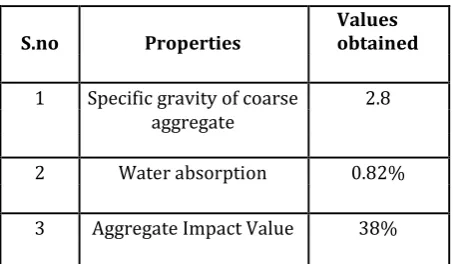
[image:6.595.185.412.146.278.2]D. Coarse Aggregate Natural hard broken stones of 20 mm size were used as coarse aggregate. The aftereffects of explicit gravity, sway estimation of the coarse total are given in Table 4.7. These tests were led according to IS 383 (1970)
Table-5 Physical Properties Of Coarse Aggregate
Water which is used for mixing and curing purpose, need to be clean and free from harmful impurities. In Potable faucet water accessible in the research centre with PH estimation of 7.1 and accommodating it the necessity of IS 456-2000 was utilized for blending of cement and relieving of specimens.
4. RESULTS AND DISCUSSIONS
Slump Cone Test
The slump value of all mixes is shown in Table. . Because of stringy part of WFSS, the water gets retained rapidly in
cement. The control blend (F30) has better droop estimation of 40mm. On expansion of WFS,
Table 6 Slump cone test results
Compaction Factor Test
Table-7 Compaction factor test results
S.no Properties Values obtained
1 Specific gravity of coarse 2.8
aggregate
2 Water absorption 0.82%
3 Aggregate Impact Value 38%
S.No Mix Slump value
(mm)
1 F0 110
2 F10 90
3 F20 50
4 F30 40
5 F40 60
6 F50 70
S.No mix Compaction
Factor
1 F0 0.97
2 F10 0.93
© 2019, IRJET | Impact Factor value: 7.211 | ISO 9001:2008 Certified Journal
| Page 1656
The compaction factor value of all mixes is shown in table from the result of compaction factor, were the values are get reduced gradually respect to increasing of foundry sand. The values are 0.97,0.93,0.92,0.87,0.86 and 0.85 for the mix of F0 to F50.
Compressive Strength
Compressive strength of all mixes increased with all ages. At 7 days, the compressive strength was 12.3, 12.57,13,13.2,12.92 and 10.48 N/mm2 The underlying quality of all blends demonstrated better outcomes aside from ideal blend. At 28 days, the compressive quality was 25.7,26.4,26.8,27,24.4 and 24 N/mm2 for F0 to F50 mixes respectively. There was increase in strength up to 30% replacement of WFS. which is considered as optimum mix. At 56 days, all mixes showed higher strength compared to 28 days. The percentage increase in strength varied from 6.93% to 10.8% which was at ideal contrasted with ordinary cement (F0 blend) at 28 days and further demonstrated diminished quality yet was higher than traditional cement. The increase in strength was due to the fact addition of WFS could probably has increase in surface area of WFS which led to reduction in water cement gel and in turn reduction in bonding as explained by Siddhique et.al.,[12]. Similar strength results was observed by Siddhique et.al.,[12]
Table-8 Compressive strength for all mixes
Flexural Strength
Shows the comparison of flexural strength at 28 days of all mixes. It was observed to be less compared to conventional concrete whereas the optimum content (F30 mix) more strength to that of control mix. The flexural strength of F0 to F50 mixes are 4.2, 4.3, 4.5, 4.7, 3.6, 3.1 N/mm2 as shown in Table 8.5. There was a slight decrease from 9.09% up to 12.2%. These results were similar to that of the flexural strength observed with Yogesh Aggarwal and Rafat Siddhique [14]. Though there was no increase in strength, the optimum mix provided similar strength to that of conventional concrete.
Rating on working conditions in development industry was taken up
4 F30 0.87
5 F40 0.86
6 F50 0.85
S.No Mix 7th day 28th day 56th
(N/mm2) (N/mm2) (N/mm2)
1 F0 12.3 25.7 26.48
2 F10 12.57 26.4 27.29
3 F20 13 26.8 27.61
4 F30 13.2 27 27.82
5 F40 12.92 24.4 25.65
© 2019, IRJET | Impact Factor value: 7.211 | ISO 9001:2008 Certified Journal
| Page 1657
Table-9 Flexural Strength at 28 days
This paper unites discoveries from various research extends the creators have been engaged with analyzing gender inequality among designers and architects. Every investigation utilized subjective, semi-organized meetings. The utilization of a semi-organized meeting guide for the meetings implied that key issues distinguished by the specialists could be investigated, while in the meantime interval.
5. CONCLUSIONS
The compressive strength was 25.7, 26.4, 26.8, 27, 24.4 and 24 N/mm2 for F0 to F50 mixes respectively. There was increase in strength up to 30% replacement of WFS. At 56th days results, the percentage of strength difference varies from 6.93 to 10.8.
Split tensile strength of all mixes increased marginally up to the optimum level. At 28th days, the split-tensile
strength was 2.1, 2.2, 2.4, 2.6, 2.1, 1.8 N/mm2 for F0 to F50 mixes respectively. The percentage of strength at optimum was 17.3.
The flexural strength of F0 to F50 mixes are 4.2, 4.3, 4.5, 4.7, 3.6 and 3.1 N/mm2, were slight difference are
have from each.
Strength properties showed that optimum mix was taken as F30, since it showed around 25% increase in
compressive strength when compared to conventional concrete. Similarly flexural strength and split tensile strength showed increased values in optimum mix.
Material properties of foundry sand showed that, due the biological treatment the heavy metals were
removed.
The fungus culture of Aspergillus Niger was used to treat the foundry sand.
it is sub-angular material and contains high amount of silica and hence can be replaced for natural river sand.
Fresh concrete properties showed that addition of foundry sand decreases workability due to the granular
property.
The slump value decreased drastically up to F30 mix, then increased the value up to 70mm for the F50 mix.
On addition of waste foundry sand, the slump value decreased gradually then increasing.
The hardened properties of concrete having marginal difference from the conventional concrete.
At 7 days, the compressive strength was 12.3, 12.57, 13, 13.2, 12.92 and 10.48 N/mm2, were the result
gradually increasing up to 30% and decreasing. At 28 days,
REFERENCES
1. Book on Foundry sand facts for civil engineers
2. Gurpreet Singh and Rafat Siddhique, “Abrasion resistance and strength properties of concrete containing waste
foundry sand”, Construction and Building Materials, volume-28, 2012 pp. 421-426
3. Gurpreet Singh and Rafat Siddhique , “Effect of waste foundry sand (WFS) as partial replacement of sand on the
strength, ultrasonic pulse velocity and permeability of concrete”, Construction and Building Materials, volume-26,2012 pp.416-422
S.No Mix Flexural strength (N/mm2)
1 F0 4.2
2 F10 4.3
3 F20 4.5
4 F30 4.7
5 F40 3.6
© 2019, IRJET | Impact Factor value: 7.211 | ISO 9001:2008 Certified Journal
| Page 1658
4. Khatib J.M, Herki B.A, Kenai S, “Capillarity of concrete incorporating waste foundry sand”, Construction and Building
Materials, volume- 47,2013 pp. 867-871
5. Rafat Siddique, Geert de Schutter, Albert Noumowe, “The effect of used-foundry sand on the mechanical properties of
concrete”, Construction and Building Materials, volume- 23,2009 pp. 976-980
6. Rafat Siddhique, Gurpreet Singh, Rafik Belarbi, Karim Ait-Mokhtar, Kunal, “A comparative investigation on the
influence of spent foundry sand as partial replacement of fine aggregates on the properties of two grades of concrete”,Construction and Building Materials, volume-83(2015) pp. 216-222
7. Rafat Siddhique , Yogesh Aggarwal, Paratibha Aggarwal, El-Hadl Kadri, Rachid Bennacer , “Strength, durability, and
micro structural properties of concrete made with used foundry sand”, Construction and Building Materials, volume- 25,2011 pp.1916-1925
8. Ravitheja and K. V. S. Gopala Krishna Sastry , “Effect of used foundry sand and mineral admixtures on strength
properties of concrete”, International Journal of Civil, Structural, Environmental and Infrastructure Engineering Research and Development Vol. 5, Issue 4, Aug 2015, pp.33-44
9. Tarun R. Naik, Viral M. Patel, Dhaval M. Parikh, and Mathew P. Tharaniyii, “Utilization of used foundry sand in
concrete”, Journal of materials in civil engineering, ASCE, 1994 6: pp.254-263
10. Yogesh Aggarwal and Rafat Siddhique, “Microstructure and properties of concrete using bottom ash and waste
foundry sand’, Elsevier, ‘Construction and Building Materials”, volume- 54,2014 pp. 210-223
11. Yucel Guney, Yasin Dursun Sari, Muhsin Yalcin, Ahmet Tuncan, Senayi Donmez, “Re-usage of waste foundry sand in
high-strength concrete”, Waste Management, volume- 30(2010), pp. 1705-1713
12. IS 10262: 2009- Concrete mix proportioning – Guildlines