© 2019, IRJET | Impact Factor value: 7.211 | ISO 9001:2008 Certified Journal
| Page 305
Design and Implementation of Smart Home Security system based on
IoT
Khyati Baghel
1, Deepak Sharma
21
Department of Electronics & Telecommunication Engineering, Chhatrapati Shivaji Institute of Technology, Durg
(C.G.), India, 491001
2
Department of Electronics & Telecommunication Engineering, Chhatrapati Shivaji Institute of Technology, Durg
(C.G.), India, 491001
---***---
Abstract - This papers presents the design and implementation of smart door lock system using the idea of internet of things. Internet of things is smart system that can help physical object to communicate with people and devices. And recently internet of things is gaining attention because of advance of hardware technology and big data. Smart home automation system playing a major role which helps in reducing a work done manually by using some embedded hardware and software technologies that come with it. The proposed system is accessed through fingerprint biometric, keypad system and also Wi-Fi based app control door lock system. The use of this proposed system is to provide access to only authorized persons. An emergency alarm is provided to protect the system if any unauthorized person intrudes into the system. In the system, motors are used for locking and unlocking the door.Keywords
-
Biometric fingerprint device, Wi-Fi, app inventor, microcontroller.1.INTRODUCTION
Nowadays home and building automation systems provide increased comfort especially when employed in a private home. The concept of Home Automation was a topic of interest in the Academic arena since the late 1970s, with time and advancement of technology [1]. Where, people’s expectations about Home Automation and how they should access their home has dramatically changed. The affordability and popularity of electronic devices and internet were offering factors to this change. Most of the home automation security system available in the market consist of a control panel that is installed somewhere in the house. The snag of the system is that the home users are not be able to access and customized the control panel when they are away from their home. Moreover, the home users are not able to monitor their home security remotely. The motivation to design this system is due to the high number of home invasion and burglary reported every year. A home automation security system should provide a security features for a home by warning (alarm) the residents from threats such as theft, intruders and animals invading [2].
A smart door locking system is implemented and governed by fingerprint biometric, keypad system and also IoT (internet of things) which authenticate and validate the user and open the door automatically. Smart door lock is arguably the most important part of a truly smart, connected home. Not only will it allow user to come and go as you please, it’ll also monitor who is entering and leaving the home while the user is away. The system allows user to check-in and check-out under fast, secure and convenient conditions. The system include door locking system which open when the user put their tag in contact with fingerprint biometric system and the user information matched with the information already stored in database. This smart lock also offers a mobile app that allows user to lock and unlock door with a simple icon tap. The smart locks, are still in their awkward adolescence of development and many of these new wireless gadgets are awkwardly designed and frustratingly unresponsive. We'll probably take to carrying a traditional key as a back-up in case our smart home lock doesn't lock or unlock as advertised. The other features to look for include keyless touchpads for those times when the user doesn’t have the phone or keys, tamper and forced entry alarms that warn the user of a possible break-in, and push, text, and email notifications that let the user knows who is coming and going in real-time.
2. FEATURES AND BENEFITES OF SMART LOCK
A. Easy to Install and Coverage
© 2019, IRJET | Impact Factor value: 7.211 | ISO 9001:2008 Certified Journal
| Page 306
B. Ability to Integrate with the of Smart devicesThis is one of the most useful features that a smart door lock can have is the ability for it to integrate with other smart devices and smart technology. This action enhances the smart door lock’s features and also allows locks to complete a series of complex tasks by working and communicating with other devices.
C. Key Features
Smart door lock that has the electronic key feature will give the ability to generate temporary keys so the user can assign over certain pockets of time. These electronic keys can also be reused by assigning them to different individuals. It helps homeowners remain in full control of their keys at all times and it has no negative effect on the key control for their homes. If anyone wants to revoke someone’s electronic key, he can simply do so through the mobile application or online, rather than having to hunt them down, have an awkward conversation and get his keys back. This key feature also helps users track keys and/or delete unwanted users from having access to home.
D. Security
It is most important for homeowners to look for smart door locks with appropriate security features, or there will be no point in even purchasing a smart lock. The most secure smart door locks will have features that make them resistant to methods of forced entry. It is more important to look for a smart lock that has the proper authentication parameters as well as one that uses secure automation protocol.
3.LITERATURESURVEY
© 2019, IRJET | Impact Factor value: 7.211 | ISO 9001:2008 Certified Journal
| Page 307
security functions that can transfer recorded images to a user's mobile device when an unwanted user attempts an illegal operation; it can also deliver alarm information to the mobile devices when the door lock is physically damaged. This door lock system enables a user to check the access information and remotely operate the door lock to enhance convenience [9]. Brundha S.M., Lakshmi P. and Santhanalakshmi S. explain Home Automation in Client-Server Approach with User Notification along with Efficient Security Alerting system. Home automation system (workflow) consists of 4 steps which is the user environment by sensing, reporting the events to a centralized entity, centralized entity analyses and triggers the workflow, workflow will execute and update user by any interactive channels or even exercise over a home device (actuating). The physical condition of the system can also be altered based on the user request [10].4. METHODOLOGY
A. Biometric approach using keypad fingerprint recognition
A fingerprint reader or fingerprint scanner is a biometric device that serves to identify that the person authenticating is who he/she claims to be. It uses automated methods of recognizing a person based on unique physical characteristics of a person's fingerprint. The fingerprint of each person must be enrolled with the database. A keypad which is pairedup with biometrics is a set of buttons or keys bearing digits, symbols and/or alphabetical letters placed in order on a pad, which can be used as an efficient input device. This keypad is a set of buttons complete with all alpha numerals and a couple of symbols. When the fingerprints are enrolled, and the person swaps finger then the image of the fingerprint is matched with the one stored in the database. If the fingerprint matches, the biometric fingerprint reader allows access to the classified data. And also keypad locks allow users to change the codes used to unlock them to new codes of their choosing where periodic code changes are generally encouraged as they provide added security in case someone was able to discover a previous code. MEGA2560 already contains the needed AT commands for controlling the modules, which it passes to the module. When MEGA2560 receives data from the sensor, it checks the data to find out whether it is valid or not. If the data is valid then the MEGA2560 switch on the solenoid lock to open the door and if invalid the door will not open. If the data is invalid then it will show error on the LCD screen.
When the user doesn’t have the phone or forgot the code, tamper and forced entry alarms that warn the user of a possible break-in, and push, text, and email notifications that let the user knows who is coming and going in real-time.
B. Wi-Fi based App control door lock
If the finger damaged then the proposed system can use app control door lock which is IoT (internet of things) based. Every authorized member of the home will have a special mobile application (app inventor) installed on his mobile device. Only this app inventor will be able to communicate with the embedded system, because there was developed a special data format for this communication. And if a person is not a part of the home, the application is deleted from his device. In order to prevent the application copying and thus give access to unauthorized people, the application (app inventor) was developed mobile device dependent.
© 2019, IRJET | Impact Factor value: 7.211 | ISO 9001:2008 Certified Journal
| Page 308
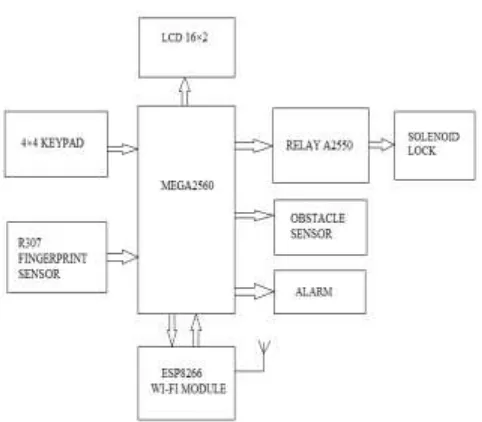
5. HARDWARE DESIGNFig. 1: Block diagram
A. R307 Fingerprint Sensor
TTL UART is a finger print sensor with TTL UART interface. Where, user can store the finger print data in the module and can configure it in 1:1 or 1: N mode for identifying the person. This module can directly interface with 3v3 Microcontroller and a level converter (like MAX232) is required for interfacing with PC. The fingerprint processing includes two tasks: fingerprint enrollment and fingerprint matching. The fingerprint of each person must be enrolled with the database. The module will process the finger images, generate a template of the finger which is based on processing results and store the template. When matching, the user enters the finger through optical sensor and module will generate a template of the finger and compare it with templates of the finger library.
B. 4×4 Keypad System
The module will have 8 terminal. Where, 4 are rows of matrix and 4 are columns of matrix. These eight pins are driven out from 16 buttons present in the module. Those 16 alphanumeric digits on the keypad system surface are the 16 buttons arranged in MATRIX formation. The actual lock mechanism works by needing a small electrical current to release the lock bolt and the current is generated when the proper code is entered at the keypad system.
C. MEGA2560
The control console consists of microcontroller MEGA2560. The module has 54 digital input/output pins, 16 analog inputs, 4 UARTs (hardware serial ports), a 16 MHz crystal oscillator, a USB connection, a power jack, an ICSP header, and a reset button. MEGA2560 is interfaced with relay A2550 while on the other hand it is communicating with the Wi-Fi module. To drive the other modules the microcontroller opens and closes the transistors. It receives the data from fingerprint sensor and keypad module and checks it. If the data is well founded, MEGA2560 starts the configuration of the modules.
D. Relay A2550
This is an electrically operated switch, typically incorporating an electromagnet to mechanically operate a switch, this is activated by a current or signal in one circuit to open or close another circuit. The relay is interfaced with solenoid lock and MEGA2560 through relay driver are operated based on the commands or data received.
E. Wi-Fi Module ESP8266
© 2019, IRJET | Impact Factor value: 7.211 | ISO 9001:2008 Certified Journal
| Page 309
F. Display Unit 16×2 LCDThis module is offered over seven segments and other multi segment LEDs. The reasons behind this: easily programmable; LCDs are economical; have no limitation of displaying special & even custom characters, animations and so on. The module has two registers, namely, Command and Data. Where, Command register stores the command instructions given to the LCD. The command is an instruction given to LCD to do a predefined task like initializing it, clearing its screen, setting the cursor position, controlling display etc. The data register stores the data to be displayed on the LCD.
6. RESULTS
The MEGA2560 as well as the app inventor application could successfully receive the needed data and to perform the required tasks. The system worked as it was desired: system gave access to the user if the data or command which was sent was valid, otherwise, no actions were performed and the data was just skipped. All the valid data was successfully operated and passed as it was designed. The app inventor application was tested several times, in order to test it’s setup, including loading the specification and needed data from the file. The networking tests of application of the system were performed several times before the system tests and they also completed successfully.
7.CONCLUSION
The Smart home Lock System could run properly and stably. The system also provides a security and easy for Android
phone users. With the Wi-Fi connection in MEGA2560 permits the system installation in more easy way. The system has been successfully designed and aimed to control the door condition using fingerprint sensor pairedup with keypad system and Wi-Fi technology. Till now we have successfully implemented hardware and one small application has been invented using app inventor on mobile phone. The Smart home lock System has great potential. The system will allow users to forget about their traditional key and to use their mobile device to get access to the needed are.REFFERENCES
[1] Arun Cyril Jose, Reza Malekian, Ning Ye, "Improving Home Automation Security; Integrating Device Fingerprinting into Smart Home," IEEE Access 4, pp. 5776-5787.
[2] Azfarina Jaafar, Murizah Kassim and Cik Ku Haroswati Che Ku Yahya, "Dynamic Home Automation Security (DyHAS) Alert System with Laser Interfaces on Webpages and Windows Mobile using Respberry Pi ", IEEE 7th Control and System Graduate Research Colloquium (ICSGRC 2016).
[3] Jayashri Bangali and Arvind Shaligram, "Design and Implementation of Security Systems for Smart Home based on GSM technology," Vol.7, No.6 (2013), pp.201-208 http://dx.doi.org/10.14257/ijsh.2013.7.6.19.
[4] Deepali Javale, Mohd. Mohsin, Shreerang Nandanwar, Mayur Shingate, "Home Automation and Security System Using Android ADK," International Journal of Electronics Communication and Computer Technology (IJECCT) Volume 3 Issue 2.
[5] K. Atukorala, D. Wijekoon, M. Tharugasini, I. Perera, C. Silva, "SmartEye - Integrated solution to home automation, security and monitoring through mobile phones", 2009 Third International Conference on Next Generation Mobile Applications, Services and Technologies.
[6] Neelam Majgaonkar, Ruhina Hodekar, Priyanka Bandagale, "Automatic Door Locking System," 2016 IJEDR, Volume 4, Issue 1, ISSN: 2321-9939.
[7] Sidhhi Kavde, Ridhhi Kavde, Sonali Bodare and Gauri Bhagat, "Smart digital door lock system using Bluetooth technology," 10.1109/ICICES.2017.8070788.
© 2019, IRJET | Impact Factor value: 7.211 | ISO 9001:2008 Certified Journal
| Page 310
[9] Ilkyu Ha, "Security and Usability Improvement on a Digital Door Lock System based on Internet of Things",International journal of security and its applications Vol 9, No. 8, 2015, pp. 45-54.
[10] Brundha S.M., Lakshmi P. and Santhanalakshmi S., " Home Automation in Client-Server Approach with User Notification along with Efficient Security Alerting system," 978-1-5386-0569-1. IEEE.
[11] A. Tseloni, R. Thompson, L. Grove, N. Tilley, and G. Farrell, "The effectiveness of burglary security devices," Security Journal, 2014.