BEARD, Colin <http://orcid.org/0000-0002-3836-3072> and PRICE, Ilfryn
Available from Sheffield Hallam University Research Archive (SHURA) at:
http://shura.shu.ac.uk/3980/
This document is the author deposited version. You are advised to consult the publisher's version if you wish to cite from it.
Published version
BEARD, Colin and PRICE, Ilfryn (2011). Mobility, physical space and learning. Management Learning. (Submitted)
Copyright and re-use policy
See http://shura.shu.ac.uk/information.html
Sheffield Hallam University Research Archive
1
Mobility, physical space and learning
Abstract
Our biological inheritance is to sense the world through many channels including the non verbal. Learning theory, in both organizational and pedagogic contexts, has come to recognise as much, yet the dominant physical expressions given to learning space in both contexts remain rooted in linear arrangements. The advent of contemporary human processing tools and artefacts have the potential to liberate the learner yet space designs, driven by dictates of notional efficiency and a view of work and learning as separate, stationary processes, constrain through a reduction in the natural reliance on sensorial, embodied human capacities. With an example of case material, we suggest an asynchronous co-evolutionary process, a syncretisation of learning theories and space design. Granting physical expression to modern views of the learning process as mobile and corporeal can, accelerate learning.
Key words
Workspace, workplace, learning, complexity, organizational ecology, mobility
Introduction
Objectives
In the 1940s neurosurgeon William Penfield developed what became an iconic diagram mapping the proportion of the human cerebral cortex devoted to different sensory organs (Penfield and Rasmussen, 1950). The Penfield Homunculus represents a human body in sense processing terms as (e.g. Figure 1)i. Hands and mouth are grossly enlarged, as to a lesser extent are the other sensory organs including the feet! It has been suggested (Distin, 2010) that the unique mouth and hand combination provided the biological substrate for cultural evolution via natural and artefactual languages. We concur but here we explore the proposition that the modern office, and perhaps much modern pedagogy, have concentrated much information processing and learning via the eyes, the dominant knowing as seeing metaphor (Lakoff & Johnson, 1999). We argue for bringing the hands, and feet, back into learning which we construe, as did Aristotle in the peripatosii, as aided and accelerated by mobility.
2
[image:3.595.220.385.225.451.2]We have previously explored some of the practical implications of such a viewpoint introducing metaphors drawn from developmental learning events into the field of workplace design (Author A and Author B, 2010) and we are actively engaged in their application in practice (below; Author B et al. 2011). Here we explore the kinaesthetic benefits available from learning spaces of various kinds. We find a developing alignment of holistic, complex ecological interpretations about work and learning in literature from both Facilities Management (FM) and pedagogy ( c.f. Becker, 1990; Davis and Sumara, 1997) but it is, we argue, still lacking physical expression in the more common physical settings for either working or educating environments. We see the reason in dominant narratives and seek to illustrate the potential of bringing true mobility and body kinaesthetics back into learning.
Figure 1 A representation of the homunculus (http://pages.slc.edu/~ebj/iminds01/notes/L3-localization&lateralization/penfield.html accessed on 24 June 2010)
Dominant narratives in space management
Before continuing a few words of caution are necessary. As a semantic signifier ‗open-plan‘ often has a negative connotation, pejorative overtones, for an academic reader (Author B and colleague, 2008; Author B 2009). That interpretation is frequently, but not automatically, justified; an assertion that demands a brief explanation. Peters (1992) wrote that:
In fact, space management may well be the most ignored — and most powerful —tool for inducing culture change, speeding up innovation projects, and enhancing the learning process in far-flung organizations. While we fret ceaselessly about facilities issues such as office square footage allotted to various ranks, we all but ignore the key strategic issue — the parameters of intermingling.
3
scholars who explored workplace issues (Baldry, 1999; Kornberger and Clegg, 2004; Edenius and Yahklef, 2007; Dale and Burrell, 2008) tended to view workspaces and especially ‗open-plans‘ as extensions of Taylorist control, frequently, and fallaciously (AuthorB, 2007; 2009), invoking Foucault‘s use of Bentham‘s Panopticon as a metaphor for all open-plans. In a structured literature review mainly concerned with learning space in schools Higgins et al. (2005) cited research showing open office spaces don‘t work (Kurpitz, 1998; Brennan et al., 2002) when, in fact both studies examined imposed, deterministic grids of cubicles; inscribed rather than incorporated spaces in the model of Edenius and Yahklef, (2007). Without diverting to another review we emphasise our support for the latter. The process of designing and inscribing imposed spaces is part of the very problem we are arguing against.
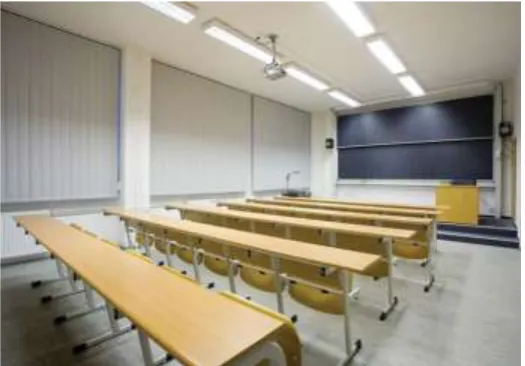
[image:4.595.167.430.396.579.2]A similar disconnect can be seen in FM thinking about learning spaces in educational institutions (except perhaps primary schools). The guidelines for university Teaching Space issued by the UK‘s funding body for Higher Education, HEFCE, define utilisation as % frequency x % occupancy / 100 (Space Management Group, 2006); a target best met by small teaching spaces fitted with rows of tables facing the now ubiquitous screen and projector. Learners see physical spaces for social learning as just as important as classrooms to their learning (Author B et al., 2009) yet guidance on notional building efficiency mitigates against their provision (ibid). Much existing teaching provision arranges students in rows, on relatively inflexible furniture. The computer / document projector and screen still allocates 25 to 30% of the available space to the teacher in front of the class (Figure 2) and aural or visual receipt of material is, by default, the dominant pedagogic medium. The pan-opticon is alive and well in the lecture theatre.
Figure 2 New, but essentially sterile, pedagogic space favoured by ‘efficiency’ guidelines
4
Research
Methodology
Our suggestions result from a shared endeavour to explore historical parallels in contrasting linear and more ecological views of spaces and the learning process. We found these interesting and believe the actual parallels have not been discussed in either the pedagogic or the FM literature. The detailed parallels are not however our main concern. We became more aware, as we contrasted them, of the significance of movement, or its absence, in the cognitive processes occurring in the spaces discussed.
We have previously (Author A and Author B, 2010) explored the implications for workspaces of various metaphors drawn from physical settings for individual and group learning. We deployed these in the current research which can be described as a space mediated dialogic inquiry into the history of thought about space in our respective fields. Our first metaphor, ‗Darwin’s Sandwalk’ highlights the power of rhythmic, mundane, repetitive movement to actually free the conscious and sub-conscious for contemplation of complex problems in the development of the synthesising mind (Wood-Daudelin, 1996). One of us deliberately visited the original at Down House, Kent and walked round it pondering the inquiry discussed below. More generally we have both deployed repetitive exercise as an aide to conversation and we deliberately took to walking round the perimeter of the academic building in which we are based to inquire into any parallels in the history of workspaces, pedagogic theory and learning. In the process we rediscovered the power of the peripatos.
Our second metaphor embraced a more general approach to reflective learning. ‗Coffee and papers’as it is referred to, got its name from learning and development settings for corporate clients in hotel lounges ‗away‘ from the workplace. This specific learning experience involved reading in a relaxed mind state, designed to be comparable to reading the Sunday papers. It invites individuals to read self-selected themed articles alone, whilst intentionally creating, then relaxing in, a specific space that engenders this relaxed state. Various refreshments add to the sensory experience (Author A, 2008a). This reading experience necessitates the solo, or internal conversation. After the period of individual reading the whole group re-assembles to construct the collective conversations, critically exploring the considerably diverse range of readings. Conscious of this specific learning experience we deliberately convened to discuss our collective work in progress over coffee in a local cafe, (location disguised for review purposes but a fortuitous adjunct to the campus) as an ‗away‘ place which provided sufficient table space for the shuffling and movement of sketches and symbols on temporary sheets of paper. We occasionally met by accidentally discovering each other working solo in the cafe. The process also imitated our third metaphor, the ‘war room’ (explained below) as a deliberate introduction of movement (of people and data in space) into our investigations.
5
Reflective conversation 1: The development of the office
[image:6.595.128.470.318.544.2]Reviews of the emergence of white-collar or clerical work typically start with the transaction processing needs of nineteenth century industries. Arguably however offices are much older. As special locations to conduct financial transactions they were a feature of the evolution of financial centres such as Venice or Florence (Ferguson, 2008), as adjuncts to administration in medieval palaces, as cells for learning and contemplation in monasteries and early universities (e.g. Myerson and Ross, 2006) and as centres for administration of large pre-industrial enterprises such as British Navy (Rodger, 2004). The last example in particular contradicts conflation of rise of management and bureaucratic organisation with rise of the mill. Rodger reproduces Pugin‘s 1807 painting of the Admiralty Boardroom (Figure 3) drawing particular attention to the rolled up charts on the wall and the connection with the external environment via the wind-vane. As we will argue later modern equivalents might learn from this picture. The wall is employed to share representations of complex situations and the office is connected to the external context in a manner that is meaningful to its occupants.
Figure 3 Rodger’s (2004) reproduction of a painting of the Admiralty Boardroom in 1807. (image reduced for review purposes)
6
sat the telephone. Those of sufficient status or power had chairs or separate tables for visitors. For the real upper echelons the office frequently included a more informal meeting area, usually modelled on a coffee table and easy chairs. Such spaces are interpretable as early examples of the awareness that physical space mediates conversation (c.f. Markus and Cameron, 2002; Baker, Jensen and Kolb, 2005; Author B 2007). Surviving examples of the genre can still be found today though in the UK they have now largely disappeared from the Central Civil Service. The denizens of Snow‘s corridors, Permanent Secretaries, extoll the benefits of open plans and even their own lack of a dedicated desk (Allen, et al. 2004).
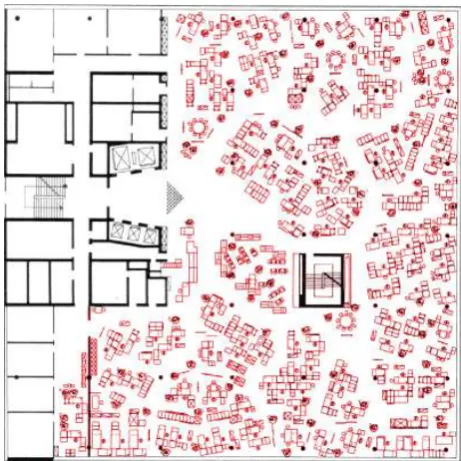
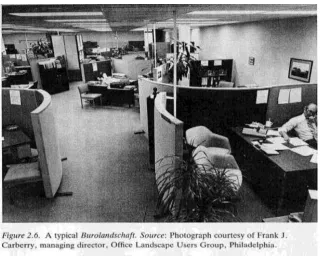
[image:7.595.181.412.312.543.2]The corridor and cellular office combination was first seriously challenged in 1960s Germany by the pioneering consultants, Wolfgang and Eberhard Schelle, who promoted the Burolandschaft, or landscaped office, arguing, even then, for freer information flow, increased openness and equality and what might now be seen as faster organisational learning. Irregular arrangements of desks displaced straight lines although the rectangular desk remained the basic work unit (Figure 4). The concept spread as a fashion and reached the USA by 1967 (Sundstrom, 1986) but, in its North American manifestations at least, landscaped offices retained the nuancing of status by desk size and furniture (Figure 5)
7
Figure 5 Burolandschaft interpreted for the USA. Note the chairs as indicators of hierarchy and activity at the desk. Reproduced with permission from Sundstrom (1986)
The desk remained necessary as a paper processing surface and stand for a cabled phone. It continued to be used as a meeting table arranged to protect occupant from subordinates. A traditional managerialist, and hierarchical culture did not fit easily in an open work place. Furthermore in Europe at least employees saw themselves as, again, watched over by directly visible superiors. Whether the sudden hike in energy costs from 1973 was a cause or an excuse, the fashion rapidly failed and there was a marked return to cellular offices. Some architects sought to resist the trend and Scandinavia, where the sense of democracy and fairness in the work space was strong, saw the development of the combi office (Van der Voort, 2003) in which, theoretically, every employee had their glazed shell looking on to a common core. In practice more junior staff were soon relegated to the core. Steele (1983) praised such workspace arrangements under his metaphor of caves and commons, stressing the benefits of the informal commons for learning; a theme developed by Becker (1990).
8
sedentary connotation. Work was presumed to happen at a single place to which the worker was allocated or ‗stationed‘.
As the desk‘s role as formal a meeting space diminished, at least for the occupants of cubicle land the emphasis shifted to supposedly bookable meeting rooms that were often colonised by managers as soon as the refit was finished (Nathan and Doyle, 2002) and to a variety of informal meeting places, often categorised as streets, though stopping in them for a coffee was often perceived by staff and managers alike as idling, as not ‗work‘ (Donald 1994). For Turner and Myerson (1998) writing on 'New Workspace, New Culture' the workplaces such as Donald described belonged to modernisers, organizations who combined fashionable new designs with traditional cultures rather than monoliths (old design and old culture) or mould breakers (changing both). Successful ‗mould-breakers‘ often recorded tangible business improvements (Author B 2009) arising out of increased informal interaction and reduced perceptions of distractions (Author B and Colleague, 2002; Colleague and Author B 2004). We present an example below.
In design terms, as illustrated below, such mould-breaking workplaces have tended to rediscover the burolandschaft emphasis on movement via the curved circulation and various departures from standard 90o L shape stations. They have abandoned the visual privacy of cubicles, reducing the distracting side effects of aural interruptions (Becker 2007). Mobile technologies have reduced, and for some eliminated, the need for a fixed space tied to a desktop computer and traditional telephone line but station metaphor persists and most new office designs remain wedded to the rectilinear grid as foreseen by Aronoff and Kaplan (1995) in their prescient analogy of the lag introducing new factory designs as electricity enabled distributed power a century ago.
Reflective conversation 2: The pedagogic comparison
Theorising about how adults learn has been subject to continual critique associated with notions of ‗deficit‘. Focussing on missing elements within the prevailing hegemony, this quasi-evolutionary process presents an unremitting quest for more ‗complete‘ ideas about how we learn. Without proposing a neat sequential timescale, parallels to the history of the office are partially mirrored in the episodic thinking and prevailing metaphors about learning and learning spaces.
Aristotle‘s peripatos and the cloisters of early universities may have emphasised movement but, by the early 20th century behaviourism had emerged as a dominant view, linked to, and associated with, a Western ethology and operant conditioning (Pavlov 1920, Skinner, 1974). Cognitivist theories began to surface in the late 1950s, with major contributors such as Lewin (1951), and Gagne (1974) but perhaps the most well known being Bloom (1956) who produced a cognitive learning taxonomy. Seeing the ‗human‘ as unique, intelligent and rational, the cognitive focus alluded to computational processes of thinking, remembering, analysing, and seeking ways to explain and make sense of the world. The burolandschaft was cognitive not behaviourist.
9
from a philosophy of counselling, there are again parallels here with the burolandschaft ideal of giving people freer, more informal, access to information.
Cultural and social context became increasingly recognised as important (e.g. Vygotsky, 1978) giving rise to a range of social constructivist theories, with learning seen as active, and contextualised. Learners were seen as constructing knowledge for themselves, both individually and through social interaction. Influential social constructivist theories are now positioned among a milieu of views about human learning, as illustrated in the unearthing the role of hidden desires and fears by psychoanalytic theories (Britzman, 1998); the questioning of a monolithic notion of a single intelligence (Gardner, 1983); advances in neuroscience leading to a reassessment of biological determinism (Damasio, 1995); and a widening recognition of the role of embodiment in learning (Lakoff & Johnson, 1999; Sheets-Johnstone, 2009), specifically bodily gestures (Gallagher, 2005), and the senses (Abram, 1997) and emotions of learning (Illeris, 2002). Such diversity illustrates the ongoing search for more integrative and comprehensive explorations of learning within and across disciplines (Dillon, 2007), where the connective relationship between mind, body and field can be further explored.
Although far from presenting a complete picture, this sketch of the history highlights a trajectory towards an increasingly complex, ecology of learning (Sterling, 2001; 2003). Indeed ecological theorists Davis and Sumara (1997: 112) argue that ‗all the contributing factors in any teaching or learning situation are intricately, ecologically, and complexly related. Both the cognizing agent and everything with which it is associated are in constant flux, each adapting to the other in the same way that the environment evolves simultaneously with the species that inhabit it‘. Holistic models embrace the complex, multi-dimensional nature of learning. A similar trend, and diversity, could be elucidated in theorising about organisations. Concepts of ‗learning‘ and ‗working‘, previously represented as entirely different, even opposed, are converging, partly as a result of a breakthrough of what has been called the ―knowledge society‖ or ―information society‖ in recent decades, with learning recognised as a critical parameter for economic growth and global competition (e.g. Illeris, 1999: 20) however the spaces provided for both work and pedagogy have not kept pace as we now explore.
Reflective conversation 3: Space for Learning and Working.
The design of spaces for learning has received much recent attention. A google search (29 July 2010) for the specific phrase "designing spaces for effective learning" yielded approximately 16,000 hits. In contrast "designing spaces for management learning" and "designing spaces for knowledge management" yielded none while "spaces for knowledge management" yielded only 5. Crude though the test is it does suggest a significant imbalance in respective interest. A recent, structured review (Woolner et al. 2007 p48) commented
We found that despite general interest in and ideas about some areas relating to learning environments, there is frequently a paucity of clear, replicable empirical studies, particularly research which addresses specific elements of the environment. Certain case study evidence exists, but there are issues of how replicable or generalisable these findings are. Moreover, some studies overlap with environmental considerations but do not have changes to the learning environment as the primary focus and therefore do not report in sufficient detail for comparisons to be made with other studies.
10
universities and colleges have expanded vocational education with requirements for experiential learning spaces. Technology, and the arrival of ‗digital natives‘ into education have obviously impacted (e..g. Oblinger, 2006 1.3) but, as she notes concerning ‗built pedagogy:
As we have come to understand more about learners, how people learn, and technology, our notions of effective learning spaces have changed. Increasingly, those spaces are flexible and networked, bringing together formal and informal activities in a seamless environment that acknowledges that learning can occur anyplace, at any time, in either physical or virtual spaces. We have also come to understand that design is a process, not a product. Involving all stakeholders—particularly learners—is essential.
Virtually the same paragraph could be written about learning in workplaces (Colleague and Author B, 2004; Author B and Colleague, 2008) and indeed Oblinger‘s sentiment resembles Becker‘s from 1990 or Peters‘ from 1992. Indeed the spaces she advocates have a strong undercurrent of the burolandschaft designs, or indeed of the Aristotelian emphasis on teaching while walking.
That said there remains a strong undercurrent of the traditional in practice. If the Larkin Building and its ilk were indeed white collar panopticons how much has actually changed in so-called modern learning spaces such as the image in Figure 2. Has the overhead projector and the ubiquitous powerpoint actually channelled more learning into the visual dimension? Gesture based technologies might not overcome this spatial-relation problem of communication but they offer an opportunity to reconnect mind, body and field (space) and remove the false conceptualisation of the separation of learner from space with space as a mere backcloth. A more recent example of a naval war room (Figure 6) using tables and walls to manipulate and represent complex information illustrates the point.
Figure 6 Reconstruction of the Second Worls War operations room for the Battle of the Atlantic (http://www.liverpoolwarmuseum.co.uk/maproom/ accessed 3 February 2011)
[image:11.595.136.463.443.619.2]11
Author B et al. (2009) conducted interactive focus groups, then web based surveys, with pupils at two secondary schools. The students richly confirmed their perceived need for social learning spaces, rating them as equally important as classrooms or libraries to their learning. One of these schools was new, having opened in 2006. The pupils showed us where social learning happened, in corridors, under stairs and in makeshift outdoor spaces. Specialist technology facilities excepted, the classrooms were traditional and genuine social space had been ‗value-engineered‘ out of the design. The older school was planning a renewal. The head-teacher confirmed the frustration of a conflict between departmental guidelines for classroom capacity and an educational vision. The same is true of universities and colleges. Oblinger‘s (op cit) case studies tend to treat new spaces as experimental.
There may be deeper seated resistance. Academe as a sector clings more than most to traditional cellular offices with ‗corridors of power‘ little changed from Snow‘s day justified on the grounds of a need for contemplation. Without doubt silence is also required for certain mental functioning and Behuniak (2005) goes so far as to argue for a pedagogy of silence as a research topic, suggesting that public spaces are diversifying whilst private spaces are declining in the academy:
Given the need for solitude, it is ironic that what most universities do is to create an environment in which students are rarely alone. Intent on forming a campus community, campus architecture creates communal spaces: classrooms, student living quarters, outdoor quads, dining halls, recreation centres, and now even libraries are places to be designed to be with others. Where, then, do they go to be alone…..Where is the private space? (Behuniak, 2005: p 11)
Heerwagen et al. (op cit.) make a similar argument suggesting knowledge work requires a, somewhat contradictory, permeable cocoon. We question why the same single space, a station for work, should necessarily be envisaged as fulfilling both functions. A sandwalk, or indeed its predecessor, a peripatos, can be a venue for silent concentration on the move while the learners in the coffee and papers experience are deliberately invited to create an impermeable, and comfortable, cocoon for the specific experience of reflection. The traditional library can be a venue for solitary reflection. Now that its contents are increasingly available digitally the same could be said for any private space to which an individual can migrate with a portable device.
A subsidiary reason for our describing the spatial dimension to our reflection, is the realisation that little or none of the gestation and preparation of this paper took place in the offices our institution provided as the notional venues for current academic work. Our joint reflection took us to shared movement through busy space, or a table temporarily occupied with coffee and papers. Our individual writing happened in deliberate retreats to private spaces and our exchange was electronic. Space to ‗think‘ and ‗write‘ with depth, and space to process paper based, workstation style tasks need not be the same if work itself is seen as a mobile activity.
12
Everyday language is clumsy and inadequate when it comes to dynamics...(and) bodily feelings are not easily or readily describable, especially when it comes to affectivity and movement
The linear formats of paper, written and spoken word, whilst symbolic of the uniqueness of the human, are now also limiting. The paper and written form created the need for desks / workstations but, along with the spoken word these forms struggle with the complex interacting kinetic-spatial dynamics of movement, required for more complex problem solving. As one of us (Author A, 2008a) sought to define a learning environment, it is
A sufficiently diverse and varied, physical or virtual, natural or artificial place and/or space that, wherever and whenever, can facilitate and engage people in the wide range of learning activities, through connectivity and community, cultivating and sustaining psychological, intellectual, emotional, social and political development…..(Author A, 2008a).
Implicit in that definition is a representation of movement and variety. Learning is not confined to a fixed, and static, ‗classroom‘ and the definition aspires to a diverse, fluid, spatial milieu suggestive of liberation. A similar linguistic shift as yet to arrive in the discourse of work spaces conceived as classroom like arrays of workstations even though more than 20 years have elapsed since Becker (1990) wrote about The Total Workplace in an attempt to portray the modern office as more than the sum of a series of individual spaces. His metaphors of workplace ecology and the organisation as a complex system finds resonance in educational theory, notably Davis and Sumara‘s (1997) argument, informed by the then recent popularisation of complexity theory, which saw constructivist accounts of cognition and learning (which they chose to conflate) as tending ―to share a tenet with representationism‖: a casting of the cognizing agent as fully autonomous. hence their query:
What happens if we reject the pervasive knowledge-as-object (as "third thing") metaphor and adopt, instead, an understanding of knowledge-as-action - or, better yet, knowledge-as-(inter) action? Or, to frame it differently, what if we were to reject the self evident axiom that cognition is located within cognitive agents who are cast as isolated from one another and distinct from the world, and insist instead that all cognition exists in the interstices of a complex ecology of organismic relationality?
Taking the ecological paradigm of organisational learning (Author B, 1995), a convergence in the co-evolution between workspace and learning space developments appears to surface, albeit with differing impetus. As the human understanding develops about the ‗how‘ of organisational and individual learning, fresh interpretations ensue as to the possible roles of spaces and places for learning beyond the functional backcloth, the workstation location or student desk. Knowledge arises in the complex intertwined processes of ‗inner‘ (cognition, corporeal) and outer (social) world ‗conversing‘, requiring a new mobility, a wandering within and between places:
13
Reflective conversation 4: A modern office as an emerging ecology of space in practice
[image:14.595.147.453.271.462.2]E C Harris is a global property consultancy. A few years ago its partners perceived the firm as becoming less competitive, with the risk of slipping from top tier of similar practices. Part of their solution was a relocation of their London headquarters to a new, open, office. Pragmatism, rather than theory, guided the redevelopment of. Their ECHQ, as it was labelled, was designed as a solution to several strategic challenges particularly differentiation and rejuvenation of a surveying practice intent on projecting itself as ‗the built asset consultancy‘. The whole workspace was reconfigured, tiered and zoned using the overriding metaphor of an airport. The Landside (Figure 7) open to clients and associates of the firm takes up some 20% of the total space and a higher proportion of the total investment. It provides a high quality cafe and a variety of formal and informal meeting spaces.
Figure 7 The ‘land side’ of ECHQ: a variety of spaces for interaction accessible to the firm and key partners
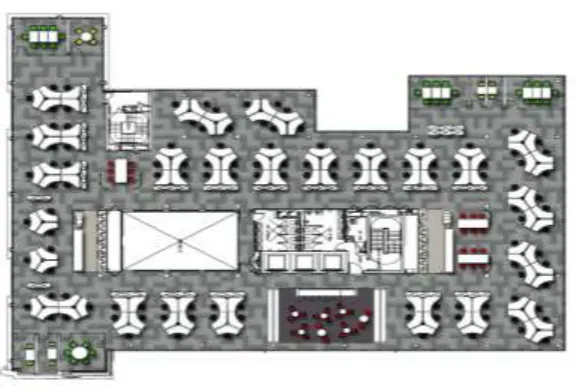
‗Air Side‘, with controlled access, is the exclusive domain of staff. Shown blank in Figure 7 and extending to three further floors the layout is deliberately open but consciously uncluttered and non-linear (Figure 8) with a range of meeting rooms, spaces for concentration and for informal interaction. There is a marked resemblance to the burolandschaft designs of 50 years earlier though the partner responsible assures us they discovered the design independently. This paper is not the place for details but the project is credited with dramatic increases in profitability as well as a significant reduction in overall cost and net CO2 emissions. It embodies significant challenges to conventional FM wisdom and consumes about 25% of the space per person of modern business schools despite failing notional HEFCE efficiency criteria (Author B et al 2011). Although, or perhaps because, competition and risk were at the heart of change, the new spatial dynamics played a central role in the success story. The reconstructed space facilitated new, fluid mobilities of people and their processing artefacts including furniture, tools and data (books, papers, laptops, desks, i-pods, blackberries). Indeed it is that mobility that is at the heart of the various benefits.
14
[image:15.595.158.446.200.395.2]increasingly mobile enterprise, creating knowledge and action from a range of conversations, both internal (solo) and the external (social).
Figure 8 Air side. A modern rediscovery of burolandschaft with the added benefit of yet more interactive space.
Discussion: Significance for management learning?
15
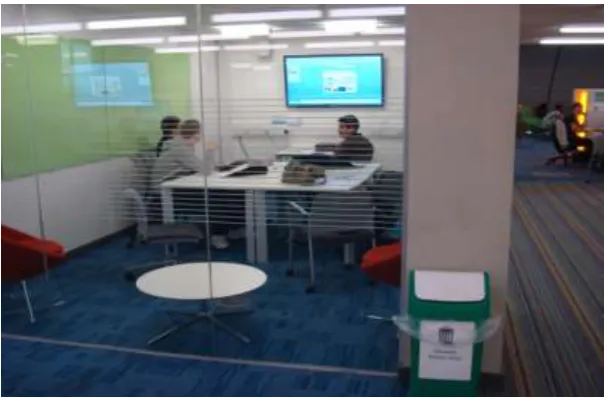
Figure 9 Team space for students in a modern learning centre (Location withheld for review)
We have argued that such a convergence is to be expected given a shift in learning theory from early simplistic attempts to understand, control and manipulate basic human functions, to a more ecological pedagogy of silence, conversation, contemplation and movement. Space, as examples given demonstrate, can be simultaneously integrative, creating a convergence for new notions of work and learning,. and at the same time an extricating, liberating force
Yet we also see in both classrooms and serried ranks of workstations a physical expression of the older ideas; one that all too commonly thinks of learning as something managers only indulge in on ‗away-days‘. That very construct suggests moving away, ceasing to be stationary. In contrast the Learning Centre or the learning centred workspace grants its users, who are itinerant, greater liberation and facilitates a greater range of interaction, Peters‘ (op cit) ‗parameters of intermingling. Why do old less functional forms persist?
Part of the answer must be power. The open-plan, in its familiar guise, and the traditional classroom both echo the pan-opticon. Liberatory theory, whether pedagogic or managerial, is easier to conceive than to implement. As Jamesion et al (2000) argued the continued separation of teacher offices and work areas from student learning areas or classrooms typifies an authority structure and power relation that ―undermines the creation of the more collaborative learning communities‖. Part is also a false discourse of efficiency. The two become conflated in debates about space standards. The same narrative of efficiency rather than efficacy that produces spaces such as that illustrated in Figure 2 pervades much open plan designiii. Deeper than either is the discourse of ‗station‘ in various guises. Heerwagen et al‘s (2004) " central conflict of collaboration"; how to balance the need to interact with the need to work individually, disappears if one rejects the notion that both must occur in the same place. Finally we see a discourse of separation. Management, working, and learning are conceived as separate activities, as are teaching and learning in the educational context. We see newer spaces diminishing or even eliminating such artificial boundaries. If managerial, and professional, learning and work are increasingly synonymous then mobility, which we have argued enhances the former, must also enhance the latter. Neither is static, and the constraints that have rendered them so are rapidly diminishing.
16
languages) or the manipulation of other semiotic indicators such as the ‗convoys‘ in Figure 6. Mobility, at various scales, assists the process and brings the kinaesthetic senses into the learning process. For most of the twentieth century, when paper was the medium by which information was transmitted and then when first the telephone and second the computer cable made their appearance, the static desk was an essential artefact. The removal of those limits allows a redirected focus on the role of the spatial context in cognitive process. Mobility within and between spaces can accelerate the complex thought that is learning. ‗Our conceptual system is grounded in, neurally makes use of, and is crucially shaped by our perceptual and motor system.‘ (Lakoff & Johnson, 1999 p555). An awareness of this syncretisation that redefines the role of space and place for learning and knowledge creation presents a prospective transformative shift in human consciousness or at least an escape from the disembodied desk and unintentionally dysfunctional venues for learning.
Acknowledgements
Anonymous for review purposesFunding
This research received no specific grant from any funding agency in the public, commercial, or not-for-profit sectors.
References
Abram, D. (1997) The Spell of the Sensuous , New York, Vintage Books.
Allen, T., Bell, A., Graham, R., Hardy, B. and Swaffer, F. (2004) Working without Walls: An Insight into Transforming Government Workplace, London: HMSO.
Aronoff, S. and Kaplan, A. (1995) Total Workplace Performance: Rethinking The Office Environment, Ottawa: WDL Publications.
Author A (2008a). To follow
Author A (2008b) To follow
Author A (2010) To follow
Author A & ANO., (2002) To follow
Author A, and ANO. (2006) To follow
Author A and Author B, (2010) To follow
Author B (1995) To follow
Author B (2002) To follow
Author B (2007) To follow
Author B (2009) To follow
17
Author B & Colleague (1998) To follow
Author B & Colleague(2008) To follow
Author B et al. (2009) To follow
Author B et al (2011) To follow.
Baldry, C. (1999) ‗Space - The Final Frontier‘, Sociology, 33(3): 535-553.
Baker, A. C., Jensen, P. J. and Kolb, D. A. (2005) ‗Conversation as Experiential Learning‘, Management Learning 6(4): 411–427.
Becker, F. D. (1990) The total workplace: facilities management and the elastic organization, New York: Van Nostrand Reinhold.
Becker, F. D. (2007) ‗Organizational Ecology and Knowledge Networks‘, California Management Review 49(2 Winter): 42-61.
Behuniak, S (2005) ‗Finding Solitude: The Importance of Silence and Space for Thinking‘, paper presented to Design For Learning, the 12th International Conference on Learning, Granada, Spain, 11-14 July.
Bloom, B. S. (1956) Taxonomy of Educational Objectives, Handbook 1: The Cognitive Domain, New York: David McKay Co Inc.
Brennan, A., Chugh, J.S. and Kline, T. (2002) ‗Traditional Versus Open Office Design: A Longitudinal Field Study‘, Environment and Behaviour 34(3): 279-289.
Britzman, D. P. (1998) Lost Subjects, contested Objects: Towards a psychoanalytic inquiry of learning, New York: State University of New York Press.
Dale, K. and Burrell G. (2008) The Spaces of Organisation and the Organisation of Space. Power, Identity & Materiality at Work, New York: Palgrave/ Macmillan.
Damasio, A.R. (1995) Emotion, reason and the human brain, New York: G.P. Putnum‘s Sons.
Davis, B.; and Sumara, D. J (1997) ‗Cognition, complexity, and teacher education‘ Harvard Educational Review 67 (1): 105-125.
Dillon, P. (2007) ‗A Pedagogy of Connection and Boundary Crossings: Methodological and epistemological transactions in working across and between disciplines‘, presented at ‗Creativity or conformity? Building Cultures of Creativity in Higher Education’, University of Wales and the Higher Education Academy, Cardiff, January 8-10.
Distin K. (2010) Cultural Evolution, Cambridge UK: Cambridge University Press.
Donald I. (1994) ‗Management and change in office environments‘, Journal of environmental psychology, 14(1); 21-30.
18
Ferguson, N. (2008) The Ascent of Money: A Financial History of the World, London: Penguin.
Gagne, R. M. (1974) Essentials of learning instruction, Hinsdale, IL: Dryden Press.
Gallagher, S. (2005) How the body shapes the mind, Oxford: Oxford University Press.
Gardner, H. (1983) Frames of mind: the theory of multiple intelligences, New York: Basic Books Inc.
Heerwagen J. H., Kampschroer K., Powell K. M. and Loftness V (2004) Collaborative knowledge work environments, Building research & information, 32, 6, 510-528.
Higgins, S., Hall, E., Wall, K., Woolner, P., and McCaughey, C. (2005) The Impact of School Environments: A Literature Review, The Centre for Learning and Teaching School of
Education, Communication and Language Science, Newcastle University. http://128.240.233.197/cflat/news/DCReport.pdf accessed 4 December 2010
Illeris, K. (2002) The Three Dimensions of Learning, Malabar Fl.: Krieger Publishing.
Lakoff, G. and Johnson, M. (1999) Philosophy in the flesh, New York, Basic books
Jamieson, P., Fisher, K., Gilding, T., Taylor, P.G., and Trevitt, A.C.F. (2000) ‗Place and Space in the Design of New Learning Environments‘, Higher Education Research and Development, 19(2) 221-236.
Kornberge,r M. and Clegg, S. R. (2004) ‗Bringing Space Back in: Organizing the Generative Building‘, Organization Studies 25(7): 1095-1114.
Kupritz, V. W. (1998) ‗Privacy in the work place: The impact of building design‘, Journal of Environmental Psychology 18(4), 341-356
Lewin, K. (1951) Field theory in social science, New York: Harper & Row.
Myerson, J. and Ross, P. (2006) Space to Work; New Office Design, London: Laurence King Publishing.
Nathan, M. and Doyle J. (2002) The state of the office - the politics and geography of working space, London: The Work Foundation
Oblinger, D. G. (2006) Educational Learning Spaces,
http://www.educause.edu/LearningSpaces accessed 3 February 2011
Pavlov, I. (1927) Conditioned reflexes: an investigation of the physiological activity of the cerebral cortex (translated by G.V.Anrep), London: Oxford University Press.
Penfield, W and Rasmussen, T. (1950) The Cerebral Cortex of Man, New York: MacMillan.
Peters, T. (1992), Liberation management: Necessary disorganization for the nanosecond nineties, London: Macmillan.
19
Rogers, C. R. (1969) Freedom to learn: a view of what education might become, Columbus OH: Charles E. Merrill http://www.panarchy.org/rogers/learning.html (accessed 13 April 2011)
Sheets-Johnstone, M. (2009) The Corporeal Turn, an interdisciplinary reader, Exeter: Imprint Academic.
Skinner, B. (1974) Adult behaviourism, London: Jonathan Cape.
Snow C P. (1964) Corridors of power, London, Macmillan.
Space Management Group (2006) Space utilisation, Practice Performance and Guidelines, http://www.smg.ac.uk/documents/utilisation.pdf Bristol: HEFCE. accessed December 3 2010
Steele F. (1983) ‗The Ecology of Executive Teams: A New View of the Top‘, Organizational Dynamics, Spring 65-78.
Sterling, S. (2001) Sustainable Education: Re-visioning Learning and Change, Totnes, Devon: Green Books.
Sterling, S.. (2003) Whole systems thinking as a basis for paradigm change in education: explorations in the context of sustainability, University of Bath, PhD Thesis.
Sundstrom, E. (1986) Work places: The psychology of the physical environment in offices and factories, New York, Cambridge University Press.
Turner G. and Myerson, J. (1998) New Workspace, New Culture: Office Design as a Catalyst for Change, London: Gower.
Van der Voordt D.J.M. (2003), Costs and benefits of innovative workplace design, Delft: Technical University ,Centre for People and Buildings.
Vischer, J. C. (2008), ‗Towards a user-centred theory of the built environment‘, Building Research and Information 36(3): 231–240.
Vygotsky, L. (1978) Mind in Society: the development of higher psychological processes, Cambridge Massachusetts: Harvard University Press.
Waddington, C. H. (1977), Tools for thought: how to understand and apply the latest scientific techniques of problem solving, New York: Basic Books.
Wood-Daudelin, M. (1996), "Learning from Experience Through Reflection", Organizational Dynamics, 24(3); 36-46.
Woolner P., Hall, E., Higgins, S., McCaughey, J. and Wall, K. (2007) ‗A sound foundation? What we know about the impact of environments on learning and the implications for Building Schools for the Future‘, Oxford Review 33(1): 47–70.
i
The Motor homunculus is similar but the mouth is relatively less enlarged.
ii
The peripatos was the covered walkway of the Lyceum, Aristotle‘s school founded in 335bc.
iii