RESEARCH
Novel optimization strategy for tannase
production through a modified solid-state
fermentation system
Changzheng Wu
1,2,3,4†, Feng Zhang
1,2,4†, Lijun Li
1,2,3, Zhedong Jiang
1,2,3, Hui Ni
1,2,3and Anfeng Xiao
1,2,3,4*Abstract
Background: High amounts of insoluble substrates exist in the traditional solid-state fermentation (SSF) system. The presence of these substrates complicates the determination of microbial biomass. Thus, enzyme activity is used as the sole index for the optimization of the traditional SSF system, and the relationship between microbial growth and enzyme synthesis is always ignored. This study was conducted to address this deficiency. All soluble nutrients from tea stalk were extracted using water. The aqueous extract was then mixed with polyurethane sponge to establish a modified SSF system, which was then used to conduct tannase production. With this system, biomass, enzyme activ-ity, and enzyme productivity could be measured rationally and accurately. Thus, the association between biomass and enzyme activity could be easily identified, and the shortcomings of traditional SSF could be addressed.
Results: Different carbon and nitrogen sources exerted different effects on microbial growth and enzyme produc-tion. Single-factor experiments showed that glucose and yeast extract greatly improved microbial biomass accumula-tion and that tannin and (NH4)2SO4 efficiently promoted enzyme productivity. Then, these four factors were optimized through response surface methodology. Tannase activity reached 19.22 U/gds when the added amounts of tannin, glucose, (NH4)2SO4, and yeast extract were 7.49, 8.11, 9.26, and 2.25%, respectively. Tannase activity under the opti-mized process conditions was 6.36 times higher than that under the initial process conditions. The optiopti-mized parame-ters were directly applied to the traditional tea stalk SSF system. Tannase activity reached 245 U/gds, which is 2.9 times higher than our previously reported value.
Conclusions: In this study, a modified SSF system was established to address the shortcomings of the traditional SSF system. Analysis revealed that enzymatic activity and microbial biomass are closely related, and different carbon and nitrogen sources have different effects on microbial growth and enzyme production. The maximal tannase activity was obtained under the optimal combination of nutrient sources that enhances cell growth and tannase accumula-tion. Moreover, tannase production through the traditional tea stalk SSF was markedly improved when the optimized parameters were applied. This work provides an innovative approach to bioproduction research through SSF.
Keywords: Biomass, Solid-state fermentation, Tannase, Aspergillus tubingensis
© The Author(s) 2018. This article is distributed under the terms of the Creative Commons Attribution 4.0 International License (http://creat iveco mmons .org/licen ses/by/4.0/), which permits unrestricted use, distribution, and reproduction in any medium, provided you give appropriate credit to the original author(s) and the source, provide a link to the Creative Commons license, and indicate if changes were made. The Creative Commons Public Domain Dedication waiver (http://creat iveco mmons .org/ publi cdoma in/zero/1.0/) applies to the data made available in this article, unless otherwise stated.
Open Access
*Correspondence: [email protected]
†Changzheng Wu and Feng Zhang have contributed equally to this work and share first authorship
1 College of Food and Biological Engineering, Jimei University, Xiamen 361021, China
Background
Tannin acyl hydrolase (EC.3.1.1.20), commonly referred to as tannase, is an attractive biocatalyst for tannin bio-degradation [1, 2]. It is extensively utilized in food [3], beverage [4], feed [5], and food additives [6], as well as in environment pollution treatments [7]. The use of tannase is particularly prevalent in the production of instant tea, acorn liquors, beers, and fruit juices [8, 9]. Although tan-nase is present in numerous tannin-rich plant materials, such as Terminalia chebula fruit, Caesalpinia coriaria
pods, and Anogeissus latifolia leaves [10], it is primarily produced on a large industrial scale through microbial production to meet market demand [1]. Tannase pro-duction methods include solid-state fermentation (SSF) [11–13] and submerged liquid fermentation (SLF) [11,
14, 15]. SSF is the preferred method for tannase produc-tion because of its lower cost, lower water consumpproduc-tion, easier operation, and higher enzyme activity than SLF [16–18]. In SSF, tannase activity is expressed in terms of extracellular protein levels, whereas in SLF, tannase activ-ity is expressed in terms of intracellular activactiv-ity [16, 19].
Agricultural byproducts are mainly utilized as sub-strates in tannase production through SSF [1]. The appli-cation of agricultural byproducts in tannase production has attracted considerable attention given its advantages of low production costs and environmental friendliness. For example, Bhoite and Murthy [19] utilized a central composite rotatable design to optimize tannase produc-tion from coffee pulp through SSF. Madeira et al. [12] used castor bean residues as a solid matrix for tannase production through SSF. Beniwal et al. [20] employed rose wood (Dalbergia sissoo) sawdust as a substrate for tannase production through SSF.
However, numerous problems, such as complex culture components, difficult process control, and complicated microbial biomass determination methods, are encoun-tered when agricultural byproducts are used as substrates in SSF. These problems complicate the investigation of the mechanism that underlies enzyme production in SSF. Hence, the mechanisms for effectively maintaining stable thermal mass transfer and oxygen transfer during SSF, the facile and accurate detection of microbial biomass in the solid medium, and the reduction of metabolic byproduct accumulation in the culture are important topics of SSF research.
A modified SSF method is occasionally employed to address the above concerns. In this approach, inert carri-ers are exclusively used as a solid matrix to absorb nutri-ents and to cultivate microbes. Ramos et al. [21] applied polyurethane foam as a solid support and tannin as the sole carbon source and tannase inducer. They then char-acterized the physicochemical properties of tannase derived from Aspergillus niger and obtained the kinetic
and thermodynamic parameters of methyl gallate hydrol-ysis. Trevino et al. [22] investigated the influence of poly-urethane supports on tannase production and gallic acid accumulation by A. niger Aa-20 in solid-state culture. Their results showed that compared with continuous and semidiscontinuous matrices, a discontinuous polyure-thane matrix is more beneficial for tannase production and gallic acid accumulation.
Although research on SSF with inert carriers as matri-ces has obtained some achievements, the dynamic variety of SSF performed with chemically defined medium can-not provide sufficient theoretical guidance for optimizing the governing mechanism and parameters of SSF systems that utilize agricultural byproducts as substrates. In this case, researchers in the field of SSF have focused on the mechanisms underlying SSF systems that utilize agricul-tural byproducts as substrates.
The present work developed a novel optimization strategy for tannase production in a modified SSF sys-tem to solve existing problems in the traditional SSF. In this strategy, enzyme activity and biomass could be measured accurately. The measurement of these param-eters revealed that the highest tannase activity, biomass, and tannase productivity could not be simultaneously obtained under the same conditions given that some factors promote cell growth, whereas others promote enzyme synthesis. Thus, optimization methods were uti-lized to identify the appropriate combination of process parameters that will simultaneously promote cell growth and enzyme synthesis to increase tannase production. This optimization strategy was also successfully applied in the traditional SSF to improve cell growth and tannase production. This strategy has excellent potential applica-tions in SSF with agricultural byproducts.
Methods Materials
Tea stalks were collected from a local tea-processing fac-tory and dried at 80 °C in an oven for 2 days to a con-stant weight. The dried stalks were then powdered using a grinder. Polyurethane sponge (PUS) was procured from ShenLong Sponge Co., Ltd. (Fujian Province, China). Propyl gallate and rhodanine were procured from Tokyo Chemical Industry Co., Ltd. (Japan). Qualitative filter paper-201 purchased from Fushun City Civil Affairs Fil-ter Paper Factory (China). All other chemical reagents are of analytical grade and were obtained from Sinop-harm Chemical Reagent Ltd., Corp. (China).
Microorganism and inoculum preparation
dextrose agar (PDA) slants at 4 °C. Prior to inocula-tion, the strain was cultivated on PDA slants at 30 °C for 4 days. Spore suspensions (1 × 10⁸ spores/mL) were then prepared by scraping spores from the surfaces of the slants into sterile physiological saline.
Culture media and tannase production
Tea stalk powder was mixed with deionized water at the ratio of 1:20 (w/v). The mixture was heated on a heated magnetic stirrer at 80 °C for 1 h. Tea stalk extract was fil-tered through filter paper while still hot. PUS was used as a solid carrier and cut into a certain length, washed three times with deionized water at 60 °C, and finally washed thrice with cold water. PUS was then dried to a constant weight at 80 °C. PUS samples (1 g in weight) were placed in 250 mL Erlenmeyer flasks and autoclaved at 121 °C for 20 min. After sterilization, the PUS samples were retained in the flasks and dried to a constant weight at 80 °C. The initial culture medium (per gram PUS) for SSF comprised 6% (w/w) glucose, 6% (w/w) NH4Cl, and 5.6 mL tea stalk extract at the initial pH of 6.0. pH was adjusted by dilute sulphuric acid (1 mol/L) and sodium hydroxide (1 mol/L) in the initial culture solution. The medium was auto-claved at 121 °C for 20 min and subsequently cooled to room temperature. Then, 5.6 mL aliquots of the sterilized media were transferred to 250 mL Erlenmeyer flasks and thoroughly mixed with spore suspensions at the concentration of 1 × 10⁸ spores/g of PUS. The contents were incubated under 30 °C for 96 h. Changes in tan-nase activity and fungal biomass were detected under the initial conditions to investigate the relationship between tannase activity and fungal biomass. The morphology of microorganisms in the high-density PUS was character-ized through scanning electron microscopy (SEM).
Enzyme extraction
Crude enzyme extracts containing extracellular tan-nase were extracted from the fermented substrate. First, 50 mL of citrate buffer (0.05 mol/L, pH 5.0) was added to each flask. The flasks were then maintained on a rotary shaker at 25 °C and 180 rpm for 1 h. The supernatant was filtered with qualitative filter paper and the paper was washed thrice with ionized water. The supernatant was transferred to vials and stored at 4 °C for further analysis. Solids were collected from the filter paper for biomass determination.
Enzyme assay
Tannase activity was assayed using the colorimetric method, as previously described [23]. Propyl gallate was used as the substrate for gallic acid production. Gal-lic acid was combined with alcohoGal-lic rhodanine to form a chromogen. The absorbance of the chromogen was
detected at 520 nm using a spectrophotometer and all assays were conducted in triplicate. One unit of enzyme activity was defined as the amount of enzyme that can release 1 μmol of gallic acid per min under standard con-ditions. Tannase production (tannase activity on PUS) and tannase productivity (tannase activity on biomass) were expressed as units/gram dry PUS (U/gds) and units/ gram dry cell weight (U/gdc), respectively.
Biomass determination and enzyme productivity calculation
The dry PUS added to the flask was designated as m1. Filter paper predried at 80 °C to a constant weight was designated as m2. The tannase extract was filtered using dried filter paper. The paper containing mycelia and PUS was dried at 80 °C to a constant weight and des-ignated as m3. Fungal biomass (M) was calculated as (m3−m2−m1)/m1 (mg/gds). Cell productivity (μ) was defined as the tannase activity (Y) of 1 g of dry cells and calculated as Y/M (U/gdc).
Single‑factor experiment for the adjustment of process parameters
The initial fermentation medium was used as the basal medium. Different process parameters and nutritional and growth conditions were adjusted, including the side length of PUS cubes (0.2–1.0 cm), content of tea stalk extract (75–95%), temperature of incubation (22–38 °C), initial pH of culture medium (3–7), size of inoculum (0.1 × 10⁷–25.6 × 10⁷ spores/g PUS), and type and con-centration of inorganic salt (NaCl, MgSO4, and K2HPO4 at 0–1.5%). Among them, to keep the final concentration of nutrients consistent, different concentrations of spore suspension were prepared to inoculate in a fixed size of 1 mL. All experiments were performed in triplicate, and the mean values were reported with standard deviation.
Additional carbon and nitrogen sources
Additional carbon and nitrogen sources have important roles in the productivity of the SSF system. To explore the influence of different carbon and nitrogen sources on tannase synthesis, the fermentation medium was sup-plemented with different carbon (lactose, starch, glycerol, maltose, sucrose, glucose, or tannin at 6%) and nitrogen (urea, beef extract, peptone, yeast extract, corn steep liq-uor, [(NH4)2NO3, NH4Cl, or (NH4)2SO4 at 6%] sources. All experiments were performed in triplicate and the mean values were reported with the standard deviation.
Response surface methodology for optimizing the combination of carbon and nitrogen sources
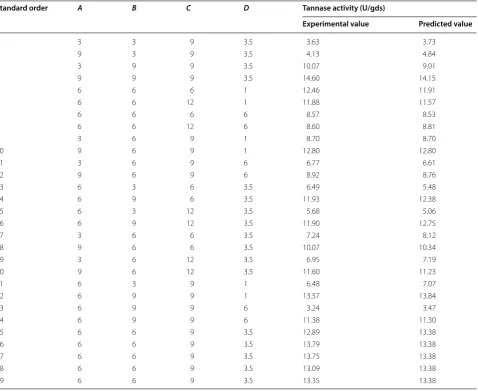
tannin, glucose, (NH4)2SO4, and yeast extract were selected for analysis and optimization through response surface methodology (RSM) [24]. The effective three-level (− 1, 0, and + 1) design (Table 1) of these param-eters was selected, and 29 experiments were conducted with these levels (Table 2). The minimum and maximum
ranges of the variables and the full experimental plan for RSM with respect to their values is listed in Table 2. The quadratic model for RSM for the prediction of optimal points is expressed in accordance with Eq. (1). Response surface regression analysis was conducted with the statis-tical software Design Expert 7.0:
where Y is the predicted response; β0 is the intercept;
β1, β2, β3, and β4 are linear coefficients; and β11, β22,
β33, β44, β12, β13, β14, β23, β24, and β34 are the interaction coefficients.
(1) Y =β0+β1A+β2B+β3C+β4D
+β11A2+β22B2+β33C2+β44D2
+β12AB+β13AC+β14AD+β23BC
+β24BD+β34,
Table 1 Variables and levels of the Box–Behnken
experiment
Variables Levels of variables
Code − 1 0 1
Tannin (%) A 3 6 9
Glucose (%) B 3 6 9
(NH4)2SO4 (%) C 6 9 12
Yeast extract (%) D 1 3.5 6
Table 2 Experimental design and corresponding responses of the Box–Behnken experiment
Standard order A B C D Tannase activity (U/gds)
Experimental value Predicted value
1 3 3 9 3.5 3.63 3.73
2 9 3 9 3.5 4.13 4.84
3 3 9 9 3.5 10.07 9.01
4 9 9 9 3.5 14.60 14.15
5 6 6 6 1 12.46 11.91
6 6 6 12 1 11.88 11.57
7 6 6 6 6 8.57 8.53
8 6 6 12 6 8.60 8.81
9 3 6 9 1 8.70 8.70
10 9 6 9 1 12.80 12.80
11 3 6 9 6 6.77 6.61
12 9 6 9 6 8.92 8.76
13 6 3 6 3.5 6.49 5.48
14 6 9 6 3.5 11.93 12.38
15 6 3 12 3.5 5.68 5.06
16 6 9 12 3.5 11.90 12.75
17 3 6 6 3.5 7.24 8.12
18 9 6 6 3.5 10.07 10.34
19 3 6 12 3.5 6.95 7.19
20 9 6 12 3.5 11.60 11.23
21 6 3 9 1 6.48 7.07
22 6 9 9 1 13.57 13.84
23 6 9 9 6 3.24 3.47
24 6 9 9 6 11.38 11.30
25 6 6 9 3.5 12.89 13.38
26 6 6 9 3.5 13.79 13.38
27 6 6 9 3.5 13.75 13.38
28 6 6 9 3.5 13.09 13.38
The responses of the dependent variables and regres-sion analysis of experimental data were analyzed using Eq. (1). The quality of the fit of the quadratic model equa-tion was expressed by the coefficient of determinaequa-tion (R2), and its statistical significance was evaluated by Fis-cher’s test value (F value).
Traditional tea stalk SSF system
The optimized conditions of the modified SSF system were directly applied to the traditional tea stalk SSF sys-tem. The initial culture medium (per gram tea stalk) for the traditional tea stalk SSF comprised the optimized concentration of carbon sources (tannin and glucose) and nitrogen sources [(NH4)2SO4 and yeast extract], and 2 mL of water at pH 5.0. After sterilization, 1 mL of spore suspension was mixed with the culture medium, and the mixture was incubated under 30 °C for 96 h.
Results
SEM analysis of the internal structures of PUS and morphological characteristics of microorganisms
The PUS used in this experiment had a density of 40 kg/ m3, open-hole diameter of 300–500 μm, and specific sur-face area of 380.6 m2/g. The internal structures of PUS and the morphological characteristics of A. tubingensis
were observed through SEM (Additional file 1: Figure S1). The smooth, flat, and open internal structure of PUS provided extensive support and adsorption interfaces. The excellent mechanical properties of PUS ensure stable oxygen and heat transfer during SSF. Moreover, biomass and enzyme productivity could be measured conveni-ently with PUS as the inert carrier. The convenient meas-urement of these parameters is crucial for the further optimization of SSF.
Effect of process parameters on tannase production
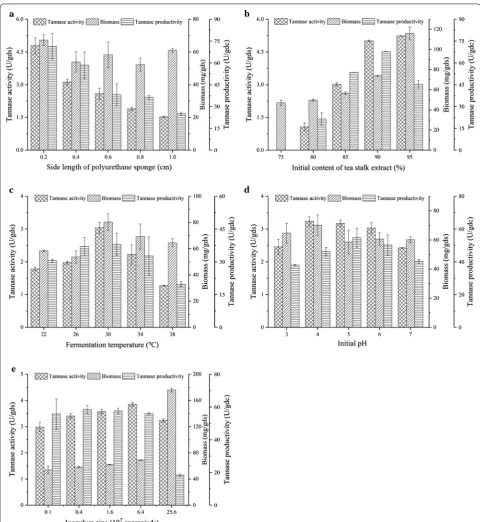
As shown in Fig. 1, different process parameters, includ-ing the side length of PUS, content of tea stalk extract, temperature of incubation, initial pH of the culture medium, and size of inoculum, were assessed, and the optimal process conditions are reshown in Table 3.
Some phenomena could be inferred from Fig. 1 and Table 3. First, all the investigated process parameters influenced tannase activity, biomass, and tannase pro-ductivity. Fermentation could thus be elucidated on the basis of the effects of these process parameters. Second, the highest tannase activity, biomass accumulation, and tannase productivity did not simultaneously occur under the same conditions. For example, the optimal inocu-lum size for tannase production is 6.4 × 10⁷ spores/g of PUS. However, biomass accumulation under this inoculum size was considerably lower than that under 25.6 × 10⁷ spores/g of PUS (Fig. 1e). Some factors
promoted cell growth, whereas others promoted enzyme synthesis. This observation is common in microbial fer-mentation. For example, Banos et al. [25] reported that biomass does not always correspond with secondary metabolite concentration. The components of the fer-mentation medium can be selectively combined to pro-mote cell growth or enzyme accumulation to achieve high enzyme production.
Effects of additional inorganic salts
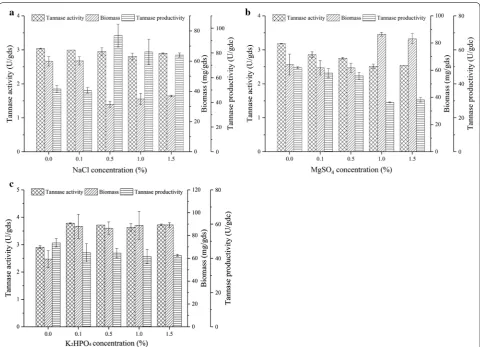
The effects of different inorganic salts on tannase pro-duction were investigated. As shown in Fig. 2, NaCl did not stimulate tannase activity and instead inhibited bio-mass accumulation. The addition of MgSO4 increased microbial growth but decreased tannase activity. The addition of 0.1% K2HPO4 increased tannase production and biomass accumulation. Given that tea stalk extract likely supplied the required amount of inorganic salts for microbial growth and secondary product synthesis, the addition of inorganic salts did not significantly affect tan-nase production.
Effect of individual and combined carbon sources on tannase production
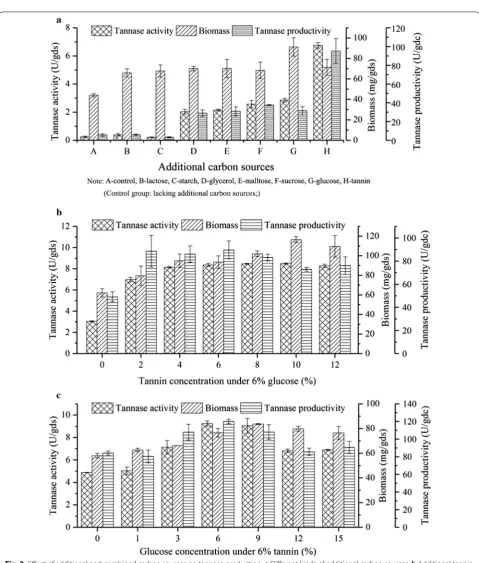
The effect of additional carbon sources on tannase pro-duction in SSF with PUS was examined. Different kinds of carbon sources exerted different effects on cell growth, enzyme activity, and productivity. Among these carbon sources, glucose remarkably increased cell growth by 107%. The addition of tannin increased tannase activity and productivity to 6.5 U/gds and 90 U/gdc, respectively (Fig. 3a).
The effect of different tannin concentrations on tan-nase production with 6% glucose is shown in Fig. 3b. The initial culture medium with 6% glucose was used as the blank control. Then, the effects of tannin on tannase production were studied by adding different concentra-tions of tannin to the culture medium. Compared with the addition of glucose, the addition of tannin not only improved cell growth but also greatly increased tannase activity. As shown in Fig. 3b, the addition of 6% tannin increased tannase activity by 2.9 times relative to the addition of the control treatment.
medium with tannin only, as shown in Fig. 3a. Thus, the appropriate combinations of glucose and tannin levels could increase biomass accumulation and consequently increase tannase activity and productivity.
Effect of individual and combined nitrogen sources on tannase production
cell growth, enzyme activity, and enzyme productivity. Among the tested nitrogen sources, (NH4)2SO4 was the most suitable nitrogen source for tannase production. All organic nitrogen sources, except for urea, promoted bio-mass accumulation; in particular, yeast extract showed the most remarkable effect. Yeast extract, however, was the most unsuitable nitrogen source for promoting tan-nase activity. It is rarely selected as a nitrogen source
for enzyme production in the traditional SSF. Neverthe-less, in the present study, given that biomass could be measured accurately, we found that yeast extract could enhance cell growth.
To determine the optimal concentration of (NH4)2SO4, NH4Cl in the basal culture medium was replaced of (NH4)2SO4. Figure 4b shows that tannase could not be synthesized without an additional nitrogen source.
Table 3 Effect of different parameters on microbial growth and enzyme synthesis
Data in brackets denote the parameter conditions to achieve maximum microbial growth or enzyme synthesis
Research parameters Maximum tannase activity (U/gds) Maximum biomass (mg/gds) Maximum tannase productivity (U/gdc)
Side length of PUS 4.8 (0.2 cm) 67.3 (0.2 cm) 71.4 (0.2 cm) Extract content 5.2 (95%) 116.1 (95%) 45.2 (90%)
Initial pH 3.2 (4) 70.2 (4) 54.7 (4)
Inoculum size 3.9 (6.4 × 10⁷ spores/gds) 176.0 (25.6 × 10⁷ spores/gds) 58.5 (0.4 × 10⁷ spores/gds)
Temperature 3.0 (30 °C) 80.1 (30 °C) 38.6 (30 °C)
Fig. 2 Effects of inorganic salts on tannase production. a NaCl, b MgSO4, and c K2HPO4; the provided values are the mean ± standard deviation of
(NH4)2SO4 drastically affected tannase activity, and the maximum tannase activity (4.5 U/gds) was observed with the addition of 9% (NH4)2SO4.
production. As shown in Fig. 4c, yeast extract could sig-nificantly promote biomass production. Increasing the added amount of yeast extract also increased tannase
as shown in Fig. 4c, the addition of 3% yeast extract accel-erated cell growth and did not negatively affect tannase activity. Thus, adding the appropriate concentrations of yeast extract and (NH4)2SO4 could increase biomass pro-duction and consequently increase tannase activity and productivity.
Combination and optimization of carbon and nitrogen sources
The above results indicated that different carbon and nitrogen sources had different effects on enzyme syn-thesis and cell growth. Tannin and (NH4)2SO4 promoted tannase synthesis, whereas glucose and yeast extract promoted biomass accumulation. Therefore, the appro-priate combination of tannin, glucose, (NH4)2SO4, and yeast extract at the optimal concentrations could further improve tannase activity. RSM was utilized to determine the optimal combination of these factors.
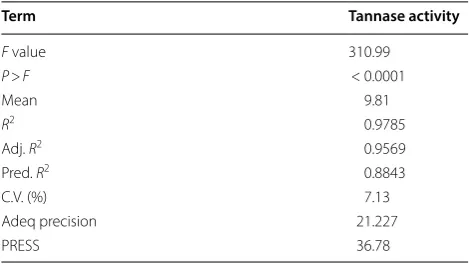
The input variables with the maximum influence on the final response (tannase activity) of the system were iden-tified through the former experiments (Figs. 3, 4). The interactive effects of various selected factors on tannase activity [tannin, glucose, (NH4)2SO4, and yeast extract] were examined through RSM following central compos-ite design (CCD). The results obtained after CCD were analyzed through standard ANOVA (Table 4), which yielded regression Eq. (2) (in terms of coded factors) for tannase activity:
where tannase activity (Y) is a function of tannin (A), glu-cose (B), (NH4)2SO4 (C), and yeast extract (D).
To validate the obtained regression coefficient, tan-nase production was subjected to ANOVA, as shown in Table 5. The results of models F and P > F were 45.43 (2) Y =13.38+1.56A+3.65B−0.012C−1.53D
+1.01AB+0.46AC−0.49AD+0.2BC+0.26BD
+0.16CD−2.57A2−2.87B2−1.58C2−1.59D2,
and < 0.0001, respectively, implying that the models are significant. The lack-of-fit values of F and P > F at 3.93 and 0.0994, respectively, implied that the lack-of-fit made the model fit. The coefficient of determination (R2) was 0.9785; this value indicated that the sample variation of 97.85% could be attributed to the variables and that only less than 3% of the total variance could not be explained by the model. A regression model with a R2 value higher than 0.95 has a high correlation.
The influences of each variable on each response value are shown in Fig. 5. All factors interacted by different degrees, thus proving that tannase activity could be pro-moted by the addition of carbon and nitrogen sources at the appropriate concentrations. Moreover, the opti-mum tannase activity (15.43 U/gds) was observed in the SSF system with 7.49% tannin, 8.11% glucose, 9.26% (NH4)2SO4, and 2.25% yeast extract.
A verification test was conducted to determine the optimal conditions for SSF for tannase production. Over 168 h of fermentation, the tannase activity, biomass accu-mulation, and tannase productivity of the optimization group were higher than those of the initial group. These results confirmed the effectiveness of the optimized strategy (Fig. 6a, b) and verified the previous inference that energy sources with different functions could be combined to promote biomass accumulation, enzyme productivity, and enzyme activity. After 96 h of fermen-tation, the measured tannase activity was 15.01 U/gds, which was in accordance with the expected value of 15.43 U/gds. The maximum enzyme activity was observed at 120 h of fermentation and was approximately 19.22 U/ gds, which was 6.36 times higher than that under the initial conditions (3.02 U/gds). Therefore, the proposed optimization strategy for tannase production could effec-tively increase enzyme activity.
Application of the optimized process in the tea stalk SSF system
Enzyme activity is the sole index for the traditional opti-mization methods for SSF given that determining bio-mass in these methods is difficult. This index, however, is not ideal for optimization because of its limited evalua-tion parameters. The present results are reliable, because tannase activity and biomass could be measured accu-rately. The optimized process conditions for tea stalk SSF could be obtained through RSM. Moreover, the nutrient solution used in this system was extracted from tea stalk. Theoretically, the optimized process parameters could be applied in actual production.
Traditional tea stalk SSF was performed with 1 g tea stalk powder, 7.49% tannin (w/w), 8.11% glucose (w/w), 9.26% (NH4)2SO4 (w/w), 7.49% yeast extract (w/w), ini-tial pH of 5.0, inoculum size of 6.4 × 10⁷ spores/gds, and
Table 4 ANOVA for the response surface quadratic model
Term Tannase activity
F value 310.99
P > F < 0.0001
Mean 9.81
R2 0.9785
Adj. R2 0.9569
Pred. R2 0.8843
C.V. (%) 7.13
Adeq precision 21.227
fermentation time of 96 h. Tannase activity reached 245 U/gds (Fig. 6c column C), which is considerably higher than a previously obtained result (84.24 U/gds, Fig. 6c column B) [26]. Tannase activity was 2.9 times higher than that of the previously reported value. Thus, the opti-mization strategy is effective and could be applied to the actual tea stalk SSF system to increase enzyme activity.
Discussion
Low-cost agricultural byproducts are widely used as substrates in SSF for the production of high-value bio-products. However, the high insoluble substrate content of the culture medium complicates the direct determi-nation of microbial biomass in SSF systems. Therefore, the previous studies have used the yield or activity of the target product as the sole index to evaluate or optimize SSF systems, such as those used for l(+)-lactic acid pro-duction from sugarcane bagasse [27], ethanol produc-tion from rice straw and husk [28], and rapeseed peptide production from rapeseed meal [29]. The same problem of complicated microbial biomass determination is also encountered in tannase SSF, because high amounts of agricultural byproducts, for example, castor bean resi-dues [12], cashew testa [30], coffee husk [31], and tea
stalk [26], are used as solid media to produce tannase. The previous studies have optimized fermentation condi-tions on the basis of a single evaluation index, including tannase activity, and ignored the effect of cell growth on tannase synthesis. Target product accumulation, how-ever, is closely associated with biomass accumulation. In this study, we identified the optimal combination of nutrient sources that promote cell growth and tannase accumulation. Under the optimal process conditions, the maximum tannase activity reached 245 U/gds. This value is considerably higher than the maximum tannase activ-ity of 84.24 U/gds obtained through the traditional opti-mized method with tea stalk as a substrate [26]. These results indicated that optimizing fermentation param-eters on the basis of a single evaluation index has sev-eral limitations. As a matter of fact, the optimization of SSF with agricultural byproduct substrates still requires improvement.
In this study, the hot-water extraction method was adopted to obtain all soluble nutrients, such as tannic acid, polyphenols, polysaccharides, and other miner-als, from tea stalks. The aqueous extract was then used in the modified SSF system to carry out the process of traditional tea stalk SSF. In the modified SSF system,
Table 5 ANOVA results of the Box–Behnken design
Source Sum of squares Degree of freedom Mean square F value P value
P > F
Model 310.99 14 22.21 45.43 < 0.0001
A 29.31 1 29.31 59.95 < 0.0001
B 159.67 1 159.67 326.56 < 0.0001
C 1.752E−003 1 1.752E−003 3.583E−003 0.9531
D 28.23 1 28.23 57.73 < 0.0001
AB 4.05 1 4.05 8.28 0.0122
AC 0.83 1 0.83 1.70 0.2129
AD 0.96 1 0.96 1.96 0.1828
BC 0.15 1 0.15 0.31 0.5858
BD 0.28 1 0.28 0.56 0.4652
CD 0.096 1 0.096 0.20 0.6643
A2 42.89 1 42.89 87.72 < 0.0001
B2 53.45 1 53.45 109.31 < 0.0001
C2 16.29 1 16.29 33.32 < 0.0001
D2 16.31 1 16.31 33.36 < 0.0001
Residual 6.85 14 0.49
Lack of fit 6.21 10 0.62 3.93 0.0994
Pure error 0.63 4 0.16
Cor total 317.84 28
Std. dev. 0.70 R2 0.9785
Mean 9.81 Adj R2 0.9569
C.V. (%) 7.13 Pred R2 0.8843
microbial biomass and tannase productivity were taken as indexes to analyze the influence of different fac-tors on cell growth and tannase synthesis. Afterward, critical factors, with tannase activity as an index, were selected to optimize fermentation conditions. The
optimized conditions could be applied to the tradi-tional SSF with agricultural byproducts as substrates. Interestingly, different carbon and nitrogen sources exerted different effects on microbial growth and prod-uct synthesis.
Fig. 5 Optimization of carbon and nitrogen sources content by RSM using Box–Behnken design. a Interaction of tannin and glucose. b Interaction of tannin and (NH4)2SO4. c Interaction of tannin and yeast extract. d Interaction of glucose and (NH4)2SO4. e Interaction of glucose and yeast extract.
This work first analyzed the metabolic characteris-tics of microorganisms under the influences of different carbon sources. The carbon sources that increased cell growth and tannase synthesis were selected for process optimization. Among the tested carbon sources, glucose remarkably promoted cell growth but negligibly pro-moted enzyme productivity, whereas tannin efficiently improved tannase production and biomass accumula-tion. Although a consensus exists that glucose increases microbial cell growth [32], the role of glucose in tan-nase production through SSF remains controversial. For example, Beniwal et al. [20] observed that supplementa-tion with glucose represses tannase producsupplementa-tion; how-ever, Rodrigues et al. [33] indicated that glucose does not adversely affect enzyme production. In the tradi-tional SSF experiments based on single-index evaluation, additional carbon sources, such as glucose that do not enhance enzyme production, are excluded from further experiments. However, the present study found that glu-cose increased microbial biomass accumulation. Thus, it was selected for further optimization. Moreover, tannin could enhance tannase production in SLF [34] and SSF
[31, 35, 36]. This study also found that tannin could con-siderably increase tannase productivity by acting as an inductor and biomass production by providing energy. Therefore, when combined, glucose and tannin would complementarily promote tannase production. These two carbon sources were then selected for combinatorial optimization for the next RSM design.
The appropriate nitrogen sources for biomass accu-mulation and tannase synthesis were identified. Among these nitrogen sources, organic nitrogen (beef extract, peptone, yeast extract, or corn steep liquor) increased cell growth but negligibly affected enzyme synthesis. The present work discovered that yeast extract pro-moted biomass accumulation but repressed tannase productivity. Battestin and Macedo [31] also pointed out that yeast extract markedly decreased tannase activity but did not present data on its effect on bio-mass. Yeast extract is rarely used as a nitrogen source in the traditional SSF because of its negligible effect on enzyme production. Yeast extract enhanced micro-bial biomass accumulation in the modified SSF system and was thus included as a factor in combinatorial Fig. 6 Application in modified SSF system and the traditional tea stalk SSF system. a Cell growth and enzyme activity in the modified SSF system.
optimization. Inorganic nitrogen sources [(NH4)2NO3, NH4Cl, or (NH4)2SO4] efficiently improve tannase pro-ductivity but negligibly contribute to cell growth. Other studies have confirmed this phenomenon. For example, Zambanini et al. [37] reported that inorganic nitro-gen sources negatively affect biomass accumulation. This effect consequently decreases secondary metabo-lite concentration. Among all the inorganic nitrogen sources used in this work, (NH4)2SO4 is the most suita-ble nitrogen source for tannase production. The highest tannase activity and tannase productivity were obtained when (NH4)2SO4 was used as the sole nitrogen source. Similarly, Rodrigues et al. [36] reported that among dif-ferent nitrogen sources, only (NH4)2SO4 could improve tannase production. Thus, the addition of yeast extract and (NH4)2SO4 would accelerate cell growth and tan-nase synthesis. Therefore, these two nitrogen sources were selected as combination factors for further RSM design.
The optimal combinations of glucose, tannin, yeast extract, and (NH4)2SO4 were identified through RSM. Under the optimized process parameters, the maxi-mum tannase activity reached 19.22 U/gds, which was 6.36 times higher than that under the initial conditions. Furthermore, the optimized parameters were directly applied in traditional tea stalk SSF. Tannase activity could reach 245 U/gds, which was 2.9 and 4.0 times higher than our previously reported values of 84.24 and 62 U/gds, respectively [13, 26]. The present results indicated that every nutrient in the culture medium could be compre-hensively assessed with biomass and tannase productivity as indexes. Synergistic effects that further improve tan-nase production may be obtained when the amounts of nutrients that augment cell growth and tannase activity are balanced.
Conclusion
A modified system was established for the rational and accurate measurement of biomass, enzyme activity, and enzyme productivity in tannase production through SSF. Results showed that different carbon and nitrogen sources exert different effects on cell growth and enzyme accumulation. Hence, tannase production could be improved by adding different combinations of different carbon and nitrogen sources that enhance biomass accu-mulation or enzyme productivity. The maximum tan-nase activity under the optimal process conditions was approximately 19.22 U/gds, which was 6.36 times higher than that under the initial conditions. The optimized pro-cess was applied in the traditional tea stalk SSF system. In this system, tannase activity reached 245 U/gds, which
was 2.9 times higher than the previously reported value of 84.24 U/gds. We hope that our work provides guidance for the optimization of SSF systems that utilize agricul-tural byproducts as substrates.
Abbreviations
SSF: solid-state fermentation; SLF: submerged liquid fermentation; PUS: polyu-rethane sponge; SEM: scanning electron microscope.
Authors’ contributions
AX conceived of the study and with CW designed the experimental pro-gramme. CW and FZ conducted experiments, analyzed and interpreted data, and wrote the manuscript. LL, ZJ, and HN modified the manuscript, figures and tables. All authors read and approved the final manuscript.
Author details
1 College of Food and Biological Engineering, Jimei University, Xiamen 361021, China. 2 Fujian Provincial Key Laboratory of Food Microbiology and Enzyme Engineering, Xiamen 361021, Fujian, China. 3 Fujian Provincial Engineering Technology Research Center of Marine Functional Food, Xiamen 361021, Fujian, China. 4 Xiamen Key Laboratory of Marine Functional Food, Xia-men 361021, China.
Acknowledgements
The authors of this paper want to acknowledge the Fujian Provincial Key Laboratory of Food Microbiology and Enzyme Engineering, Fujian Provincial Engineering Technology Research Center of Marine Functional Food and Xia-men Key Laboratory of Marine Functional Food.
Competing interests
The authors declare that they have no competing interests.
Availability of data and materials Data will be made available upon request.
Consent for publication
All the authors consented on the publication of this work.
Ethics approval and consent to participate
All authors have approved the manuscript and agree with submission to Biotechnology for Biofuels.
Funding
This work was supported by National Natural Science Foundation of China (31371751) and Science and Technology Planning Project of Fujian Province, China (2016N0021).
Publisher’s Note
Springer Nature remains neutral with regard to jurisdictional claims in pub-lished maps and institutional affiliations.
Received: 24 September 2017 Accepted: 22 March 2018
References
1. Chavez-Gonzalez M, Rodriguez-Duran LV, Balagurusamy N, Prado-Barra-gan A, Rodriguez R, Contreras JC, Aguilar CN. Biotechnological advances Additional file
and challenges of tannase: an overview. Food Bioprocess Technol. 2012;5(2):445–59.
2. Tahmourespour A, Tabatabaee N, Khalkhali H, Amini I. Tannic acid degradation by Klebsiella strains isolated from goat feces. Iran J Microbiol. 2016;8(1):14–20.
3. Liu TPSL, Costa RMPB, Freitas DJD, Nacimento CO, Motta CMD, Bezerra RP, Herculano PN, Porto AL. Tannase from Aspergillus melleus improves the antioxidant activity of green tea: purification and biochemical characteri-sation. Int J Food Sci Technol. 2017;52(3):652–61.
4. Macedo JA, Ferreira LR, Camara LE, Santos JC, Gambero A, Macedo GA, Ribeiro ML. Chemopreventive potential of the tannase-mediated bio-transformation of green tea. Food Chem. 2012;133(2):358–65.
5. Chamorro S, Viveros A, Rebole A, Arija I, Romero C, Alvarez I, Rey A, Brenes A. Addition of exogenous enzymes to diets containing grape pomace: effects on intestinal utilization of catechins and antioxidant status of chickens. Food Res Int. 2017;96:226–34.
6. Nie G, Zheng ZM, Jin W, Gong GH, Wang L. Development of a tan-nase biocatalyst based on bio-imprinting for the production of propyl gallate by transesterification in organic media. J Mol Catal B Enzym. 2012;78:32–7.
7. Salgado JM, Abrunhosa L, Venancio A, Dominguez JM, Belo I. Combined bioremediation and enzyme production by Aspergillus sp. in olive mill and winery wastewaters. Int Biodeterior Biodegrad. 2016;110:16–23. 8. Jana A, Halder SK, Ghosh K, Paul T, Vagvolgyi C, Mondal KC, Das
Mohapa-tra PK. Tannase immobilization by chitin-alginate based adsorption-entrapment technique and its exploitation in fruit juice clarification. Food Bioprocess Technol. 2015;8(11):2319–29.
9. Yao J, Guo GS, Ren GH, Liu YH. Production, characterization and applica-tions of tannase. J Mol Catal B Enzym. 2014;101:137–47.
10. Kar B, Banerjee R. Biosynthesis of tannin acyl hydrolase from tannin-rich forest residue under different fermentation conditions. J Ind Microbiol Biotechnol. 2000;25(1):29–38.
11. Chavez-Gonzalez ML, Guyot S, Rodriguez-Herrera R, Prado-Barragan A, Aguilar CN. Production profiles of phenolics from fungal tannic acid biodegradation in submerged and solid-state fermentation. Process Biochem. 2014;49(4):541–6.
12. Madeira JV, Macedo JA, Macedo GA. Detoxification of castor bean residues and the simultaneous production of tannase and phytase by solid-state fermentation using Paecilomyces variotii. Bioresour Technol. 2011;102(15):7343–8.
13. Wang F, Ni H, Cai HN, Xiao AF. Tea stalks—a novel agro-residue for the production of tannase under solid state fermentation by Aspergillus niger JMU-TS528. Ann Microbiol. 2013;63(3):897–904.
14. Boer E, Breuer FS, Weniger M, Denter S, Piontek M, Kunze G. Large-scale production of tannase using the yeast Arxula adeninivorans. Appl Micro-biol Biotechnol. 2011;92(1):105–14.
15. Selwal MK, Yadav A, Selwal KK, Aggarwal NK, Gupta R, Gautam SK. Optimi-zation of cultural conditions for tannase production by Pseudomonas aeruginosa IIIB 8914 under submerged fermentation. World J Microbiol Biotechnol. 2010;26(4):599–605.
16. Aguilar CN, Augur C, Favela-Torres E, Viniegra-Gonzalez G. Induction and repression patterns of fungal tannase in solid-state and submerged cultures. Process Biochem. 2001;36(6):565–70.
17. Aguilar CN, Favela-Torres E, Viniegra-Gonzalez G, Augur C. Culture conditions dictate protease and tannase production in submerged and solid-state cultures of Aspergillus niger Aa-20. Appl Biochem Biotechnol. 2002;102(1):407–14.
18. Barrios-González J. Solid-state fermentation: physiology of solid medium, its molecular basis and applications. Process Biochem. 2012;47(2):175–85. 19. Bhoite RN, Murthy PS. Biodegradation of coffee pulp tannin by Penicillium
verrucosum for production of tannase, statistical optimization and its application. Food Bioprod Process. 2015;94:727–35.
20. Beniwal V, Goel G, Kumar A, Chhokar V. Production of tannase through solid state fermentation using Indian Rosewood (Dalbergia sissoo) sawdust—a timber industry waste. Ann Microbiol. 2013;63(2):583–90. 21. Ramos EL, Mata-Gomez MA, Duran LV, Belmares RE,
Rodriguez-Herrera R, Aguilar CN. Catalytic and thermodynamic properties of a tannase produced by Aspergillus niger GH1 grown on polyurethane foam. Appl Biochem Biotechnol. 2011;165(5–6):1141–51.
22. Trevino L, Contreras-Esquivel JC, Rodriguez-Herrera R, Aguilar CN. Effects of polyurethane matrices on fungal tannase and gallic acid production under solid state culture. J Zhejiang Univ Sci B. 2007;8(10):771–6. 23. Sharma S, Bhat TK, Dawra RK. A spectrophotometric method for assay of
tannase using rhodanine. Anal Biochem. 2000;279(1):85–9. 24. Jana A, Maity C, Halder SK, Mondal KC, Pati BR, Das Mohapatra PK.
Tannase production by Penicillium purpurogenum PAF6 in solid state fermentation of tannin-rich plant residues following OVAT and RSM. Appl Biochem Biotechnol. 2012;167(5):1254–69.
25. Banos JG, Tomasini A, Szakacs G, Barrios-Gonzalez J. High lovastatin pro-duction by Aspergillus terreus in solid-state fermentation on polyurethane foam: an artificial inert support. J Biosci Bioeng. 2009;108(2):105–10. 26. Xiao AF, Huang YF, Ni H, Cai HN, Yang QM. Statistical optimization for
tannase production by Aspergillus tubingensis in solid-state fermentation using tea stalks. Electron J Biotechnol. 2015;18(3):143–7.
27. van der Pol EC, Eggink G, Weusthuis RA. Production of l(+)-lactic acid from acid pretreated sugarcane bagasse using Bacillus coagulans DSM2314 in a simultaneous saccharification and fermentation strategy. Biotechnol Biofuels. 2016;9:248.
28. Wood IP, Cao HG, Tran L, Cook N, Ryden P, Wilson DR, Moates GK, Collins SRA, Elliston A, Waldron KW. Comparison of saccharification and fermen-tation of steam exploded rice straw and rice husk. Biotechnol Biofuels. 2016;9(1):193.
29. He R, Ju XR, Yuan J, Wang LF, Girgih AT, Aluko RE. Antioxidant activities of rapeseed peptides produced by solid state fermentation. Food Res Int. 2012;49(1):432–8.
30. Viswanath V, Leo VV, Prabha SS, Prabhakumari C, Potty VP, Jisha MS. Bio-synthesis of tannase from cashew testa using Aspergillus niger MTCC5889 by solid state fermentation. J Food Sci Technol. 2015;52(11):7433–40. 31. Battestin V, Macedo GA. Tannase production by Paecilomyces variotii.
Bioresour Technol. 2007;98(9):1832–7.
32. Wu XF, Liu Q, Deng YD, Li JH, Chen XJ, Gu YZ, Lv XJ, Zheng Z, Jiang SY, Li XJ. Production of itaconic acid by biotransformation of wheat bran hydrolysate with Aspergillus terreus CICC40205 mutant. Bioresour Technol. 2017;241:25–34.
33. Rodrigues THS, Pinto GAS, Gonçalves LRB. Effects of inoculum concentra-tion, temperature, and carbon sources on tannase production during solid state fermentation of cashew apple bagasse. Biotechnol Bioprocess Eng. 2008;13(5):571–6.
34. Aissam H, Errachidi F, Penninckx MJ, Merzouki M, Benlemlih M. Production of tannase by Aspergillus niger HA37 growing on tannic acid and olive mill waste waters. World J Microbiol Biotechnol. 2005;21(4):609–14.
35. Sabu A, Pandey A, Daud MJ, Szakacs G. Tamarind seed powder and palm kernel cake: two novel agro residues for the production of tannase under solid state fermentation by Aspergillus niger ATCC 16620. Bioresour Tech-nol. 2005;96(11):1223–8.
36. Rodrigues THS, Dantas MAA, Pinto GAS, Gonçalves LRB. Tannase produc-tion by solid state fermentaproduc-tion of cashew apple bagasse. Appl Biochem Biotechnol. 2007;137:675–88.