The carcasses of cattle are classified in the abat-toirs by muscle conformation and fat content. The carcasses classification is mostly subjective; the objective methods are used rarely, such as video image analysis (whole carcasses or their parts) (BARTOŇ et al. 2001) or sonography. A perspec-tive method for the estimation of beef carcass quality seems to be bioelectric impedance analysis (BOHUSLÁVEK 2000, 2003).
The relations between the selected dimensions of some parts (mostly loin) and the total carcass composition are searched. The amounts of muscle and of fat in a carcass can be estimated using the equation containing the rib eye area, the ratio of fat to total area, and the carcass weight (NADE et al. 2001). The image analysis can be used for this
purpose evaluating the images that are shot by digital camera or acquired using a two-dimen-sional sonography. Different muscles dimensions, such as those of musculus longissimus lumborum et thoracis (MLLT), musculus iliocostalis (MI), and musculus trapezius (MT) are also used (see Figure 1).
BRANSCHEID (1999) compared three different ways of restriction of the loin cross-section area (see Figures 2–4) and obtained equations for the estimation of the muscle and adipose tissues ra-tios (r = 0.92 and 0.88, respectively) from the data measured.
ANADA & SASAKI (1992), using the computer analysis, evaluated the cross-section images of the loin area which were circumscribed in the
Use of Video Image Analysis for the Evaluation of Beef
Carcasses
OLDŘICH SMÉKAL
1, PETR PIPEK
1, MITSUYOSHI MIYAHARA
2and JARMILA JELENÍKOVÁ
11
Department of Food Preservation and Meat Technology,
Faculty of Food and
Biochemical Technology, Institute of Chemical Technology, Prague, Czech Republic;
2Department of Agriculture and Biological Chemistry, College of Bioresource Sciences,
Nihon University, Fujisawa, Japan
Abstract
SMÉKAL O., PIPEK P., MIYAHARA M., JELENÍKOVÁ J. (2005): Use of video image analysis for the evalua-tion of beef carcasses. Czech J. Food Sci., 23: 240–245.
Video image analysis was used for the objective evaluation of beef carcasses parts as an additional parameter of the carcass classification. The pictures of cross sections of dorsal parts of beef carcasses between 8th and 9th vertebra were
taken under industrial conditions and evaluated using LUCIA software. The areas of muscle and adipose tissues were thresholded on several ways (the whole loin area, the areas of individual muscles and those of different loin sections) and the correlations between these areas were searched. The best correlations were found between large areas. Video image analysis proved to be a suitable method for the evaluation of selected carcass parts.
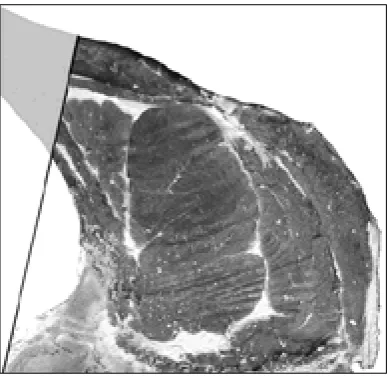
horizontal level by the tangent line from the tho-racic vertebra and by a line vertical to the thotho-racic vertebra (Figure 5). The second evaluated area was restricted by a line that links the end of thoracic vertebra and musculus iliocostalis (Figure 6). Pre-diction equations for estimating the muscle and fat ratio from the measured data had the correlation coefficient r = 0.94.
The accuracy of the image analysis was verified by the repeated measurements of the cross-sec-tion between the 6th and 7th ribs. The measured
parameters were the areas of different muscles, the total cross-section area, and the areas of lean meat, fat, and bone. The corresponding correlation coefficients ranged from 0.95 to 0.99 (KARNUAH
et al. 1999). The correlation coefficients obtained from the adjusted (for age) data between the in-formation extracted by CIA and the carcass com-position were only slightly lower than those of the unadjusted data sets (KARNUAH et al. 1996). This indicates that the computer image analysis enables to estimate the carcass composition independently of the age of the slaughtered cattle.
MATERIAL AND METHOD
Different methods were tested for the measure-ment of the muscle areas on the cross-section through the beef carcass after quartering between 8th and 9th ribs. 139 cross-sections of bulls and
90 ones of cows were evaluated. The age of animals and the slaughter weights were not taken into consideration during the classification. Correla-tions were searched between different areas on the dorsal parts of carcasses both generally for all animals and separately for bulls and cows.
The images of cross-sections of dorsal parts of beef carcasses were shot under industrial condi-tions of a large slaughterhouse two or three days
post mortem. For the shooting, a digital camera Olympus 2020Z (focal distance 18 mm) was used that was fixed on a special modified frame with two fluorescent tubes that enssured a homog-enous lighting of the objects. The photographs were analysed using the software LUCIA 3.52b (Laboratory Imaging, Prague) by three different methods: after BRANSCHEID (1999) (three
[image:2.595.73.282.84.233.2]dif-Figure 1. Muscles on the loin cross-section: A – m. ilio-costalis; B – m. longissimus lumborum et thoracis; C – m. trapezius
[image:2.595.67.282.514.729.2] [image:2.595.303.529.516.730.2]ferently bounded areas on the loin cross-section (Figures 2–4), after ANADA & SASAKI (1992) two areas bounded according to Figures 5 and 6 and with our own method that evaluated the area of the cross-section without bones (Figure 7), the areas of the muscles musculus longissimus lumborum et thoracis, musculus iliocostalis and musculus trapezius, and the total area of all muscles on the cross-section.
The areas in pixels were transferred to the val-ues in mm2 using two-dimensional calibration of
software LUCIA and known dimensions in the picture.
RESULTS AND DISCUSSION
[image:3.595.67.289.83.299.2]The video image analysis was used as an addi-tional method for the testing of the bioelectrical impedance analysis of beef carcasses. Correlations were searched between the selected differently defined areas in the images of the loin cross sec-tion. This investigation was part of an extensive research focused on the use of bioelectric imped-ance analyses. This partial research intended to find a suitable object to which the electrical data could be correlated. As there are different models for the evaluation in the literature using image analysis, we tried to compare and correlate them to find the most suitable one.
Figure 5. The whole loin area after Anada
[image:3.595.315.522.83.259.2] [image:3.595.313.520.529.728.2] [image:3.595.86.282.541.729.2]It was found that relatively close correlations exist between the individual areas (r = 0.55–0.99) as evident from Table 1. The selected relations are also demonstrated in figures. The results indicate with a certain probability the possibility of predic-tion the loin composipredic-tion using the measurement of the selected area.
Very good correlations were achieved between large areas, especially between the whole loin area and the one after avoiding the bones (r = 0.99; see Figure 8). The same high correlation was also obtained between the whole loin area and the area restricted by a line according to Anada (Figure 9).
The omitting of the bones in both cases represents only a small change of the total area of the loin cross-section and the variability of the bones di-mensions is relatively small in comparison with the muscle and fat tissues areas.
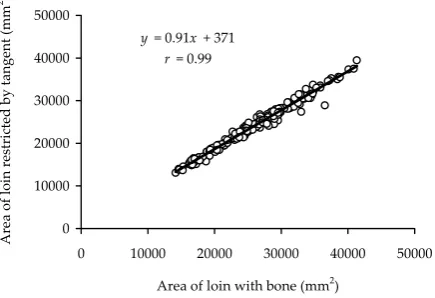
The total area of loin (including bones) correlated highly (r = 0.99) also with the area restricted by the line after Branscheid (Figure 4). The correlation was higher with the cows (r = 0.99) in comparison with the bulls (r = 0.98).
The dependences of the areas of the individual muscles varied considerably, being much higher in the case of larger muscles in comparison with the small ones. A relatively good correlation (r = 0.91) was found between the area of musculus longis-simuslumborum et thoracis and the total area of all muscles (∑muscle)(Figure 10). With the bulls, the correlation coefficient was lower (r = 0.86) than with the cows (r = 0.94).
On the contrary, a low correlation (r = 0.78) was found between the area of the boneless loin and the area of musculuslongissimus lumborum et thoracis (Figure 11). This fact can be related to the variable fat content (both intramuscular as intermuscular); the white fat tissue area then significantly influenced the total area of the loin cross-section. The high variability of the fat con-tent caused a lower correlation coefficient with the bulls (r = 0.67) in comparison to that with the cows (r = 0.85). Whereas old cows have mostly a relatively constant fat content, the fat content in old bulls is more dependent on the age.
The lowest correlation coefficient was found between the area musculus iliocostalis and the total area of all muscles (∑muscle) (see Figure 12), being with the bulls only 0.65 (with the cows r = 0.75). This muscle has a relatively small area on
Table 1. Correlations between individual areas on the cross-section of the loin
lwb. bll. ∑ muscles arlB artB
bll. 0.99 – 0.84 0.99 0.92
∑ muscles 0.85 0.84 – 0.83 0.77
MLLT 0.80 0.78 0.91 0.78 0.74
MI 0,65 0.61 0.75 0.60 0.55
MT 0,75 0.68 0.83 0.66 0.58
arlB 0.99 0.98 0.83 – 0.96
artB 0.92 0.92 0.77 0.96 –
arlA 0.99 0.89 0.88 0.87 0.79
[image:4.595.63.291.113.269.2]MI – musculus iliocostalis;MT – musculus trapezius; MLLT – musculus longissimus lumborum et thoracis; ∑ muscles – sum of the areas of muscles MI, MT and MLLT; bll – boneless loin, arlB – area restricted by line after Branscheid; artB – area restricted by tangent after Branscheid; arlA – area restricted by line after Anada; lwb – loin with bones
[image:4.595.312.530.576.725.2]Figure 8. Relation of the area of boneless loin (bll) to the area of loin with bone (lwb)
Figure 9. Relation of the area of loin restricted by line after Anada (arlA) to the area of loin with bone (lwb)
y = 0.91x – 1863
r = 0.99 0
10000 20000 30000 40000
10000 15000 20000 25000 30000 35000 40000 45000
Area of loin with bone (mm2)
A re a of b on el es s lo in (m m
2 ) y = 0.91x + 371
r= 0.99
0 10000 20000 30000 40000 50000
0 10000 20000 30000 40000 50000
Area of loin with bone (mm2)
[image:4.595.66.285.578.713.2]the cross-section and thus every small inaccuracy during thresholding induces a high deviation. In addition to this, m. iliocostalis narrows in this place, and so every small deviation at the level of the cross-section used substantially influenced the measures of the muscle area.
The correlations with the bulls and cows were summarised in Table 2. It is evident that these cor-relations are higher with the cows in comparison to the bulls. This can be explained by different ages of the slaughter animals and a higher variability in the breed of the bulls.
Table 2. Correlations between individual areas on the cross-section of the loin for bulls and cows
lwb bll ∑ muscles arlB artB
bll 0.98 0.99 – 0.79 0.88 0.98 0.99 0.88 0.94
∑ muscles 0.81 0.86 0.79 0.88 – 0.78 0.87 0.68 0.83
MLLT 0.79 0.87 0.67 0.85 0.86 0.94 0.67 0.85 0.61 0.82
MI 0.53 0.72 0.48 0.70 0.65 0.75 0.46 0.70 0.40 0.67
MT 0.70 0.74 0.65 0.64 0.79 0.78 0.63 0.60 0.52 0.55
arlB 0.98 0.99 0.98 0.99 0.78 0.87 – 0.94 0.97
artB 0.88 0.95 0.88 0.94 0.68 0.83 0.94 0.97 –
arlA 0.98 0.99 0.89 0.85 0.85 0.86 0.87 0.83 0.75 0.78
MI – musculus iliocostalis;MT – musculus trapezius;MLLT – musculus longissimus lumborum et thoracis; ∑ muscles – sum of the areas of muscles MI, MT and MLLT; bll – bo-neless loin, arlB – area restricted by line after Branscheid; artB – area restricted by tangent after Branscheid; arlA – area restricted by line after Anada; lwb –.loin with bones bold marked correlations – bulls, the other correlations – cows
The results presented indicate a possibility to predict with certain probability the dimensions of the individual loin parts using the measurement of the investigated areas on the loin cross-section. These areas will be used for the following correla-tion with bioelectrical parameters.
CONCLUSION
[image:5.595.66.288.80.212.2]The computer video analysis proved to be a suit-able method for the prediction of some parts of
[image:5.595.306.531.85.210.2]Figure 12. Relation of the area of muscles sum (∑ muscles) to the area of muscle MI
Figure 10. Relation of the area of muscles sum (∑ muscles)
to the area of muscle MLLT Figure 11. Relation of the area of boneless loin (bll) to the area of muscle MLLT
the cattle loin composition. Best correlations were achieved between large areas on the cross-section of loin. These correlations were higher with cows in comparison with bulls. This partial data obtained will be used in an extensive research focused on the bioelectric impedance analyses.
y = 4.46x + 4475 r = 0.65
bulls
y = 7.24x + 888 r = 0.75
bulls 0
5000 10000 15000
0 500 1000 1500 2000
Area of musculus iliocostalis (mm2)
A re a of � m us cl e (m m 2 )
y = 2.94x + 5384
r= 0.78
0 10000 20000 30000 40000
0 2000 4000 6000 8000 10000 12000
Area of muscle MLLT (mm2)
A rea of bo neles s loin (mm 2)
y = 1.51x + 611
r = 0.91
0 5000 10000 15000 20000
0 2000 4000 6000 8000 10000 12000
Area of muscle MLLT (mm2)
[image:5.595.304.532.295.550.2] [image:5.595.66.287.444.568.2]References
ANADA K., SASAKI Y. (1992): Image analysis prediction of beef carcass composition from the cross section. Animal Science and Technology, 63: 846–854. BARTOŇ L. et al. (2001): Učební texty pro školení
klasifi-kátorů jatečných těl skotu (SEUROP). Výzkumný ústav živočišné výroby, Praha-Uhříněves.
BOHUSLÁVEK Z. (2000): Estimation of EUROP – Confor-mation and Fatness of Beef Carcasses by Bioelectrical Impedance Analysis. Scientia Agriculturae Bohemica, 31: 55–64.
BOHUSLÁVEK Z. (2003): Odhad složení jatečně upravených těl skotu pomocí počítačové analýzy obrazu příčných řezů mezi 8. a 9. žebrem. In: Sborník XXXIV. sympo-zia o nových směrech výroby a hodnocení potravin. Skalský dvůr: 50–53.
BRANSCHEID W. (1999): Application of video image in grading of carrle. Fleischwirtschaft International, 4: 12–15.
KARNUAH A.B., MORIYA K., SASAKI Y. (1999): Image analysis prediciton of beaf carcass composition from the cross sections. Asian-Australasian Journal of Animal Science, 12: 1171–1176.
KARNUAH A.B., MORIYA K., MITANI K., YAMAZAKI T., SASAKI Y. (1996): Estimation of carcass image analysis in the cross section of cross-breed steers. Canadian Journal of Animal Science, 76: 498–506.
NADE T., KARNUAH A.B., MASUDA Y., HIRABARA S., FUJITA K. (2001): Estimation of carcass composition from the cross-section at ribloin of Japanese Black steers by computer image analysis. Animal Science Journal, 72: 313–320.
Received for publication June 27, 2005 Accepted after corrections September 20, 2005
Corresponding author:
Ing. OLDŘICH SMÉKAL, Vysoká škola chemicko-technologická v Praze, Fakulta potravinářské a biochemické technologie, Ústav konzervace potravin a technologie masa, Technická 3, 166 28 Praha 6, Česká republika