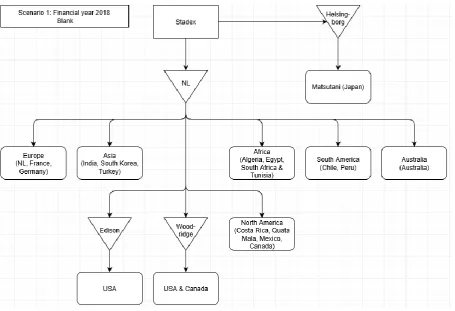
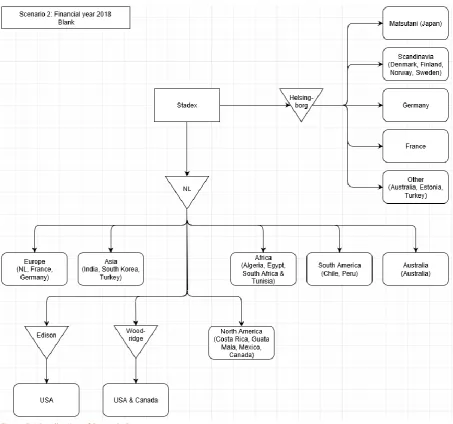
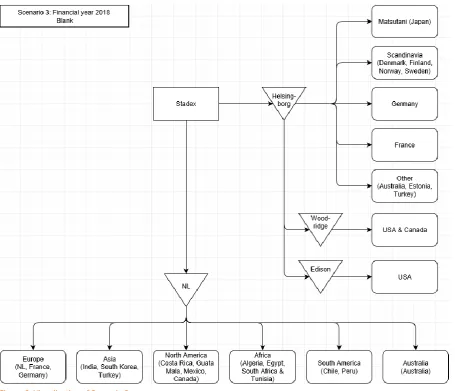
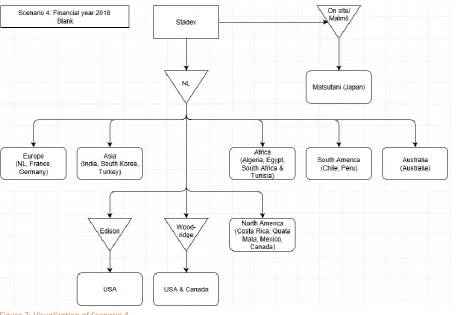
Determining the optimal
warehouse location
Ruben Zwiers
Industrial Engineering and Management
Bachelor year 3
University of Twente
Bachelor Thesis: Industrial Engineering and Management
Determining the optimal
warehouse location
Bachelor Thesis: Industrial Engineering and Management
5-7-2019
Author
Ruben Zwiers
S1832972
BSc. Industrial Engineering and Management
University of Twente
Drienerlolaan 5
7522 NB, Enschede
The Netherlands
Supervisors of the University of Twente
Dr. IR. L. L. M. van der Wegen
Dr. Ir. E. A. Lalla
Supervisors of Avebe
MSc. Ing. C. Bontjer
Preface
This report is the result of my Bachelor graduation thesis in the field Industrial Engineering and Management, at the University of Twente. I conducted this research for Avebe in the period from February 2019 till July 2019. At Avebe, I did research to determine the optimal storage location to replace their current warehouse in Sweden. I have done this by conducting semi-structured individual in depth interview with the management. Next to that I have applied discrete location modelling.
I would like to thank Erik Pricker and Carlijn Bontjer from Avebe, for their help during this research and their time and energy invested. I would like to thank also all the other employees of Avebe which were involved in my research.
Next to that I would like to thank supervisors from the University of Twente for their critical and good feedback which strongly enhanced the quality of my report. My first supervisor Leo van der Wegen who supervised me during his sabbatical and my second supervisor Eduardo Lalla.
Lastly, I would like to thank my family and Marlinde Vetkamp for their mental support, interest and feedback.
Summary
Introduction
Avebe is corporation of approximately 2500 potato farmers, which core business is making starch and protein products out of potatoes. In order to do so, Avebe has production plants and
warehouses in Germany, Sweden and The Netherlands to fulfill customer demand all over the world. This is done by approximately 1350 employees.
Motivation and core question of this research
The warehouse in Sweden needs to close since the Swedish government wants to build houses at that location by October 2020. Therefore, Avebe asked to determine the optimal storage location for Avebe to store their products when the currently used warehouse closes. Besides, the customer demand allocation over the warehouse that replaces the warehouse in Sweden and the warehouse in The Netherlands is researched.
Problem solving approach
First the current process between the factory in Sweden and the customers is analyzed. This analysis concerns the following information:
1. The current process layout including the product flows.
2. The costs in the current process split into storage, transportation, labor and handling costs. 3. The CO2 emission caused by transportation based on the different transportation means.
4. The changes in the process between the factory in Sweden and the customer when the warehouse in Sweden is replaced.
5. An analysis on the stakeholders of the process and their roles.
6. My personal view on how the warehouse scenarios should be assessed, being the costs, sustainability and ethical impact.
Secondly, the problem-solving approach is based on literature in three ways. First, this research provides an overview of the variables on which the warehouse scenarios should be assessed according to professional companies in the field of warehouse solutions. Second, a systematic literature review is conducted to determine the different types of discrete facility location models that exist and when these should be applied. Lastly, based on the systematic literature review the fixed charge uncapacitated facility location model is selected and applied in this research to determine the score of the different warehouse scenarios on the operationalized criterion costs. Thirdly, semi-structured individual in depth interviews with the management are conducted to determine what important requirements and wishes of the management are when analyzing different warehouse solutions. This together with my personal view and the assessment criteria according to the professionals in the field of warehouse solutions resulted in two things. First, the operationalized criteria in this study being the costs (split into storage, transportation, labor and handling costs) and the CO2 emission caused by transportation. Secondly, the points of attention for
Result, conclusion and recommendation
Based on scores of the different warehouse scenarios analyzed, this research shows that Avebe can best locate its new warehouse on the site of their factory in Sweden. Besides, the allocation of customer demand should stay the same except for the fact that the products of the customers delivered from The Netherlands should directly after production be transported to the warehouses in The Netherlands (without storing these in Sweden). The numbers used in the calculations of this report are the real numbers of financial year 2018, which starts at August 2017 and ends in July 2018. I recommend Avebe to change to this new warehouse scenario as soon as possible, since this yields Avebe a cost saving of €303,313 per year which is 11.1% of the total costs between the factory and the customer. Besides, the CO2 emission caused by transportation can be reduced with 1,040
kilograms per year, which is 0.03% of the total CO2 emission caused by transportation. Next to that,
Summary (in Dutch)
Introductie
Avebe is een coöperatie van ongeveer 2500 aardappelboeren, wiens kernactiviteit het maken van zetmeel- en eiwitproducten uit aardappelen is. Om dit te realiseren heeft Avebe fabrieken en magazijnen in Duitsland, Zweden en Nederland waarmee aan de klanten vraag over de hele wereld wordt voldaan. Dit alles wordt gedaan door de plus minus 1350 werknemers van Avebe.
Motivatie en kernvraag van dit onderzoek
Het magazijn in Zweden moet dicht omdat de Zweedse overheid per Oktober 2020 huizen wil bouwen op deze plek. Daarom heeft Avebe mij gevraagd om te onderzoeken wat de beste opslaglocatie voor de producten van Avebe is, wanneer het huidige magazijn gesloten wordt. Daarnaast moet de allocatie van de klanten over de magazijnen opnieuw bekeken worden.
Probleem aanpak
Allereest is het huidige proces tussen de fabriek in Zweden en de klanten geanalyseerd. Deze analyse bevat de volgende informatie:
1. De huidige proces indeling inclusief de product stromen.
2. De kosten in de huidige situaties opgesplitst in de opslag, transport, arbeid en in- en uitslag kosten.
3. De CO2-uitstoot veroorzaakt door transport gebaseerd op de verschillende
transportmiddelen.
4. De veranderingen in het proces tussen de fabriek in Zweden en de klanten wanneer het magazijn in Zweden vervangen wordt.
5. Een analyse van de stakeholders van dit onderzoek en hun rol.
6. Mijn mening over waarop de verschillende scenario’s in dit onderzoek beoordeeld moeten worden. Dit zijn de kosten, duurzaamheid en ethische impact.
Ten tweede is de probleem aanpak gebaseerd op verschillende literaire onderzoeken. Allereerst, geeft dit onderzoek een overzicht van de variabelen waarop de scenario’s beoordeeld moeten worden volgens professionele bedrijven die gespecialiseerd zijn in het bieden van magazijn oplossingen. Ten tweede, is er een systematisch literatuuronderzoek gedaan om een overzicht te creëren van de verschillende discrete locatie modellen die bestaan de wanneer deze dienen te worden toegepast. Tot slot, wordt er gekozen voor het “fixed charge uncapacitated facility” locatie model op basis van het uitgevoerde systematische literatuuronderzoek.
Ten derde zijn er semigestructureerde individuele diepte-interviews afgenomen met het management om de belangrijkste eisen en wensen, voor het beoordelen van de magazijn oplossingen, volgens de managers vast te stellen. Deze interviews hebben samen met mijn persoonlijke mening en de beoordelingscriteria van de professionele bedrijven tot twee dingen geleidt. Allereerst, de geoperationaliseerde criteria kosten (opgebouwd uit de opslag, transport, arbeid en in- en uitslag kosten) en CO2-uitstoot veroorzaakt door transport. Ten tweede, een advies
rapport met aandachtpunten voor de inkoopafdeling wanneer ze één specifiek magazijn moeten kiezen naar aanleiding van dit onderzoek.
Resultaten, conclusies en aanbevelingen
Gebaseerd op de scores van de verschillende scenario’s die geanalyseerd zijn in dit onderzoek, kan ik concluderen dat het nieuwe magazijn het best op de grond van de fabriek in Zweden kan worden geplaatst. Verder kan de allocatie van de klant vraag het beste gelijk blijven aan hoe deze in de huidige situatie is. Alleen moeten de producten voor de klanten die beleverd worden vanaf
Nederlands direct na productie in Zweden naar de Nederlandse magazijnen getransporteerd worden (zonder eerst te worden opgeslagen in Zweden). De berekeningen in dit onderzoek om tot deze conclusie te komen zijn gebaseerd op de echte getallen van financieel jaar 2018.
Ik adviseer Avebe om zo snel mogelijk over te gaan op dit nieuw scenario aangezien dit Avebe een kostenbesparing van €303.313,- per jaar oplevert. Dit is gelijk aan 11,1% van de totale kosten tussen de fabriek in Zweden en de klant in de huidige situatie. Daarnaast zal deze verandering een reductie van 1.040 kilogram CO2-uitstoot per jaar, veroorzaakt door transport, opleveren. Dit is gelijk aan
0,03% van de totale CO2-uitstoot veroorzaakt door transport in de huidige situatie. Daarnaast kunnen
de mensen die in het huidige magazijn werken weer in het nieuwe magazijn werken, aangezien dit één kilometer verderop is. Tot slot is er gevoeligheidsanalyse van de uitkomsten van dit onderzoek gegeven. Op basis van deze gevoeligheidsanalyse kan worden geconcludeerd dat de uitkomsten van dit onderzoek niet veranderen door een realistische verandering in de kosten coëfficiënten
Table of Contents
Preface ... 5
Summary ... 6
Summary (in Dutch) ... 8
Reader’s guide ... 12
Definition of key concepts and variables ... 13
1. Introduction ... 14
1.1 A few words about Avebe ... 14
1.2 Research motivation ... 14
1.3 Problem description ... 14
1.4 The scope of research ... 15
1.5 Research objective ... 15
1.6 Research (sub) questions and plan of approach for answering the research questions ... 15
1.7 Summarizing overview of the problem-solving approach ... 21
2. The current process between factory and customer ... 22
2.1 What does the process between factory and customer look like? ... 22
2.2 What are the costs and CO2 emission in the process between factory and customer? ... 25
2.2.1 What are the storage costs in the current warehouse situation? ... 25
2.2.2 What are the transportation costs of the current process? ... 26
2.2.3 What are the labor and handling costs of the people working at the current warehouses? ... 27
2.2.4 What is the CO2 emission in the current processes? ... 27
2.3 What changes in the process between factory and customer? ... 28
2.4 What are the complexities in the process between factory and customer? ... 29
2.5 Who are the stakeholders in this process? ... 29
2.6 What are based on the research so far criteria that I should assess possible future warehouses on, according to myself ... 31
... 32
Summary of Chapter 2... 32
3. Background Study ... 33
3.1 What are criteria that possible future warehouses should be assessed on, according to professionals in the field? ... 33
3.2 What discrete location models do exist? ... 34
3.3 Which of these discrete location models are suitable for my research? ... 35
4. Requirements, wishes and scope of the management ... 37
4.1 What are requirements of the management? ... 37
4.2 What are wishes of the management? ... 38
4.3 What are the warehouse scenarios in scope of research? ... 40
... 48
Summary of Chapter 4... 48
5. The best warehouse ... 49
5.1 How do the warehouse scenarios score on the operationalized criteria? ... 49
5.2 The best choice ... 74
Sensitivity analysis on the cost coefficient “storage costs on the Stadex site” ... 75
Sensitivity analysis on cost coefficient “cost per kilogram CO2 emission” ... 75
... 76
Summary of Chapter 5... 76
6. Conclusions, recommendations and discussion ... 77
6.1 What are the conclusions of the research? ... 77
6.2 What are the recommendations of my research? ... 78
6.3 What should be discussed about my research? ... 79
6.3.1 What are the assumptions made in my research? ... 79
6.3.2 What are the limitations of my research? ... 81
References ... 82
Appendices ... 84
Appendix 1 Detailed explanations of calculations ... 84
Appendix 1.1 Calculation of the storage costs in the current situation ... 84
Appendix 1.2 Explanation of the calculation of the transportation costs in the current situation .. 85
Appendix 1.3 Explanation of the calculations done to determine the CO2 emission of the current warehouse situation ... 86
Appendix 1.4 Calculations done to determine the transportation costs of the warehouse scenarios ... 89
Appendix 2 The systematic literature review ... 94
Appendix 2.1 The variable and fixed key theoretical concepts of the systematic literature review 94 Appendix 2.2 Detailed description and argumentation of the systematic literature review ... 95
12
Reader’s guide
In this reader’s guide, a short and clear overview is given of what can be found in which chapter of my thesis. This makes it possible to quickly find what you are looking for. In case of reading the whole thesis, the guide gives an idea of the direction in which the research is going.
Chapter 1 Introduction
In this chapter the company description, research motivation, problem statement, scope of research, research objectives, research questions and problem-solving approach are stated.
Chapter 2 The current process between factory and customer
In this chapter the current process between the factory and the final customers is described in terms of product flows, storage and transportation. Special attention is payed to the costs and CO2
emission in the current situation. Besides, the changes, stakeholders and complexities in the current process are highlighted. Lastly, my personal view on what good assessment criteria are to access warehouse scenarios on is given.
Chapter 3 Background study
In this chapter theoretical background is provided to support my problem-solving approach. A study about what the warehouse scenario assessment criteria should be according to three professional companies in the field of warehouse solutions is given. After that, a systematic literature review to find out what type of discrete location models exists and when these should be used, can be found. Lastly, the discrete location model used in this thesis is chosen. This is done based on the outcomes of the systematic literature review.
Chapter 4 Requirements, wishes and scope of the management
In this chapter the requirements, wishes and warehouses in scope of this research are determined. This is done based on semi-structured individual in depth interviews with the management.
Chapter 5 The best warehouse
In this chapter is determined what the best warehouse scenario is. This is done by scoring the different warehouse scenarios based on the operationalized assessment criteria, which are determined in Chapter 4.
Chapter 6 Conclusions, recommendations and discussion
13
Definition of key concepts and variables
Below I provide a list of the variables and concepts which I use in my research, in order to make sure that the message comes across the way it is intended to.
Avebe
When I am talking about Avebe in relationship to storage capacity, product flows, transportation and CO2 emission, I am talking about the products made at the factory (Stadex) in Malmö.
The management
When I am talking about the management of Avebe, I mean the supply chain director of Avebe, the supply chain manager of Avebe, the supply chain manager at Stadex, the category manager transport & warehousing of Avebe and the sales and operations planner at Avebe (my supervisor).
The Analytical Hierarchy Process (AHP) tool
The Analytic Hierarchy Process (AHP), introduced by Thomas Saaty (1980), “is a multicriteria model that provides a methodology for comparing alternatives by structuring criteria into a hierarchy, providing for pair-wise comparisons of criteria at the lowest level of the hierarchy to be entered by the user, and synthesizing the results into a single numerical value”. (Phillips-Wren G. E., Mora, M. & Forgionne, G., 2008)
Fixed costs
“Fixed costs are the expenses that have to be paid by a company, independent of any business activity” (Investopedia, 2018). Examples of fixed cost in this research are the storage costs and the labor costs.
Variable costs
“Variable costs are expenses that are dependent on the business activity” (Investopedia, 2019). Examples of variable costs in this research are the transportation costs and the handling costs.
Transportation cost
“The expenses involved in moving products or assets to a different place” (Business-Dictionary, 2019). At Avebe, transportation is outsourced. Therefore, the transportation costs are equal to the costs of the contracts with the transportation companies.
CO2 emission
In this research the CO2 emission is calculated based on the amount of transportation kilometers, the
weight of the products transported (in ton kilograms) and the different CO2 ratios for transportation
by truck, train and ship.
Storage costs
The storage costs are the renting cost for the warehouse. These costs are based on the number of squared meters warehouse rent.
Handling costs
The handling costs are the costs for loading and unloading of the truck, train or ship, when this is done by external people.
Labor costs
14
1. Introduction
This chapter consist of seven different sections. Section 1.1 gives a short introduction about Avebe. Section 1.2 provides the original reason for this research. In Section 1.3, the core problem of this research is stated. Section 1.4 describes the scope of the research. In Section 1.5, the goal of this research is stated. Section 1.6 mentions the research questions and the approach of answering these research questions. Lastly, in Section 1.7 a summarizing overview of the problem-solving approach is given.
1.1 A few words about Avebe
The organization that this research focusses on, is Avebe. Avebe is a corporation of approximately 2500 potato farmers and has its headquarters in Veendam, The Netherlands. The core business of Avebe is producing starch and protein products out of potatoes. These products do have a lot of different applications in, amongst others, the paper, healthcare, animal feeding and human food industry. The production plants of Avebe are located in Germany, Sweden and The Netherlands. These factories process about three million tons of potatoes each year. From these plants, the products of Avebe are distributed all over the world. All this is done by approximately 1350 employees of Avebe.
1.2 Research motivation
The reason for this research within Avebe is as follows. One of the production plants of Avebe (Stadex) is located in Malmö, Sweden. Next to this plant, Avebe rents a warehouse (called Briggen) where the products, made at the Stadex plant, are stored. Both the Stadex factory and Briggen (the warehouse) are located within the living area of Malmö. This is due to the urban development. Now, Avebe estimates that the odds are large that the Swedish government wants to build houses at the location of their current warehouse. Building these houses can start, worst case scenario, in November 2020 since Avebe’s contract with warehouse Briggen is valid until October 2020. Therefore, Avebe asked to make a business plan which states the current situation and gives an advice about what warehouse Avebe should rent when it is no longer possible to store the products at Briggen. Avebe does not have the money to buy or build a warehouse itself, but it is possible that another company builds a new warehouse for Avebe in exchange for a renting contract with Avebe.1
1.3 Problem description
This research is focusing on the following core problem:
“Which warehouse should Avebe rent when it is no longer possible to store products at Briggen?”
The reason for choosing this as the core problem is the following. The government is likely going to build houses at the location of the current warehouse, while Avebe needs a warehouse to store its products. This means that Avebe must look for a new warehouse. Next to this core problem, Avebe also wants to know if the allocation of customer demand over this new warehouse and the existing warehouses can be done in a better way.
1 I found out that this build and rent back construction is possible during the interviews I conducted with the
15
1.4 The scope of research
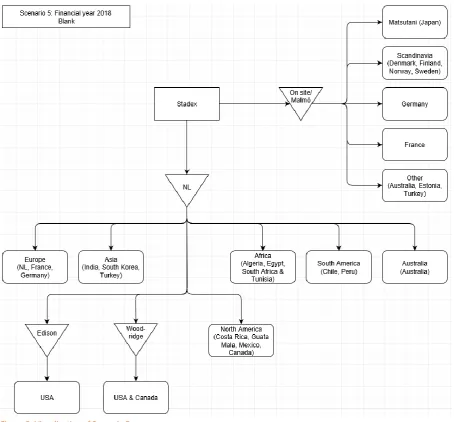
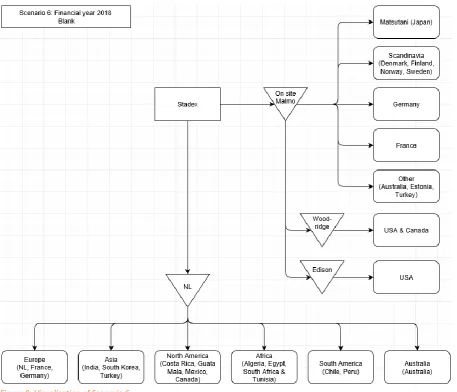
This research focusses on finding the best warehouse solution for Avebe when Briggen needs to close. The warehouse scenarios in analysis of this research do have scenario specific fixed warehouse locations and customer demand allocations over the warehouses. Both the warehouse locations and customer demand allocations are asked for in the interviews with the management which I conduct. The outcome of these interviews can be found in Section 4.3.
Next to that, this research assumes that the factory (Stadex) and the warehouses in the USA stay the same. Besides, the research is based on the numbers of financial year 2018 (which is from August 2017 till July 2018). I chose to base this research on financial year 2018, because this is the latest full year of data available and therefore the most representative data for future calculations.
Lastly, it is important to know that this research concerns products made at the Stadex factory in Sweden. So, the products made at the factories in Germany and The Netherlands are not in scope of this research.
1.5 Research objective
The objective of the research is to find the optimal warehouse location, and related customer demand allocation, for the storage of Stadex products when Briggen needs to be closed. To do so, I deliver the following:
1. Insights into what are criteria on which the potential new warehouse scenarios should be assessed.
2. An advisory report for the purchasing department which states the points of attention when selecting one specific warehouse based on the outcomes of this research.
3. A model which can be used to determine the costs of different warehouse scenarios. 4. A model which can be used to determine the CO2 emission caused by transportation of
different warehouse scenarios.
5. This thesis which describes the research, outcomes and a piece of advice for Avebe. Also, the calculations and underpinning are provided.
6. A well substantiated advice to Avebe about what warehouse Avebe should rent instead of Briggen and which customer demand should be fulfilled from this warehouse.
1.6 Research (sub) questions and plan of approach for answering the research
questions
16
(Ch 2.) The current process between factory and customer
In this chapter, I describe and analyze the current situation. Describing and analyzing the current situation helps me to get a good idea about the process I am researching. This yield me useful insights in the complexities of the current process and the stakeholders involved, which help me to analyze possible future warehouse solutions. Next to this, the current process acts as a ‘base line’ for analyzing the other possible warehouses. For example, once I know what the costs involved in the current process between factory and customers are, I have a better idea of the costs which I find by analyzing other warehouse scenarios (since I do have the current situation to compare with). Lastly, at the end of this chapter, focusing on describing and analyzing the current situation, I ask myself what criteria I think that possible future warehouse should be assessed on, based on the research that I have done so far. I ask myself this question because, the research done so far is mainly based on numbers and facts, which means that I am not yet influenced by personal perceptions of managers at this stage. This makes it possible to have an independent look at the process. Next to that, the list of criteria helps me to execute the background study of Section 3.1 and therefore to have a good structure and good questions for the semi-structured individual in depth interviews. I conduct these interviews to determine the requirements and wishes of the management. The outcomes of the interviews are given in Chapter 4.
Below an overview of sections (2.1-2.4) handling the knowledge questions I ask myself, in order to determine how the current processes are organized, is given. In Section 2.5, the stakeholders in the process are mentioned. When the stakeholders are concerned in the research, the chance of successful implementation of outcomes of the research is bigger. Therefore, it is interesting to know the stakeholders and their roles. Section 2.6 is based on my personal view and handles a decision instead of a knowledge question.
(2.1) What does the process between factory and customer look like?
(2.2) What are the costs and CO2 emission in the process between factory and customer?
(2.2.1) What are the storage costs paid in the current warehouse situation? (2.2.2) What are the transportation cost of the current process?
(2.2.3) What are the labor and handling costs of the people working at the current warehouses?
(2.2.4) What is the CO2 emission in the current process? (2.3) What changes in the process between factory and customer?
(2.4) What are the complexities in the process between factory and customer? (2.5) Who are the stakeholders in this process?
(2.6) What are based on the research so far criteria that I should assess possible future warehouses on, according to myself
17
(Ch 3.) Background study
In this chapter, a background study (Section 3.1) and a systematic literature review (Section 3.2 and Section 3.3) are conducted. Section 3.1 answers to the following knowledge question:
(3.1) What are criteria that possible future warehouses should be assessed on, according to professionals in the field?
The reason for answering this knowledge question, based on the advice of professionals in the field, is that I use the answer as a guideline for the interview questions of Chapter 3, aiming to determine the requirements and wishes of the management. This does not mean that the criteria found by this research are equal to the operationalized criteria that I use in my research, but I mention these criteria to the managers during the interviews, in case they do not mention the criteria themselves. I tell the manager that based on my study also criterion “x” is important and ask whether he or she thinks that this criterion indeed is important for my research. Only when at least one person of the management thinks that it is a good criterion, I assess the possible future warehouses on the
criterion or mention this criterion in the advice for the sourcing department. In this way, I make sure that there are no criteria, without reason, not considered in my research that according to expert in the field should be considered in my research.
The second and third section, answer the following knowledge questions:
(3.2) What discrete location models do exist?
(3.3) Which of these discrete location models are suitable for my research?
First of all, I focus on discrete location models, because Avebe asked me to analyze scenarios. These scenarios are always a combination of two predetermined warehouses and a predetermined distribution of demand over these warehouses. Of these two warehouses, one warehouse is always the warehouse in The Netherlands and the other is a warehouse determined in the interviews (Section 4.3). This means that I focus on finding the location of this second warehouse which has a discrete location, since this should be rent. Renting a warehouse implies that the warehouse already exists, therefore the location is discrete2. Besides, the allocation of demand over the two warehouses
is done on beforehand, by the supply chain manager and myself for each of the scenarios that I analyze (I also ask the managers during the interviews if they have ideas about this and take these into consideration). This means that my study is focusing on the optimal location for the warehouse and the best allocation of demand over these locations. Since the core question of my research is what warehouse should replace Briggen and the sub-question related to this researching the allocation of customer demand, I chose the focus is on discrete location models. I answer the questions of Section 3.2 and Section 3.3, because this yields me a theoretical guideline that I can use to determine the final scores of the warehouse scenarios. The question of Section 3.2 is meant to orientate myself on the discrete location models that exist, while the question of Section 3.3, is meant to theoretically support my decision for the specific discrete location model I use in my research.
All the background studies in this chapter are executed using the database ‘Scopus’ and/or ‘Web of Science’ and/or the book Supply Chain Management (Chopra, S. & Meindl, P., 2013) or by conducting research on the internet. In this way, this chapter enhances the strength of the outcome of my research, since it makes sure that the problem-solving approach is based on literature.
18
(Ch 4.) Requirements, wishes and scope of the management
This chapter provides answers to three knowledge questions. The first and second section answer the following knowledge questions:
(4.1) What are requirements of the management? (4.2) What are wishes of the management?
The reason for answering these knowledge questions is the following. The management is, at the end of the day, going to make the decision. So, at the end of my research, these people need to have all information about the possible warehouses that they want to have in order to make a decision. To provide the management with this data for the warehouses that are suitable to solve the action problem, I need to know what the requirements and the wishes (which I translate to criteria) for the possible warehouses are. Otherwise, it can happen that at the end of my research the conclusion is, that I should have researched other things in order to make a decision, which I want to avoid. The outcome of answering these two knowledge questions is a list of the requirements and wishes (decision criteria) of the management. These are the criteria to measure how good the different warehouses in scope are. Next to that, based on these criteria, I know what data I need to gather about the warehouses.
I gather the data needed to answer these two knowledge questions, by conducting semi-structured individual in depth interviews with the management. In these interviews, I first describe my research and ask the managers what, according to them, are the requirements and wishes related to the warehouses. In case they do not mention the criteria of a good warehouse solution, according to the background study that I have done in Section 3.1, I mention these and ask them whether they think that I also should take those criteria into account. Besides, I always ask why they think the criterion, that they mention as being important, is important.
19 Next to the fact that I need to know the requirements and wishes related to the warehouse I also find an answer to the following question:
(4.3) What are the warehouses scenarios in scope of research?
The reason that I answer this question, is that it is impossible for me to analyze all warehouses in the world. Therefore, I ask the management, in a semi-structured individual in depth interview, to provide specific warehouses or warehouse locations which I should analyze, according to them (including the allocation of customers to this warehouse locations). In order to make sure that the managers have ideas about this, I tell them some days before that I ask this question. This makes it possible to provide well thought out answers. Based on the interviews, I make an overview of warehouses that I include in my research. In this overview, I include all suggestions that are given by the management.
(Ch 5.) The best warehouse
This chapter is spilt into two sections. Section 5.1 provides the scores of the warehouse scenarios on the operationalized criteria. Besides the calculations done to determine these scores can be found. Section 5.2 states which warehouse scenario is the best choice. Next to that, the outcomes of the sensitivity analyses on two important cost coefficients in this research are given. Lastly, I give some insights in the way my problem-solving approach changed during the research. This can be found underneath the header “Insights in the original problem-solving approach of Chapter 5”
The first section handles the following knowledge question:
(5.1) How do the warehouse scenarios score on the operationalized criteria?
The reason for asking this knowledge question, is that I need to know how the warehouse scenarios score on the operationalized criteria, in order to compare these different warehouse scenarios. I answer this question by using the data which is available at Avebe. When the information is lacking, I gather the information myself or together with employees of Avebe.
After I know how the different warehouses score on the operationalized criteria, I look at what the best warehouse scenario is in the following section:
(5.2) The best choice
The reason for having this section is that this research aims to give a piece of advice to Avebe in which is stated what Avebe should do when warehouse Briggen needs to close. Since I want to give a piece of advice, I need to choose between the different warehouse scenarios. This is done based on the scores of the operationalized criteria in Section 5.1. Besides, the outcomes of the sensitivity analyses on two important cost coefficients in this research is given. The reason for doing these sensitivity analyses is that I want to know the impact off small changes in these cost coefficients on the total costs including the costs for CO2 emission of the warehouse scenarios. I conducted these
20
Insights in the original problem-solving approach of Chapter 5
Until I had the scores of the warehouse scenarios on the operationalized criteria, I thought that Chapter 5 was going to have the following structure from Section 5.2 onwards:
(5.2) What is the outcome of the AHP-tool on the criteria and scores? (5.3) What warehouse scenario is best?
(5.4) What is the outcome of the management discussion about the differences between the managers?
I planned to ask the managers to fill out the AHP-tool, on the importance of the criteria and on the different warehouse scenarios, in new semi-structured individual in depth interviews. In this way, I was planning to make ranking of the different warehouse scenarios for each specific manager based on their filled out AHP-tool. After that, I intended to have a management discussion about the possible differences between the managers about what the best warehouse solution is. Based on this discussion I hoped to create a solution which everyone agrees upon, which would have been the outcome of the research.
There are two reasons why I chose to deviate from this original approach. First, I came to know that the board of Avebe has decided that the CO2 emission tax for CO2 emission caused by transportation
is €0.05 per kilogram CO2. This made it possible to express all the operationalized criteria into one
criterion which is total costs. This made it superfluous to use the AHP-tool since at least two criteria are needed to fill out this tool. Second, the scores of the warehouse scenarios on the two
operationalized criteria in Section 5.1 where such, that a quick search on the costs of CO2 emission
yielded almost immediately the conclusion that the differences in CO2 emission are way too small to
have a serious impact on the differences between the costs of the different warehouse scenarios. For these two reasons I decided not to uses the AHP-tool which would not have affected the outcome of this research and therefore only wasted the time of the managers and myself.
In Section 5.2 is stated how I assessed the different warehouse scenarios by ranking them based on the total costs including the costs of CO2 emission.
(Ch 6.) Conclusions, recommendations and discussion
This chapter mentions the conclusion of my research, the recommendations for Avebe and a discussion about the assumptions and limitations of the research. In order to do so, the following questions are answered:
(6.1) What are the conclusions of the research? (6.2) What are the recommendations of my research? (6.3) What should be discussed about the research?
I answer Question 6.1 and 6.2 based on the findings in Sections 5.2. Question 6.3, I answer by
21
1.7 Summarizing overview of the problem-solving approach
In this section, I give a short summarizing overview of the problem-solving approach. This can be used as sort of a guide to keep following the logic while reading the report.
Chapter 2 “The current process between factory and customer”
2.1 Product flows
2.2 Costs and CO2 emission
2.3 Changes 2.4 Complexities 2.5 Stakeholders
2.6 Warehouse scenario assessment criteria according to myself
Chapter 3: “Background study”
3.1 Warehouse scenario assessment criteria according to professionals in the field 3.2 Types of discrete location models that exist and their features
3.3 The discrete location model applied in this research
Chapter 4: “Requirements, wishes and scope of the management”
4.1 The warehouses requirements according to the management 4.2 The warehouses wishes/criteria according to the management 4.3 Warehouse scenarios in scope of this research
All sections of Chapter 4 are based on semi-structured individual in depth interviews with the managers
Chapter 5: “The best warehouse”
5.1 Scores of the warehouse scenarios on the operationalized criteria 5.2 The best warehouse scenarios
- Sensitivity analyses on two important cost coefficients
22
2. The current process between factory and customer
In this chapter, the current process between the factory (Stadex) and the final customer is analyzed. This analysis is split into six sections, each answering a different question. In Section 2.1, a
visualization of the current process can be found. This includes information about the product flows and their size. In Section 2.2, the costs and CO2 emission (caused by transportation) in the process
between factory and customers can be found. The costs are split into warehousing costs, transportation costs and the labor/handling costs of the people working at the warehouses. In Section 2.3, an analysis on what changes to the current process when Briggen needs to be closed, is given. Section 2.4 mentions the most important complexities in the current process. In Section 2.5, the stakeholders in the process are given. Lastly, Section 2.6 provides an overview of what I think that the most important criteria are to assess the possible future warehouse scenarios on.
2.1 What does the process between factory and customer look like?
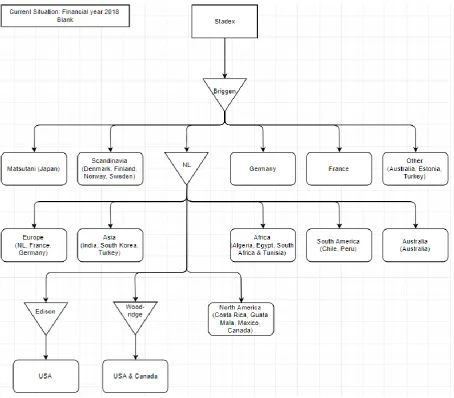
[image:22.595.72.527.341.739.2]In order to know what I am exactly researching and to create an overview, I analyzed the current process between the factory (Stadex) in Malmö and the final customers of the products made at Stadex. In Figure 1, the visualization of the current process can be found.
23 In this figure a rectangle means that it is a factory, a triangle is a warehouse and a rounded rectangle is a final customer. Based on this figure I would like to mention a few things about the process. First of all, all products, in the research and in this visualization, are products made at Stadex. Secondly, there are in total four warehouses in the current process according to the figure. Namely, Briggen in Malmö, NL, Edison (USA close to New York) and Woodridge (USA close to Chicago). This needs a small side note because, in reality there are four storage locations in the Netherlands. These are the “Sample Room” in Foxhol, “Van der Vorst” in Dinteloord, “Teuben” and “Teuben TAK” in Ter
Apelkanaal. The last two warehouses, which are located about three and a half kilometers away from each other are located in Ter Apel and in Ter Apelkanaal, are responsible for 99,97% of the storage of Stadex products in the Netherlands. Therefore, I summarized the four warehouses to “NL” meaning storage in Ter Apelkanaal.
Thirdly, the overview shows all the countries where customers are located for the distribution of products from Briggen, from NL to North America, from Edison to the USA and from Woodridge to the USA and Canada. For the distribution of products from NL to Europe, Asia, Africa, South America and Australia I only mention (between brackets) the countries which are responsible for more than 10% of the demand of the continent in which the country is located. I chose to do it like this, otherwise the figure would have become unclear. Since, products are distributed from the Netherlands to 67 countries all over the world.
24 After determining the process overview (Figure 1), I determined the quantities related to the
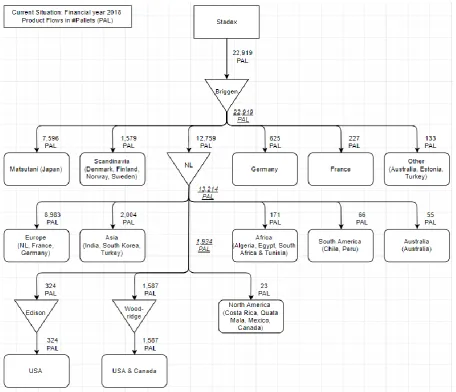
[image:24.595.70.527.122.514.2]different product flows. The result of this research is stated in Figure 2. The underlined numbers are summations of pallet flows.
Figure 2: Visualization of the product flow in pallets in financial year 2018
The number of products going to the different countries is important for a few reasons. First of all, it helps to determine what the most important customers are and where these are located. Secondly, it gives an idea of the amount of product that is produced at the factory. Thirdly, this overview makes it possible to quickly see whether locating a possible future warehouse in a certain country makes sense.
25 In my analysis, I chose to express the product flows in number of pallets (PAL). I have done this, because almost all products are ordered and transported on pallets. Only a small part of products is ordered in bags or in kilograms. In this case, I look how much bags fit on one pallet for each specific material (done using the VLOOKUP function). For the orders in kilograms I use the rule of thumb consisting of 1000 kilograms is equal to one pallet, which is used in Avebe as well. This yields the overview stated in Figure 2.
In Figure 2 can be found that in total 12,759 pallets go from Briggen to The Netherlands. However,
adding up the pallets going from NL to the next locations, yields 13,214 pallets. This means that there are 13,214 – 12,759 = 455 pallets more going from The Netherlands than pallets going to The
Netherlands. There are two reasons for this difference. First of all, there is a material, Eliane sc160, that is transported from Briggen to the Netherlands on pallets with 45 bags of Eliane sc160. Only part of the bags is distributed on pallets which have place for 25 bags. This means that more pallets are needed to transport the same amount of product from the Netherlands. This explains 101 pallets of the difference. The left-over difference of 354 pallets can be explained in two ways. First, by the differences in the inventory in the warehouses in The Netherlands between the start and the end of financial year 2018. Second, by the assumption that 1000 kilograms of material fits on one pallet.
2.2 What are the costs and CO
2emission in the process between factory and
customer?
In this section, an overview of the costs of the process between factory and customer is provided in three steps. section 2.2.1 provides the storage costs of the currently used warehouses. section 2.2.2 gives the transportation costs of the process between factory and customer. Sub-section 2.2.3 states the labor and handling costs of the people working at the current warehouses. Lastly, Sub-section 2.2.4 provides the total CO2 emission caused by transportation in the current
situation.
2.2.1 What are the storage costs in the current warehouse situation?
With the storage costs I mean the costs of having “x” amount of square meters warehouse. These costs are most of the time determined by multiplying the number of square meters with the price per square meter per year. This definition and way of calculating the storage costs I have determined myself, the company agreed on this.
In the current scenario storage costs are paid for the warehouse Briggen and the warehouses in The Netherlands, within the scope of this research. The rent paid for warehouse Briggen is 3,250,000 Swedish Crown (SEK) which is 286,334 euros per year. This number is provided by the manager of the Stadex factory and warehouse Briggen. The storage costs paid for the warehouses in The
Netherlands are 127,871 euros per year. This makes the total storage costs of the current scenario €286,334 + €127,876 = 414,220 euros per year.
The calculations done to determine the storage costs in The Netherlands can be found in Appendix 1.1.
26
2.2.2 What are the transportation costs of the current process?
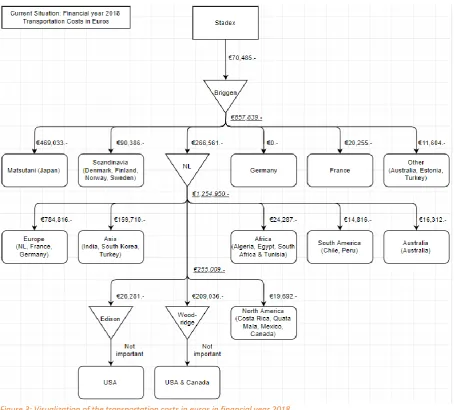
In Figure 3, the outcome of the research to determine the transportation cost of the distribution of
[image:26.595.71.528.136.546.2]Stadex products in the current situation can be found. The underlined numbers are summations of the transportation costs mentioned below in the figure.
Figure 3: Visualization of the transportation costs in euros in financial year 2018
Looking at this overview two questions are useful to discuss. The first question is: “Why are the transportation costs from warehouse Briggen to the customers in Germany equal to zero?”. This is because, Avebe has a contract with these customers, which states that the customers need to pick up the ordered products themselves. So, these customers arrange the transportation and not Avebe. The second question is: “Why are the transportation costs from the warehouses Edison and
Woodridge not important?”. The reason for this is that these warehouses do not change in this research. So, the costs of the warehouses, the allocation of these customers and the transportation costs and kilometers do not change from these warehouses onwards.
Adding up all transportation costs, I found that the total transportation costs in the current warehouse situation are equal to 2,183,274 euros. Namely €70,485 + €857,839 + €1,254,950 = €2,183,274
27
2.2.3 What are the labor and handling costs of the people working at the current
warehouses?
In warehouse Briggen nowadays two people are working fulltime. Part of their job is to do the handling (racking and un-racking the pallets) in the warehouse. The labor cost of these employees at Briggen are 800.000 Swedish Crown (SEK) which is 94,803 euros per year. The handling costs are included in this. This number is provided by the supply chain manager of Stadex.
The difference between labor costs and handling costs is the following. When own people work in the warehouses, the company has labor cost. Although, when external people work in the
warehouse, they get payed based on the number of pallets that are racked and un-racked. These costs are called “handling costs” instead of “labor costs”.
In the current situation also handling costs are paid for the warehouse in The Netherlands. These handling costs are €42,284 per year. This number is calculated by multiplying the number of pallets stored in the warehouse with the costs for handling, which yield 13,214 pallets times 3.20 euros is equal to 42,284 euros per year. The handling costs are based on the current situation and provided by the sourcing department. The number of pallets stored in The Netherlands can be found in Figure
2.
2.2.4 What is the CO
2emission in the current processes?
The outcome of calculations done to determine the total CO2 emission, caused by transportation, in
the current warehouse situation is 3,027,300 kilograms CO2. This number is based on transportation
that took place in financial year 2018. I calculated the CO2 emission by editing the CO2 emission
calculations done by almost all transportation companies (namely by using CO2 emission ratios) in a
customized way for Avebe. This resulted in the following method:
1. I spilt the transportation kilometers in transportation by truck, train and ship. 2. I used different “ratios” for the truck, train and ship. These “ratios” state how much
kilograms CO2 emission is caused by the transportation of 1000 kilograms over one kilometer
using a certain transportation means. The ratios I use are 0.0415 kilograms CO2 per ton
kilograms per kilometer for transportation by truck, 0.0160 kilograms CO2 per ton kilograms
per kilometer for transportation by train and 0.0100 kilograms CO2 per ton kilograms per
kilometer for transportation by ship. These “ratios” are based on the report “STREAM Goederenvervoer 2016” (Otten, M., t' Hoen, E. & Den Boer, E.).
3. I calculated the average transportation kilometers and therefore the CO2 emission on
country level based on the known distances (within Avebe) to the postal codes of the customers.
4. I only concerned the transportation kilometers that Avebe is responsible for. Some contracts state “Ex works FCA”, this means that the transportation of the product is done by the customer and therefore Avebe is not responsible for the CO2 emission caused by this
transportation.
5. To determine the number of tons transported I excluded the Ex works FCA and I assumed (on advice of the supply chain manager of Avebe) that one pallet is equal to one ton (1000 kilograms) of product. I only made this assumption for the transportation from the warehouses in The Netherlands. For the transportation between Stadex and Briggen and From Briggen to the next station, I have received the real number of tons transported in financial year 2018 from the transportation companies (DSV, Green Carrier and Vos
transport). There are too many different transportation companies that transport products from the warehouses in The Netherlands to do the same here. Therefore, I assumed for these product flows that one pallet is equal to one ton.
A detailed explanation of the calculations done to determine the CO2 emission can be found in
28
2.3 What changes in the process between factory and customer?
Looking at the process between Stadex and the final customer several things change, when the warehouse location of Briggen changes. For example, when Briggen is replaced by a warehouse in Helsingborg, the first thing that changes are the transportation costs between the factory and the customers. This is due to the fact that the transportation kilometers change and maybe also the way of transportation. The transportation of certain products from Briggen to The Netherlands is done by truck nowadays, while in a new situation this might be done by ship. This difference in way of
transportation and the amount of transportation kilometers affect the amount of CO2 emission in the
process.
Secondly, if there are customers supplied from an illogical warehouse nowadays, according to the managers (being a warehouse in The Netherlands or Briggen), I take the proposed other distribution of customers into analysis for the scenarios of analysis (see Section 4.3). This means that the needed storage capacity in The Netherlands and Sweden can change. Due to other customer demand allocations to the warehouses.
Thirdly, the costs for renting the warehouses changes. When a warehouse has a different location and a different storage capacity, the renting cost of the warehouse is different. For example, the warehouses in Sweden are more than twice as expensive as the warehouses in The Netherlands, according to the purchase department of Avebe.
Fourth, the labor cost of the people working at the warehouses change. These costs highly differ from country to country, since the living costs are also different from country to country. This means that relocation of warehouses effects the labor costs.
Fifth, the number of operations between production and fulfilling demand changes. When, for example, customers are directly delivered from Briggen, the products only need to be transported from Stadex to Briggen and from Briggen to the customer. Whereas, the number of operations is bigger when, for example, the products are first stored at Briggen, then in The Netherlands and then transported from The Netherlands to the customer. The number of operations is not the primary focus in this research but is good to be aware of the impact. Since, more operations also result in more damaged material. The reason for this is that the fork truck drivers sometimes damage the products in the warehouses. Also, the handling/labor and storage costs are likely to be bigger when a product is stored two times instead of once.
29
2.4 What are the complexities in the process between factory and customer?
Based on the analysis of the current situation of the process between factory and customer I point out some complexities that I encountered. The first thing that makes the process complex, is the fact that there are 52 different products made at Stadex. This makes it hard to get an overview of the different products that are made and what these different products need in terms of storage environment.
Secondly, the same product does not always have the same sales unit. One product can be ordered in number of bags, number of pallets or number of kilograms. Besides, not always the same number of bags fits on one pallet and not all pallets do have the same size. Next to that, there is a difference in the density of the product which means that not always the same number of kilograms fit in one shipment. These differences in sales units make it complex to get an overview of the total product flows within the process.
Lastly, the huge number of customers located in 67 countries all over the world make the process complex. When I change for example the warehouse location from which these customers are supplied nowadays, I must recalculate the transportation kilometers for all these customers. Besides, the contract with these customers differ. Some customers pick up the orders at the warehouse while others get the products delivered.
2.5 Who are the stakeholders in this process?
When doing research which might change company processes, it is good to know who the stakeholders of the process researched are. Therefore, I give an overview of the most important stakeholders in this research. Besides, the reason for being a stakeholder is given.
Employees working at the current warehouses
The employees working at the existing warehouses can be highly affected by the outcome of my research. Imagine that the outcome of my research is, that the new warehouse should be located in Helsingborg. This means that the people currently working at Briggen lose their job. Next to that, in case the outcome of my research is less extreme and more in terms of a change in the customer distribution over the warehouses, the amount of work that needs to be done at the warehouses might change. This implies that the number of employees needed at the warehouse can change. Therefore, the employees working at the existing warehouses are clearly stakeholders in this research.
Transportation companies
Since Avebe outsources transportation, the transportation companies are also affected by the outcome of my research. The result of my study might be that transportation needs to be done from different warehouse locations and in other ways. This changes the transportation costs and the demands from the transportation companies. Transportation which currently is done by truck might change to transportation using ships or the other way around. Therefore, the transportation
30
The landlords of the current warehouses
The landlords of the current warehouses can also be highly affected by the outcome of my research. Imagine, the outcome of my research is that Avebe should have way less storage capacity in the warehouses in The Netherlands. This means that the landlord of the warehouse in The Netherlands loses part of its income and need to look for new parties to do business with. Although the impact of the outcome of the research on the landlords will not affect the decision making in this research, since it is not Avebe’s problem, the landlords are still stakeholders.
The sourcing department of Avebe
A very important stakeholder in this research, is the sourcing department of Avebe. First of all, this department is responsible for finding a new warehouse at the location, determined in this research. Secondly, purchasing needs to find new transportation companies or negotiate with the currently used transportation companies about new contracts to fulfill the changing requirements of Avebe. Therefore, the purchasing department of Avebe is an important stakeholder in this research.
The customers of Avebe
The customers of Avebe are important stakeholders in my research for two reasons. First of all, if the warehouse locations change and/or the distribution of the customer demand over these warehouse locations change, the delivery times to the customers might also change. Secondly, especially the customers picking their orders at the existing warehouses are affected by a change in warehouse locations. Since these customers need to pick their order from other locations, which changes the transportation kilometers and costs. For example, all the customers in Germany pick their orders at the warehouses at Avebe. Avebe, of course, does not want to lose these customers because of relocation of the warehouses. Therefore, the customers of Avebe are important stakeholders of my research.
Stakeholders/members of Avebe
Since Avebe is a corporation of potato farmers, the primary stakeholders are the farmers. These want to have the highest price for their potatoes. This means that when the outcome of my research yields a bigger profit margin, by reducing the costs for example, the primary stakeholders are very happy to implement my proposed solution. Although, when this profit margin is does not improve or even decrease by my purposed solution, it is very unlikely that Avebe implements this solution. Since, the farmers likely do not want that, and the farmers must agree. Therefore, stakeholders/members of Avebe are the primary stakeholders in this research.
The management of Avebe
The managers of Avebe are going to make the final decision. Once they do not agree upon the advised warehouse scenario, the warehouse scenario is not going to be implement. This means that it is very important to stay in contact with the management during the research. In this way, the management knows what the research is about and has the feeling that the solution that I advise is also partly their own work. This results in a bigger chance that the advice is followed by the
31
2.6 What are based on the research so far criteria that I should assess possible future
warehouses on, according to myself
Looking at the current process and the research done so far, I think that there are three important categories of criteria on which possible future warehouses should be assessed. I wrote this section explaining my personal few before doing the interviews. This forced me to have an objective and uninfluenced opinion about what important assessment criteria are before having interviews with the management. This approach enhances the independency of this research and helps me to structure the interviews. Below, I explain why I think that the criteria categories costs, sustainability and ethical impact are important.
Costs
I think that the costs of the process between factory to customers is a very important criterion. The reason for this is the fact that the most important stakeholders in this research are the potato farmers. They are the ones that make the decisions at the end of the day. Potato farmers want the highest profit margin on their potatoes which means the lowest cost and the highest sales price. Therefore, the costs are a very good assessment criterion for the quality of a possible scenario. These costs should be based on at least the storage costs of the warehouse and the labor/handling costs. Besides, if it is possible to determine the transportation costs for the different future scenarios as well, it should be added. These three costs categories together give a good overview of the costs of the different scenarios of analysis.
Sustainability
Next to the costs, I think that sustainability is a relevant criterion to assess the warehouse scenarios on. This can be operationalized by looking at the carbon dioxide emission (CO2). Since the earth is
heating up at a rapid pace, because of all the CO2 emission, the CO2 emission is becoming more and
more important. Besides, Avebe states in its strategic goals that it strives to save energy and to reduce the CO2 emission.
To measure the CO2 emission, I should look at the number of transportation kilometers. In order to
transform the transportation kilometers into the CO2 emission, I need to know with what
transportation means the products are transported, how much kilograms of product are transported and the transportation distances. Then I can use the existing CO2 ratios, which state how many CO2
emission is caused by transporting “x” kilograms of product using transportation means “y”, to calculate the total CO2 emission of the warehouse scenario caused by transportation.
Of course, sustainability is more than only the CO2 emission, but I think that the CO2 emission caused
by transportation is good first criteria for measuring the sustainability. Since, the largest changes in the CO2 emission between the current situations and the warehouse scenarios are caused by the
differences in transportation (the production process does not change).
Ethical impact
32
Summary of Chapter 2
In this chapter first of all, the process layout of the current situation, including the product flows in pallets is given. Secondly, I determined that the total costs of the current situation are €2,734,581 per year. These costs are split into storage costs (€414,220), transportation costs (€2,183,274) and labor & handling costs (€137,087). Thirdly, I found out that the CO2 emission in the current situation
is 3,027,300 kilograms per year. Fourth, attention is given to what changes in the current process between factory (Stadex) and the final customer, when the warehouse location Briggen changes. I also investigated the stakeholders of the process. Lastly, I mentioned three important categories of criteria on which possible future warehouses should be assessed according to myself. These are costs (split into storage, labor/handling and transportation costs), sustainability (measured in CO2 emission
33
3. Background Study
This chapter is divided into three sections. In Section 3.1 the outcome of the research to determine what important criteria are to assess warehouse scenarios on, according to three professional warehousing companies, can be found. In Section 3.2 an overview of the different discrete location models and when these should be applied is given, based on a systematic literature review. Lastly, Section 3.3 states what kind of discrete location model suits this research best.
3.1 What are criteria that possible future warehouses should be assessed on,
according to professionals in the field?
In order to determine what the criteria to assess the possible future warehouse on should be, I researched what professionals in the field of warehouse selection recommend looking at. These companies are representative for my business, because these companies provide warehouse
solutions for production companies like Avebe. The professionals that I have looked at are Conveyco, Taylored Services and APS Fulfillment. Below I give a short introduction to these companies based on their websites.
Conveyco
“Conveyco is a recognized expert in the integration of automated material handling systems.” (Conveyco, 2019) The annual turnover of Conveyco is estimated at 5.6 Million dollars and the number of employees at 44. (Owler, Conveyco, 2019)
Taylored Services
“Taylored services is a fully integrated third party logistic provider specializing in wholesale, retail and direct to customer unit fulfillment operating with 1.5 million square feet of distribution space.” (TayloredServices, 2019) The annual turnover of Taylored Services is estimated at 26.1 Million dollars and the number of employees at 84. (Owler, Taylored Services, 2019)
APS Fulfillment
“APS Fulfillment is a product fulfillment and direct mail marketing production facility in South Florida with turnkey, state-of-the-art technology that provides fast, flexible and cost-effective solutions for client.” (APSFulfillment, 2019) The annual turnover is estimated at 30 Million dollars and the number of employees at 41. (Owler, APS Fulfillment, 2019)
Based on the pieces of advice of these three companies, I made one list of things that should be looked at when choosing a warehouse location. This list is stated below. I have gathered these pieces of advice from the websites of the companies.
1. The accessibility of the warehouse.
How is the warehouse accessible? By truck, by train, by ship or even by plane and how good is this connection.
2. The accessibility of reliable and cost-effective labor.
34 3. The price of the warehouse itself.
The renting costs of the warehouse itself, calculated based on the number of squared meters needed.
4. The technology used in the warehouse.
When comparing warehouses there might be a difference in the technology used in the warehouses. Some warehouses use simple fork trucks while others use automated systems. 5. The distance to the customers.
A significant part of the costs, CO2 emission and delivery times is determined by the distance
to the customers. Therefore, the transportation distance to the customers is important to look at when choosing between warehouses.
6. Environmental factors that might influence the operations.
Examples of environmental factors that might influence the operations of the company are the presence of earthquakes or volcanoes but also the presence of living areas nearby the warehouse. Having a warehouse nearby a living area can result in traffic issues or safety issues, when the truck needs to drive on roads where for example children play. 7. The experience of the warehouse.
Lastly, the experience of the warehouse and the people working at the warehouse. When a warehouse is completely new, it is plausible that more mistakes are made at the beginning.
3.2 What discrete location models do exist?
In this section the outcome of the systematic literature review, to determine what discrete location models exist and when these should be applied, can be found. The execution of the systematic literature review itself, is stated in Appendix 2.
Integration of theory: Answering the knowledge question
Based on the systematic literature review and studying the articles which I selected for reviewing the following answer can be given to my knowledge question.
35 The second category of discrete location problems is the category of the median-based models. Median-based models are used to minimize the demand-weighted average distance between a demand node and the facility to which it is assigned. Median-based models are often used for distribution planning aiming to reduce the transportation cost but also considering the fixed cost of, for example, the facility itself. There are two types of median-based models. The first is the p-median model. This model aims to minimize the demand-weighted average distance between the facilities and the customers. Given a predetermined number of facilities in scope and a predetermined number of facilities used. The second are the fixed charge location models. These models aim to minimize the sum of the fixed facility and transportation costs. A distinction often made related to these models is the distinction between capacitated and uncapacitated Fixed Charge Location models. Capacitated models take the capacity of the facilities into account while uncapacitated models assume the capacity of the facilities to be infinite.
The third category of discrete location problems is the category of other models. These are models that are used in situations that do not fit into the two previously mentioned categories. Two
examples of these models are the p-dispersion model and the hub location model. The p-dispersion model aims to find the facility locations that maximize the minimal distance between the pairs of facilities. This type of model is often used when franchise locations need to be determined. In this situation, the aim is to avoid that the two facilities of the same owner compete. The hub location model is a “two stage facility location model in which there is a set of facilities that supply to a set of distribution centers, which in turn supply to a set of demand points.” (Basu, S., Sharma, M. & Ghosh, P. S., 2015)
3.3 Which of these discrete location models are suitable for my research?
Looking at the overview, of the types of discrete location models that exist and their features (See Section 3.2), the Uncapacitated Single Fixed Charge Facility Location model suits this research best for the following reasons.
First of all, an important criterion in this research are the costs of the different warehouse scenarios. These costs can be divided into fixed facility costs (storage costs and labor costs) and variable costs (transportation and handling costs). Therefore, the fixed charge location model should be used. The storage costs are fixed costs since Avebe needs to pay a certain amount of rent for the number square meters that they can use. This rent is also paid when for example half of the warehouse is used in practice. Also, the labor costs are fixed costs, the salary of the employees is independent of the amount of work. This is different for the external people working in the warehouses, these get paid for the number of pallets stored which is defined as handling costs. Therefore, the handling costs are variable costs. Lastly, the transportation costs are also variable costs. The transportation companies get paid based on the number of transportations, the size and the distance.
Secondly, this research is meant to find a new warehouse location when Briggen needs to close. When searching a new warehouse location, the capacity of the warehouses in scope is a requirement that is set up-front. Therefore, it cannot happen that the warehouses that are used in the scenario analysis of this research do not have the needed capacity. This means that the capacity of the warehouses in scope are not going to be a constrain in this research, which implies that an
uncapacitated model can be used. Besides, the selection of a specific warehouse is what the sourcing department of Avebe does based on this study. In this study warehouse areas are used, in which more possible warehouses are located that the sourcing department can take into consideration before making the final decision.