Academic literacies in policy and practice
Hilda Hidalgo Avilés, BA, MA, MPhil
This thesis is submitted in partial fulfillment of the requirements for the degree of Doctor of Philosophy at the University of Lancaster.
Declaration
I hereby declare that this thesis is my own work, and has not been submitted in
substantially the same form for the award of a higher degree elsewhere.
Abstract
In Mexico, where this study takes place, the role of writing and reading as part of the culture of universities is changing in line with changing national and institutional policies. In this thesis, I investigate how academic literacy practices (in particular reading and writing practices) are constructed in policy documents, in interviews with both students and lecturers, which include talk around texts written by
students. I explore the academic literacy practices of undergraduate students in two disciplines, Education and Chemistry. I combine two frameworks: critical discourse studies (Fairclough, 2001, 2003) and academic literacies (Lea & Street, 2006; Lillis, 2001) to investigate how broader social and institutional contexts influence specific academic literacy practices reported by university students and staff.
My analysis reveals that academic literacy practices are constructed in terms of a human capital model, which connects what happens at universities with the economic development of the country as a whole. Academic literacy practices are also constructed in terms of their functional value, and I find that reading, not
writing, is seen as responding to broader demands since it is ubiquitous in all the four policy documents. Alongside the emphasis on reading in the policy documents, writing is constructed as a skill that students are supposed to have already mastered when they start university. In interviews with students and lecturers, I found that they share this last view; they focus on the arguably more superficial aspects of the writing students do. In addition to establishing how academic literacy practices are constructed, a key contribution of the thesis is to illustrate how a triangulated
analysis of data drawn from different levels of context can be carried out in this field.
ABSTRACT ... 1
LIST OF TABLES ... 7
LIST OF FIGURES ... 7
1. INTRODUCTION ... 8
1.1 OVERVIEW AND MOTIVATIONS FOR THE STUDY ... 8
1.2 OVERVIEW OF KEY FRAMEWORKS ... 9
1.3 RESEARCH DESIGN ... 10
1.4 RESEARCH QUESTIONS ... 13
1.5 ORGANISATION OF THE THESIS ... 14
2. A CONSIDERATION OF CONTEXT ... 16
2.1 INTRODUCTION ... 16
2.2 ACADEMIC LITERACIES RESEARCH AND THE ROLE OF CONTEXT ... 16
2.3 THE SOCIOPOLITICAL CONTEXT ... 20
2.4 THE EDUCATIONAL CONTEXT ... 23
2.4.1 A reform to the Mexican education system ... 25
2.4.1.1 The 1992 Reform ... 25
2.4.1.2 2004 ... 26
2.4.1.3. 2006 ... 27
2.4.1.4 2011 ... 27
2.5 THE INSTITUTIONAL CONTEXT ... 30
2.6 THE DISCIPLINARY CONTEXT ... 31
2.7 CONCLUSIONS ... 32
3. POLICY AND DISCOURSE ON ACADEMIC LITERACIES IN HIGHER EDUCATION: THEORETICAL FRAMEWORKS ... 33
3.1 INTRODUCTION ... 33
3.2 DEFINING LITERACY ... 33
3.3 LITERACY AS SOCIAL PRACTICE ... 35
3.4 PERSPECTIVES ON LITERACIES IN ACADEMIC CONTEXTS ... 37
3.4.1 Study Skills ... 37
3.4.2 Academic socialization ... 38
3.4.3 Academic literacies ... 39
3.5 WRITING AND READING IN HIGHER EDUCATION ... 42
3.6 CRITICAL DISCOURSE STUDIES ... 43
3.6.1 Defining discourse and discourses ... 44
3.6.2 Text and Genre ... 45
3.7 DEFINING POLICY ... 46
3.7.1 Policy as text ... 47
3.7.2 Policy as discourse ... 47
3.8 POLICY INTO PRACTICE ... 48
3.8.1 Globalisation ... 48
3.8.2 Governance ... 50
3.8.3 International agencies ... 51
3.9 CONTEXTUAL AND TEXTUAL LEVELS OF ANALYSIS ... 52
3.9.1 Micro, macro and meso in critical discourse studies ... 52
3.9.2 Micro, meso and macro in literacy studies ... 54
3.9.3 Combining discourse studies and literacy studies perspectives on micro/macro ... 55
3.10 CONCLUSIONS ... 57
4. METHODOLOGY ... 58
4.1 INTRODUCTION ... 58
4.2 OVERALL APPROACH ... 59
4.3 RESEARCH QUESTIONS ... 60
4.4.1 Policy documents ... 63
4.4.2 Semi-‐structured interviews ... 64
4.4.3 Talk around the texts written by students ... 64
4.5 PARTICIPANTS ... 67
4.5.1 BA Education and Chemistry students ... 67
4.5.2 Lecturers ... 67
4.6 PILOT STUDY ... 68
4.7 TRANSCRIPTION KEY AND CHALLENGES AROUND TRANSCRIPTION ... 70
4.8 TRANSLATION ... 71
4.9 DATA ANALYSIS ... 72
4.9.1 Adopting a critical discourse analysis approach ... 72
4.9.2 Linguistic features ... 73
4.10 CODING THE INTERVIEWS ... 75
4.11 CONCLUSIONS ... 78
5. CONSTRUCTING ACADEMIC LITERACIES THROUGH POLICY DOCUMENT ANALYSIS ... 79
5.1 INTRODUCTION ... 79
5.2 A DESCRIPTION OF THE POLICY DOCUMENTS ... 79
5.2.1 The National Development Plan ... 80
5.2.2 The National Education Programme ... 82
5.2.3 The Education Model ... 83
5.2.4 The Institutional Development Plan ... 83
5.3 CONSTRUCTING ACADEMIC LITERACIES THROUGH POLICY DOCUMENTS ... 84
5.3.1 Constructing academic literacies as a set of skills ... 85
5.3.1.1 Illiteracy as a disease or war ... 85
5.3.1.2 Illiteracy as geographically bound ... 86
5.3.1.3 Illiteracy as numbers ... 87
5.3.1.4 The obligation of Higher Education ... 89
5.3.2 Literacy as human capital development ... 90
5.3.2.1 Education as a resource ... 90
5.3.2.2 Technologies ... 93
5.3.2.3 Literacy as competencies ... 98
5.3.2.4 Literacies as language-‐mediated ... 100
5.3.2.5 Reading as competencies ... 101
5.4 CONCLUSIONS ... 107
6. DESCRIBING READING AND WRITING PRACTICES IN HIGHER EDUCATION ... 110
6.1 INTRODUCTION ... 110
6.2 INTERVIEW VIGNETTES: STUDENTS’ READING AND WRITING PRACTICES OUTSIDE AND INSIDE CLASSROOM SETTINGS ... 111
6.3 LECTURERS’ READING AND WRITING PRACTICES OUTSIDE AND INSIDE ACADEMIA ... 115
6.4 CONSTRUCTIONS OF ACADEMIC LITERACY PRACTICES BY PARTICIPANTS ... 118
6.4.1 Writing as shaping words on paper or communicating ideas and knowledge ... 118
6.4.2 Academic literacy practices as a set of skills that have (not) been acquired at school ... 124
6.4.3 Previous schooling experiences ... 124
6.4.4 Writing as spelling and grammar ... 127
6.4.5 Lecturers’ views: writing as a problem ... 129
6.4.6 Student writing as an apprenticeship to the academy ... 131
6.4.7 Academic literacy practices as an enabling critique ... 135
6.4.7.1 Solving problems ... 135
6.4.7.2 Writing to become critical ... 138
6.5 READING AS PREPARATION FOR CLASS ... 140
6.5.1 Linking reading and writing ... 144
6.6 CONCLUSIONS ... 146
7. STUDENTS AND LECTURERS’ PERCEPTIONS ABOUT WRITING ASSIGNMENTS ... 149
7.1 INTRODUCTION ... 149
7.2.1 Students´views ... 152
7.2.2 Lecturers talking about students’ voices ... 157
7.3 FUNCTIONS OF WRITING ... 161
7.3.1 Writing for class discussion ... 161
7.3.2 Writing for occupational purposes ... 165
7.3.3 Writing for research purposes ... 170
7.4 CONCLUSIONS ... 174
8. CONCLUSIONS ... 177
8.1 INTRODUCTION ... 177
8.2 SUMMARY OF FINDINGS ... 177
8.3 LINKING DISCOURSES OF POLICY DOCUMENTS AND PARTICIPANTS’ PERSPECTIVES ... 180
8.4 CONTRIBUTIONS ... 181
8.4.1 Insights for me as a researcher and teacher of academic writing ... 183
8.5 LIMITATIONS AND FURTHER RESEARCH ... 184
8.6 RECOMMENDATIONS ... 185
APPENDIX 1 ETHICS DOCUMENTATION ... 199
APPENDIX 3 STUDENTS’ INTERVIEW GUIDE ... 204
APPENDIX 2 TRANSLATED INTERVIEW TRANSCRIPT ... 209
List of tables
TABLE 1 A MAJOR REFORM AND ITS THREE STAGES ... 30
TABLE 2 OPERATIONALISATION OF RESEARCH QUESTIONS ... 62
TABLE 3 TEXTS WRITTEN BY STUDENTS ... 66
TABLE 4 CODE: WRITING FOR CLASS DISCUSSION ... 77
TABLE 5 INTERVIEW CATEGORIES AND SUBCATEGORIES ... 77
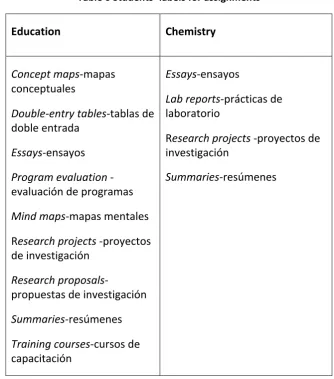
TABLE 6 STUDENTS´ LABELS FOR ASSIGNMENTS ... 150
List of figures
FIGURE 1 DISCOURSE AS TEXT INTERACTION AND CONTEXT ... 17FIGURE 2 LAYERS OF CONTEXT ... 18
FIGURE 3 CONTEXTS OF ACADEMIC WRITING (MODIFIED FROM JAKOBS, 2005) ... 19
1. Introduction
1.1 Overview and motivations for the study
In this research project, I analyse how academic literacy practices, and in particular the writing and reading practices of Mexican undergraduate students, are
constructed in policy documents, and in interviews with both students and lecturers, which included talk around texts written by students. Academic literacies as a field of research originated in the United Kingdom and has been developed over the past two decades to examine the writing students do at university in relation to identity and power issues (Lea & Street, 2006). Lea (2008) also suggests that reading should be considered alongside writing because of the self-‐evident relationship between the two. I also discuss how reading practices are constructed. Academic literacies
research views writing as a social practice that is influenced by the context in which it is embedded. Specific practices can thus be related to general cultural views of using written language. The purpose is to go beyond the texts themselves and focus on what people do with literacy, with whom, where and how (see Hamilton, 2010, p.11). Academic literacy practices are understood in this thesis as the writing and reading students do at university in relation to the choices they make when writing the assignments they produce. Academic literacy practices are what students have to do when undertaking academic studies, e.g. writing an assignment. That is, as Tardy (2010) suggests, writing tasks in higher education may require students to “conduct research, summarize and paraphrase, cite sources, adopt genre conventions, and select words and patterns” (p. 12).
to international demands such as globalisation and internationalisation.
Concurrently, writing is becoming central to higher education in this institution.
As I have stated above, writing is the means students use to demonstrate disciplinary knowledge attainment. I am interested in the role of writing and reading in
contemporary higher education, and thus explore the different meanings attached to these practices in two different data sets. In other words, I examine how academic literacy practices are discursively constructed (i.e. talked about) from different perspectives. Discursive construction is not a common term employed in academic literacies research. In this thesis, as suggested earlier, it refers to the different ways texts and people describe and talk about academic literacy practices respectively.
The second central issue in my research is policy, which I conceive as a social practice that mobilises discourses. Policy contains and reflects broader ideologies and aspects of power. Policy may influence institutions´ decisions, which reflect broader or international demands. I argue that to understand academic literacy practices, it is important to analyse the social context in which these practices take place and policy contributes to this analysis.
To carry out this research, I bring my own experience as a lecturer informed by the theoretical work of others who have researched in the tradition of academic literacies and critical discourse studies (CDS) as well as the information provided by my participants.
1.2 Overview of key frameworks
It is important in reading my thesis to distinguish between the different
“academic socialization” (see section 3.4.2), and “academic literacies” (3.4.3). Finally, the specific reading and writing practices of students or staff in higher education are sometimes referred to as “academic literacy/ies” – I will avoid this usage, and instead always refer to “academic literacy practice(s)” (or just “practices” if it is clear from the context) when I have this more specific meaning in mind.
Studies of academic literacy practices have thus far generally focused on what academic literacy practices are rather than how they are discursively constructed; by which I mean how they are talked and written about as mentioned above. However, several scholars have engaged in policy analysis to investigate a wide array of aspects of higher education (see Rogers et al., 2005 for a review). For example, Fairclough (1993) analyses the discursive aspects of marketisation of public discourse in higher education in Britain. Hamilton (2012a) examines adult education representations by looking at policy, images and texts written by students. Papen (2015) undertakes, what she calls, a “loosely critical reading” of policy documents to analyse the current policy of synthetic phonics in an elementary school in England. Probably the most illustrative study in relation to academic literacy practices is the study by Clark and Ivanič (1997) who describe the politics of writing in relation to different fields or domains. They combine Halliday’s systemic functional linguistics (SFL) and
Fairclough’s (1989) approach to discourse as a social practice. There has been little analysis of the discursive representation of academic literacy practices in policy documents. Ashwin and Smith (2015) argue that, “sustained analyses of the relations between particular policy texts and higher education practices are very much the exception in higher education research” (p.1016). This research attempts to
contribute to the field by bringing critical discourse studies and academic literacies together by analyzing policy documents alongside interview analysis, which included talk around texts written by students.
1.3 Research design
policies with textual analysis of academic literacy practices. In this, I assume that policies both reflect and create ideologies. These are to a certain extent identifiable in discourses, which are mediated by semiosis, i.e. decisions about how to express different meanings, and these meanings (with all their discursive and ideological “baggage”), can in turn be identified by examining specific linguistic realisations.
As I suggest above, I adopt theoretical and methodological frameworks based, on the one hand, on Fairclough’s (e.g. 2001, 2003) approach. On the other hand, I draw on academic literacies research or more specifically the “talk around the text” approach (e.g. discourse-‐based interviews, Lillis, 2001). These two different approaches let me link policy analysis and analysis of academic literacy practices, and give some insight into how sociopolitical, educational, institutional and disciplinary contexts influence local practices. Within this framework, I analyse how academic literacy practices are constructed in two different data sets. I argue that my datasets, which are policy texts, and interviews with lecturers and students including talk around the texts students have produced are interwoven. Many of the discursive constructions occur in both datasets. This analysis shows that dominant discourses, usually dictated by policy texts, influence lecturers/students constructions of academic literacy practices and the way they conceptualise them in their immediate context. This explains how these different constructions respond to a specific view of the world from above.
This allows me to triangulate (see Wodak, 2001) between them, and thus show how academic literacy practices are influenced by the social, political, institutional and disciplinary contexts in which they are embedded and how students and lecturers talk about them. I analyse these data sets from a CDS perspective because as Taylor (2004) states, CDS “explores how texts construct representations of the world, social relationships, and social identities, and there is an emphasis on highlighting how such practices and texts are ideologically shaped by relations of power” (p.435).
literacy practices are constructed, and because they represent different levels of policy that ultimately seek to govern the learning and teaching of the students and teachers whose constructions of practices I am investigating; they are themselves also a relevant part of the context.
These documents help me identify the relationship between context and academic literacy practices: how this relationship is realised at the textual level through linguistic phenomena in texts about education, and how the social actors (i.e. students, lecturers) interpret it. To gain more of an insight into these “from-‐below” interpretations, I also conducted interviews with students and lecturers.
I follow Fairclough’s (2001, 2003) framework for the analysis of the policy
documents. The framework uses critical discourse analysis to a) show how social context and genre shape practices at the contextual level (i.e. in institutions and societies) and b) how they are produced in linguistic realisations at the textual level (see section 3.9 for a more extensive discussion). Fairclough aims to map the discourses around academic practices in certain policy documents, which guide public policymaking in the UK, to unveil how they are constructed. My work, however, focuses on Mexico.
It should be noted that there is a long tradition of genre analysis in research in academic contexts (see section 3.6.2). However, I follow Fairclough in using genre as a concept that relates particularly to the communicative purpose of texts in their social context. I do not attempt to conduct “genre analysis” as such of any of my data sets. Instead, at the textual level, I conduct a linguistic analysis by focusing
As I briefly describe above, in addition to the policy analyses, I interview students and lecturers to show how social actors (i.e. students and lecturers) interpret policy discourses. Alongside my linguistic analysis of the policy documents, I also look for salient themes by means of content analysis drawing on the approach developed by Krippendorff (2004). Salient means here that they have stood out to me as
particularly important based on careful reading of the data and my own contextual knowledge (see Unger, 2013 for a discussion of salience).
My decisions around data collection and selection are described in section 4.7. I argue that this triangulated approach, i.e. focusing on constructions of academic literacy practices in policy texts, and in interviews (including talk around students’ work) allows a broader understanding of the practices as well as shedding light on how the social context can be linked to the students’ writing and reading practices in higher education. It can also be seen as a response to Lea’s (2008) critique that writing has tended to be seen in isolation within higher education teaching. Previous studies that have brought critical discourse studies into the educational field (see Rogers et al. 2005 for a review) have also emphasized the need for multi-‐level analysis, which focuses on contexts and texts alongside practices.
1.4 Research questions
The overarching question that frames this study is the following:
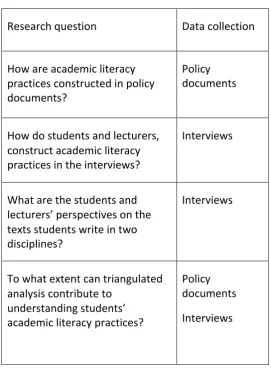
How are academic literacy practices of Mexican undergraduate students constructed in two disciplines at different levels of context?
Some sub-‐questions that narrow the focus of the research are stated below:
a. How are academic literacy practices constructed in policy documents?
mobilise certain discourses that arguably influence conceptions of academic literacy practices.
Because, as Clark & Ivanič (1997) argue, practices are what people make of them, I decided it was important to talk to my participants and learn what they have to say about their own academic literacy practices:
b. How do students and lecturers construct academic literacy practices in interviews?
Since it can be argued that the texts students and others create are equally
important in understanding academic literacy practices, I also focus more specifically on the ways participants talk about the texts and genres that students have to write for class (and might choose to write outside of class):
c. What are the students and lecturers’ perspectives on the texts students write in two disciplines?
Finally, I have added a methodological research question which serves as a reflection on the potential offered by conducting analysis at different levels and with different types of data:
d. To what extent can triangulated analysis contribute to understanding students’ academic literacy practices?
This relates to the opening up of different perspectives and insights by means of triangulation (Wodak, 2001), which I have already mentioned above. In my research, triangulating means identifying how these practices are discursively constructed from a more pluralistic set of data sources, which arguably also contributes to a more valid and reliable study.
1.5 Organisation of the thesis
research is presented in Chapter 3. It starts by defining literacy and I discuss literacies as a social practice as well as the perspectives on academic literacies. Research into what students write in higher education is also included. I discuss critical discourse studies. I define policy and explain its link with academic literacies. I finally discuss the framework that supports this thesis. Chapter 4 presents the methodology and research design including the approach adopted, the framework that guides this research, and the data sources providing a detailed description of the participants and how the analyses were conducted.
The analysis of the four policy documents is discussed in Chapter 5. A link is
established between the discourses about academic literacy practices and how they come to shape the way in which reading and writing are conceptualized in formal education. Chapter 6 provides an account of the construction of academic literacy practices based on the comments made by the students and lecturers in my study during interviews. I describe the construction of academic literacy practices based on talk about the students’ written assignments in Chapter 7. In Chapter 8, I present some conclusions including a comprehensive summary of the project as well as a reflection on the challenges of this study and the benefits of having approached academic literacy practices from a critical discourse analysis perspective. Finally, I present an evaluation of what my study has contributed to the field before
discussing some limitations of this project and possible further research, as well as some policy recommendations.
2. A consideration of context
2.1 Introduction
This chapter provides a comprehensive description of the sociopolitical, educational institutional and disciplinary contexts that are relevant to this study of academic literacy practices. As I suggested in the previous chapter, the social context plays an important role in understanding the writing and reading practices of students. It will become evident from the present research that academic literacy practices shape and are shaped by the context in which they are embedded. This chapter starts by theorising context in relation to language and academic literacy research. In section 2.2, I draw on three main studies that have discussed context in relation to the social purpose of language (Fairclough, 1989); its relation to “lower” layers of academic writing (Samraj, 2002) and specifically the contexts of academic writing (Chitez & Kruse, 2012). I then briefly describe the sociopolitical events that characterise former Mexican President Vincente Fox’s government and its actions on Education in section 2.3. In section 2.4, I describe the educational context by discussing the education system in Mexico and I explain a major education reform and its three stages. This reform illustrates the change processes the education system in Mexico has undertaken as an attempt to respond to international demands. In section 2.5, I describe the institutional context chosen for this research. Finally, in section 2.6 I outline the disciplinary contexts. These considerations of context taken together theorise the role of context in my research, but also provide the necessary backdrop of knowledge a reader will need to understand my analysis in the later chapters.
2.2 Academic literacies research and the role of context
1I argue in Hidalgo-‐Avilés (2006) that context is central to the understanding of academic literacy practices. Context is a contested term in scholarly literature, and has often been defined in relation to its everyday use (Halliday, 1991, p.5), that is, as “the events that are going on around when people speak (and write)”. However,
1 I provide an extensive discussion of context in academic writing in Hidalgo-‐Avilés (2006). In this
researchers such as van Dijk (2009) have suggested that context refers to a
subjective construct: it is individuals who decide what language to use when writing a text and these decisions affect the situation and not the other way around. For example, different participants understand how a text is organized based on their own interpretation. Context thus does not simply refer to a physical place or a specific setting, but to what contributes to the situation in which the event takes place.
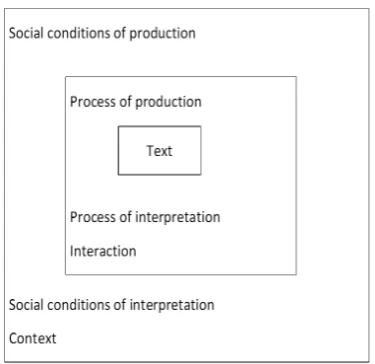
Fairclough (1989, p. 25, 2015) integrates a description of language with the social context and shows that a text (written or spoken) is immersed in the processes of production and interpretation, which in turn are immersed in the local, institutional and socio-‐historical conditions within which participants are situated (see Figure 1).
Figure 1 Discourse as text interaction and context
Source: Fairclough, 1989, p.25
[image:17.595.217.405.361.543.2]disciplinary ideologies and the social expectations which surround those immediate circumstances” (p.23).
Fairclough (1989) explains his model by arguing that,
The social conditions relate to three different ‘levels’ of social organization: the level of the social situation, or the immediate social environment in which the discourse occurs; the level of the social institution which constitutes a wider matrix for the discourse; and the level of the society as a whole. (p.25)
Context comprises the local circumstances in which people are communicating as well as the social, cultural and political aspects within which this communication takes place (Clark & Ivanič, 1997, p.11).
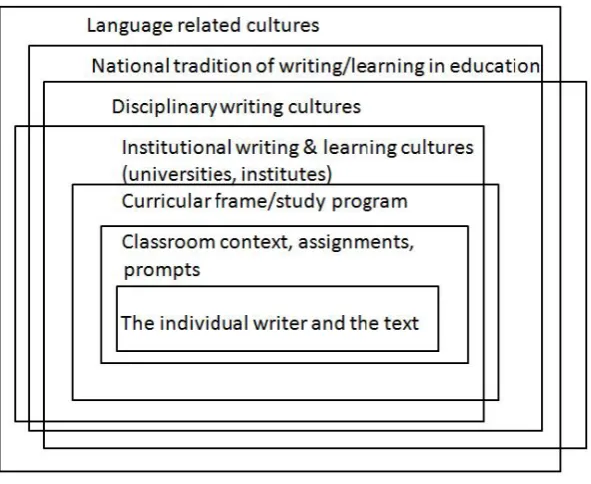
At a local level and in terms of the relationship between various contextual features surrounding academic writing, Samraj (2002) proposes a taxonomy of contextual layers that are arranged into levels (Figure 2). She shows how context and its different layers shape writing:
The highest level of context that appears to influence writing is the academic institution. The academic discipline forms a contextual level below this. At another level below comes the context of the course, which does not completely overlap with the discipline in terms of its values. A more specific context within the course is that of task, and finally we have the context of each individual student in terms of his or her background and choices influencing the text produced. (p.165)
Figure 2 Layers of context
Samraj’s discussion of context clearly contributes to explain that academic writing can differ even within the same academic institution due to the specificities of the discipline, the course, the task and the student. As argued by Ivanič (1998) “writing is a social practice and social practices are not universal: they differ from one social context to another” (p.65).
From another perspective and centred on the student writer, Chitez and Kruse (2012) suggest six contexts of academic writing in which the individual writer, in the core field at the bottom, is not a socially isolated being, but part of many contextual factors that determine his or her actions and thoughts (p.154) as shown in Figure 3.
Figure 3 Contexts of academic writing (modified from Jakobs, 2005)
Source: Chitez and Kruse, 2012, p. 154.
In Chitez and Kruse’s (2012) contexts of academic writing, the first level of context, academic writing, may be influenced by a) the answer to a prompt or a question that is linked to a classroom situation, and b) the set of values and attitudes of the
[image:19.595.170.466.277.519.2]based on the epistemological specifications of disciplines. The fifth level refers to the writing culture in which students have been socialised which may in turn influence students’ literacy development. Finally, “writing is influenced in many ways by the language, not only because language provides a basic system of grammar, lexis, and idiomatic but also because it determines to a certain degree perception and
thinking” (Chitez & Kruse, 2012, p.155).
These six levels have to do with institutional settings which are embedded in the practices students engage in and they can be related to the layers of context proposed by Samraj (2002). These layers correspond to the institution, discipline, course concrete tasks and student background respectively as explained above. Samraj (2002) places the academic institution at a higher level of context, while Chitez and Kruse (2012) consider language to be the most influential aspect in academic writing practices. It seems that these authors leave out the broader levels theorised by Fairclough (1989) which arguably can help explain the reading and writing practices of a given institution. I therefore bring in Fairclough’s categories as I investigate higher levels of context beyond the institution. As stated by Ivanič et al., (2009) “context does not pre-‐exist practice but co-‐emerges through and with it” (p.23). I argue that a broader conception of context is needed to uncover the
different layers of analysis (sociopolitical, educational, institutional and disciplinary). I will return to the relationships between context and data in the next chapter, but in this chapter, I will now move to describe the sociopolitical context of my study, both to provide information for readers unfamiliar with Mexican higher education, and to highlight political developments that are particularly relevant to the policy texts that I analyse in Chapter 5.
2.3 The sociopolitical context
National Action Party (Partido de Acción Nacional, PAN), came to power after 70 years of rule by a right-‐wing party. Vicente Fox’s government represented hope, change and transformation as shared needs.
My interest in this event is due to the marked political change it represents. As Fairclough (2003) suggests, “social research is concerned with the nature and consequences of these changes” (p.4). Echávarri (2013) states that “after the arrival of the new president, the results of the PISA (The Programme of International Student Assessment) assessment placed Mexico within the last places, so it was evident the new government needed to take in hand the matter of education urgently” (p.1). It is therefore not surprising that Fox claimed to place an
“educational revolution” at the forefront, and education became one of the main aims of Fox’s agenda. However, Moreno (2004) argues that the education proposal of Vicente Fox was a continuation of the traditional Mexican educational discourse (see section 2.4 below):
Economic development, secularism, free public education, values of
modernity combined with the educative discourse derived from globalisation. This second discourse draws on values to invoke productivity, quality,
excellence, competitiveness, effectiveness, efficiency, competence and innovation. The means, mechanisms and tools that will make these objectives possible are reflected on the educational policy known as ‘productive
linkage’. (p. 17, my translation)
This statement highlights two distinct aspects, modernity and globalisation, which in turn are linked to the functional role given to education since it is believed that education contributes to the development of the country. The author points out that “the same discourse of ‘educational revolution’, implemented during Miguel de la Madrid (1982-‐1988) government emphasizing education as the central priority of the NDP” (p.24, my translation), prevailed.
Mulderrig (2012) claims, “the impact of neoliberalism on education policy was increasing structural and ideological pressure to align schooling more closely with economic policy goals” (p.705). Returning to Mexico, Varela-‐Petito (2012) states that,
A strategic planning perspective guided the official policy (ANUIES2, 2000). Accordingly, it was supposed to be the case that, looking ahead to the 21st century, higher education policy must form part of an educational system that fulfils its strategic role for national development attenuating acute social disparities by tapping into human capital, productivity and competitiveness. (p.982)
This statement suggests the need to link education with economic growth and the need to promote actions towards the achievement of these goals. I will argue this is something that occurs in my data, particularly in the policy texts (see Chapter 5). In Varela-‐Petito’s view (2012), “Mexico’s higher education system can disseminate universal culture through proper ties with society and, to bring quality to the fulfillment of its function, it should have the necessary human resources at its disposal” (p. 982). From the above, it is evident that like other countries, the
challenges faced by higher education in Mexico were, at that time, the ones related to coverage and quality. However, Moreno (2004) argues that, “the educational policy proposal goes around the traditional vision, training human resources and its adaptation to the context because of globalisation” (p.23, my translation).
This last argument invokes globalisation, which had a huge impact on education during this period. Globalisation plays an important role in Mexico: one of the central aims of this government was “to build a new country: a competitive country with a global vision” (NDP, p.ix). As suggested by Dale (1999), one of the effects of
globalisation on education policy is the reorganisation of states to make them more competitive (p. 4). Along these lines, raising economic competitiveness becomes a target of this government by bringing together education and social development (see Chapter 5).
2.4 The educational context
The education system in Mexico is based on the General Education Law, which in turn, is based upon Article 3 of the Mexican Constitution. It establishes the general provisions, organizations and general structure of the Mexican educational system (Botello & Davila, 2012). The Ministry of Education (Secretaría de Educación Pública or SEP because of its initials in Spanish) regulates education in Mexico. In addition, the Ministry sets the standards and goals at all levels except for autonomous universities that are ruled by their own norms.
The institutional framework includes pre-‐school education, for four-‐year old children. Children complete three years of pre-‐school, which has been mandatory since 2004. Primary education comprises years 1 to 6; secondary education comprises years 7-‐9 and high school years 10-‐12. By law, both primary and secondary education is
compulsory. This was, however, a recent modification of the law because in 1993 the Ministry of Education officially increased compulsory education from completion of primary school (grade six) to completion of secondary school (grade nine).
The National Curriculum applies to students of elementary and secondary school age in public schools. The programmes contain the attainment targets, goals, and
approaches of the curriculum based on the competences students need to develop so they become the citizens the country needs in this globalised and competitive world (SEP, 2011). Each subject (Spanish, Mathematics, History, Science, Geography, and Civic Education) is based on textbooks that are distributed by SEP throughout the nation and provides a framework for what pupils should be taught. Rockwell (2013) states that “since 1960 the Secretariat of Public Education has published and delivered free of charge to each elementary school child graded texts and workbooks covering all primary school subjects” (p.187).
that a textbook-‐based curriculum meant:
Memorizing spelling lists; doing exercises in traditional grammar like filling in cloze gaps or simply rote learning grammatical rules; ‘composition’ marked according to its compliance with the conventions of ‘standard’ English; and testing ‘correct’ knowledge of spelling and grammar in formal examinations. (p.44)
This example is relevant to my own context because a similar situation occurs. That is, a traditional education based on memorization is still promoted in several education settings.
As stated earlier, higher education is not regulated by SEP, which means that
universities establish their own programmes, goals and outcomes. Higher education comprises a Bachelor’s degree at the undergraduate level. In most universities, it lasts at least four years divided into eight semesters, but it can last up to nine or ten semesters depending on the programme. Some differences emerge regarding the implementation of these programmes. For example, the US system emphasises late specialisation with a period of general education in the first two years of university, and writing in several disciplines. Russell, Lea, Parker, Street and Donahue (2009, p. 396) point out that “in the UK students have tended to specialize early and write for one discipline, although recently “modular” courses have involved more ‘mix’ of disciplines and therefore more switching of written genres (Lea & Street, 1998; 2006)”. Like the UK, the Mexican system emphasises specialisation from the beginning of the programme students choose to study (OECD-‐CERI, 2003). The programme may include some additional modules such as English and computer science; however, the core modules are studied throughout the four or five years of study.
Gardner (2012) state that these requirements “are relevant to all disciplines, and are particularly important in disciplines where the degree qualification is recognized by a professional body” (p.170). They also argue that writing is also done for accreditation purposes in the UK, and many university programmes must go through this process.
Nesi and Gardner (2012) add that, “departments generally regard accreditation as a worthwhile activity because it provides a means of quality assurance and enhances the employability of their graduates” (p.170). In Mexico, unlike the UK, all Mexican university programmes are eligible for evaluation and accreditation by external professional bodies. In every discipline, evaluation and accreditation are essential, as these are also the means of quality assurance.
Varela-‐Petito (2012) notes that, “the education process is increasingly permeated by evaluation mechanisms prompted by educational policy which range from the evaluation and certification of students by organisms outside the HIEs to the evaluation of the academics, institutions and administrative processes themselves” (p. 984). The emphasis is on quality assurance to achieve good results.
Finally, there are three degrees at the postgraduate level: a one-‐year Diploma (Especialidad), a two-‐year master’s degree and a three-‐year doctorate. A major reform has taken place in Mexico over the last two decades that has affected the organization of the education system and is discussed below.
2.4.1 A reform to the Mexican education system
A major reform started in 1992 with the national Agreement for the Modernization of Basic Education (Acuerdo Nacional para el Mejoramiento de Educación Básica, ANMEB). Zorrilla and Barba (2008) identify three other main stages of this reform after 1992, namely 2004, 2006 and 2011 as described below.
2.4.1.1 The 1992 Reform
the decentralization of basic education, the reform also aimed to improve “efficiency, quality and relevance of the results” (OECD-‐CERI, 2003, p. 6). As suggested above, there is an increasing focus on human resource development. Zorrilla and Barba (2008) state that the process of decentralization was a response to “the demands of social change and the modernization of the productive sector that is, to prepare human resources with better qualifications to compete in the new economy” (p.9, my translation).
Tatto (2012) argues that in addition to the decentralization of basic education, the agreement also considered provisions to the development of the Educational Development Programme, which aimed the following strategies:
(a) The reformulation of teaching methods, curricular content and materials; (b) the formation, upgrading and improvement of teachers; (c) the provision of infrastructure and educational materials (including the rincones de lectura or reading corners); and (d) the production and distribution of free textbooks for all basic levels of education; among others. (p. 236)
Tatto (2012) points out that, “according to the reform rhetoric, the implementation of these strategies would improve the coverage, efficiency, and quality of education in the country and specifically for the rural poor” (p.236). Zorrilla and Barba (2008) and Tatto (2012) agree that the reform established a model based on competencies in accordance with a constructivist framework. That is, “the Educational
Development Plan argued for a curriculum that would promote critical thinking among all pupils and more independent learning” (Tatto, 2012, p.241). However, as López-‐Bonilla (2013) states, even when the syllabus was modified in 1993, traditional practices (i.e. copying texts, dictation, repetition of information) still predominate in Mexico. Another important characteristic of this reform is that secondary school became mandatory in 1993 from years six (age 12) to nine (age 15) as a result of the General Education Law. I now discuss the different stages of this reform.
2.4.1.2 2004
three years. That is, basic education comprises 12 years: three for kindergarten, six for elementary school and three for secondary school (from age 3 to 15).
In terms of competencies, SEP (2006) points out that the “new preschool education programme emphasizes the competencies that will promote students’ starting point to think, organize and develop the pedagogical work” (p.14, my translation).
However, as Alcántara (2011) states, “the basic education reform continues with the participation of teachers in all public schools in the country, and continues to
question his [sic] competency-‐based approach” (p.120).
2.4.1.3. 2006
Despite the efforts of the 1992 reform, the means in secondary education (i.e. to move from a behaviorist paradigm to a constructivist one) were not the expected ones. Guerrero (2013) argues that, “the repetition of information is a practice that the 2006 reform explicitly suggests modifying” (p. 167). In addition, SEP (2006) states that the lack of interest of students to learn “has to do with saturated study plans, teaching practices that prioritize memorization over active participation and the frequency and definitive role attached to examinations” (p.18, my translation). Because of this situation, among other reasons, the study programmes of secondary education were modified in 2006 through the 384 Agreement (Zorrilla & Barba, 2008, my translation).
The educational reform responded to the present learning needs that are linked with the “reflection capacity and critical analysis; exercise civil and democratic rights; the production and exchange of knowledge through different means; care about health and environment, and participate in an increasingly versatile labour market” (SEP, 2006, p.8, my translation). In addition, the aim of the new curriculum was to
promote the identification of problems, make some judgments and provide diverse solutions (SEP, 2006, p. 10, my translation).
2.4.1.4 2011
de la Educación Básica, RIEB), which started in 2011, takes the previous curricular reforms of preschool in 2004, elementary school in 1993 and secondary school in 2006 as its antecedent (p.46, my translation). Its purpose was to “strengthen the quality of the national education system” (p.46, my translation). It “introduced learning standards focused on competencies to improve the coherence of the system and its emphasis on student achievement” (OECD, 2013, p.13).
In addition, the OECD (2013, p. 15) points out that in 2012 the federal government and the most important political parties in Mexico signed the Pact for Mexico (Pacto por México). This agreement establishes,
To increase education coverage in upper secondary (80%) and tertiary education (40%); to improve teaching and learning conditions by providing more autonomy to schools and establishing full-‐time schools; to create a professional teaching service and promote system improvement with more transparency and consolidation of the evaluation authority. (p.15)
The OECD (2013) states that the Alliance for the Quality of Education (2008-‐12) celebrated an agreement between the Mexican Government and the national teachers’ union (Sindicato Nacional de Trabajadores del Estado, SNTE) following guidelines established in the Sectorial Education Programme 2007-‐2012 (p.15). It focused on:
1) Modernization of schools, 2) professionalizing of teachers and education authorities, 3) students’ well-‐being and personal development, 4) students’ preparation for life and work, and 5) evaluation to improve the quality of education. This led to a number of reforms, including the introduction of the National Teaching Post competition. (OECD, 2013, p.15)
implementation of a curriculum based on competencies that in turn has been the Latin American translation of the Tuning project (see Robertson, 2008). However, Clark and Ivanič (1997) argue that,
If real democracy is to flourish it is even more urgent that future citizens be properly and critically equipped to take as full a part as possible in political and cultural life as well as economic life. The development of a critical awareness of the world, and of the possibilities for changing it, ought to be the main objective of all education. (p.229)
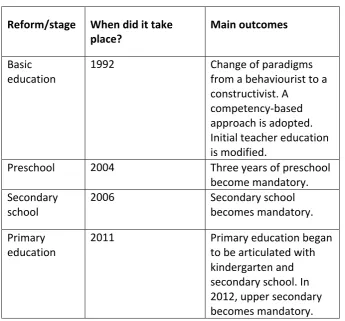
This statement also maps into the Mexican context, where as I have described above, education is assumed to be responsible for the future of the country. However, “these reforms have not yet ensured appropriate capacity and distribution of responsibilities across the decentralized system” (OECD, 2013, p.15), but important modifications have been made that have affected the educational system. These reforms also reflect the importance of policies since they have influenced the curriculum and instruction under efficiency and global competitiveness arguments (Tatto, 2012). I summarise the reform and its three stages as well as the main outcomes proposed in each one of them in Table 1.
Table 1 A major reform and its three stages
Reform/stage When did it take
place? Main outcomes
Basic education
1992 Change of paradigms
from a behaviourist to a constructivist. A
competency-‐based approach is adopted. Initial teacher education is modified.
Preschool 2004 Three years of preschool
become mandatory. Secondary
school 2006 Secondary school becomes mandatory.
Primary
education 2011 Primary education began to be articulated with kindergarten and
secondary school. In 2012, upper secondary becomes mandatory.
2.5 The institutional context
[image:30.595.101.447.97.418.2]The university is organised into six institutes located on the main campus in the city and nine campuses located across the state. It offers 52 BA degrees; 19 Diploma courses; 20 MA degrees and 10 PhD degrees in a traditional teaching format (UAEH, 2011, p.70). Online courses are also offered, namely 1 Diploma and 2 MA degrees.
2.6 The disciplinary context
Hyland (2011b) argues that language is intimately related to the epistemological framework of each (individual) discipline that determines how to view the world (p.7). A discipline is a branch of knowledge and students are expected to write according to the conventions of that particular discourse community. Kruse (2013, p.39) argues that the disciplinary context “is the most influential factor in making students engage in their majors and get acquainted with the respective genres and rhetorical practices. Writing, from this perspective, is a means of integration into and specialization in their fields of study”.
The syllabi of both programmes included in my study, Education and Chemistry, were selected because they represent two very distinct disciplines. They state that
students should have good use of oral and written language. The documents state that both reading and writing serve several functions: teaching and learning strategies; to conduct research; to develop critical analysis. However, there is no specific module dedicated to the teaching of reading and writing.
Some features of the two disciplines are mentioned here to describe briefly the context of this study in terms of writing and reading. The literacy practices of academic disciplines can be viewed as varied social practices associated with different communities. The two programmes, Education and Chemistry, state the outcomes in terms of students’ profiles once they graduate.