warwick.ac.uk/lib-publications
A Thesis Submitted for the Degree of PhD at the University of Warwick
Permanent WRAP URL:
http://wrap.warwick.ac.uk/109025
Copyright and reuse:
This thesis is made available online and is protected by original copyright.
Please scroll down to view the document itself.
Please refer to the repository record for this item for information to help you to cite it.
Our policy information is available from the repository home page.
THE BRITISH LIBRARY
BRITISH THESIS SERVICE
TITLE
BAYESIAN INFERENCE ON NON-STATIONARY
DATA
AUTHOR
Giovanni
AMISANO
DEGREE
PhD
AWARDING
Warwick University
BODY
DATE
1995
THESIS
DX193331
NUMBER
THIS THESIS HAS BEEN MICROFILMED EXACTLY AS RECEIVED
The quality of this reproduction is dependent upon the quality of the original thesis submitted for microfilming. Every effort has been made to ensure the highest quality of reproduction. Some pages may have indistinct print, especially if the original papers were poorly produced or if awarding body sent an inferior copy. If pages are missing, please contact the awarding body which granted the degree.
Previously copyrighted materials (journals articles, published texts etc.) are not filmed.
This copy of the thesis has been supplied on condition that anyone who consults it is understood to recognise that it's copyright rests with its author and that no information derived from it may be published without the author's prior written consent.
BAYESIAN INFERENCE ON
NON-STATIONARY DATA
Giovanni Amisano
Department o f Economics,
University o f Warwick
September 1995
To my parents with love and gratitude
Two roads diverged in the yellow wood,
and I,
I took the road less traveled by
Table of Contents:
Acknowledgements v
Summary vi
Chapter 1: Introduction and Outline I PART I: The Univariate Analysis of Non-Stationary Time Series 7 Chapter 2: The Frequentisi Approach to Non-stationarity in univariate 7
Time Series Analysis
[2 0] An Overview of the Chapter 7
[2.1] Integrated versus trend stationary processes 7
[2.2] Inference on trend stationary and integrated univariate processes 13
[2.3] Some General Considerations About Unit Root Testing in a 25
Classical Framework
Chapter 3: The Bayesian Approach to Time Series Analysis: 28 Problems and Methods.
[3.0] An Overview of the Chapter 28
[3.1] General Philosophy o f the Bayesian Approach 28
[3.2] Bayesian Inferential Techniques 33
[3.3] The specification of the priors 40
[3.4] Computational Problems and Technical Solutions 46
[3.4. a] Approximations 47
[3 4.b] Numerical integration 48
[3.4.c] Monte Carlo Integration and Importance Sampling 49
[3.4.d] Markov Chain Monte Carlo: Gibbs Sampling and Metropolis- 56
Hastings Algorithms
[3 .4.e] Measuring the accuracy o f MC Monte Carlo estimates 63
1 [3 6] Ignorance Priors in Time Series Models 74
C hapter 4: Bayesian Analysis of Integration a t Different Frequencies in 78
Q uarterly D ata
[4 0] An Overview of the Chapter 78
[4 .1] General Features of the Model 80
[4.2] The Specification of the Priors 84
[4.3] The Joint Posterior Distribution 87
[4 4] The conditional posterior distributions 90
[4.5] A Convenient Description of the Posterior Odds Ratio 91
[4.6] An Application 97
[4.7] Conclusion 105
Appendix [4. A]: Proofs of distributional results 105
Appendix [4 B] : Rejection Sampling from the Conditional Posterior 110
Distributions
Appendix [4.C] : Proofs of the Smooth Transition Results 113
PART II: The Multivariate Analysis of Non Stationary Time Series 120
Chapter 5: Non Stationarity in Multivariate Time Series Analysis. 120
The Classical Approach
[5.0] An Overview of the Chapter 120
#
[5.1] Spurious Regression and Cointegration 121
[5.2] Representation and identification issues 123
[5.3] Estimation Issues 128
[5.4] Interpretation of the Cointegrating Coefficients 136
[5.5] Asymptotic Distributions of the Parameter Estimates 139
Chapter 6: Bayesian Inference in Cointegrated Systems 145
[6 0] An Overview o f the Chapter 145
[6.1] Motivations 146
[6.2] The Model 148
[6.3] The Prior Distribution 150
[6 4] The Joint Posterior Distribution 152
[6.5] Inference on Cointegration Rank 159
[6 6] Testing Restrictions on the Cointegration Space 162
[6 7] Some Applications 165
[6.7.1] A simulated data set example 166
[6.7.2] The Danish Money Demand Example 168
[6 7.3] The Finnish Money Demand Example 172
[6.7 4] The UK PPP/UIP Example 175
[6 8] Conclusion 179
Chapter 7: Concluding remarks 191
References 196
List of tables and illustrations
Table 4 1 100
Table 4.2 100
Table 4.3 101
Table 4 4 104
Figure 4 1 115
Figure 4.2 116
Figure 4 3 117
Figure 4 4 118
Figure 4 5 119
Table 6.2.1 171
Table 6.2.2 172
Table 6 3.1 174
Table 6.3.2 174
Table 6 4 1 178
Table 6.4.2 179
Figure 6.2 1 180
Figure 6.2.2 180
Figure 6.2.3 181
Figure 6.2 4 181
Figure 6.2.5 182
Figure 6.3.1 182
Figure 6.3.2 183
Figure 6 3.3 183
Figure 6.3 4 184
Figure 6 3.5 184
Figure 6.3 6 185
Figure 6 4 1 185
Figure 6 4.2 186
Figure 6 4.3 186
Figure 6 4 4 187
Figure 6 4.5 187
Figure 6.4.6 188
Figure 6.4.7 188
Figure 6.4 8 189
Figure 6 4 9 189
Figure 6.4.10 190
Aknowledgments
I would like to express my sincere gratitude to all the people I bothered with my
questions I greatly benefitted from discussions with Rocco Mosconi, Mario
Seghelini, Jeremy Smith and Sanjay Yadav I also received valuable suggestions
from Frank Kleibergen, John Geweke and Hermann van Dijk at different stages of
my work.
Carlo Giannini deserves all my gratitude for having been my first and great
econometrics teacher He started me off as an econometrician, encouraged me to
go and study abroad, and gave me constant scientific inspiration throughout my
career Grazie Carlo, sei un fra tello
Kenneth Wallis, my supervisor, let me have the benefit of all his experience and
competence, and gave me his warm encouragement in several difficult stages in the
preparation of this thesis I sincerely thank him for that, and I apologise for having
so often tested his infinite patience
The only non-econometrician person to appear in this list is my wife Anne who did
not know what "Bayesian" and "unit root" meant before she met me I am not sure
Summary
This thesis argues in fa vo u r o f Bayesian techniques fo r the analysis o f non-stationary linear time series. The main motivations are to avoid using asymptotic results and to explicitly incorporate prior beliefs, where they exist.
The properties o f univariate and multivariate unit root models, and the available frequentist inferential results are described. Some problem s in their applications are highlighted: the discrepancies between asym ptotic and fin ite sample properties and the role o f the determ inistic components in determ ining the reference asymptotic distributions.
The advantages and disadvantages o f Bayesian techniques are then examined with the recent developments in the M onte Carlo integration by M arkov Chain sampling. Two case studies are conducted with the aim o f providing evidence o f the applicability o f Bayesian techniques.
The fir s t o f these cases develops a procedure to test fo r seasonal and/or zero frequency unit roots in quarterly series. A new param eterisation is provided and the priors implemented are discussed and justified. The analysis relies on a Gibbs sam pling scheme. The inferential technique used is the evaluation o f posterior odds ratios. These ratios are defined as posterior expectations o f functions o f the parameters, and therefore can be consistently estim ated The procedure is applied to some UK variables. The results are robust w ith respect to different prior distributions, and conflict w ith some conclusions reached by using classical asym ptotic unit root tests.
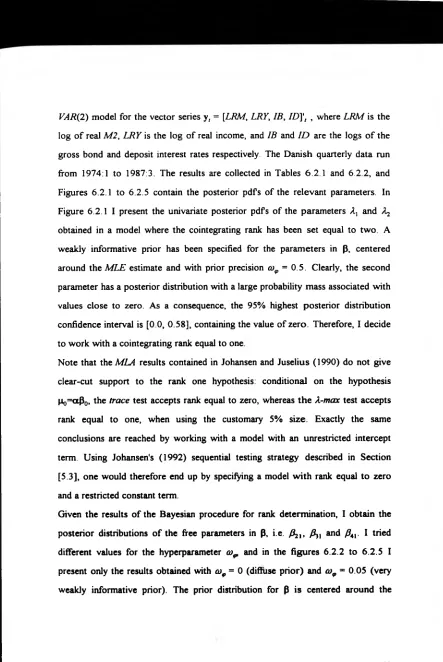
The second case study develops a Bayesian procedure to conduct inference in cointegrated systems. Inference regards the number o f cointegrating relationships and their structural interpretation, and is based on the evaluation o f highest posterior density confidence intervals.
Chapter 1: Introduction and Outline
Weakly stationarity processes, processes whose first and second order moments
do not vary over time, have played a central role in the traditional econometric
analysis o f linear time series data Unfortunately, assumptions o f constancy of
moments seem at odds with most observed economic time series.
Different alternative models o f non-stationarity behaviour have been proposed,
implying radically different long-run properties for the series under study. A simple
way to account for non-stationarity is to assume that the process is stationary
around a deterministic trend. Such a process has constant second order moments
and shocks have only a transitory effect on it. Alternatively, it is very often
assumed that one or more unit roots are present in the autoregressive
representation. A unit root process is characterised by a growing variance, and by
the fact that shocks have a permanent effect on the level o f the series
Economic theory has provided models implying the presence of unit roots in many
macroeconomic aggregates. General equilibrium business cycle models emphasise
the role o f persistent shocks Intertemporal quadratic utility maximisation leads to
non-stationarity for individual consumption The efficient market hypothesis
implies an exploding variance for the asset price forecast error, as the forecasting
horizon grows.
In the last two decades the statistical analysis of linear time series has made
enormous progress by providing the researcher with the technical tools necessary
to deal with unit root processes, and to discriminate between different models of
non-stationarity The asymptotic distributions o f the parameters estimates for unit
root autoregressive processes have been thoroughly investigated and some
First of all, these distributions are non-standard, since they are complicated
functionals of Brownian motion processes The exact form of these functionals
depends on which deterministic components are included in the estimated model
and in the true data generation mechanism. On the basis of these new asymptotic
results, some testing procedures have been developed to ascertain the presence of
unit roots in observed time series and therefore to discriminate between competing
models o f non-stationary behaviour.
As in the analysis of the long-run properties of univariate processes, also the
phenomenon o f seasonality can be explained on the basis o f different competing
models A first possibility is to account for seasonality by introducing a set of
seasonal dummy variables A second possibility is that unit roots at seasonal
frequencies are present in the autoregressive polynomial This particular form of
seasonality requires the application of an adequate filter to induce stationarity and
raises the issue o f the occurrence of common stochastic seasonality patterns in
multivariate time series Seasonal unit root tests have been developed, in order to
discriminate between competing ways to model seasonality As the zero-frequency
unit root tests, these testing procedures are based on non-standard asymptotic
distributional results
In the analysis o f multivariate time series, the problem o f the interpretation of
results o f regressions among non-stationary variables is directly connected to the
"spurious regression" problem The notion of spurious regression relates to a
regression among non stationary variables, when good measures of fit may be
found even in the absence of any direct links among the variables
In many cases, though, true long-run relationships do exist among non-stationary
variables Long-run relationships are particularly interesting because they relate to
the notion of equilibrium links among sets of economic variables The widely
popular concept o f cointegration directly refers to the existence o f long-run
long-run multipliers in the autoregressive representation o f a vector series. The rank of
this matrix gives the number of stationary variables generated as independent linear
combinations of the non-stationary series being considered Each one of these
stationary variables can be interpreted as deviations from a corresponding long-run
relationship
During the last few years, new inferential techniques have been proposed in order
to analyse potentially cointegrated vector series Inference mainly regards the
number of cointegrating relationships and their structural interpretation as
equilibrium relationships The asymptotic distributional properties of estimators
and testing procedures being used in this regard are again non-standard and depend
on which deterministic components are thought to be present in the 'true' data
generation process
In synthesis, the analysis of univariate and multivariate inferential properties of unit
root processes led to a great advancement in the statistical foundations of
econometric modelling, allowing proper treatment o f non-stationary data
Unfortunately, these new inferential results present the applied researcher with
some unpleasant features Many Monte Carlo studies have revealed that the finite
sample inferential properties of non-stationary models can be radically different to
their known asymptotic counterparts In most macroeconometric applications,
where the typical sample size is well below 100 observations, reliance on
inappropriate inferential results is extremely likely In addition, the sensitivity o f the
scaled asymptotic distribution to the deterministic part o f the model causes further
complications, since the researcher cannot be sure about the correctness o f the
model specification in this regard
Moreover, it is evident that the finite sample behaviour of observed series can be
explained almost equally well by unit root and by stationary near-unit root
processes This problem o f observational equivalence clearly generates very bad
For these reasons, recent contributions in the analysis of non-stationary series have
suggested that resorting to a Bayesian inferential framework could yield more
sensible results.
Bayesian analysis presents three main advantages First of all, uncertainty about the
parameters can be directly measured on the basis o f their posterior distributions,
and no reference to asymptotic results is ever necessary Secondly, a Bayesian
approach requires a clear statement of the researcher's beliefs, in the form o f the
specification o f a prior distribution for the parameters This does not happen in
applications of the frequentist inferential procedures, where prior beliefs, though
unstated, are often incorporated Thirdly, unlike the classical Neyman-Pearson
apparatus, Bayesian model selection techniques are fully consistent, since the
probabilities o f picking a wrong model go to zero as more sample information
becomes available
On the other hand, Bayesian methods present two primary disadvantages The first
one is related to the necessity of providing a prior distribution While most
Bayesian researchers agree on the irrelevance of the issue of how to represent prior
ignorance, a central problem in Bayesian analysis is how to render results
universally acceptable, although they are clearly based on personal convictions
The second disadvantage is a computational one In fact, the typical results of
Bayesian analysis can be defined as posterior expectations o f certain functions o f
interest, these functions need to be integrated with respect to the posterior
probability density function Excluding only a narrow class of cases, this
integration is almost always analytically unfeasible
A satisfactory way of overcoming the first disadvantage is to assess the sensitivity
of the results with respect to the choice o f the prior distribution This can be done
by providing results corresponding to different alternative priors
As for the computational difficulties, the Monte Carlo principle can be used to
consistent estimates of the posterior expectations being studied, but in this context
"consistency" refers to the number of steps in the simulations, which can be as high
as desired, and not to the sample size which is seldom the result of the researcher's
choice
The main problem is then that of efficiently simulating the relevant posterior
distributions, and this goal can be satisfactorily achieved in most econometric
applications by using Markov chain sampling schemes
This dissertation intends to provide examples o f how Bayesian analysis can be
efficiently used to conduct inference on non-stationary series These examples take
the form o f new applications of posterior inference techniques to series which
potentially have unit roots The thesis deals with both univariate and multivariate
issues and is structured as follows
Chapter 2 explains the different properties o f unit root and trend stationary
univariate processes, reviews the frequentist inferential results available for
univariate unit root process, and discusses the properties o f the main testing
procedures to discriminate between the two competing ways to account for non-
stationarity
In Chapter 3 the main characteristics of the Bayesian methodology are examined
Computational problems and technical solutions are discussed at length, with
special emphasis on Markov chain Monte Carlo methods. The literature on the
application o f Bayesian inferential techniques on unit root processes is surveyed
Chapter 4 describes a Bayesian inferential methodology to test for the presence o f
unit roots at seasonal frequencies The technique is based on the evaluation o f
posterior odds ratios by means of a Gibbs sampling scheme. An application on a
set o f UK series is presented
Chapter 5 discusses the problems of how to determine the number of cointegrating
based on maximum likelihood estimation are discussed together with their
asymptotic and finite sample performances.
Chapter 6 describes a Bayesian procedure to test for the cointegrating rank based
on a Gibbs sampling scheme Having determined the rank, other Bayesian
procedures are proposed to test for the over-identifying restrictions on the
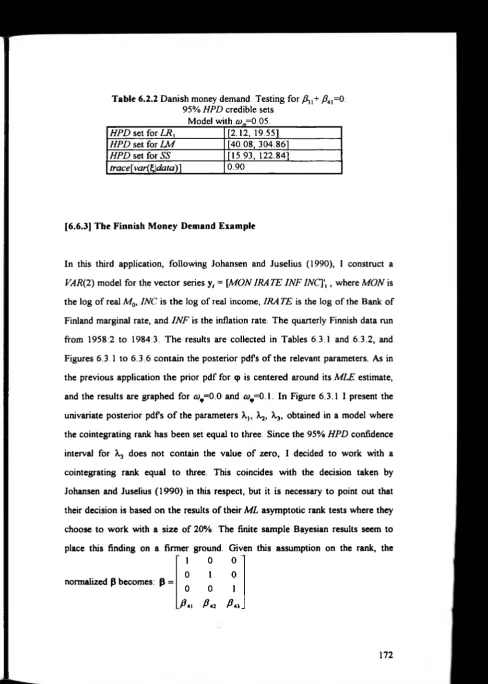
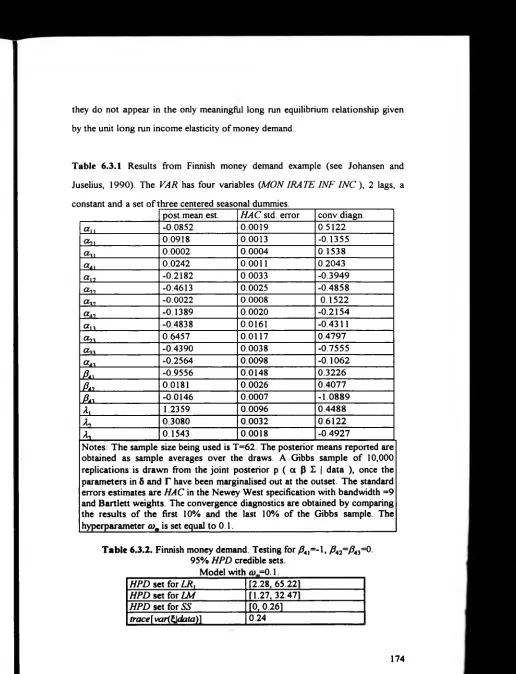
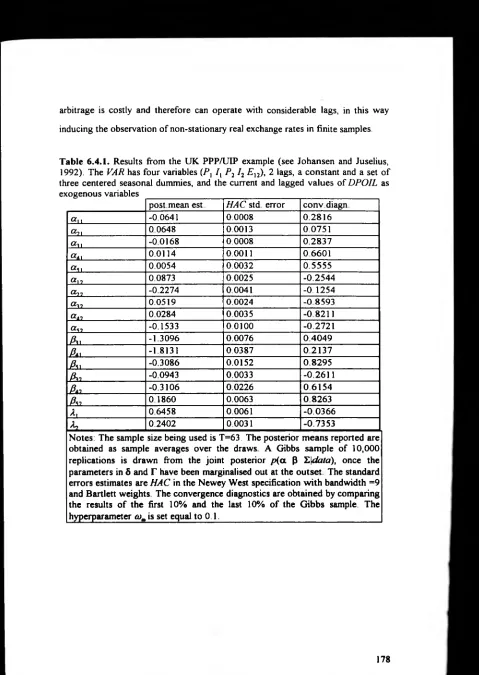
cointegration space Some applications are presented on money demand and
exchange rate examples
Chapter 7 contains some conclusive considerations on the evidence gathered in this
PART I: The Univariate Analysis o f Non-Stationary Time Series
Chapter 2: The Frequentist Approach to Non-stationarity in univariate Time Series Analysis.
(2.0] An Overview of the Chapter.
This chapter contains an overview o f the issue o f non-stationarity in univariate
models as seen from a frequentist point of view. In the first section the concepts of
trend and difference stationary processes are introduced, and their different
modelling properties are highlighted In Section [2 2], I describe the existing
inferential procedures designed to detect the presence of unit roots Section [2.3]
contains a brief summary of the main problems encountered in using the techniques
surveyed in the previous section, and provides the main motivations supporting the
adoption o f a Bayesian inferential strategy
[2.1] Integrated versus trend stationary processes.
Many macroeconomic time series show evident trending patterns The theoretical
justification for such non-stationary behaviour is often related to the occurrence of
phenomena like technological progress, increases in population and in the capital
stock, in short to all the forces supposed to drive the key economic variables over
time in the long run. However, the tools o f time series analysis are mainly based on
the assumption o f weak stationarity of the series under study, that is, the
assumption that first and second order moments are time-invariant Therefore, how
to deal properly with the observed non-stationarity is an important question, and
simple and straightforward procedure could be to assume the presence of a
deterministic trend, and detrend the data accordingly by means of a simple
regression, having performed such a transformation, one could then focus on the
resulting series and model the remaining dynamics by means of the available
techniques that rely on stationarity Thus, it is implicitly assumed that the series is
affected by a steady growth pattern, around which it fluctuates due to the
transitory effects of disturbances. Such series is said to be 'trend stationary', i.e to
possess a stationary invertible ARMA representation once the trend has been
removed In the case of a linear trend, we have
A L K y . - n - S t) = % L ) e , (1)
where e, is i.i.d. distributed with mean 0 and variance <re2, and p (L) and 6 (L) are
respectively stationary and invertible, thus in particular y, - p- S t has bounded
variance.
In this framework, the long run is accounted for in a completely deterministic way
(i.e. it is predictable with zero error), and what remains is produced as the dynamic
response to the realisation o f a series o f random disturbances These shocks have
an effect that vanishes in the long run. In fact, the zero-mean stationary process z,
= y , - p - S t admits a Old representation:
z, = [ ^ L ) l f K L ) ] e , = c ( L ) e „
Z c 2 < 00.
J-0
(
2
)Given the square summability of MA coefficients for a stationary process, we see
that the effect of a random shock on the levels of the series tends to vanish as time
(3)
lim [àyl+kl â e , ] - lim ck - 0. k-> « k-+<x>
The above quantity measures the persistence of the shocks hitting the series. Such
disturbances can be taken to reflect , in a highly stylised way, the occurrence of
demand side shocks, which induce the observed series to deviate temporarily from
its long run fundamentals (technological progress, demographic factors,
accumulation) driving it along its steady-state path As in Blanchard and Fischer
(1989, p 8), the model can be intended as a canonical form, in which the single
stochastic term is taken to represent the action o f a plurality o f random shocks
This is coherent with the analysis of Granger and Morris (1976)
Secondly, it is possible to conceive o f the observed series as generated by the
cumulated ever-lasting effects of purely random shocks This hypothesis has found
technical justification in the Box-Jenkins ARIMA modelling framework, where it is
recommended that the series be differenced until stationarity is achieved This
means that in the proposed ARM A(p,q) representation:
the autoregressive polynomial, p (Z,), is supposed to have d unit roots, hence once
the series has been differenced d times, y, admits ARM A(p’,q) representation
with p ’ - p - d The original series is then called difference stationary', or to
possess d unit roots in its autoregressive polynomial
If attention is restricted to first differencing, as seems to be plausible for many
macroeconomic aggregates, then we have a stationary ARMA model for the first
differences:
P(L)y, = 0 ( L ) e, (4)
The series is called integrated of order one. As Beveridge and Nelson (1981) show,
any such process can be decomposed into two different random components, the
first being a random walk with drift , and the second a stationary zero-mean
ARMA process:
y, = y f ’ + y!>
Ay; = 5 + k l ) / p ( l ) k = S + c ( l ) e „
.
1 1 (6)y, = c (L)e, ,
c(L) = [fl(L)/p*(L)] = c'(Z )A + C(l).
The drift arises only if the differenced process has a non-zero mean The first
component can be interpreted as accounting for the growth of the process: its
differences deviate randomly from the non-zero expected value given by the drift,
with a variance which is [c(\)]2ae2 The second component gives the transient
short run dynamics In this model shock have an ever-lasting effect on the level of
the series given by a non-zero persistence measure:
lim [ à y , ^ t de, \ = c(l) * 0.
k-* oo (7)
A synthetic measure of the importance o f the non-stationary component y , is
therefore given by the sheer size of c(l), which is a non-linear function o f the
parameters of the AR and MA coefficients
Note however that both components are by definition generated in terms of the
same random disturbance term ep hence the long run and transitory dynamics
cannot be considered as distinct, and the shocks affect the variable in a permanent
way through their effect on y , This is just one of the possible decompositions
decomposition in terms of different orthogonal processes, which forms the basis of
the ' structural time series modelling1.
Models like (6), when applied to variables such as gnp or its components, are
compatible with a very different explanation o f the observed fluctuations, namely
that provided by the "real business cycle" theory. See, for example, Plosser (1982),
Kydland and Prescott (1982), Prescott (1986), King, Plosser and Rebelo (1988),
Campbell (1994) In such a theoretical framework, the role of inter-temporal
optimising behaviour o f rational agents in labour-leisure and consumption-
investment choices is emphasised, and shocks from different sources are allowed to
produce permanent effects on the series itself, by modifying its random growth
pattern These shocks are mainly, but not only technological: disturbances can
affect tastes and preferences, and can take the form of public sector interventions
(see Baxter and King, 1993 or Campbell 1994), or of unexpected changes in the
terms of trade (as in Mendoza 1991, or Correia et al. 1995). It is not even
necessary that such shocks be given a non-stationary specification to produce
permanent effects, given the inter-temporal capital accumulation process In the
short run, the occurrence of disturbances produces temporary effects through the
adjustment mechanism, which are intended to be accommodated in the second term
o f the above decomposition Moreover such short-run disturbances are part o f the
optimal reaction of economic agents For this reason they should be considered as
Pareto optimal and not as something the government should aim at offsetting This
is not the only possible explanation o f the occurrence o f persistent shocks, and its
validity is strongly questioned (see Mankiw, 1989). Campbell and Mankiw (1987)
regard this persistence as better explained by the presence o f nominal rigidities or
by multiple equilibria.
In many other fields of economic analysis recent theories imply difference
the presence o f a unit root is often a theoretical im plication o f m odels which
postulate the rational use o f information available to economic agents. Examples
from economics include various financial market variables, such as future
contracts [...], dividends and earnings [...], spot and forw ard exchange rates [...],
and even aggregate variables like real consumption [...] and investment
(Perron (1988, p.297)
From a more technical viewpoint, in the recent methodological literature it has
been emphasised that the correct starting step in econometric modelling is a well
defined estimated statistical model (Spanos, 1986)' to account for the statistical
properties of the series under study Therefore, it is important to discriminate
between the two kinds of non-stationarity at the outset, also in the light of the
impact on properties of estimators
In many studies, e g Phillips and Durlauf (1986), Park and Phillips (1988) and
(1989), West (1988) and Sims, Stock and Watson (1990) inter alia, properties of
estimators have been analysed in regression contexts where some o f (or all) the
variables involved are integrated In such cases, estimators may not have
asymptotic normal distributions, and they usually do not have Therefore all the
tests that are commonly used in regression analysis have asymptotic distributions
which deviate from the usual %2, and need numerical tabulation
For all these reasons a host o f applied studies have been conducted on a univariate
basis, to discriminate between trend and difference stationarity The first and most
influential paper in that respect is Nelson and Plosser (1982), where most of the
U S. macroeconomic variables considered have been found integrated o f order one
The technical instruments used there are the usual unit root tests put forward by
D A Dickey and W A. Fuller, which are discussed in the following section, after
providing an overview of the properties of the OLS estimates in the trend
[2.2] Inference on trend stationary and integrated univariate processes.
Let us consider a simple zero-mean first order autoregressive process:
y, = p y,-\+ e, .
e, ~i.i.d.(0,cr2). (8)
Clearly, when |p| < 1 the model is an extremely simple stationary process, with
stationary oscillations around its zero unconditional mean The dynamic effect of
shocks can be described via the moving average representation
y, = c(L)e, ,
c, = 0 , i = 1, 2, (9)
Being given a sample of T+1 observations, .y0, y x, ..., y T, the simplest way to
estimate the unknown parameters o f the above process is to use ordinary least
squares, which entails maximising the likelihood conditioned on the initial
observation y 0:
T
j j.
p = '-'r ' ' , a 2 =(T-\y'j^(y, - p y,_,)2 (10)
zx.
t = lIt is well known, since the work by Mann and Wald (1943), that the asymptotic
distribution o f the normalised estimate is normal:
7"/J( p - p ) i t f [ 0 , ( 1 - p 2)] (11)
Therefore, given the sample size, the precision of the estimate of p is an increasing
drawn from a different viewpoint, which will be become relevant in the next
chapter. Assuming that the error terms are Gaussian, the conditional log-likelihood
function of the model, reads:
(12)
The Fisher information matrix I T(b) is:
/j.(b) = [ - £ ( ^ log L/i?b<?b')] = 77 2o-4 0
0
T / ( \ - p 2) (13)
Given the notorious equivalence o f the OLS and the conditional ML estimators,
and the usual asymptotic properties of the latter one, the second diagonal element
o f the information matrix conveys immediately the Mann and Wald (1943) result
Nevertheless, it is important to stress that in finite samples the shape o f the
distribution o f p is very different from normal, being skewed to the left, the
skewness being an increasing function of the true unknown value o f p
A generalisation of result (11) holds for the estimation of a stationary AR (p)
process:
y, = p,y,-i + py,.2 + + p? ,.p + £r ( 14)
stating that the scaled OLS estimate of p = [p,, p^, .... pp]' is asymptotically
(15)
7”'2(p- P)4 n[o, ct2V' ] ,
V = varf^,,, y,_2 y,_p]
Therefore, also for higher order stationary AR processes, inference can be
conducted by using asymptotic normality.
Furthermore, if the stationary model is augmented to include a linear time trend:
y, = a + P t + p,y,_, + pyyu2 + ... + pjy,_p + e, (16)
the scaled OLS estimator of b = [p', a, p ]' is asymptotically multivariate Normal:
Tj.(b-b)^>N [o,
---1
< o o
__
1 ’T V2l p 0 0 'V ‘ = 0 1 1/2 II O In M O
0 1/2 1/3 0 0 T in
V = var[z,_, z,_2 ',2, =y, - a - f i t .
Note that the trend term o f the deterministic component has a higher rate of
convergence than the other coefficients and this circumstance calls for the use of
different scaling factors through the apt definition o f the scaling matrix T r (see
Sims, Stock and Watson 1990).
Given the distributional results described above, it is possible to make standard
inference on the parameters o f a stationary AR process Things seem to radically
change when dealing with processes with a unit root. In the case the process is
difference stationary, radically different properties attain for the parameters
estimates. Early studies in this respect are Fuller (1976), Dickey (1976), Dickey
and Fuller (1979, 1981) More recently Phillips (1987) has given a more formal
description o f these properties by making extensive use o f the functional central
Let us consider the simple model (8) where the true value of p is unity. In order to
describe the asymptotic properties o f the OLS estimate of p, it is necessary to
define:
[ Tr]
ST(r)= 2 e„ r e [ 0 ,l] , Sr (r): [0 ,l]-> R , (18)
with [T r] denoting the integer part of T r. A very useful result is what in the
literature is termed as "Donsker's theorem", or "functional central limit theorem",
or "invariance principle" (see Billingsley 1968), stating that:
r ina ' S T(r)=>W(r), (]9 )
where the random variable W (r) is a Brownian motion process, and => denotes
weak convergence of the associated probability measure, this property is the
analogue of convergence in distribution as applied to function spaces It is possible
to see that this result holds also in the presence o f less strict requirements for the
error terms ep for instance when there is some correlation and time-heterogeneity
among them, and this is used in Phillips (1987). Expression (19) states the
asymptotic normality of any normalised sample mean obtained by making use of
sub-sets of the sample observations For instance, when r =1, S ^ l ) is the
normalised sample mean obtained using the full sample, whose asymptotic
distribution is clearly A (0,1), and it is known that this is indeed the distribution of
W(\). In other terms (18) is a more general statement of the central limit theorem
A second very useful result is given by the "continuous mapping theorem", (Hall
and Heyde, 1980) stating that if S ^ r ) converges to S, and g(Sj(r)) is a continuous
functional, then g(Sj(r)) converges to g(S).
Given these results, it is possible to obtain the asymptotic distribution o f the
(20)
0
It is necessary to stress some features of the distribution above, contrasted to the
ones of the analogue asymptotic distribution in the case of stationarity. First of all,
in order to have a non-degenerate distribution, it is necessary to scale ( p -1) by T
and not by P a as in the stationary case In other terms p is Op(T) and not
0,(7™ ). Secondly, although the finite sample distribution o f p is skewed both
under the stationary and the integrated case, in the latter case the asymptotic
distribution o f the adequately normalised bias retains its skewness, whereas it is
Gaussian in the former case
On the basis of the continuous mapping theorem, also the asymptotic distribution
of the t statistic for testing the presence of a unit root can be directly obtained
The random variables defined in the expressions (20) and (21) can be simulated
and therefore it is possible to obtain the desired quantiles Tables for both statistics
are contained in Fuller (1976, p 371). Together with the asymptotic quantiles,
Fuller provides also the quantiles for different finite sample sizes by means of direct
numerical simulation o f the model under the hypothesis of a unit root. To do that
Fuller needs the extra assumption o f Gaussian errors
With the results described above, it is possible to give a solution to the inferential
problem o f deciding whether or not the simple i47?(l) model (8) has a unit root In
hypotheses involved is {//„: p = 1, //,: p < 1}, leaving aside the uninteresting issue
about the presence of a explosive root This is the way taken by Dickey (1976),
Fuller (1976), Dickey and Fuller (1979, 1981) Given the asymmetry with which
the hypotheses are treated in a classical inferential approach, what becomes
relevant is the distribution of the relevant statistics under the null hypothesis of
difference stationarity. We have just seen that these distributions are non-standard
and call for reference to the tables provided by Fuller
When it is required to discriminate between different sensible ways o f accounting
for non-stationarity, the simple AR(\ ) model without deterministics is not
satisfactory and has to be augmented in two dimensions: include a sensible
deterministic part, and consider higher dynamics in the autoregressive
representation
As for the deterministic components, the most straightforward way to achieve this
augmentation is to linearly append the desired deterministic component to the
model For this reason, starting from the aforementioned works by Dickey and
Fuller, the following two models are commonly specified:
Notice that in the above models the c and P coefficients have different
interpretations depending on whether or not the model is integrated When the
model is stationary, for y, c and P clearly define the intercept and the linear trend
terms respectively, but when there is a unit root, c is the linear trend coefficient in
model (22), and p is twice the quadratic trend coefficient in model (23). Therefore,
the parameterisation used in the two models above can give the possibility of
discriminating between trend stationarity and difference stationarity but only by
jointly considering a set of statistics to test the following hypotheses
y , = c + p y , - \ + e , ,
y, =c + p t + py, _] +e,
(
22)
(1) c = 0 against c * 0 in models (22), (23)
(2) II o against p * 0 in model (23)
(3) p = 1 against p < 1 in models (22), (23)
(4) c = 0, p = 1 against c 0, p < 1 in model (22)
(5) P =o,p = \ against P * 0 , p < 1 in model (23)
(6) o II © II p II against c *0, P*, p <1 in model (23)
The asymptotic distributions o f these statistics under the integration hypothesis can
be obtained using the concept o f convergence on function spaces, as in the simplest
no-deterministics case The only complication arises for the presence in the
estimated coefficient vectors of terms with different rates of convergence under the
integration hypothesis The main results can be summarised as follows
a) Estimating model (22) one has to distinguish between the circumstance that the
"true" value o f c be zero or not In the former case, T(p -1) and t ( p =1) have non
standard asymptotic distributions given by functionals of Brownian motions The
test for the joint hypothesis labelled as (4) in the table above involves the use o f a
Wald "F” test which does not have standard distribution On the other hand when c
* 0, the estimated coefficient are asymptotically Gaussian (see West, 1988), once
scaled by means of the matrix Tr = 0 In this case one can
asymptotically rely on the standard critical values The reason why this result is
obtained is that the presence of a drift term renders y, asymptotically dominated by
the resulting linear trend Therefore the regressor y, is asymptotically equivalent to
a trend, and therefore asymptotic normality of the coefficients attains
b) Estimating model (23), the only relevant case under the null is when p = 0,
otherwise the model will imply non-stationarity around a quadratic trend, which is
not conceptually adequate for most economic time series The statistics being used
motion process. As in the case of the simpler model (8), the finite sample quantiles
of the relevant statistics were obtained by Dickey and Fuller (1979, 1981), for
different sample sizes, via direct simulation o f the dgp with Gaussian disturbances
I turn now to the problem of unit root inference in models with richer dynamics.
From an estimation point of view, the most straightforward way to augment the
model is to specify an AR{p) fory»,, as in Dickey and Fuller (1981) If we consider,
for instance, the model with a linear trend we have
f t L ) y , = c + p t + e,,
. „ (24)
p{L) = \ - p xL - p 1L1- . . . - p pL’>.
This model can be easily reparameterised as:
p' (L)Ay, = c + p i + p y , . l +e,,
p(L) = p \ L ) A + p,
p ( D = \ - p \ L - p 2L1- . . - p p_lLp- \
P = Pi 1)
The unit root occurs when p - 0 The testing strategy consists then in augmenting'
the model with p- 1 lagged differences, and in evaluating the same statistics as in
the simpler /47?(1) case above The resulting tests are known as Augmented
Dickey Fuller' (ADF) tests
In the presence of any kind o f deterministic components in the model and in the
dgp, it is possible to show that the limiting distribution o f the test statistics coincide
with the ones that would be valid for the AR(1) model with the corresponding
deterministic part The intuition behind this result is that the model is augmented
with a set of stationary regressors (the lagged Ays) which do not alter the
asymptotic distribution of the relevant parameters In more formal terms this
variance-covariance matrix o f the coefficients is asymptotically block-diagonal (see Banerjee
et u l, 1993) Therefore the use of the same critical values is asymptotically correct
Model augmentation poses an additional complication, since the validity of the test
results depends crucially on the correct identification o f the lag order When a
general ARMA representation o f unknown order is allowed, things get even more
complicated, since its approximation via the autoregressive representation could
require a very high lag order, Said and Dickey (1984) develop a truncation rule
meant to yield consistent results Hall (1988) considers the problem from a
different viewpoint the simultaneity between regressors and the error term induced
by any finite order truncation He proposes test statistics based on instrumental
variable estimation.
A completely different route is suggested in Phillips (1987), Perron and Phillips
(1987), Phillips and Perron (1988), and Perron (1988) Their idea rests on Solo
(1984), and consists in referring to an i4/i(l) model with the desired deterministic
component The i.i.d. hypothesis on the errors is abandoned, and e, is considered
as an infinite dimensional time dependent and weakly heterogeneous nuisance
parameter The conditions imposed on it are the following ones (see Phillips
1987, p280):
a) £(<?,) = 0 V( .
b) sup, E(\e\P) < oo for some P> 2. T c) lim E C T ' S } ) = a 2 > 0 , whereST = ¿ e ,
T-¥oo /»I
d) The process e, is strongly mixing with mixing coefficients a, obeying
2, a, < ao. i-i
These conditions imposed on e, define a time dependent, weakly heterogeneous
process to which extensions of the central limit theorem can be validly applied The
class o f processes satisfying these requirements is wide enough to include any
The first order autoregressive model is estimated by means o f OLS, and the
statistics proposed by Dickey and Fuller are shown to have limiting distributions
differing from the corresponding ones attained with i.i.d. errors, because of the
presence of the nuisance parameter A = (cfi-cr2)/!, where a2 is defined in property T
(c) and of = lim 7~' ¿ £ ( e ,2) In fact, when errors are i.i.d. a2 = o 2 and A = 0 T->co t=\
Under weak stationarity for e„ the quantity a2 is (2 rf) times the spectral density
function of e, at its origin, and can therefore be non-parametrically estimated in the
time domain by means of a finite number of autocovariances Following Newey
and West (1987), smoothing is achieved via a triangular Bartlett window, to ensure
the non-negativity of the resulting estimate:
f T m T \
CT2 = T + 2' £w( j , m)
\ f=l ]-\ t= j + 1
= max[0,l - j / ( m+ 1)].
In this respect, it is necessary to choose the truncation parameter m, the bandwidth
of the estimate With m growing with the sample size and defined to be o (P/4),
consistent estimates of a2 can be obtained
T
The quantity a 2 is consistently estimated as s] = T [^ e , 2 . In this way it is
1=2
possible to estimate consistently the nuisance parameter A, and the Dickey-Fuller
statistics can be corrected to take it into account As a result, the available critical
values can be validly used
Unfortunately, many problems arise in the empirical application o f the unit root
tests so far described As already pointed out, the operative testing strategy
consists in taking jointly into account a plurality of tests, whose outcomes may
happen not to be mutually coherent Moreover, the tests have very low power
presence of a structural break is envisaged. In this case the above testing
procedures tend to over-estimate the order of integration In Perron (1989) the
conclusions of Nelson and Plosser (1982) are endorsed for most of the series
considered, on the basis of a different testing procedure allowing for the presence
of a structural break. In addition, by means o f Monte Carlo simulations, Schwert
(1987, 1988) shows that the distributions of the Dickey-Fuller statistics and o f
their non-parametric corrections have a remarkably slow convergence to their
limiting distributions This fact can induce important differences between nominal
and effective sizes in empirical applications. Finally, the way in which the presence
of a deterministic trend is accounted for seems deeply unsatisfactory In fact, as has
been pointed out already, the parameters of the deterministic components have
different interpretations when the series is stationary and when it is integrated:
under the null, the deterministic component being considered is a quadratic trend
Dealing for example with model (23), in order to have a deterministic trend o f the
same order under both hypotheses, the parameter p should be set equal to zero
when p = 1. It is hence redundant under the integration null, inducing a power loss
in the statistics based on this model For this reason, Schmidt and Phillips (1992)
describe as 'clumsy' this parameterisation and suggest using the more convenient
alternative proposed by Barghava (1986): in the simple AR( 1) case, we can write:
x, =Px,-\+en x,=y,-M - s
1
(26>
Note that the model is non-linear in the parameters and that p disappears when p
= 1 In this context no parameter is redundant under either hypothesis: when the
series is trend stationary, p and 8 indicate respectively intercept and slope o f the
deterministic trend, when the series is integrated, p vanishes and 8 gives the drift.
On the basis of this parameterisation, Schmidt and Phillips develop two LM test
for weakly dependent and heterogeneous error terms in the same way as the
Dickey and Fuller tests.
Given the difficulties encountered, some authors, like Campbell and Mankiw
(1987), propose to reverse completely the testing framework: the series is
differenced at the outset; then, embedding stationarity under the null, one should
test for over-differencing', i.e. for the presence of a unit root in the MA
polynomial. This is closely related to the Beveridge-Nelson representation seen in
expression (6) above: when a stationary process is differenced, in the Beveridge-
Nelson representation we have c(l)=0
Unfortunately, in the estimation of MA parameters the so-called pile-up' problem
emerges: by means o f simulation experiments on the basis of a MA( \ ) process,
Sargan and Barghava (1983, section 5) show that the event that the ML estimator
is equal to one has a positive probability mass even when the 'true' parameter value
is not equal to one but close to it Therefore testing procedures based on the
estimated MA parameters could lead to spuriously detecting over-differencing
For this reason, other routes should be followed A possible solution, suggested by
Nerlove and Pinto (1984) is to resort to alternative likelihood-based estimation
techniques, such as the ones based on frequency-domain approximation o f the
likelihood function Another, already in use, consists in focusing in the spectral
density function o f the differenced series, to check whether it gets to zero at the
origin, as it should in case of over-differencing. In this respect, see Ouliaris, Perron
[2.3] Some General Considerations About Unit Root Testing in a Classical Framework
In synthesis, all the classical procedures for unit root testing share some unpleasant
features
(i) The necessity to refer only to asymptotic non standard results, which is given by
the particular properties of integrated processes. In finite samples, the distributions
o f the test statistics are indeed o f unknown form, and the only information
available in this respect come from M onte Carlo investigations As we have already
stressed, Schwert (1989) demonstrates how the finite sample properties of most
unit root tests have radically different properties from their asymptotic
counterparts. For this reason, the actual size of tests tend to be substantially
different from the nominal one Schwert (1989) compares the properties o f ADF
and Phillips-Perron tests on data generated as AR1M A{0,\,\) processes, finding
that the actual size tends to get extremely high when the dgp has a large negative
MA coefficient.
(ii) Generally poor power performances This is the most difficult aspect relating to
the empirical application of these tests, i.e the evident difficulty of discriminating,
in finite samples, between alternative models of non-stationarity which replicate
sufficiently well the correlation properties of the series under analysis. This is the
so-called "near observational equivalence" described in Sims (1989) and Campbell
and Perron (1991) DeJong, Narkervis, Savin and Whiteman (1992) conducted an
interesting simulation exercise and report type II errors comparable to ones
attained in a coin tossing game
(iii) Different deterministic components in the dgp and in the estimated model
imply different asymptotic distributions This is a source o f potential coniiision,
since it is first necessary to decide which deterministic component to take into
necessary to resort to a battery o f different test statistics, whose combined
outcome often has a problematic interpretation
(iv) Asymmetry in the treatment of the hypotheses. In the usual Neyman-Pearson
approach, the test procedure assigns different treatment to the two possible wrong
outcomes. The probability of falsely discarding the null is fixed for whichever
sample size, wherever the probability o f rejecting the alternative tends to converge
to zero as the sample size increases, in the absence o f any model misspecifications.
It is possible to try and solve each one of these problem, just by resorting to
Bayesian inferential techniques. First o f all, the Bayesian framework does not rely
on asymptotic distributions, given that posterior inference is carried out on the
basis o f the relevant finite sample distributions. Secondly, it is possible to decrease
the extent o f the "observational equivalence" problem by allowing the researchers
to implement explicitly their own personal a priori information about the
parametric nature of the data generation process (henceforth DGP), in this way
increasing the efficiency of the resulting estimate Moreover, it turns out that
different deterministic components do not have any relevant impact on the marginal
posterior distributions o f the relevant parameters Finally, we will see that the
Bayesian analysis allows one to compare hypotheses on the basis of the
corresponding posterior probabilities. The posterior distributions under both the
hypotheses are not asymmetric, and the testing is fully "consistent", in that the
probability o f picking the wrong model goes to zero as the sample size increases
This property is shared also by other Bayesian inferential procedures designed to
evaluate hypotheses, such as the one based on the relevant highest posterior
density (HPD) confidence intervals
Moreover, since the relevance of the unit root inferential problem is often related
to some decisions the applied researcher has to take in the model building process,
i.e. difference the series, insert a trend, apply a seasonal frequencies filter, it seems
consistently proved to be a valid support to decision making in other fields of
human activity.
The more general advantages and disadvantages of the Bayesian techniques also
apply to this problem The advantages, together with the ones already described,
are essentially related to the fact that the Bayesian approach is simple, and it
constitutes the only logical formalisation of the process o f learning. The
disadvantages are mainly o f a computational kind. Bayesian methods are "labour
intensive" techniques.
The main aim o f this thesis is to provide fresh examples o f the ways in which a
Bayesian approach can be validly used to deal with non-stationarity issues, trying
Chapter 3: The Bayesian Approach to Time Series Analysis: Problems and Methods.
(3.0] An Overview o f the Chapter.
I
In this chapter, I discuss the main methodological and implementation issues
arising in the application of Bayesian techniques in the analysis o f time series
models The chapter is organised as follows: Section [3.1] introduces the concept
of prior and posterior distributions. Section [3 .2] reviews the Bayesian inferential
techniques, with particular emphasis being given to the problem of reporting o f the
results and o f model selection Section [3.3] explains the general criteria followed
in the specification of the prior distribution Section [3.4] explains the
computational problems arising in a Bayesian approach and the solutions that are
available to solve them. The use o f Markov chain Monte Carlo integration is
discussed at length, in order to show its success in freeing the researcher from the
conjugate prior straitjacket Section [3.5] gives some relevant examples of
Bayesian studies concerning non-stationary univariate models, and the final section
discusses the remarks made by Phillips (1991a) concerning the concept of
"ignorance priors" in time series models
[3.1] The General Philosophy of the Bayesian Approach.
Let us consider a parametric model of the kind:
where y, is a (wxl) vector o f dependent variables, x, is a (£x 1) vector o f
predetermined and/or exogenous variables, e, is vector error term, 0 is a vector o f
parameters and f( ) is a given function o f its arguments. In the classical approach,
the inferential problem can be summarised as follows: a string of T observations on
y, and x, is available, the researcher has then to obtain a sensible estimate of the
unknown vector of parameters 0. This amounts to considering data as the unique
source of information.
Most of the time it is possible to write down the joint probability distribution
function (henceforth pdf) of the whole sample When regarded as a function of the
parameters, this pdf is called likelihood function. Writing the likelihood function
requires making an assumption on the distribution o f the error terms, and a certain
specification for the f( ) function To provide an example, let us assume that y, is
scalar, that the error terms are i.icL and N (0, a2) (henceforth N.i.d.(0, a2)) , and
that the model is linear in the parameters:
y, = V P + ep e,~ N{0, a2), 0 = [p1, a2]' (2)
Then the likelihood function reads:
£(0|y) = P(y|0) = (2 *■ d2)-™ exp [-{Mid2) e'e], (3)
t = [ e l, e 2, ...,e T]',
In the expression above I have considered the dependence o f the likelihood
function on the exogenous variables as implicit; for this reason I write L(0|y) and
My|0)
The classical inference consists in maximising the likelihood function, in order to
estimate of the associated uncertainty, which is used to construct confidence
intervals and to perform hypothesis testing.
The Bayesian approach radically diverges from the classical one, particularly in the
way in which the parameter vector is considered. In the Bayesian analysis, there is
no such thing as a "true" unknown value of the parameters. On the contrary, these
are considered as random unobservable variables, on which the researcher might
have some extra-sample ( prior) information The problem is then how to optimally
combine sample and non-sample information This is accomplished by means of
Bayes theorem, or the "principle of inverse probability": the likelihood function is
regarded as the probability o f the sample data given the parameters (A»(y|0)), the
extra-sample information about the parameters is in terms o f a "prior" distribution
p(0), assigning probability mass to any subset of 0 Using Bayes' theorem, it is
possible to write:
P(0|y) = P(6) p(yiey [IP(Q) My|0)d0 ] = p(Q) p(ylQ)/p(y), (4)
where the integration at the denominator is performed over ©
The distribution p(0|y) is called the "joint posterior distribution" of the parameter
vector. This pdf measures the uncertainty on the parameters which results after
combining all the sources o f available information, and constitutes the starting
point for conducting inference in such a framework. It is important to note that the
posterior pdf, given the observed sample y, is fully described by the product of the
likelihood function and the prior distribution. The denominator of expression (4),
insofar it is different from zero, can be interpreted as a normalising constant;
therefore it is very common to see in the Bayesian literature:
In this respect, it is possible to give the posterior distribution a very useful
interpretation: in expression (5), the likelihood function is being weighted using the
prior pdf as the weighting function. Under this point o f view, the classical approach
corresponds to a special case o f the Bayesian analysis: when the prior pdf is diffuse
over the parameter space, i.e. p(B) oc 1, the posterior distribution is proportional to
the likelihood function, which is the starting point in the classical inference ‘.T o
provide a very simple example, imagine one is dealing with the linear regression
model (2), with only one regressor xn and with a 2 = 1 The researcher has some
prior information about the values of the parameter /?, which can be summarised in
the following prior distribution:
P ~ N (jip o jf ). (6)
By applying Bayes' theorem, the posterior distribution for p is therefore:
P(A y ) x exp{-(\l2)[t't\-[\l(2op2)]\J}-HpY), (7)
which is the kernel o f a univariate Normal distribution with moments:
E (0 y ) = [ x 'x + V H x 'y + V / ^ , Var <J3 |y) = [x'x+cr^]-' (8)
Expression (7) states that, for any value o f p, the posterior pdf is given by the
product between the density given by the prior distribution and the likelihood 1
1 For the moment, 1 overlook the problem of assigning non-informative priors to variance
function evaluated at that point. Notice that an "ignorance", or "diffuse" prior
would be the one assigning equal prior weights to all the possible values o f ß, i.e.
p(ß) oc 1. Such a prior is "improper", given that:
\p(ß) d ß -» oo,
i.e. the integral of the pdf would not be finite. In other terms, all the integer order
moments o f the prior, comprised the one o f order zero, do not exist It is
immediate to realise that the ignorance prior corresponds to the limit o f the prior
pdf (6) when the prior variance ajj- goes to infinity, i.e. when the "strength" o f the
prior beliefs about ß fades away, equivalently one can think about the inverse
variance, which is termed prior precision, going to zero In such a case the
posterior moments become:
E(fl y ) = [x'x]-‘[x'y], Var (ß y) = [*'*]->. (9)
These quantities correspond to the usual maximum likelihood estimate o f ß and of
its variance: this is not surprising given that the posterior distribution coincides
with the likelihood function This very simple result holds also in models with more
than one regressor and more than one equation
The way in which the likelihood function and the prior information are combined
can be interpreted also under a different viewpoint, which does not require
distributional assumptions on the model. With respect to a simple linear regression
model: