Exploring the Future
Development in Employee Involvement:
The Influence of Organizational Centralization
on the Conclusion of idiosyncratic Deals
Author: Carolin Straubel
University of Twente P.O. Box 217, 7500AE EnschedeThe Netherlands
ABSTRACT
Purpose
– The purpose of this paper is to explore what influence the decision-making structure within a company has on the amount of concluded idiosyncratic deals (deals) expected in the future and of what kind of i-deals a conclusion is anticipated to be more/less likely.Design/methodology
– Based on a survey 22 experts with a variety of backgrounds were with the usage of a survey split up into two groups based on their decision-making structure, centralized and decentralized. Via the Delphi method consensus was achieved. Two rounds, first qualitative then quantitative, helped to develop an extensive list of i-deals and to study the expected likelihood of a conclusion of these i-deals in the future.Findings
– The decision-making structure does not have a significant influence on the future amount of i-deals concluded. Four new types of i-deals have been identified and consensus was achieved. Generally, the conclusions of Task & Work responsibility i-deals and Schedule flexibility i-deals are expected in the future. Financial incentives are seen as unlikely to be concluded in the future. Within the service industry i-deals are seen as more likely.Originality/value
– The novelty of the study lies in the exploration of the future of i-deals, which would enhance CEOs’, managers’, employees’ and possible future employees’ planning regarding multiple aspects and this way increase their competiveness and value. It can already be observed that difference regarding the amount of i-deals used within companies exist, but no clear indications about what part of the organizational structure is influencing the amount, has been given so far.1
stSupervisor: Dr. Jeroen Meijerink
2
ndSupervisor: Dr. Ida (A.A.M.) Wognum
Keywords
Idiosyncratic deals (i-deals), Centralization, Future expectations, Organizational structure, Employee involvement, Delphi Method
Permission to make digital or hard copies of all or part of this work for personal or classroom use is granted without fee provided that copies are not made or distributed for profit or commercial advantage and that copies bear this notice and the full citation on the first page. To copy otherwise, or republish, to post on servers or to redistribute to lists, requires prior specific permission and/or a fee.
5th IBA Bachelor Thesis Conference, July 2nd, 2015, Enschede, The Netherlands.
1.
INTRODUCTION
Idiosyncratic deals (I-deals) became an increasingly relevant topic in today’s business community and are expected to have an even bigger influence in the upcoming future.
I-deals are individualized agreements between a valuable employee and his or her employer creating a condition that both parties benefit from (Hornung, Rousseau, & Glaser, 2008; Hornung, Rousseau, Glaser, Angerer, & Weigl, 2010; Rousseu, Ho, & Greenberg, 2006). These kinds of deals give the employee the possibility to shape the employee arrangement based on personal preferences that differ to a certain degree from the standard agreements their co-workers have (Hornung, Rousseau, & Glaser, 2009; Rousseau, 2001; Rousseau, 2005). I-deals can include various terms, which can usually be assigned to one of the four categories of i-deals that are outlined by Rosen, Slater and Johnson (2013) namely: Task & Work responsibility related i-deals (e.g. increased empowerment, special training for further development), Schedule flexibility i-deals (e.g. flexible working hours), Location flexibility i-i-deals (e.g. home office), and Financial incentives (e.g. individually increased salary). The willingness of CEOs and Top managers to conclude i-deals can enhance companies’ ability to retain an efficient and valuable workforce (Capelli, 2000; Leana & Rouseau, 2000), which is crucial considering the steadily increasing mobility among talented people (Rousseu et al. 2006, Frank & Cook, 2010) and the ongoing shift from manufacturing to knowledge companies (Spender & Grant, 1996), where employees tend to expect more unique treatment. Furthermore, i-deals provide a great amount of flexibility that does not only help the employer to respond to individual differences of employees, but also to the increased need to innovate based on the complex and constantly changing circumstances (Rousseau, 2005; Rousseau et al., 2006; Hornung, Rousseau, Weigl, Müller, & Glaser, 2014).
Especially considering the future, where the complexity of products will increase tremendously and where competition will be even stronger, the development of i-deals will be influenced: Where currently i-deals are mainly made to satisfy the employee and enhance the person-job fit (Hornung et al., 2010), an increased complexity of reward systems in terms of customized deals might soon represent a necessary standard considering the growing need for flexibility. Employees are expected to become more independent and gain increasingly more decision-making power and with it, the amount of i-deals concluded within a firm will increase respectively. Looking at the future of i-deals therefore rises the expectation of an increased amount of i-deals concluded within companies, however, varying organizational structures provide different circumstances and therefore are likely to influence this future amount. One dimension of organizational structure, which describes the internal characteristics of an organization, is centralization (Daft, 2010). Centralization has a crucial influence on the internal flexibility of an organization, as well as its internal degree of innovativeness (Zheng, Yang, & McLean, 2010; Daft, 2010). It is defined as the “extent to which decision-making power is concentrated at the top levels of the organization” (Zheng et al., 2010, p. 765) and therefore describes how an organization is coordinated and controlled. The degree of centralization can have an impact on the company’s performance in terms of responsiveness to the external environment and the ability to adapt (Zheng et al., 2010; Englehardt & Simmons, 2002), a competence that is essential considering the environment that acts as a quickly changing external force to which organizations have to constantly adapt to remain effective, profitable and with it, competitive (Damanpour & Gopalakrishnan, 1998). Looking
towards the future, and considering the current speed of product development, the expectation arises that companies shift to a more decentralized organizational structure, to be able to adopt quickly and successful to their environment by high internal flexibility, and furthermore to enhance internal creativity and innovativeness (Georgopoulos & Tannenbaum, 1957; Homburg, Workman, & Jensen, 2000; Engelhardt & Simmons, 2002).
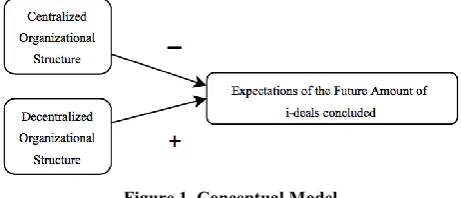
[image:2.595.310.541.362.461.2]The previous outlines lead to the assumption that companies, that focus more on flexibility and therefore have a decentralized structure, are more likely to have a higher amount of i-deals made than companies with a rather centralized structure, focusing on stability and standardization (represented in Figure 1). This assumption is based on the relationship between the key features of both variables: flexibility and power. I-deals can only be made if the company is flexible enough to allow these non-standard deals and when employees have enough power to dare negotiating their employment conditions; the degree of centralization is characterized by power dispersion and internal flexibility. Hence, within flexible organizations, the decision-making power is dispersed, thus decentralized, and the existence of non-standard agreements that can only exist within a flexible environment is more likely. Thus, regarding the future, where the focus has to be more on flexibility it can be expected that the organizational structure will become more decentralized and a higher amount of i-deals within the company will be concluded.
Figure 1. Conceptual Model
Considering the stated practical relevancies of future expectations of i-deals the following research question will guide the investigation presented in this paper:
What are the differences between centralized and decentralized organization regarding management expectations of the future types of i-deals concluded with employees?
This paper will contribute to the existing literature by not only investigating the future development of i-deals but furthermore, by putting it in relationship with, and exploring the trend of organizational structures in terms of the spread of power in the decision-making process.
2.
THEORETICAL FRAMEWORK
2.1
I-deals
I-deals are arrangements that employees (a) individually negotiate with their employer, to achieve (b) personalized changes of their employment contract that differ from the ones of the co-workers and that are (c) mutually beneficial to both parties (Rousseau, 2005; Rosen et al., 2013). Additionally i-deals can (d) vary in scope, meaning that they can be a one time only negotiation on one aspect or that multiple points of the employment arrangement are discussed (Rosen et al., 2013). Any employee can try to negotiate customized arrangements, but usually only the ones that have special skills or knowledge and that are a highly valuable contribution to the organization that way, succeed (Rousseau, 2001; Rosen et al., 2013). Based on the work of Rousseau (2005), Rousseau et al. (2006), Hornung et al. (2008) and Hornung et al. (2009), Rosen et al. (2013) differentiated four different types of i-deals: Schedule flexibility, Task & Work responsibility, Financial incentives and Location flexibility i-deals.
The first type of personalized deals that can be concluded are Schedule flexibility i-deals, which have the purpose to fit the individual needs or desires of an individual to their working schedule. This type overlaps perfectly with the Flexibility i-deal described by Hornung et al. (2014) and could for example be done by increasing the flexibility of an employee’s working hours and shifts. The basis for employees to negotiate a Schedule flexible i-deal is high job-demand that gives the employee the feeling of not being able to fulfill the task under the agreed conditions. Giving a worker the possibility to shape their own time schedules has been proven to “indirectly reduce psychological irritation” (Hornung et al., 2014, p. 612), which is defined as the “subjectively perceived emotional and cognitive strain in occupational contexts” (Mohr, Müller, Rigotti, Aycan, & Tschan, 2006, p. 198).
The Task & Work responsibility i-deals cover everything that is related to the content of the job, including arrangement regarding the employee’s task, and arrangements referring to the career of the employee. The increased variety in tasks, mentioned by Hornung et al. (2014), leads to changes in the job content of the employee that can come in form of a new job assignment, an increase of autonomy, higher degree of independency or more decision-making rights. Task & Work responsibility i-deals also influence the content of the job by individualized deals that concern the career of an employee and include negotiations concerning activities that enhance the acquisition of skills or support the worker’s development otherwise (Hornung et al., 2014). Examples would be special coaching and training sessions, specific goal setting for the individual growth, or giving the employee the opportunity to be promoted or allocate to a new and more challenging assignment that will trigger the individual development. Arrangements regarding the task and the career of an employee stem from different motivations of the employee but the willingness of
CEOs and top managers to conclude them can represent a valuable opportunity in the future. Individual changes in task emerge from the employee’s intrinsic desire to make their job more pleasant again by making it more motivating and rewarding. They have been proven to have a significantly positive effect on the performance of the employee in his task or role (Hornung et al., 2014). Personalized arrangements regarding the career are based on employees’ career planning that is increasingly future oriented and employees’ recognition of the need to constantly develop their skills to remain competitive in the job market. By concluding these kind of i-deals the workers inner belief of being able to perform well with the own capabilities, so called self-efficacy, is enhanced (Bandura, 1977), which can have the positive effect that employees fulfill their job with more satisfaction and confidence.
The last two types of i-deals, Financial incentives and Location flexibility i-deals, have been added by Rosen et al. (2013) based on the reasoning that these i-deals are found to be the most “common domain across which i-deals are negotiated” (Rosen et al., 2013, p. 716). Furthermore, especially Location flexibility i-deals that are based on the negotiation of the location where an employee works, like for example being allowed to work from home or being transferred to a different branch, promote the employees work-life balance and with it enhances the motivation, thus, are mutually beneficial. Financial incentives can include everything that does not belong to the three previously outlined i-deals and that is associated with an expense for the company, e.g. the usage of a company car also for private matters. Negotiating a Financial incentive with an employee and letting the individual be a part of the creation of his/her own compensation plan, is a great way to show the employee recognition (Rosen et al., 2013). In general, i-deals create a higher degree of engagement of the employees, which was seen as very important to achieve overall organizational success by 72% of 550 executives, in a Harvard Business Review Analytical Service report (2013). Looking at the future trends “making employee engagement happen will be the business challenge of the next decade and a focal point of the emerging talent imperative” (Aon Hewitt, 2014, p. 2) and hence, an increased importance of the conclusion of all kinds of i-deals can be expected.
2.2
Centralization
major changes in the environment of the firm (Damanpour & Gopalakrishnan, 1998).
Is the structure of a firm characterized by a very low degree of centralization, so to speak decentralized, the decision-making autonomy is spread across the whole company, participation of various employees is high (Homburg et al., 2000; Daft, 2010) and the information flow as well as the decision-making happens via a bottom-up approach (Damanpour & Gopalakrishnan, 1998). Often the organizational structure within companies following a decentralized decision-making structure is flat, with a decreased number of hierarchical levels, and low division of labor, which enhances the flexibility of the organization and enables it to quickly respond to external, as well as internal, changes (Fiss, 2011; Englehardt & Simmons, 2002). Typically, decisions are made at the point where the problem occurs, which increases the speed of decision-making and further enables the organization to respond to unexpected changes and challenges more efficiently (Englehardt & Simmons, 2002). Besides the increased speed, also the flow of communication is enhanced by a decentralized structure, which encourages the emergence of ideas and thus increases employees’ creativeness (Englehardt & Simmons, 2002; Zheng et al., 2010). This also explains why decentralized decision-making structures can more often be found in future oriented organizations that are adaptive, follow a proactive strategy and where major focus is put on the employees (Zheng et al., 2010). Stein (2002) further confirmed that a decentralized structure is especially useful in uncertain situations, where companies deal with soft data, which is difficult to measure and time consuming to transfer. Looking at the quickly changing environment, where companies have to be able to adapt quickly also in uncertain situations, companies are assumed to become more decentralized, which expectedly leads to an increased amount of i-deals concluded within these firms, as outlined in the following section.
2.3
The Link between I-deals and
Centralization
Within some organizations customized deals are perceived as relatively common, where in other organizations just the thought of treating one employee of the workforce differently than the colleagues can cause disturbance (Rousseau, 2001). It is therefore well known that different organizational factors, as for example its goals or the various challenges the organizations face, influence the likelihood that i-deals are concluded within a firm (Rousseau et al. 2006; Hornung et al. 2009; Littleton, Arthur, & Rousseau, 2000). The link between centralization of an organization and the amount of i-deals made has not been studied so far, but based on existing literature assumptions about an existing relationship can be made.
Hage and Dewar (1973) already confirmed that in centralized organizations ideas from the lower layers of the hierarchy are found to be ignored, to avoid the possible change in the distribution of power and at the same time to eliminate the opportunity for employees to ask for additional and non-standard rewards, thus i-deals. Acts like these, but also the simple fact that decisions are only ought to come from the top, reduce the opportunity for individual growth and development (Zheng et al., 2010), hence, the existence of Task & Work responsibility i-deals to support individual advancement is assumed to be unlikely. Also the other types of i-deals (Schedule flexibility, Financial incentives, Location flexibility) are most likely not present in centralized organizations, because the power, information and decision-making rights are supposed to remain at the top of the hierarchy but for employees to even start trying to negotiate an individualized
deal, a certain degree of power is necessary. One can argue that based on the concentrated decision-making power at the top the likelihood of a conclusion of a Financial incentives in any form is increased, since the top managers in a centralized organization have the best overview of the financial situation but these incentives will most likely not be based on employee negotiation, since they do not have the power to even start such negotiations. Additionally, in centralized organizations Financial incentives, for example an increase in salary, will most likely apply to everyone in that layer of the hierarchy, to maintain stability, and thus will not be individual. Stability is in the focus of the centralized organization, where i-deals are rather known for increasing internal flexibility, hence are unlikely to emerge within a centralized setting. Lastly, centralization is most of the times linked to strictly formalized structures (Hage & Dewar, 1973), including standardized processes and clearly defined responsibilities and tasks, which does not create a basis for employees to negotiate individualized and non-standard deals.
individualized and where personalized arrangements, hence i-deals, are very common. Thus, overall it can be assumed that organizations tend to become more decentralized in the close future, which will most likely also bring a change in the amount of i-deals concluded, since i-deals are more probable to be concluded in a decentralized organizational setting.
One of the goals or main focuses of organizations with a decentralized decision-making structure is flexibility. Decisions can be made at every layer of the hierarchy, increasing the speed of the decision-making process and enhancing the ability of the firm to react and adapt quickly to changes in the environment (Damanpour & Gopalakrishnan, 1998; Englehardt & Simmons, 2002). Flexibility is also a key feature of i-deals, increasing an individual’s flexibility in terms of schedules and locations, but also making the system in general more flexible, by allowing the possibility to adapt certain aspects to individual needs and preferences. Hence, a decentralized structure supports the emergence of i-deals and displays a setting in which customized deals are likely to be useful. Another goal of these decentralized and often future-oriented organizations is a higher degree of creativity, for which the free flow of communication that leads to an increased emergence of ideas, creates the basis (Zheng et al., 2010). To support the free flow of communication the division of labor is typical low, where tasks and responsibilities are varying across all employees. Based on the free communication flow, people are more likely to express their different priorities (Hage & Dewar, 1973), and thus the likelihood of them trying to negotiate a personalized deal rises. On the one hand, one could argue now that it is rather standard to have varying tasks and that for instance everyone has flexible working hours and a high degree of autonomy, which would imply that no idiosyncratic deals, which have to be individually negotiated to be idiosyncratic, exist. On the other hand, the high autonomy among the employees gives them the power to negotiate, a necessity for i-deals to occur. Thus, even when for example flexible working hours and various training sessions are part of the daily procedure, individual employees still have the possibility to bargain for other, non-standard, arrangements, e.g. the private usage of a company car. These personalized agreements would then be an i-deal in an anyhow flexible organization that was only concluded because of the high spread of power among the employees, hence the decentralized organizational structure. A further characteristics of decentralized firms are the dispersed decision-making rights, which enhance the understanding and contribution of the various decision-makers, increases the spread of responsibility and power, and with it leads to an increased value contribution of each employee (Englehardt & Simmons, 2002). Employees can be expected to be aware of their extraordinary contribution and based on their possession of power, which is needed for being able to negotiate an i-deal, are more likely to bargain special compensations. Generally speaking, within decentralized organizations a major focus is put on employees to enhance their creativity (Zheng et al., 2010), but also to generate a more desirable climate for worker that supports their individual growth and advancement (Damanpour & Gopalakrishnan, 1998), which means that the conclusion of Task & Work responsibility i-deals is more likely. To keep employees satisfied and motivated it is important to keep the work-life balance, which is especially promoted by Location and also Schedule flexibility i-deals. Concluding it can be said that a decentralized organizational structure creates the circumstances and opportunities for i-deals to be concluded, where in centralized structures the possibility for any type of i-deals to occur appears to be minor. Therefore, the following two hypotheses emerge.
H1: Within centralized organizations, the expected future amount of all kinds of i-deals concluded within the firm will be relatively low.
H2: Within decentralized organizations, the expected future amount of all kinds of i-deals concluded within the firm will be relatively high.
3.
METHOD
To investigate the outlined research problem and realize the goal of the study the Delphi Method and a survey was used. The Delphi Method is said to be “an iterative multi-stage process designed to combine opinions into group consensus” (Hasson, Keeney, & McKenna, 2000, p. 1010) and based on the repeated observations of the same variable over a period of time, a longitudinal study. It is highly useful to analyze complex questions that are more speculative and include a high degree of uncertainty (Okoli & Pawlowski, 2004), as in the presented study about the future development of i-deals. Furthermore, in this case a longitudinal study like the Delphi study, was useful, since it gave the respondents the possibility to rethink the given answers in the first questionnaire round and adjust their answers respectively in the second round (Heiko, 2012). Being a tool for expert problem solving it is highly effective based on structured group communication, while at the same time offering a great amount of flexibility since the experts do not need to physically sit together to discuss the problem, which is time saving and further prevents the direct confrontation of the experts (Okoli & Pawlowski, 2004; Cohon, Manion, & Morrison, 2011; Dalkey & Helmer, 1963). Based on the fact that not all experts come from the same city or even country, using the Delphi Method is very convenient, while still giving the researcher the opportunity to constantly follow up with the participants. This fact also makes the Delphi Method a quasi-anonymous study, meaning that the researcher knows the participants and their responses but otherwise their answers will remain strictly anonymous to everyone else (Heiko, 2012). Furthermore, the various respondents do not know each other and cannot influence each other consciously. Hence, the tool brings the advantage of clarity and collegiality, leading to a statistical group response, while still protecting the respondent’s privacy (Cohon et al., 2011; Heiko, 2012). For this study, two rounds of questionnaires were needed to find a consensus within the group of experts, where all of them where sent via email to speed up the turn-around time of each round (Okoli & Pawlowski, 2004). The initial contact was made via phone, where the process as well as the goal of the study was explained, the anonymity was assured and a verbal commitment to answer the first as well as the second round of questionnaires was given. To be able to find a meaningful consensus within the group of experts, it is important that the participants maintain involvement over the whole study process (Hasson et al., 2000). Therefore, to maximize the response rate, in case of both rounds one reminder in form of an email was send to each expert who had not answered the questionnaire or survey within one week. If still no responds was received, the expert dropped out of the study.
workers. Based on a scale that was used by Fiss (2011) and was originally developed by the ESRC Centre for Business Research at the University of Cambridge, the degree of centralization could be determined this way. With Cronbach’s coefficient alpha of 0.74 the scale lies above the frequently recommended alpha of 0.70 and therefore can be seen as reliable (Fiss, 2011; Nunnally, Bernstein & Berge, 1967). Firms where the decision-making power is located mainly at the top level, hence with the board of directors or the CEO, have a high degree of centralization (Daft, 2010). Organization where the direct worker, the department head or the division head have a high decision-making power, hence the rather lower levels of the hierarchy, have a low degree of centralization, thus a high degree of decentralization. The cross over midpoint based on the literature therefore lies between the CEO and the division head (Fiss, 2011). Regarding the received data, the average mean lies at 3.7 out of 5.0, suggesting a slightly higher cut-off point, namely between the CEO and the board of directors. In combination with the literature and considering the fact that some smaller companies do not even have a board of directors, the cross over midpoint was decided to be at a mean of 3.0 out of 5.0, which simultaneously meant between the division head and the CEO. Hence, when an experts indicated 3 or more times that the CEO or the board of directors are the last person or body whose permission has to be obtained before legitimate actions may be taken, then the company was characterized as centralized, since the mean was then between 3.2 and 5.0 out 5.0. In case the expert indicated 3 or more times that either the direct worker, department head or division head are the last person whose permission has to be obtained before legitimate actions may be taken, then the mean was between 2.4 and 3.0 out of 5.0 and the company was characterized as decentralized. After asking for information regarding the decision-making structure the survey part was completed and the actual part of the Delphi study began. For that, open questions had been formulated to receive a high variety of i-deals that the experts expect to be concluded in the future. These questions are based on a scale developed by Rosen et al. (2013) but to be able to use it for the current study, two adjustments had to be made. Firstly, the point of view was changed from the view of the employee to the view of the agent of the employee (CEO and Top-management), since this study talks about the expectation regarding the amount of i-deals managers are willing to conclude, which can only be given by leading positions, who actually have the power to make individualized arrangements with employees. These authorized people are the ones that have the possibility to respond to individual differences and to this way retain an efficient workforce (Capelli, 2000; Leana & Rouseau, 2000), which is crucial for competitive performance. Secondly, the time span of five years was included to clarify that the future expectation are being researched. Five years is a period that was assessed to be feasible for the experts to foresight realistically, but simultaneously a period enough in the future to still reveal valuable insights.
The scale by Rosen et al. (2013), which is seen as reliable and valid, directed the four open questions towards Schedule flexibility, Task & Work responsibility, Financial incentives, and Location flexibility i-deals, that also created the basis for the later following coding of the answers. The slightly adapted questions are valid in the way they lead the respondent into a direction, but still leave space for the desired large variety of answers. To give an example, the question directed towards Location flexibility i-deals is the following: “Within 5 years from now do you expect employees to negotiate and receive unique arrangements based on individual needs or particular circumstances that allow the employee to complete a portion of their work outside of the office? If yes, how could these unique
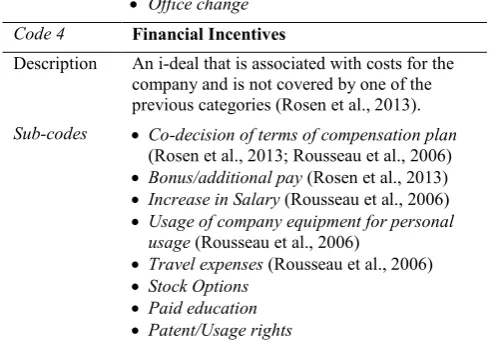
change”, meaning the change of offices in terms of rooms within the same office, or the transfer to a different office in a completely different location. To Code four, Financial incentives, three further sub-codes were detected in the data, namely “stock options”, “paid education” (including language courses or a delayed college degree), and giving an employee a “patent or certain usage rights”. All three relate to financial expenses for the company and are supposed to increase the employee’s motivation and thus could be categorized as sub-codes of Financial incentives. Regarding the sub-code “patent/usage rights” it further can be argued that these are intangible assets, which by giving them to an employee, impose opportunity costs. The employee now has the right to sell the patent, meaning that it can be seen as equal to pure monetary assets, thus as a Financial incentive. This way, based on inductive and deductive coding certain sub-codes were assigned to the first level codes and a comprehensive coding list was developed (see Table 1). For an increase in reliability of the coding and to assure consistency over time the same person coded the data twice, at two different points in time. Every segment was coded with the same first-level code, but in two cases different sub-codes were assigned, leading to a reliable consistency over time of 98.2%. Furthermore, for consistency over people an additional researcher coded the data once, where one time a different overall first-level code was chosen and ten times a different sub-codes was assigned to the text segment, leading to an inter-coder reliability of 90.4%.
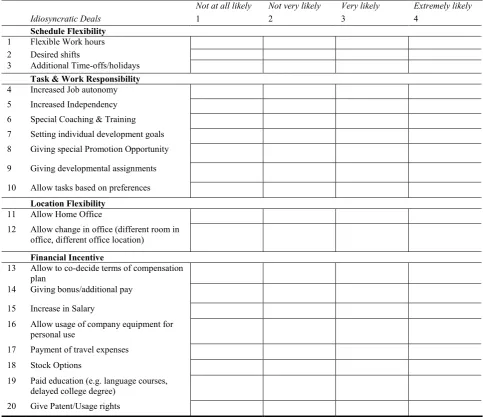
Table 1. Codes used for the Coding Process based on Literature and Outcomes of Round one (adapted from
Fereday & Muir-Cochrane, 2008). Code 1 Schedule Flexibility
Description “Personalized work hours and their scheduling to better fit individual needs and preferences” (Hornung, 2014, p. 612).
Sub-codes Work hours (Hornung, 2014; Rousseau et al., 2006)
Desired shifts (Hornung, 2014)
Time-offs/holidays (Rousseau et al., 2006)
Code 2 Task & Work Responsibility
Description I-deals that are based on a “negotiation of what an employee does on the job”, hence the job content (Rosen et al., 2013, p. 716).
Sub-codes Job autonomy in terms of “self-determined decision-making” and increased
responsibility (Hornung, 2014, p. 611)
Independency (Hornung, 2014; Rousseau et al. 2006)
Special Coaching & Training (Hornung, 2014)
Setting development goals (Hornung, 2014)
Promotion Opportunity, which can additionally bring along an improved status (Hornung, 2014; Rousseau et al., 2006)
Developmental assignments (Hornung, 2014; Rosen et al., 2013; Rousseau et al., 2006)
Tasks based on preferences (Rosen et al., 2013; Rousseau et al., 2006)
Code 3 Location Flexibility
Description I-deals that include a personalized location where the employee works (Rosen et al., 2013)
Sub-codes Home office (Rosen et al., 2013)
Office change Code 4 Financial Incentives
Description An i-deal that is associated with costs for the company and is not covered by one of the previous categories (Rosen et al., 2013).
Sub-codes Co-decision of terms of compensation plan
(Rosen et al., 2013; Rousseau et al., 2006)
Bonus/additional pay (Rosen et al., 2013)
Increase in Salary (Rousseau et al., 2006)
Usage of company equipment for personal usage (Rousseau et al., 2006)
Travel expenses (Rousseau et al., 2006)
Stock Options Paid education Patent/Usage rights
scale (Heiko, 2012). The 4-point Likert scale was used for the survey, a scale that has been proven as highly useful and reliable when measuring ordinal data, as it is the case in this study and proved as helpful to test the hypotheses and assess the expected likelihood of the conclusion of i-deals in the future. The used scale is based on the Raddon Financial Group (Rothaar, 2009), with an adjustment suggested by Allen and Seaman (2007) to eliminate the “neutral option in a forced choice survey scale” (p. 64), leading to the following scale ranking from Not at all likely (value 1), Not very likely (value 2), Very likely (value 3), to Extremely likely (value 4). This way undecided answers, not useful to answer the research question, where eliminated beforehand. The experts’ answers of the second round where analyzed using the Mann-Whitney U Test. This non-parametric test was chosen based on the fact that there is only one continuous outcome variable, one categorical predictor with two categories (centralized and decentralized) for which different experts where asked and further based on the not-fulfillment of the assumption for a parametric test (e.g. no normal distribution, less than 40 respondents) (Field, 2013; De Veaux et al., 2011). The Mann-Whitney U Test was conducted to see if the distribution of values in decentralized companies is significantly higher than the distribution of values in the centralized group. A one-sided test was conducted based on the earlier argued expectation that experts from decentralized companies are expected to indicate that the conclusion of i-deals will be more likely than the experts of centralized companies. For the test the individual average values of the experts indicated for each level code was used. These first-level code values represented the average of the values the expert indicated for each sub-code of that first level value. To name an example for clarification, one expert indicated value 1 for the sub-code “Home office” and value 2 for the sub-code “Office change”, resulting in a first-level code value of 1.5. This was done for each expert, eventually allowing the calculation of an overall value. These overall values were expressed for each group, centralized and decentralized companies, in three different ways, namely mean, mode and median and gave further insights for each of the four types of i-deals, enabling the presentation of what types of i-deals are said to be more likely to be concluded in the future. For that an overall value between 1.0 and 2.4 based on the 4-point Likert scale was decided to represent that a conclusion of such an i-deal is unlikely in the future, from 2.5 upwards the tendency is more towards the value 3, hence towards the statement that a conclusion of that kind of i-deal would be very likely. An overall value between 2.5 and 4.0 based on the 4-point Likert scale represent a high likelihood of a conclusion of that type of i-deal. Using three different kinds of average measures was done to ensure that the choice of average does not distort the outcome. The mean is the most commonly used average and said to be useful when comparing sets of data, but to eliminate its falsification by outliers the median was calculated additional, which was also needed to determine the IQR. The mode was found to be useful for a scale that has only four values and helped to avoid polarization and clustering around a point in the results (Osborne, Collins, Ratcliffe, Millar, & Duschl, 2003; Heiko, 2012). Based on the results of the two rounds the study was concluded, since it appeared that a third round would not add to the understanding further.
3.1
The Experts
The choice of the experts was made carefully, since their knowledge and experience create the whole basis for the research. The focus for the expert group was on CEOs and leading managers, since they are expected to have an in-depth knowledge about the current situation of organizational
structure and the reward systems, including i-deals, and can additionally, based on their experiences, make the best predictions for the future conclusion of i-deals. Both, CEOs as well as managers will have similar perspectives since they usually work closely together and have similar skills that are relevant for an in-depth answer. To ensure a certain level of quality among the experts, a list of criteria for choosing an expert was developed: Knowledge of the organizational structure and how the decision-making process looks like, a high awareness of the rewarding system within the company, in-depth knowledge about possible special deals made with employees, the ability to give employees i-deals, and long-lasting experiences in the business were desired. These characteristics are necessary to be able to make valuable predictions about the future development of i-deals and this way reach relevant outcomes. During the invitation via phone, the experts were asked to judge themselves if they think they fulfill the list of criteria. Only if they felt eligible enough, the participation in the study was possible.
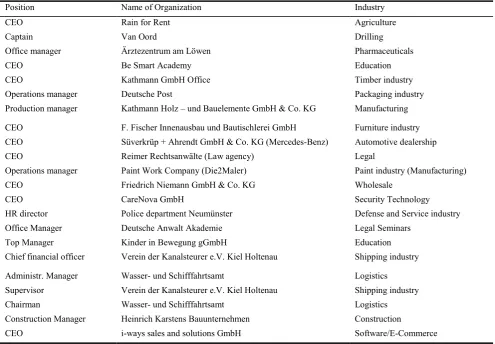
Following the Delphi literature there should be around 10 to 18 experts (Okoli & Pawlowski, 2004) and based on the expected emergent of two sub-groups (rather centralized and rather decentralized organizations), 22 experts were asked to ensure that both groups are represented. The experts selected (see Table 9.2 in the Appendix) have a wide range of experiences and skills and come from a variety of industries, which allows a certain degree of generalizability of the results (Okoli & Pawlowski, 2004). Finding a complete consensus, thus an IQR of 1.0 or lower, is usually rather unlikely in case of experts with a variety of backgrounds (Hsu & Sandford, 2007) but especially in the current study reaching consensus was expected to be difficult, since especially for questions concerning the future intuitive probability estimates on the part of each respondents are made (Dalkey & Helmer, 1963).
4.
RESULTS
4.1
First Round
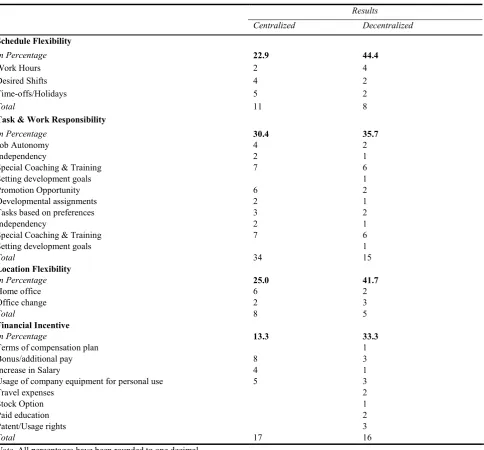
represented than centralized ones, it is noticeable that nevertheless every sub-type of i-deal is expected to be concluded at least one time, which is not the case for the centralized companies, where the setting of individual goals as well as various Financial incentives are not expected to be concluded at all.
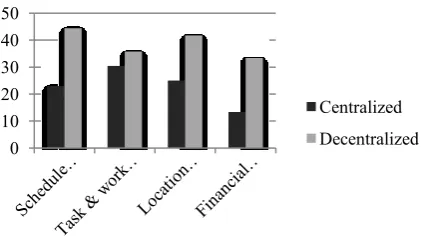
[image:9.595.60.274.426.545.2]To be able to compare the two unevenly represented groups, percentages of the expectations within each group for each first-level code where calculated, showing how many of the i-deals actually are expected to be concluded of all possible i-deals in one category. For Schedule flexibility i-deals, with three sub-codes, centralized companies could have expected 48 ideals to be concluded (16 companies x 3 sub-codes), but only 11 actually are expected, hence 22,9% of the experts from a centralized company expect an schedule i-deal to be concluded within the next five years. For the first level code Task & Work responsibility 112 i-deals would have been the maximum numbers of i-deals that centralized companies could have expected to be concluded (16 companies x 7 sub-codes), but only 34 actually are expected, hence 30,4% of the centralized companies expect Task & Work responsibility i-deals to be concluded within the next five years. This calculation was done for both groups for all four first-level codes, where all exact percentages can be seen in Table 9.3 in the Appendix. The percentage comparison presented in Figure 2 shows that for respondents from decentralized companies the expectations for every kind of the four first-level i-deals are higher than for experts from centralized companies, which is an outcome that supports both of the earlier stated hypotheses. The second round of the Delphi study (see Table 9.1 in the Appendix) added more detailed information to the understanding, enabling to reach consensus and to test if the difference between the two groups, as presented in Figure 2, is actually significant.
Figure 2. Comparison of i-deals expected in centralized and decentralized companies within the next five years (in
percentage)
4.2
Second Round
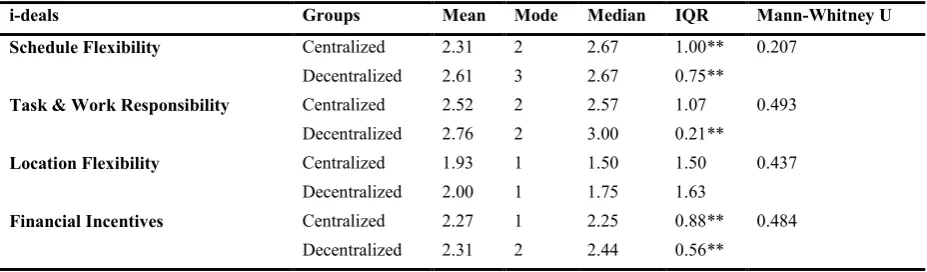
For the second round the response rate decreased from 100% in the first round (22 out of 22) to 95.5% in the second round (21 out of 22), where the drop out was an expert from a centralized company and thus both groups remain represented sufficiently. The study remains generalizable since the drop out is an operation manager from a small paint company (1-9 employees), which belongs to the manufacturing industry, hence a type of expert that is still represented by other companies of similar size from the manufacturing industry. Table 9.4 in the Appendix summarizes the study results of the second round, including the three types of averages and IQR
corresponding for both groups and each first-level i-deal, and further the outcome of the Mann-Whitney U test, comparing the two groups. Based on the Mann-Whitney U Test conducted for every first-level i-deal for each of the two groups it can be concluded that the median representing the expectations of experts from decentralized companies is not significantly higher for any kind of i-deal, or lower as a matter affect, than the median of the centralized companies. Hence, hypotheses one and two have to be rejected. Within centralized organizations, the expected future amount of all kinds of i-deals concluded within the firm will not be relatively low. Furthermore, within decentralized organizations, the expected future amount of all kinds of i-deals concluded within the firm will not be relatively high. Additional understanding was added by the achievement of consensus regarding the expectation of concluding the various kinds of i-deals in the future, meaning that even if no median for one kind of i-deal of the one group was significantly different from the corresponding median of the other group, there still was partly consensus achieved within the groups regarding what kind of i-deal is likely to be concluded in the future and what kind is not. Consensus was earlier defined with an IQR of 1 or lower, being based on the median. The other types of averages are only indicated to ensure that outcome of the average expectations is not distorted. The mean and the median were always suggesting the same expected likelihood of a conclusion, besides in the case of Schedule flexibility i-deals in the centralized group, where the median was slightly higher than the mean. The mode is usually slightly lower than the mean and median, but does not imply a distortion of results. In the centralized group for two kinds of i-deals consensus was achieved, namely for Financial incentives and Schedule flexibility i-deals. For the latter the mean and mode suggest that on average the experts do not expect the conclusion of Schedule flexibility i-deals in the future, but the median, on which the achievement of consensus is build, suggests the opposite. Financial incentives are in conformity with all experts not seen as likely to be concluded. For Location flexibility all types of average suggest as well that a conclusion is not expected, but no consensus was reached. The same applies to Task & Work responsibility i-deals, where no significant result was found. Within the decentralized group consensus could be achieved in three of the four kinds of i-deals. The conclusion of Schedule flexibility i-deals and Task & Work responsibility i-deals is conformingly seen as likely in the future, where in conformity with all experts Financial incentives are seen as unlikely to be concluded. Looking at the average value the conclusion of Location flexibility i-deals is also indicated to be unlikely, but no consensus was achieved.
After being aware of the fact that the decision-making structure does not have any influence on the expected amount of i-deals concluded, the two groups where combined, adding further understanding by looking at the achievement of consensus regarding the expected amount of the various kinds of i-deals in the future. Combined the majority of the 22 experts agreed that the conclusion of Schedule flexibility i-deals and Task & Work responsibility i-deals is likely in the future, where the agreement on individualized Financial incentives is seen as rather unlikely. No consensus was reached in the case of Location flexibility i-deals. In Table 2 exact numbers can be seen, including the average value for each kind of ideal in form of the median and the corresponding IQR.
0 10 20 30 40 50
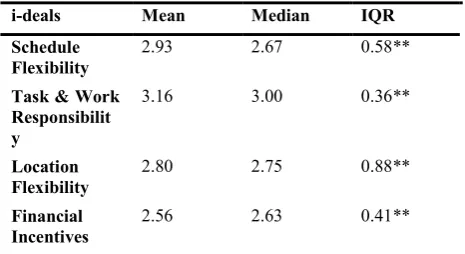
Looking at the individual results in round two of each expert, nine indicated on average, based on the 4-point Likert scale, 2.5 or higher. All nine experts work in an industry where a service is directly provided to the customer, most of the times even on-site. As an illustration, one expert is from the education industry, offering development and supervision to the parents of young children. Another expert works at a police department, offering protection and help to the society and another one is working for a company that prepares and holds seminars for lawyers all over Germany. All companies not providing a direct service scored below 2.5, besides one, who scored below 2.5 but is actually offering education. Hence, overall ten companies out of the 21 experts are offering a service, of which nine scored individually on average 2.5 or higher on the 4-point Likert scale, indicating that i-deals are seen as very likely in the future. Considering only the ten experts of the service industry, thus including the one outlier, consensus can be achieved in case of all four i-deals. The medians, as well as the means, for all four first-level i-deals indicate a high likelihood of a conclusion of such an i-deal in the future. A median of 2.63 out of 4.00 for Financial Incentives is the lowest, where Task & Work responsibility i-deals reach a median of 3.00 out of 4.00. All exact numbers, including the averages and IQRs, can be seen in Table 3.
For a further increased understanding the ten results of the service industry were compared to the 11 results of the non-service industry, to which for example the shipping and logistic industries were allocated. As it was done before, a one-tailed Mann-Whitney U Test was used, testing if the distribution of
values among the experts from the service industry is significantly higher than the distribution of values from all other experts. Significant results were achieved. For Schedule flexibility i-deals the Mann-Whitney U Test indicated that the expected likelihood of a conclusion of such an i-deal is significantly greater for experts from the service industry (Mdn = 2.67) than for experts from a different industry (Mdn = 1.67), U = 11.0, p = .0001. The same accounts for the Task & Work responsibility i-deals, where the expectation of the service Industry (Mdn = 3.00) is also significantly greater than from experts from another industry (Mdn = 2.00), U = 4.5, p = .0001. Regarding the Location flexibility i-deals the average likelihood expected by experts from the service industry (Mdn = 2.75) is likewise significantly higher than the average expectations from experts of other industries (Mdn = 1.00), U = 2.5, p = .0001. Lastly, also significantly higher are the expectations regarding Financial Incentives given in the future for the service industry group (Mdn = 2.63) compared to the other experts from a non-service industry (Mdn = 1.88), U = 22.0, p = .009. After the industry brought significant results, other characteristics that were known from the study were also observed individually (size, position of expert, and country), but no patterns could be observed.
Concluding, it can be said that looking at round one and also at the mean and median values of round two it appears that experts from decentralized companies think that the likelihood of the conclusion of i-deals is relatively higher. It has to be taken into account though that this difference was tested not to be significant and thus is not of high value. Among the whole group of experts consensus was reached regarding the expected future amount of three of the four kinds of i-deals. Further, when focusing only on the service industry, consensus can be achieved in case of all four types of i-deals, agreeing on a high likelihood of future conclusions, and additionally the median of the group of experts coming from the service industry was tested to be significantly higher in all four cases than the median of the remaining experts.
5.
DISCUSSION
In this paper the influence of the decision-making structure within a company on the management expectations of the future types of i-deals concluded with employees was explored. Although existing literature gives the basis for the assumption of a relationship, no significant influence could be discovered and both hypotheses have to be rejected. However, the type of industry was found to have a significant influence on the future expectations and consensus was found among all experts of what i-deals are more likely to be concluded within the next five years.
[image:10.595.64.271.106.225.2]The insignificant difference between the centralized and decentralized group could result from the fact that even when companies vary in their decision-making structure, many companies tend to make more usage of teamwork, which has been shown to be one of the effective best practices and a good basis for innovative outcomes (Pfeffer, 1998). Individual benefits would be counterproductive for a positive working atmosphere in between the team members. Another best practice mentioned by inter alia Pfeffer (1998) is “extensive training” (p. 96) that can substantially enhance every company’s performance, independent of the decision-making structure. Furthermore, every company needs to be able to adapt to the quickly changing environment for which internal flexibility is crucial and thus the empowerment of employees became more common within a variety of companies. Giving employees more power and autonomy might not be an individual act but more often belongs to the general change in
Table 3. Outcome of all Values indicated by the ten Experts from the Service industry in Round two,
including Mean, Median and IQR i-deals Mean Median IQR Schedule
Flexibility
2.93 2.67 0.58**
Task & Work Responsibilit y
3.16 3.00 0.36**
Location Flexibility
2.80 2.75 0.88**
Financial Incentives
2.56 2.63 0.41**
[image:10.595.52.285.548.675.2]Note. Averages are based on a 4-point Likert scale. ** Consensus reached at IQR =< 1.0.
Table 2. Outcome using combined Values indicated by experts in Round 2, including Median
and IQR
i-deals Median IQR Schedule
Flexibility
2.67 1.00**
Task & Work Responsibility
2.71 1.00**
Location
Flexibility 1.50 1.50 Financial
structure, again independent of the decision-making structure. A further factor that was found to influence the results and can help to explain the insignificant difference between centralized and decentralized companies is the type of industry, suggesting that not the decision-making structure but the industry influences the future expectations of i-deals concluded. Within the service industry that is represented by ten experts and was found to expect a significantly higher amount of i-deals in the future, direct customer contact and quick decision-making happens on a daily basis, for which autonomy and independency of the workers, thus Task & Work responsibility i-deals, are fundamental. Furthermore, the “variety in working locations” has been mentioned by multiple of the experts from a service industry in round one as Location flexibility i-deal, and even more often the agreement to on-site tasks instead of background office tasks was stated as expected i-deal, which again also explains the high expectations that were achieved in conformity with all experts from the service industry regarding the Task & Work responsibility i-deals. Nowadays, customers often expect a 24/7 service, building the path for Schedule flexibility i-deals, where preferred working hours for highly valued employees are respected. Additionally, in round one it was mentioned by experts from the service industry that they trust certain employees more and thus, give the employee the flexibility of time, as long as they fulfill a job to the satisfaction of the customer and in an efficient way, which is further supporting the agreed great expectations of future Schedule flexibility i-deals in round two. Lastly it has to be mentioned that within the service industry direct supervision is often difficult and the performance factors, like customer satisfaction, are difficult to measure. Therefore, it is reasonable that performance related Financial incentives, as for example the in the first round mentioned stock options, or bonuses as motivational factors, are more common within the service industry.
Besides the type of industry, also the country of origin was tested of being a possible influencing variable, based on the by Rousseau (2001) identified “zones of negotiability” (p. 264) in different countries, meaning that the location of the company and the culture in this country might have an influence on the willingness of employees to start negotiating and thus on the amount of i-deals concluded. However, no significant results could be found among countries, most likely resulting from the fact that only three experts are representing America and The Netherlands. Additionally, also the size was not found to influence the future expectations in the studied sample of experts. Although it is noticeable that five out of the 22 companies indicated the maximum size, 245 or more employees, and out of theses five, four are decentralized. Simultaneously, this implies that four out of only six decentralized companies have 245 or more employees, hence are rather big. Out of the nine companies that indicated a rather small size with 10 to 49 employees, eight are centralized, which could spring from the fact that in a smaller company the CEO has the possibility to control everything and to remain the decision-making power at the top. Whereas the size seems to have an influence on the decision-making structure, no relationship with the amount of i-deals expected could be observed. Although, it could be argued that bigger companies are more likely to have a higher amount of i-deals than smaller organizations since they have more possibilities to facilitate i-deals, for example individual career options or special training sessions, where within companies with only a few employees special treatments might quickly arise tensions among workers. Knowing that the decision-making structure has no significant influence on the expected amount of i-deals concluded, the
values of the combined group, representing the whole picture of all participating experts, appeared interesting and valuable, keeping in mind that the goal of a Delphi study is the achievement of consensus. The conclusion of Task & Work responsibility i-deals was seen by the majority of the experts as likely to be concluded in the future. This category covers a wide area of i-deals of which the conclusion has been proven to positively effect the performance of employees (Hornung et al., 2014) but further, the education and development of employees also lets the company benefit and is crucial to not fall behind the competition. Additionally, as argued earlier, training is widely accepted as being one of the best practices and thus, also individual training sessions that are based on individual needs can be expected in the future. Furthermore, Schedule flexibility i-deals have been indicated in conformity as likely to be concluded in the future. They do not only increase employees’ flexibility but furthermore have been shown to enhance their satisfaction and thus motivation and working commitment (Hornung et al., 2014). Lastly, consensus was found in the case of Financial incentive, where it was agreed on that conclusions in the future are rather unlikely. What is striking that during the first round of the Delphi study a variety of possible Financial incentives was listed and only after recalling again in the second round that this study is focusing solely on agreements that are done with individual employees, the expectations among the experts were lowered. Financial incentives seem to be a common part of the reward system but in a rather standardized form instead of individualized, contradictory with the statement by Rosen et al. (2013) naming Financial incentives as most common basis for negotiations. The decisive factor is most likely the difference in perspectives, where Rosen et al. (2013) studied i-deals from the view of the employees, who prefer to simply get more money at the end of the month; CEOs and managers seem to prefer giving deals that they benefit from more, as for example investing in the development of their employees. Other reasons for the low expectations of Financial Incentives could be the avoidance of giving employees the feeling of being treated unfairly (Rousseau, 2001) or the increased focus on teamwork where individual incentives would harm the team spirit. Splitting the category into monetary and non-monetary incentives, where monetary would include deals that cover only the tangible money (e.g. bonus, increase in salary), and non-monetary would include also other incentives that imply a financial expense for the company but are not achieved in the direct form of money from the employee (e.g. patents or the allowance to co-decide the terms of compensation plan), might lead to a different, more detailed result. In the case of Location flexibility i-deals no consensus was reached, where it still appears interesting to discuss what variables the experts disagree on and what aspects might be the basis that impedes the ability to agree on future expectations. Regarding Location flexibility i-deals the conflict could lie between the advantages of flexibility and increased employee satisfaction, and the disadvantages of the absence of face-to-face contact, teamwork and in case of necessary presents for customers, the simple infeasibility.
implications for influencing factors that might be more on an individual level, as for example the characteristics of employees, instead of the organizational level. The mentioned consensus was found for two kinds of i-deals (Schedule flexibility, Task & Work responsibility) being more likely to be concluded in the near future, and for one kind of i-deal (Financial incentives) being unlikely to be concluded in the close future. An important practical implication is the discovery of four new i-deals that have not been recognized so far but can be grouped to the four overall categories of i-deals, namely Office change, Paid education, Stock options, and Patent/Usage rights. The extension of the existing list of i-deals gives employees a broader basis for negotiating goals, and managers a deeper insight in what i-deals exist and can be asked for. Furthermore, based on the consensually achieved great expectations within the service industry, individuals currently active in this industry or planning on working in the service area, can expect to have better possibilities to negotiate and receive i-deals than people in other industries. Ending, this study, outlining the benefits of i-deals and simultaneously showing that they are not an everyday occurrence in every organization yet, can give an impulse to managers to change their attitude and expectations regarding individualized agreements for highly valuable workers.
6.
LIMITATION AND FUTURE
RESEARCH
The outlined contributions of the study have to be seen in the light of the limitations. Often a problem with the Delphi technique and the included coding of qualitative data is the fabrication of evidence in form of unconsciously coding the data in a way that they fit the expectations (Fereday & Muir-Cochrane, 2008). Two people with approximately the same expertise, knowledge about i-deals and experience with coding interpreted the data. This process allowed for consistency in the method but failed to provide multiple perspectives from a variety of people with differing expertise. When using this method for another study, the coding of data could involve several individuals with categories being developed using discussions with other researchers, a panel of experts, and/or the participants themselves. Furthermore, there were only six experts representing decentralized companies, which made it easier to reach consensus, but has the effect that the reached consensus is less significant. Redoing the study with equally represented groups might bring different and significant results. Also, even when regarding the size of the organizations in the current study no relationship could be observed, future studies could explore the possible influence the size of the company has on not only the amount of i-deals concluded but further even on the possible intermediate variable decision-making structure within the organization. Additionally, other aspects of the organizational structure of companies might influence the expectation of experts regarding the future amount of i-deals, e.g. the degree of formalization, which is often coupled to decision-making structure. Further, this study presents an extensive list of i-deals and to find further consensus sending out the list to a higher number of experts could be revealing. Additionally, the number of rounds could be increased to the commonly used three to four rounds instead of the here used two rounds. In addition, the study is, based on the variety of industries, generalizable but after looking only at the service industry significant results where discovered, suggesting further research to look at multiple industries more in depth. More specific studies could further be done in terms of countries, since based on the unequal representation of the countries no significant difference could be found in the current study. Lastly, the study only takes into account the future expectations
of CEOs and managers where actually employees are the ones that are actively making the negotiations and thus, not the whole picture is presented leaving room for research with different kind of expert groups.
7.
CONCLUSION
The decision-making structure of an organization does not have a significant influence on the future amount of i-deals expected by a variety of experts and no substantial differences were discovered between the two examined groups. Although overall, the development of employees’ expectations and opportunities, the constant growth of competition and other external trends, allowed the achievement of consensus among the experts regarding the gaining importance of Task & Work responsibility i-deals, as well as Schedule flexibility i-deals, in the near future. To pursue preparation for the future, further empirical work has to be conducted to imply what in the organizational structure is influencing the observed difference among all experts and thus, what is actually influencing the amount of i-deals concluded.
8.
REFERENCES
Allen, I. E., & Seaman, C. A. (2007). Likert scales and data analyses. Quality Progress, 40(7), 64-65.
Anand, S., Vidyarthi, P. R., Liden, R. C., & Rousseau, D. M. (2010). Good citizens in poor-quality relationships: Idiosyncratic deals as a substitute for relationship quality.
Academy of Management Journal, 53(5), 970-988.
Aon Hewitt. (2014). 2014 Trends in Global Employee
Engagement. Retrieved from
http://www.aon.com/attachments/human-capital- consulting/2014-trends-in-global-employee-engagement-report.pdf
Bandura, A. (1977). Self-efficacy: toward a unifying theory of behavioral change. Psychological review, 84(2), 191.
Basit, T. (2003). Manual or electronic? The role of coding in qualitative data analysis. Educational research, 45(2), 143-154. Broschak, J. P., & Davis-Blake, A. (2006). Mixing standard work and nonstandard deals: The consequences of heterogeneity in employment arrangements. Academy of Management Journal, 49(2), 371-393.
Brooks, K. W. (1979). Delphi Technique: Expanding Applications. North Central Association Quarterly, 53(3), 377-85.
Cappelli, P. (2000). A market-driven approach to retaining talent, Harvard Business Review, Vol. 78, pp. 103-11
Cohon, L., Manion, L., Morrison, K. (2011). Research Methods on Education (7th ed.). Oxon: Routledge.
Conway, S. & Steward, F. (2009). Managing and Shaping Innovation. Oxford University Press.
Daft, R. (2010). Organization theory and design. Cengage learning/South Western.
Dalkey, N., & Helmer, O. (1963). An experimental application of the Delphi method to the use of experts. Management science, 9(3), 458-467.
Damanpour, F., & Gopalakrishnan, S. (1998). Theories of organizational structure and innovation adoption: the role of environmental change. Journal of Engineering and Technology Management, 15(1), 1-24.