How people search for a job? The difference of job search
behavior between younger and older people.
Author: Daisy Blömer University of Twente
P.O. Box 217, 7500AE Enschede
The Netherlands
Abstract
Since the global economic recession, started the unemployment rate increased. As a result more people began searching for new jobs. Job search behavior is a goal oriented action, that activates search behavior to bring about the goal. Past research shows that there is a di fference between goals of younger and older people. When the age has increased, the goals shift from a more extrinsic performance-oriented, to a more intrinsic mastery-related pattern. The way age influence job search goals has not been studied before, so this behavior of people is studied here by introducing the job search goals and job search methods. There are four types of job search goals, such as finding a new job, staying aware, developing a network, and obtaining leverage. Job search methods are the way in which people are searching for a job and achieve job search goals. There are two types – i.e. formal and informal job search methods. The objective of this study was to l ink the concept of age with these two concepts, and minimize the gap between the influence of age on the job search goals. The expectations I made, were tested by conducting interviews of younger and older people. A total of ten interviews with younger workers and ten interviews with older workers were conducted. The findings of thi s study demonstrate that younger workers make more use of the job search goal finding a new job. And older workers make more use of the job search goals developing a network, and staying aware. Also the findings should be show that younger workers make more use of formal job search methods and older workers make more use of informal job search methods. This may contribute to more theoretical insight about the
2
1. Introduction
In the end of 2008, a global economic recession started that had lead to an increase in
unemployment rates and alone in the U.S. millions of individuals were laid off (Wanberg, Zhu & Van Hooft, 2010). As a result, more people are seeking for a job, therefore job seeking behavior has become an important subject of research interest. A lot of studies showed that unemployment is a highly stressful life experience, individuals report lower level of life satisfaction and happiness, higher levels of depression, literally sickening experience, other mental health problems, and also it h as gained social costs (Koen et al., 2010; Stavrova et al., 2014).Stavrova et al. (2014) showed that when job seekers have these problems, the effort of searching a job decreases. Unemployment is thus a serious problem for society, it is important that less people are unemployed. Therefore it is
important to know what the job seeking behavior of people is to decrease the unemployment rate. The literature about job seeking behavior is growing and among others, focuses on the means through which individuals seek employment, and the factors affecting job search (Van Dam & Menting, 2012). The importance of job search for job seekers and organizations has increased over the past decade (Saks, 2006). Job search behavior can be defined as the; “purposive, volitional pattern of action that begins with the identification and commitment to pursuing an employment goal. The employment goal, in turn, activates search behavior designed to bring about the goal (Kanfer, Wanberg & Kantrowitz, 2001, p. 838)”. Boswell et al. (2012) show that job searching is a motivated and self-regulated process that begins with the identification of and commitment to pursuing an employment goal, which is followed by activates the search behavior to bring about the goal.
3 that goal setting difference in age. This research focused on how people search there job and if there is a difference between the job search behavior of younger and older people the research questions is as follows: “What is the difference between the job search behavior between older and younger workers?”
The paper is structured as follows. The first part was an introduction about the research topic, and introduce the research question. The second part is the theoretical background. This part is given about the various important components of this research. Than follows the methodology that is used in this research, in this part the sample, data collection and the data analysis will be described. In the fourth part the findings are presented, this follows by the discussion, conclusion, and finally the limitations and tips for future research.
2. Theoretical background
2.1 Job search
Saks (2006) showed that job search involves gathering information of potential job opportunities, generating and evaluating the job alternatives, and choosing a job from the alternatives. Most studies have conceptualized job search in one of the following ways the job search intensity, job search effort and the job source usage. Kanfer et al. (2001) defined the job search intensity as a concept that refers to the frequency with which job seekers, during a set period of time, engage in specific job search behaviors. Job search intensity is the time that people spending during their search for a new job, to acquire information and generate employment opportunities (Koen, Klehe, Van Vianen, Zikic & Nauta, 2010; Boswell, Zimmerman & Swider, 2012). Job search effort is the amount of energy, time, and persistence that a job seeker spends on their job search (Kanfer, Wanberg & Kantrowitz, 2001). Job search effort does not focus on specific job search activities or behavior, like job search intensity does, but describes the time and effort that job seekers have devoted to their job search (Blau, 1993; Blau, 1994). Job search involves the sources used for the reason to acquire information about job openings (Schwab et al., 1987). Job sources refer to the means by which job seekers learn about job opportunities (Saks, 2006). This study examines on this latter dimension of job search – i.e. job source usage – since workers rely on different job sources when pursuing different goals (Van Hoye & Saks, 2008). In other words, a study of job source usage reveals the way in which people search for a job and achieve job search goals.
2.2 Job source usage
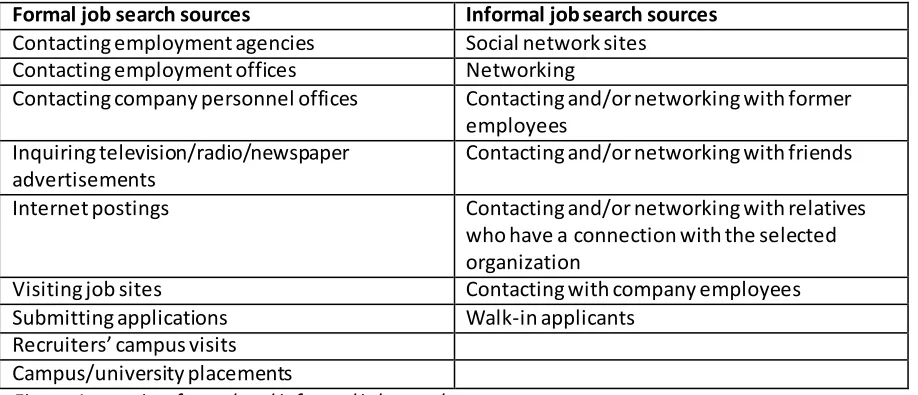
Many studies have conceptualized the way that people are searching for a job into two job search activities or sources that is formal and informal sources. Formal job sources are those that involving formal intermediaries – e.g. private or government placement agencies, search firms, college
placement offices, and recruitment advertisements (Barber et al., 1994). Informal job sources are the sources that not involving the use of formal intermediaries, and are the contacts that exist primarily for purposes other than recruitment – e.g. friends and relatives as well as other company employees (Barber et al. 1994).
2.2.1 Formal job source usage
Saks (2006) showed that formal sources involve the use of public intermediaries – e.g.
4 source usage makes use of different activities. Formal job search behavior or activities include contacting employment agencies, employment offices, company personnel offices, inquiring television/radio/newspaper advertisements, visiting job sites, submitting applications, recruiters’ campus visits, and university placements (Nikolaou, 2014; Barber et al., 1994; Van Hoye et al., 2008). The formal sources, as reading newspapers, Internet postings or other publications, are consistently the most popular way of searching over time (Wanberg, Glomb, Song & Sorenson, 2005).
2.2.2 Informal job source usage
The informal job sources involve the reliance on private intermediaries (Saks, 2006). The informal job search activities consist of contacting and networking with former employees, friends or- relative who have a connection with selected organizations, and also contacting with other comp any employees (Nikoalou, 2014; Saks, 2006; Barber et al., 1994). Use of social networking Web sites is also an informal search behavior (Nikolaou, 2014); this is because the goal of the use of the social networking Web sites are networking. Wanberg, Kanfer, and Banas (2000) defined job
Search networking as “individual actions directed towards contacting friends, acquaintances, and other people to whom the job seeker has been referred for the main purpose of getting information, leads, or advice on getting a job (Wanberg et al., 2000, p. 492)”. The social network sites are also an informal source, because it is networking through the social sites. Thus also contacting friend and other people whom leads, or advice on getting a job. Only this contact is via the social network Web sites. Social networking Web sites appear to be an increasingly useful tool for human resource management professionals to advertise job openings and seek information about job seekers in an efficient way. To search for a job is one of the main reasons why people join and use social
networking Web sites, such as LinkedIn (Nikolaou, 2014). Further, informal job search activities include walk-in applicants, walk-in applicants could be seen as people that walk in by a company and asked or they have some vacancies or to network with the company (Van Hoye et al., 2009; Nikoalou, 2014). In the research of Saks (2006) the use of informal job sources was negatively related to the number of job offers and employment status, they received fewer job offers and less likely to find employment.
Formal job search sources Informal job search sources
Contacting employment agencies Social network sites Contacting employment offices Networking
Contacting company personnel offices Contacting and/or networking with former employees
Inquiring television/radio/newspaper advertisements
Contacting and/or networking with friends Internet postings Contacting and/or networking with relatives
who have a connection with the selected organization
Visiting job sites Contacting with company employees
Submitting applications Walk-in applicants
[image:4.596.65.524.465.663.2]Recruiters’ campus visits Campus/university placements
5
2.3 Age
Looking to the way of searching, there is a difference between the way of searching and aging. Nikolaou (2014) showed that older people used LinkedIn more often, but younger people spend more time on social networking Web Sites. Also younger people used Facebook and job boards more frequently than older people. In other studies is found that those who were unemployed at
graduation their use of formal sources increase (Barber et al., 1994; Saks & Ashforth, 2000). Given that job source usage differs with age, this study examines the role of age in using job sources for realizing job search goals.
Since workforces are ageing throughout Europe, the role of age in the workplace increased and is more important in the literature. (Bal & Kooij, 2014). Ageing are the changes in biological,
psychological and social functioning over the time, and involves biological, psychological and social maturation (Kooij, Bal, Kanfer, 2014). The biological maturation refers to changes in the biological part of a human, as the individuals position relation to their life expectancy (Stern & Miklos, 1995). Whereas social maturation refers to the changes in the social life of people – i.e. the changes in the social norms and roles applied to an individual (Kooij et al. 2014; Sterns et al. 1995). The
psychological maturation refers to multiple change trajectories, like different trajectories in cognitive abilities, fluid intellectual abilities as working memory, and crystallized intelligences as general knowledge (Kanfer & Ackermann, 2004). As such, ageing refers to a multidimensional process that encompasses changes in functioning over time (Schalk et al., 2010).
Schalk et al. (2010) distinguished different kinds of age; chronological age, performance-based or functional age, organizational age, life-span age, psychosocial age, and social age. Chronological age refers to the number of lived years or something has existed, the calendar age (Schalk et al., 2010). The functional age, also seen as the psychological age, is a medical construct, and based on the variation in health and physical decline. Rather than the actual number of lived years, people’s state of health/performance capacity is the most important determinant for being young or old (Schalk et al., 2010). The third type of age conceptualized by Schalk et al. (2010) is the organizational or job age, this refers to the confounding of age and company. The organizational age can be indicated with the company tenure, thus how long an employee in is a company. The life span age could be indicate with the home situation, the home situation of people on the same age can differ a lot, this could be influence the life span age. The life span age emphasizes the influence of family life and economic constraints on behavior. Psychosocial age include the social and self-perception of worker (Sterns & Doverspike, 1989), the perception of the worker self about their social life result in the psychosocial age of the worker. Social age refers to the attitudes, expectations, norms, and characteristics for people at different ages (Schalk et al., 2010). People can have the perception and report that they feel, look, act, and prefer to be younger than their chronological age, their self -perceptions are lower than their normal age (Schalk et al., 2010).
6 organization context, where chronological age is the indicator of aging in the workplace (Kooij et al., 2011). There is a difference in the goals setting related to the chronological age of people, younger and older people have different goals (Kanfer et al., 2013). That is why in the next part is going to look to the goal setting of people.
2.3.1 Goal setting
The job search behavior is the “purposive, volitional pattern of action that begins with the identification and commitment to pursuing an employment goal. The employment goal, in turn, activates search behavior designed to bring about the goal (Kanfer, Wanberg & Kantrowitz, 2001, p. 838)”. Job search behavior is thus goal oriented; therefore this study focuses on the difference in goals across the life.
A goal is the object or aim of an action (Locke & Latham, 2002). A goal can affect performance through four mechanism; goals serve a directive function, goals have an energizing function, goals affect persistence, and goals affect action indirectly by leading to the arousal, discovery, and/or use of task-relevant knowledge and strategies (Locke et al., 2002). Locke & Latham (2002) showed that the relationship between the goal and the performance is the strongest when people are committed to their goal. Two key categories of factors that increase goal commitment are factors that make goal attainment important to people, and the self-efficacy, the belief that they can attain the goal (Locke & Latham, 2002).
It is thus important for the performance that people are committed and motivated to their goal. De Lange et al. (2010) showed that when the age is increased, goals shift from a more extrinsic
competitive pattern of achievement to more intrinsically rewarding objectives. And such, - as people grow older their goal setting shift from a more performance-related to a more mastery-related pattern. This could be for the following reasons, several researchers (Ebner et al., 2006; Freund, 2006; Hechhausen, 1997) demonstrate that the goal orientation of people changes across the life span, age have a positive relation with a stronger orientation on maintenance. And loss prevention among comparing to other people. And older people need also more cognitive support (Baltes et al., 1999). Older workers have a stronger focus on standards of competences that are intrinsically (Kanfer et al., 2000; Maehr et al., 1981). Research of Kooij et al. (2011) supported this outcome that the goal shift from a more performance to a more mastery-related pattern, they shows that age was significant and positively related to self-reported importance of work-related intrinsic motives and negative to the extrinsic motives.
7 standard is more about the performance compared to others, performed better than others. Thus the performance goals are focuses on the demonstration of competence relative to others (Elliot & McGregor, 2001), e.g. to search a job to compared those job situation with the job situation of others.
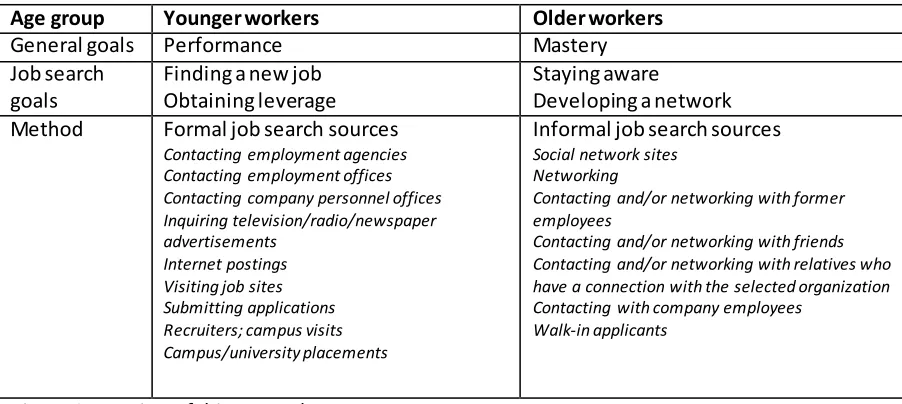
Looking to the work of Elliot (1999) and Elliot & McGregor (2001), there are two types of the definition of the goals, the mastery and performance goals. Concluded the mastery goal is a goal for the individual and is intrinsic, and the performance goal is to satisfy a norm and compared with others and is more extrinsic. The Lange et al. (2010) showed that the motivation shift from a more extrinsic to a more intrinsic pattern, from performance to mastery when people grow older. In other words, younger people are more performance oriented and ol der people are more mastery oriented, as can be seen in figure 2.
Age group Younger workers Older workers
General goals Performance Mastery
Job search goals
Finding a new job Obtaining leverage
Staying aware
Developing a network Method Formal job search sources
Contacting employment agencies Contacting employment offices Contacting company personnel offices Inquiring television/radio/newspaper advertisements
Internet postings Visiting job sites Submitting applications Recruiters; campus visits Campus/university placements
Informal job search sources
Social network sites Networking
Contacting and/or networking with former employees
Contacting and/or networking with friends Contacting and/or networking with relatives who have a connection with the selected organization Contacting with company employees
[image:7.596.66.517.244.446.2]Walk-in applicants
Figure 2 overview of this research
When are looking to the research of different goals for job search behavior. Boswell et al. (2002) and Boswell et al. (2004) conceptualized four job search goals - such as to find new jobs, staying aware, developing a network, and obtain leverage. Those four job search goals are explained in the next section.
2.3.2 Job search goals
8 relationships with others who have the potential to assist them in their work or career (Wanberg et al., 2000). The last job search goal, obtaining leverage, involves the aim to increase bargaining leverage to require specific information about job opportunities, for example employees search to gather information that they can use for negotiating higher compensation (Van Hoye et al. 2008).
2.4. Conceptualizing job search goals as mastery and performance goals
Looking to the four job search goals of Boswell et al. (2002) and Boswell et al. (2004), the four job search goals can be placed in the two dimensions of Elliot & McGregor (2001); mastery and
performance goals. Some propositions can made, the first proposition is that finding a new job and obtaining leverage are performance, and thus younger workers pursue this goals by search a job. And the second proposition is that staying aware and developing a network is mastery goals, and thus pursued by older workers, as seen in figure 2.
2.4.1 Performance goals
The first goal, finding a new job/turnover is a performance goal. This is for the reason that nowadays almost everyone has a job; it is thus normal that people have a job and work. When people are unemployed they didn’t satisfy to the norm. Research of Stutzer & Lalive (2010) showed that how stronger the social norm is, the more quickly unemployed people find a new job. Other research showed that the subjective norm is a direct predictor of the search behavior of a job (β=.11, p≤.01) (Van Ryn et al. (1992). They defined the subjective norm as a perceived degree to which people think the behavior should be performed some motivation to comply with reference to others. Thus the reference to others has a positive relation with finding a new job. That the subjective norm has a positive relation with some behavior, like finding a new job, is in line with the theory of planned behavior of Ajzen (1991).
Obtaining leverage can be seen as an improvement in work elements and improve the current employment conditions (Boswell et al., 2004). By obtaining leverage an employee search for alternatives that they can use to negotiate about different things in their current position. A very specific example is to search the same job but where the salary is higher than in the current job, the employee can use this knowledge to negotiate for more salary by their current job. Older workers reported a lower motive strength for financial compensation (Kooij et+ al., 2011). The information that is gained by obtaining leverage could be seen as a human capital and improved the negotiating success in work elements. This human capital can be used to obtain some leverage (Boswell et al., 2004). Obtaining leverage could be compared to the equity theory; the equity theory is the balance between the input of people (i.e. time, effort and expertise) and the output (i.e. rewards and recognition) compared to others (Maslach & Leiter, 2008; Walster et al, 1973). When comparing this theory to the work situation, the output could be seen as the primary and secondary working
conditions, and the input could be seen as the time and effort people spent on their job. By obtaining leverage people search for alternatives and they compared it to their current position. They
compared their job situation, thus the input and output, of those to others. By obtaining leverage is the comparing to others important, for that reason it is more a performance goal.
2.4.2 Mastery goals
9 more desirable to stay (Boswell et al., 2002). An employee search for individual information about job alternatives and improved their own knowledge about the job opportunities. Staying aware is a more intrinsic goal, thus a mastery goal.
Developing a network, the third job search goal, as a management strategy is increased a lot in the years (Forret & Dougherty, 2001). Employees that develop a professional network were more strongly related to preparatory than to active job search behavior, building a network can be seen as a preparation for searching a job (Boswell et al., 2002). People prepared themselves for searching a job, they obtain an individual network and knowledge and skills from that network. Concluded to this, developing a network could be seen as a tool to develop personal and intrinsic, it is thus a mastery goal.
2.5 Linking age with job search methods
Based on work of Wanberg et al. (2005), Van Hoye et al. (2008) distinguish six job search methods – looking at job ads, visiting job sites, contacting employment agencies, networking, contacting employers and submitting applications. Networking is an informal job search source, the other five are formal job search sources, as can be seen in figure 2.When comparing the performance based job search goals, finding a new job and obtaining leverage and how they are related to the six job search methods of Van Hoye et al. (2008). Van Hoye et al. (2008) showed that the job search goal finding a new job is positive related to all six job search methods, and obtaining leverage is positive related to contacting employers (β=.21, p<.05). Five of the six job search methods that positive related to finding a new job, are formal job search sources also obtaining leverage is positive related to a formal job search source (Van Hoye & Saks, 2008). Thus the performance job search goals are overall related to formal job search methods. Therefore the proposition is that people that use performance related job goals make more use of formal job search methods. So younger workers make more use of formal job search sources, as can be seen in figure 2.
Staying aware is a more passive job search goal (Van Hoye et al., 2008). Job seekers that used staying aware as a job search goal are not actively looking for new job, but still want to stay aware of
possible job opportunities (Steel, 2002). Thus it is most likely to use passive job search methods to achieve the job search goal staying aware. Boswell et al. (2002) found that the job search goal staying aware was more strongly related to preparatory that to active job search methods. So the
expectation is that people that want to stay aware make more use of informal job search me thods, for the reason that they want to search in a passive way.
Developing a network is positive related to methods that involve human contact – such as
10
3. Methodology
To answer the central research question a qualitative research will be conducted. Therefore the data will collect through interviews. This research choose for qualitative data in the form of interviews, for the reason that we want to know in which way people search a job. For example we want to know how people use the Internet for searching a job. Another important reason why we choose for interviews are probing can be used. For this research probing is very important, because we want to know what the motivation behind the actions are. When we know the actions and job search behavior of people, we can ask why people do it on that way. With a quantitative research design you can test the extent to which the activities are done, but not why they do those activities. This motivation and the reasons come more in front than with a quantitative research design. For this research semi-structured interviews will be used. A semi-structured interview is a interview that has a list of questions on fairly specific topics to be covered, that referred as an interview guide, but the interviewee has a great deal of leeway in how to reply (Bryman & Bell, 2011). The reason why for this research a semi-structured interview is choose, is that I want to have the leeway space by the
interviewee but also by the interviewer to ask question for additional answers. And we want to know something about several concepts thus it is also important to have a guideline in the interview. In this research there are used 20 qualitative interviews, to explore the different goal needed to search the job search goals and the job source usage.
3.1 Sample
There will be several interviews with people of different ages that have experiences with searching a job. The sample of interviewees consist of 20 respondents, the group of respondents exist three main research streams in the field of job search – i.e. new entrants, job losers, and employed job seekers. The sample is a non-probability sample, that means that the sample has not been selected using a random sampling methods (Bryman & Bell, 2011). This is for the reason that some people in the population are more likely to be selected than others. It is important that people are active or where active with searching vacancies/jobs, and also has a technological background. The last condition that people must have a technological background is for the reason that the results will be
communicated with a technological employment agency. Because a technological agency what I have spoken about mine research, they are very interested in the output.
To get 20 respondents snowball sampling will be used, some people that are relevant to the research topic are contacted, and also these people are used to establish contacts with others. The snowball focuses sampling there on people who has a technological background and are active with searching a job. Also people from the technological employment agency are contacted. For this research 10 younger and 10 older respondents are used, to make an equivalent comparison. The younger workers are with the age till 45 years and the older workers are people of 45 years and older. Th is is for the reason that in the study of Freund & Baltes (2002) people are place in three age groups, young (20-30 years), adults (30-60 years), older adults (60-75 years). In this research is chosen for two age groups younger and older workers. The middle group, adults can be split. So the age range groups are young (20-45 years) and older adults (45-75 years).
11 and ninety percent were men.
Respondent Age Gender Education level Working situation
1 40 Men MBO+ Employed job seeker (fixed contract)
2 49 Men MBO Working via an employment agency
3 45 Men MBO Employed job seeker (fixed contract)
4 54 Men MBO Employed job seeker (fixed contract)
5 23 Men HBO Employed job seeker (1/2 year contract)
6 24 Men WO Employed job seeker (year contract)
7 39 Woman WO Working via an employment agency
8 38 Men HAVO Working via an employment agency
9 25 Men MBO Employed job seeker (1/2 year contract)
10 48 Men HBO Employed job seeker (fixed contract)
11 25 Men HBO Employed job seeker (1/2 year contract)
12 30 Men WO Employed job seeker (fixed contract)
13 46 Men MBO+ Employed job seeker (fixed contract)
14 46 Men HBO Employed job seeker (fixed contract)
15 38 Men WO Employed job seeker (fixed contract)
16 57 Men WO Employed job seeker (fixed contract)
17 40 Woman HBO Employed job seeker (fixed contract)
18 45 Men HBO Employed job seeker (fixed contract)
19 47 Men HBO Employed job seeker (fixed contract)
[image:11.596.63.522.566.690.2]20 46 Men WO Employed job seeker (fixed contract)
Figure 3 general information about the respondents
3.2 Conceptualize concepts
The concepts that will used in this research comes back in the interviews, for each concept different questions need to be asked.
3.2.1 Job goals
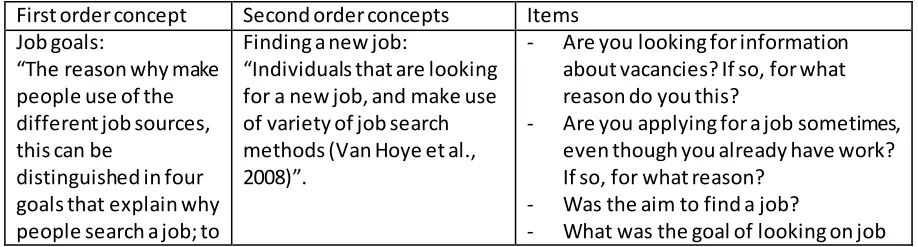
In line with Boswell et al. (2002, 2004) classification, the job goals are measured in four different objectives of engaging in job search, namely finding a new job/turnover, staying aware of alternative job opportunities, developing a network of professional relations, and obtaining leverage against the current or a potential employer. Different questions will be asked to showed for what reason people search for a job, as can be seen in figure 4.
First order concept Second order concepts Items Job goals:
“The reason why make people use of the different job sources, this can be
distinguished in four goals that explain why people search a job; to
Finding a new job:
“Individuals that are looking for a new job, and make use of variety of job search methods (Van Hoye et al., 2008)”.
- Are you looking for information about vacancies? If so, for what reason do you this?
- Are you applying for a job sometimes, even though you already have work? If so, for what reason?
- Was the aim to find a job?
12 find a new job, staying
aware of alternative job opportunities, developing a network of professional relationships, and obtaining leverage against an employer (Boswell et al., 2002; Boswel et al., 2004; Van Hoye et al., 2008)”.
sites?
- Why do you use LinkedIn?
- Do you this to stay working and find a new job?
- Was the application to find a job? Staying aware:
“Employed job seekers search for job information to stay aware of the job
opportunities available in the labor market (Boswell et al., 2002)”.
- Are you looking for information about vacancies? If so, for what reason do you this?
- Are you looking ever for vacancies to compare your job situation with the job situation of others? If so, why do you do this and what do you do with this information?
- Are you applying for a job sometimes, even though you already have work? If so, for what reason?
- What was the goal of looking on job sites?
- Why do you use LinkedIn?
- Do you look sometimes on Internet for the reason to look this is mine work and this is more. What can I do more, what can other jobs offer more?
- You want to stay informed?
- What do you do with the difference you found by comparing yourself with others?
- And looking what kind of alternatives they are?
Developing a network: “Individuals aim to develop and maintain a network of professional relationships with others who have the potential to assist them in their work or career (Wanberg et al., 2000)”.
- Are you looking for information about vacancies? If so, for what reason do you this?
- Have you ever search a vacancy to increase you network? If so, for what purpose want you to increase your network? Do you make use of your network if you are looking for a job? If so, who in your network and for what purpose?
- Are you applying for a job sometimes, even though you already have work? If so, for what reason?
13 - Why do you use LinkedIn?
Obtaining leverage:
“Involves the aim to increase bargaining leverage to require specific information about job opportunities (Van Hoye et al. 2008)”.
- Are you looking for information about vacancies? If so, for what reason do you this?
- Are you looking ever for vacancies to compare your job situation with the job situation of others? If so, why do you do this and what do you do with this information?
- Are you applying for a job sometimes, even though you already have work? If so, for what reason?
- What was the goal of looking on job sites?
- Why do you use LinkedIn?
- Do you look sometimes on Internet for the reason to look this is mine work and this is more. What can I do more, what can other jobs offer more?
- You want to stay informed?
- You didn’t go to your current job and say if I do this I should become more? - What do you do with the difference
[image:13.596.67.526.68.421.2]you found by comparing yourself with others?
Figure 4 conceptualization of the job goals
3.2.2 Informal and formal job source usage
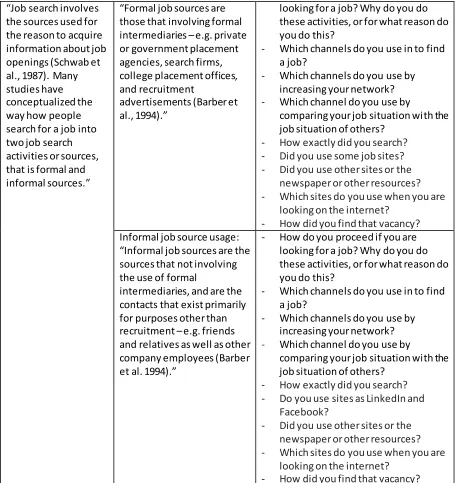
The identify the job source usage, questions will be asked to observe which job source usage the respondents make use of, informal or informal. For the formal job source usage the following activities will be observed; looking at job ads on television/radio/newspaper, visiting job sites, contacting employment agencies, recruiters’ campus visits, and university placements. By the informal job search usage the use of the following activities will be asked; networking, contacting employers for information about jobs, contacting friends, contacting former employees, looking at social media sites and social networking Web sites. In the interview different question will be asked to know how people search a job and which channels they used, see figure 5. By the following question is probing important; “How do you proceed if you are looking for a job?”. It is important that I asked why they do these activities, or for what reason they do that. The other question is a very direct question about the use of the channe ls, they have some sub questions; “Which channels do you use in to find a job, which channels do you use by increasing your network, and which channel do you use by comparing your job situation with the job situation of others?” First order concept Second order concepts Items
14 “Job search involves
the sources used for the reason to acquire information about job openings (Schwab et al., 1987). Many studies have conceptualized the way how people search for a job into two job search activities or sources, that is formal and informal sources.”
“Formal job sources are those that involving formal intermediaries – e.g. private or government placement agencies, search firms, college placement offices, and recruitment
advertisements (Barber et al., 1994).”
looking for a job? Why do you do these activities, or for what reason do you do this?
- Which channels do you use in to find a job?
- Which channels do you use by increasing your network? - Which channel do you use by
comparing your job situation with the job situation of others?
- How exactly did you search?
- Did you use some job sites?
- Did you use other sites or the
newspaper or other resources?
- Which sites do you use when you are
looking on the internet?
- How did you find that vacancy?
Informal job source usage: “Informal job sources are the sources that not involving the use of formal
intermediaries, and are the contacts that exist primarily for purposes other than recruitment – e.g. friends and relatives as well as other company employees (Barber et al. 1994).”
- How do you proceed if you are looking for a job? Why do you do these activities, or for what reason do you do this?
- Which channels do you use in to find a job?
- Which channels do you use by increasing your network? - Which channel do you use by
comparing your job situation with the job situation of others?
- How exactly did you search?
- Do you use sites as LinkedIn and
Facebook?
- Did you use other sites or the
newspaper or other resources?
- Which sites do you use when you are
looking on the internet?
[image:14.596.65.532.70.553.2]- How did you find that vacancy?
Figure 5 conceptualization of the job search methods
3.3 Data analysis
15 inductive, by reading the transcripts different sub-codes are be made. The following sub-codes are used; pathways, job sites, employment agencies, UWV, friend/family, newspaper, mouth -to-mouth, branch sites, company sites, traineeships, classmates, LinkedIn, supervisors/department
leaders/teachers of school, Monsterboard, magnet.me, Intermediair, email, news, telephone, walk-in, place an advertisement, newspaper advertisements, Brunel, Equipe, Tracé, Motech, Wepro, network drinks, Indeed, google, and network groups.
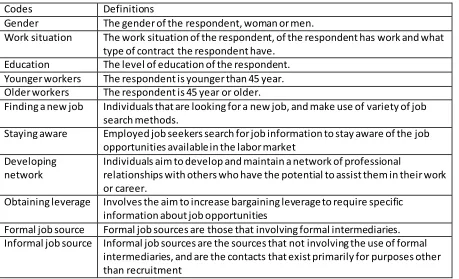
Codes Definitions
Gender The gender of the respondent, woman or men.
Work situation The work situation of the respondent, of the respondent has work and what type of contract the respondent have.
Education The level of education of the respondent. Younger workers The respondent is younger than 45 year. Older workers The respondent is 45 year or older.
Finding a new job Individuals that are looking for a new job, and make use of variety of job search methods.
Staying aware Employed job seekers search for job information to stay aware of the job opportunities available in the labor market
Developing network
Individuals aim to develop and maintain a network of professional
relationships with others who have the potential to assist them in their work or career.
Obtaining leverage Involves the aim to increase bargaining leverage to require specific information about job opportunities
Formal job source Formal job sources are those that involving formal intermediaries. Informal job source Informal job sources are the sources that not involving the use of formal
[image:15.596.67.526.163.442.2]intermediaries, and are the contacts that exist primarily for purposes other than recruitment
Figure 6 the different codes with definition
The codes gender, work situation, education, younger workers, older workers are used for the general information about the respondents. The codes finding a new job, staying aware, developing a network and obtaining leverage help to see of it more a mastery or performance goal and help to find out of age has a positive or negative relation with those job goals. Thus what types of job search goals certain respondent use, to search a job. The codes of informal and formal job source usage help to find out what the job search behavior of the respondents is and how the respondents search. The remaining goals are used, because these are the important concepts of this research model and connect the concepts of age with the job search behavior. This connection will be done through looking at the age of respondents and looking which job goals they used and what type of job search methods they used. So the difference between the job search behavior between older and younger workers can be seen. The sub-codes are used to specify the different activities, and give more information about the activities.
16 it is that the coding is consistent between coder (Bryman & Bell, 2011).To test it different quotes, 20 quotes, are sending to two students. This students give different codes to the quotes, by student 1 85% of the codes are the same. By student 2 also 85% of the codes are the same. Between the students there is are 90% of the codes the same. It can be said that the inter-coder reliability is quite high.
4. Findings
This section summarizes the key findings of the interviews. First, about the relationship between age and the job search goals; finding a new job, staying aware, developing a network, obtaining leverage. And second the relationship between the age and job search goals with the job search methods; informal and formal.
4.1 Age and job search goals
First the findings of the first proposition, it assumed that the younger workers more frequently pursue the job goals ‘finding a new job’ and ‘obtaining leverage’. And the second proposition is that older workers make more use of the job goals; staying aware and devel oping a network. In figure 7 can be seen how much employees use the different job search goals. The employees are numbered, because this study is anonymous. Each number represents a respondent. A worker can make use of more than one goal to search a job, for that reason a number can be present in more than ones. For example worker 1 search a job for certain goals – i.e. finding a new job, staying aware and developing a network.
Finding a new job Obtaining leverage
Staying aware Developing a network Younger workers 1, 5, 6, 7, 8, 9, 11,
12, 15, 17
12 1, 5, 6, 12, 15, 17 1, 5, 12
Older workers 2, 18 3 3, 4, 10, 13, 14,
16, 19, 20
[image:16.596.66.527.377.460.2]3, 4, 10, 13, 14, 16, 18, 19, 20 Figure 7 relationship between age and job search goals
4.1.1 Younger workers and job search goals
Looking at the first proposition, this proposition is not fully correct. The first proposition says that younger workers make more use of finding a new job and obtaining leverage. As can be seen in figure 7, all younger workers support that younger workers make more use of the job search goal finding a new job. However it can be seen one younger workers support that younger workers make more use of obtaining leverage. So this supported the expectation that younger workers make more use of the job search goal finding a new job, but that the younger workers make also more use of obtaining leverage couldn’t be supported by the goals that the younger workers mentioned in the interviews. So the first proposition can’t be fully accepted.
17 now I have a job then I didn’t search information about vacancies (respondent 9)”. By asking
respondent 6 or he search a lot of information about vacancy on various sites, and of that was especially to find a job. He answered; “Yes, what goal can you have more?” Telling him that you can search a job for various goals, like developing a network, staying aware of the job opportunities. He said that it was only for finding a new job. This respondent only search and think that you can search a job for finding a new job. It is thus a typically younger worker, that only searches a job to find a new job.
One younger worker is using the job search goal of obtaining leverage. The question that is asked is of the younger worker used the information that he found with comparing themselves with others, to get more by their current job? The younger worker answered as follows; “Yes, that is going to happen. But inclusive a back up. That is a part you take with you, but it has always to do with the primary working conditions, sometimes also with the secondary. By the primary call I a few examples and also a few savings that I realized through my own actions. And then you summed everything, so you have a good picture, why you should have more money (respondent 12).” He obtained leverage through making a good picture of want he did for the company, the savi ngs that he realized and comparing to others/another job, and why he should have become more. This leverage he used to get more salary. The reason for obtaining leverage is that he is not satisfy about his output compared to the input of him and others.
The reasons why people search a job are not always performance based, what is expected from the research model. For example respondent 1 says that he only search for himself, he answered the question why they search for a job as follows; “I am searching broader, because I just wanted to work. I thought I just go a step back and see where I go to (respondent 1).” And he said that he switch to another job for the following reason; “Yes and on a moment it doesn’t attract me anymore. There must be some tickle of it is fun to go to work. And on some point that tickle wasn’t anymore. So I go searching further (respondent 1).” Respondent 6 want to find a job to started on the labor market, as can be seen; “First when I finished school I search a bit, but I couldn’t find anything. Then eventually the first months I have actually done nothing. I go to party, but later I came to the conclusion that I have actually do something, I am a month of three further and now I actually still have something (respondent 6).” Asking him why he searches a job, respondent 6 answered as follows; “I want to find a job what fits me (respondent 6).” So the reason to find a job was to find something to started on the labor marked what also have personal-job fit. Another example of a respondent that search a job to increase the personal-job fit is respondent 7; “Yes sometimes, because I am not quite satisfied with what I do now. I would prefer something in the direction of what I studied (respondent 7).”
The reason why respondent 8 search a job is a little bit more performance based, by asking him what the goal is of searching a job he said: “Yes, that you have work, and yes on some moment you want to leave a good impression with the employer (respondent 8)”. He searches a job for the primary reason that he has work thus that isn’t a performance-based goal. But secondary he want to leave a good impression, this is a more performance related goal.
18 that I used to search another job (respondent 15).” This a more performance based reason to search a job than others used. Because he compared himself to others, and performance goals are focuses on the performance compared to others and want to performed better than others (Elliot & McGregor, 2001).
Respondent 11 planned to be more active on the Internet, for a more performance-based reason. He said; “I still can be ashamed that I didn’t have LinkedIn, but I would still be a time for serious progress. I want to start with blogging at stuff (respondent 11).” Asking him for which reason, he said; “It is not impossible that I stay here forever. I mean maybe still 5 or 10 years, maybe I leave earlier. But is always good to present yourself well on the market. A little bit of self-promotion is that (respondent 11).” It is not fully searching a job for a performance based reason, but the reason to be active by social job sites on the internet have a performance based reason. Respondent 12 have sort of the same reason to become more active, he said; “I want to have an interesting profile. Because I think that I am pretty interesting, but an outsider didn’t knows that now (respondent 12).”
4.1.2 Older workers and job search goals
Looking at the second proposition, this will be correct if the older workers used the job search goals staying aware and developing a network more. As can be seen in figure 7, many older workers mentioned developing a network and staying aware as a goal they used for searching a job. Both are relatively large groups, the older workers make less use of the other two job search goals. This is with an inter-coder reliability of 85%, so it can be trusted that these results are coding on a reliable way. So, generally proposition 2 can be accepted. This means that the older workers make more use of the job search goals staying aware and developing a network that obtaining leverage and finding a new job. A good example of an older worker is respondent 20, he used both job search goal; developing a network and staying aware. First an example of using developing a network. For respondent 20 is a network very important, for the following reason: “It is been 20 years successful. Finally knows my network, what I can, and what I want.” When he want to switch for a job he used their network; “Physically, I have never applied. Network talk to each other, and says you have to drink a coffee with him and that’s is what I do. Than it is important that there is a click (respondent 20).”
An example of staying aware by respondent 20 is that he said also that he looks to job to stay aware and looks to the job alternatives, for the following reason: “You always need a bit of benchmarks, in the sense of I, I have strong ambitions in the sense of why I also change every 4 years. You compare yourself with the supply and demand in the market, compared with people why they are on some position and I not. What isn’t in my background which might well be handy (respondent 20).”
19 Examples of the job search goals staying aware are; “To know how it is by other companies, how people their worked, what companies asked for the function that you have now (respondent 4).” “What people asked at the moment, and where is the growth (respondent 10).” “What for a vacancies is in the region (respondent 13).” “How develop the market (respondent 16).” “Yes and follow some companies. To looked, what the companies do. Where are the growth, some companies I know what are they doing, and which vacancies have they (respondent 16).” “I find it important that you always assesses how it is by yourselves and by others. That is on the one hand a piece of market conformity, and others to Asses of it are good. Sometimes curiosity also, but there is a learning effect in it (respondent 19).”
In the research concept of this research is excepted that older workers use more the job search goals ‘developing a network’ and ‘staying aware’, because those goals are mastery related goals. Thus the respondents that are used this job search goals, focus on task-based and intrapersonal standards of competences (De Lange et al., 2010). Looking to the reasons why people used these job search goal, it can’t be said that these job search goals always used for a mastery reason. There are different examples that shows that the respondents used other reasons for using the job search goals staying aware and developing a network.
Reasons why people used developing as job search goal are different, a few examples are; “My network are the guys you have done a lot of business and still won a little confidence, in a mutual side (respondent 10).” This respondent tills that they use they network because they have built mutual confidence by them. “It is been 20 years successful. Eventually my network knows what I can, knows what I want. So I can spar with people to explain, to define mine future better. Because just like you, even if you are 46years, sometimes you do not know exactly what you want. And in those sparring, it gives a lot a freedom to be able to make choices. Thus it gives you something. You are sparring with people to further define that choice. On the other hand your network have also a network, and on the moment that your network want to work for you. That means that they do something extra for you, it is wonderful to see. And so I also come to this job (respondent 20).” Respondent 20 used his network because it is quite successful for them, they have good experience with it, and for him it is easy to use it. “Sometimes it is important that you have good connections. How do you come by your job, probably through connections. It is easier to find a job if you have connections (respondent 13). ” This respondent find it easier to find a job with his network, it decrease the difficulty of finding a job. Another respondent 4 find it also easy to know something of his network. It is a sort of mastery goal, because he wants to develop they knowledge with his network. Respondent 4 said; “It is easy that you know where people work, if you want to know something of them. Not only to apply but for everything (respondent 4).” Also respondent 13 have a more of mastery reason to develop a
20 The reasons for staying aware are more mastery related than by developing a network, overall the people want to know something and use this knowledge for themselves. A few examples are; “I have the focus on the alternatives on the labor market. Of course, because the question is to ask where is the growth on this moment (respondent 10).” Respondent 10 use this information for him to know what are the alternatives, and also want to do something with this information. He said also; so what are the alternatives and how can we fix it (respondent 10).” Respondent 19 said the following; “I find it important that you always assess how it is by yourselves and by others. That is on the one hand a piece of market conformity, and others to assess of it is good. Sometimes curiosity also, but there is a learning effect in it (respondent 19)”. For him it is a mastery goal to search a job to stay aware, he want to know it for him. He wants to know what do others, and want to learn about it or use it for his own knowledge. Respondent 20 do kind of the same; “You compare yourself with the supply and demand in the market, compared with people why they are on some position and I not. What isn’t in my background which might well be handy (respondent 20).” He wants to gain knowledge about himself and others in the labor market. And also he told when asking him what he are going to do when he found something what is not in his background, he said that he can’t do always what with it. But if it can he wants to do something with it. So he want it for his own, to gain more knowledge and skills. Respondent 4 also use staying aware to gain knowledge; “To know what they asked, which education you need. And if you only need education or also experience is required (respondent 4). ”
However, there are a few remarks for accepting proposition 2. There is one respondent (2) that do not fit the proposition. Respondent 2 is an older worker, who only uses the job search goal finding a new job. The respondent said: “Then I actually started looking for any job that you can get”. “And when I have a job then it is good, I will not apply for the baloney, no I wouldn’t do that.” The
respondent said that he only search for a reason to get a job, for him every job is good. And when he has a job he doesn’t search or apply for an another job.
Also two other respondents (3, 18) do not fully fit proposition 2. respondent 3 used three job search goals; staying aware, developing a network, and obtaining leverage. And respondent 18 do not use the job search goal staying aware, but used finding a new job and developing a network. Respondent 3 is the only older worker that use the job search goal obtaining leverage he said; “I have told
anyone, which I know that he passed his mouth, that I had run an application what I like a lot, because I was not satisfied with my salary. I know that he passed his mouth and tell it to another person, but I told it extra to him. I told him that he didn’t say it to anyone, they said I do not tell it to anyone. So it is fallen to the direction and I have got 500euros a month more (respondent 3).”
4.2 Linking age with job search methods
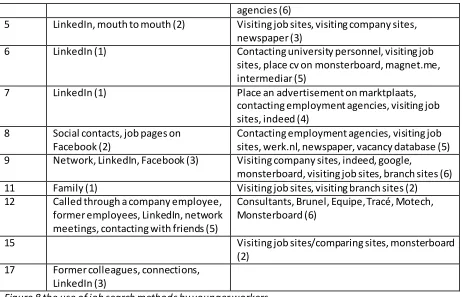
Looking to the proposition that younger workers make more use of formal job search methods will be analyzed with Atlas TI and the results are shown in figure 8. In figure 8 there is shown which job search methods each younger worker use to search a job, also the number of job search methods are included.
Younger workers
Informal job search methods Formal job search methods 1 Networking, contacting with
family/friends (2)
21 agencies (6)
5 LinkedIn, mouth to mouth (2) Visiting job sites, visiting company sites, newspaper (3)
6 LinkedIn (1) Contacting university personnel, visiting job sites, place cv on monsterboard, magnet.me, intermediar (5)
7 LinkedIn (1) Place an advertisement on marktplaats,
contacting employment agencies, visiting job sites, indeed (4)
8 Social contacts, job pages on Facebook (2)
Contacting employment agencies, visiting job sites, werk.nl, newspaper, vacancy database (5) 9 Network, LinkedIn, Facebook (3) Visiting company sites, indeed, google,
monsterboard, visiting job sites, branch sites (6) 11 Family (1) Visiting job sites, visiting branch sites (2)
12 Called through a company employee, former employees, LinkedIn, network meetings, contacting with friends (5)
Consultants, Brunel, Equipe, Tracé, Motech, Monsterboard (6)
15 Visiting job sites/comparing sites, monsterboard
(2) 17 Former colleagues, connections,
[image:21.596.67.531.68.365.2]LinkedIn (3)
Figure 8 the use of job search methods by younger workers
Figure 8 showed all the job search methods that a younger worker used to search a job . Figure 8 shows that the formal job search methods are mentioned a lot more than the informal job search methods. In overall it could be expected that the proposition that younger workers make more use of formal job search methods is true.
A few examples of answers that younger workers give on the question how they proceed if they are looking for a job are given next. Respondent 5 give the answer; “Especially via the Internet, so on job sites, the big job sites, and the more targeted job sites they are focused on the industry. And also looked at interesting companies, or what they have on the site (respondent 5).” Respondent 7 said; “Just through an employment agency, so I put my CV on the Internet and go later to the employment agency (respondent 7).” Respondent 8 describe how they search a job; “Yes, employment agencies, just register, search on job sites, search on werk.nl. That are the thing that you just used to look for a job (respondent 8).”
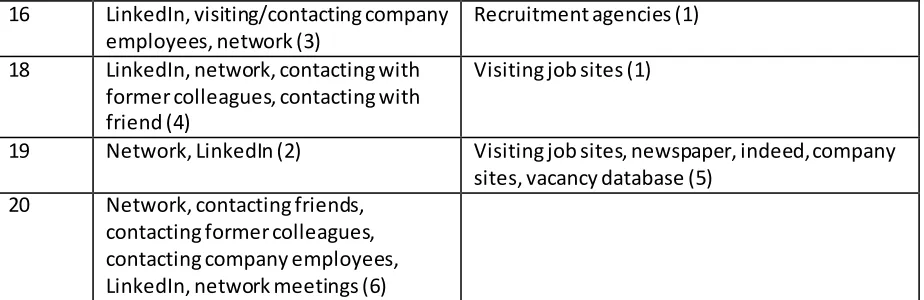
22 As can be seen in figure 9 the older workers make more use of the informal job search to search a job. And make less use of the formal job search methods. The proposition that older work ers make more use of informal job search methods can be generally accepted. Also an interesting point is that LinkedIn is an informal job search methods that is used by almost every older worker. By the younger workers is LinkedIn also the most used job search goal. The reasons why older workers make use of LinkedIn is that it is easy, but also successful. Most of the time the older worker has great experience with LinkedIn.
When asking older workers how they proceed if they are looking for a job they giv e the following answers; “Yes, first I make use of mine network (respondent 10)”. “Yes, because I have some experience, I first look at my own network. And then as addition you have latterly many LinkedIn (respondent 13)”. “Then I’m going to respond to the people who contact me via LinkedIn. I go networking, and that would I do with the people I know and I know that they have a job. And agencies (respondent 14).” “How I always go to work is uh, use my network (respondent 20).”
Almost all of the older people used LinkedIn by searching a job. It is thus important that when someone searches an older people, it is known by a lot of people on LinkedIn. Because older people didn’t use only LinkedIn but also a lot of time they contact friend/family/their network. So when a lot of people know it, it can be come by the right candidate for that job.
By both propositions there are several exceptions, so search respondent 17 (younger worker) a job only with informal job search methods. When asking respondent 17 how the proceed if they are looking for a job, she said; “At this moment, I would like search via connections, because I already been longer in business. And on LinkedIn, I approached a lot and I see things around me which I think that is a nice company. And on that way I would go search for another job (respondent 17).”
And respondent 19 use more formal job search methods then informal job search methods. But generally it could be said that younger workers make more use of formal job search methods and that older workers make more use of informal job search methods. Also respondent 2 is an
exception, this person use also more formal job search methods than informal job search methods. Older
workers
Informal job search methods Formal job search methods
2 Contacting friends (1) Contacting employment agencies, job sites (2) 3 LinkedIn, contacting friends,
contacting people by the sport club, mouth-to-mouth, Facebook (5)
Google, contacting employment office (2)
4 LinkedIn, contacting former colleagues, contacting company employees, network, Facebook (5)
Newspaper, visiting job sites, visiting company sites (3)
10 Network, LinkedIn, contacting with company employees, walk-in (4)
News, Newspaper (2)
13 Network, LinkedIn (2) Newspaper advertisements (1) 14 LinkedIn, network, contacting with
former colleagues, contacting with friends (4)
23 16 LinkedIn, visiting/contacting company
employees, network (3)
Recruitment agencies (1) 18 LinkedIn, network, contacting with
former colleagues, contacting with friend (4)
Visiting job sites (1)
19 Network, LinkedIn (2) Visiting job sites, newspaper, indeed, company sites, vacancy database (5)
[image:23.596.67.529.71.221.2]20 Network, contacting friends, contacting former colleagues, contacting company employees, LinkedIn, network meetings (6)
Figure 9 the use of job search methods by older workers
5. Discussion
5.1 Contribution to theory
The contribution to theory is to fill the gap in the literature. The job search literature showed that younger and older workers set different goals (De Lange et al. 2010). That age has an influence on the goal setting theory is been studied before, but not how age influences the job search behavior what is also a sort of goal setting theory showed by Kanfer et al. (2001). In this research different job search goals are linked to the younger and older workers and also the job search methods are linked to them. By the concept that younger and older workers are used different job search goals, two propositions are made. The first proposition that younger workers make more use of the job search goals ‘finding a job’ and ‘obtaining leverage’ is not fully correct. The findings prove that that every younger worker uses the goal finding a new job, but that obtaining leverage as job search goal is not use a lot of times. So it can’t be said that younger workers make more use of the job search goal obtaining leverage than older workers.
This first proposition follows out the literature that younger workers make more use of performance related goals, and thus for that reason younger workers make more use of the job search finding a new job and obtaining leverage. The findings showed that it couldn’t be said that younger workers make more use of performance based goals, because not so many younger workers search a job for a performance-based goal. This finding didn’t support the idea of this research that younger workers make more use of performance related goals.
24 also it can be research if person-job fit have an influence on it. It could also be that younger workers think that they have the time to search for another job to create a better person-job fit, and that older workers didn’t take the risk to switch. For obtaining leverage it is important to search more out why there is not a difference between younger and older workers. The reason that people used is that they are not satisfy any more about their output, they looked to the inputs and compared them. Maybe the equity theory is a better theory to explain the job search goal.
Furthermore, the second proposition is that older workers make more use of the job search goals ‘developing a network’ and ‘staying aware’, the findings prove that this expectation is correct. So the older employees search their job through contacting their network and adding some people to their network. Also the older workers search jobs to see what the job alternatives are. But that this comes because older people are more mastery oriented, are not fully true. Because it can’t fully accepted that the job search goals ‘developing a network’ and ‘staying aware’ follows from mastery oriented reasons. Developing a network have various reasons; easy, successful and to gain knowledge. By staying aware is the overall reason to gain knowledge thus this job search goal is more goal oriented. So it could be that older people use this job search goals for another reason than that they want b e mastery-oriented.
So by staying aware could be said that they used this job search goal for a mastery related reason. But by developing a network are there various reasons, like easy, successful and to gain knowledge. Looking to those three reasons one of them could be seen as a mastery related goal, gain knowledge. But the other two aren’t mastery related. The reasons easy and successful can be seen as a sort of predictors of the job search behavior, also as in the theory of planned behavior of Ajzen ( 1991). The reason easy is a perceived behavior control, the perceived behavior control refers to the perceived ease or difficulty of the performing of the behavior (Ajzen, 1991). That it is successful is a sort of attitude to the job search behavior, the attitude refers to the degree to which a person has a favorable or unfavorable evaluation or appraisal of the behavior (Ajzen, 1991). Easy is a perceived behavior control and successfulness is a kind of favorable evaluation of the behavior, thus an
attitude. So it could be that the theory of planned behavior is a better concept to explain the reasons why people use the job search goal developing a network.
Concluding to the four job search goals, those four goals could be fully explained by the theory performance and mastery-related goal setting. It is better to use for each job search goal an another theory to explain it. So for the job search goal finding a new job is it better to look to the person -job fit theory. By obtaining leverage the equity theory can be used. For developing a network the theory of planned behavior could be useful. And for staying aware the mastery-related goal setting theory can be used. Thus it is good to split the job search goal in the research, to use different theories. However also not every job search goal showed a big difference between younger and older workers, by finding a new job and developing a network there is a big difference between them. By staying aware there is a difference and older workers used it more, but the difference is not so big as by the other two. And by obtaining leverage there is not a difference between the frequency of use by younger and older workers.
25 more informal job search methods to search a job. In other words, when people till 45 years search a job they used more formal methods like job sites, company sites, employment agencies, and other formal methods. When older people search a job they used more informal methods, like LinkedIn, their network, and contacting friends, company employees and former colleagues. So it is important to used different job search methods for different age groups. And that the different age groups are be approached differently. This is in line with the literature of mastery and performance goals, but the respondents didn’t support it that they used those methods for a mastery or performance goal. For researchers are it important that by research in the field of the job search behavior that the influence of age is included.
Furthermore, this paper aims to contribute to more theoretical insights about the relationship between age and the job search, like job search goals and methods. This papers comes with other propositions that can help to create more insight – i.e. younger workers search a job to create a better person- job fit. Also developing a network could be seen as an behavior that can be explain through the theory of planned behavior. So the proposition could be that attitude, perceived
behavior control and subjective norm have an influence on the job search goal developing a network. And also the proposition that there is not a difference between the goal obtaining leverage by younger and older workers. The relation between age and goal setting is researched before. De Lange et al. (2010) showed that younger people make more use of performance goals and that older people make more use of mastery goals. It can be said that finding a new job and obtaining leverage are performance goals and that developing a network and staying aware are mastery goals. So the conclusion that younger workers make more use of finding a new job and that older workers make more use of developing a network and staying aware is in line with the expectation of this research, this expectation follows from the theory of De Lange et al. (2010). However that it follows form a more performance- or mastery-oriented reason cannot accepted, because the respondents use also other reasons for the job search goals. So it could be useful to use different theories fo r the different job search goals. This research showed that younger and older people have different job search goals and use different job search methods. So it is also for companies important to know how they search their job. For the reason that they can find the people quicker and also place their vacancies on the right places.