University of Pennsylvania
ScholarlyCommons
Publicly Accessible Penn Dissertations
1-1-2014
Topics in Tree-Based Methods
Alex Lauf Goldstein
University of Pennsylvania, [email protected]
Follow this and additional works at:http://repository.upenn.edu/edissertations Part of theStatistics and Probability Commons
This paper is posted at ScholarlyCommons.http://repository.upenn.edu/edissertations/1288
For more information, please [email protected].
Recommended Citation
Goldstein, Alex Lauf, "Topics in Tree-Based Methods" (2014).Publicly Accessible Penn Dissertations. 1288.
Topics in Tree-Based Methods
Abstract
This work introduces methods and associated software for enhancing the interpretability of fitted models, with emphasis on classification and regression trees. We begin in Chapter 1 by describing novel techniques for growing classification and regression trees designed to induce visually interpretable trees. This is achieved by penalizing splits that extend the subset of features used in a particular branch of the tree. After a brief motivation, we summarize existing methods and introduce new ones, providing illustrative examples throughout. Using a number of real classification and regression datasets, we find that these procedures can offer more interpretable fits than the CART methodology with very modest increases in out-of-sample loss.
These techniques are implemented in the R package itree, described in Chapter 2. In addition to the
procedures introduced in Chapter 1, itree implements a method for visualizing the out-of-sample risk as well as the usual classification and regression tree methodologies. Chapter 2 presents illustrative examples and demonstrates itree's usage for aspects of the software that are novel or unique to itree.
Whereas Chapters 1 and 2 relate to tree-based methods, Chapter 3 describes Individual Conditional Expectation (ICE) plots, a methodology for visualizing the model estimated by any supervised learning algorithm. Classical partial dependence plots (PDPs) help visualize the average partial relationship between the predicted response and one or more features. In the presence of substantial interaction effects, the partial response relationship can be heterogeneous. Thus, an average curve, such as the PDP, can obfuscate the complexity of the modeled relationship. Accordingly, ICE plots refine the partial dependence plot by graphing the functional relationship between the predicted response and the feature for individual observations. ICE plots highlight the variation in the fitted values across the range of a covariate, suggesting where and to what extent heterogeneities might exist. In addition to providing a plotting suite for exploratory analysis, we include a visual test for additive structure in the data generating model. The procedures outlined in Chapter 3 are available in the R package ICEbox.
Degree Type
Dissertation
Degree Name
Doctor of Philosophy (PhD)
Graduate Group
Statistics
First Advisor
Andreas Buja
Keywords
Subject Categories
TOPICS IN TREE-BASED METHODS
Alex L. Goldstein
A DISSERTATION
in
Statistics
For the Graduate Group in
Managerial Science and Applied Economics
Presented to the Faculties of the University of Pennsylvania
in
Partial Fulfillment of the Requirements for the
Degree of Doctor of Philosophy
2014
Supervisor of Dissertation
Signature Andreas Buja
The Liem Sioe Liong/First Pacific Company Professor of Statistics
Graduate Group Chairperson
Signature Eric Bradlow
Professor of Marketing, Statistics, and Education
Dissertation Committee
Richard A. Berk, Professor of Criminology and Statistics Ed George, Universal Furniture Professor of Statistics
TOPICS IN TREE-BASED METHODS
COPYRIGHT © 2014
Dedication
Acknowledgments
ABSTRACT
TOPICS IN TREE-BASED METHODS
Alex L. Goldstein
Andreas Buja
This work introduces methods and associated software for enhancing the
inter-pretability of fitted models, with emphasis on classification and regression trees. We
begin in Chapter 1 by describing novel techniques for growing classification and
re-gression trees designed to induce visually interpretable trees. This is achieved by
penalizing splits that extend the subset of features used in a particular branch of
the tree. After a brief motivation, we summarize existing methods and introduce new
ones, providing illustrative examples throughout. Using a number of real classification
and regression datasets, we find that these procedures can offer more interpretable
fits than the CART methodology with very modest increases in out-of-sample loss.
These techniques are implemented in theRpackageitree, described in Chapter 2.
In addition to the procedures introduced in Chapter 1,itreeimplements a method for
visualizing the out-of-sample risk as well as the usual classification and regression tree
methodologies. Chapter 2 presents illustrative examples and demonstrates itree’s
usage for aspects of the software that are novel or unique to itree.
Whereas Chapters 1 and 2 relate to tree-based methods, Chapter 3 describes
Individual Conditional Expectation (ICE) plots, a methodology for visualizing the
model estimated byany supervised learning algorithm. Classical partial dependence plots (PDPs) help visualize the average partial relationship between the predicted
response and one or more features. In the presence of substantial interaction effects,
as the PDP, can obfuscate the complexity of the modeled relationship. Accordingly,
ICE plots refine the partial dependence plot by graphing the functional relationship
between the predicted response and the feature forindividual observations. ICE plots highlight the variation in the fitted values across the range of a covariate, suggesting
where and to what extent heterogeneities might exist. In addition to providing a
plotting suite for exploratory analysis, we include a visual test for additive structure
in the data generating model. The procedures outlined in Chapter 3 are available in
Contents
List of Tables ix
List of Figures x
1 Penalized Split Criteria for Interpretable Trees∗ 1
1.1 Introduction . . . 1
1.2 Fundamentals of Classification and Regression Trees . . . 3
1.2.1 Splits and Splitting Criteria . . . 3
1.2.2 CART Impurity Functions . . . 5
1.2.3 Interpretability of Trees . . . 6
1.3 Penalized Split Criteria for Interpretable Trees . . . 8
1.3.1 Penalized Split Criteria . . . 8
1.3.2 New Variable Penalty . . . 11
1.3.3 EMA-Style Penalty . . . 14
1.4 Out of Sample Performance . . . 19
1.5 Conclusion . . . 22
2 Software for Interpretable Classification and Regression Trees 24 2.1 Introduction . . . 24
2.2 Overview of Classification and Regression Trees . . . 25
2.3 One-Sided Gain Functions . . . 28
2.3.1 One-Sided Purity . . . 29
2.3.2 One-Sided Extremes . . . 36
2.4 Penalized Split Criteria for Interpretable Trees . . . 40
2.5 Local Risk Estimation . . . 45
2.5.1 A Bootstrap Procedure for Local Risk Estimation . . . 45
2.5.2 Implementation in itree . . . 47
3 Statistical Learning Model Visualization with Individaul Conditional
Expectation Plots∗ 52
3.1 Introduction . . . 53
3.2 Background . . . 54
3.2.1 Survey of Black Box Visualization . . . 54
3.2.2 Friedman’s PDP . . . 55
3.3 The ICE Toolbox . . . 58
3.3.1 The ICE Procedure . . . 58
3.3.2 The Centered ICE Plot . . . 60
3.3.3 The Derivative ICE Plot . . . 61
3.3.4 Visualizing a Second Feature . . . 63
3.4 Simulations . . . 64
3.4.1 Additivity Assessment . . . 65
3.4.2 Finding interactions and regions of interactions . . . 66
3.4.3 Extrapolation Detection . . . 68
3.5 Real Data . . . 69
3.5.1 Depression Clinical Trial . . . 71
3.5.2 White Wine . . . 73
3.5.3 Diabetes Classification in Pima Indians . . . 74
3.6 A Visual Test for Additivity . . . 76
3.6.1 Procedure . . . 76
3.6.2 Examples . . . 78
3.7 Discussion . . . 79
4 Conclusion 82 A Appendices 84 A.1 Chapter 1 Supplement: Penalized Split Criteria for Interpretable Trees . . . 84
A.1.1 Gain Function Scaling . . . 84
A.1.2 One-Sided Split Criteria . . . 86
A.1.3 Algorithms . . . 88
A.1.4 Out-of-Bag Performance Statistics . . . 89
A.2 Chapter 2 Supplement: Software for Interpretable Classification and Regression Trees . . . . 94
A.3 Chapter 3 Supplement: Statistical Learning Model Visualization with Individaul Conditional Expectation Plots . . . 95
A.3.1 Algorithms . . . 95
List of Tables
1.1 Summary of Notation . . . 4
2.1 Summary of Notation . . . 28
A.1 Scaling of Impurity Functions . . . 86
A.2 Defintions of One-Sided Impurity Functions . . . 87
A.3 OOB performance of penalization: CART on regression datasets . . . 89
A.4 OOB performance of penalization: One-Sided Purity on regression datasets . . . 90
A.5 OOB performance of penalization: High-Means on regression datasets 90 A.6 OOB performance of penalization: Low-Means on regression datasets 91 A.7 OOB performance of penalization: CART on classification datasets . 92 A.8 OOB performance of penalization: One-Sided Purity on classification datasets . . . 92
List of Figures
1.1 CART fit to the Boston Housing data . . . 7 1.2 CART fit to the Boston Housing data with and without the New
Vari-able Penalty . . . 12 1.3 CART fit to the Boston Housing data with the New Variable Penalty 13 1.4 One-sided High-Means fit to the Boston Housing data. . . 14 1.5 One-Sided Purity fit to the Pima data with and without the New
Vari-able Penalty . . . 15 1.6 CART fit to the Boston Housing data with the EMA-Style penalty . 17 1.7 High-Means fit to the Boston Housing data with the EMA penalty . . 17 1.8 One-Sided Extremes fit to the Pima data with and without the EMA
penalty . . . 18 1.9 One-Sided Purity fit to the Pima data with and without the EMA penalty 19 1.10 CART fit to the Red Wine data with and without the EMA Penalty . 22
2.1 CART and One-Sided Purity applied to the Boston Housing Data . . 31 2.2 CART and One-Sided Purtiy applied to the Pima Indians data . . . . 33 2.3 CART and One-Sided Purtiy applied to the Autism data . . . 34 2.4 Close-up: One-Sided Purity applied to the Autism data . . . 35 2.5 CART and One-Sided Purtiy applied to the Digit Recognition data . 36 2.6 CART and One-Sided Extremes applied to the Boston Housing data . 38 2.7 CART and One-Sided Extremes applied to the Digit Recognition data 39 2.8 Parsimony Example . . . 41 2.9 CART applied to the Boston Housing data with the New Variable Penalty 43 2.10 One-Sided Extremes applied to the Digit Recognition data with the
New Variable Penalty . . . 44 2.11 One-Sided Purity applied to the Pima Indians data with and without
3.1 Scatterplot and PDP of X2 versus Y for a sample from the process
described in Equation 3.3 . . . 58
3.2 SGB ICE plot for X2 from the data generating process described by Equation 3.3 . . . 59
3.3 RF ICE plot for the predictor agein the Boston Housing data . . . . 60
3.4 c-ICE plot for agewith x∗ set to the minimum value of age . . . 62
3.5 d-ICE plot for agein the BHD . . . 63
3.6 The c-ICE plot forage of Figure 3.4, colored by rm . . . 64
3.7 ICE and d-ICE plots for S =X1 for aGAM . . . 66
3.8 ICE plots for an SGBfit to the simple interaction model of Equation 3.6 68 3.9 ICE plots forS =x1 of aRF model fit to Equation 3.7 . . . 70
3.10 ICE plots of a BARTmodel for the effect of treatment on depression score 72 3.11 ICE plots of a NN model for wine ratings versus pH . . . 73
3.12 ICE plots for a RF for the variable skin coloredage . . . 75
1
Penalized Split Criteria for Interpretable Trees
∗Abstract
This chapter describes techniques for growing classification and regression trees
de-signed to induce visually interpretable trees. This is achieved by penalizing splits
that extend the subset of features used in a particular branch of the tree. After a
brief motivation, we summarize existing methods and introduce new ones, providing
illustrative examples throughout. Using a number of real classification and
regres-sion datasets, we find that these procedures can offer more interpretable fits than the
CART methodology with very modest increases in out-of-sample loss.
1.1
Introduction
We assume familiarity with the techniques introduced in Breiman et al. (1984) for
fitting binary trees to data. For brevity we refer to these techniques both collectively
and individually by the acronym CART. Its authors state that CART is designed to
“produce an accurate classifier or to uncover the predictive structure” of a problem.
In comparison with the former task, the degree to which a model “uncovers structure”
eludes quantification. We offer no help on this front, but adopt Breiman et al. (1984)’s
preference for “simple characterizations of the conditions that determine when an
object is [in] one class rather than another” as our guiding principle, which we call
interpretability.
What is meant by a “simple characterization”? For classification trees, the question
of whether we predict yis in one class or another is determined by the terminal node
to which its associatedxvector belongs. Hence the conditions leading toy’s predicted
class are exactly the sequence of splitting rules that lead to its terminal node. As such,
the tree that offers the simpler sequence of splits also offers the simpler explanation of
y’s predicted class. In this sense, splitting procedures that encourage simple sequences
of split rules can result in particularly interpretable trees. Such procedures are the
focus of this chapter.
In Section 1.2 we review the fundamentals of CART, paying special attention to
gain and impurity, the critical functions for tree-growing. Further, we make the
no-tion of “simple sequences of splits” more precise. In Secno-tion 1.3 we present novel tree
growing techniques for the usual classification and regression settings where
inter-pretability is desirable. Section 1.4 reviews the out-of-sample performance of these
methods. The evidence suggests that in many cases the methods described in Section
1.3 yield interpretable trees with little sacrifice in generalization error. Section 1.5
1.2
Fundamentals of Classification and Regression
Trees
1.2.1
Splits and Splitting Criteria
Where possible we follow the terminology and notation of Breiman (1996b), as
out-lined below. Readers will recall that given a learning sampleLofN pairszi = (yi,xi)
from an arbitrary distribution in which E(y|x) = f(x), the algorithms described in
Breiman et al. (1984) output a binary tree ˆf(x) that aims to approximatef or
thresh-oldf(x) whenyis binary. Here ˆf is called a classification or regression tree depending
on whether y is categorical or continuous, respectively.
For any x, ˆf(x) is given by the mean (for regression) or the most common (in
classification)yi value over alli∈ Lthat are in the same terminal node asx, denoted
byt(x). In either case, all observations in a given node tshare the same fitted value,
which we denote j(t) herein.
Each non-terminal node in the tree is defined by a splitting rule s. Each splitting rule comprises a pair (x, t) consisting of a variable x and a split location t. The rule
s= (x1,0), for instance, divides thentobservations intinto two subsets, depending on
whether eachxvector has a positive first coordinate. In this examplex1 is termed the
split variableand 0 thesplit point. Thegrowing phase consists of selecting the bestsat
tand then sendingt’s observations to the appropriate child nodes, where the recursion
begins anew. Though the details of both growing and pruning certainly influence
interpretability, our focus here is on tree-growing methods. Defining procedures for
choosing splits that lead to interpretable trees is the subject of Section 1.3.
at
s? = arg max s∈S
θ(t, s), (1.1)
meaning we choose the split that maximizes the split criterion, where S is the set of
all possible splits including no split. For CART,θ is of the form
θ(t, s) =φ(t)−
ntL nt
φ(tL) + ntR
nt
φ(tR)
, (1.2)
wheretLandtR are the left and right child nodes defined bys, andφis the loss or
so-calledimpurity function. By multiplyingφLandφRby the proportion of observations in the left and right child nodes,θ(t, s) measures the average improvement in impurity
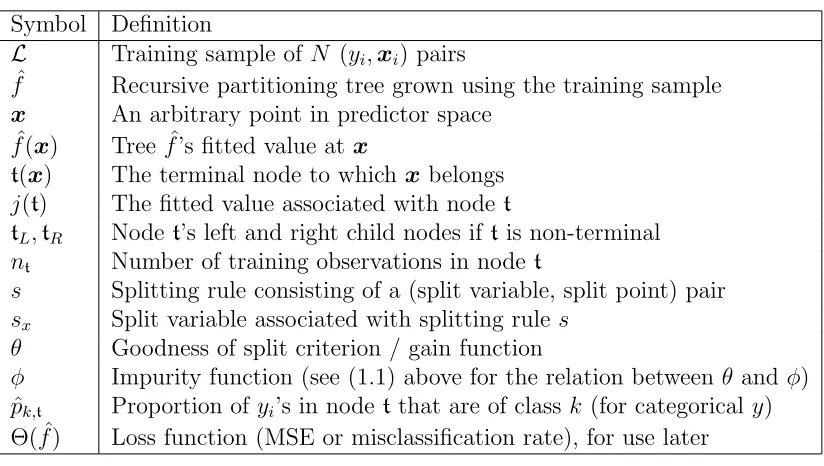
from splitting t as per rule s. For convenience, Table 1.1 summarizes our notational
conventions.
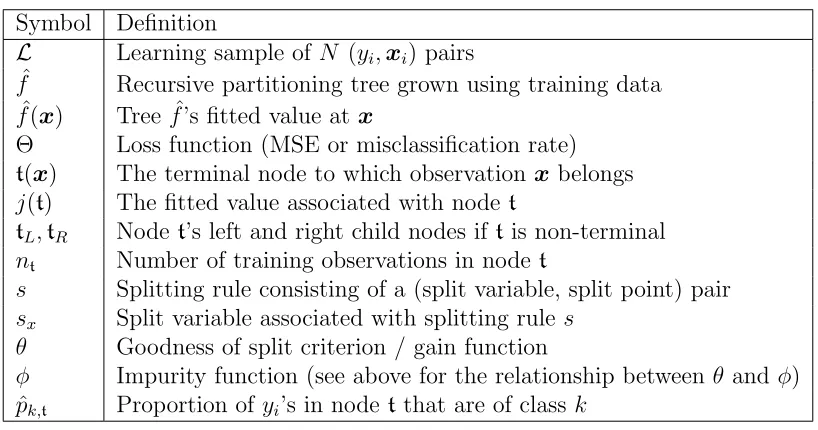
Table 1.1: Summary of Notation
Symbol Definition
L Training sample of N (yi,xi) pairs ˆ
f Recursive partitioning tree grown using the training sample
x An arbitrary point in predictor space ˆ
f(x) Tree ˆf’s fitted value at x
t(x) The terminal node to which x belongs j(t) The fitted value associated with node t
tL,tR Node t’s left and right child nodes ift is non-terminal nt Number of training observations in node t
s Splitting rule consisting of a (split variable, split point) pair sx Split variable associated with splitting rule s
θ Goodness of split criterion / gain function
φ Impurity function (see (1.1) above for the relation between θ and φ) ˆ
1.2.2
CART Impurity Functions
In a regression setting we typically seek to minimize absolute or squared deviations
between fitted and observed values. Though Breiman et al. (1984) presents regression
trees based on both criteria, it is commonplace to use squared-error loss and so we
set
φR(t) = 1 nt
X
i∈t
(yi−j(t))2. (1.3)
Recall that in regression we set j(t) to the sample mean of the in-node y values, and
so readers will quickly identify (1.3) ast’s (biased) sample variance, ˆσ2(t). Further, as
the sample mean minimizes squared error loss, we see that j(t) minimizes empirical
within-node impurity.
Though intuitively appealing, when growing trees for classification we donot take φto be the weighted average misclassification error (Breiman et al., 1984). The reason
is that the misclassification rate is insensitive to certain distinctions in desirability of
splits. As a heuristic example, consider the following proposed splits for classifying
y∈ {A, B} in a 100 observation node with nA = 70 and nB = 30.
Split Left Node Distribution Right Node Distribution
s1 nA= 45, nB = 0 nA= 25, nB = 30
s2 nA= 60, nB = 15 nA= 10, nB = 15
Heres1 ands2 both have misclassification error of 0.25, even though s1 yields a node
without errors. Clearly s1’s left node has zero impurity on L and requires no further
splits, making s1 preferable. The difficulty lies in the fact that the misclassification
rate is piecewise linear in the sample proportion pA, whereas the example illustrates
that the impurity function should decrease more rapidly aspAapproaches 0 or 1. See
Buja and Lee (2001) or Buja et al. (2005) for a more complete discussion of impurity
functions for classification trees.
For the multiclass problem with y∈ K={1,2, ...K} the Gini criterion is written
φG(t) =
X
k∈K
ˆ
pk,t(1−pˆk,t) (1.4)
where ˆpk,t is the proportion of yi’s in node t that are of class k. Cross-entropy is
defined
φCE(t) =
X
k∈K
ˆ
pk,tlog(ˆpk,t). (1.5)
It is easy to verify that both functions satisfy the requirement above. Breiman (1996b)
notes that empirically, Gini tends to yield splits resulting in purer nodes, especially
when K > 2. In addition, if in-node sample proportions are interpreted as class
probability estimates, Gini corresponds to squared-error loss (see Breiman et al. (1984)
or Hastie et al. (2009)). In their informative description of the R package rpart,
a popular implementation of CART, Therneau and Atkinson (1997) comment that
from a practical perspective there is usually little difference between the methods,
especially whenK = 2. Like rpart, many software packages implement both criteria
but default to Gini. For brevity we do likewise; when referring to the conventional
method of growing classification trees we assume Gini impurity as defined in (1.4).
1.2.3
Interpretability of Trees
The interpretability of a particular tree is a function of its splitting rules. As an
example, consider the regression tree in Figure 1.1. This tree, ˆf, is the result of
applying the CART procedure to the Boston Housing data, where the goal is to
fit median housing prices in census tracts using a variety of features about homes’
average physical characteristics and locations. As our focus is on the growing phase
rather than pruning, unless noted otherwise all trees herein cease splitting once the
Figure 1.1: CART fit to the Boston Housing data. Terminal nodes are restricted to
contain no fewer than 5% of all observations. In-sample R2 = 0.8.
| rm< 6.941
lstat>=14.4
crim>=6.992
lstat>=19.85 dis< 1.986
crim>=0.6148
rm< 6.543
lstat>=9.66
dis>=4.442
age>=69.15
nox< 0.601
dis>=4.196
lstat>=7.57
lstat>=6.03 rm< 7.437
10.5614.44 14.9
15.9619.8319.51
19.56 21.5
21.9521.1723.65 27.02
25.9830.13 32.11 45.1
Now because ˆf is a binary tree we can find ˆf(x) simply by applying a series
of rules. We write Bt to denote the sequence of split variables leading to node
t. Let t be the left-most terminal node. Then the sequence of splits leading to t
is therefore (rm,6.941), (lstat,14.4), (crim,6.992), (lstat,19.85) corresponding to
Bt ={rm,lstat,crim,lstat}. As noted previously, the fitted value of an observation
for which x∈t is explained by simply enumerating this sequence of rules:
“If the rm is less than 6.94, lstat is greater than 14.4, crim is greater
than 6.99, andlstatis greater than 19.85, then the fitted value is 10.56.”
The node is at depth four and so the explanation is an intersection of four rules. Now
clearly the more features used to reach a given terminal node t, the more difficult it
is to summarize the partition of X t describes. Note, however, that in this case the
explanation can be simplified by condensing the two statements aboutlstatinto the
single rule “lstatgreater than 19.85.” Similarly, the right-most terminal node can be
described with the single rule “if rmexceeds 7.437, then ˆf(x) is 45.1,” despite the fact
More generally, because terminal nodes represent contiguous regions of X, depth
d terminal nodes whose branches split on fewer than dseparate predictors can be
in-terpreted as the intersection of fewer thandrules. Put differently, sequential splits on
the same variable are easily explained because they predictyusing a single dimension
of X. In the most extreme case, therefore, a node whose branch uses only a single
variable corresponds to a contiguous region inX defined by a single dimension. This
yields a single-rule explanation of the fitted value, regardless of the depth at which the
node appears. Additionally, if these sequential splits uncover a monotonic
relation-ship between the split points and fitted values, the explanation becomes easier still.
In this sense, Breiman’s concept of “simple characterizations” ofX can be understood
in part by the extent to which a tree’s branches tend to reuse split variables.
1.3
Penalized Split Criteria for Interpretable Trees
1.3.1
Penalized Split Criteria
As we have seen, branches comprising small subsets of predictors are more
inter-pretable than those containing new predictors at each split point. With this in mind,
the criterion presented in this section encourages interpretable trees by penalizing
splits that extend the set of features used in a given branch. Under this criterion the
chosen splits? is not necessarily the one that most reduces impurity, which obviously
worsens the extent to which the tree fits the data. Nevertheless, it is encouraging
that the presence of a single split which minimizes impurity does not imply the
ab-sence of other suitable split options, even if minimizing impurity is the sole objective.
Readers familiar with the literature will recall that the chosen split s? can be quite
unstable, and that in reality many different splits may result in similar values of the
follows.
At any given node, there may be a number of splits on different variables, all of which give almost the same decrease in impurity. Since the data are noisy, the choice between competing splits is almost random.
As pointed out by many authors, the variability of CART splits is a drawback from
a bias-variance perspective (see Breiman (1996a) and Hastie et al. (2009)). Here
we focus on interpretability, and in the following sections we show how the presence
of multiple splits with similar φ values can actually be advantageous for growing
interpretable trees.
The central idea is that if choosing a particular split rule from a set of competing
rules with similarφ’s is “almost random” as Breiman et al. (1984) asserts, then
select-ing the most interpretable one from the set rather than that which strictly maximizes
the gain function should yield a tree that both fits the data and is easy to explain.
To that end, given a non-negative penalty function γ for splitting t as per rule s, we split according to
s? = arg max s∈S
{θ(t, s)−γk(t, s,Bt)}, (1.6)
where the k refers to a penalization constant to be discussed shortly. As before, Bt
is the ordered list of split variables used in the branch of the tree leading to t. The
algorithm is still recursive but is now path dependent. Particular definitions of γ are
the subject of Sections 1.3.2 and 1.3.3. Note that while penalizing the split criterion
as in 1.6 is related to variable costs insofar as both methodologies can reduce the
subset of variables a tree uses, variable costs must be specified by the user a priori.
In contrast, the methodologies described herein are completely automatic.
The constant k is a tuning parameter that controls the tradeoff between the gain
function and the penalty: high k values will correspond to a strong preference for
splits with less than the maximal gain can result in reduced fit in terms of R2 or
the misclassification rate. Nevertheless, as we shall see in the subsequent sections, in
many cases the reduction is not drastic and could well be worth the improvement in
interpretability. Of course the nature of the tradeoff varies with the dataset, and so
it is advisable to run the algorithm for a variety ofk values. If we do not wish to use
the tree for out-of-sample prediction this could very well be the end of the story – we
simply choose the tree that yields the best combination of fit and interpretability for
the problem at hand.
If a more systematic approach is desired, a natural procedure is to select the
highest k that results in a global fit no worse than that of the unpenalized tree’s
by some predefined fraction. We define this formally as follows. Recalling that L
denotes our learning sample of N (yi,xi) pairs, we write Θ[ ˆf ,L] to denote tree ˆf’s
loss evaluated on L. At this point we only consider in-sample metrics (Section 1.4
discusses penalization’s out-of-sample performance), and so L serves as ˆf’s training
data as well. In regression, for example, we take
Θ[ ˆf ,L] =X i∈L
(yi−fˆ(xi))2, (1.7)
the usual squared-error loss. For convenience, in plots and tables we re-express this
quantity as R2 in order to remove the scale of y. In classification we let Θ be the
misclassification rate (MR). Writing ˆfk indicate a tree grown with a particular tuning
parameter, we choose the parameter k? as per
k? = max k
n
k: Θ[ ˆfk,L] ≤ (1 +c) Θ[ ˆf0,L] o
, (1.8)
where c >0. That is, we choose the largest k that still results in a tree whose loss is
k’s for the penalized trees displayed in Sections 1.3.2 and 1.3.3 are chosen according
to this procedure with c= 0.10.
Note that in regression θ(t, s) is the decrease in mean squared error, which is
dependent on the scale of the response variable. Penalizing MSE directly means the
choice of k in (1.6) is dependent on the level of y in a given problem. To make k
values comparable across datasets, in the sections below we re-express θ to measure
the proportional improvement in impurity gained by splitting t as per rule s. The details of the scaling vary with the impurity function and are deferred to Appendix
A.1.1, but in each case we ensure that θ≤1 for all s∈ S, we prefer splits with larger
θ, and we are indifferent between splitting and not splitting when θ = 0. Herein we
assume scaled gain functions, letting us restrict k to the interval [0,1].
1.3.2
New Variable Penalty
The first of our new methods is targeted at limiting the number of predictors used
to reach a tree’s terminal nodes. As we have described, the more variables used to
reach t the more complex the explanation of t’s subset of X, and so in cases where
many splits offer nearly the sameφit may be preferable to choose a split on a variable
already used inBt.
Letting sx ∈ {1, ..., p} denote rule s’s split variable, the new variable penalty is written
γk(t, s,Bt) = k1(sx ∈/ Bt). (1.9)
Hence if s introduces a new variable into the branch the penalty is k. If s uses a
previously used variable, there is no penalty. Thus splits that introduce new variables
must improveθby at leastkin order to be selected, whereas splits on old variables can
be selected so long as the improvement is greater than 0. Whatever the split criterion,
not introduce new variables into the branch. This penalty (and more generally any
penalized criterion written in the form of Equation 1.6) can be made compatible with
any suitably scaled split criterion. In the following we demonstrate the performance
of the penalty (1.9) on the previously used datasets for a selection of split criteria.
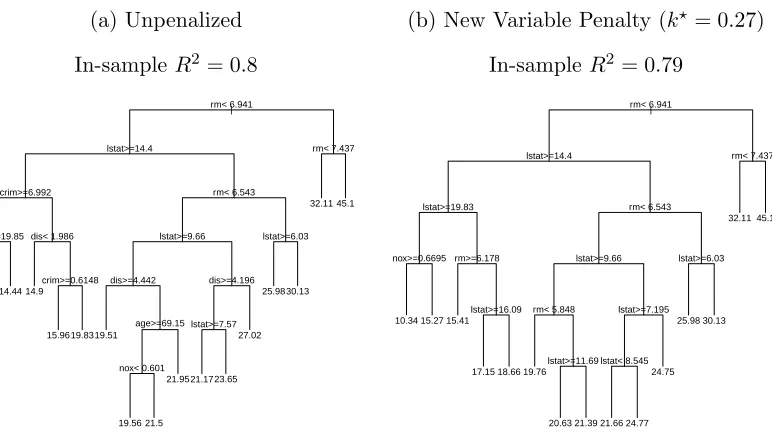
In Figure 1.2 we compare trees grown to the Boston Housing data using (1.3), the
conventional CART regression criterion, with and without the new variable penalty.
First we note that despite the penalization, the R2 values are comparable. The trees
are equivalent up to the third level of splits, where the conventionally grown tree
(Figure 1.2a) introduces crim into the leftmost branch. All told, the unpenalized
tree uses as many as five variables in reaching a terminal node, whereas the penalized
tree (Figure 1.2b) never uses more than three. This makes a considerable difference
when one attempts to explain the fit at a particular node. For instance, the region
described by the bottom-left node of the penalized tree (for which j(t) = 20.63)
might be described by saying “if rm is between 5.85 and 6.54 and lstat is between
9.66 and 14.4, the fitted value is 20.63.” Constructing an analogous description of the
bottom-left node of the unpenalized tree is substantially more tedious.
Figure 1.2: CART applied to the Boston Housing data.
(a) Unpenalized
In-sampleR2 = 0.8
| rm< 6.941
lstat>=14.4
crim>=6.992
lstat>=19.85 dis< 1.986
crim>=0.6148
rm< 6.543
lstat>=9.66
dis>=4.442 age>=69.15
nox< 0.601
dis>=4.196
lstat>=7.57
lstat>=6.03 rm< 7.437
10.5614.44 14.9
15.9619.8319.51
19.56 21.5
21.9521.1723.65 27.02
25.9830.13 32.11 45.1
(b) New Variable Penalty (k? = 0.27)
In-sampleR2 = 0.79
| rm< 6.941
lstat>=14.4
lstat>=19.83
nox>=0.6695 rm>=6.178
lstat>=16.09
rm< 6.543
lstat>=9.66
rm< 5.848
lstat>=11.69
lstat>=7.195
lstat< 8.545
lstat>=6.03 rm< 7.437
10.34 15.27 15.41
17.15 18.66 19.76
20.63 21.39 21.66 24.77 24.75
As per (1.8), 0.27 is the maximal value for k that achieves a mean-squared error
no more than 1.10 times that of the traditionally grown tree. Of course depending
on how the analyst values fit versus interpretability, he can use higher values for k
resulting in even fewer variables used and a commensurate increase in in-sample MSE
(decrease in R2). For instance, Figure 1.3 uses k = .4, and largely describes the
monotonic relationship between average home size and median prices.
Figure 1.3: CART fit to the Boston Housing data with the New Variable Penalty
(k?=0.4). In-sample R2=0.67.
| rm< 6.941
rm< 6.546
rm< 5.858
rm< 5.548
rm< 5.758
rm< 6.049
rm>=5.909
rm< 5.979
lstat>=14.44
lstat>=17.91 lstat>=9.98
rm>=6.258 rm< 6.676
rm< 7.437
14.89
17.23 17.8
18.44 18.75 20.8
13.89 16.59 21.02
23.65 24.79 24.89 25.95
32.11 45.1
The penalization framework applies to split criteria besides the usual CART
methodology. As an example, we consider the one-sided high means criterion
de-scribed in Buja and Lee (2001). Unpenalized, this method chooses the split s that
isolates the single child node with the highest mean:
s?hm= arg max s∈S
{max
s {y¯tL,y¯tR}}. (1.10)
An overview of the one-sided procedures introduced in Buja and Lee (2001) is
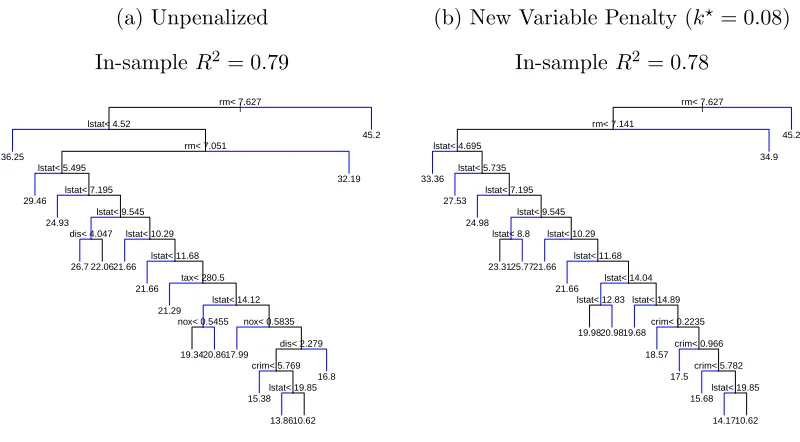
con-tained in Appendix A.1.2. Applying this procedure to the Boston Housing data yields
the left tree in Figure 1.4, with the penalized version appearing on the right. TheR2
values are comparable, but the penalized tree is considerably simpler as it involves
only three predictors instead of six. The trees use only rm and lstat until the
on nox and tax, whereas the penalized tree uses only crim and lstat, leaving the
monotonic relationships undisturbed.
Figure 1.4: One-sided High-Means fit to the Boston Housing data.
(a) Unpenalized
In-sampleR2 = 0.79
| rm< 7.627 lstat< 4.52 rm< 7.051 lstat< 5.495 lstat< 7.195 lstat< 9.545 dis< 4.047 lstat< 10.29
lstat< 11.68 tax< 280.5
lstat< 14.12 nox< 0.5455 nox< 0.5835
dis< 2.279 crim< 5.769 lstat< 19.85 36.25 29.46 24.93 26.7 22.0621.66 21.66 21.29 19.3420.8617.99 15.38 13.8610.62 16.8 32.19 45.2
(b) New Variable Penalty (k? = 0.08)
In-sampleR2 = 0.78
| rm< 7.627 rm< 7.141 lstat< 4.695 lstat< 5.735 lstat< 7.195 lstat< 9.545 lstat< 8.8 lstat< 10.29
lstat< 11.68 lstat< 14.04 lstat< 12.83 lstat< 14.89
crim< 0.2235 crim< 0.966 crim< 5.782 lstat< 19.85 33.36 27.53 24.98 23.3125.7721.66 21.66 19.9820.9819.68 18.57 17.5 15.68 14.1710.62 34.9 45.2
Turning to classification, Figure 1.5 combines the new variable penalty with Buja
and Lee (2001)’s one-sided purity criterion, which splits so as to isolate the single
child node with minimum Gini (minimum classification impurity). Comparing the
penalized tree in Figure 1.5b with its unpenalized counterpart in Figure 1.5a, we see
that we can achieve less than 10% increase in the in-sample misclassification rate
while reducing the total number of predictors used from seven to two. Here applying
the new variable penalty allows us to uncover high-purity regions of X that are also
relatively simple to interpret.
1.3.3
EMA-Style Penalty
Let us consider more closely the four leaf nodes at depth 6 in the penalized tree
in Figure 1.2b (the leftmost of these leaf nodes has j(t) = 20.63). Using the new
Figure 1.5: One-Sided Purity fit to the Pima Indians Diabetes data with and without
the New Variable Penalty. (MR = Misclassification Rate)
(a) Unpenalized
In-sample M = 0.21
| body< 22.8
plasma< 89.5 age< 25.5 plasma< 94.5
plasma< 99.5
plasma< 166.5 body< 25.45
age< 24.5
plasma< 117.5 pedigree< 0.7335 pedigree< 0.202 age< 27.5 body< 38.45 bp>=79 thick>=24.5 insulin< 132.5 neg 57/2 neg 45/0 neg 38/7 neg 35/4 neg 35/5 neg 42/4 neg 37/4 neg 37/15 neg 37/14 neg 30/12 neg 22/16 neg 25/20 pos 21/29 pos 13/26 pos 15/42 pos 8/33 pos 3/35
(b) New Variable Penalty (k? = 0.63)
In-sample MR = 0.23
|
body< 22.8 body< 25.45
body>=24.35 body< 26.75 body< 27.85 body< 29.85 plasma< 87.5 plasma< 165.5 plasma< 99.5 plasma< 107.5 body< 42.2 plasma< 147.5 body>=37.25 plasma< 129.5 body>=34.05 neg
neg neg neg neg neg neg neg neg neg neg neg pos pos pos pos
This represents an improvement over the corresponding branches in the unpenalized
tree in Figure 1.2a that eventually split on dis, ageand nox. Nevertheless, the fact
that the predictors are interleaved makes constructing a more precise explanation
difficult. Longer sequences of splits on the same variable would enable us to interpret
the fits as monotonic relationships inrm and/or lstat, but here that is not possible.
This should be no surprise – while (1.9) expresses our preference for using fewer
variables, it is indifferent to the ordering of variables in a given branch.
Our second method targets both preferences. Here we penalize not only new
variables, but also favor variables used recently in the branch. We achieve this by
employing an exponential moving average-style (EMA) penalty, defined as:
γk(t, s,Bt) =
d−1 X
j=0
1(sx 6=sj)k(1−k)(d−1)−j ford >0, (1.11)
and otherwise 0. As before,k ∈[0,1] is the user-specified penalty constant and sx is
depth ofBt’s nodes, and sosj is the split variable inBt at depthj. The branches we
last discussed from Figure 1.2 have s0=rm, s1=lstat and s2=rm, for instance. Here
d is the depth of the branch not including the proposed split, or equivalently, the
number of nodes in Bt. Hence when considering candidates for the second split in a
branch we have d= 1. Obviously when considering the root split there should be no
penalty (nor does (1.11) make sense), and so we setγ = 0.
Setting aside the notational details, we see that (1.11) is an exponential moving
average of indicator functions. The j-th indicator is 1 if s’s split variable is different
from the variable used at depth j. If s splits on the same variable, as we prefer,
the indicator is 0. Further, as j → 0 we know k(1−k)(d−1)−j decreases, and so
the weights attenuate as we move up Bt towards the root. This conforms to our
preferences: splitting a node on a different predictor from its parent is a graver offense
than splitting on a different predictor from the root. Correspondingly, the former
infraction contributes more to γ than the latter. Lastly we note that setting k = 0
recovers the unpenalized version of the splitting criterion.
Figure 1.6 displays a regression tree grown using the CART procedure but with
the EMA-style penalty. The unpenalized version of this tree appears in Figure 1.2a.
Immediately we see that the new penalty eliminates the previously observed tendency
for consecutive nodes to switch between splitting on rm and lstat. The benefit is
that the fit is easily explained primarily in terms of two monotonic relationships: for
areas with very large homes (rm>6.94) prices are monotonically increasing in home
size, and for the remaining areas prices are decreasing in lstat. A very similar story
emerges from using the EMA penalty with the high-means criterion, as displayed in
Figure 1.7. In fact, some of the nodes in these trees characterize the exact same
Figure 1.6: CART fit to the Boston Housing data with the EMA-Style penalty (k? =
.15). In-sampleR2 = 0.77. In comparison with the unpenalized version in Figure 1.2,
this tree uses only two predictors.
| rm< 6.941 lstat>=14.4
lstat>=19.83 lstat>=5.41 lstat>=9.95
rm< 7.437
12.35 16.95
20.69 24.17 29.94
32.11 45.1
Figure 1.7: High-Means fit to the Boston Housing data with the EMA penalty
(k?=.01). In-sample R2 = 0.78.
|
rm< 7.627
lstat< 4.52
rm< 7.051
lstat< 5.495
lstat< 7.195
lstat< 9.545
lstat< 8.8 lstat< 10.29
lstat< 11.68
lstat< 14.04
lstat< 12.83 lstat< 14.89
crim< 0.2235
crim< 0.966
lstat< 18.93
lstat< 22.67 36.25
29.46
24.93
22.66 25.77 21.66
21.66
19.98 20.98 19.68
18.57
17.5
15.11
13.26 11.07 32.19
45.2
In Figure 1.8 we apply the the EMA penalty to the Pima Indians data and Buja
and Lee (2001)’s one-sided extremes criteria. This procedure chooses the split that
results in the single child node with the highest sample proportion of a specified
class. Here we search for regions of X associated with high incidence of of diabetes.
From previous examples we know that this dataset can withstand very high penalties
before the misclassification rate breaks down. Hence in this example we setcto 0 and
tree, in comparison, never uses the same variable more than twice consecutively and
employs seven predictors in all. Figure 1.9 displays the one-sided purity tree with
and without the EMA penalty when c= 0.10.
Figure 1.8: One-Sided Extremes fit to the Pima Indians data with and without the
EMA penalty. Figure 1.8b uses the EMA penalty with the highest penalty parameter
such that the penalized tree’s misclassification is no higher than that of the
unpenal-ized tree. Note the penalunpenal-ized tree uses only plasma, whereas the unpenalized tree
uses 7 predictors.
(a) Unpenalized
In-sample MR = 0.25
| plasma< 166.5 plasma< 154.5 body< 42.85 plasma< 143.5 pedigree< 0.9325 pregnant< 9.5 pregnant< 6.5 plasma< 130.5 age< 39.5 age< 30.5 pedigree< 0.633 plasma< 118.5 thick< 31.5 plasma< 107.5 body< 30.05 insulin< 132.5 neg 86/0 neg 38/1 neg 37/3 neg 35/5 neg 34/7 neg 30/8 neg 34/11 neg 28/16 neg 29/16 neg 39/22 neg 21/17 neg 21/17 neg 25/23 pos 19/24 pos 13/30 pos 8/33 pos 3/35
(b) EMA Penalty (k? = 0.70)
In-sample MR = 0.25
Figure 1.9: One-Sided Purity fit to the Pima Indians data.
(a) Unpenalized
In-sample MR = 0.21
| body< 22.8
plasma< 89.5 age< 25.5 plasma< 94.5
plasma< 99.5
plasma< 166.5 body< 25.45
age< 24.5
plasma< 117.5 pedigree< 0.7335 pedigree< 0.202 age< 27.5 body< 38.45 bp>=79 thick>=24.5 insulin< 132.5 neg 57/2 neg 45/0 neg 38/7 neg 35/4 neg 35/5 neg 42/4 neg 37/4 neg 37/15 neg 37/14 neg 30/12 neg 22/16 neg 25/20 pos 21/29 pos 13/26 pos 15/42 pos 8/33 pos 3/35
(b) EMA Penalty (k? = 0.03)
In-sample MR = 0.23
| body< 22.8
plasma< 89.5 age< 25.5 plasma< 94.5
plasma< 99.5
plasma< 166.5 body< 25.45
age< 24.5 plasma< 117.5 plasma< 153.5
plasma< 106.5 pedigree< 0.7335 insulin< 132.5 neg 57/2 neg 45/0 neg 38/7 neg 35/4 neg 35/5 neg 42/4 neg 37/4 neg 37/15 neg 32/15 neg 108/86 pos 10/30 pos 13/28 pos 8/33 pos 3/35
1.4
Out of Sample Performance
We have seen that one-sided split criteria and penalization often yield more
inter-pretable trees than the traditional CART methodology with only modest sacrifices
in in-sample loss, Θ. Until now we have computed loss over our learning sample L,
but naturally it is important to understand how these techniques fare on new data,
znew = (ynew,xnew), as well. To that end, in this section we study the impact of the
various techniques for growing ˆf on the risk, defined by
R=
Z
znew
Z
L
Θ[ ˆfL,(ynew,xnew)] dP(L)dP(znew). (1.12)
We write ˆfL to emphasize that the fitted tree is a function of the training sample
L. In general our results suggest that applying an interpretability penalty to a given
splitting criterion has very little impact on out-of-sample loss in comparison with the
a variety of splitting methods. In the remainder of this section we discuss these results
in greater detail.
As we have neither true distribution functions nor an elegant form for the fitting
procedure L →fˆL at our disposal, we study (1.12) using the “out-of-bag”
generaliza-tion error estimate discussed in Breiman (1997). For each dataset we takeB bootstrap
samples L1, ..., LB from L. Let the bootstrap samples be indexed by b ∈ {1, . . . B}.
Observations in L not in Lb are set aside as holdout data, Hb. Using a tree fitting
procedure F we fit a tree to each sample. Then for each tree we evaluate loss Θ on
its holdout data Hb, yielding an estimate of generalization error ˆΘb. The procedure
is given completely by Algorithm 1 in Appendix A.1.3. We then approximateR with
the mean of the ˆΘ values:
ROOB = 1 B
B
X
b=1
ˆ
Θb. (1.13)
In Algorithm 1 F represents the fitting procedure. Here we use both CART and
the one-sided splitting criteria introduced in Buja and Lee (2001). One-sided splitting
criteria are written
θOS(t, s) = φ(t)−min{φ(tL), φ(tR)}, (1.14)
with s? ∈ S still chosen by maximizing the gain function as in (1.1). In replacing
(1.2)’s weighted sum over child nodes with minimization, (1.14) favors splits with low φ on the left at the expense of high φ on the right and vice versa, regardless of
relative node size. Appendix A.1.2 describes how the high means and one-sided purity
methodologies seen previously fit into this framework in addition to summarizing the
remainder of the procedures described by Buja and Lee (2001).
Turning to the interpretability penalties, the reader will recall that we set the
the most interpretable tree that still achieves a certain fraction of the unpenalized
method’s performance on the data at hand. When we write “penalization method” or
“penalization procedure” we mean a particular penalization function coupled with our
rule for choosing k. To study the penalties’ out-of-sample performance, we compute
the out-of-bag error estimate as before but apply (1.8) to each bootstrap learning
sample. By this we mean that theF from Algorithm 1’s lineTb ←F(Lb) includes the
search over possiblekvalues. Hence ˆΘ remains a metric of out-of-sample performance.
Starting with Table A.3 in Appendix A.1.4 we display the estimated loss obtained
from applying each splitting criterion and penalty method combination (including
no penalty) to our datasets. We set B = 100 and k = (0.01,0.02, . . . ,0.99). For the
penalized methods, the column entitled “Averagek?” reports the meankvalue selected
across the B bootstrap samples. Low averagek? values suggest that on average, the
splits chosen by the non-penalized methods have relatively few competitors in terms
of reducing loss. The two wine datasets are examples of this – apparently in predicting
wine quality, swapping the “best” split for a more interpretable one coincides with a
substantial increase in MSE. In contrast, highk?, such as those found on the “ankara
dataset”, suggest that many predictors yield similar performance.
Generally, the results suggest that our method for choosingk? results in penalized
trees whose risk remains quite close to that of the unpenalized methods. For example,
Table A.3 shows that on our ten benchmark regression tasks, penalized CART’s
esti-mated risk is always less than 10% higher than CART’s. In fact over all 2×4×10 = 80
possible penalty/criterion/dataset combinations in Tables A.3-A.6, only one has an
increase in MSE above 10%. The evidence from classification is similar – in just one
case does applying a penalty increase a splitting criterion’s holdout misclassification
rate by more than 10%. In many cases misclassification rate decreases.
Moreover, the gains in interpretability can be substantial amounting to a “free
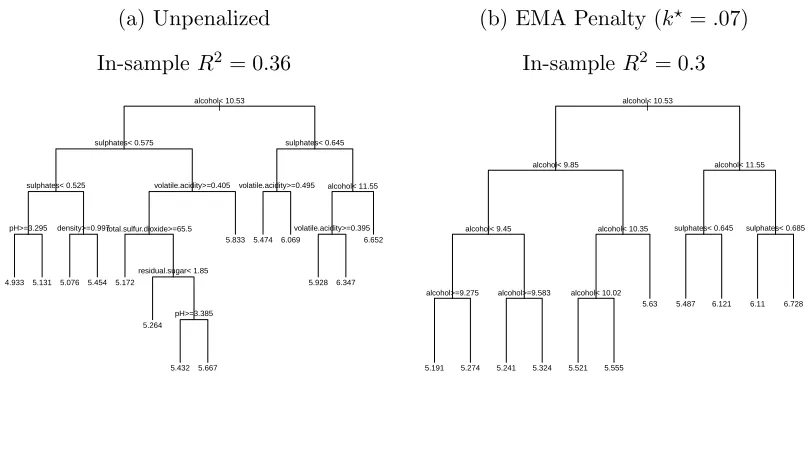
predict each wine’s (ostensibly) human-labelled quality score using predictors that
measure various aspects of the wine’s chemical composition. Figure 1.10 displays the
unpenalized CART tree on the left and the EMA penalized tree on the right. We
select k? = .07 by our usual method with c = 0.10. The unpenalized tree uses as
many six predictors in a branch, whereas the penalized tree uses only alcohol and
sulphates in the entire tree. Moreover, the right tree’s fit is easily described as an
increasing relationship between alcohol and quality for low values of alcohol and
an increasing relationship betweensulphates and quality for higheralcoholvalues.
The EMA penalty’s out-of-bag risk estimate is only 1.8% higher than that of CART’s
(see Table A.3), suggesting we can replace the CART fit with a far more interpretable
tree that we can expect to perform essentially just as well on new data.
Figure 1.10: CART fit to the Red Wine data.
(a) Unpenalized
In-sampleR2 = 0.36
|
alcohol< 10.53
sulphates< 0.575
sulphates< 0.525
pH>=3.295 density>=0.997
volatile.acidity>=0.405
total.sulfur.dioxide>=65.5
residual.sugar< 1.85
pH>=3.385
sulphates< 0.645
volatile.acidity>=0.495 alcohol< 11.55
volatile.acidity>=0.395
4.933 5.131 5.076 5.454 5.172
5.264
5.432 5.667
5.833 5.474 6.069
5.928 6.347 6.652
(b) EMA Penalty (k?=.07)
In-sampleR2 = 0.3
|
alcohol< 10.53
alcohol< 9.85
alcohol< 9.45
alcohol>=9.275 alcohol>=9.583
alcohol< 10.35
alcohol< 10.02
alcohol< 11.55
sulphates< 0.645 sulphates< 0.685
5.191 5.274 5.241 5.324 5.521 5.555
5.63 5.487 6.121 6.11 6.728
1.5
Conclusion
This chapter describes penalization methods for growing classification and regression
trees targeted at settings where interpreting the resultant tree is particularly
subset of variables used in each branch. By requiring that less interpretable candidate
splits decrease the parent node’s impurity more than others, penalization allows us
to favor interpretability when many splits offer similar improvements. Interestingly,
it is the tendency for many splits to offer very similar decreases in impurity – one of
CART’s perceived disadvantages – that makes this possible.
Using real datasets we show that the penalty functions can indeed result in trees
that are substantially easier to explain than their unpenalized counterparts. This
observation holds for a variety of splitting criteria and across both classification and
regression problems. Further, our study suggests that tuning a penalization parameter
to maintain in-sample loss no more than a fraction c of that of the unpenalized
procedure’s results in generalization error that is almost always within 100c% of the
unpenalized method’s. That is, in nearly all cases the penalization techniques return
a more interpretable fit for very little increase in out-of-sample loss, yielding a “free
lunch” of sorts. This raises a number of interesting questions, such as why this might
be the case, whatX designs it is true for, or if further gains can be made by explicitly
tuning penalty parameters to minimize holdout loss.
Acknowledgements
We thank Ed George and Abba Krieger for their insightful comments on this project.
We also thank Richard Berk for his thorough reading and substantive edits on an
2
Software for Interpretable Classification and
Regression Trees
Abstract
This chapter describesitree, anRpackage for fitting for classification and regression
trees. Besides the familiar CART methodologies, the package implements splitting
criteria and risk estimation techniques that aim to enhance a tree’s visual
inter-pretability. For the procedures unique to itree we give a methodological overview,
present illustrative examples, and demonstrate itree’s usage.
2.1
Introduction
Recursive partitioning trees are a popular supervised learning technique. Indeed, the
rich variety of Rpackages implementing ideas that descend from Breiman et al. (1984)
or Quinlan (1986) attests to the community’s continued interest in these methods. In
this chapter we describe itree, an addition to R’s tree-fitting landscape that
imple-ments a variety of methods useful for growing interpretable and/or parsimonious trees.
usual CART methodology, the software extends and modifies rpart, the excellent
package for classification and regression trees.
From a methodology perspective, the procedures unique to itree are naturally
organized into three groups. The first set of techniques was first introduced in Buja
and Lee (2001) and concern splitting criteria that induce imbalanced trees. Buja and
Lee (2001) refers to them collectively as one-sided procedures. The second group is based on the work of Goldstein and Buja (2013), which discusses ways to favor splits
that restrict the subset of predictors used in a given branch of a tree. Goldstein and
Buja (2013) achieves this by introducing penalties into the splitting criteria. As we
will see, itree implements these penalties as to work with any valid splitting rule
whether CART, one-sided, or even user-defined. The third concerns a technique first
illustrated in Breiman (1997) for using the out-of-bag observations created by bagging
to assess a tree’s local out-of-sample performance. Here we extend the ideas found in
Breiman’s paper both by generalizing the methodology to classification and allowing
the user to plot the metric alongside a tree’s fitted values. The result is a visual
diagnostic for assessing a method’s out-of-sample performance over different regions
of the feature space.
The chapter is organized as follows. In Section 2.2 we provide a brief CART
overview and introduce some notational conventions. Sections 2.3, 2.4 and 2.5
ad-dress the one-sided criteria, penalization, and local risk procedures in turn. In each
section we demonstrate the package’s use with code snippets alongside the
method-ology discussion. Section 2.6 contains concluding remarks.
2.2
Overview of Classification and Regression Trees
Where possible we follow the notation used in Breiman (1996b). For convenience
recall that given a learning sampleLofN pairs (yi,xi) from an arbitrary distribution,
the algorithms described in Breiman et al. (1984) output a recursively grown binary
tree ˆf(x). Here ˆf is called a classification or regression tree and the loss function Θ is
taken to be the misclassification rate or mean-squared-error (MSE, herein) depending
on whether y is categorical or continuous, respectively.
For anyx, ˆf(x) is given by the mean (for regression) or most common (in
classifi-cation)yi value over alli∈ L that are in the same terminal node as x, denoted t(x).
In either case, all observations in a given nodet share a single fitted value, which we
denote j(t) herein.
To each non-terminal node, a splitting rule s is applied, defined by a pair (x, t) consisting of a variable xand a split location t on that variable. The rules= (x1,0),
for instance, divides the nt observations int into two subsets, depending on whether
each x vector has a positive first coordinate. We call sx = x1 the split variable
and 0 the split point. The growing phase consists of selecting the best split for the observations in t and then sending them to the appropriate child nodes, where the
recursion begins anew.1 Proposing new meanings of “best split” is the subject of
sections 2.3 and 2.4.
CART determines the “best s” by the goodness of split criterion or gain function θ(t, s) which quantifies the benefit of splitting nodet as per rule s. Each node splits
at
s? = arg max s∈S
θ(t, s), (2.1)
meaning we choose the split that maximizes the split criterion, where S is the set of
all possible splits including no split. θ is of the form
θ(t, s) =φ(t)−
ntL nt
φ(tL) + ntR
nt
φ(tR)
, (2.2)
1To lessen overfitting, it is common practice to set a minimum node size and/or prune the tree
wheretLandtR are the left and right child nodes defined bys, andφis the loss or
so-calledimpurity function. By multiplyingφLandφRby the proportion of observations in the left and right child nodes,θ(t, s) measures the average improvement in impurity
from splitting tas per rule s.
As mentioned above, in regression settings we wish to minimize MSE and so we
set
φR(t) = 1 nt
X
i∈t
(yi−j(t))2 (2.3)
Recall that in regression we set j(t) to the sample mean of the in-node y values, and
so readers will quickly identify (2.3) as t’s (biased) sample variance, ˆσ2(t). This is the
impurity function rpart uses when one setsmethod="anova".
For reasons that are well documented, when growing trees for classification or class
probability estimation we do not take φ to be the weighted average misclassification
error (see Breiman et al. (1984) or Buja and Lee (2001), for instance). Rather,
we use either the Gini or Cross-entropy criterion. For the K-class problem with y∈ {1,2, ...K} the Gini criterion is written
φG(t) =
X
k∈K ˆ
pk,t(1−pˆk,t) (2.4)
where ˆpk,t is the proportion of yi’s in node t’s that are of class k. Cross-entropy is
defined by
φCE(t) =
X
k∈K ˆ
pk,tlog(ˆpk,t). (2.5)
Breiman (1996b) notes that empirically, Gini tends to yield splits resulting in purer
nodes, especially whenK >2. In their informative description of theRpackagerpart,
Therneau and Atkinson (1997) comment that from a practical perspective there is
usually little difference between the methods, especially when K = 2. The rpart
do likewise; when referring to the conventional method of growing classification trees
we assume Gini impurity as defined in (2.4).
Table 2.1: Summary of Notation
Symbol Definition
L Learning sample of N (yi,xi) pairs ˆ
f Recursive partitioning tree grown using training data ˆ
f(x) Tree ˆf’s fitted value at x
Θ Loss function (MSE or misclassification rate)
t(x) The terminal node to which observation x belongs j(t) The fitted value associated with node t
tL,tR Node t’s left and right child nodes ift is non-terminal nt Number of training observations in node t
s Splitting rule consisting of a (split variable, split point) pair sx Split variable associated with splitting rule s
θ Goodness of split criterion / gain function
φ Impurity function (see above for the relationship between θ and φ) ˆ
pk,t Proportion of yi’s in node tthat are of class k
2.3
One-Sided Gain Functions
Clearly (2.2) enforces a measure of balance between the impurity in right and left
child nodes – candidate splits with low impurity on the left at the expense of high
impurity on the right will likely be passed over for splits with more even performance.
Put differently, (2.2) represents a compromise between φL andφR. Insofar as we care
about ˆf’s performance over the entire X space, as is typically the case, balance is a
virtue.
An alternative approach to growing binary trees is described in Buja and Lee
(2001). Instead of balancing a statisticφ over the left and right nodes, these methods
splitting criteria can be written
θOS(t, s) = φ(t)−min{φ(tL), φ(tR)}, (2.6)
with s? ∈ S still chosen by maximizing the gain function as in (2.1). In replacing
(2.2)’s weighted sum over child nodes with minimization, (2.6) favors splits with low φ on the left at the expense of highφ on the right, regardless of relative node size. It
is because they ignore theφ value in one of the child nodes that Buja and Lee (2001)
refer to these methods as “one-sided.”
2.3.1
One-Sided Purity
Recursively splitting as per (2.6) amounts to a greedy search for partitions of X
associated with lowφ. Ifφis a loss metric, for instance, the procedure finds partitions
of X in which f(x) is particularly well approximated by a binary tree. More simply,
this corresponds to findingxvectors whose associatedy’s are close together. To that
end, Buja and Lee (2001) proposes setting φ to be the conventional CART impurity
functions. For regression this gives us
φosp,R(t) = 1 nt
X
i∈t
(yi−j(t))2 = ˆσ2(t), (2.7)
and combined with (2.6) this yields
θosp,R(t) = ˆσ2(t)−min
ˆ
σ2(tL),σˆ2(tR) . (2.8)
Recalling that we split at the rule that maximizes θ, it is clear thats? is the split
that finds the single child node with the lowest average squared-error loss.
appropri-ately. As an example, we use itree to fit both the conventional CART tree and the
one-sided purity tree to the well-known Boston Housing data, where the goal is to
fit median home prices in a census tract using a variety of predictors regarding the
homes’ average physical characteristics and locations. The code is as follows.
> library(itree)
> bh.cart <- itree(medv~.,data=bh,minbucket=25,minsplit=25,cp=0) > bh.purity <- itree(medv~.,data=bh,method="purity",
+ minbucket=25,minsplit=25,cp=0)
Note that in the first line itree figures out from medv that this is a regression
problem and chooses method="anova"for the CART tree implicitly. More generally,
readers familiar withrpart will note that the syntax and arguments are exactly the
same, save the fact that itree accepts"purity"as a valid method. In fact, in cases
where one enters a valid rpart command, itree gives the same results. Thus many
scripts written for rpart can be modified to use itree by swapping occurrences of
“rpart” for “itree” and adjusting the arguments. The call creatingbh.cartwould run
identically in rpart and give the same tree, for example.
The methods outlined in this chapter focus on tree-growing rather than pruning,
and so our convention is to cease splitting oncent reaches 5% of n. This is controlled
using theminsplitandminbucketarguments, which function identically torpart’s.
The Boston Housing data has 506 observations, hence we setminbucket=minsplit=25
above. To be clear, the 5% convention is not the default functioning of itree, hence
leaving these arguments out of the commands above would result in trees with smaller
terminal nodes. As an aside, we remark that the cp argument (identical torpart’s)
also allows for premature stopping of the tree-growing phase. See Therneau and
Atkinson (1997) for details. Its functioning is considerably more complex than the
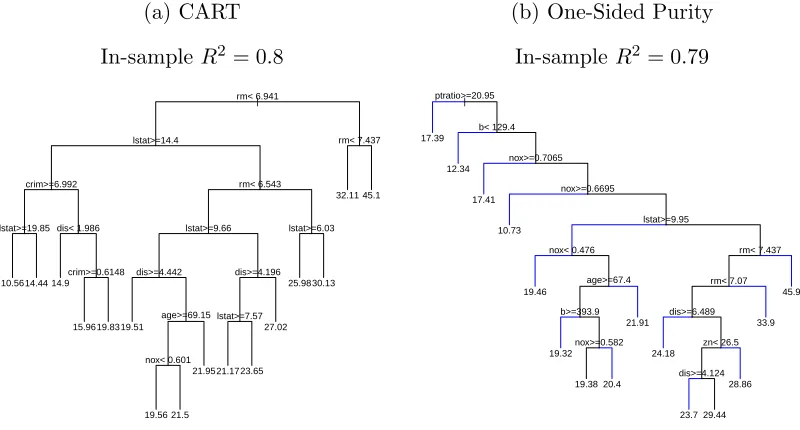
Figure 2.1 displays the result of plotting the returned objects using the usual
plot(...) command. Each subfigure’s caption shows the applicable model’s
in-sample R2. Note that plotting follows rpart, and so the call plot(bh.cart) plots
bh.cart’s skeleton and text(bh.cart) then labels the nodes by printing splits and
fitted values where appropriate.
Figure 2.1: CART and One-Sided Purity applied to the Boston Housing Data.
Ter-minal nodes are restricted to contain no fewer than 5% of all observations.
(a) CART
In-sampleR2 = 0.8
| rm< 6.941
lstat>=14.4
crim>=6.992 lstat>=19.85 dis< 1.986
crim>=0.6148 rm< 6.543 lstat>=9.66 dis>=4.442 age>=69.15 nox< 0.601 dis>=4.196 lstat>=7.57 lstat>=6.03 rm< 7.437 10.5614.44 14.9 15.9619.8319.51 19.56 21.5 21.9521.1723.65 27.02 25.9830.13 32.11 45.1
(b) One-Sided Purity
In-sampleR2 = 0.79
| ptratio>=20.95 b< 129.4 nox>=0.7065 nox>=0.6695 lstat>=9.95 nox< 0.476 age>=67.4 b>=393.9 nox>=0.582 rm< 7.437 rm< 7.07 dis>=6.489 zn< 26.5 dis>=4.124 17.39 12.34 17.41 10.73 19.46 19.32 19.38 20.4 21.91 24.18 23.7 29.44 28.86 33.9 45.9
For one-sided trees, branches highlighted in blue correspond to the node generating
minimumφ. This is done using the highlight.color argument as shown below.
> plot(bh.purity,highlight.color="BLUE")
Setting highlight.color="BLACK" or highlight.color="RED" turns off
highlight-ing and highlights the branch in red, respectively.
Turning to the trees themselves, we see that despite their similar R2 values, these
fits suggest very different explanations of what makes homes particularly expensive
or cheap. Immediately we see that the root splits, known to be the most stable, are
average number of rooms, rm only enters the one-sided tree in Figure 2.1b at depth
6. The one-sided tree’s root split uses pt, the parent-teacher-ratio, which does not
enter the CART tree at all. Obviously the variables used to greedily minimize CART
impurity and those used to find regions of purity are quite different.
More generally, splitting as per (2.6) yields greater variation in the depth of
termi-nal nodes, giving the one-sided tree an unbalanced look. The reason for this is clear
– should we find a bucket with high purity, it is both likely to be small and unlikely
to be split again. If our goal is to understand the subsets of X with high purity in y
this is ideal – fewer splits yield simpler, more intuitive explanations.
In classification the analogous function one-sided purity function is
φosp,C(t) =
X
k∈K ˆ
pk,t(1−pˆk,t). (2.9)
Buja and Lee (2001) only considers the two-class case in which (2.9) simplifies to
ˆ
p0pˆ1. Asitreeextends Buja and Lee (2001) to the multi-class problem, we leave the
function as written in (2.9) to make the generalization to the multi-class case obvious
– we just compute the Gini criterion at each node as before.2 Here again, substituting
(2.9) into the one-sided split criterion shows that s? is the split which identifies the
child node with minimum Gini impurity.
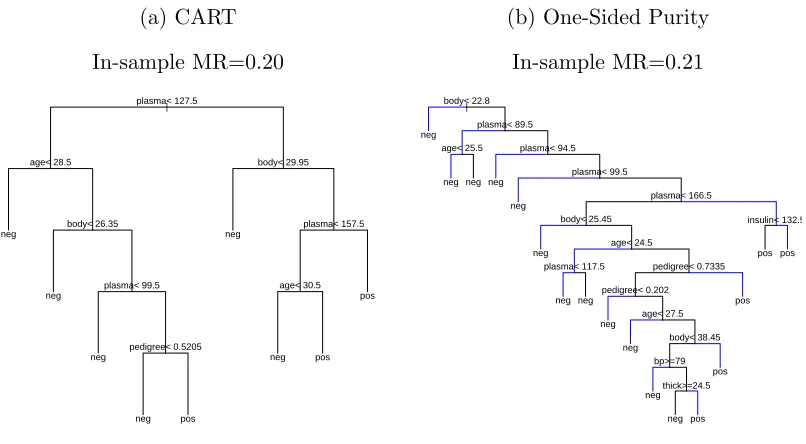
As an example, Figure 2.2 displays a one-sided purity tree along with the usual
CART tree on the Pima Indians dataset. In this problem y ∈ {pos, neg}
depend-ing on whether the individual has diabetes and x ∈ R8. Once again, we stop
splitting once nt is 5% of the overall n. Note that for illustrative purposes we set
method="class_purity", in which case the software does not need to make an
educated guess as to whether the user intends to fit a classification or regression
tree. In this case the diabetes variable is of class factor, and so simply passing
2Readers should note that this is one possible generalization to the multi-class purity problem;