Relational Learning of P a t t e r n - M a t c h R u l e s for
Information E x t r a c t i o n
M a r y E l a i n e C a l i f f a n d R a y m o n d J . M o o n e y D e p a r t m e n t of C o m p u t e r S c i e n c e s
U n i v e r s i t y o f T e x a s a t A u s t i n A u s t i n , T X 78712
{mecaliff ,mooney}@cs. utexas, edu
A b s t r a c t
Information extraction systems process natural language documents and locate a specific set of relevant items. Given the recent success of empirical or corpus- based approaches in other areas of natu- ral language processing, machine learning has the potential to significantly aid the development of these knowledge-intensive systems. This paper presents a system, RAPmrt, that takes pairs of documents and filled templates and induces pattern-match rules that directly extract fillers for the slots in the template. The learning al- gorithm incorporates techniques from sev- eral inductive logic programming systems and learns unbounded patterns that in- clude constraints on the words and part- of-speech tags surrounding the filler. En- couraging results are presented on learn- ing to extract information from com- puter job postings from the newsgroup misc. jobs. offered.
1 I n t r o d u c t i o n
An increasing amount of information is available in the form of electronic documents. The need to in- telligently process such texts makes information ex- traction (IE), the task of locating specific pieces of data from a natural language document, a particu- larly useful sub-area of natural language processing (NLP). In recognition of their significance, IE sys- tems have been the focus of DARPA's MUC program (Lehnert and Sundheim, 1991). Unfortunately, IE systems are difficult and time-consuming to build and the resulting systems generally contain highly domain-specific components, making them difficult to port to new domains.
Recently, several researchers have begun to ap- ply learning methods to the construction of IE sys- tems (McCarthy and Lehnert, 1995, Soderland et ah, 1995, Soderland et al., 1996, Riloff, 1993, Riloff, 1996, Kim and Moldovan, 1995, Huffman, 1996). Several symbolic and statistical methods have been employed, but learning is generally used to construct only part of a larger IE system. Our system, RAPIER (Robust Automated Production of Information Ex- traction Rules), learns rules for the complete IE task. The resulting rules extract the desired items directly from documents without prior parsing or subsequent processing. Using only a corpus of doc- uments paired with filled templates, RAPIER learns unbounded Eliza-like patterns (Weizenbaum, 1966) that utilize limited syntactic information, such as the output of a part-of-speech tagger. Induced pat- terns can also easily incorporate semantic class infor- mation, such as that provided by WordNet (Miller et al., 1993). The learning algorithm was inspired by several Inductive Logic Programming (ILP) sys- tems and primarily consists of a specific-to-general
(bottom-up) search for patterns that characterize slot-fillers and their surrounding context.
The remainder of the paper is organized as follows. Section 2 presents background material on IE and re- lational learning. Section 3 describes RAPIEK's rule representation and learning algorithm. Section 4 presents and analyzes results obtained on extracting information from messages posted to the newsgroup mist.jobs.offered. Section 5 discusses related work in applying learning to IE, Section 6 suggests areas for future research, and Section 7 presents our conclusions.
2 B a c k g r o u n d
2 . 1 I n f o r m a t i o n E x t r a c t i o n
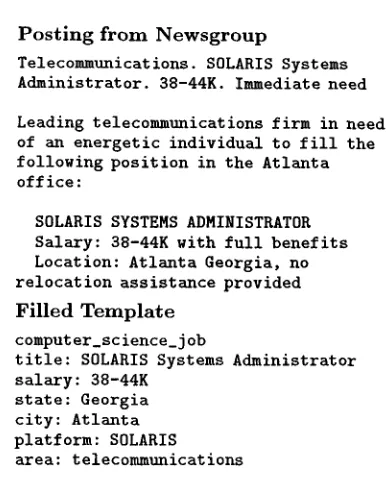
In information extraction, the data to be extracted from a natural language text is given by a template specifying a list of slots to be filled. The slot fillers
Califf 8J Mooney 9 Relational Learning
P o s t i n g f r o m N e w s g r o u p
Telecommunications. SOLARIS Systems Administrator. 38-44K. Immediate need
Leading telecommunications firm in need of an energetic individual to fill the following position in the Atlanta office:
SOLARIS SYSTEMS ADMINISTRATOR Salary: 38-44K with full benefits Location: Atlanta Georgia, no relocation assistance provided
Filled Template
computer_science_job
title: SOLARIS Systems Administrator salary: 38-44K
state: Georgia city: Atlanta platform: SOLARIS
a r e a : telecommunications
Figure 1: Sample Message and Filled Template
may be either one of a set of specified values or strings taken directly from the document. For ex- ample, Figure 1 shows part of a job posting, and the corresponding slots of the filled computer-science job template.
IE can be useful in a variety of domains. The var- ious MUC's have focused on domains such as Latin American terrorism, joint ventures, rnicroelectron- ics, and company management changes. Others have used IE to track medical patient records (Soderland et al., 1995) or company mergers (Huffman, 1996). A general task considered in this paper is extracting information from postings to USENET newsgroups, such as job announcements. Our overall goal is to extract a database from all the messages in a news- group and then use learned query parsers (Zelle and Mooney, 1996) to answer natural language questions such as "What jobs are available in Austin for C + + programmers with only one year of experience?". Numerous other Internet applications are possible, such as extracting information from product web pages for a shopping agent (Doorenbos, Etzioni, and Weld, 1997).
2.2 R e l a t i o n a l L e a r n i n g
Most empirical natural-language research has em- ployed statistical techniques that base decisions on very limited contexts, or symbolic techniques such as decision trees that require the developer to spec- ify a manageable, finite set of features for use in making decisions. Inductive logic programming and other relational learning methods (Birnbaum and
Collins, 1991) allow induction over structured exam- ples that can include first-order logical predicates and functions and unbounded data structures such as lists, strings, and trees. Detailed experimen- tal comparisons of ILP and feature-based induction have demonstrated the advantages of relational rep- resentations in two language related tasks, text cat- egorization (Cohen, 1995) and generating the past tense of an English verb (Mooney and Califf, 1995). While RAPIEa is not strictly an ILP system, its rela- tional learning algorithm was inspired by ideas from the following ILP systems.
GOLEM (Muggleton and Feng, 1992) is a bottom- up (specific to general) ILP algorithm based on the construction of relative least-general generalizations, rlggs (Plotkin, 1970). The idea of least-general gen- eralizations (LGGs) is, given two items (in ILP, two clauses), finding the least general item that covers the original pair. This is usually a fairly simple com- putation. Rlggs are the LGGs relative to a set of background relations. Because of the difficulties in- troduced by non-finite rlggs, background predicates must be defined extensionally. The algorithm op- erates by randomly selecting several pairs of posi- tive examples and computing the determinate rlggs of each pair. Determinacy constrains the clause to have for each example no more than one possible valid substitution for each variable in the body of the clause. The resulting clause with the greatest cover- age of positive examples is selected, and that clause is further generalized by computing the rlggs of the selected clause with new randomly chosen positive examples. The generalization process stops when the coverage of the best clause no longer increases.
[image:2.596.63.256.93.332.2]plemented, and the process repeats. CHILLIN uses the notion of empirical subsumption, which means t h a t as new, more general clauses are added, all of the clauses which are not needed to prove positive examples are removed from the definition.
PROGOL (Muggleton, 1995) also combines b o t t o m - u p and top-down search. Using mode decla- rations provided for both the background predicates and the predicate being learned, it constructs a most specific clause for a r a n d o m seed example. The mode declarations specify for each argument of each predicate both the argument's type and whether it should be a constant, a variable bound before the predicate is called, or a variable bound by the predicate. Given this most specific clause, PROGOL employs a A*-like search through the set of clauses containing up to k literals from that clause in order to find the simplest consistent generalization to add to the definition. Advantages of PROGOL are t h a t the constraints on the search make it fairly efficient, especially on some types of tasks for which top-down approaches are particularly inefficient, and t h a t its search is guaranteed to find the simplest consistent generalization if such a clause exists with no more than k literals. T h e primary problems with the system are its need for the mode declarations and the fact t h a t too small a k m a y prevent PROGOL from learning correct clauses while too large a k m a y allow the search to explode.
3 R A P I E R S y s t e m
3.1 R u l e R e p r e s e n t a t i o n
I:LAPIER's rule representation uses patterns that make use of limited syntactic and semantic informa- tion, using freely available, robust knowledge sources such as a part-of-speech tagger and a lexicon with se- mantic classes, such as the h y p e r n y m links in Word- Net (Miller et al., 1993). T h e initial implementation does not use a parser, primarily because of the dif- ficulty of producing a robust parser for unrestricted text and because simpler patterns of the type we pro- pose can represent useful extraction rules for at least some domains. T h e extraction rules are indexed by template name and slot name and consist of three parts: 1) a pre-filler pattern t h a t must match the text immediately preceding the filler, 2) a pattern t h a t must match the actual slot filler, and 3) a post- filler pattern t h a t must match the text immediately following the filler. Each pattern is a sequence (pos- sibly of length zero in the case of pre- and post-filler patterns) of pattern items or pattern lists. A pattern item matches exactly one word or symbol from the document t h a t meets the item's constraints. A pat-
Pre-filler Pattern: Filler Pattern: Post-filler Pattern: 1) word: leading 1) list: len: 2 1) word: [firm, company]
tags: Inn, nns]
Figure 2: A Rule Extracting an Area Filler from the Example Document
tern list specifies a m a x i m u m length N and matches 0 to N words or symbols from the document t h a t each must match the list's constraints. Possible con- straints are: a list of words, one of which must match the document item; a list of part-of-speech (POS) tags, one of which must match the document item's POS tag; a list of semantic classes, one of which must be a class t h a t the document item belongs to. Figure 2 shows a rule created by hand t h a t extracts the a r e a filler from the example document in fig- ure reftemplate. This rule assumes t h a t the docu- ment has been tagged with the POS tagger of (Brill,
1994).
3.2 T h e L e a r n i n g A l g o r i t h m
As noted above, RAPIER is inspired by ILP meth- ods, and primarily consists of a specific to gen- eral (bottom-up) search. First, for each slot, most- specific patterns are created for each example, speci- fying word and tag for the filler and its complete con- text. Thus, the pre-filler pattern contains an item for each word from the beginning of the document to the word immediately preceding the filler with con- straints on the item consisting of the word and its assigned POS tag. Likewise, the filler p a t t e r n has one item from each word in the filler, and the post- filler pattern has one item for each word from the end of the filler to the end of the document.
Given this maximally specific rule-base, R~APIER. attempts to compress and generalize the rules for each slot. New rules are created by selecting two existing rules and creating a generalization. T h e aim is to make small generalization steps, covering more positive examples without generating suprious fillers, so a standard approach would be to generate the least general generalization (LGG) of the pair of rules. However, in this particular representation which allows for unconstrained disjunction, the L G G m a y be overly specific. Therefore, in cases where the LGG of two constraints is their disjunction, we want to create two generalizations: one would be the dis- junction and the other the removal of the constraint. Thus, we often want to consider multiple generaliza- tion of a pair of items. This, combined with the fact t h a t patterns are of varying length, making the num- ber of possible generalizations of two long patterns extremely large, makes the computational cost of
For each slot, S in the template being learned
SlotRules = most specific rules from documents for S while compression has failed fewer than lira times
randomly select 2 rules, R1 and R2, from S find the set L of generalizations of the fillers of R1
and R2
create rules from L, evaluate, and initialize
RulesList
let n -- 0
while best rule in RuleList produces spurious fillers and the weighted information value of the best rule is improving
increment n
specialize each rule in RuleList with general- izations of the last n items of the
pre-filler patterns of R1 and R2 and
add specializations to RuleList
specialize each rule in RuleList with general- izations of the first n item of the
post-filler patterns of R1 and R2 and
add specializations of RuleList
if best rule in RuleList produces only valid fillers Add it to SlotRules and remove empirically
subsumed rules
Figure 3: RAPIER Algorithm for Inducing IE Rules
producing all interesting generalizations of two com- plete rules prohibitive. But, while we do not want to arbitrarily limit the length of a pre-filler or post- filler p a t t e r n , it is likely t h a t the i m p o r t a n t parts of the p a t t e r n will be close to the filler. Therefore, we s t a r t by c o m p u t i n g the generalizations of the filler p a t t e r n s of the two rules and create rules from those generalizations. We m a i n t a i n a list of the best n rules created and specialize the rules under consid- eration by adding pieces of the generalizations of the pre- and post-filler p a t t e r n s of the two seed rules, working outward f r o m the fillers. T h e rules are or- dered using an information value metric (Quinlan, 1990) weighted by the size of the rule (preferring smaller rules). W h e n the best rule under consider- ation produces no negative examples, specialization ceases; t h a t rule is added to the rule base, and all rules empirically s u b s u m e d by it are removed. Spe- cialization will be abandoned if the value of the best rule does not improve across k specialization itera- tions. Compression of the rule base for each slot is a b a n d o n e d when the n u m b e r of successive iterations of the compression algorithm which fail to produce a compressing rule exceed either a pre-defined limit or the n u m b e r of rules for t h a t slot. An outline of the a l g o r i t h m a p p e a r s in Figure 3 where RuleList is a prioritized list of no more t h a n Beam- Width rules. T h e search is s o m e w h a t similar to a b e a m search in t h a t a limited n u m b e r of rules is kept for considera-
tion, but all rules in RuleList are expanded at each iteration, rather t h a n only the best.
As an example of the creation of a new rule, con- sider generalizing the rules based on the phrases "lo- cated in Atlanta, Georgia." and "offices in Kansas City, Missouri." T h e rules created f r o m these phrases for the city slot would be
Pre-fdler Pattern: Filler Pattern: Post-filler Pattern: 1) word: located 1) word: atlanta 1) word: ,
tag: vbn tag: nnp tag: , 2) word: in 2) word: georgia
tag: in tag: nnp
3) word: . tag: . and
Pre-filler Pattern: Filler Pattern: Post-filler Pattern: 1) word: offices 1) word: kansas 1) word: ,
tag: nns tag: imp tag: ,
2) word: in 2) word: city 2) word: missouri tag: in tag: imp tag: nnp
3) word: . tag: .
T h e fillers are generalized to produce two possible rules with e m p t y pre-filler and post-filler patterns. Because one filler has two items and the other only one, they generalize to a list of no m o r e t h a n two words. T h e word constraints generalize to either a disjunction of all the words or no constraint. T h e t a g constraints on all of the items are the same, so the L G G ' s tag constraints are also the same. Since the three words do not belong to a single semantic class in the lexicon, the semantics remain unconstrained. T h e fillers produced are:
Pre-filler Pattern: Filler Pattern: Post-filler Pattern: 1) list: len: 2
word: [atlanta, kansas, city] tag: nnp
and
Pre-filler Pattern: Filler Pattern: Post-filler Pattern: 1) list: len: 2
tag: nnp
Either of these rules is likely to cover spurious e x a m - ples, so we add pre-filler and post-filler L G G s . T h e items produced from the "in" 's and the c o m m a s are identical and, therefore, unchanged. Assuming t h a t our lexicon contains a semantic class for states, gen- eralizing the state n a m e s produces a s e m a n t i c con- straint o f t h a t class along with a t a g constraint nnp and either no word constraint or the disjunction of the two states. Thus, a final best rule would be: Pre-filler Pattern: Filler Pattern: Post-filler Pattern: 1) word: in 1) list: len: 2 1) word: ,
tag: in tag: nnp tag: , 2) tag: nnp
semantic: state
4
E v a l u a t i o n
tO0
/ Preel~on -e--
/ Rel~all
1o
2o
~o
,'o
io
o o Training ExamplesFigure 4: Performance on job postings
postings t h a t could be used to create a database of available jobs. The computer-related job post- ing template contains 17 slots, including informa- tion about the employer, the location, the salary, and job requirements. Several of the slots, such as the languages and platforms used, can take multiple values. T h e current results do not employ semantic categories, only words and the results of Brill's POS tagger.
The results presented here use a d a t a set of 100 documents paired with filled templates. We did a ten-fold cross-validation, and also ran tests with smaller subsets of the training examples for each test set in order to produce learning curves. We use three measures: precision, the percentage of slot fillers produced which are correct; recall, the percentage of slot fillers in the correct templates which are pro- duced by the system; and an F-measure, which is the average of the recall and the precision.
Figure 4 shows the learning curves generated. At 90 training examples, the average precision was 83.7% and the average recall was 53.1%. These num- bers look quite promising when compared to the measured performance of other information extrac- tion systems on various domains. This performance is comparable to t h a t of CRYSTAL on a medical do- main task (Soderland et al., 1996), and better than t h a t of AuTOSLOG and AUTOSLOG-TS on part of the MUC4 terrorism task (Riloff, 1996). It also com- pares favorably with the typical system performance on the MUC tasks (ARPA, 1992, ARPA, 1993). All of these comparisons are only general, since the tasks are different, but they do indicate that RAPIER is do- ing relatively well. T h e relatively high precision is an especially positive result, because it is highly likely t h a t recall will continue to improve as the number of training examples increases.
The rules RAPIER, learns are of several different types. Some are fairly simple memorizations of words or phrases t h a t consistently appear in par- ticular slots: these include things like programming languages and operating systems. Others learn the context of the filler, usually also constraining the parts of speech of the filler: for example, a rule for the language slot where the prefix is constrained to "familiarity with", the suffix is "programming" and the filler is a list of up to three items which must be proper nouns or symbols.
5
R e l a t e d
W o r k
Previous researchers have generally applied machine learning only to parts of the IE task and their sys- tems have typically required more h u m a n interaction than just providing texts with filled templates. RE- SOLVE uses decision trees to handle coreference deci- sions for an IE system and requires annotated coref- erence examples (McCarthy and Lehnert, 1995).
CRYSTAL USeS a form of clustering to create a dictio-
nary of extraction patterns by generalizing patterns identified in the text by an expert (Soderland et al., 1995, Soderland et al., 1996). AUTOSLOG creates a dictionary of extraction patterns by specializing a set of general syntactic patterns (Riloff, 1993, Riloff, 1996). It assumes t h a t an expert will later examine the patterns it produces. PALKA learns extraction patterns relying on a concept hierarchy to guide gen- eralization and specialization (Kim and Moldovan, 1995). AUTOSLOG, CRYSTAL, and PALKA all rely on prior sentence analysis to identify syntactic ele- ments and their relationships, and their o u t p u t re-- quires further processing to produce the final filled templates. LIEP also learns IE patterns (Huffman, 1996). Line's primary limitations are t h a t it also re- quires a sentence analyzer to identify noun groups, verbs, subjects, etc.; it makes no real use of semantic information; it assumes t h a t all information it needs is between two entities it identifies as "interesting"; and it has been applied to only one domain in which the texts are quite short (1-3 sentences).
6
F u t u r e R e s e a r c h
Currently, RAPIER, assumes slot values are strings taken directly from the document; however, MUC templates also include slots whose values are taken from a pre-specified set. We plan to extend the sys- tem to learn rules for such slots. Also, the current system a t t e m p t s to extract the same set of slots from every document. RAPIER must be extended to learn patterns t h a t first categorize the text to determine which set of slots, if any, should be extracted from a
[image:5.596.44.278.101.274.2]given document. Finally, the same pattern learning algorithm may prove applicable to other natural lan- guage processing tasks such as identifying the sense of an ambiguous word based on its surrounding con- text.
7
C o n c l u s i o n
The ability to extract desired pieces of information from natural language texts is an important task with a growing number of potential applications. Tasks requiring locating specific data in newsgroup messages or web pages are particularly promising applications. Manually constructing such informa- tion extraction systems is a laborious task; however, learning methods have the potential to help auto- mate the development process. The RAPIER system described in this paper uses relational learning to construct unbounded pattern-match rules for infor- mation extraction given only a database of texts and filled templates. The learned patterns employ lim- ited syntactic and semantic information to identify potential slot fillers and their surrounding context. Results on extracting information from newsgroup jobs postings have shown that for one realistic ap- plication, fairly accurate rules can be learned from relatively small sets of examples. Future research will hopefully demonstrate that similar techiques will prove useful in a wide variety of interesting ap- plications.
8 A c k n o w l e d g e m e n t s
This research was supported by a fellowship from AT&T awarded to the first author and by the Na- tional Science Foundation under grant IRI-9310819.
R e f e r e n c e s
ARPA, editor. 1992. Proceedings of the Fourth DARPA Message Understanding Evaluation
and Conference, San Mateo, CA. Morgan
Kaufman.
ARPA, editor. 1 9 9 3 . Proceedings of the Fifth DARPA Message Understanding Evaluation
and Conference, San Mateo, CA. Morgan
Kaufman.
Birnbaum, L. A. and G. C. Collins, editors. 1991. Proceedings of the Eighth International Work- shop on Machine Learning: Part VI Learning Relations, Evanston, IL, June.
Brill, Eric. 1994. Some advances in rule-based part of speech tagging. In Proceedings of the Twelfth
National Conference on Artificial Intelligence, pages 722-727.
Cohen, W. W. 1995. Text categorization and rela- tional learning. In Proceedings of the Twelfth International Conference on Machine Learn- ing, pages 124-132, San Francisco, CA. Mor- gan Kaufman.
Doorenbos, R. B., O. Etzioni, and D. S. Weld. 1997. A scalable comparison-shopping agent for the world-wide web. In Proceedings of the First International Conference on Au- tonomous Agents.
Huffman, S. B. 1996. Learning information extrac- tion patterns from examples. In S. Wermter, E. Riloff, and G. Scheler, editors, Connec- tionist, Statistical, and Symbolic Approaches to Learning for Natural Language Processing. Springer, Berlin, pages 246-260.
Kim, Jun-Tae and Dan I. Moldovan. 1995. Acquisi- tion of linguistic patterns for knowledge-based information extraction. IEEE Transactions
on Knowledge and DataEngineering, 7(5):713-
724, October.
Lehnert, Wendy and Beth Sundheim. 1991. A per- formance evaluation of text-analysis technolo- gies. AI Magazine, 12(3):81-94.
McCarthy, J. and W. Lehnert. 1995. Using decision trees for coreference resolution. In Proceedings of the Fourteenth International Joint Confer- ence on Artificial Intelligence, pages 1050- 1055.
Miller, G., R. Beckwith, C. Fellbaum, D. Gross, and K. Miller. 1993. Introduction to WordNet: An on-line lexical database. Available by ftp to clarity.princeton.edu.
Mooney, R. J. and M. E. Califf. 1995. Induction of first-order decision lists: Results on learning the past tense of English verbs. Journal of Artificial Intelligence Research, 3:1-24.
Muggleton, S. and C. Feng. 1992. Efficient induction of logic programs. In S. Muggleton, editor, In- ductive Logic Programming. Academic Press, New York, pages 281-297.
Plotkin, G. D. 1970. A note on inductive general- ization. In B. Meltzer and D. Michie, editors, Machine Intelligence (Vol. 5). Elsevier North- Holland, New York.
Quinlan, J.R. 1990. Learning logical definitions from relations. Machine Learning, 5(3):239-266.
Riloff, E. 1993. Automatically constructing a dictio- nary for information extraction tasks. In Pro- ceedings of the Eleventh National Conference on Artificial Intelligence, pages 811-816.
Riloff, Ellen. 1996. Automatically generating extrac- tion patterns from untagged text. In Proceed- ings of the Thirteenth National Conference on Artificial Intelligence, pages 1044-1049.
Soderland, Stephen, D. Fisher, J. Aseltine, and W. Lehnert. 1995. Crystal: Inducing a con- ceptual dictionary. In Proceedings of the Four- teenth International Joint Conference on Ar- tificial Intelligence, pages 1314-1319.
Soderland, Stephen, David Fisher, Jonathan Asel- tine, and Wendy Lehnert. 1996. Issues in inductive learning of domain-specific text ex- traction rules. In Stefan Wermter, Ellen Riloff, and Gabriele Scheller, editors, Connectionist, Statistical, and Symbolic Approaches to Learn- ing for Natural Language Processing, Lecture Notes in Artificial Intelligence. Springer, pages 290-301.
Weizenbaum, J. 1966. E L I Z A - A computer pro- gram for the study of natural language com- munications between men and machines. Com- munications of the Association for Computing Machinery, 9:36-45.
Zelle, J. M. and R. J. Mooney. 1994. Combining top-down and bottom-up methods in induc- tive logic programming. In Proceedings of the Eleventh International Conference on Machine Learning, pages 343-351, New Brunswick, N J, July.
Zelle, J. M . and R. J. Mooney. 1996. Learning to parse database queries using inductive logic programming. In Proceedings of the Thirteenth National Conference on Artificial Intelligence, Portland, OR, August.