P
EDIATRICS
Oct 1997VOL. 100 NO. 4
zzz zzz zzz zzz zz
Otitis Media-related Antibiotic Prescribing Patterns, Outcomes, and
Expenditures in a Pediatric Medicaid Population
Stephen Berman, MD*; Patricia J. Byrns, MD‡§; Jessica Bondy, MHA§; Pamela J. Smith, PharmD, MBAi; and Dennis Lezotte, PhD§
ABSTRACT. Background. Treatment of otitis media is the most frequent reason for administering antibiotics to children in the United States. However, only limited data are available on medical effectiveness of antibiotic pre-scribing patterns for otitis media and their associated expenditures or the factors that influence antibiotic pre-scribing.
Methods. The study population consisted of 131 169 children during 1991 and 157 065 children during 1992 who were <13 years of age and enrolled in Colorado’s fee-for-service Medicaid program. Among these children, 5127 (1991) and 7254 (1992) were enrolled in the cohort treated for a “new” episode of acute otitis media. An analysis using this cohort was performed to document the antibiotics used to treat a new episode of acute otitis media, factors influencing antibiotic selection, and the short-term outcomes of therapy. An analysis using the entire Medicaid population was performed to document the annual use of antibiotics for otitis, the associated antibiotic expenditures, and factors influencing antibi-otic selection.
Results. In the cohort analysis, office-based physi-cians prescribed second- and third-generation cephalo-sporins more often than did physicians in other settings (17% vs 9.7% and 11.8%), whereas hospital clinics pre-scribed trimethoprim plus sulfamethoxazole more fre-quently than did office-based physicians (19.2% vs 7.1% and 10.9%). Family physicians prescribed second- and third-generation cephalosporins more often than did pe-diatricians (16.6% vs 12.3%) but trimethoprim plus sulfa-methoxazole and erythromycin plus sulfisoxazole less often than did pediatricians (10.5% vs 17%).
The average rate of prescribing a second course of antibiotics within 24 days after initial antibiotic treat-ment of a new acute otitis media episode was 11.6% when
less expensive antibiotics (amoxicillin, trimethoprim plus sulfamethoxazole, or erythromycin plus sulfisox-azole) were prescribed, and 13.2% when more expensive antibiotics (cefaclor, amoxicillin plus clavulanate, or ce-fixime) were prescribed. The average adverse drug reac-tion rate was 5.9% when less expensive antibiotics were prescribed, compared with 6.1% when more expensive antibiotics were prescribed.
In each of the two study years, amoxicillin accounted for almost half of the total antibiotic fills but only 9% to 10% of the expenditures. Low-cost antibiotics (amoxicil-lin, trimethoprim plus sulfamethoxazole, and erythromy-cin plus sulfisoxazole) were prescribed for 66% to 67% of the total fills and accounted for 21% of the total projected expenditures. More expensive antibiotics (cefaclor, ce-fixime, amoxicillin plus clavulanate) prescribed for 30% of the fills generated 76% to 77% of expenditures. Cefa-clor, prescribed for 17% to 18% of the total fills, gener-ated 43% to 45% of total antibiotic expenses.
Conclusions. The findings of this study document a preference for amoxicillin as the initial antibiotic for a new episode of acute otitis media. Although there was a wide variation in the selection of antibiotics to treat otitis, the more expensive antibiotics were not associated with better outcomes. This wide variation has important financial implications because of differences in antibi-otic costs. Changes in prescribing patterns among ini-tially uncomplicated children that reduce the use of high-cost antibiotics could reduce expenditures substantially without compromising short-term outcomes. Pediatrics 1997;100:585–592; otitis media, acute otitis media, unre-sponsive otitis media, antibiotics.
ABBREVIATIONS. MMED, Medicaid Management Information System; UAOM, unresponsive acute otitis media; ADR, adverse drug reaction.
T
reatment of otitis media is the most frequent reason for administering antibiotics to children in the United States. Understanding the factors that influence which antibiotics are prescribed for otitis media has important financial and public From the *Departments of Pediatrics and Health Policy Program,‡Medi-cine, §Preventive Medicine and Biometrics, andiSchool of Pharmacy, Uni-versity of Colorado Health Sciences Center, Denver, Colorado.
Received for publication Dec 30, 1996; accepted Mar 3, 1997.
Reprint requests to (S.B.) Children’s Hospital, 1056 East 19th Ave, B032, Denver, CO 80218.
health considerations. Prescribing patterns impact medical expenditures because of the large variability in the costs of different antibiotics used to treat otitis media. Clinical trials of antibiotic treatment for acute otitis media fail to document the superiority of any antibiotic.1Despite these financial considerations, no published studies document the patterns of otitis media-related antibiotic use and their relative short-term effectiveness for large pediatric populations. The major barrier to obtaining this information has been the limited availability to researchers of large data bases that link antibiotic use with diagnoses, outpatient and emergency department visits, and types of providers. We overcame this barrier by us-ing the Colorado Medicaid data base, which links this data for individual patients and allows longitu-dinal analysis. This study describes antibiotic scribing by physicians, factors associated with pre-scribing, the medical effectiveness of antibiotics used to treat a new episode of acute otitis media in un-complicated patients, and annual Medicaid antibiotic expenditures for otitis media.
STUDY POPULATION
The study population consisted of 131 169 children during 1991 and 157 065 children during 1992 who were #13 years of age and enrolled in Colorado’s fee-for-service Medicaid program during 1991 and 1992. Colorado Medicaid eligibility during this pe-riod conformed to mandatory federal requirements. During the period of the study,.95% of the state’s Medicaid recipients obtained services in a fee-for-service environment.
METHODS
Data obtained from an extract of the Medicaid Medical Events Database (MMED) included patient demographics; provider in-formation; and claims paid by Medicaid for prescriptions, outpa-tient office and clinic visits, emergency department visits, and inpatient hospitalizations. A detailed description of MMED and the artificial intelligence software developed by the research team has been described in previous publications.2,3The analyses fol-lowed individual patients over time, using the unique Medicaid recipient identification numbers that are maintained across inter-rupted periods of enrollment, name changes, and moves to differ-ent counties.
International Classification of Diseases, 9th revision, diagnostic codes were used to identify visits for otitis media. No attempt was made to use these codes to distinguish chronic from acute otitis designations, because documentation of physicians’ coding prac-tices suggests sufficient variability that renders such distinctions invalid.4An antibiotic was considered to be prescribed to treat otitis media if dispensed up to 24 hours before or within 48 hours after a diagnosis of otitis media.5,6Identification of the sites for the visits for otitis media (a hospital emergency department, a hospi-tal outpatient department, a community clinic, an office, a feder-ally qualified health center) was determined using “provider-type” and current procedural terminology code for all but emergency department visits, which were determined using only current procedural terminology codes. A site was listed as “inde-terminate” if a recipient had more than one otitis-related visit on the same day with two different providers.
The patient demographic variables included age, sex, urban/ rural residence, ethnicity, and enrollment category (Aid to Fami-lies with Dependent Children, etc). Residence referred to the first county of residence during the study year, with “urban” defined by the Census Bureau’s Metropolitan Statistical Areas. The classi-fication for ethnicity included Caucasian, Hispanic, African-Amer-ican, Native AmerAfrican-Amer-ican, and Other. We calculated days of enroll-ment for all children and assigned each child to one of two
enrollment categories: continuously enrolled children who were either eligible for all of the study year or born during the study year and enrolled from birth to the end of the study year; all other children were considered to be discontinuously enrolled. When appropriate, analyses include only continuously enrolled children rather than the entire population. When study results for both study years are similar, they are combined in the same table.
Cohort Analysis of Treatment of a New Acute Otitis Media Episode
An analysis, using the cohort of 36 170 children during 1991 and 43 973 children during 1992 who were#30 months with a “new” episode of otitis, was performed. The index visit for this “new” episode was defined as an ambulatory visit with a diag-nosis of otitis media and an antibiotic fill when in the previous 3 months otitis media was not diagnosed and an antibiotic was not prescribed unless there was a non-otitis diagnostic explanation. This means a child evaluated for inclusion in the cohort could have had an antibiotic in the previous 3 months associated with another diagnosis, such as impetigo, but would have been ex-cluded by our criteria if this antibiotic prescription had been filled without an associated diagnosis. This criteria excluded most chil-dren with recurrent acute otitis or persistent middle ear effusion from the cohort who were receiving antibiotic prophylaxis but not having visits. Children with an appropriate index visit had to meet the following additional criteria for inclusion: age at the time of the index visit#30 months; subsequent 6 months of continuous Medicaid enrollment after the index visit; no hospitalization within 24 days of the index visit with diagnoses of sepsis, bron-chiolitis, croup, meningitis, sinusitis, pneumonia, or mastoiditis; and no index visit with a secondary diagnosis of mastoiditis, hearing loss, cholesteatoma, or perforation. This cohort of children without associated infections or complications was used to docu-ment the antibiotics prescribed for a “new” episode of acute otitis media and short-term clinical outcomes.
New antibiotic fills within the first 24 days after the initial antibiotic treatment for the otitis at the index visit were docu-mented. Reasons for prescribing a new antibiotic were classified as unresponsive acute otitis media (UAOM) or adverse drug reaction (ADR)/side effect. UAOM was defined as a change in antibiotic within 24 days of the index visit, accompanied by an ambulatory visit that had no diagnosis consistent with a drug reaction/side effect or diagnosis other than otitis. An ADR or side effect was defined as a change in antibiotic within 24 days either 1) accom-panied by another visit and a diagnosis of an allergic reaction, urticaria, diarrhea, or emesis, or 2) without a visit. When a new antibiotic was prescribed by telephone without a visit, it was conservatively considered as an ADR/side effect, even though it was not possible to determine whether the new antibiotic was prescribed because of an adverse reaction or clinical unrespon-siveness. A follow-up visit for otitis was defined as a visit occur-ring within 90 days of the index visit; the interval between the index visit and follow-up visits was categorized as,10 days, 11 to 24 days, 25 to 45 days, and 46 to 90 days. It was not possible to determine when an antibiotic administered during a follow-up visit after 24 days represented a new or continued infection.
Analysis of Entire Medicaid Population
RESULTS
Antibiotics Prescribed for a “New” Episode of Acute Otitis Media
Among children ,30 months of age enrolled in Medicaid, 5127 of 36 170 (1991) and 7254 of 43 973 (1992) were enrolled in the cohort treated for a “new” episode of acute otitis media. Males comprised 53% of the cohort. Caucasians accounted for 54%, Hispan-ics 33%, African-American 11%, and Native Ameri-can and Other 2%. A total of 66% of the cohort were Medicaid-eligible through Aid to Families with De-pendent Children, 32% through the Medicaid expan-sion, and 1% through programs for foster care, blind/disabled, and other. A total of 81% of the cohort lived in urban areas and 19% in rural areas. The sociodemographic characteristics of the children
,30 months of age with a new episode of otitis were similar to the characteristics of the entire Medicaid population,30 months of age.
A total of 581 physicians prescribed an antibiotic at
the index visit, with 179 physicians treating more than five patients in the cohort. A pediatrician diag-nosed the otitis at 32% of the index visits in 1991 and 33% in 1992. A family physician diagnosed the otitis in 34% of the index visits in 1991 and 30% in 1992. Otolaryngologists made the diagnosis in ,1% of children during both years. The specialty of the cli-nician could not be determined in 34% of the 1991 index visits and 37% of the 1992 visits.
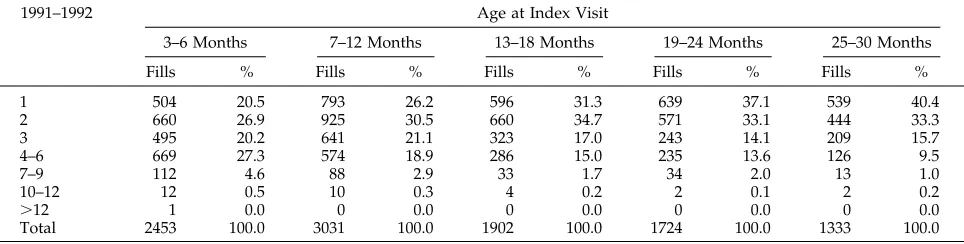
The total number of courses of antibiotics pre-scribed for children during the 6-month follow-up period after a “new” episode of acute otitis according to age is shown in Table 2. Younger patients were more likely to have more antibiotic courses. For ex-ample, more than twice as many infants 3 to 6 months of age received three or more courses of antibiotics (52.6%), compared with children 25 to 30 months of age (22.3%) (P , .001). This difference could be attributable to younger infants having more unresponsive infections, more episodes of persistent
TABLE 1. Lowest Cost by Age for a 10-Day Course of Oral Antibiotics Prescribed for Acute Otitis Media
Drug 0–6
Months
7–12 Months
13–18 Months
19–24 Months
25–30 Months
31–36 Months
3–6 Years
7–9 Years
10–13 Years
Amoxicillin $ 2.07 $ 2.55 $ 2.94 $ 2.94 $ 2.94 $ 2.94 $ 5.88 $ 5.88 $ 4.30
Amoxicillin/clavulanate $24.35 $36.80 $36.80 $48.70 $48.70 $48.70 $73.08 $ 85.26 $ 97.44
Ampicillin $ 2.37 $ 4.12 $ 4.12 $ 4.12 $ 4.12 $ 4.12 $ 5.60 $ 5.20 $ 5.20
Cefaclor $27.43 $41.83 $41.83 $41.83 $41.83 $41.83 $64.62 $ 86.16 $ 86.16
Cefixime $27.76 $27.76 $44.33 $44.33 $44.33 $44.33 $64.62 $ 86.16 $ 86.16
Cefprozil $24.21 $33.22 $43.87 $43.87 $43.87 $87.74 $75.90 $ 55.80 $ 55.80
Cefuroxime — — $62.80 $62.80 $62.80 $62.80 $88.20 $113.60 $113.60
Cephalexin $ 7.72 $ 7.72 $15.44 $15.44 $15.44 $15.44 $11.24 $ 11.24 $ 22.48
Ciprofloxacin $58.40 $58.40 $58.40 $58.40 $58.40 $58.40 $58.40 $ 58.40 $ 58.40
Erythromycin $ 8.86 $ 8.86 $ 8.86 $ 8.86 $ 8.86 $22.03 $11.20 $ 7.48 $ 14.96
Erythromycin with sulfisoxazole
$12.45 $12.45 $16.12 $16.12 $16.12 $24.99 $32.24 $ 48.36 $ 48.36
Sulfisoxazole $ 9.39 $18.78 $18.78 $18.78 $18.78 $32.72 $ 2.34 $ 3.12 $ 3.12
Tetracycline — — — — — — $ 2.23 $ 1.85 $ 2.77
Trimethoprim with sulfa
$ 6.92 $ 6.92 $ 6.92 $ 6.92 $ 6.92 $ 6.92 $ 6.92 $ 2.23 $ 1.35
Exclusions: This table does not include drugs billed under HCPC codes or not available through Medicaid’s drug benefit. Empty cells (–) [for other than erythromycin with sulfisoxazole] indicate that the drug is contraindicated for that age group.
General approach: Each drug form was assigned a cost for an age group by form and strength, and was based on calculations of milligrams/kilograms/day, schedule, and 95th percentile weight.
Age and forms: The following assumptions were made: 1) children,2 years of age used liquids; 2) children.2 could use pills or tabs if they could be crushed and the entire amount of drug used; 3) children$3 can use chewable drugs; 4) children.9 can swallow pills or tablets.
Prices and unit doses: Prices are the AWP or federal MAC according to the 1991 Redbook.
Prices/form within age group: If the cost of a single form varied by age within the age category, the cost for the oldest child was included. Multiple forms within age groups: If multiple formulations were appropriate for an age group (eg, 250 mg/mL and 125 mg/mL or both a liquid and a pill), the form with the lowest cost was considered.
TABLE 2. Total Number of Antibiotic Fills Prescribed to the Cohort,30 Months of Age With a “New” Episode of Acute Otitis Media According to Age During the Follow-up Period*
1991–1992 Age at Index Visit
3–6 Months 7–12 Months 13–18 Months 19–24 Months 25–30 Months
Fills % Fills % Fills % Fills % Fills %
1 504 20.5 793 26.2 596 31.3 639 37.1 539 40.4
2 660 26.9 925 30.5 660 34.7 571 33.1 444 33.3
3 495 20.2 641 21.1 323 17.0 243 14.1 209 15.7
4–6 669 27.3 574 18.9 286 15.0 235 13.6 126 9.5
7–9 112 4.6 88 2.9 33 1.7 34 2.0 13 1.0
10–12 12 0.5 10 0.3 4 0.2 2 0.1 2 0.2
.12 1 0.0 0 0.0 0 0.0 0 0.0 0 0.0
Total 2453 100.0 3031 100.0 1902 100.0 1724 100.0 1333 100.0
middle ear effusion, and/or more recurrent epi-sodes. During 1991, an antibiotic was prescribed at 38% of the first follow-up visits and at 51% to 71% of the other follow-up visits.
Although amoxicillin was the most frequent choice for treating a new otitis media episode, a cephalo-sporin was prescribed to at least one child at an index visit by 320 (55%) of the 581 physicians who cared for the cohort. Among the 179 physicians who followed more than five patients in the cohort, 83 (46.4%) prescribed a cephalosporin for$20% of the children treated at their index visit.
The antibiotic selections at the index visit are shown according to the type of setting (private office, hospital clinic, federally qualified health center) and type of physician (pediatrician, family physician, otolaryngologist, or indeterminate) in Tables 3 and 4, respectively. Office-based physicians prescribed sec-ond- and third-generation cephalosporins more of-ten than did physicians in other settings (17% vs 9.7% and 11.8%) (P,.0001), whereas hospital clinic personnel prescribed trimethoprim plus sulfame-thoxazole (TMP/SMZ) more frequently than did office-based and emergency department physicians (19.2% vs 7.1% and 10.9%) (P,.0001). Family phy-sicians prescribed second- and third-generation cephalosporins more often than did pediatricians (16.6% vs 12.3%) (P, .0001) but trimethoprim plus sulfamethoxazole and erythromycin plus sulfisox-azole less often than did pediatricians (10.5% vs 17%) (P,.0001).
The antibiotic fills prescribed at the index and subsequent visits are shown in Table 5. The use of amoxicillin decreased progressively during the sub-sequent otitis visits. During the first, second, and third follow-up visits, use of cefaclor and tri-methoprim plus sulfamethoxazole showed the great-est increase. Use of amoxicillin plus clavulanate and cefixime increased most after the second follow-up visit.
Outcomes: UAOM and ADRs/Side Effects
The rates of unresponsive episodes and ADRs are shown in Table 6 according to age and in Table 7 according to the type of antibiotic prescribed at the initial index otitis media visit. The frequency of un-responsive episodes within 24 days of diagnosis had a range of 10.% for children 25 to 30 months of age to 13.6% for infants 7 to 12 months of age. This data suggest that different rates of unresponsive otitis do not account for the large difference in the number of
antibiotic courses prescribed to younger infants. Therefore, younger patients probably had more per-sistent middle-ear effusions and/or more recurrent acute episodes.
The average rate of prescribing a second course of antibiotics within 24 days after initial antibiotic treat-ment of a new acute otitis media episode was 11.9% overall. The rate was 11.6% when less expensive antibiotics (amoxicillin, trimethoprim plus sulfame-thoxazole, or erythromycin plus sulfamethoxazole) were prescribed and 13.2% when more expensive antibiotics (cefaclor, amoxicillin plus clavulanate, or cefixime) were prescribed (P 5 .029). The average ADR rate within 24 days was 5.9% when less expen-sive antibiotics were prescribed, compared with 6.1% when more expensive antibiotics were prescribed (P
value not significant). Therefore, a second antibiotic was filled within 24 days of the initial treatment in 17.5% of cases for either unresponsive otitis or ADR when less expensive antibiotics were prescribed ver-sus 19.3% of cases when more expensive antibiotics were prescribed.
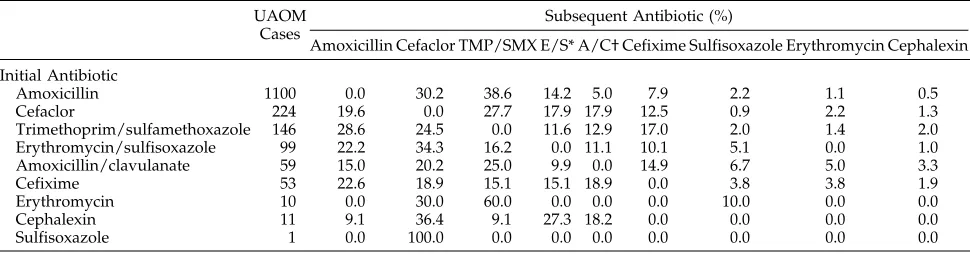
Table 8 displays the antibiotic selection for cases of unresponsive otitis according to the initial antibiotic prescribed at the index visit. Physicians who initially treated the patient with amoxicillin most often used trimethoprim plus sulfamethoxazole or cefaclor to treat unresponsive otitis. Physicians who initially se-lected trimethoprim plus sulfamethoxazole for acute otitis treated UAOM with a second- or third-gener-ation cephalosporin in 42% of cases. Physicians se-lecting cefaclor to treat the acute episode had no clear preference for unresponsive cases. Physicians select-ing a low-cost antibiotic to treat the acute episode selected another low-cost antibiotic for unresponsive otitis in 54% of cases. Physicians selecting a high-cost antibiotic to treat the acute episode selected another high-cost antibiotic for unresponsive otitis in 31% of cases.
Annual Use of Antibiotics for Otitis Media
The age-specific rates for antibiotic fills associated with a diagnosis of otitis media per child-year are shown in Table 9 for children with otitis enrolled continuously in Medicaid during 1991 and 1992. The per child-year rates differ slightly from the per child rates, because many of the children were enrolled for a portion of the year. Children ,30 months of age have at least two antibiotic fills per child-year. The highest child-year rate for antibiotic fills, about 21⁄3 fills occurred for children 13 to 24 months of age. It is
TABLE 3. Antibiotics Filled for the Cohort,30 Months of Age for a “New” Episode of Acute Otitis Media According to the Site of Ambulatory Care
Antibiotic (1991–1992) Site of Index Visit
Office Hospital/Clinic Emergency Department
Fills % Fills Fills % Fills Fills % Fills
Cefaclor 1162 13.2 170 8.4 346 11.1
Cefixime 334 3.8 27 1.3 23 0.7
Erythromycin/sulfisoxazole 455 5.2 126 6.2 171 5.5
Amoxicillin 5969 67.7 1255 62.2 2083 67.0
Amoxicillin/clavulanate 275 3.1 52 2.6 145 4.7
not clear from this data whether these children had higher antibiotic fill rates because they experienced a higher frequency of acute episodes, had a higher proportion of unresponsive episodes requiring mul-tiple antibiotic treatments, or received more antibi-otics for otitis with persistent effusions.
In addition to affecting the rate of antibiotic fills,
age influenced the selection of antibiotics. The age-specific antibiotic fill rates per child-year are plotted in the Figure according to the type of antibiotics prescribed most frequently (amoxicillin, cefaclor, tri-methoprim plus sulfamethoxazole, erythromycin plus sulfisoxazole, amoxicillin plus clavulanate, and cefixime) for children enrolled continuously in
Med-TABLE 4. Antibiotics Filled for the Cohort for a “New” Episode of Acute Otitis Media According to Physician Specialty
Antibiotic (1991–1992) Office/Clinic-based Index Visit
Pediatrician Family Practice Other*
Fills % Fills Fills % Fills Fills % Fills
Cefaclor 346 9.4 443 12.6 545 14.2
Cefixime 105 2.9 139 4.0 126 3.3
Erythromycin/sulfisoxazole 248 6.8 137 3.9 211 5.5
Amoxicillin 2474 67.6 2463 70.2 2424 63.1
Amoxicillin/clavulanate 114 3.1 94 2.7 123 3.2
Trimethoprim/sulfamethoxazole 375 10.2 233 6.6 411 10.7
* Includes physicians whose specialty cannot be determined.
TABLE 5. Percentage Distribution of Antibiotic Fills According to Visit
1991–1992 Follow-up Visits
Index Visit %
UAOM* %
1st %
2st %
3rd %
4th %
5th %
6th %
7th %
8th %
Antibiotic
Amoxicillin 65.7 8.0 45.8 44.4 33.4 26.4 24.2 19.7 18.3 18.3
Cefaclor 12.0 25.5 16.6 16.3 18.0 19.0 17.0 17.3 14.6 16.4
Trimethoprim/sulfamethoxazole 9.1 32.5 12.6 16.1 17.3 20.1 19.1 20.3 26.4 22.0
Erythromycin/sulfisoxazole 5.6 13.5 7.6 7.6 9.6 8.7 10.1 10.0 7.3 7.6
Amoxicillin/clavulanate 3.4 8.0 6.0 6.0 8.0 10.8 12.0 12.4 11.4 12.1
Cefixime 3.0 10.5 6.0 6.6 9.6 8.4 10.7 11.9 13.1 16.3
Other† 1.1 2.0 5.6 3.0 4.1 6.6 6.9 8.3 8.9 7.3
Total antibiotic fills 14 519 1958 3860 4428 2424 1500 893 515 335 170
* UAOM is the visit with unresponsive acute otitis media when an antibiotic was changed within 24 days. † Additional antibiotics, each prescribed at fewer than 1% of the visits.
TABLE 6. Rates for UAOM and ADRs in the Cohort,30 Months According to Age Treated for a “New” Episode of Acute Otitis Media*
Children UAOM Rate (%) ADR Rate
(%),24 days
,10 days ,24 days
Age
3–6 months 3048 9.4 12.2 7.1
7–12 months 4015 8.8 13.6 7.9
13–18 months 2767 9.8 11.2 6.1
19–24 months 2516 8.8 10.3 5.6
25–30 months 2004 10.3 10.0 3.8
* Table 6 does not include complicated children or indeterminate antibiotic fills.
TABLE 7. The Rates of UAOM and ADRs for the Cohort,30 Months According to the Antibiotic Prescribed at the Index Visit* 1991–1992
Fills UAOM Rate % ADR Rate %
,10 days ,24 days ,10 days ,24 days
Antibiotic
Amoxicillin 9451 2.8 11.6 2.1 5.6
Cefaclor 1683 3.1 13.3 1.4 5.5
Trimethoprim/sulfamethoxazole 1362 2.2 10.7 2.0 6.5
Erythromycin/sulfisoxazole 767 2.1 12.9 4.2 8.1
Amoxicillin/clavulanate 479 3.3 12.3 3.3 8.6
Cefixime 394 1.8 13.4 2.3 6.1
icaid during 1991 and 1992. Additional antibiotics used very infrequently (data not shown) included sulfisoxazole alone, erythromycin alone, ampicillin, cephalexin, tetracycline, and fluoroquinolones. Dur-ing both years, amoxicillin was the most frequently prescribed antibiotic at all ages. Amoxicillin fill rates were highest during the first 6 months of life. The antibiotics most often prescribed after amoxicillin were second- and third-generation cephalosporins (cefaclor and cefixime), trimethoprim plus sulfame-thoxazole (bactrim), amoxicillin plus clavulanate, and erythromycin plus sulfisoxazole. The highest rates for prescribing antibiotics other than amoxicil-lin occurred when children were 19 to 24 months of age. The reasons for this shift in prescribing patterns away from amoxicillin for patients at this age are unclear.
Antibiotic Expenditures for Treatment of Otitis Media
Table 10 displays the projected expenditures for the antibiotics prescribed to treat otitis media diag-nosed in all Medicaid children #13 years during 1991 and 1992. In each of the two study years, amoxi-cillin accounted for almost half of the total antibiotic fills, but for only 9% to 10% of the expenditures. Low-cost antibiotics (amoxicillin, trimethoprim plus sulfamethoxazole, and erythromycin plus sulfisox-azole) were prescribed for 66% to 67% of the total fills and accounted for 21% of the total projected expenditures. Cefaclor, prescribed for 17% to 18% of
the total fills, generated 43% to 45% of total antibiotic expenses. More expensive antibiotics (cefaclor, ce-fixime, amoxicillin plus clavulanate), prescribed for 30% of the fills, generated 76% to 77% of expendi-tures.
DISCUSSION
Because the antibiotics for all children enrolled in Medicaid during the study period were pro-vided without any copayments in a noncapitated, fee-for-service environment, there were no finan-cial incentives or disincentives related to antibiotic selection for the patient or physician. Yet, antibi-otic selection differed by practice setting and type of physician. There are several possible reasons why physicians in private practice more often pre-scribed expensive antibiotics, compared with phy-sicians working in clinics. Private practice
physi-cians may have been more influenced by
pharmaceutic detail representatives. It is also pos-sible that prescribing patterns for commercially insured families influenced physicians in private practice to prescribe higher-cost antibiotics for oti-tis media more frequently to their Medicaid pa-tients. Alternatively, physicians practicing in hos-pital clinics and community health centers may have adhered to a restricted formulary. These phy-sicians may also have been more likely to develop a common approach to managing otitis that stressed cost containment or cost effectiveness. The finding that family physicians were also more likely than were pediatricians to prescribe certain higher cost antibiotics for otitis may represent dif-ferences in residency training, graduate medical education, and/or the influence of pharmaceutic detailing.
This study assessed the frequency with which cli-nicians prescribed a second antibiotic within 24 days of diagnosing and treating initially uncomplicated cases of acute otitis media because of unresponsive otitis or an ADR. The 11.9% rate of unresponsive otitis found in this medical effectiveness study of actual clinical practice is higher than the 7% reported in a metaanalysis of randomized antibiotic clinical trials for acute otitis media.1 Physicians in practice may have less skill in performing pneumatic oto-scopy compared with clinicians who participate in
TABLE 8. Distribution of Antibiotic Fills for Unresponsive Acute Otitis Filled for the Cohort,30 Months According to the Initial Antibiotic Prescribed at Index Visit During 1991 and 1992
UAOM Cases
Subsequent Antibiotic (%)
Amoxicillin Cefaclor TMP/SMX E/S* A/C† Cefixime Sulfisoxazole Erythromycin Cephalexin
Initial Antibiotic
Amoxicillin 1100 0.0 30.2 38.6 14.2 5.0 7.9 2.2 1.1 0.5
Cefaclor 224 19.6 0.0 27.7 17.9 17.9 12.5 0.9 2.2 1.3
Trimethoprim/sulfamethoxazole 146 28.6 24.5 0.0 11.6 12.9 17.0 2.0 1.4 2.0
Erythromycin/sulfisoxazole 99 22.2 34.3 16.2 0.0 11.1 10.1 5.1 0.0 1.0
Amoxicillin/clavulanate 59 15.0 20.2 25.0 9.9 0.0 14.9 6.7 5.0 3.3
Cefixime 53 22.6 18.9 15.1 15.1 18.9 0.0 3.8 3.8 1.9
Erythromycin 10 0.0 30.0 60.0 0.0 0.0 0.0 10.0 0.0 0.0
Cephalexin 11 9.1 36.4 9.1 27.3 18.2 0.0 0.0 0.0 0.0
Sulfisoxazole 1 0.0 100.0 0.0 0.0 0.0 0.0 0.0 0.0 0.0
* Erythromycin/sulfisoxazole. † Amoxicillin/clavulanate.
TABLE 9. Age-specific Antibiotic Fill Rates to Treat Otitis Media in Children,13 Years of Age* Enrolled Continuously in Medicaid
Fills Fills/
Child-Years
Age
7–12 months 8721 2.1
13–18 months 13 333 2.3
19–24 months 11 631 2.4
25–30 months 7745 2.0
31–36 months 5360 1.8
3–6 years 20 005 1.5
7–9 years 4870 1.2
10–13 years 2912 1.1
Total 74 577 1.5
otitis media clinical trials, and may be less likely to confirm their findings with tympanometry. There-fore, they may be more likely to treat children with another course of antibiotics. Other factors such as differences in ages, ethnicity, and socioeconomic sta-tus may have contributed to the difference in the rates of unresponsive episodes.
The frequency of prescribing a second course of antibiotics for unresponsive acute otitis was slightly less when a low-cost drug such as amoxi-cillin, trimethoprim plus sulfamethoxazole, or erythromycin plus sulfisoxazole was initially pre-scribed, compared with a high-cost drug such as cefaclor, cefixime, or amoxicillin plus clavulanate. It is possible that clinicians used more expensive antibiotics when they thought children had find-ings of more severe disease or were more likely to be at higher risk of unresponsive otitis because of differences in age or history of recurrent otitis media. However, although clinicians selected a
more expensive antibiotic most often when the patient was 19 to 24 months of age, the rates of unresponsive otitis were slightly lower at this age compared with rates for younger children.
There are limitations in this study to determin-ing antibiotic expenditures accurately. Estimatdetermin-ing the cost of a 10-day course of a particular drug for a particular age for acute otitis media has many difficulties such as (1) manufacturer rebates and agreements between health systems and pharma-cies that affect acquisition price but are not in the public domain; (2) the fact that the average whole-sale price of a drug is formulation-specific (strength-form packaging) and that there may be several formulations that are appropriate for chil-dren of a given age; and (3) the absence of pub-lished standards for crushing pills in food or about the age at which children can be expected to chew or swallow a medication. In addition, the method-ology for cost calculation in this study is unlikely
Figure. Age-specific antibiotic fill rates per child-year according to type of antibiotic.
TABLE 10. Expenditures for Otitis Media-related Antibiotic Fills Prescribed to All Children,13 Years of Age Enrolled Continuously or Discontinuously in Colorado Medicaid During 1991 and 1992
Fills % Expenditures ($) %
Antibiotic
Amoxicillin 46 094 46.6 184 735 9.2
Cefactor 17 124 17.3 888 890 44.3
Trimethoprim/sulfamethoxazole 13 310 13.4 88 618 4.4
Amoxicillin/clavulanate 6886 7.0 384 938 19.2
Erythromycin/sulfisoxazole 6629 6.7 142 512 7.1
Cefixime 5731 5.8 273 346 13.6
Sulfisoxazole 1443 1.5 22 585 1.1
Erythromycin 778 0.8 8822 0.4
Cephalexin 735 0.7 10 254 0.5
Ampicillin 233 0.2 1145 0.1
Ciprofloxacin 8 0.0 467 0.0
Tetracycline 5 0.0 11 0.0
to reflect actual costs in non-Medicaid systems, because Pharmacy Benefit Management firms now use strategies to obtain manufacturer rebates based on market share, discounts by selectively contracting with pharmacies, and formulary re-strictions of either entire drugs or certain formu-lations. However, the relative cost index (ie, that some drugs cost 10 times more than others) is likely to hold across all systems.
CONCLUSIONS
Although there was a wide variation in the selec-tion of antibiotics to treat a new episode of acute otitis media, the outcomes associated with more ex-pensive antibiotics were not superior to less expen-sive antibiotics. Changes in prescribing patterns for acute otitis media among initially uncomplicated children that reduce the use of high-cost antibiotics could reduce expenditures substantially without compromising outcomes. For example, in 1992, if half of the cefaclor, cefixime, and amoxicillin plus clavulanate prescriptions (8359) were written for
amoxicillin instead, the Medicaid program would have realized savings of $399 412.
ACKNOWLEDGMENT
This study was supported by a grant from the Agency for Health Care Policy and Research (RO1 HS07816-03).
REFERENCES
1. Rosenfeld RM, Vertrees JE, Carr J, et al. Clinical efficacy of antimicrobial drugs for acute otitis media: metaanalysis of 5400 children from 33 randomized trials.J Pediatr.1994;124:355–367
2. Wade TD, Byrns PJ, Steiner JF, Bondy J. Finding temporal patterns—a set-based approach.Art Intell Med.1994;6:263–271
3. Byrns PJ, Bondy J, Glazner JE, Berman S. Utilization of services for otitis media by children enrolled in Medicaid. Arch Pediatr Adolesc Med.
1997;151:407– 413
4. Roark R, Petrofski J, Berson E, Berman S. Practice variation among pediatricians and family practice physicians in the management of otitis media.Arch Pediatr Adolesc Med.1995;149:839 – 844
5. Roos LL, Sharp SM, Wajda A. Assessing data quality: a computerized approach.Soc Sci Med.1989;28:175–182
6. Quam L, Ellis LBM, Venus P, et al. Using claims data for epidemiologic research. The concordance of claims-based criteria with the medical record and patient survey for identifying a hypertensive population.
DOI: 10.1542/peds.100.4.585
1997;100;585
Pediatrics
Stephen Berman, Patricia J. Byrns, Jessica Bondy, Pamela J. Smith and Dennis Lezotte
Expenditures in a Pediatric Medicaid Population
Otitis Media-related Antibiotic Prescribing Patterns, Outcomes, and
Services
Updated Information &
http://pediatrics.aappublications.org/content/100/4/585
including high resolution figures, can be found at:
References
http://pediatrics.aappublications.org/content/100/4/585#BIBL
This article cites 6 articles, 0 of which you can access for free at:
Subspecialty Collections
b
http://www.aappublications.org/cgi/collection/infectious_diseases_su Infectious Disease
following collection(s):
This article, along with others on similar topics, appears in the
Permissions & Licensing
http://www.aappublications.org/site/misc/Permissions.xhtml
in its entirety can be found online at:
Information about reproducing this article in parts (figures, tables) or
Reprints
http://www.aappublications.org/site/misc/reprints.xhtml
DOI: 10.1542/peds.100.4.585
1997;100;585
Pediatrics
Stephen Berman, Patricia J. Byrns, Jessica Bondy, Pamela J. Smith and Dennis Lezotte
Expenditures in a Pediatric Medicaid Population
Otitis Media-related Antibiotic Prescribing Patterns, Outcomes, and
http://pediatrics.aappublications.org/content/100/4/585
located on the World Wide Web at:
The online version of this article, along with updated information and services, is
by the American Academy of Pediatrics. All rights reserved. Print ISSN: 1073-0397.