REVIEW ARTICLE
Universal Newborn Hearing Screening: Systematic
Review to Update the 2001 US Preventive Services
Task Force Recommendation
Heidi D. Nelson, MD, MPHa,b,c, Christina Bougatsos, BSa, Peggy Nygren, MAa
aOregon Evidence-based Practice Center, Department of Medical Informatics and Clinical Epidemiology, andbDepartment of Medicine, Oregon Health & Science University, Portland, Oregon;cWomen and Children’s Health Research Center, Providence Health and Services, Portland, Oregon
The authors have indicated they have no financial relationships relevant to this article to disclose.
ABSTRACT
OBJECTIVE.This review is an update for the US Preventive Services Task Force on universal newborn hearing screening to detect moderate-to-severe permanent, bilateral congen-ital hearing loss. We focus on 3 key questions: (1) Among infants identified by universal screening who would not be identified by targeted screening, does initiating treatment before 6 months of age improve language and communication outcomes? (2) Compared with targeted screening, does universal screening increase the chance that treatment will be initiated by 6 months of age for infants at average risk or for those at high risk? (3) What are the adverse effects of screening and early treatment?
METHODS.Medline and Cochrane databases were searched to identify articles published since the 2002 recommendation. Data from studies that met inclusion criteria were abstracted, and studies were rated for quality with predetermined criteria.
RESULTS.A good-quality retrospective study of children with hearing loss indicates that those who had early versus late confirmation and those who had undergone uni-versal newborn screening versus none had better receptive language at 8 years of age but not better expressive language or speech. A good-quality nonrandomized trial of a large birth cohort indicates that infants identified with hearing loss through universal newborn screening have earlier referral, diagnosis, and treatment than those not screened. These findings are corroborated by multiple descriptive studies of ages of referral, diagnosis, and treatment. Usual parental reactions to an initial nonpass on a hearing screen include worry, questioning, and distress that resolve for most parents. Cochlear implants have been associated with higher risks for bacterial meningitis in young children.
CONCLUSIONS.Children with hearing loss who had universal newborn hearing screening have better language outcomes at school age than those not screened. Infants identified with hearing loss through universal screening have significantly earlier referral, diagnosis, and treatment than those identified in other ways.Pediatrics2008; 122:e266–e276
T
HIS SYSTEMATIC EVIDENCEreview updates a previous review for the US Preven-tive Services Task Force (USPSTF) on universal newborn hearing screening (UNHS) to detect moderate-to-severe bilateral permanent congenital hearing loss(PCHL).1,2 Based on research available in 2001, the USPSTF concluded that the evidence was insufficient to
recommend for or against routine screening of newborns for PCHL during the postpartum hospitalization.3 In their previous recommendation, the USPSTF found that evidence was inconclusive regarding whether earlier treatment resulting from UNHS leads to clinically important improvement in speech and language skills at 3 years of age and beyond, because existing studies had important design limitations. Since then, additional studies with speech and language outcomes of children screened or not screened as newborns have been published. This update focuses on these new studies.
The Joint Committee on Infant Hearing (JCIH), composed of representatives from audiology, otolaryngology, pediatrics, education, and state speech and hearing programs, provides position statements and establishes practice standards for early identification, intervention, and follow-up care for infants and young children with hearing loss. According to the JCIH, hearing screening should identify newborns at risk for specifically defined hearing loss that interferes with development.4,5The aim for UNHS programs is detection of permanent sensory or conductive hearing
www.pediatrics.org/cgi/doi/10.1542/ peds.2007-1422
doi:10.1542/peds.2007-1422
The findings and conclusions in this document are those of the authors, who are responsible for its content, and do not necessarily represent the views of AHRQ. No statement in this report should be construed as an official position of the AHRQ or of the US Department of Health and Human Services.
Key Words
evidence-based medicine, hearing impairment, hearing screening, newborn screening, systematic reviews
Abbreviations
USPSTF—US Preventive Services Task Force
UNHS— universal newborn hearing screening
PCHL—permanent congenital hearing loss JCIH—Joint Committee on Infant Hearing OAE— otoacoustic emission
ABR—auditory brainstem response CI— confidence interval NNS—number needed to screen
Accepted for publication Jan 14, 2008 Address correspondence to Heidi D. Nelson, MD, MPH, Oregon Evidence-based Practice Center, Oregon Health & Science University, Mail Code BICC, 3181 SW Sam Jackson Park Rd, Portland, OR 97239-3098. E-mail: [email protected]
loss averaging 30 to 40 dB or more in the frequency region important for speech recognition (⬃500 – 4000 Hz). The focus of UNHS is on congenital as opposed to acquired or progressive hearing loss that may not be detected in the newborn period.
The rate of PCHL among newborns ranges from 1 to 3 per 1000 live births.6–9 Compared with children with normal hearing, those with hearing loss have more dif-ficulty learning vocabulary, grammar, word order, idi-omatic expressions, and other aspects of verbal commu-nication.10Hearing loss in children is also associated with delayed language, learning, and speech development and with low educational attainment.4Hearing disorders have also been associated with increased behavior prob-lems, decreased psychosocial well-being, and poor adap-tive skills.11–13
Risk factors associated with a higher incidence of
PCHL include NICU admission for ⱖ2 days; syndromes
associated with hearing loss; family history of hereditary childhood sensorineural hearing loss; craniofacial abnor-malities; and congenital infections.4However,⬃50% of infants with PCHL do not have any known risk fac-tors.9,14–18
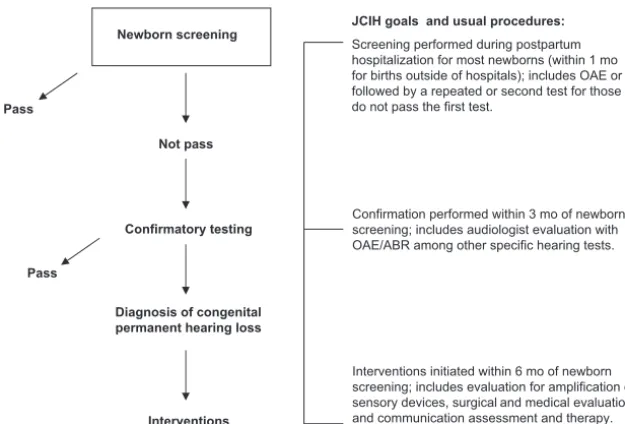
In the JCIH 2000 and 2007 position statements,4,5the JCIH endorsed integrated, interdisciplinary state and na-tional systems of UNHS; evaluation; and family centered intervention outlined in Fig 1. In addition, the JCIH recommended that all infants with risk indicators should undergo periodic monitoring for 3 years. The 2007 state-ment expands screening protocols for NICU infants and provides additional guidance for the diagnostic audiol-ogy evaluation, medical evaluation, early intervention, surveillance, communication, and tracking.5
Newborn hearing screening involves the use of objec-tive physiologic measures. Currently, otoacoustic emissions (OAEs) and/or auditory brainstem responses (ABRs) are most often used to detect sensory or conductive hearing loss.19 Both technologies are noninvasive recordings of physiologic activities that are easily recorded in
new-borns and are highly correlated with the degree of pe-ripheral hearing sensitivity. In UNHS programs, a 2-step process using OAEs followed by ABRs in those who fail the first test is often used to improve test performance. In a large trial using this approach, screening test sensi-tivity and specificity were 0.92 and 0.98, and the positive and negative likelihood ratios were 61.00 and 0.08, re-spectively.15 Referral rates are lower in programs using dedicated technicians rather than volunteers and stu-dents.20 Under ideal conditions, instruments designed specifically for newborns can test and record findings on
sleeping newborns in⬍5 minutes.
With legislation for UNHS being enacted in 39 US states in recent years, screening practices and procedures have become routine in the postpartum hospital setting. Newborn hearing screening is generally well accepted and tolerated by parents. Rates of refusals in a US com-munity-based health system were reported as 7 of 8707 during the first 10 months of 2007 (Christi Sperry, AuD, Providence Health and Services, written communica-tion, 2007).
Infants not passing the newborn screening tests are referred for confirmatory testing for a diagnosis of PCHL. The American Academy of Pediatrics has set a referral
standard of ⬍4% of all screened newborns, and some
hospitals use this measure to monitor quality of the screening program. Confirmation requires an evaluation by an audiologist using behavioral, as well as technolog-ical, methods. Although the American Academy of Pe-diatrics has set a standard of 95% for compliance with follow-up testing, this rate is typically much lower de-pending on tracking systems and local practices and services.21–24
The JCIH recommends that early intervention services should be designed to meet the individualized needs of the infant and family, including acquisition of communication competence, social skills, emotional well-being, and posi-tive self-esteem.4Early intervention includes evaluation for amplification or sensory devices, surgical and medical
eval-Newborn screening
Pass
Not pass
Confirmatory testing
Pass
Diagnosis of congenital permanent hearing loss
Interventions
JCIH goals and usual procedures:
Screening performed during postpartum hospitalization for most newborns (within 1 mo for births outside of hospitals); includes OAE or ABR followed by a repeated or second test for those who do not pass the first test.
Confirmation performed within 3 mo of newborn screening; includes audiologist evaluation with OAE/ABR among other specific hearing tests.
Interventions initiated within 6 mo of newborn screening; includes evaluation for amplification or sensory devices, surgical and medical evaluation, and communication assessment and therapy.
FIGURE 1
uation, and communication assessment and therapy. Co-chlear implants are often considered in infants with severe-to-profound hearing loss after inadequate response to hearing aids.25–28Research in neurologic and auditory cor-tical development suggests that early verses late implanta-tion may be linked to more normal cortical auditory pathway development.29–31
METHODS
Evidence reviews for the USPSTF follow a specific meth-odology.32The analytic framework outlines the patient population, interventions, outcomes, and adverse effects of the screening process (Fig 2). Corresponding key questions examine a chain of evidence about the effec-tiveness and potential adverse effects of UNHS and sub-sequent early intervention. Key questions include: (1) Among infants identified by universal screening who would not be identified by targeted screening, does ini-tiating treatment before 6 months of age improve lan-guage and communication outcomes? (2) Compared with targeted screening, does universal screening in-crease the chance that treatment will be initiated by 6 months of age for infants at average risk or for those at
high risk? (3) What are the adverse effects of screening and early treatment?
For this review, targeted screening indicates selective screening of newborns based on the presence of risk factors or associated conditions. Newborns at high risk are those with risk factors known to be associated with PCHL and/or newborns admitted to the NICU. Addi-tional key questions included in the previous report, such as sensitivity and specificity of testing procedures, were not updated in this report, because they were adequately addressed by existing evidence.1,2
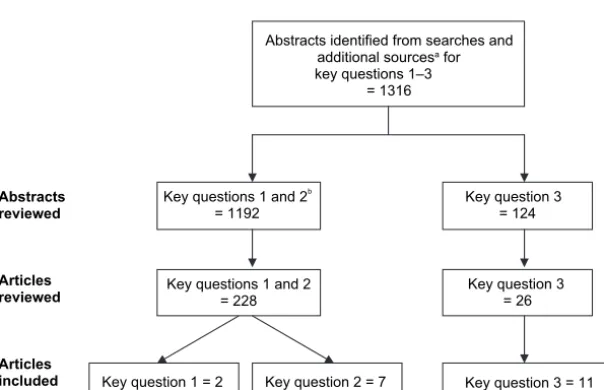
We conducted literature searches to systematically identify articles relevant to the key questions.33 Data-bases included the Cochrane Central Register of Con-trolled Trials, Cochrane Database of Systematic Reviews, Database of Abstracts of Reviews of Effects (through the fourth quarter of 2007), and Ovid Medline (2000 to November 2007 for key questions 1 and 2 and 1996 to November 2007 for key question 3). Additional articles were obtained from reference lists of related reviews, studies, editorials, reports, Web sites, and by consulting experts. Figure 3 describes results of the searches.
We reviewed abstracts and selected full-text articles
Improved mental health, psychosocial and cognitive function, school and occupational performance throughout life Earlier diagnosis
and treatment of permanent, bilateral, moderate-to-profound
hearing loss Screen with OAE
and/or ABR
Early Interventiona High-risk and
average-risk newborn infants
Improved language and communication (preschool age)
3
Adverse effects of early intervention
1
Adverse effects of screening
3 Newborn screening
2
FIGURE 2
UNHS analytic framework and key questions. The key questions are: (1) Among infants identified by universal screening who would not be identified by targeted screening, does initiating treatment before 6 months of age improve language and communication outcomes? (2) Compared with targeted screening, does universal screening increase the chance that treatment will be initiated by 6 months of age for infants at average risk or for those at high risk? (3) What are the adverse effects of screening and early treatment?aInterventions include hearing aids or other amplification, cochlear implants, American Sign Language and/or English instruction, speech and language therapy, family education, and support.
Abstracts reviewed
Articles reviewed
Articles included
Abstracts identified from searches and additional sourcesa for
key questions 1–3 = 1316
Key questions 1 and 2 = 228
Key question 3 = 26
Key question 1 = 2 Key question 2 = 7 Key question 3 = 11 Key questions 1 and 2b
= 1192
Key question 3 = 124
FIGURE 3
based on inclusion and exclusion criteria specific to each key question. Eligible studies addressed key questions and were English language; conducted in the United States or a comparable location; and, for screening stud-ies, included infants screened before 6 months of age. For key questions 1 and 2, we included controlled trials and observational studies. For key question 3 on adverse effects, we included descriptive, as well as comparative, studies. Data from the full text of the original articles were abstracted to evidence tables.
Study quality was rated by using design-specific cri-teria developed by the USPSTF.32 The overall rating of each study considers internal validity and applicability. Descriptive studies without quality criteria are summa-rized. An outcomes table estimating the number needed to screen under various assumptions was determined using estimates from the most relevant studies.
The USPSTF advised the Oregon Evidence-based Prac-tice Center in formulating and reporting this review. Ad-ditional experts provided comments on an earlier draft.
RESULTS
Key Question 1: Among Infants Identified by Universal Screening Who Would Not Be Identified by Targeted Screening, Does Initiating Treatment Before 6 Months of Age Improve Language and Communication Outcomes?
A Cochrane review comparing the long-term effective-ness of UNHS and early treatment with high-risk or opportunistic screening was updated in February 2005.34 No randomized, controlled trials were identified that fulfilled inclusion criteria. No additional trials comparing screening approaches were identified by our searches.
A good-quality retrospective cohort study evaluated the effect of UNHS on speech and language outcomes of children with PCHL.35A total of 120 children with PCHL were identified from a cohort of 157 000 children born in 8 districts of southern England between 1992 and 1997 and underwent speech and language assessment at school age (mean: 7.9 years; range: 5.4 –11.7 years). Included children were either part of the Wessex Uni-versal Neonatal Hearing Screening Trial,16 constituting 34% of the birth cohort in this study, or from districts in greater London providing UNHS or not at the time of birth. Seventy-one percent of children with PCHL in the cohort who were eligible for the study participated. Par-ticipants were similar to nonparPar-ticipants in age, gender, and severity of hearing loss.
Protocols for screening and confirmation of hearing impairment were similar at all of the sites, and all of the children had bilateral impairment of a ⱖ40-dB hearing level.16All of the children were also screened using the Health Visitor Distraction Test at 7 to 8 months of age as usual care in the United Kingdom. Therapy was pro-vided for all of the children as a public health service and included education and audiology services with access to hearing aids. Sixty-three age-matched children with normal hearing underwent testing to derivezscores for outcome measures.
Baseline characteristics were similar between com-parison groups. Outcome measures were adjusted for
degree of hearing loss, maternal education, and age-adjusted nonverbal ability. Receptive language was eval-uated by the Test for Reception of Grammar, British Picture Vocabulary Scale, and aggregate scores. Expres-sive language was evaluated by the Renfrew Bus Story Test sentence information and 5 longest sentences and aggregate scores. Speech was evaluated by the Chil-dren’s Communication Checklist speech scale. Evalua-tors were blinded to the children’s histories.
Children with hearing impairment confirmed byⱕ9
months of age had significantly better age-adjusted scores than those confirmed later on 2 tests of receptive language and 1 of 2 tests of expressive language but not on the speech scale. All of the aggregate scores for re-ceptive and expressive language were significantly better for the early confirmation group. Differences in higher scores for early versus late confirmation are equivalent to an increase of 10 to 12 points in the verbal compared with nonverbal IQ.
Children who underwent UNHS had better scores than those who did not on 2 tests of receptive language but not on 2 tests of expressive language or speech. Aggregate scores for receptive language were better for the UNHS group.
Limitations of the study include the potential for un-derestimation of the size of benefit because the system of screening and follow-up has improved since the study birth cohort underwent these processes. Also, it is not clear whether children not undergoing UNHS had the onset of hearing impairment after birth or not. A sensi-tivity analysis indicated that benefit for the UNHS group would have been higher if all of the cases in the study were truly congenital. Speech was assessed on the basis of parental or professional report, which may lack sen-sitivity as an outcome measure, rather than by direct measurement. This study does not report the propor-tions of hearing-impaired children that would have been considered high versus average risk for hearing impair-ment at birth. However, the proportion of children with other disabilities (13%–26%), a possible surrogate for risk at birth, was similar between early versus late con-firmation and UNHS versus not-screened comparison groups.
A fair-quality retrospective cohort study conducted in Australia provides speech and language outcomes for a birth cohort exposed to targeted newborn hearing screening.36This study examined the relationship of age at diagnosis of PCHL and severity of impairment on several language, speech, and reading measures in chil-dren 7.0 to 8.0 years of age who were fitted with hearing aids by age 4.5 years. All of the children born in the state of Victoria who were identified with PCHL through risk-based screening of infants, universally available behav-ioral hearing screening at 8 to 10 months of age, and other referral mechanisms were included. The govern-ment provided services for all of the eligible children and data obtained at the time that services were used in the study.
read-ing comprehension, intelligibility, and family functionread-ing. Evaluators were blinded to the children’s history and hear-ing status. Regression models were constructed that con-trolled for confounders, including nonverbal IQ, maternal education, paternal occupational prestige, and family func-tioning.
Few children in the cohort were diagnosed with PCHL at⬍6 months of age (n⫽11) or 12 months (n⫽
28). The mean age of diagnosis was 21.6 months, and the mean age of hearing aid fitting was 23.2 months. Comparisons of characteristics between early versus late-diagnosed children were not reported, except that the age at diagnosis was negatively correlated with se-verity at diagnosis. Age at diagnosis did not contribute significantly to the variance on any measures except receptive vocabulary; however, the small number of children diagnosed at young ages may provide inade-quate power to evaluate an age effect. The severity of impairment contributed significantly to the variance on all of the measures except reading comprehension.
Lan-guage outcomes were ⬎25 points lower than expected
from IQ scores.
Several other observational studies report the effects of early intervention programs.37–45 These studies were reviewed for the previous USPSTF recommendation. All of these studies have important methodologic limita-tions, including the use of convenience samples, non-blinded assessments, and lack of information on attrition and follow-up, among others.1,2All of these studies re-port better outcomes for children with hearing impair-ment identified and/or treated early versus late.
Key Question 2: Compared With Targeted Screening, Does Universal Screening Increase the Chance That Treatment Will Be Initiated by 6 Months of Age for Infants at Average Risk or for Those at High Risk?
The Wessex Universal Neonatal Hearing Screening Trial is a good-quality nonrandomized, controlled trial inves-tigating whether the addition of UNHS to usual care screening at 7 to 8 months of age versus usual care screening alone increases detection and improves the early management of infants with PCHL in the United Kingdom.16The trial included all of the newborns born in 4 participating hospitals from 1993 to 1996, including 25 609 born during periods of UNHS and 28 172 not screened as newborns. Newborns screening positive us-ing OAE followed by ABR for those who failed the first test were referred for audiologic assessment to deter-mine their hearing levels. All of the infants were also subjected to screening using the Health Visitor Distrac-tion Test at 7 to 8 months of age as usual care. Children with abnormal newborn screening tests, abnormal Health Visitor Distraction Tests, or additional concern for impairment were referred to audiology services. These are public health services available to all children.
All of the newborns enrolled in the Wessex Trial were
included in an 8-year follow-up study.15 Information
about diagnoses and management was obtained from multiple sources (records, therapists, etc). Children with postnatal causes of hearing impairment were excluded from the study.
In this analysis, 1 additional case of PCHL was re-ferred before the age of 6 months for every 1969 (1011– 12 896) infants in the UNHS population. More infants with true PCHL were referred to audiology services be-fore 6 months of age if they were born during periods with UNHS rather than during periods without (74% vs 31%; difference: 43% [95% confidence interval (CI):
19%– 60%]; P ⫽ .001). Adjustment for the effect of
severity of hearing impairment on age of referral in-creased the odds ratio between newborn screening and
early referral from 6.3 to 6.9 (95% CI: 2.2–22.0; P ⫽
.001). The age at referral was lower for children
under-going UNHS versus not (0 vs 8 months;P⬍.001).
Results may have been limited by the effects of initi-ating a new clinical service as part of the trial. Parents of 7 children with subsequently diagnosed hearing impair-ment initially refused newborn screening. Also, 23% of all of the cases included in the analysis may actually have had progressive hearing losses that would not be detected at birth. Although referrals were early in the study, management was often initiated later than de-sired (48% after 18 months).
Several descriptive studies report follow-up data from UNHS programs (Table 1).9,16–18,46,47 In the most recent study of a national UNHS program in the United King-dom, referred infants who were not admitted to the NICU had their first follow-up visits at a median age of 4 weeks, were diagnosed at 10 weeks, enrolled in educa-tion services at 10 weeks, and were fitted with hearing
aids at 14 weeks.17 Infants from the NICU used these
services at slightly older ages and had their first fol-low-up at 9 weeks, were diagnosed at 13 weeks, and received hearing aids at 24 weeks.
In a national survey of 151 parents with children⬍6 years old with hearing impairment in the United States, children screened as newborns were diagnosed and re-ceived hearing aids at younger ages than those not screened.48For children with unknown causes for hear-ing impairment, the median ages of confirmation for screened versus nonscreened children were 4.0 vs 25.0 months for mild or moderate impairment and 2.0 vs 15.0 months for severe or profound impairment. The median ages for hearing aid fitting for screened versus non-screened children were 6.0 vs 30.5 months for mild or moderate impairment and 4.0 vs 16.0 months for severe or profound impairment.
Key Question 3: What Are the Adverse Effects of Screening and Early Treatment?
Two fair-quality cohort studies,49,501 poor-quality
case-control study,51 and 5 survey studies with ⬎40%
ing loss had higher levels of distress than those with confirmed normal hearing.51,53
No studies addressed the potential adverse effects of early treatment using hearing aids, American Sign
Lan-guage, English instruction, speech and language ther-apy, or family education and support. Case series reports of cochlear implantation indicate few surgical complica-tions in children.57–60However, among children who had
TABLE 2 Studies of Potential Adverse Effects of Screening
Source (Quality) Study Design Subjects Screening Setting Results
Kennedy et al,49
1999 (fair)
Retrospective cohort Parents of average-risk newborns: 100 passed UNHS and 100 did not pass; subset of Wessex Trial
OAE and ABR United Kingdom; 2–12 mo after UNHS
No differences in scores on the Spielberger State-Trait Anxiety Inventory and Attitudes Toward the Baby Scale between parents of newborns who passed UNHS versus not passed Weichbold and
Welzl-Mueller,50
2001 (fair)
Prospective cohort 85 mothers whose newborns failed first and/or second screening tests
OAE; 2 times Innsbruck, Austria 59% of mothers whose newborns failed the first screen were not concerned, 27% were slightly concerned, and 14% were highly concerned; in an additional sample of 43 mothers whose newborns failed the second screening, 42% were not concerned, 37% were slightly concerned, and 21% were highly concerned; differences in proportions between groups were not statistically significant Poulakis et al,512003
(poor)
Case control Parents of infants: 108 at risk for hearing impairment; 64 control subjects for at risk infants; 103 failed distraction test; 53 control subjects for infants failing the test
Distraction test Australia Parent concerns about language development, general development, and perceived vulnerability to ill health did not differ among the 4 groups;⬃18% of parents continued to feel worried 6 mo after the definitive hearing testing; 6% rated the test procedures as somewhat difficult or unpleasant; parents of children who failed the distraction test reported more negative emotions (anger, sadness, upset, worry, and confusion) after their child’s definitive hearing test than parents of children considered at risk (P⬍.05)
Crockett et al,522006 Survey (questionnaire) Parents of 722 screened
newborns (53% response rate); 103 with 1 or 2 negative tests; 81 with third negative test; 105 with third test positive in 1 ear; 55 with third test positive in both ears
OAE; ABR final test
United Kingdom; 3 wk and 6 mo postscreening
Significant trends for increased anxiety (P⬍.05), increased worry (P⬍.001), and decreased certainty (P⬍.001) as the number of tests increased; parents in group 4 who understood test implications had lower anxiety (P⫽.01) and lower worry (P⬍.01) versus those who did not
de Uzcategui and Yoshinaga-ltano, 199753
Survey (questionnaire) Parents of 201 screened newborns who were referred for further testing (51% response rate)
Not reported Colorado; 2 university hospitals
78% of parents were not angry, 81% felt informed, 38% did not feel comforted by hospital staff; 14% had negative emotions, half had a child with a confirmed hearing loss; parents of children with confirmed hearing losses had a higher level of frustration, anger, depression, and confusion versus other parents; 25% of the sample did not return for follow-up testing after a referral was indicated Hergils and Hergils,54
2000
Survey (questionnaire) Parents of 83 screened newborns (95% response rate)
OAE Linkoping, Sweden; well-infant visit, 5–6 mo of age
76 were satisfied with screening, 3 neutral, 3 dissatisfied, 1 did not know; screening raised questions for 28 and no questions for 44; 79 were positive about the test and 4 were negative; information on the test was sufficient for 64 and insufficient for 9; the majority of parents were positive about the screening; most felt early detection was good, test was easy and did not bother their infant; negative comments included the test being too demanding, test took too long, clearing the ear canal would be difficult for newborns; complaints included getting information about the test earlier and test methodology; parents of 6 of the 10 infants needing retesting reported anxiety Russ et al,552004 Survey (questionnaire) Parents of 134 hearing impaired
children after hearing aid fitting (61% response rate)
ABR; distraction test
Victoria, Australia Themes analysis showed parents had generally positive responses to ABR screening and mixed response to the distraction test; denial and shock at diagnosis; frustrations in delays in diagnosis; and communication difficulties with providers; difficulty testing children with other medical and development problems was also reported
Vohr et al,562001 Survey (interview) Mothers of 307 screened
newborns (85% response rate); mothers of 40 newborns needing rescreening (90% response rate)
cochlear implantation from 1997 to 2002 at⬍6 years of age, 41 episodes of postimplantation bacterial meningitis occurred among 38 children.61,62 None of the children with meningitis received their implants at⬍12 months of age, and rates of infection did not indicate age-related risks. The highest risks were among those using implants
with positioners,63 a wedge inserted next to the
im-planted electrode to facilitate transmission. Implants with the positioner were voluntarily recalled in the United States in 2002.
Few studies of psychological issues associated with treatment specifically focus on young children or the adverse effects of early treatment. Parents of 123 chil-dren with hearing loss (average: 38 months of age) were asked about their stress and quality of life related to 3 types of treatments.64All had cochlear implants, hearing aids, or switched treatments (hearing aid first then co-chlear implants). Parents of children with switched treatments had significantly reduced quality of life and increased stress, whereas parents of children using only cochlear implants had improved quality of life and normal stress.64
Parents of 28 children 12 to 30 months old undergo-ing cochlear implantation in Turkey noted on question-naires that making the decision for cochlear implanta-tion was stressful.65Families were anxious about possible device failure and maintenance of the equipment and acknowledged that their children needed more support from the family after the implantation. Most parents reported benefits of implantation, including improved communication, self-confidence, well-being, and social relationships.
Yield of Screening
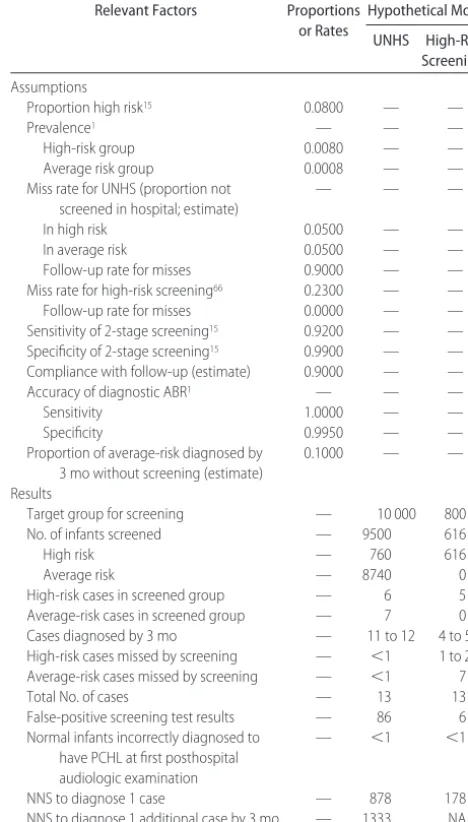
Although no studies directly compare the yields of uni-versal versus targeted screening approaches, estimates can be determined by applying results of relevant studies in an outcome table model (Table 3). Assumptions for the model include the proportion of newborns consid-ered high risk,15the prevalence of PCHL in populations at high and average risk,1the proportion not screened in the hospital,66the sensitivity of 2-stage screening,15the compliance with follow-up testing (estimated), the ac-curacy of diagnostic tests,1and the proportion of new-borns at average risk diagnosed with PCHL by 3 months (estimated). Assumptions in this model differ from those in the previous evidence review because they draw from recently published data of universal and targeted screen-ing.15,66 Using these assumptions, if 10 000 newborns underwent UNHS, there would be 11 to 12 diagnosed cases by 3 months of age, 86 false-positive screening test results, and possibly 1 missed case. The number needed to screen (NNS) to diagnose 1 case would be 878. If only newborns at high risk underwent screening, there would be 4 or 5 diagnosed cases, 6 false-positive screen-ing test results, and 8 or 9 missed cases. The NNS to diagnose 1 case would be 178.
DISCUSSION
Results of a community-based cohort study of children with PCHL indicated that those who had early versus
late confirmation and those who had UNHS versus none
had better language outcomes at 8 years of age.35 In
contrast, a community-based cohort study of children with hearing impairment who were exposed to risk-based newborn screening indicated no relationship be-tween age at diagnosis and language, speech, and read-ing measures at 7 to 8 years of age.36In this cohort, few children were diagnosed by 6 months of age and had the opportunity for early treatment.
No trials directly compare targeted screening with UNHS and report data about the initiation of early treat-ment for infants at average risk or those at high risk. Data from a large nonrandomized trial and descriptive studies indicate that infants at average and high risk with PCHL born in hospitals with UNHS have earlier referral and initiation of treatment than those born in hospitals
TABLE 3 Yield of Screening in a Hypothetical Cohort of 10 000 Newborns for Moderate-to-Profound PCHL
Relevant Factors Proportions or Rates
Hypothetical Model
UNHS High-Risk Screeninga
Assumptions
Proportion high risk15 0.0800 — —
Prevalence1 — — —
High-risk group 0.0080 — —
Average risk group 0.0008 — —
Miss rate for UNHS (proportion not screened in hospital; estimate)
— — —
In high risk 0.0500 — —
In average risk 0.0500 — —
Follow-up rate for misses 0.9000 — —
Miss rate for high-risk screening66 0.2300 — —
Follow-up rate for misses 0.0000 — —
Sensitivity of 2-stage screening15 0.9200 — — Specificity of 2-stage screening15 0.9900 — — Compliance with follow-up (estimate) 0.9000 — —
Accuracy of diagnostic ABR1 — — —
Sensitivity 1.0000 — —
Specificity 0.9950 — —
Proportion of average-risk diagnosed by 3 mo without screening (estimate)
0.1000 — —
Results
Target group for screening — 10 000 800
No. of infants screened — 9500 616
High risk — 760 616
Average risk — 8740 0
High-risk cases in screened group — 6 5
Average-risk cases in screened group — 7 0 Cases diagnosed by 3 mo — 11 to 12 4 to 5 High-risk cases missed by screening — ⬍1 1 to 2 Average-risk cases missed by screening — ⬍1 7
Total No. of cases — 13 13
False-positive screening test results — 86 6 Normal infants incorrectly diagnosed to
have PCHL at first posthospital audiologic examination
— ⬍1 ⬍1
NNS to diagnose 1 case — 878 178
NNS to diagnose 1 additional case by 3 mo — 1333 NA
NA indicates not applicable.
aHigh risk was defined by risk factors (family history of hearing impairment, perinatal infection,
without UNHS. The most impressive follow-up measures come from the most recently published studies, poten-tially reflecting refinements in screening techniques, sys-tem and process improvements, incorporation of UNHS as a routine practice, and increasing commitment to implementing successful programs in response to prac-tice and policy changes.
Studies of adverse effects of screening indicate that usual parental reactions to an initial nonpass include worry, questioning, and distress. Negative emotions re-solve for most parents when a diagnostic test is provided with a normal result. No studies addressed the adverse effects of delaying screening of PCHL. Now that practice standards exist, it would be difficult to conduct adequate comparison studies of early versus late initiation of treat-ment to evaluate both benefits and adverse effects.
A major limitation of the application of the key stud-ies in this update is that they were conducted outside of the United States. Although the methods of screening and the inpatient maternity experiences are likely simi-lar, the processes of referral, follow-up, and treatment would be expected to differ. Currently, there is no stan-dard method in the United States to track children through these processes to ultimately obtain language outcomes from a birth cohort, as was done in the United Kingdom study,35although approaches to do so are be-ing piloted. Factors influencbe-ing follow-up and treatment in the United States would need to be considered, as well as exposure to UNHS when determining long-term out-comes.
CONCLUSIONS
More studies of long-term functional outcomes related to UNHS are needed to support the findings of the United
Kingdom study.35 Although the United Kingdom study
reported important long-term benefits with UNHS for re-ceptive language, expressive language and speech out-comes were not better. Other functional outout-comes, such as school performance, social interactions, and quality of life, may be more relevant to children and their families. Future research should include these as well.
Results of this review indicate that infants identified with PCHL through UNHS have significantly earlier re-ferral, diagnosis, and treatment than those identified in other ways. Although the clinical community has ac-knowledged the significance of early treatment for many years, evidence of its effect on long-term functional out-comes has been limited. New data on improved language outcomes at school age strengthen the case for UNHS but are also dependent on effective methods of referral, fol-low-up, and treatment. As these needs are being ad-dressed with ongoing projects, further research will be required to demonstrate effectiveness for the entire pro-cess that UNHS initiates.
ACKNOWLEDGMENTS
This article is based on research conducted by the Oregon Evidence-based Practice Center under contract (290-02-0024) to the Agency for Healthcare Research and Quality (Rockville, MD).
We thank Dr Colin Kennedy (University of Southamp-ton, SouthampSouthamp-ton, United Kingdom), Kristi Sperry (audi-ologist, Providence Health and Services in Oregon), and Andrew Hamilton (librarian, Oregon Health and Science University) for important contributions to this project.
REFERENCES
1. Thompson DC, McPhillips H, Davis RL, Lieu TL, Homer CJ, Helfand M. Universal newborn hearing screening: Summary of evidence.JAMA.2001;286(16):2000 –2010
2. Helfand M, Thompson DC, Davis RL, McPhillips H, Homer CJ, Lieu TL. Newborn hearing screening: systematic evidence re-view. Available at: www.ncbi.nlm.nih.gov/books/bv.fcgi?rid⫽ hstat3.chapter.1787. Accessed September 22, 2006
3. US Preventive Services Task Force. Newborn hearing screening: recommendations and rationale. Available at: www. ahrq.gov/clinic/3rduspstf/newbornscreen/newhearrr.htm. Ac-cessed September 22, 2006
4. Joint Committee on Infant Hearing: American Academy of Audiology; American Academy of Pediatrics; American Speech-Language-Hearing Association; Directors of Speech and Hearing Programs in State Health and Welfare Agencies. Year 2000 position statement: principles and guidelines for early hearing detection and intervention programs.Pediatrics. 2000;106(4):798 – 817
5. American Academy of Pediatrics, Joint Committee on Infant Hearing. Year 2007 position statement: principles and guide-lines for early hearing detection and intervention programs.
Pediatrics.2007;120(4):898 –921
6. U.S. Department of Health and Human Services.Healthy People 2010: With Understanding and Improving Health and Objectives for
Inproving Health Services.Washington, DC: 2000
7. Vartiainen E, Kemppinen P, Karjalainen S. Prevalence and etiology of bilateral sensorineural hearing impairment in a Finnish childhood population. Int J Pediatr Otorhinolaryngol. 1997;41(2):175–185
8. Barsky-Firkser L, Sun S. Universal newborn hearing screenings: a three-year experience.Pediatrics.1997;99(6). Available at: www. pediatrics.org/cgi/content/full/99/6/e4
9. Mehl AL, Thomson V. The Colorado newborn hearing screen-ing project, 1992–1999: on the threshold of effective popula-tion-based universal newborn hearing screening. Pediatrics. 2002;109(1). Available at: www.pediatrics.org/cgi/content/ full/109/1/e7
10. National Information Center for Children and Youth with Dis-abilities.Deafness and Hearing Loss.Washington, DC: 2004. Pub-lication FS3
11. Davis A, Hind S. The impact of hearing impairment: a global health problem. Int J Pediatr Otorhinolaryngol. 1999;49(suppl 1):S51–S54
12. van Eldik TT. Behavior problems with deaf Dutch boys.Am
Ann Deaf.1994;139(4):394 –399
13. Vostanis P, Hayes M, Feu MD, Warren J. Detection of behav-ioural and emotional problems in deaf children and adolescents: comparison of two rating scales.Child Care Health Dev.1997;23(3):233–246
14. Fortnum HM, Davis A. Epidemiology of permanent childhood hearing impairment in Trent Region [published correction ap-pears inBr J Audiol. 1998;32(1):63].Br J Audiol.1997;31(6): 409 – 446.
15. Kennedy C, McCann D, Campbell MJ, Kimm L, Thornton R. Universal newborn screening for permanent childhood hear-ing impairment: an 8-year follow-up of a controlled trial. Lan-cet.2005;366(9486):660 – 662
permanent childhood hearing impairment. Lancet. 1998; 352(9145):1957–1964
17. Uus K, Bamford J. Effectiveness of population-based newborn hearing screening in England: ages of interventions and profile of cases.Pediatrics.2006;117(5). Available at: www.pediatrics. org/cgi/content/full/117/5/e887
18. Dalzell L, Orlando M, MacDonald M, et al. The New York State universal newborn hearing screening demonstration project: ages of hearing loss identification, hearing aid fitting, and enrollment in early intervention. Ear Hear. 2000;21(2): 118 –130
19. American Speech-Language Hearing Association. Newborns and infants. Available at: www.asha.org/public/hearing/ testing#newborns㛭and㛭infants. Accessed September 22, 2006 20. Vohr BR, Oh W, Stewart EJ, et al. Comparison of costs and
referral rates of 3 universal newborn hearing screening proto-cols.J Pediatr.2001;139(2):238 –244
21. Korres SG, Balatsouras DG, Gkoritsa E, Eliopoulos P, Rallis E, Ferekidis E. Success rate of newborn and follow-up screening of hearing using otoacoustic emissions.Int J Pediatr
Otorhino-laryngol.2006;70(6):1039 –1043
22. Windmill S, Windmill IM. The status of diagnostic testing fol-lowing referral from universal newborn hearing screening.
J Am Acad Audiol.2006;17(5):367–378, quiz 379 –380
23. Todd NW. Universal newborn hearing screening follow-up in two Georgia populations: newborn, mother and system corre-lates.Int J Pediatr Otorhinolaryngol.2006;70(5):807– 815 24. Moeller MP, White KR, Shisler L. Primary care physicians’
knowledge, attitudes, and practices related to newborn hearing screening.Pediatrics.2006;118(4):1357–1370
25. Govaerts PJ, De Beukelaer C, Daemers K, et al. Outcome of cochlear implantation at different ages from 0 to 6 years.Otol
Neurotol.2002;23(6):885– 890
26. Hammes DM, Novak MA, Rotz LA, Willis M, Edmondson DM, Thomas JF. Early identification and cochlear implantation: Critical factors for spoken language development. Ann Otol
Rhinol Laryngol.2002;189(suppl):74 –78
27. Manrique M, Cervera-Paz FJ, Huarte A, Molina M. Advantages of cochlear implantation in prelingual deaf children before 2 years of age when compared with later implantation.
Laryngo-scope.2004;114(8):1462–1469
28. Schauwers K, Gillis S, Daemers K, De Beukelaer C, Govaerts PJ. Cochlear implantation between 5 and 20 months of age: the onset of babbling and the audiologic outcome.Otol Neurotol. 2004;25(3):263–270
29. Sharma A, Martin J, Roland P, et al. P1 latency as a biomarker for central auditory development in children with hearing impairment.J Am Acad Audiol.2005;16(8):564 –573
30. Sharma A, Dorman M, Spahr A, Todd W. Early cochlear im-plantation allows for normal development of cortical auditory pathways. Ann Otol Rhinol Laryngol. 2002;111(5 pt 2 suppl 189):38 – 41
31. Sharma A, Dorman M, Spahr A. A sensitive period for the development of the central auditory system in children with cochlear implants: implications for age of implantation. Ear
Hear.2002;23(6):532–539
32. Harris RP, Helfand M, Woolf SH, et al. Current methods of the U.S. Preventive Services Task Force: a review of the process.
Am J Prev Med.2001;20(3 suppl):21–35
33. Nelson HD, Bougatsos CM, Nygren P.Universal Newborn Hear-ing ScreenHear-ing: Systematic Review to Update the 2001 US Preventive
Services Task Force Recommendation.Rockville, MD: Agency for
Healthcare, Research, and Quality; 2007. Available at: www. ahrq.gov/clinic/uspstf/uspstopics.htm#Ntopics. Accessed July 2008
34. Puig T, Municio A, Meda` C. Universal neonatal hearing screen-ing versus selective screenscreen-ing as part of the management of
childhood deafness. Cochrane Database Syst Rev. 2005;(2): CD003731
35. Kennedy CR, McCann DC, Campbell MJ, et al. Language abil-ity after early detection of permanent childhood hearing im-pairment.N Engl J Med.2006;354(20):2131–2141
36. Wake M, Poulakis Z, Hughes EK, Carey-Sargeant C, Rickards FW. Hearing impairment: A population study of age at diag-nosis, severity, and language outcomes at 7– 8 years.Arch Dis
Child.2005;90(3):238 –244
37. Apuzzo M, Yoshinaga-Itano C. Early identification of infants with significant hearing loss and the Minnesota child develop-ment inventory.Semin Hear.1995;16(2):124 –139
38. Calderon R, Naidu S. Further support of the benefits of early identification and intervention with children with hearing loss.
Volta Rev.2000;100(5):53– 84
39. Mayne AM, Yoshinaga-Itano C, Sedey A, Carey A. Expressive vocabulary development of infants and toddlers who are deaf or hard of hearing.Volta Rev.2000;100(5):1–28
40. Moeller MP. Early intervention and language development in children who are deaf and hard of hearing.Pediatrics. 2000; 106(3). Available at: www.pediatrics.org/cgi/content/full/106/ 3/e43
41. Yoshinaga-Itano C, Coulter D, Thomson V. Developmental outcomes of children with hearing loss born in Colorado hos-pitals with and without universal newborn hearing screening programs.Semin Neonatol.2001;6(6):521–529
42. Yoshinaga-Itano C, Coulter D, Thomson V. The Colorado New-born Hearing Screening Project: effects on speech and language development for children with hearing loss.J Perinatol.2000; 20(8 pt 2):S132–S137
43. Yoshinaga-Itano C, Apuzzo M. The development of deaf and hard of hearing children identified early through the high-risk registry.Am Ann Deaf.1998;143(5):416 – 424
44. Yoshinaga-Itano C, Apuzzo M. Identification of hearing loss after age 18 months is not early enough.Am Ann Deaf.1998; 143(5):380 –387
45. Yoshinaga-Itano C, Sedey A, Coulter DK, Mehl AL. Language of early- and later-identified children with hearing loss.
Pedi-atrics.1998;102(5):1161–1171
46. Joseph R, Tan HK, Low KT, Ng PG, Tunnel J, Mathew S. Mass newborn screening for hearing impairment.Southeast Asian J
Trop Med Public Health.2003;34(suppl 3):229 –230
47. Bailey HD, Bower C, Krishnaswamy J, Coates HL. Newborn hearing screening in Western Australia. Med J Aust. 2002; 177(4):180 –185
48. Harrison M, Roush J, Wallace J. Trends in age of identification and intervention in infants with hearing loss.Ear Hear.2003; 24(1):89 –95
49. Kennedy CR. Controlled trial of universal neonatal screening for early identification of permanent childhood hearing impairment: coverage, positive predictive value, effect on mothers and incremental yield. Wessex Universal Neonatal Screening Trial Group.Acta Paediatr Suppl.1999;88(432):73–75 50. Weichbold V, Welzl-Mueller K. Maternal concern about posi-tive test results in universal newborn hearing screening.
Pedi-atrics.2001;108(5):1111–1116
51. Poulakis Z, Barker M, Wake M. Six month impact of false positives in an Australian infant hearing screening programme.
Arch Dis Child.2003;88(1):20 –24
52. Crockett R, Wright AJ, Uus K, Bamford J, Marteau TM. Ma-ternal anxiety following newborn hearing screening: the mod-erating role of parents’ knowledge.J Med Screen.2006;13(1): 20 –25
54. Hergils L, Hergils A. Universal neonatal hearing screening; paren-tal attitudes and concern.Br J Audiol.2000;34(6):321–327 55. Russ SA, Kuo AA, Poulakis Z, et al. Qualitative analysis of
parents experience with early detection of hearing loss.Arch
Dis Child.2004;89(4):353–358
56. Vohr BR, Letourneau KS, McDermott C. Maternal worry about neonatal hearing screening.J Perinatol.2001;21(1):15–20 57. Bhatia K, Gibbin KP, Nikolopoulos TP, O’Donoghue GM.
Sur-gical complications and their management in a series of 300 consecutive pediatric cochlear implantations. Otol Neurotol. 2004;25(5):730 –739
58. Waltzman SB, Roland JT Jr. Cochlear implantation in children younger than 12 months.Pediatrics.2005;116(4). Available at: www.pediatrics.org/cgi/content/full/116/4/e487
59. Miyamoto RT, Houston DM, Bergeson T. Cochlear implanta-tion in deaf infants.Laryngoscope.2005;115(8):1376 –1380 60. Hehar SS, Nikolopoulos TP, Gibbin KP, O’Donoghue GM.
Sur-gery and functional outcomes in deaf children receiving co-chlear implants before age 2 years.Arch Otolaryngol Head Neck
Surg.2002;128(1):11–14
61. Reefhuis J, Honein MA, Whitney CG, et al. Risk of bacterial
meningitis in children with cochlear implants.N Engl J Med. 2003;349(5):435– 445
62. Biernath KR, Reefhuis J, Whitney CG, et al. Bacterial menin-gitis among children with cochlear implants beyond 24 months after implantation.Pediatrics.2006;117(2):284 –289
63. Schultz D. FDA public health notification: continued risk of bacterial meningitis in children with cochlear implants with a positioner beyond twenty-four months post-implantation. Available at: www.fda.gov/cdrh/safety/020606-cochlear.html. Accessed October 20, 2006
64. Burger T, Spahn C, Richter B, Eissele S, Lo¨hle E, Bengel J. Psy-chic stress and quality of life in parents during decisive phases in the therapy of their hearing-impaired children.Ear Hear. 2006;27(4):313–320
65. Incesulu A, Vural M, Erkam U. Children with cochlear implants: parental perspective. Otol Neurotol. 2003;24(4): 605– 611
DOI: 10.1542/peds.2007-1422
2008;122;e266
Pediatrics
Heidi D. Nelson, Christina Bougatsos and Peggy Nygren
US Preventive Services Task Force Recommendation
Universal Newborn Hearing Screening: Systematic Review to Update the 2001
Services
Updated Information &
http://pediatrics.aappublications.org/content/122/1/e266 including high resolution figures, can be found at:
References
http://pediatrics.aappublications.org/content/122/1/e266#BIBL This article cites 53 articles, 9 of which you can access for free at:
Subspecialty Collections
ine_sub
http://www.aappublications.org/cgi/collection/evidence-based_medic Evidence-Based Medicine
following collection(s):
This article, along with others on similar topics, appears in the
Permissions & Licensing
http://www.aappublications.org/site/misc/Permissions.xhtml in its entirety can be found online at:
Information about reproducing this article in parts (figures, tables) or
Reprints
DOI: 10.1542/peds.2007-1422
2008;122;e266
Pediatrics
Heidi D. Nelson, Christina Bougatsos and Peggy Nygren
US Preventive Services Task Force Recommendation
Universal Newborn Hearing Screening: Systematic Review to Update the 2001
http://pediatrics.aappublications.org/content/122/1/e266
located on the World Wide Web at:
The online version of this article, along with updated information and services, is
by the American Academy of Pediatrics. All rights reserved. Print ISSN: 1073-0397.