Original Research Article
Assessment of immunization status of 12 to 23 months old
children in rural Patna
Ayesha K. Rahman
1, Jamil Raazi
2*
INTRODUCTION
For immunization to be effective in decreasing the cases of Vaccine Preventable Diseases (VPDs) and deaths, every child needs to be fully immunized.1 According to UNICEF, VPDs cause an estimated 2 million deaths or more every year, of which 1.5 million deaths occur among children below 5 year.2 About 29% deaths in children 1-59 months of age are vaccine preventable (World Health Organization, 2012). Immunization currently averts an estimated 2-3 million deaths every year in all age groups from diphtheria, tetanus, pertussis and measles.3 Recognized as one of the most powerful public health interventions, immunization is the key
driving force behind efforts to meet the Millenium Development Goals (MDGs).
WHO launched expanded programme of immunization (EPI) in 1974 to develop and expand immunization programme around the world.4
In 1978, Immunization Programme in India was started as EPI. The programme gained momentum in 1985 as Universal Immunization Programme (UIP) and expanded to cover all the districts in the country by 1989-90 in phased manner. Since 1992, UIP has been the part of child survival and safe motherhood (CSSM). The immunization activities have been an important component of National Reproductive and Child Health
ABSTRACT
Background: For immunization to be effective in decreasing the cases of vaccine preventable diseases and deaths, every child needs to be fully immunized. The present study was conducted with an objective to assess the immunization status and vaccination coverage of 12-23 months old children in the rural areas of Patna district.
Methods: A community-based cross-sectional survey was conducted in the rural areas of Patna. The study was conducted using 30 cluster technique. The proforma designed by UNICEF was used as a study tool.
Results: The vaccination coverage for bacille calmette guerin, pentavalent 1, 2 and 3 and measles were respectively 93.63%, 98.18%, 90%, 84.54% and 76.36%. The proportions of fully immunized children were 80.90%, partially immunized 19.10% and no unimmunized children. The dropout rate was 9.7% for DPT3, 14.56% for BCG-Measles and 13.83% for DPT1-DPT3.
Conclusions: Although the vaccination coverage shows higher coverage but the dropout rates are still more than acceptable standards.
Keywords: Immunization status, Rural Patna, 12-23 months old children
1Department of Community and Family Medicine, All India Institute of Medical Sciences, Patna, Bihar, India 2Department ofCommunity Medicine, Saraswati Medical College, Unnao, Uttar Pradesh, India
Received: 16 November 2019
Revised: 13 December 2019
Accepted: 16 December 2019
*Correspondence:
Dr. Jamil Raazi,
E-mail: [email protected]
Copyright: © the author(s), publisher and licensee Medip Academy. This is an open-access article distributed under the terms of the Creative Commons Attribution Non-Commercial License, which permits unrestricted non-commercial use, distribution, and reproduction in any medium, provided the original work is properly cited.
Programme since 1997. At present, immunization is among the important area under NRHM, which was launched in 2005. The immunization coverage has seen an improvement over the years. However, there is a further need for improvement especially in DPT3 and OPV3 coverage and reducing drop-outs.5 India has one of the largest UIP in the world in terms of quantities of vaccines used, number of beneficiaries (27 million infants and 30.2 million pregnant women) covered, geographical spread and manpower involved6. India spends more than 2,000 crore every year in immunization programme to immunize the children against VPDs including Polio Eradication Programme.6
The efficacy of a single dose of OPV given within 7 days of birth as studied by different workers is reported to be 30-42.3% when OPV is given at < 3 days. When the 3 doses were given at 4-week interval starting at 7 days of age, the seroconversion rates were 70-85%, being almost similar to those achieved with three doses given at 6 weeks, 10 week and 14 weeks. The zero-dose given in addition to three doses at 6, 10 and 14 weeks gave a seroconversion of 75-90% to the three types of poliovirus showing the additional doses given at birth, only gives a marginal advantage over the conventional three doses.7
The antibody levels following the fourth primary (or the first booster) of DPT at 18 months of age progressively decline. Protective effect of the vaccine declines with age from 100% at one year to about 42% at 7 year. In areas of high endemicity like India, natural infections may keep boosting the antibody levels.7
The seroconversion rate is around 97% with measles vaccination at 9-11 month of age. In 1995, an EPI policy paper published an updated schedule that added yellow fever vaccination for selected countries at risk, and hepatitis B vaccine for all. In an attempt to co-ordinate the use of HBV with other UIP vaccines, a study was carried out using three doses of HBV at 0, 6 and 14 weeks. Ninety-five percent sero-conversion was seen and no case of vaccine failure was reported.7 The drop-out rates from completion of scheduled immunization is one of the ways to monitor the immunization services. The performance of immunization programme in Bihar was revealed to be worse than the national level.8
The present study was conducted to assess the immunization status of 12-23 months old children in the rural areas of Patna district with objective to assess the immunization status and vaccination coverage of 12-23 months old children in the rural areas of Patna district.
METHODS
This cross-sectional study was conducted in the rural areas of Patna, Bihar from January to March 2018. The 30 clusters proposed by the World Health Organization (WHO) is a standard method for rapid assessment of coverage evaluation. Measuring and evaluating
vaccination coverage not only gives the true picture of the vaccination status of the target population but also indicates trends in the vaccination at the earliest to take appropriate and timely action. It actually reflects the vaccination performance of the preceding year.
The cluster sampling technique was used to collect data from the households of selected clusters. Using convenience sampling, a PHC was selected for the purpose of study. Using simple random sampling, 9 villages were selected. Each village was divided into four quadrants, each representing one cluster. The first household was selected randomly by selecting directions from the central point of the village by spinning a pencil. When the pencil stopped, the direction indicated by the tip was selected. The first household to be interviewed was selected at random and subsequent households were considered with children aged 12-23 months in the respective quadrants. The informed consent from the study participants was taken. The sample size estimation was according to WHO 30 cluster sampling technique for coverage evaluation survey, the sample size is 210, i.e. 7 children from each cluster. The present study however included a total of 110 children aged 12-23 months, either because of unavailability of the child or refusal to participate in the study.
Inclusion criteria
Children between 12-23 months on the day of survey were selected for the study.
Exclusion criteria
The children unavailable at the time of study and those who refused to participate in the study were excluded.
After the informed consent, a structured, pre-tested questionnaire designed by UNICEF was used after necessary modifications for recording the information. An effort was made to collect data from maximum number of children during the available time period and 110 children were included. The information was assessed primarily from the immunization card. If card was unavailable, the information was gathered by directly asking the mothers / guardians after their informed verbal consent.
Operational definitions
Fully immunized
The child who received BCG, three doses of Pentavalent and 1 dose of measles vaccine plus first dose of vitamin A.
Partially immunized
Unimmunized
The child who never received any vaccination.
Formulae used to calculate the drop- out rates in Immunization
Penta 1-Penta 3 = (No. of children who received penta1-No. of children who received penta 3)×100/No. of children who received penta 1.
Measles = (No. of children who received BCG-No. of children who received Measles) × 100/BCG-No. of children who received BCG.
Penta1-Measles = (No. of children who received penta1-No. of children who received Measles)×100/No. of children who received penta 1.
Statistical analysis
The data was entered in the software, SPSS version 22.0 to analyze the data.
RESULTS
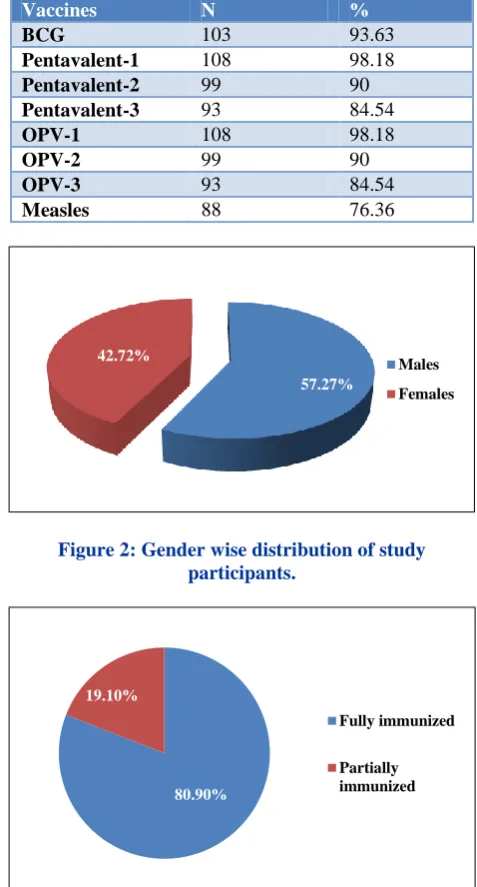
In the present study, there were 63 (57.27%) males and 47 (42.72%) females.
Out of a total of 110 children, 91 children had vaccination card, of which 73 had government cards while 18 had private vaccination card and 19 were without the card (Figure 1).
Figure 1: Availability of vaccination card.
The vaccine-wise coverage is shown in Table 1. Out of 110 children, 103 (93.63%) had received BCG vaccine while 108 children had received Penta-1 and OPV1 vaccines. But Penta-3 and OPV3 vaccines were given in 93 children (84.54%). Measles vaccine with 1st dose of vitamin A was given 88 (76.36%) children. Table 2 shows that the vaccine dropout rate of DPT1- Measles was the highest i.e. 18.51% followed by BCG-Measles (14.56%).
Table1: Vaccine-wise coverage of study population (n=110).
Vaccines N %
BCG 103 93.63
Pentavalent-1 108 98.18
Pentavalent-2 99 90
Pentavalent-3 93 84.54
OPV-1 108 98.18
OPV-2 99 90
OPV-3 93 84.54
Measles 88 76.36
Figure 2: Gender wise distribution of study participants.
Figure 3: Immunization status of study participants.
Table 2: Dropout rates in routine immunization.
Dropout rates in the Immunization
BCG-Penta3 9.7%
BCG-Measles 14.56%
Penta 1- Penta3 13.83%
Penta1-Measles 18.51%
The immunization status of these children shows that 89 (80.90%) children were fully immunized and 21 (19.09%) were partially immunized (Figure 3). No single unimmunized child was found. There were many reasons found for partial immunization. The most common reason was casual attitude towards the immunization.
82.72% 17.27%
Yes
No
57.27% 42.72%
Males
Females
80.90% 19.10%
Fully immunized
DISCUSSION
The present study was conducted on 110 children. There were 63 (57.27%) males and 47 (42.72%) females. In a study conducted at rural Ahemdabad, they also found male children 63 (52.5%) more than female children 57 (47.5%).9
In the present study, out of a total of 110 children, 91 children had vaccination card, of which 73 had government cards while 18 had private vaccination card and 19 were without the card. This suggests that the majority availed the government facility for immunization. Only 17.27% did not possess the vaccination card, which suggests that the people are aware about the importance of immunization and for keeping its record. Similarly, in a study conducted at Gandhinagar, 77.7% of the respondents reported having a card.10
Of the total, 93.63% had received BCG vaccine while around 98% children had received Penta-1 and OPV1 vaccines. But Penta-3 and OPV3 vaccines were given in 84.54%. Measles vaccine with 1st dose of vitamin A was given in 76.36% children. The vaccine dropout rate of DPT1- Measles was the highest i.e. 18.51% followed by BCG-Measles (14.56%). In a study at rural Ahemdabad by Govani KJ et al, 98% had taken BCG vaccine and BCG scar was seen in 91.2%.9 All the children had received DPT1 and OPV1 vaccines. But DPT3 and OPV3 vaccines were taken in 80%. Measles vaccine with 1st dose of vitamin A was given to 101 children. Vaccine dropout of DPT1-3 and OPV1-3 was highest i.e. 20% followed by BCG-DPT3 (18.6%) and DPT1-measles (16%). The drop-out rate of >10% is considered poor utilization of the immunization services. In a study conducted in Surat, the coverage was the highest for BCG (75.1%) and lowest for measles (29.9%).11 Coverage for DPT3 and OPV3 was almost the same (48.6% and 47.9%). Only 85 (28.9%) received vitamin A supplements at the time of measles vaccination.
In this study, 80.90% children were fully immunized and 19.09% were partially immunized. No single unimmunized child was found. In a study done at Gandhinagar, 79.55% were fully immunized and 11 (4.16%) were not immunized at all. The remaining 16.29% were partially immunized. The dropout rate was highest for BCG-Measles (>10%) while other dropout rates were below 10%. The vaccination coverage and immunization status in the rural areas of Patna is better possibly because of the supportive supervision of routine immunization aided by UNICEF.
Although, the drop-out rates in the subsequent vaccines is more than 10% except in BCG- Penta 3 which suggests that with the passage of time, the respondents become casual in their attitude towards vaccination despite their awareness and importance about the vaccination.
CONCLUSION
The vaccination coverage shows good access to services (coverage >80%) but at the same time reflects poor utilization (dropout rate >10%).
Recommendations
As the retention of card for vaccination is an important determinant during the survey, health functionaries must act proactively to deliver the 4 key messages to every mother/caretaker. Coverage surveys can be done on a periodic basis to improve the coverage and to reduce the dropouts.
Funding: No funding sources Conflict of interest: None declared Ethical approval: Not required
REFERENCES
1. Immunization Module: Monitoring your Immunization Programme Available at: https://www.open.edu/openlearncreate/mod/ouconte nt/view.php?Id=53371&printable=1. Accessed on 3 June 2019.
2. Patra N. Universal Immunization Programme In India: The Determinants of Childhood Immunization. Elsevier. 2006.
3. WHO/UNICEF coverage estimates 2013 revision, July 2014. Available at: http://apps.who.int/ immunization_monitoring/globalsummary/timeserie s/tswucoveragebcG.html. Accessed on 3 June 2019. 4. Drain PK. Vaccine Preventable Diseases and
Immunization Programs. Global Health Education Consortium (GHEC): World Health organization (WHO). 2012;2004.
5. Annual Report 2010-11, Department of Health and Family Welfare, Ministry of Health and Family Welfare. GoI. 2012;71-72.
6. A Park’s Textbook of Preventive and Social Medicine, K. Park 21st edition. Handbook for vaccine and cold chain Handlers 2010, Department of Health and Family Welfare, MoHFW. Immunization in Practice: A Practical Resource Guide for Health Workers, Geneva, WHO, 2004. Available at: www.who.int/vaccinedocuments / Dox Trng/h4iip.htm. India National Universal Immunization Programme Review, New Delhi, UNICEF_WHO, 2004. Available at: http://www.who.india.org/LinkFiles/ Rotine_Imm unization_Acknowledgements_contents.pdf.
Accessed 12 October 2019.
7. Sutter RW. Immunogenicity of bivalent types 1 and 3 oral poliovirus vaccine: a randomised, double-blind, controlled trial. Lancet. 2010;376(9753):1682-8.
/R309_UNICEF_2010_INDIA_2009 Coverage Survey.pdf. Accessed 12 October 2019.
9. Govani KJ, Sheth JK, Bala DV. Immunization status of 12-23 months children in rural Ahmedabad. Healthline J. 2013;4(1):38-42.
10. Sheth JK, Trivedi KN, Mehta JB, Oza UN. Assessment of vaccine coverage by 30 clusters sampling technique in Rural Gandhinagar, Gujarat. Natl J Community Med. 2012;3(3):496-501.
11. Sharma R, Desai VK, Kavishvar A. Assessment of immunization status in the slums of Surat by 15 clusters multi indicators cluster survey technique. Indian J Comm Med. 2009;34(2):152.