Modern Techniques to Attain Smart Vehicular
Schemes using Embedded Systems
I
Dr. S.R.BOSELIN PRABHU,
IIN.BALAKUMAR,
IIIA.JOHNSON ANTONY
IAssistant Professor, Dept. of Electronics and Communication Engineering, SVS College of Engineering, Coimbatore, India.
IIAssistant Professor, Dept. of Electrical and Electronics Engineering, Tamilnadu College of Engineering, Coimbatore, Tamilnadu, India. IIIAssistant Professor, Dept. of Electrical and Electronics Engineering,
Karpagam Institute of Technology, Coimbatore, Tamilnadu, India.
I. Introduction
Intelligent transport systems vary in technologies applied, from
basic management systems such as car navigation; traffic signal
control systems; container management systems; variable message signs; automatic number plate recognition or speed cameras to monitor applications, such as security CCTV systems; and to more advanced applications that integrate live
data and feedback from a number of other sources, such as parking guidance and information systems; weather information; bridge de-icing (US deicing) systems; and the like. Additionally, predictive techniques are being developed to allow advanced modelling and comparison with historical baseline data. Some of these technologies are described in the following sections. When the internal combustion engine, and later the automobile, was
first introduced to the public, no one could have seen the extent to which they would influence daily life. Today, with information
age in full swing, it is still hard to believe the way that computers and other information technology have permeated people’s lives
and seems only natural to expect information technologies to
enhance the way we view automobiles.
People now take for granted automotive systems like emission control and fuel injection. Recent advances in vehicle electronics have led to a move towards fewer, more capable computer processors on a vehicle. A typical vehicle in the early 2000s would have between 20 and 100 individual networked microcontroller/ Programmable logic controller modules with non-real-time operating systems. The current trend is toward fewer, more costly microprocessor modules with hardware memory management and real-time operating systems. The new embedded system platforms allow for more sophisticated software applications to be implemented, including model-based process control,
artificial intelligence, and ubiquitous computing. Perhaps the
most important of these for Intelligent Transportation Systems
is artificial intelligence. In fact, many people do not realize
many systems inside their automobile are already monitored and controlled by computers. Fuel delivery, ignition, emission,
air-conditioning, and automatic transmission system are example
of the systems used daily by a car that are computer controlled
or assisted. An articulation of automated car is shown in figure 1.Now in the information age, people have come to realize on the
Abstract
The technical challenges that remain to be mastered to be involve software safety, fault detection, a malfunction management. The state of the art of software design not yet sufficiently advanced to support the development of software that can be guaranteed to perform correctly in safety–critical application has complex road vehicle automation excellent performance of automated vehicle control system has been proven under normal operating conditions, in the absence of failures. Elementary fault detection and mall function management systems have already being implemented to address the most frequently encounter fault conditions, for use by well-trained test drivers. However, commercially implemented will need to address all realistic scenarios and provide safe responses even when the driver is a completely untrained member of the general public. Significant efforts are still needed to develop system hardware and software designs that can satisfy these requirements. The non-technical challenges involve issues of liability, costs, and perception. Automated control of vehicles shifts liability for most crashes from the individual driver (and his or her insurance company) to the designer, developer and vendor of the vehicle and roadway control systems. Provided the system is indeed safer than today’s driver-vehicle highway system, overall liability exposure should be reduced. But its costs will be shifted from automobile insurance premiums to the purchase or lease price of the automated vehicle and toll for use of the automated highway facility. All new technologies tend to be costly when they become available in small quantities, then their costs decline as production volumes increase and the technologies nature. We should expect vehicle automation technologies to follow the same patter. They may initially be economically viable only for heavy vehicles (transit buses, commercial trucks) and high-end passenger cars. However, it should not take long for the costs to become affordable to a wide range of vehicle owners and operators, especially with many of the enabling technologies already being commercialized for volume production today .It is important to recognize that automated vehicles are already carrying millions of passengers every day. Most major airports have automated people movers that transfer passengers among terminal buildings. Urban transit lines in Paris, London, Vancouver, Lyon and Lillie, among others, are operating with completely automated, driverless vehicles; some have been doing so for more than a decade. Modern commercial aircraft operate on autopilot for much of the time, and they also land under automatic control at suitably equipped airports on a regular basis. The main goal of this paper is to make the experience of driving less burdensome and accident less, especially on long trips. This can be achieved by making the highway itself part of the driving experience and integrating roadside technologies that would allow the overburdened highway system to be used more efficiently.
Keywords
other driver assistance technologies, such as mobile phones and in-vehicle navigation systems.
Fig.1: Smart Transportation
The goal of these technologies is to make the experience of
driving fewer burdens, especially on long trip. Even when cars were still young, future began to think about vehicles that could dive themselves without human help. Perhaps the best known of these conjectures was the “General Motor Futurama” the hit of the 1939 New York World’s Fair [2]. During the following decades interest in automated vehicles rose and fell several times. Now at the start of the new century, its worth taking a fresh look at this concept and asking how automation might change transportation and the quality of our lives. Automating the process of driving is
a complex endeavor. Advancements in information technology of the past decade have contributed greatly, and research specifically
devoted to the design of automated highway system has many
specific contributions. These progresses make it possible for us
to formulate operational concepts and prove out the technologies that can implement them.
II. Review of Literature
We can now readily visualize your trip on an automated highway
system. Imagine, leaving work at the end of the day and needing to drive only as far as the nearest on-ramp to the local automated highway. At on-ramp you press a button on your dashboard to
select the off-ramp close to your home and then relax as your car’s
electronic systems, in cooperation with roadside electronics and similar systems on other cars, guide your car smoothly, safely and effortlessly towards your destination [3]. En-route you save time
by maintaining full speed even at rush-hour traffic volumes. At
the end of the off-ramp you resume normal control and drive the remaining distance to your home, better rested and less stressed than if you had driven the entire way. The same capability can also be used over longer distances, e.g. for family vacations that
leave everybody, including the “DRIVER” relaxed and
well-rested even after a lengthy trip in adverse weather. Although many different technical developments are necessary to turn this image
into reality, none requires exotic technologies, and all can be
based on systems and components that are already being actively developed in the international motor vehicle industry. These could be viewed as replacements for the diverse functions that drives perform every day: observing the road, observing the preceding vehicles, steering, acceleration, braking, and deciding when and where to change course.
III. Surveillance of The Road
Cheap permanent magnets are buried at four-foot intervals along the lane centerline and detected by magnetometers mounted under the
vehicle’s bumpers. The magnetic-field measurements are decoded
to determine the lateral position and height of each bumper at accuracies of less than a centimeter. In addition the magnet’s orientations (either North Pole or South Pole up) represent a binary code [4] (either 0 or 1), and indicate precise milepost location along the road geometry features such as curvature and grade. The software in the vehicle’s control computer uses this information to determine the absolute position of the vehicle, as well as to anticipate upcoming changes in the roadway [6-15].
Other researchers have used computer vision system to observe the road. These are vulnerable to weather problems and provide less accurate measurements, but they do not require special roadway installations, other than well-maintained lane markings. Both automated highway lanes and intelligent vehicles will require special sensors, controllers and communications devices to
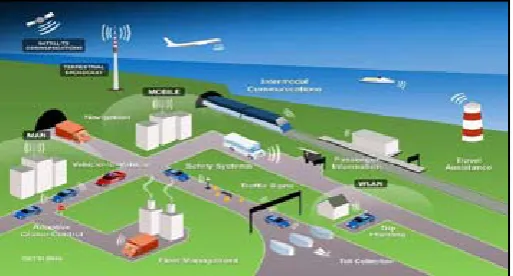
coordinate traffic flow. A national automated highway consortium is depicted in figure 2.
Fig. 2: Smart Cities of The Future
IV. Activities on Observation
The distance and closing rates to preceding vehicles can be
measured by millimeter-wave radar or a laser rangefinder. Both
technologies [5] have already been implemented in commercially available adaptive cruise control system in Japan and Europe. The
laser systems are currently less expensive, but the radar systems are
more effective at detecting dirty vehicles and operating in adverse weather conditions. As production volumes increase and unit costs
decrease, the radars are likely to find increasing favour.
V. Research Challenges
The equivalents of these driver muscle functions are electromechanical actuators installed in the automated vehicle. They receive electronic commands from the onboard control computer and then apply the appropriate steering angle, throttle angle, and brake pressure by means of small electric motors.
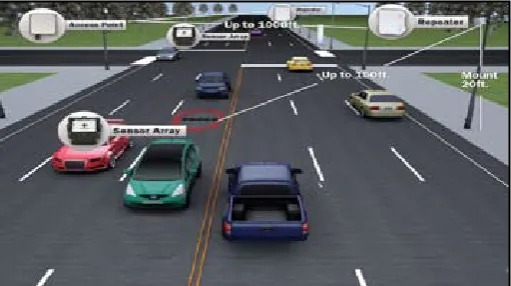
A sketch of automated communication is given in figure 3.
Early versions of these actuators are already being introduced into production vehicles, where they receive their commands directly from the driver’s inputs to the steering wheel and pedals. These decisions are being made for reasons largely unrelated to automation. Rather they are associated with reduced energy
consumption, simplification of vehicle design, enhanced case of
Fig. 3: MEMS sensor solutions
Computers in the vehicles and those at the roadside have different functions. Roadside computers are better suited for traffic management, setting the target speed for each segment and lane of roadway, and allocating vehicles to different lanes of a multilane
automated facility. The aim is to maintain balanced flow among
the lanes and to avoid obstacles or incidents that might block a lane. The vehicle’s onboard computers are better suited to handling
decisions about exactly when and where to change lanes to avoid
interference with other vehicles.
Some additional functions have no direct counterpart in today’s driving. Most important, wireless communication technology makes it counterparts in adjoining vehicles. This capability enables vehicles to follow each other with high accuracy and safety, even at very close spacing, and to negotiate cooperative maneuvers such as
lane changes to increase system efficiency and safety. Any failure
on a vehicle can be instantly known to its neighbors, so that they can respond appropriately to avoid possible collisions.
In addition there should be electronic ”check -in “ and
“check-out “ stations at the entry and exit points of the automated lane,
somewhat analogous to the toll booths on close where you
a ticket at the entrance and then pay a toll at the exit ,based
on how far you travel on the road at checking station ,wireless communication between vehicles and road side would verify that the vehicle is in proper operating condition prior to its entry to the automated line .similarly, the check out system would seek
assurance of the drivers readiness to resume control at the exit the traffic management system for an automated highway would also have broader scope than today’s traffic systems, because it
would select an optimal route for every vehicle in the system ,continuously balancing travel demand the system capacity ,and directing vehicles to follow those routes precisely [25-29]. Most of the functions have already been implemented and tested
in experimental vehicles. All except for check-in, check-out and traffic management were implemented in the platoon-scenario demonstration vehicles of demo’97 .a single116 megahertz Pentium
computer handled all the necessary in vehicle computation for sensing , control and communications .
VI. Research Insights
The technical challenges that remain to be mastered to be involve software safety, fault detection, a malfunction management. The
state of the art of soft ware design not yet sufficiently advanced to
support the development of soft ware that can be guaranteed to
perform correctly in safety–critical application has complex road vehicle automation excellent performance of automated vehicle
control system has been proven under normal operating conditions,
in the absence of failures. Elementary fault detection and mall function management systems have already being implemented to address the most frequently encounter fault conditions, for use by well trained test drivers. However, commercially implemented will need to address all realistic scenarios and provide safe responses even when the driver is a completely untrained member
of the general public. Significant efforts are still needed to develop
system hardware and software designs that can satisfy these requirements.
VII. Design Clallenges
The non technical challenges involve issues of liability, costs, and perception. Automated control of vehicles shifts liability for most crashes from the individual driver (and his or her insurance company) to the designer, developer and vendor of the vehicle and roadway control systems. Provided the system is indeed safer than
today’s driver-vehicle highway system, overall liability exposure
should be reduced. But its costs will be shifted from automobile insurance premiums to the purchase or lease price of the automated vehicle and toll for use of the automated highway facility.
All new technologies tend to be costly when they become available in small quantities, then their costs decline as production volumes
increase and the technologies nature. We should expect vehicle
automation technologies to follow the same patter. They may initially be economically viable only for heavy vehicles (transit buses, commercial trucks) and high-end passenger cars. However, it should not take long for the costs to become affordable to a wide range of vehicle owners and operators, especially with many of the
enabling technologies already being commercialized for volume production today .It is important to recognize that automated
vehicles are already carrying millions of passengers every day. Most major airports have automated people movers that transfer passengers among terminal buildings. Urban transit lines in Paris, London, Vancouver, Lyon and Lillie, among others, are operating with completely automated, driverless vehicles; some have been doing so for more than a decade. Modern commercial aircraft operate on autopilot for much of the time, and they also land under automatic control at suitably equipped airports on a regular basis [28-36].
Given all of this experience in implementing safety-critical
automated transportation systems, it is not such a large leap to develop road vehicles that can operate under automatic control on their own segregated and protected lane. That should be a
realistic goal for the next decade. The transportation system will thus gain substantial benefits from the revolution in information
technology.
VIII. Major Components
The IR proximity detector uses same technology found in a
TV remote control device. The detector sends out modulated
infra-red light, and looks for reflected light coming back. When
enough light is received back to trigger the detector circuit, the circuit produces a high on the output line. Light in the form of a continuous string of bursts of modulated square waves. Bursts alternate between left and right LEDs. A microprocessor generates the bursts, and correlates the receiver output to burst. The IRPD had used Panasonic Pna4602M IR sensor coupled with two IR LEDs to detect obstacles. The Panasonic module
contains integrated amplifiers, filters and limiter. The detector
noise associated with sunlight and certain lighting fixtures. The
LEDs are modulated by an adjustable free running oscillator. The sensitivity of the sensor is controlled by altering the drive current to LEDs. The microcontroller alternatively enables the LEDs end
checks for a reflection. As provided from the microcontroller one
for enabling the left IR LED the second for enabling the righter LED. A third analog output from the IRPDKIT is connected to an
analog-to-digital convertor. The detector is an infrared reflective
sensor that can be attached to the front of the car to follow a white line on a black background, or vice versa.
There are three reflective sensors, which are made from one piece
of infrared LED and photo detector that are directed at the surface
bellow the vehicle. Each of the sensors looks reflected IR light.
When one of the sensors is positioned over dark or black surface its output will be high. The line detector works effectively when thickness ranged between “1/4 to 3/4” the track can be white tape on a black background or black tape on a white background.
The sensor can be at a maximum height of .5 inches above the
ground. The three IR-Detector pairs are depicted on the right of the circuit diagram. The base of each of the transistors is passed through an inverter. The lines from the inverter are passed to microcontroller and to the LEDS indicating the position of the detector on the road. As the emitted light from the IR LED is
reflected from the road back to the transistor the current starts flowing through the emitter making the base low. The base
is connected to the inverter which causes the line to go at its output. Since the output lines are also connected to the LEDs the corresponding LED glows when the particular output line is high.
IX. Major Devices
A servo comprises of control, a set of gears, a potentiometer is connected to the motor via gear set a control signal gives the motor a position to rotate to and the motor starts to turn. The potentiometer rotates with motor and as it does so it does so its resistance changes. The control circuit monitors its resistance, as soon as its reaches its appropriate values the motor stop and
the servo is in correct position. A servo is a classic example of
a closed loop feedback system. The potentiometer is coupled to the output gear. Its resistance is proportional to the position of the servo’s output shaft (0 to 180 degrees)
X. Conclusion
National Highway Traffic and Safety Administration is an ongoing
research on collision avoidance and driver/vehicle interfaces. AHS was a strong public/private partnership with the goal to build a prototype system. There are many things that can be done in the vehicle, but if we do some of them on the roadway it will
be more efficient and possibly cheaper. Preliminary estimates
show that rear-end, lane-change, and roadway-departure crash-avoidance systems have the potential to reduce motor-vehicle
crashes by one-sixth or about 1.2 million crashes a year. Such
systems may take the form of warning drivers, recommending control actions, and introducing temporary or partial automated
control in hazardous situations. AHS described in this paper is
functional there is much room for improvement. More research
is needed to determine if any dependencies exit that influence
velocity of the vehicle maintaining proper following distance while following a path. Assuming such system is ever perfected, one would imagine it would tend to render the great tradition of the free-ranging car into something approaching mass –transit. Future
works will be concentrated on developing a real-time hardware for this proposed system.
References
[1] M. A. Al-Mohammed, Onur Toker, Abdulkhalik Al-Harthy, “A 3-D Vision based Man-Machine Interface for Hand-Controlled Tele-Robot, “ Transactions on Industrial Electronics, vol. 52, pp.306-319, February 2005
[2] R S Ramakrishna, chang wook Ahn, “A Genetic Algorithm for shortest path (sp) routing problem and the sizing of populations “Transactions and Evolutionary Computation, vol, 6,pp. 566-579,December 2002.
[3] Ching-tang Hsieh, mu-Chun Su, Eugene Lai,” A segmentation method for continuous speech utilizing hybrid Neuro Fuzzy Network,” Journal of information science and engineeringpp.615-628, January 1999.
[4] Emanuele Menegatti, Enzo Mumolo, Massimiliano Nolichi, Enrico Pagello,” a surveillance system based on audio and video sensory agents cooperating with a mobile robot,” Italian national council of research, 2003.
[5] Hamid Ali Abed Al-Asadi, “Temperature dependence of the lasing characteristics of vertical cavity surface emitting lasers,” Engineering Journal of Technology University, Vol. 145, 1994.
[6] Boselin Prabhu S.R. and Sophia S., “Environmental monitoring and greenhouse control by distributed sensor Network”, International Journal of Advanced Networking and Applications, 5(5), 2014.
[7] Boselin Prabhu S.R. and Sophia S., “Greenhouse control using wireless sensor network”, Scholars Journal of Engineering and Technology, 2(4), 2014.
[8] Hamid Ali Abed Al-Asadi, “Temperature dependence of the noise characteristics of Multiisection semiconductor lasers,” Science Journal, vol. 7, No. 3, 2001.
[9] Hamid Ali Abed Al-Asadi, “Linewidth characteristics of vertical cavity surface emitting lasers due to external optical feedback,” Science Journal, vol. 8, 2001.
[10] Boselin Prabhu S.R. and Sophia S., ‘Modern cluster integration of advanced weapon system and wireless sensor based combat system’, Scholars Journal of Engineering and Technology, 2(6A), 2014.
[11] Boselin Prabhu S.R. and Sophia S., ‘A review of efficient information delivery and clustering for drip irrigation management using WSN’, International Journal of Computer Science and Business Informatics, 14(3), 2014.
[12] Hamid Ali Abed Al-Asadi, “Linewidth characteristics of vertical cavity surface emitting lasers due to external optical feedback,” Science Journal, vol. 8, 2002.
[13] Hamid Ali Abed Al-Asadi, “Theoretical investigation of spectral linewidth properties of double fused 1.3 um MQW-VCA in reflection and transition modes,” Tikrit Journal for Pure Science, vol. 8, No. 2, 2002.
[14] Boselin Prabhu S.R. and Sophia S., ‘Mobility assisted dynamic routing for mobile wireless sensor networks’, International Journal of Advanced Information Technology, 3(3), 2013.
[15] Boselin Prabhu S.R. and Sophia S., ‘A review of energy efficient clustering algorithm for connecting wireless sensor network fields’, International Journal of Engineering Research and Technology, 2(4), 2013.
cavity length dependence the saturation power and quantum efficiency,” Tikrit Journal of Pure Science, vol. 9, No. 2, 2003.
[17] Hamid Ali Abed Al-Asadi, “Effects of pump recycling technique on stimulated Brillouin scattering threshold: A theoretical model,” Optics. Express, Vol. 18, No. 21, pp. 22339-22347 Impact factor: 3.88, 2010.
[18] Boselin Prabhu S.R. and Sophia S., ‘Variable power energy efficient clustering for wireless sensor networks’, Australian Journal of Basic and Applied Sciences, 7(7), 2013. [19] Boselin Prabhu S.R. and Sophia S., ‘Capacity based clustering
model for dense wireless sensor networks’, International Journal of Computer Science and Business Informatics, 5(1), 2013.
[20] Hamid Ali Abed Al-Asadi, “Brillouin Linewidth Characterization in Single Mode Large Effective Area Fiber through the Co-Pumped Technique,” International Journal of Electronics, Computer and Communications Technologies (IJECCT), Vol. 1(1), pp. 16-20, 2010.
[21] Boselin Prabhu S.R. and Sophia S., ‘An integrated distributed clustering algorithm for dense WSNs’, International Journal of Computer Science and Business Informatics, 8(1), 2013.
[22] Boselin Prabhu S.R. and Sophia S., ‘A research on decentralized clustering algorithms for dense wireless sensor networks’, International Journal of Computer Applications, 57(20), 2012.
[23] Hamid Ali Abed Al-Asadi, “Analytical study of nonlinear phase shift through stimulated Brillouin scattering in single mode fibre with pump power recycling technique,”, Volume 13 Number 10, Journal of Optics. Impact factor: 1.99, 2011.
[24] Hamid Ali Abed Al-Asadi , “Architectural Analysis of Multi-Agents Educational Model in Web-Learning Environments,” Journal of Emerging Trends in Computing and Information Sciences, Vol. 3, No. 6, June 2012.
[25] Boselin Prabhu S.R. and Sophia S., ‘Hierarchical distributed clustering algorithm for energy efficient wireless sensor networks’, International Journal of Research in Information Technology, 1(12), 2013.
[26] Boselin Prabhu S.R. and Sophia S., ‘Real-world applications of distributed clustering mechanism in dense wireless sensor networks’, International Journal of Computing Communications and Networking, 2(4), 2013.
[27] Haitao, Z, Shiwei, Z &Wenshao, B 2014, ‘A clustering routing protocol for energy balance of wireless sensor network based on simulated annealing and genetic algorithm’, International Journal of Hybrid Information Technology, vol. 7, no. 2, pp. 71-82.
[28] Han, L 2010, ‘LEACH-HPR: An energy efficient routing algorithm for heterogeneous WSN’, Proceedings of the IEEE International Conference on Intelligent Computing and Intelligent Systems, pp. 507-511.
[29] Y.linde, An Buzo, Gray,” an algorithm for vector quantizer design”/IEEE transactions on communication, vol.28, pp.84-95, January 1980.
[30] Balakumar N. and Boselin Prabhu S.R.., “Literature and Comparative Survey of Future Wireless Communication”, Galaxy: International Multidisciplinary Research Journal, 4(1), 2016.
[31] Elavarasan S. and Balakumar N., “A Research on Wireless
Power Transmission using Distinguished Methodologies”, International Journal of Research and Engineering, Volume 3, Number 7, 2016.
[32] Balakumar N. and Boselin Prabhu S.R.., “Evaluation of Quality in Network and Interoperable Connectivity between IP Networks”, International Journal of Current Engineering and Scientific Research (IJCESR), Volume 3, Issue 9, pp. 81-85, 2016.
[33] Boselin Prabhu S. R. and Balakumar N., “Highly Scalable Energy Efficient Clustering Methodology for Sensor Networks”, International Journal of Advances in Engineering Research (IJAER), Vol. No. 12, Issue No. IV, October 2016, pp. 01-12.
[34] Boselin Prabhu S. R. and Balakumar N., “Functionalities and Recent Real World Applications of Biosensors”, International Journal of Computer Science & Communication Networks, Vol 6 Issue 5, pp. 211-216.
[35] Boselin Prabhu S. R. and Balakumar N., “An Investigation on Future Wireless Communication Technologies and Applications”, International Journal of Advances in Engineering Research (IJAER), Vol. No. 12, Issue No. VI, December 2016, pp. 01-08.