A New Approach to Distributed Energy - Efficient Cluster
for Heterogeneous WSNs
Praveen Sah
Shekhar Kumar
CSE Dept. GBPEC, Pauri, India
CSE Dept. GBPEC, Pauri, India
ABSTRACT
A wireless sensor network consists of inexpensive power constrained sensors collecting data from the environment and transmits it towards the base station in a concerted way. Energy saving and extending the network lifetime is one of the main challenge in wireless sensor networks. In this paper, the distributed Energy efficient clustering protocol is used to calculate the energy efficiency of the network. The existing DEEC was modified and developed to a new protocol called DTDEEC. DTDEEC allows more number of data to be sent from the base station to the cluster head in a particular time interval. Compared to DEEC, DTDEEC performs less delay for sending the data, hence increasing the energy efficiency of the heterogeneous network. Simulation results show that our purposed protocol performs better than the DEEC in terms of network lifetime and stability.
Keywords
Clustering; DEEC protocol; Heterogeneous environment; Energy-efficiency; Wireless sensor networks
1. INTRODUCTION
Wireless sensor network (WSN) consists of spatially distributed sensor nodes to monitor physical or environmental conditions, such as sound, vibration, pressure, temperature, motion or pollutants, at different locations [1]. This network contains a large number of nodes which sense data from an impossibly inaccessible area and send their reports toward a processing centre which is called ―sink‖ or ―base station‖. As known sensor nodes are power-constrained devices, frequently used and long-distance transmissions should be kept to minimum in order to extend the network lifetime. Thus direct communications between nodes and the base station should not be encouraged. One effective approach is to divide the network into several clusters, each electing one node as its cluster head [2]. The cluster head collects data from sensors in the cluster, fuse that data and transmitted to the base station. Thus, only some nodes are required to transmit data over a long distance and the rest of the nodes will need to do only short-distance transmission. Then, more energy is saved and overall network lifetime can be sustained. Clustering structure is used in many energy-efficient routing protocols, where cluster heads are elected periodically [2], [3]. These techniques can be extremely effective in broadcast and data query [10], [11]. Distributed Energy Efficient Clustering (DEEC) is a clustering algorithm for heterogeneous wireless sensor networks where the probability of being a cluster head is based on the ratio between residual energy of node and the average energy of the network which is compared with a threshold. The nodes with high residual and initial energy will have more possibility to be the cluster-heads than the lower energy nodes. Thus DEEC can keep up the network lifetime, stability period, by heterogeneous aware clustering algorithm [3]. This choice sanctions always the advanced nodes as cluster heads, especially when their residual energy depletes
and come to the range of the normal nodes. In those conditions the advanced nodes die rapidly than the normal nodes. The Developed Threshold Distributed Energy-Efficient Clustering (DTDEEC) permits to balance the cluster head selection overall network nodes following their residual energy. So, the advanced nodes are largely solicited to be selected as cluster heads for the first transmission rounds, and when their energy decrease sensibly, these nodes will have the same cluster head election probability like the normal nodes[6]. The rest of the paper is organized as follows: Section 2 describes the related work. Section 3 contains the radio energy dissipation model and network model along with its assumptions. In section 4 we present details of DTDEEC. Section 5 shows the simulation results followed by conclusion and references.
2. RELATED WORK
Heinzelman, et. al. [2] proposed a hierarchical clustering algorithm for homogeneous wireless sensors called Low Energy Adaptive Clustering Hierarchy (LEACH) networks. LEACH includes distributed cluster formation and randomly selects some sensor nodes as cluster heads (CHs) and rotates this role for distributing the energy load among the sensors in the network [1].
Manjeshwar et. al. introduced Threshold sensitive Energy Efficient sensor Network protocol (TEEN) [8]. TEEN follows a hierarchical mechanism along with a data-centric approach. In TEEN, the cluster head broadcasts two thresholds to the nodes. These are hard threshold and soft threshold for sensed attributes. TEEN is not a good idea for applications where user needed periodic reports. Manjeshwar et. al. then proposed Adaptive Threshold sensitive Energy Efficient sensor Network protocol (APTEEN) [12] which aims capturing periodic data collections along with reacting to time-critical events.
Li Qing et.al. [3] Proposed DEEC (Distributed energy efficient Clustering) algorithm in which cluster head is selected on the basis of probability of ratio of residual energy of node and average energy of the network.
B. Elbhiri et al [12], proposed SDEEC (Stochastic Distributed Energy-Efficient Clustering (SDEEC) SDEEC introduces a balanced and dynamic method for the cluster head election. It uses a stochastic strategy to extend the network lifetime.
In DEEC and other heterogeneous clustering approaches we continue to punish more just advance nodes, so they spent more energy and they will die quickly, to avoid this unbalanced case, Elbhiri, B.; Saadane, R.; El Fkihi, S.Aboutajdine introduce a new protocol Developed Distributed Energy Efficient Clustering(DDEEC) in which average probability 𝑝𝑖to be a cluster head is changed[6]
3. RADIO ENERGY DISSIPATION
MODEL AND NETWORK MODEL
3.1 Radio Energy Dissipation Model
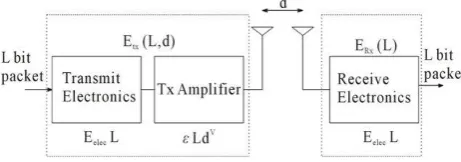
[image:2.595.55.286.255.336.2]This model is based on [2] Energy model for the radio hardware energy dissipation where the transmitter dissipates energy to run the radio electronics, the power amplifier and the receiver dissipates energy to run the radio electronics as shown in Figure 1
Fig 1: Radio Energy Dissipation Model
In this model, both free space (𝑑2 power loss) and the multipath fading (𝑑4power loss) channel models are used, these models depend on the distance between the transmitter and receiver [2, 9]. Power control can be used to overcome this loss by appropriate setting of the power amplifier—if the distance is less than a threshold do, the free space model is used else the multipath model is used. Thus, to transmit a L-bit message to a distance, the radio expands.
ETx L, d = L. Eelec + L. Efs . d
2 if d < d 0
L. Eelec + L. Eamp . d4 if d ≥ d0 (1)
The electronics energy 𝐸𝑒𝑙𝑒𝑐 depends on factors such as the digital coding, modulation,spreading of the signal and filtering, whereas the amplifier energy, 𝐸𝑓𝑠.𝑑2or 𝐸𝑎𝑚𝑝.𝑑4 depends on the distance to the receiver and the acceptable bit-error rate [2, 3].value of threshold distance do is given by:
𝑑0=𝐸𝐸𝑓𝑠
𝑎𝑚𝑝 (2)
3.2 Network Model
Network model used consists of N nodes in M X M network field. In the network model some assumptions have been made for the sensor nodes as well as for the network. Hence the assumptions and properties of the network and sensor nodes are as follows:
Sensor Nodes are uniformly, randomly spread in the network.
There is one Base Station which is located at the centre of the sensing field.
Nodes always have the data to send to the base station.
Nodes are location-unaware, i.e. these are not equipped with GPS capable antennas.
All nodes have similar capabilities in terms of processing and communication and of equal implication.
nodes are equipped. Nodes have different initial energy; some nodes have more energy than the normal nodes.
3.2.1Two Level Heterogeneous Network
We have used two types of nodes in the network, normal and advanced nodes. E0 is the initial energy of the normal nodes, and ‗m‘ is the fraction of the advanced nodes, which own ‗a‘ times more energy than the normal nodes. Thus there are m. N advanced nodes equipped with initial energy of E0. (1 + a) and (1-m).N normal nodes that are equipped with initial energy of E0. The total initial energy of the two-level heterogeneous networks is given by:
Etotal = N. 1 − m . E0 + m. N. 1 + a . E0
=N.E0(1+a.m) (3)
3.2.2 Three -Level Heterogeneous Networks
There are three types of sensor nodes in three- level heterogeneous networks. They are normal nodes, advanced nodes and super nodes. Let consider ‗m‘ be the fraction of the total number of nodes N, and ‗m0‘ is the fraction of the total number of nodes which are equipped with ‗b‘ times more energy than the normal nodes, called as super nodes, the number is N.m.m0. The rest N.m. (1-m0) nodes are equipped with ‗a‘ times more energy than the normal nodes; called as advanced nodes and remaining N. (1-m) as normal nodes. The total initial energy of the three -level heterogeneous networks is given byEtotal = N. 1 − m . E0+ N. m. 1 − m0 1 + a . E0
+ N. m. m0. E0. (1 + b)
= N.𝐸0.(1+ m.(a +𝑚0. 𝑏)) (4)
4. DTDEEC
In this section we present details about our protocol DTDEEC. Since the probabilities calculated depend on the residual energy of node and average energy of the network at round r, so the average energy is estimated as
𝐸 (r)= 𝑁 1𝐸𝑡𝑜𝑡𝑎𝑙(1- 𝑟𝑅) (5) Where R denotes the total rounds of the network lifetime. R can be expressed as
R= 𝐸𝐸𝑡𝑜𝑡𝑎𝑙
𝑟𝑜𝑢𝑛𝑑 (6)
𝐸𝑟𝑜𝑢𝑛𝑑is the energy dissipated in the network in a round. The total energy dissipated 𝐸𝑟𝑜𝑢𝑛𝑑 is equal to
𝐸𝑟𝑜𝑢𝑛𝑑 = L 2N𝐸𝑒𝑙𝑒𝑐+ 𝑁𝐸𝐷𝐴+ 𝑘𝐸𝑎𝑚𝑝 𝑑𝑡𝑜𝐵𝑆4
+ N𝐸𝑓𝑠 𝑑𝑡𝑜𝐶𝐻2 (7)
here k is number of clusters, 𝑑𝑡𝑜𝐵𝑆 is the average distance between cluster head and the base station and 𝑑𝑡𝑜𝐶𝐻 is the average distance between the cluster members and the cluster head.
Now 𝑑𝑡𝑜𝐶𝐻 = 2𝜋𝑘𝑀 𝑑𝑡𝑜𝐵𝑆 = 0.765𝑀2 (8) By calculating the derivative 𝐸𝑟𝑜𝑢𝑛𝑑of with respect to k to zero we get optimal number of clusters as
𝐾𝑜𝑝𝑡= 2𝜋𝑁𝑑𝑡𝑜𝐵𝑆𝑀 2 𝐸𝑓𝑠
𝐸𝑎𝑚𝑝 (9)
At each round node decides whether to become a cluster head or not based on threshold calculated by the suggested percentage of cluster heads for the network (determined a priori) and the number of times the node has been a cluster-head yet. This decision to be a CH is made by the nodes by choosing the random number between 0 and 1. If this number is less than a threshold T(s) the node becomes a cluster-head for the present round. The threshold is determined as:
𝑇 𝑠 = p
1−p r mod p1 if s ∈ G 0 Otherwise
(10)
where p, r, and G represent respectively the desired percentage to be cluster-heads, the current round number, and the set of nodes that are not selected cluster-heads in the last 1/p rounds. Using this threshold each node will be a cluster head, just once at some point within 1/p rounds.
In DTDEEC approach we have adjusted the value of threshold, on which a node decides to be a cluster head or not, based on ratio of residual energy of node and average energy of network on that round in respect to the optimum number of cluster heads as explained in TDEEC. So that only nodes having a more energy becomes the cluster head. The threshold Eq. (9) is set as
𝑇 𝑠 = p 1−p r mod p1 ∗
𝑅𝑒𝑠𝑖𝑑𝑢𝑎𝑙 𝑒𝑛𝑒𝑟𝑔𝑦 𝑜𝑓 𝑛𝑜𝑑𝑒 ∗𝐾𝑜𝑝𝑡
𝐴𝑣𝑒𝑟𝑎𝑔𝑒 𝑒𝑛𝑒𝑟𝑔𝑦 𝑜𝑓 𝑛𝑒𝑡𝑤𝑜𝑟𝑘 if s ∈ G 0 Otherwise
(11)
The probabilities of normal and advanced nodes in case of two level heterogeneity are:
𝑝𝑖=
𝑝𝑜𝑝𝑡 𝐸𝑖(𝑟)
1 + 𝑎𝑚 𝐸 𝑟 𝑖𝑓 𝑠𝑖𝑖𝑠 𝑛𝑜𝑟𝑚𝑎𝑙 𝑝𝑜𝑝𝑡(1 + 𝑎)𝐸𝑖(𝑟)
(1 + 𝑎𝑚)𝐸 (𝑟) 𝑖𝑓 𝑠𝑖 𝑖𝑠 𝑎𝑑𝑣𝑎𝑛𝑐𝑒
(12)
The probabilities of normal, advanced and super nodes in case of three-level heterogeneity are:
pi=
popt Ei(r)
1+m.(a+m0.b) E r if siis normal popt(1+a)Ei(r)
1+m.(a+m0.b) E r if si is advance popt(1+b)Ei(r)
1+m.(a+m0.b) E r if si is super
(13)
The probability of being a cluster head in case of multilevel heterogeneity is given by:
pi=
popt.N. 1+ai .Ei(r)
N+ Ni=1ai .E (r) (14)
Although TDEEC continue to punish advance nodes. Same is the problem with DEEC, it continues to punish just advance nodes and DDEEC is only effective for heterogeneous network as mentioned previously in related work [6], DTDEEC uses the same concept and the changes are based on absolute residual energy level Tabs, which is the value in which advance have same energy level as that of normal nodes. The idea specifies that under Tabs all normal and advance nodes have same probability for CH selection. Our proposed probabilities for selection of CH in DTDEEC are given as follows:
pi=
popt Ei r
1+m. a+m0.b E r for Nml nodes, Ei r > 𝑇𝑎𝑏𝑠
popt 1+a Ei r
1+m. a+m0.b E r for Adv nodes, Ei r > 𝑇𝑎𝑏𝑠
po pt 1+b Ei r
1+m. a+m0.b E r for Super nodes, Ei r > 𝑇𝑎𝑏𝑠
𝑐. popt 1+b Ei r
1+m. a+m0.b E r for Sup, Adv, Nml nodes Ei r ≤ 𝑇𝑎𝑏𝑠 15
The value of absolute residual energy level, Tabsis written as Tabs = zE0 (16) Where z∈(0, 1). If z = 0 then we have traditional DEEC. In reality, super, advanced nodes may have not been a CH in rounds r, it is also possible that some of them become CH and same is the case with the normal nodes. So, exact value of z is not confirmed. However, through numerous of simulations using random topologies, we try to estimate the closest value of z by varying it for best result based on first dead node in the network and find best result for z = 0.7.
Therefore,Tabs= 0.7𝐸0 .Similarly value of c is estimated near to 0.02 after performing numerous simulation [6].
5. SIMULATION AND RESULTS
We have simulated the wireless sensor network in MATLAB environment in 100 X 100 field. The table 1 shows the simulation parameters used.
TABLE 1: Simulation parameters Parameters Value
Network field (100,100)
Number of nodes 100
𝐸0 (Initial energy of normal nodes)
0.5 J
Message size 4000 bits
Eelec 50nJ/bit
𝑬𝒇𝒔 10nJ/bit/𝑚2
Eamp 0.0013pJ/bit/𝑚2
EDA 5nJ/bit/signal
popt 0.1
For simplicity, we consider all nodes are either fixed or micro-mobile as supposed in and ignore energy loss due to signal collision and interference between signals of different nodes that are due to dynamic random channel conditions. In this scenario, we are considering that, BS is placed at centre of the network field.
Fig 2: nodes dead during round
Fig 3: nodes alive during round
Fig 4: packet sent to base station
In heterogeneous WSN, we use radio parameters as mentioned in Table 1 for different protocols deployed in WSN and estimate the performance for three level heterogeneous WSNs. Parameter m refers to fraction of advanced nodes containing extra amount of energy a in network whereas, mo is a factor that refers to fraction of super nodes containing extra amount of energy b in the network. Here we put a=1.5, b=3, m=0.5, m0=0.4 for our scenario.
[image:4.595.293.549.81.191.2]The performance analysis of DTDEEC against DEEC and DDEEC are compared on following parameters described in table 2
TABLE 2: Performance comparison
6. CONCLUSION
In this paper we proposed DTDEEC (Developed Threshold Distributed Energy Efficient Clustering) protocol which improves stability and energy efficient property of the heterogeneous wireless sensor network and hence increases the lifetime. Simulation results show that DTDEEC performs better as compared to DEEC, DDEEC and EDDEEC in heterogeneous environment for wireless sensor networks.
7. REFERENCES
[1] Al-Karaki, J.N.; Kamal, AE., "Routing techniques in wireless sensor networks: a survey," Wireless Communications, IEEE , vol.11, no.6, pp.6,28, Dec. 2004
[2] Heinzelman, W.R.; Chandrakasan, A; Balakrishnan, H., "Energy-efficient communication protocol for wireless microsensor networks," System Sciences, 2000. Proceedings of the 33rd Annual Hawaii International Conference on , vol., no., pp.10 pp. vol.2,, 4-7 Jan. 2000 [3] Li Qing, Qingxin Zhu, Mingwen Wang, Design of a
distributed energy-efficient clustering algorithm for heterogeneous wireless sensor networks, Computer Communications, Volume 29, Issue 12, 4 August 2006, Pages 2230-2237, ISSN 0140-3664.
[4] ParulSaini and Ajay K Sharma. Article:Energy Efficient Scheme for Clustering Protocol Prolonging the Lifetime
of Heterogeneous Wireless Sensor
Networks. International Journal of Computer Applications 6(2):30–36, September 2010.
[5] Dilip Kumar, Trilok C. Aseri, R.B. Patel, EEHC: Energy efficient heterogeneous clustered scheme for wireless sensor networks, Computer Communications, Volume 32, Issue 4, 4 March 2009, Pages 662-667, ISSN 0140-3664.
[6] Elbhiri, B.; Saadane, R.; El Fkihi, S.; Aboutajdine, D., "Developed Distributed Energy-Efficient Clustering (DDEEC) forheterogeneous wireless sensor networks," I/V Communications and Mobile Network (ISVC), 2010 5th International Symposium on, vol., no., pp.1,4, Sept. 30 2010-Oct. 2 2010
[7] Lindsey, S.; Raghavendra, C.S., "PEGASIS: Power-efficient gathering in sensor information systems," Aerospace Conference Proceedings, 2002. IEEE , vol.3, no., pp.3-1125,3-1130 vol.3, 2002
[8] A. Manjeshwar and D. P. Agarwal, "TEEN: a routing protocol for enhanced efficiency in wireless sensor networks," In 1st International Workshop on Parallel and Distributed Computing Issues in Wireless Networks and Mobile Computing, April 2001.
[9] U. Sajjanhar, P. Mitra, ―Distributive Energy
Parameters DEEC
DDEEC
EDDEEC DTDEEC Stability
(round) 1049 1386 1245 1302 Lifetime
Sensor Networks‖, Proceedings of the 2007 International Conference on Mobile Data Management, pp. 326 - 330, 2007.
[10]Thein, M.C.M.; Thein, T., "An Energy Efficient Cluster-
Head Selection for Wireless Sensor
Networks," Intelligent Systems, Modelling and Simulation (ISMS), 2010 International Conference on , vol., no., pp.287,291, 27-29 Jan. 2010
[11]Yingchi Mao; Zhen Liu; Lili Zhang; Xiaofang Li, "An Effective Data Gathering Scheme in Heterogeneous Energy Wireless Sensor Networks," Computational
Science and Engineering, 2009. CSE '09. International Conference on , vol.1, no., pp.338,343, 29-31 Aug. 2009 [12] A. Manjeshwar and D. P. Agarwal, "APTEEN: A
hybrid protocol for efficient routing and comprehensive information retrieval in wireless sensor networks," Parallel and Distributed Processing Symposium., Proceedings International, IPDPS 2002, pp. 195-202 [13]N. Javaid, T.N. Qureshi, A.H. Khan, A. Iqbal, E. Akhtar,