Original Research Article
A cross sectional study to assess awareness regarding rabies amongst
medical students of Rajindra hospital, Patiala, Punjab
Aman Dev Singh
1*, Ritu Rochwani
2, Ishan Sagar
3, Riya
3, Ankur Jain
3INTRODUCTION
Rabies (Rages or madness in Latin), a preventable enzootic endemic disease in India, is a viral disease caused by Lysavirus causing acute inflammation of brain in humans and other warm blooded animals.1,2 It is typically transmitted through bites from infected animal. The disease affects domestic as well as wild animals and is spread to people through infective material, usually saliva, via bites and scratches.3 Rabies is estimated to
cause 59 000 human deaths annually in over 150 countries, with 95% of cases occurring in Africa and Asia. India accounts for 59.9% of rabies deaths in Asia and 35% of deaths globally.4 Community awareness on all aspects of rabies is generally lacking viz. first aid, management of animal bites, pre & post exposure prophylaxis etc.5 There are many myths and false belief associated with wound management, these include application of oils, herbs, and red chilies on wound inflicted by rabid animals, and not washing the wound
ABSTRACT
Background: Rabies is a preventable enzootic endemic disease in India, it is a viral disease caused by Lysavirus causing acute inflammation of brain in humans and other warm blooded animals. It is typically transmitted through bites from infected animal. Human rabies deaths are almost entirely preventable through prompt delivery of post-exposure prophylaxis (PEP) to victims of bites by rabid animal. Appropriate knowledge regarding rabies and its prevention among medical students is very important to prevent rabies deaths. The aims and objectives of the study were to assess awareness regarding rabies amongst medical students.
Methods: This was a cross sectional study which was conducted in month of April 2018. There were total of 496 students, we could obtain the information from 373 students as the questionnaire was given during a theory class and some of the students were absent. A pretested, structured questionnaire was administered to assess their knowledge about rabies, classification and management of bite wounds, including different vaccination schedules, site and dose. The data was entered using Microsoft excel and statically analysed by Epi Info 7.
Results: Almost all (97.32%) students knew that rabies is a fatal disease and 78.02% knew that dog was the primary transmitting animal. Only 41.29% students were aware that head, neck and face to be the danger site of bite. Almost all 98.6% students were aware about washing the wound with soap and water as the primary first aid measure following dog bite whereas 0.27% said suturing as first aid measure.
Conclusions: Awareness of medical students regarding cause of rabies and its fatality were good but they had less awareness about the danger sites of animal bite.
Keywords: Rabies, Medical students, Animal bite
Department of Community Medicine, 1Government Medical College, Patialal, Punjab, 2East Point College of Medical Sciences and Research Center, Bangalore, Karnataka, India
3
Government Medical College, Patialal, Punjab, India
Received: 19 November 2018
Accepted: 29 December 2018
*Correspondence:
Dr. Aman Dev Singh,
E-mail: [email protected]
Copyright: © the author(s), publisher and licensee Medip Academy. This is an open-access article distributed under the terms of the Creative Commons Attribution Non-Commercial License, which permits unrestricted non-commercial use, distribution, and reproduction in any medium, provided the original work is properly cited.
properly.6 Human rabies deaths are almost entirely preventable through prompt delivery of post-exposure prophylaxis (PEP) to victims of bites by rabid animal.7,8 A WHO report on the animal experiments shown that the local wound treatment tends to reduce rabies incidence up to 80%.9 Medical professionals should have adequate knowledge related to the cause and the preventive measures of rabies to avoid the disease.3 Medical students are the physicians of the future, so appropriate knowledge regarding rabies and its prevention among them is very important to prevent rabies deaths.10 The present study was undertaken to identify the awareness regarding animal bite management and pre and post exposure prophylaxis including vaccination among medical students (new final and old final year).
Aims/objectives
Aim of the study was to assess awareness regarding Rabies amongst medical students.
METHODS
A cross sectional study was conducted in month of April 2018 among new final and old final students (MBBS) of government medical college, Patiala. There were total of 496 students, we could obtain the information from 373 students as the questionnaire was given during a theory class and some of the students were absent. Staff of Community Medicine department helped in invigilating the session and use of mobile phone was restricted during session. After 15 minutes the proforma were collected for analysis. Informed consent from the students was taken before hand. A pretested, structured questionnaire was administered to assess their knowledge about rabies, classification and management of bite wounds, including different vaccination schedules, site and dose. The data was entered using Microsoft excel and statically analysed by Epi Info 7 results obtained were expressed in terms of percentages and proportions.
RESULTS
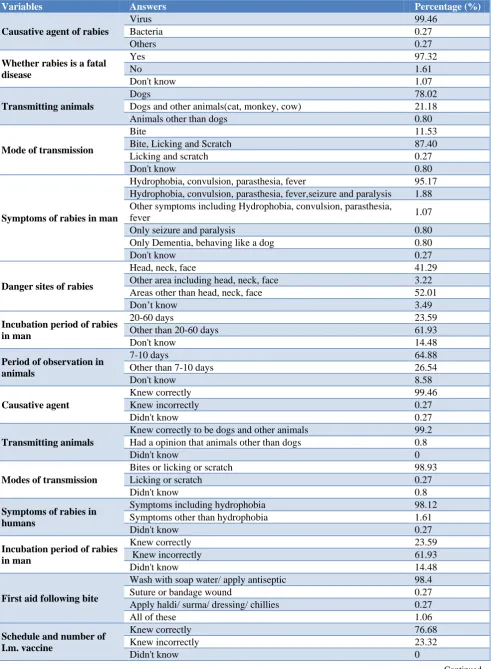
In present study out of the total 373 students interviewed 211 were females and 161 were males. Most of the students were in age group of 20-25 years with mean age of 21.22 years (with range from 19 to 26 years). Around all (99.5%) of the students knew about the viral cause of rabies and only 2 student each said bacteria as the other answer. Almost all (97.32%) students knew that rabies is a fatal disease. More than three fourth (78.02%) knew that dog was the primary transmitting animal whereas 21.18% said animals such as cat, monkey, cow etc may be the cause of rabies. Table 1 shows that 87.40% students said that rabies was caused by bites, licking and scratches of rabid animal. About the symptom of rabies in humans 95.17% said hydrophobia, fever, convulsions and paraesthesia and 1.88% said in addition to above seizures and paralysis also as symptoms whereas. Less than half (41.29%) students were aware that head, neck, and face
to be the danger site of bite whereas 52.01% said lower limbs to be danger sites of bite and 3.22% areas other than head neck and face to be danger site and 3.49% had no knowledge off danger site Figure 1.
Figure 1: Awareness regarding danger sites of animal bite for rabies.
Figure 2: Awareness regarding schedule and number of I.m. vaccine.
Figure 3: Awareness regarding incubation period of rabies in man.
0 10 20 30 40 50 60
Head, neck, face
Other area including head, neck,
face
Areas other than head, neck, face
Don,t know
Percentage
Head, neck, face
Other area including head, neck, face Areas other than head, neck, face Don,t know
41.29%
3.22%
52.01%
3.49%
76.68, 77% 23.32, 23%
Percentage
knew correctly knew incorectly
23.59
61.93
14.48
0 10 20 30 40 50 60 70
knew correctly knew incorrectly didn't know
Table 1: Awareness regarding rabies amongst medical students.
Variables Answers Percentage (%)
Causative agent of rabies
Virus 99.46
Bacteria 0.27
Others 0.27
Whether rabies is a fatal disease
Yes 97.32
No 1.61
Don't know 1.07
Transmitting animals
Dogs 78.02
Dogs and other animals(cat, monkey, cow) 21.18
Animals other than dogs 0.80
Mode of transmission
Bite 11.53
Bite, Licking and Scratch 87.40
Licking and scratch 0.27
Don't know 0.80
Symptoms of rabies in man
Hydrophobia, convulsion, parasthesia, fever 95.17 Hydrophobia, convulsion, parasthesia, fever,seizure and paralysis 1.88 Other symptoms including Hydrophobia, convulsion, parasthesia,
fever 1.07
Only seizure and paralysis 0.80
Only Dementia, behaving like a dog 0.80
Don't know 0.27
Danger sites of rabies
Head, neck, face 41.29
Other area including head, neck, face 3.22
Areas other than head, neck, face 52.01
Don’t know 3.49
Incubation period of rabies in man
20-60 days 23.59
Other than 20-60 days 61.93
Don't know 14.48
Period of observation in animals
7-10 days 64.88
Other than 7-10 days 26.54
Don't know 8.58
Causative agent
Knew correctly 99.46
Knew incorrectly 0.27
Didn't know 0.27
Transmitting animals
Knew correctly to be dogs and other animals 99.2 Had a opinion that animals other than dogs 0.8
Didn't know 0
Modes of transmission
Bites or licking or scratch 98.93
Licking or scratch 0.27
Didn't know 0.8
Symptoms of rabies in humans
Symptoms including hydrophobia 98.12
Symptoms other than hydrophobia 1.61
Didn't know 0.27
Incubation period of rabies in man
Knew correctly 23.59
Knew incorrectly 61.93
Didn't know 14.48
First aid following bite
Wash with soap water/ apply antiseptic 98.4
Suture or bandage wound 0.27
Apply haldi/ surma/ dressing/ chillies 0.27
All of these 1.06
Schedule and number of I.m. vaccine
Knew correctly 76.68
Knew incorrectly 23.32
Didn't know 0
Variables Answers Percentage (%)
Schedule and number of I.d. vaccine
Knew correctly 39.14
Knew incorrectly 60.86
Didn't know 0
Causative agent
Knew correctly 99.46
Knew incorrectly 0.27
Didn't know 0.27
Transmitting animals
Knew correctly to be dogs and other animals 99.2 Had a opinion that animals other than dogs 0.8
Didn't know 0
Modes of transmission
Bites or licking or scratch 98.93
Licking or scratch 0.27
Didn't know 0.8
Symptoms of rabies in humans
Symptoms including hydrophobia 98.12
Symptoms other than hydrophobia 1.61
Didn't know 0.27
Incubation period of rabies in man
Knew correctly 23.59
Knew incorrectly 61.93
Didn't know 14.48
First aid following bite
Wash with soap water/ apply aniseptic 98.4
Suture or bandage wound 0.27
Apply haldi/ surma/ dressing/ chillies 0.27
All of these 1.06
Schedule and number of I.m. vaccine
Knew correctly 76.68
Knew incorrectly 23.32
Didn't know 0
Schedule and number of I.d. vaccine
Knew correctly 39.14
Knew incorrectly 60.86
Didn't know 0
In the present study 23.6% correctly know about the incubation period of rabies in humans Figure 2. Regarding incubation period in animals 64.88% said it to be 7-10 days. Almost all 98.6% students were aware about washing the wound with soap and water as the primary first aid measure following dog bite whereas 0.27% said suturing as first aid measure and 0.27% said applying haldi/surmsa/chillies as first aid following bite and 1.07% said all of the above as the first aid following bite. Around 76.68% students knew correctly regarding Schedule and number of I.m. vaccine Figure 3.
Only 78.01% knew about both intradermal and intra-muscular schedule of vaccination. Nearly 48.2% knew deltoid region as site of vaccination only 2.14% said deltoid and anterolateral aspect of thigh as site of choice whereas 16.6% said gluteal region to be site of vaccination and another 0.53% said all as site of vaccination whereas 7.77% had no knowledge about site of vaccination. Most of the students 79.6% knew that there are 3 categories of bite. Around 70.77% students said category 3 bite as indication of ARS and 29.33% were not aware regarding indication for ARS. Only 43.6% knew about the duration in which ARS can be given in the present study 94.01% thought that vaccination of dogs is important only 12.8% said that it was mouse brain derived vaccine and most of them
88.2%were not aware about the type of vaccine it is. On the total number of doses of vaccine required 68.0% said to be 5 doses and 22.5% said it to be 4 whereas 6.97% said 7 as answer and another 2.41% said it to be 14. Around 37% said that pregnancy was a contraindication for rabies vaccination whereas 36.1% said it was not a contraindication and 27.07% did not know the answer.
DISCUSSION
cause of rabies and almost all (97.32%) students knew that rabies is a fatal disease. Almost all 99.2% knew correctly to be dogs and other animals as rabies transmitting animal. Similar findings were observed by Mishra and Anjana.3,10 Transmission of rabies occur following a deep bite or scratch from an animal with rabies. In current study 87.40% medical students were aware about the transmission of rabies through deep bite and scratches these findings are comparable to other studies.10 Mali observed 89.33%students were aware about mode of transmission of rabies.2 In the present study 41.29% students respond that head, neck and face to be the danger site of bite. Almost all 98.6% students were aware about washing the wound immediately with soap and water as the primary first aid measure following animal bite. The awareness regarding wound care was more in our study as compare to other studies. This is because visits of students to anti rabies clinic during their field postings. In present study only 78.01% knew about both intradermal and intramuscular schedule of vaccination. Nearly 48.2% knew deltoid region as site of vaccination only 2.14% said deltoid and anterolateral aspect of thigh as site of choice. Anjana observed that only 72.2% students were aware about proper wound care and only 10.4% students are aware about the correct sites of vaccination.10 In our study only 39.14% students were aware about Schedule and number of I.d. vaccine and 76.68% knew about Schedule and number of I.m. vaccine. Similar findings were observed by Anjana (43.7%), Mali N (43.33%).2,10
CONCLUSION
Awareness of medical students is a major determinant of appropriate treatment for patients in future. This study highlighted that awareness regarding rabies is inadequate in second year students of the medical college. Awareness of medical students regarding cause of rabies and its fatality were good but they had less awareness about the danger sites of animal bite and intradermal schedule and number of vaccines.
Recommendations
There is an essential need for generating awareness about rabies and animal bite among medical students. There is a need to organize re-orientation programs and continuing medical education (CME) sessions for medical students regarding rabies and its prevention on a regular basis. There should be interactive animal bite clinic visits for students and regular postings to anti rabies clinic of interns to address specific knowledge gaps. Timely quiz competitions and poster competitions for improve awareness for rabies prevention also should be organised to create awareness regarding rabies.
Limitations
This study may be helpful in creating an awareness regarding animal bite and rabies. The study was confined
to a small number of subjects, which resulted in reduced power in statistical analysis. No standardized tools were available; therefore a tool was prepared for the purpose of this study. This study took place in tertiary care hospitals, and the results of the study cannot be generalized at the country level. Our study was done with small sample size and better study can be planned with more sample size. Future study can be planned with involving doctors, students and other healthcare workers.
ACKNOWLEDGEMENTS
The authors are grateful to Dr. Amarjit Singh Professor and Head, Dept of Community Medicine, G.M.C. Patiala, Punjab, India for his valuable inputs. The authors are also thankful to the students of G.M.C. Patiala. The corresponding author would like to thank his mother Dr Parmjit Kaur for her blessing and support.
Funding: No funding sources Conflict of interest: None declared
Ethical approval: The study was approved by the Institutional Ethics Committee
REFERENCES
1. Chopra D, Jauhari N, Dhungana H, Nasrah. Assessment of awareness about rabies and the animal bite among the staff nurses in a medical institute in Lucknow. Int J Com Med Pub Health. 2017;4(6):2046-51.
2. Mali A, Solanki SL. An assessment of Knowledge of Prevention and Management of Rabiesin Second Year MBBS Students of American International Institute of Medical Sciences, Udaipur (Rajasthan). Int J Cur Res Rev. 2018;10(6):49-52.
3. Mishra N, Solanki SL. Assessment of knowledge about rabies in interns of Geetanjali medical college, Udaipur. Int J Community Med Public Health. 2015;2(2):121-3.
4. Rabies – world health organization available at www.who.int/rabies/epidemiology/Rabiessurveillan ce.pdf. Accessed on 3 August 2018.
5. Gaikwad B, Kulkarni P, Takalkar A, Bhise M, Sarita Mantri S. Dog bite and its management: Awareness among the first year students of a Medical College. J Basic Clin Res. 2016;3(2):18-23 6. Sekhon AS, Singh A, Kaur P, Gupta S.
Misconceptions and myths in the management of animal bite case. Indian J Community Med. 2002;27:9-11.
7. Chowdhury R, Mukherjee A, Naskar S, Lahiri SK. A study on knowledge of animal bite management and rabies immunization among interns of a government medical college in Kolkata. Int J Med Public Health. 2013;3(1):17-20.
Control: A Community Survey in Tanzania. PLoS Negl Trop Dis. 2014;8(12):e3310.
9. WHO. Current WHO guide for rabies pre & post-exposure prophylaxis in humans. In: WHO, eds. WHO Guide. Geneva: WHO; 2007.
10. Tiwari A. Assessment of knowledge regarding rabies and its prevention among the medical students of Government Medical College
Rajnandgaon, Chhattisgarh, India. Int J Community Med Public Health. 2018;5(4):1397-401.
Cite this article as: Singh AD, Rochwani R, Sagar I, Riya, Jain A. A cross sectional study to assess awareness regarding rabies amongst medical students of Rajindra hospital, Patiala, Punjab. Int J