RESEARCH ARTICLE
MANAGING TECHNOLOGY IN QUANTUM AGE
*
Nirmal Kundu, Chandan Bhar and Visvesvaran Pandurangan
1
Associate Professor, Teerthanker Mahaveer University, Moradabad-Delhi Road, NH24,
Moradabad- 244001, UP., India
2
Professor, Department of Management Studies, Indian School of Mines, Dhanbad – 826004, India
3Professor, Department of Mechanical
Engineering, MVN University, Palwal, India
ARTICLE INFO
ABSTRACT
Technology is changing at a very fast pace and quantum of changes, many of the times, overtakes imagination. Science and Technology are getting redefined and the Quantum theory has totally shaken the age old belief of Newtonian mechanics. As Science is progressing and technology is closely following science, managing technology in this Quantum age has become far more difficult. In this article, an attempt has been made to focus on the issues of Quantum age and argue why a radical change in knowledge, attitude and skill set need to be developed for managing technology to effectively navigate in Quantum age.
Copyright © 2016Nirmal Kunduet al.This is an open access article distributed under the Creative Commons Attribution License, which permits unrestricted use,
distribution, and reproduction in any medium, provided the original work is properly cited.
INTRODUCTION
A close look around the surrounding environment leads to conclude that things are going out of control today. Life expectancy is increasing but life killing diseases are starting at an early age, material comfort is increasing but mental peace is totally eroded, motion is tremendous but emotion is trivial. It is becoming increasingly difficult to predict how the future will turn out when so many events in the present are so disturbing. It seems that the changes are much more profound than it has been in the past and “the script that is unfolding has a different set of characteristics than those with which we are familiar with” (Benevensite, 1994). “The rules of the game seem to have changed: they no longer work either to explain or to help us adapt to the change …!” (Carlson, 1994). It seems as if the theory of classical mechanics is being applied in the domain of sub-atomic particles and waiting to see the expected result. The root cause of the dilemma is clear from Schrodinger’s statement “We never experiment with single electrons, atoms or small molecules…In thought experiments we assume that we do. It always results in ridiculous consequences…” (Schrödinger, 1952).
*Corresponding author: Nirmal Kundu
Associate Professor, Teerthanker Mahaveer University, Moradabad Delhi Road, NH24, Moradabad 244001, UP., India
A key characteristic of quantum physics is that if there is a possibility for something happening, given enough time it does happen. The main thrust of managing technology in Quantum age is to manage risks so that the highest probable outcome remains the one that meets objective. The risk happens because of the uncertainty. To deal with this uncertainty, it demands a different set of knowledge, mindset, skill set, strategy and action plan which the classical and conventional approach is not able to meet with. In the quantum age, focus should be on ideas rather than fact, approach needs to be changed to probabilistic from deterministic approach, from information based to intuition based decision making, to learn to deal with expectedness rather than exactness, learn to discuss open ended question rather than close ended question, develop intuitive power, imagination and not afraid of being exposed to ‘not knowing’. These will lead to great strategy and execution required in quantum age.
Although technologically Quantum age has been realized and well accepted and preparedness is in full swing, however, managing technology in Quantum age has attracted little attention. This has lead to the concept of “Chaos” in Management and has lead to the famous saying “When butterfly flaps its wings at Tokyo, there is tornado at Toronto” (Billie, 2015).
ISSN: 0976-3376
Asian Journal of Science and Technology Vol.07, Issue, 04, pp.2834-2841, April,2016ASIAN JOURNAL OF
SCIENCE AND TECHNOLOGY
Article History:
Received 20th January, 2015
Received in revised form
18th February, 2016
Accepted 16th March, 2016
Published online 27th April, 2016
Key words:
Quantum age, Quantum Management, Quantum Theory,
Chaos does not mean random or clueless. It is the limitation of existing knowledge, frame of mind or perception that lead to term it as chaos. When someone fails to explain the phenomenon logically (a characteristics of Newtonian thinking), he stops thinking intuitively and happy to explain everything as Chaos to be in comfort zone. However, it may not solve the problem and lead to nowhere. ‘The framework of laws governing the universe whose unfamiliar features such as uncertainty, quantum fluctuations & wave particle duality become most apparent on the microscopic scales of atoms & sub nuclear particles.’ (Greene, 1999).
MATERIALS AND METHODOLOGY
The research methodology used in this study is a combination of
Literature review
Case study
Key informant interviews
The literature review includes both published as well as unpublished sources.
Case study is on Electronic Energy metering in India. In India around 1994, when the electromechanical meters were being replaced by electronic energy meters, there were two types of organizations- one with long background of metering but no experience of electronics and another with good background of electronics but not of metering. This case study gives an insight what generally go wrong in managing technology in the present age and also suggest how the same could have been avoided. In case of key informant interviews, informal telephonic discussions have been carried out with the key executives of the organizations who are actively engaged in the process of technology management. The discussion is mainly based on the framework and strategy needs to be adopted for achieving success in technology management in present age (Quantum age).
Research objectives
The followings are research objectives;
To establish that the present age as Quantum age,
To establish that the classical way of thinking and managing Technology will not yield result
To develop a framework for managing technology in Quantum age
To develop an effective strategy of managing technology in Quantum age
Literature ReviewS
Why Quantum Age
“The nineteenth century was known as the machine age, the twentieth century will go down in history as the information age. I believe the twenty-first century will be the quantum age.” Paul Davies, Professor Natural Philosophy – Australian Centre for Astrobiology, (Anthony, 2003). “The modern era encompasses a period that technologically could be called The Quantum Age.” (Shelton and Darling, 2001).
“Quantum mechanics is the study of subatomic particles in motion” (Shelton, 1999). However, subatomic particles are not material things; rather, they are “probability tendencies--energy with potentiality”. According to quantum theory, “the universe is basically a set of signals or a field of information. It is much more like a great thought than the great machine metaphor of the Newtonian paradigm “(Shelton & Darling, 2003). In fact the Quantum Age started even before the onset of twenty first century. When de Broglie propounded his famous theory of Wave - Particle dualism in 1923 by stating that light follows dual nature, or Heisenberg’s Uncertainty principle says that if the position of sub atomic particle is certain, then momentum will be uncertain, it has shaken altogether the Newtonian philosophy of thinking. The whole concept has changed since then from “exactness” to “expectedness”, from deterministic to stochastic. However science has changed since then. Technology is also no longer in behind. It is closely tracking the development in Science. Quantum Physics (Robert Eisberg & Robert Resnick, , 1985), Quantum Chemistry (Szabo, Attila & Ostlund, Neil S.,1996) Quantum Biochemistry (Pullman, Bernard & Pullman, Alberte ,1963) , Quantum Biology (Jim Al-Khalili, & Johnjoe McFadden, 2014), Quantum metrology (Sergienko, A. V, 2001) have been followed by Quantum computer (Feynman, R. P.,1982)., Quantum laser (Kohki Mukai et al.,1998), Quantum cryptography (Bennett, C.H. and G. Brassard,1904). Application of Quantum theory in the arena of healthcare (Porter-O‟Grady, T. 2007.) sports (Razavi, M. H., 2013), Modern Portfolio Theory (Curtis, 2002) - all have become reality. In recent times, attempts have been made to ascribe the quantum mechanical properties to mind, brain, a nd consciousness (Chalmers 1996: Lockwood 1989; Penrose 1989; Penrose et. al. 2000; Pessa and Vitiello 2003; Satinover 2001). Although humankind may primarily be viewed as a material being but there is also an intangible, nonmaterial dimension (mind, consciousness or spirit) that gets affected by quantum principles (Dyer, 1995, in Shelton, C. K & Darling,J. R.,2001). Classical mechanics describes the dynamics of machines, whereas, Quantum mechanics describes ‘the dynamics of ideas! These above discussion and literature reviews suggest that there was a sea change started happening from the early twentieth century when Newtonian physics started loosing its supremacy to Quantum mechanics and lot of developments happened on this thought thereafter. Hence present age which is characterized by uncertainty can be called as Quantum age.
Issues in Quantum Age
This phenomenon was not realized because learning as well as diffusion of information was very slow. What has transformed the society and value system in between is the tremendous speed of information flow. Technology is changing at a very fast pace. Size and speed are getting challenged every hour. The traditional value system what the humankind was nurturing and preserving with utmost care over the ages has now become irrelevant and obsolete. These qualities have no taker today. Efficiency, action, loyalty, rigidity, collaboration has no place in today’s world and being replaced by effectiveness, result, adaptation, flexibility and competition. The root cause is uncertainty. Causal knowledge can be readily understood. Chaos is not causal and not transparent. So it needs special skill set to understand but can never be disregarded as irrelevant. The issue today is that a society that leads to act largely upon mechanistic ideas: the conventional thinking and action based on any rational approach must be transformed and to be applied in real life problem solving in managing technology.
Management Concept in Quantum Age
The traditional management is based on four principles: planning, organizing, directing, and controlling. These are simply inadequate for leading in The Quantum Age. These traditional skills were, in fact, derived from classical, Newtonian physics; therefore, it is reasonable to use the principles of quantum physics to identify a more contemporary skill set (Shelton & Darling, 2001). When there is quantum leap, it requires quantum changes of mindset to adapt to the changed scenario. The power and quality required is being changed, another set of quality and power are required for success. The power required in this quantum age is intuitive power and the qualities required are survival with uncertainty and living in imagination. As the world enters a new age, the requirement of knowledge, skill set, mind set and strategy to manage changes- thus definition of power gets redefined in the ages, Enough evidence is there that present way of managing is not yielding result. Time has come to shift from conventional management to quantum management styles. When most of the parameters are uncertain, the deterministic style of decision making needs a change to probabilistic decision making. Managing also need to change from intelligence or information based to intuition concentric-that spreads a shockwave in our classical thinking process. “It is being recognized that some experiments related with the human decision making processes could not be explained by the conventional classical decision theory but the same could be explained by the models based on quantum mechanics. It is now recognized that we need quantum mechanics in psychology as well as in economics and finance.” (Paras M. Agarwal and Sharda, 2012). What is needed is to develop and create a culture and pass on to people around us are the skills of Inquiry: of asking open ended questions, not-easily-answered questions which leads to exploring, or discovering. ‘Inquiry’ then becomes a process and tool for engaging the ‘discovering’ paradigm. The people should be honoured and rewarded for the courage of their questions rather than the brilliance of their answers. They should develop comfort with questions leading to more questions. They should celebrate the ability to stay in the realm of ‘not knowing’.
An apparently “Wrong “outcome is as significant as “Right “outcome. In the chaos of change, it is equally important to know the wrong to understand or make the thing right. In Quantum age ‘knowing’ is not a paradigm that is sought for. It is the unknowing, curiosity and the willingness to be in search for are the prized traits.. It is the willingness to be in a perpetual state of ‘discovering’. These are the qualities which will lead the road to success for this century. “Some aspects of the human behavior can be explained by quantum mechanical equations, but not by the classical mechanics. It may be noted that classical mechanics and quantum m echanics differ ideologically as well as mathematically; and for macro-systems the approximate form of mathematical equations of quantum mechanics agrees with the equations of classical mechanics.” (Yukalov, V. I., D. Sornette, 2009). Quantum Leadership means to be comfortable with of not having the right answer; to be exposed to 'unknowing' publicly; and share ideas with others. Quantum Leadership expects high levels of emotional intelligence. To grow emotional intelligence one must overcome the discomfort of exploring the deeply personal arenas which Quantum Leadership requires (Gwen McCauley, 2015)
Management of Technology in Quantum Age
jobs because they could not guess the reality and manage technology.
Case study: Technology Management in Electronic Energy Meter industry in India
Scenario -1 1992-93
According to DSIR report “the total demand for energy meters in 1991-92 was approximately 60 lakh meters, of which more than 90% was for electromechanical type energy meter for domestic /commercial use and the rest for meters (both electromechanical and electronic) used for industrial bulk metering…..The world market of energy meters is dominated by Schlumberger, Landis & Gyr, ABB (Westinghouse) and Siemens….. Till recently, only ABB had a representation in India in the meters area but now reportedly Schlumberger (with Crompton Greaves) and Landis & Gyr (with VXL India) have decided to enter the Indian market. …..The technology used throughout the world for energy metering is neither complex nor a closely guarded secret.”
The market scenario is
Industry's overall installed capacity is 50 percent more than the demand
Reluctance of SEBs to pay a higher price for a better quality meter
SEBs not having reliable data on past performance of meters of different suppliers,
Few progressive SEBs like RSEB and Ahmadabad Electricity Corporation ( AEC) are planning to replace existing electromechanical meter by electronic meter (www.dsir.gov.in/reports/techreps/tsr135.pdf)
Scenario 2: 1996-1997: There are about 15 large manufacturers of electromechanical energy meters for domestic /commercial use, constituting a total installed capacity of 67 lakh meters per annum. Of these, seven manufacturers also make meters for industrial use. Besides these, there are about 18-20 manufacturers in the small scale sector including two manufacturers of electronic energy meters (www.dsir.gov.in/reports/techreps/tsr135.pdf). The major players in existing market was Capital Meters, Bentex control and switchgear ltd , Accurate meters, Jaipur metals, Havells India Ltd. and of course Landis & Gyr ( their product cost was more than double of the nearest competitor) in electromechanical meter segments. Secure meters and Vikas and Hybrids are in electronic meter segment trying hard to introduce new concepts and advantage of electronic metering.
Scenario -3 2011-12: As per Frost & Sullivan’s analysis, in financial year (FY) 2010-11 (April 2010-March 2011) the overall electricity meters market was estimated at $460 million, Tariff meters and panel meters contributed nearly 90 percent and 10 percent, respectively. Presently, HPL Electric & Power Pvt. Ltd. (HPL), Secure Meters Pvt. Ltd., Genus Power Infrastructure Pvt. Ltd., L&T Ltd., and Landis and Gyr Ltd. dominate the Indian electricity meters market (Frost and Sullivan, 2012).
The back ground of leading manufacturers is given below.
HPL Electric and Power Pvt. Ltd. (HPL): Incorporated in 1956. HPL is among the most reliable multi product Electrical
Equipment Company in India. Its product range covers, Low Voltage Electrical Switchgears, Control gear, Circuit Breakers, Lighting and Wires & Cables. In 1997, HPL started manufacturing electronic energy meter in a small set up and today “HPL is among the largest manufacture of Electronic Energy Meters in the world producing over 6 million annually”. The core team of electronic energy meter in HPL is from electronic back ground and not related to metering. (http://www.hplindia.com/aboutus.aspx)
Secure Meters Pvt. Ltd: In 1985, Secure Meters conceived the idea of entering into the electricity metering business. Secure meter started manufacturing unit in 1993 at Udaipur. They are the first Indian electrical manufacturer to invest in overseas business- invested in PRI Ltd. UK in 1996. In 2002, Secure Mrters launched metering related services- Low Power Radio powered AMR system, STARS, the ABT metering software launched. Secure meter works in premium segment of metering and focuses on service and solution. They are not only pioneer in metering in India but also establish the benchmark for metering industry. Their success can be attributed to technology foresightedness and understanding of future requirement (http://www.securetogether.com/ en/about_us/).
Genus Power Infrastructure Pvt. Ltd: started its operation in 1994 with manufacturing of Hybrid Micro circuits and SMT PCB assemblies. The core team of electronic energy meter in Genus is from electronic back ground and not related to metering. Genus started manufacturing electronic energy meter and supplied to Rajasthan Electricity board in 1996.. Now they are in metering solution, solar energy solution, power back up system, engineering construction and contracts. With a humble beginning of 2 crores in 1995, now they have touched turnover of 2000 crores in a span of 20 years (http://www.genus.in/ about/company.aspx)
L&T Ltd: Larsen & Toubro is an Indian multinational conglomerate headquartered in Mumbai, Maharashtra, India. It was founded in 1938 by Danish engineers taking refuge in India, as well as an Indian financing partner. L&T Ltd. is a major technology, engineering, construction, manufacturing and financial services conglomerate,.L&T is a leading player in electricity metering segment in India. Having entered the market in the early 90s on the strength of its indigenously designed single phase and poly-phase meters, it has over a decade’s experience in design, manufacturing and supply of electronic electricity meters to Indian utilities. (http://www.larsentoubro.com/corporate/about-lt-group/)
Landis & Gyr Ltd: Landis & Gyr is one of the world leaders in smart metering, energy management solutions, and related services, with presence in 30 countries. The head quarter is based in Zug, Switzerland and the Global Development Centre is based in Noida, India. Today, the Company offers the broadest portfolio of products and services in the electricity metering industry, and for the next generation of smart grid. Kolkata factory was established long back, and used to produce electro mechanical meters. Now two factories are manufacturing static meters since 2000.
VHEL Industries: Incorporated as, Vikas Hybrid & Electronics (VHEL) commenced business in 1986. The company's products include hybrid micro circuits (HMC), hybrid transformers and printed circuit boards (PCB). It also manufactured electronic energy meters. in Bhiwadi and transformers, microwave systems, solar photo voltaic, optical line terminal equipments, etc, in Bangalore. Within a span of ten years its remarkable growth is from less than a crore to 250 crore and became sick by 1997. Because of unplanned growth and too diverse technology portfolio, with all oher ingredients of success in favour , they could not manage technology and lost in oblivion, (http://www.indiainfoline.com/
markets/company/background/company-profile/vhel-industries-ltd/1634)
Analysis of the case and Validation of the research objectives
None of the existing manufacturers (except one Landis & Gyr who has international background) who were the leaders in metering industry could not continue their position or to be even in the first five.
Although there was on the wall that a change in technology is on offing, market expectation and incompatibility with the current age, the electromechanical energy meter manufacturers who had few decades of experience fail to understand and appreciate the above changes.
Secure Meter could forecast the situation and even before the market really needed the solution, they kept themselves ready with solution. This is exactly what is called managing technology in quantum age and it was possible because of their understanding of Quantum environment.
The other three manufacturers viz. HPL, Genus and L&T who were not in metering but because of their intuitive abilities could rise to the situation and derived maximum benefits.
Landis & Gyr who is the most knowledgeable player and working across the globe, even failed to realize the ground reality but because of their vast experience and competitive ability over the globe could manage the show.
Few of the then energy meter manufacturers who finally realized the situation at very late stage like capital meters are struggling today for survival.
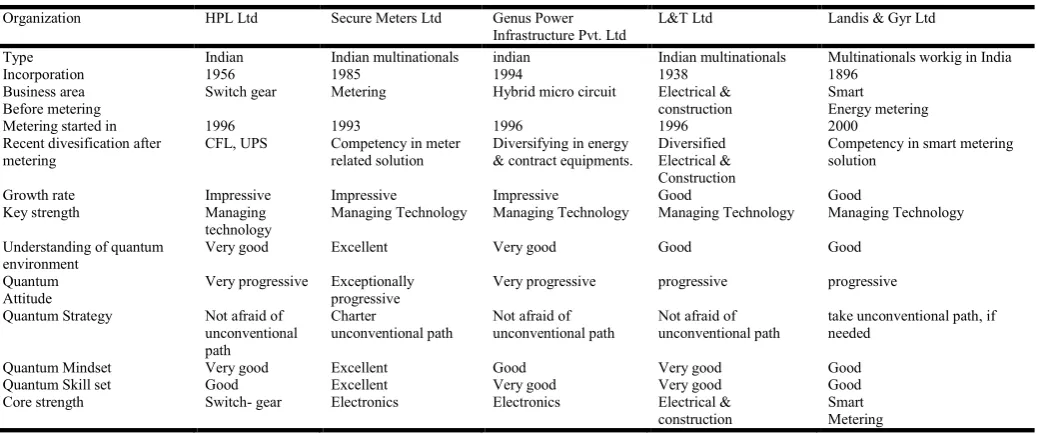
A comparative analysis of the prominent manufacturers is shown in table1.
Development of frame work for managing technology in quantum age
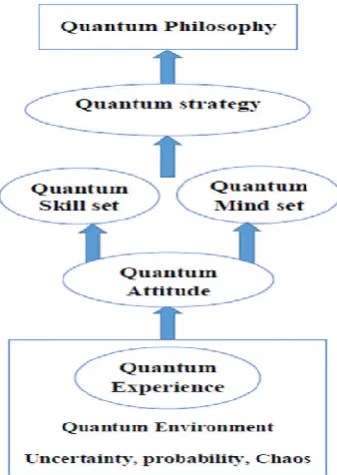
Managing Technology demands understanding of Quantum environment and developing Quantum Philosophy for the organization. Quantum management principle starts with understanding of new business environment (Quantum environment) which is characterized by uncertainty, probability and chaos. Understanding and appreciation of Quantum Environment result in developing Quantum Attitude to cope with the situation. Once quantum attitude is developed, changing to Quantum mindset automatically starts. Training is needed at this stage to learn for Quantum Skill sets. Quantum strategy is formulated based on Quantum Mindsets and Quantum skillsets and they help building Quantum Strategy. and subsequently in Quantum Philosophy for the organization. This is the most prized possession in Quantum age. Following Quantum philosophy, Quantum management is achieved. This is shown in Figure 1.
Quantum philosophy
Quantum management is not classical or traditional management philosophy
It is Probabilistic management not Deterministic management
Cause and effect and non linear assumption have limited applicability here.
It is based on Get it right even at the last time
Quantum strategy
The strategy is to build synergy in diversities.
Table 1. Case analysis in Electronic meter industry
Organization HPL Ltd Secure Meters Ltd Genus Power
Infrastructure Pvt. Ltd
L&T Ltd Landis & Gyr Ltd
Type Indian Indian multinationals indian Indian multinationals Multinationals workig in India
Incorporation 1956 1985 1994 1938 1896
Business area Before metering
Switch gear Metering Hybrid micro circuit Electrical &
construction
Smart Energy metering
Metering started in 1996 1993 1996 1996 2000
Recent divesification after metering
CFL, UPS Competency in meter
related solution
Diversifying in energy & contract equipments.
Diversified Electrical & Construction
Competency in smart metering solution
Growth rate Impressive Impressive Impressive Good Good
Key strength Managing
technology
Managing Technology Managing Technology Managing Technology Managing Technology
Understanding of quantum environment
Very good Excellent Very good Good Good
Quantum Attitude
Very progressive Exceptionally
progressive
Very progressive progressive progressive
Quantum Strategy Not afraid of
unconventional path
Charter
unconventional path
Not afraid of unconventional path
Not afraid of unconventional path
take unconventional path, if needed
Quantum Mindset Very good Excellent Good Very good Good
Quantum Skill set Good Excellent Very good Very good Good
Core strength Switch- gear Electronics Electronics Electrical &
construction
The strategy is to honor and reward for the courage of asking unconventional questions rather than the brilliance of conventional answers
The strategy is to explore possibilities
Quantum attitude
Living in potential not living in actual
Lateral thinking approach not linear thinking approach
Focus on outcome not on process
Acceptance of ambiguity
Tolerance of conflict
Use results to drive planning
Effectiveness is important, not efficiency
Approach is to find out the clue for differences not to search for uniqueness
Quantum skill set
Focus on continued learning not conventional learning
Focus on inquisitiveness
Develop Willingness to cooperate and create synergy
Inculcate openness
Asking answer for open ended question not close ended question
Quantum mindset
Chaos is the norm
Welcome changes
Focus on intuition not logical thinking
Emphasize on Flexibility not on Fixedness
Focus on differentials not on consensus
Uncertainty is the rule of the game
Work through heart, not by head only
In Quantum age ‘knowing’ is not a paradigm that is sought for rather curiosity and the willingness to search. It is the willingness to be in a perpetual state of ‘discovering’.
These are the qualities leading to success for this century. Quantum managing means to be comfortable with not having the right answer. It also teaches to be exposed to 'unknowing' publicly; and to share ideas with others. Quantum Innovation expects high levels of emotional intelligence. Managing technology demands Quantum skill sets and Quantum mind sets; which include Quantum thinking and Quantum Acting. Knowing’ how to link every opportunity to the bottom line
result is a highly prized ability in business. It is the unknowing, the curiosity, the willingness to be in search of that drives for the economy is to be linked to bottom line now... Passion convinces to declare ideas, overcome fears and reach for that which has so far remained elusive, innovative, and transformational. Quantum thinking encourages always challenging oneself, his beliefs, and his working models, to rediscover one’s true possibilities. The most important thing is that one should not be guided by any preconditioned mind set.
(Kundu, N. et al, Managing Innovation in Quantum Age, Proceedings of National Conference on Governance of Traditional Knowledge and Contemporary Innovations, IIT, Roorkee March13-14, 2015)
Fig. 1. Framework of Managing Technology in Quantum age
Effective strategy for Management of Technology in Quantum Age
The classical way of managing technology does not work and it will be proven more futile day by day.
Based on Newtonian idea, we are habituated to think that cause and effect bear a linear transformation relationship. Identical causes will result identical events innumerable times. These do not happen in reality especially in fast changing high technology domain. This necessitates development of an effective approach for Technology Management based on Quantum thinking and Quantum acting. Some of the important initiatives needed for the development of an effective approach for technology management are shown in Table 2.
Table 2. Quantum shift in strategy of technology Management
Serial No. Strategy Present focus Quantum shift to
1. Technology Development Initiative By Public sectors By Private sectors
2. Technology Import Technology transfer Tacit & Knowledge Transfer
3 S & T Policy focus Science Technology
4. Technology development By own effort By networking effort
5 Research and Development Corporate R&D Contract R&D
6 Leading technology by Discovery/Invention approach Innovation approach
7. Ongoing research Research for research Research for Purpose
8 Educational system Conventional Continued Education system
9 Industry –academic relation Isolation/confrontation Affiliation/collaboration
Managerial Implication
It has been long accepted that prosperity of the country or, economic growth depends on the degree of exploitation of technology for production. Exploitation of technology again depends on judicial management of the technology. Managing Technology is the most important priority of the day. Although everyone feels there are tremendous changes happening around, but comfortable with the usual way of thinking and acting.
The irony is that in spite of adequate knowledge of the technology, the policy makers and the practitioners fail to understand, realize and appreciate the change in present age which needs to be addressed first. The approach and strategy should be based on present quantum environment which is characterized by uncertainty, probabilistic and chaos and should be guided by Quantum Philosophy. This understanding will help to take the right course of action and the present paper has dealt with this issue.
Proposition of further work
Due to paucity of time and resource constraints, the research was limited to literature study, single case examples, informal questionnaire, personal interview and sharing of views mainly among the industry colleagues. Although single case study has been discussed, however, innumerable case studies are on store where the existing business leaders lost the business even with slightest change of technology. In fact high tech technology arena, repeatability of performance is difficult to assure, just because insufficient knowledge on managing business in changed quantum environment. This paper focuses on issues, conceptual framework and strategy development. However as the research topic is being shared it becomes imperative, a full fledged research including academician, industry experts, research institutes, government officials, financial institutions, policy makers over all industry segments are required to appreciate the issue, to identify the relative importance of individual factors in success and failure of managing technology and fine tune the Quantum skillsets and Quantum Mindsets to develop the Quantum Philosophy. is required to effectively navigate in the quantum age.
Conclusion
Economic growth depends on management and exploitation of technology both at macro and micro level. The classical way of handling issues in fast quantum age will not yield effective result. To cope up with the fast changing technology, a high degree of knowledge, skill set, attitude and appropriate strategy are needed. This knowledge is not the conventional knowledge; rather it is an exploration of ideas, application of emotional intelligence. Similarly for skill set, it is a whole new way of thinking, believing and acting. It is the high time to ponder, introspect, and make appropriate strategy and start taking action.
REFERENCES
Anthony, J. G. Hey and Patrick Walters. The New Quantum
Universe, Cambridge University Press, 2003
Beneveniste G. The TwentyFirst Century
Organization, Jossey-Bass Publishing, San
Francisco, CA, 1994.
Bennett, C.H. and G. Brassard, “Quantum cryptography: Public key distribution and coin tossing” In Proceedings of IEEE International Conference on Computers, Systems and
Signal Processing, volume 175, page 8, New York, 1984.
Billie G. Blair, What is Chaos theory and how does it apply to your organisation, http://www.changestrategists.com/ productgraphics/WHAT_IS_CHAOS_THEORY.pdf, Accessed on June 10, 2015
Carlson, L.K. From garden peas to global brain’,
Healthcare f or um Journal. 1994; 37(3):24-28. (1994)
Chalmers, D. The conscious mind. Oxford University Press, Oxford, 1996
Curtis, G “Modern portfolio theory and Quantum Mechanics”’, The journal of wealth Management, . 2002 Winter pp 1-7
Dyer, W. W. Your Sacred Self. New York: Harper-Collins. IHM Research Update, Boulder Creek, CA: Institute of Heart Math, 1(1). 1995.
Feynman, R. P. "Simulating physics with computers".
International Journal of Theoretical Physics 21 (6), 1982,
467–488.
Frost and Sullivan, “Analysis of the electricity meters market in India”, Asian power, 08 Aug 2012
Greene, B, The elegant universe: Superstring, Hidden
Dimensions and the quest for ultimate theory, W W
Norton, 1999
Gwen McCauley Leadership in a Quantum Age www.WEL-Systems.com. Accessed on June 10, 2015
http://www.dsir.gov.in/reports/techreps/tsr135.pdf, accessed on June 10, 2015
http://www.genus.in/about/company.aspx, accessed on June 10, 2015
http://www.hplindia.com/aboutus.aspx, accessed on June 10, 2015
http://www.indiainfoline.com/markets/company/background/c ompany-profile/vhel-industries-ltd/1634, accessed on June 10, 2015
http://www.landisgyr.net.in/who-we-are.html, accessed on June 10, 2015
http://www.larsentoubro.com/corporate/about-lt-group, accessed on June 10, 2015
http://www.securetogether.com/en/about_us/, accessed on June 10, 2015
Jim Al-Khalili, & Johnjoe McFadden, Life on the Edge: The
Coming of Age of Quantum Biology, Bantam Press, 2014
Kohki Mukai et al “Quantum-dot Lasers Fabricated with Self-assembled Microcrystals”, FUJITSU Sci. Tech. J.,34,2, .1998, pp.223-234
Kundu, N. et al, 2015. “Managing Innovation in Quantum Age:”, Proceedings of national conference on Governance of traditional knowledge and contemporary innovations, March13-14.
Lockwood, M. 1989. Mind, brain and the quantum. Basil Blackwell, Oxford. Neuro leadership Summit, 2007,
“Quantum Mechanics and 21st Century Business Management” Asolo, Italy, May 14-16
Parente, S. L., and e c. Prescott, “Barriers to technology adoption and development”, Journal of Political Economy, Vol. 102(2), 1994, pp. 298–321
Penrose, R. The emperor’s new mind. Oxford University Press, Oxford, 1989
Penrose, R., A. Shimony, N. Cartwright, S. Hawking. The
Large, the Small and the Human Mind. Cambridge
University Press, .2000
Pessa, E., G. Vitiello, 2 0 0 3 . “ Quantum noise, entanglement and chaos in the quantum field theory of mind-brain states”;. MindandMatter 1(1), 59–79.
Porter-O‟Grady, T. Quantum Leadership: A resource for
health care innovation. Jones and Bartlet Publishers,
London, 2007
Pullman, Bernard; Pullman, Alberte. Quantum Biochemistry. New York and London: Academic Press. 1963
Razavi M. H, “Study and comparison the rate of applying quantum skills in sports organizations in Iran”,
International Research Journal of Applied and Basic
Sciences, Vol., 4 (7), 1828-1832, 2013
Robert Eisberg & Robert Resnick, 1985. Quantum Physics of
Atoms, Molecules, Solids, Nuclei, and Particles, John
Willey & Sons, 1985.
Rothberg, G., “Accessing ideas to develop leadership and organization”, Leadership & Organisation Development
Journal, 26(6), 476 -491, 2004
Satinover, J.. The quantum brain. Wiley, New York. . 2001 Schrodinger E., “Are There Quantum Jumps? “ British Journal
for the Philosophy of Science III, August, 1952
Sergienko, A. V, ‘Quantum metrology with entangled photons”, Proceedings of the International School of Physics “Enrico Fermi” Course CXLVI, T. J. Quinn, S. Leschiutta and P. Tavella (Eds.), IOS Press, Amsterdam 2001
Shelton, C. K and Darling ,J. R., ‘The Quantum skill models in management: a new paradigm to enhance effective leadership’, Leadership and Organizational Development
Journal, 22(6),264-273, 2001.
Shelton, C. Quantum Leaps, Butterworth-Heinemann, Boston, MA, 1999.
Shelton, Charlotte D, Darling, John R, “Using new science concepts to create learning organizations”, The Learning
Organization, Volume 10, Number 6 · 2003 · 353-360
Shelton, Charlotte K.; Darling, John R ‘”Entrepreneurship in the Quantum Age: A New Set of Skills to Enhance Organizational Development”, Academy of
Entrepreneurship Journal, Vol. 7, 2001, No. 1
Szabo, Attila; Ostlund, Neil S., Modern Quantum Chemistry:
Introduction to Advanced Electronic Structure Theory.
Dover, 1996.
Yukalov, V. I., and D. Sornette. 2009. “‘Processing information in quantum decision theory”. Entropy 11(4), 2009, 1073-1120.