Original Research Article
A prospective cohort study on incidence of “opportunistic infections”
among HIV infected ART naïve rural people of Kanchipuram district
A. Kasthuri
1*, K. Mohana Krishnan
2, Amsavathani
3INTRODUCTION
The spectrum of opportunistic infections has been found to be varying from continent to continent and from region to region. In HIV-infected patients, progressive decline in their immunological response makes them susceptible to variety of common and opportunistic infections. These infections responsible for morbidity and mortality, vary from region to region.1
Opportunistic infections (OI)
People with advanced HIV are vulnerable to infections called “opportunistic infections” because they take the advantage of the opportunity offered by a weakened immune system. HIV infection leads to AIDS and major cause of morbidity and mortality of such patients are opportunistic infections. Many organisms responsible for opportunistic infections in such patients mimic similar clinical presentation. The type of pathogen responsible
ABSTRACT
Background: In HIV-infected patients, progressive decline in their immunological response makes them susceptible to variety of common and opportunistic infections.
Methods: This study was designed as a prospective cohort study and was done at the Meenakshi Medical College & Research institute, an academic and Tertiary medical centre in Kanchipuram, Tamil Nadu, South India. The study duration was from June 2004 to June 2010. The study was approved by the institutional review board of MAHER University, Chennai. The study population was drawn from the population of newly diagnosed HIV infected ART naïve rural people receiving care at the hospital.
Results: In this study, from June 2004 to June 2010, faecal specimens were collected from a total of 207 HIV reactive patients and 20 controls. Of the total reactive patients, the following number of patients were present with the intestinal opportunistic infections like cryptosporodiosis 31 (15%), isosporiasis 13 (6.3%), cyclosporiasis 2 (1%), strongyloidiasis 8 (3.9%) and microsporodiosis 1 (0.5%). also, some of the other opportunistic infection were found during routine screening like candidiasis 32 (15.5%), toxoplasma infection 5 (2.4%), herpes infection 7 (3.4%) and CMV 5 (2.4%) (p=0.01). All the controls who had been tested for the above parasitic infections showed negative results. There were 42 (20.3%) patients diagnosed with pulmonary tuberculosis and 12 (5.2%) cases were diagnosed with extra pulmonary tuberculosis (p=0.01).
Conclusions: Among the incidence ofopportunistic infections, intestinal parasites and TB are more common among HIV infected ART naïve patients is significantly high than the controls.
Keywords: HIV infected ART naïve, Intestinal opportunistic infection
1Department of Community Medicine, SMMCH&RI, Chennai, Tamil Nadu, India
Department of Microbiology, 2SMMCH&RI, Chennai, Tamil Nadu, 3MMC&RI, Mysuru, Karnataka, India
Received: 06 May 2018
Revised: 02 June 2018
Accepted: 04 June 2018
*Correspondence:
Dr. A. Kasthuri,
E-mail: [email protected]
Copyright: © the author(s), publisher and licensee Medip Academy. This is an open-access article distributed under the terms of the Creative Commons Attribution Non-Commercial License, which permits unrestricted non-commercial use, distribution, and reproduction in any medium, provided the original work is properly cited.
for morbidity and mortality vary from region to region. The identification of such pathogens is very important to manage the case.2 OI cause substantial morbidity and hospitalization necessitate toxic and expensive therapies and shorten the survival of people with expensive therapies. Opportunistic infections of the gastro intestinal tract have played a critical role in determining symptomatic illness in immune compromised patients. Among the Protozoans that cause severe diarrhea in the AIDS patients, Cryptosporidium, Microsporodia and
Isospora, are the most common organisms encountered in addition to Cyclospora cayetanensis, which is an important newly, recognized emerging protozoan causing diarrhea.3
Globally an estimated 350–400 million people are chronically infected with hepatitis B virus (HBV), 190 million are chronically infected with hepatitis C Virus (HCV) and 33 million are living with HIV infection today. As a result of shared routes of transmission, the HIV, HBV and HCV epidemics overlap, with around 10% of the HIV infected population estimated to have chronic HBV infection and around a third estimated to have chronic HCV infection.4
METHODS
Study design
This study was designed as a prospective cohort study and was done at the Meenakshi Medical College & Research institute, an academic and Tertiary medical centre in Kanchipuram, Tamilnadu, South India. The study duration was from June 2004 to June 2010. The study was approved by the institutional review board of MAHER University, Chennai. The study population was drawn from the population of newly diagnosed HIV infected ART naïve rural people receiving care at the hospital. The study subjects met the following eligibility criteria
Inclusion criteria
Inclusion criteria were patients with rural background and HIV reactive serum, which is confirmed by 3 serological test kits with different principles; visit the hospital ICTC for diagnosis and counseling; not on antiretroviral therapy; consented for testing.
Exclusion criteria
Exclusion criteria were patients or their attendants who did not give informed consent to participate were excluded; HIV reactive patients with Urban background were not included.
The HIV reactive ART naive patients were analysed for frequency distribution and also the opportunistic and co infections were detected. The statistical analysis using
SPSS was done and the frequency table and chi-square test was made.
Study populations
HIV seropositive ART naïve rural patients
Totally, 12791 patients referred from various departments like Internal Medicine, Chest Medicine, Dermato Venereology, Pediatrics, Surgery and Gynecology were taken for the study. After obtaining the informed consent, Blood samples were taken from the suspected patients and tests like Immunocomb, Comb aids, Tridot or Triline and ELISA were done.
If the sample was “Nonreactive”, it was informed to the patient and was not included in the study. If the sample was “Reactive”, the result was confirmed with two other Rapid/ELISA tests using two different principles as per the NACO strategy algorithm III and was revealed after proper counselling.
The 207 reactive patients were included in the study group after obtaining the informed consent for the research.
Faecal specimens were collected from 20 normal individuals attending Meenakshi Medical College & Research Institute, Kanchipuram and used as controls for the coproparasitological study.
Specimen screening & establishment of HIV-1&2 infection statuses for the study groups
Individuals suspected to have HIV were tested with WHO/UNAIDS certified commercial assays. The algorithm of testing is in compliance with WHO/NACO strategy III for diagnosis of HIV infection (March 2007). The algorithm of testing is in compliance with WHO/NACO strategy III for diagnosis of HIV infection in the study.
Proforma collection
HIV reactive patients proforma were collected including the age, sex, address, marital status, occupation, personal history of smoking and alcohol use and status of the spouse to assess the frequency distribution. Also, the reactive patients were assessed for the Stage of the disease based on the WHO staging of HIV 2005.The patients were also discussed about the problems they are facing after the HIV detection.
Coproparasitological study
were used as controls. Stool specimens were collected in labelled, leak proof, clean sterile plastic containers and were transported to the laboratory within three hours of collection according to the WHO standard procedure and examined microscopically following direct and formal-ether concentration methods.
The stool samples obtained from the patients were preserved in 10% formalin. Routine parasitological examination through direct observation in saline (0.85% NaCl solution) and Lugol’s iodine were carried out for the detection of ova, larvae, trophozoites and cysts of intestinal parasites.
Smears of direct and concentrated specimens were examined by modified acid fast staining for C. parvum, I. belli and Cyclospora. Modified trichrome stain (Hi-media laboratories, India, Qualigens Fine Chemicals, India) was used for detecting Microsporodia. The study was approved by institutional ethical committee.
Cryptosporidium parvum oocyst stained red colour against green background cyclospora oocyst appears as pinkish red spherical bodies, measuring 8-10 um against green background. Isospora belli mature oocyst stained red colour against green background.
Modified trichrome
A thin smear was made and fixed by heating. The smear was again fixed in methanol for 5 minutes. The smear was stained with modified trichrome stain at 50° C for 10 minutes at room temperature. It was then rinsed in acid alcohol for 10 seconds and briefly in 95% alcohol for 5 min. The smear was then dehydrated in 95% alcohol for 5 minutes and in 100% alcohol for 10 minutes. The slide was cleared in xylene for 10 minutes and then examined under 1000 X magnification.
Pulmonary and extra pulmonary tuberculosis
The specimens like sputum, CSF, urine and body fluids were received from the reactive persons suspected for tuberculosis and were processed for Acid fast staining procedure to identify the Mycobacterium tuberculosis and it was classified as pulmonary and extra pulmonary tuberculosis. Classification guidelines followed in Revised National TB control programme guidelines is followed. zeil- Neilson technique were used for sputum smearing.
Statistical tools
Statistical tools used SPSS 13 is used to analyse the data.
RESULTS
During the study period between June 2004 and June 2010, total of 12971 suspected patients screened for HIV, of which 236 patients were found to be reactive for HIV
1or 2. Among the total, 14 patients were with urban background and was not included in the study. Also, there were 9 patients who were not willing to give consent for the study and 6 patients who could not be followed so that not included. The remaining 207 (1.59%) patients were alone included in this study.
Table 1: Intestinal opportunistic infection.
Intestinal OI Frequency % P value
Cryptosporidium 31 15 <0.001**
Cyclospora 2 1 <0.001**
Isospora 13 6.3 <0.001**
Strongyloides 8 3.9 <0.001**
Microsporidium 1 0.5 <0.001**
Table 2: Pulmonary tuberculosis and HIV.
Pulmonary
Tuberculosis Frequency % P value
No 165 79.7
Yes 42 20.3 <0.001**
Total 207 100.0
Among the total reactive patients, 143 (69.1%) patients belonged to the sexually active age group i.e., 13-40 and rest of them were above 40 years including elderly persons and paediatric age group with 58 (28%) and 6 (2.9%) patients respectively.
Male population was the predominant group with 144 (69.6%) patients and remaining were females with 63 (30.4%) patients.
The predominant occupation among the rural infected PLHA was cooly/daily wages with 40.1% and followed by the self employed with 16.4%.
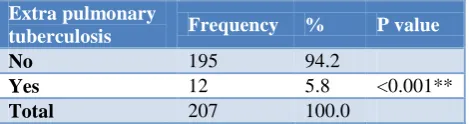
Table 3: Extra pulmonary TB and HIV.
Extra pulmonary
tuberculosis Frequency % P value
No 195 94.2
Yes 12 5.8 <0.001**
Total 207 100.0
Totally, 90.3% (187) of the patients were married and the remaining 9.7% (20) patients including children were unmarried.
There were 144 (69.6%) persons with spouse negative for HIV, 48 (23.2%) persons with spouse positive status and the rest of the study population i.e., 15 (7.2%) were adults living alone or dependent children.
Opportunistic infections (OI)
In this study, from June 2004 to June 2010, faecal specimens were collected from a total of 207 HIV reactive patients and 20 controls. Of the total reactive patients, the following number of patients were present with the intestinal opportunistic infections like cryptosporodiosis 31 (15%), isosporiasis 13 (6.3%), cyclosporiasis 2 (1%), strongyloidiasis 8 (3.9%) and microsporodiosis 1 (0.5%). Also, some of the other opportunistic infection were found during routine screening like Candidiasis 32 (15.5%), Toxoplasma infection 5 (2.4%), Herpes infection 7 (3.4%) and CMV 5 (2.4%). All the controls who had been tested for the above parasitic infections showed negative results. There were 42 (20.3%) patients diagnosed with pulmonary tuberculosis and 12 (5.2%) cases were diagnosed with extra pulmonary tuberculosis.
DISCUSSION
In the recent years it has spread from urban to rural areas and from individuals practicing risk behaviour to the general population. More and more women attending antenatal clinics are being found testing HIV-positive thereby increasing the risk of perinatal transmission. One in every 4 cases of HIV positive reported is a woman. About 84% of the infections occur through the sexual route (both heterosexual and homosexual).6 The spread of HIV infection occurs most frequently in the sexually active and economically productive age group of 15 to 44 years. Globally during 2004 the male to female ratio was nearing equal.7 In India, according to NACO, the total number of PLHA was estimated at 24 Lakh (19.3–30.4) in 2009. Children (<15 yrs) accounted for 3.5% of all infections, while 83% were in the age group of 15-49 years. Of all HIV infections, 39% (9.3 lakh) were Women.8 In our study also sexually active age group was predominant with 69%. Also, prevalence of infection among males was predominant with 69% while only 31% were females.
In this study, daily wages workers accounted for 40.1% of the infections followed by self-employed which was around 16%. Interestingly, high risk groups such as drivers 4.3%, CSW 3.4% were very low in numbers. Probably, the infection moved to the general population from high risk groups as mentioned by several research groups such as YRG care.
An important gateway to both prevention and care is knowledge of HIV-1 status.9 Fear of knowledge of status, including stigma and discrimination, has discouraged many from seeking voluntary counseling and testing services.10 In Rural settings, this led to major problem and increases the transmission rate as shown in our study. The current worldwide expansion of AIDS epidemic is primarily driven by sexual transmission of HIV-1. In the
most populous regions of the world, sexual transmission among heterosexuals is the dominant mode of spread.11 Reduction of heterosexual transmission is crucial for control of the epidemic in many parts of the world.12 Prevention of mother-to-child transmission has seen advances in both industrialised and resource-constrained settings.13 According to NACO 2009-10 Annual Report, the mode of transmission were as follows: Heterosexual (87.4%), mother to child (5.4%), IDU (1.6%), MSM (1.5%) and blood and blood products (1%).14 In our study also, the major route of transmission was heterosexual (96.6%) followed by mother to child 2.6% and percutaneous 0.5%. Sexual transmission among Homosexual men is still a significant part of epidemic spread in United States and Europe.15
The common enteric opportunistic pathogens described are Cytomegalovirus, Cryptosporidium spp, Isospora belli, Microsporodium spp., Mycobacterium avium intracellulare and more recently, Clostridium difficile, Cryptosporidium spp. and I. belli have been reported as the most common causes of diarrhea, however, most studies have focused only on protozoan etiology. Cryptosporidiosis is also a substantial threat to HIV-infected individuals and affects up to 50% of patients with AIDS in the developing world.16,17 Guk et al studied the prevalence of the parasitic infections in 105 HIV-infected patients and found the following opportunistic pathogens; Cryptosporidium parvum (10.5%; 7/67),
Isospora belli (7.5%; 5/67), Clonorchissinensis (3.0%; 2/67), Giardialamblia (1.5%; 1/67),
Gymnophalloidesseoi (1.5%; 1/67), and Pneumocystis carinii (28.3%; 17/60).18
Praveen et al found that most of the study patients were manual labourers followed by truck drivers. Sexual (heterosexual) route was found to be the major risk factor for HIV/AIDS. The most common symptom in these patients was cough and expectoration, followed by fever and weight loss. Acid-fast bacilli (AFB) smear positivity was found in 21.4% patients. On chest skiagram, infiltrative lesions were commonly seen in 61.9% patients. Extra pulmonary tubercular manifestations were seen in 45.6% of HIV/TB cases.19
Rajendraprasad et al in the year 2005 showed that tuberculosis was one of the commonest opportunistic infections seen among HIV positive patients and active TB is common in Karnataka, India. Sputum negative pulmonary TB was the commonest presentation. Among patients with extra-pulmonary TB, both pleural effusion and tuberculous lymphadenitis were common.20
control (CDC) classification. They found that tuberculosis was the commonest opportunistic disease, seen in 163 patients. Of these, 68 had exclusively pulmonary tuberculosis, 55 extra pulmonary disease, and 40 the disseminated form. Pulmonary and Extra pulmonary tuberculosis had low positive predictive value (PPV) (51% and 42%) for CD4 levels of <200 when compared with the disseminated form (specificity 87% and PPV75%). Among 86 patients with radiological evidence of tuberculosis, typical radiological features of post-primary tuberculosis were present in 60 cases (70%). Other features such as effusion (14 patients, 16%) and miliary shadows (12 patients, 14%) were comparatively rare. They concluded that pulmonary and extra pulmonary forms of tuberculosis should be considered in AIDS defining illness.21
In our data, among the reactive patients, the following number of patients were present with the intestinal opportunistic infections like cryptosporodiosis 31 (15%), isosporiasis 13 (6.3%), cyclosporiasis 2 (1%), strongyloidiasis 8 (3.9%) and microsporodiosis 1 (0.5%). Also, some of the other opportunistic infection were found during routine screening like Candidiasis 32 (15.5%), Toxoplasmosis 5 (2.4%), Herpes infection 7 (3.4%) and CMV 5 (2.4%). Among the entire reactive group 42 (20.3%) patients diagnosed with pulmonary tuberculosis and 12 (5.2%) cases were diagnosed with extra pulmonary tuberculosis.
In an Australian study, 23% of the HIV-infected patients developed chronic HBV infection after acute hepatitis B, compared to 4% of non-HIV-infected patients. 22 According to Alter et al HCV-HIV co-infection affects 25% of HIV patients and 5-10% HCV patients in Europe and North America.23 Patel et al showed that the HbsAg co infection prevalence was 5.3% (14/266); 2 of 252 patients had positive anti hepatitis C serology (0.8%).24 Sud et al have reported 33.8% prevalence of HBV co-infection in HIV positive patients.25
Use of drugs or alcohol by the male partner may result in faulty use of condoms (due to impaired judgement) and failure to use condoms. After controlling for all other vulnerability factors, baseline heavy alcohol consumption, moderate to heavy drug use, younger age and, to a lesser extent, smoking were associated with seroconversion.26 Tobacco smoking may be an independent risk factor for HIV infection although residual confounding is another possible explanation. Smoking did not appear to be related to progression to AIDS although this finding may not be true in developing countries or with the longer life expectancies seen with highly active antiretroviral therapy.26 In our study, more than 50% of the patients were alcoholics, which may be one of the causes for high risk behavior and seroconversion. Also, because of the low literacy rate, discrimination and lack of awareness, majority of the patients were diagnosed only at 3rd or 4th stages of the disease. Since, the rural people are the new population at
risk, awareness programs should be focused more on rural areas to prevent the risk of transmission.27
Funding: No funding sources Conflict of interest: None declared
Ethical approval: The study was approved by the Institutional Ethics Committee
REFERENCES
1. Ayyagari A, Sharma AK, Prasad KN, Dhole TN, Kishore J, Chaudhary G. Spectrum of opportunistic infections in Human Immunodeficiency Virus (HIV) infected cases in a tertiary care hospital. Indian J Med Microbiol. 1999;17:78-80.
2. Singh A, Bairy I, Shivananda PG. Spectrum of Opportunistic infections in AIDS cases. Ind J Med Sci. 2003;53(1):16-21.
3. Cegielki JP, Ortega YR, Mckee S, Madden JF. Cryptosporidium, Enterocytozoon and Cyclospora infections in paediatric and adult patients with diarrhea in Tanzania. Clin Infect Dis. 1999;28:314-21.
4. Soriano V, Barreiro P, Nunez M. Management of chronic hepatitis B and C in HIV Co infected Patients. J Antimicrob Chemother. 2006;57:815-8. 5. Sehgal R and Malla N. Pre – Congress CME cum
workshop on parasitic Diseases: Newer techniques for the next millennium - XXIII National Conference of IAMM. 1999;18:13-31.
6. National institute of health and family welfare; Available at: http://www.nihfw.org. Accessed on 3 March 2018.
7. Report and Global AIDS Epidemic; Epidemiological fact sheetson HIV/AIDS and Sexually Transmitted Diseases –UNAIDS/WHO working group. 2009.
8. NACO. Press release. 2009
9. Rennie S, Behets F. Desperately seeking targets: the ethics of routine testing in low income countries. Bull WHO. 2006;84:52-7.
10. Manzi M, Zachariah R, Teck R, Buhendwa L, Kazima J, Bakali E, et al. High acceptability of voluntary counselling and HIV-testingbut unacceptable loss to follow up in a prevention of mother-to-child HIV transmission programme in rural Malawi: scaling-up requires a different way of acting. Trop Med Int Health. 2005;10:1242–50. 11. Mann J, Chin J, Piot P, Quinn T. The International
Epidemiology of AIDS. Sci AM. 1988;259:82-9. 12. Chan DJ. Factors affecting sexual transmission of
HIV-1: Current evidence and implications forprevention. Curr HIV Res. 2005;3:223–41. 13. Luzuriaga K, Sullivan JL. Prevention of Mother to
child transmission of HIV infection. Clin Infect Dis. 2005;40:466-7.
14. NACO. Annual report. 2009-10.
16. Banerjee I, Primrose B, Roy S, Kang G. Enteric parasites in patients with diarrhoea presenting to a tertiary care hospital: Comparison of Human Immunodeficiency Virus infected and uninfected individuals. J Assoc Phys India. 2005;53:492. 17. Farthing MJ, Kelly MP, Veitch AM. Recently
recognised microbial enteropathies and HIV infection. J Antimicrob Chemother. 1996;37:61-70. 18. Guk SM, Seo M, Park YK. Parasitic infections in
HIV-infectedpatients who visited Seoul National University Hospital during the period1995-2003, Korean J Parasitol. 2005;43(1):1-5.
19. Kumar P, Sharma N, Sharma NC. Clinical profile of tuberculosis in patients with HIV infection/AIDS. Indian J Chest Dis Allied Sci. 2002;44(3):159-63. 20. Rajendraprasad S, Balasubramanya M, Chang H.
Clinical Spectrum of Tuberculosis in HIV Positive Patients in resource limited settings in Karnataka, India. IAS Conf HIV Pathog Treat. 2005;3:24-7. 21. Attili VSS, Singh VP, Rai M. Evaluation of the
status of tuberculosis as part of the clinical case definition of AIDS in India. Postgrad Med J. 2005;81:404-8.
22. Bodsworth NJ, Cooper DA, Donovan B. The influence of Human immunodeficiency virus type 1 infection on the development of the Hepatitis B virus carrier state. J Infect Dis. 1991;163:1138-40.
23. Alter MJ. Transmission of Hepatitis C virus - route, doseand titer. N Engl J Med. 1994;330:784-6. 24. Patel P, Davis S, Tolle M, Mabikwa V, Anabwani
G. Prevalence of Hepatitis B and Hepatitis C co infections in an adult HIV centre population in Gaborone, Botswana. Am J Trop Med Hyg. 2011:85(2):390-4.
25. Sud A, Singh J, Dhiman RK, Wanchu A, Singh S, Chawla Y. Hepatitis B virus Coinfection in HIV infected patients. Trop Gastroenterol. 2001;22:90–2. 26. Penkower L, Dew MA, Kingsley L, Becker JT, Satz P, Schaerf FW, Sheridan K. Behavioral, Health and Psychosocial factors and risk for HIV infection among sexually active homosexual men: The Multicenter AIDS Cohort Study. Am J pub Health. 1991;81:194-6.
27. Furber AS, Maheswaran R, Newell JN, Carroll. Is smoking tobacco an independent risk factor for HIV infection and progression to AIDS? A systemic review. Sex Transmitted Infection. 2007;83:41-6.