Physical Properties of Selected
Transition Metal Oxides
J. E. L. Waldron
Royal Institution of Great Britain
London
thesis submitted for the degree o f Doctor o f Philosophy
from the University of London
All rights reserved
INFORMATION TO ALL USERS
The quality of this reproduction is dependent upon the quality of the copy submitted.
In the unlikely event that the author did not send a complete manuscript and there are missing pages, these will be noted. Also, if material had to be removed,
a note will indicate the deletion.
uest.
ProQuest U643690
Published by ProQuest LLC(2016). Copyright of the Dissertation is held by the Author.
All rights reserved.
This work is protected against unauthorized copying under Title 17, United States Code. Microform Edition © ProQuest LLC.
ProQuest LLC
789 East Eisenhower Parkway P.O. Box 1346
M onoclinic N b j20 29 has been synthesised by topotactic reduction o f H -N b2 0^. It
has a com plex crystallographic shear structure m ade up o f 3x4 blocks o f com er
shared N bO ^ octahedra. N b 1 2 ^ 2 9 is a m ixed d^/dj com pound w hich, can be w ritten
as Nb^^2^t)^^io029" It has been found, using Rietveld refinem ent o f pow der neutron
diffraction data, to undergo a charge ordering transition at around 12K resulting in a
low ering o f sym m etry from A 2/m to Am. B elow this transition, one Nb^+ ion is
localised on a crystallographically distinct site in the centre o f the 3x4 blocks. This
charge ordering transition has an associated transition to an incom m ensurate one
dim ensional antiferrom agnetic state. The nature o f the m agnetic order has been
in v e stig a te d u sin g s u sc e p tib ility and |xSR m easu re m en ts. S u scep tib ility
m easurem ents reveal that only 48% o f the Nb"^+ in the system is localised, and its
tem perature d ependence is w ell fitted to a B onner-F isher m odel for S = l/2 one
dim ensional antiferrom agnets. It is found that the rem aining valence electrons in
^ ^1 2 ^ 2 9 itinerant and contribute to its m etallic conductivity.
Further evidence for the unique properties o f m onoclinic N b^2029 been
obtained by doping the structure w ith sm all am ounts o f diam agnetic Ti^+, w hich
rapidly causes a destruction o f the long range m agnetic order at only 3% doping, but
leaves the m etallic conductivity unaffected, as is expected for a one dim ensional
F irstly I w ould like to thank M um m y and D addy for all th eir help and
support in so m any w ays over the last 4 years.
I w ould also like to say a huge thank you to M ark G reen for his endless
guidance and backing th ro ug ho ut and particularly during the last few m onths o f
w riting up. W ithout h im none o f this w ould have been possible. T hank you to
Professor Day for allow ing m e to do a PhD at the RI and for all the opportunities
this has afforded me. T hank you too to Steve Bram w ell for his sharp insight into all
aspects o f m agnetism .
I am m uch indebted to Professor Iw asa for all his help during my trip to
Japan and especially to Chris N uttall who spent so long trying to m ake the pressure
rig w ork w ith me. T hank you also to A lex Lappas for all his hard w ork fitting the
pS R data w hich has m ade such a difference to the analysis o f my SQUID data. I am
naturally grateful to D an N eum an at N IST and A lan H ew at at ILL for all their help
during neutron diffraction experiments.
Thank you to Justin, M att, Gavin, Steve and Jo for m aking all those hours
spent in the XRD room doing GSAS alm ost fun! Thanks also to Sarah and G ayna for
all those swift halves, to Fiona for being a com plete star and alw ays there to pick up
the pieces w hen things w ent w rong and to Al, G reg, Justin and Jo w ho practically
forced me to sit at m y com puter and type.
Finally, thanks to Rod, D oug and everyone else at K illin for giving m e the
perfect place to escape from everything. W ithout all o f y ou I never w ould have
finished.
C hapter 1 Introduction
1.1 Introduction
1.2 Low D im ensionality in H igh Superconductors
1.3 One D im ensional M agnetism
1.4 Spin Peierls System s
1.5 A lternating C hain C om pounds
1. 6 Spin Ladder System s
1.7 V anadium Oxides
1. 8 N iobium Oxides
18 18
20
23 27 29 32 37 43C hapter 2 T heory
2.1 D iffraction
2.1.1 Rietveld Refinem ent
2.2 M agnetism
2.2.1 M agnetic U nits
2.2.2 Types o f M agnetic O rdering
2.2.2.1 Long Range Order
2 2 2 2
Spin G lasses2.2.3 Types o f M agnetic Exchange
2.2.3.1 Direct Exchange
2.2.3.2 Superexchange
2.2.3.3 RK K Y
2.2.4 Curie W eiss
2.2.5 Low D im ensional M agnetism
2.2.5.1 D im er M odel
2.2.5.2 One D im ensional M agnetic Systems
2.2.5.2.1 Spin Peierls
2.2.5.2.2 A lternating Chain M odel
2.2.5.2.3 Spin Ladders
2.2.5.3 Tw o D im ensional M agnets
2.3 C onductivity
2.4 iliSR
66
66
67
C hapter 3 E xperim ental M ethods 71
3.1 D iffraction 71
3.1.1 N eutro ns vs X -rays 71
3.1.2 X -ray D iffraction 71
3.1.3 N eutron D iffraction 72
3.1.3.1 Institut Laue-Langevin, G renoble, France 72
3 .1 .3 .2 D 2 B 73
3.1.3.3 D I A 74
3.1.3.4 N ational Institute o f Standards and Technology, N IST,
G aithersburg, U SA 75
3.1 .3 .5 B T -1 75
3.2 M agnetism 76
3.2.1 S QUID m agnetom eters 76
3.3 C onductivity 77
3.3.1 H igh Pressure Conductivity 78
3.4 M uon Spin Relaxation, p S R 80
C hapter 4 N bj2029 : B ackground and Synthesis
4.1 Introduction
4.2 Crystallographic Shear Structures
4.3 Previous Studies o f N bj2029 and R elated Structures
4.4 Synthesis
4.4.1 Synthesis M ethod
4.4.2 Low Tem perature Reactions
4.4.3 R eactions at 1200°C
4.4.4 H igh Tem perature Reaetions
4.5 Summary
99
102
C h a p te r s • Structure 105
5.1 Introduction 105
5.2 Previous Structural W ork on N bj2029 107
5.3 X -ray Structure 109
5.4 N eutron Structure 110
5.4.1 N IST data 110
5.4.1.1 Refinem ent R esults, N IST data 110
5.4.1.2 A tom Positions and R efinem ent Profiles, N IST
data 1 1 2
5.4.2 A m Space G roup 118
5.4.3 N eutron D iffraction at the Institut Laue Langevin 119
5.4.3.1 Refinem ent Results, ILL data, A 2/m 119
5.4.3.2 A tom Positions and Refinem ent Profiles, ILL
data, A2/m 121
5.4.3.3 Refinem ent Results, ILL data. Am 126
5.4.3.4 A tom Positions and Refinem ent Profiles, ILL
data. Am 127
5.4.4 C om parison o f A 2/m and A m 132
5.4.5 N b - 0 Bond D istances 134
5.4.6 B ond D istance A nalysis 139
C hapter 6 N bj2029 : P hysical Properties
6.1 Introduction
6.2 T ran sport Properties
6.3 M agnetism
6.3.1 Susceptibility o f M onoclinie N bj2029
145
145
146
148
6.3.2 Curie W eiss Fitting 151
6.4 M uon Spin Relaxation (|iSR ) 152
6.5 Fitting to Low D im ensional M odels 157
6.5.1 D im er M odel 157
6.5.2 B onner-Fisher M odel 158
6.5.3 A lternating Chain M odel 161
6.5.4 Spin Ladder M odel 162
6 . 6 Summary 162
C hapter 7 Tij^Nbj2_x029 167
7.1 Introduction 167
7.2 Synthesis 172
7.3 Structure 178
7.4 M agnetism 182
7.5 C onductivity 190
7.6 Conclusions 193
Figure 1.1 Phase D iagram o f L a2_xSr] _xCu0 4 19
Figure 1.2 Structures o f LaNiOg and PrNiOg. Ln in green, NiO^ octahedra
in grey. 19
Figure 1.3 Structures o f the R uddlesden-Popper series general form ula
^ n + i ^ n ^3n+i- ^ ^ 6 octahcdra are represented in blue, A
is shown in green. 2 0
Figure 1.4 Structure o f L a2_^Sr,^C u0 4 21
Figure 1.5 V ariation o f w ith the num ber o f connected planes in various high
tem perature superconductors. 2 2
Figure 1.6 Structure o f the n = l, 2, and 3 m em bers o f the TlBa2Ca^_ ^ ^ ^ n ^3n+ 2
series 2 2
Figure 1.7 D ifferent possible exchange pathw ays in low dim ensional m agnets
24
Figure 1.8 Structure o f D iC hlorobi (thiazole) copper (II) (Cu is red) 25
Figure 1.9 Structure o f SrCu0 2 (Cu is red, Sr is green, O is blue) 25
Figure 1.10 Structure o f Sr^CuOg (Cu is red, Sr is green, O is blue) 26
Figure 1.11 Structure o f CsNiClg (N i is red, Cs is green. Cl is purple) 28
Figure 1.12 CuGeOg (Cu is red, Ge is green, O is blue) 29
Figure 1.13 Structure o f (V O)2P2 0 2 (V in red, P in green, O in blue) w ith spin
ladder exchange pathw ay superim posed 30
Figure 1.14 Structure o f (V O)2P2 0 2 w ith the alternating chain exchange
pathw ay superim posed 30
Figure 1.15 Structure o f LiCuClg H2 0 (Cu in red. Cl in green, Li in blue, H2O in
grey) 31
Figure 1.16 Structure o f Cu2(l ,4-diazacycloheptane)2Cl4 (Cu in red. Cl in green)
32
Figure 1.17 Possible exchange pathw ays in alternating chain com pounds 33
Figure 1.19 Structure o f Sr2CugOg (Cu in red, Sr in green, O in blue) 3 5
Figure 1.20 Structure o f L aC uO j 5 (Cu in red. L a in green, O in blue) 36
Figure 1.21 Structure o f N aV2 0 ^ (V^^O^ in green, in red, N a in blue) 38
Figure 1.22 The two distinct vanadium environm ents in N aV2 0g
corresponding to V 4+and 39
Figure 1.23 Structure o f M gV2 0^ (VO^ in grey, M g in blue) 40
Figure 1.24 Structure o f LiV2 0 ^ showing V2O5 layers (V^"*" in blue,
in grey, Li in pale blue) 41
Figure 1.25 Structure o f LiV2 0 g showing zig-zag chains o f (blue) and
(grey) 41
Figure 1.26 Structure o f CSV2O5 (square pyram idal in blue, tetrahedral
in grey, Cs in pink) 42
Figure 2.1 Pictorial D epiction o f B ragg’s Law 49
Figure 2.2 E w ald’s Sphere 50
Figure 2.3 Cation-anion-cation m agnetic super-exchange in a (top) and
K
(bottom ) bonds w ith an interaction at 180° 57
Figure 2.4 Exchange as a function o f distance for a m agnetic impurity
em bedded in a sea o f conduction electrons as described by
the RK K Y interaction. 58
Figure 2.5 Exchange param eters in an alternating chain 63
Figure 2.6 Exchange param eters for next nearest neighbour interactions 65
Figure 2.7 Exchange param eters for zig-zag chains 65
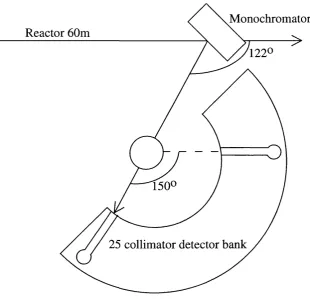
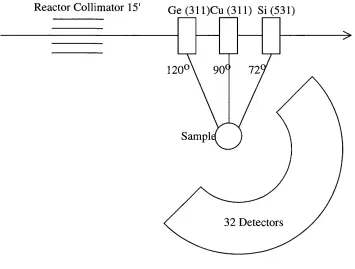
Figure 3.1 Schematic diagram o f diffractometer D2B 73
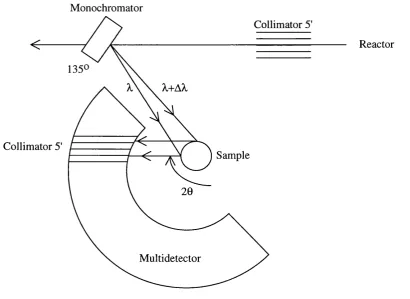
F igure 3.2 Schematic diagram o f diffractometer D IA 74
Figure 3.3 Schematic diagram o f diffractometer B T l 75
Figure 3.4 M ain com ponent o f a SQUID m agnetom eter 76
Figure 3.5 Set up o f pellets for conductivity m easurem ents 77
Figure 3.7 Longitudinal setup o f a jiSR experim ent 80
Figure 4.1 Form ation o f crystallographic shear planes 83
Figure 4.2 The structure o f H -N b2 0g 84
Figure 4.3 The structure o f N b2 5 0 ^ 2 85
Figure 4.4 The structure o f m onoclinic N bj2029 8 6
Figure 4.5 The structure o f orthorhom bic N bj2029 87
Figure 4.6 N b2 0^ im purities in Nb^2029 90
Figure 4.7 X -ray diffraction pattern o f N bj2029 after extended heating
showing an increase o f the [hOO] reflection, w hich occurs w hen
the m aterial is over reacted. 91
Figure 4.8 X -ray diffraction pattern o f sam ple m ade from N b and N b2 0^ and
heated at 700°C for 12 hours 93
Figure 4.9 X -ray diffraction pattern o f sam ple m ade from N b0 2 and N b2 0^ and
heated at 700°C for 12 hours 93
Figure 4.10 X -ray diffraction pattern o f sam ple m ade from N b and N b2 0^ and
heated at 1100°C for 12 hours 94
Figure 4.11 X -ray diffraction pattern o f sam ple m ade from N b0 2 and N b2 0g and
heated at 1100°C for 12 hours 95
Figure 4.12 X -ray diffraction pattern o f sam ple m ade from N b and N b2 0^ and
heated at 1200°C for 48 hours 96
Figure 4.13 X -ray diffraction pattern o f sam ple m ade from N b and N b2 0g and
heated at 1200°C for 3 hours 96
Figure 4.14 X -ray diffraction pattern o f sam ple m ade from N b and N b2 0 ^ and
heated at 1200°C for 90 m inutes 97
Figure 4.15 X-ray diffraction pattern o f sam ple m ade from N b and N b2 0^ and
heated at 1200°C for 1 hour 98
heated at 1200°C for 30 m inutes 98
Figure 4.17 X -ray diffraction pattern o f sam ple m ade from N b0 2 and N b2 0g
and heated at 1200°C for 30 m inutes 99
Figure 4.18 X -ray diffraction pattern o f sam ple m ade from N b and N b2 0g and
heated at 1300°C for 5 m inutes 100
Figure 4.19 X-ray diffraction pattern o f sam ple m ade from Nb and N b2 0^ and
heated at 1350°C for 8 m inutes 100
Figure 4.20 X -ray diffraction pattern o f sam ple m ade from N b0 2 and N b2 0g
and heated at 1300°C for 5 m inutes 101
Figure 4.21 X -ray diffraction pattern o f sam ple m ade from N b0 2 and N b2 0^
and heated at 13 50°C for 10 m inutes 101
Figure 4.22 X -ray diffraction pattern taken over 12 hours o f a 1 gram sam ple
o f m onoclinic N bj2029 m ade from N b and N b2 0g and heated at
1200°C for 1 hour 102
Figure 5.1 M onoclinic N bj2029 w ith the [100] lattice plane 105
Figure5.2 Key for N b positions in all structures 108
Figure 5.3 M onoclinic N bj2029 in the A 2/a space group as solved by N orin 108
Figure 5.4 M onoclinic N bj2029 the A 2/m space group 109
Figure 5.5 Refinem ent profile o f room tem perature N IST data refined
in A 2/m 113
Figure 5.6 Refinem ent profile for 25K N IST data refined in A 2/m 115
Figure 5.7 Refinem ent profile o f the 5K N IS T data refined in A 2/m 117
Figure 5.8 M onoclinic Nbj2029 in the A m space group showing the 12
crystallographically distinct sites in each 3x4 block 118
Figure 5.9 Refinem ent profile o f 1.594Â 2K ILL data refined in A 2/m 122
Figure 5.10 Refinem ent profile o f 2.398Â 2K ILL data refined in A 2/m 123
Figure 5.11 Refinem ent profile o f 2.398Â 3OK data refined in A 2/m 125
Figure 5.13 R efinem ent profile o f 2K 2.398Â ILL data refined in A m 129
Figure 5.14 R efinem ent profile for 3 OK ILL data refined in Am 131
Figure 5.15 Peak at 20 = 60° (2K, 1.594A, ILL data) refined in A 2/m 133
Figure 5.16 Peak at 20 = 60° (2K, 1.594À, ILL data) refined in Am 133
Figure 6.1 R esistivity as a function o f tem perature for monoclinic
^ ^ 1 2 ^ 2 9 147
Figure 6.2 C onductivity m easurem ents at am bient pressure and lOkBar 148
Figure 6.3 Field cooled and zero field cooled Susceptibility plot for
m onoclinic N bj2029 at lOOG 149
Figure 6.4 Field cooled and zero field cooled Susceptibility plot for
m onoclinic N b j2Û2 9 at lOOOG 150
Figure 6.5 Field cooled and zero field cooled Susceptibility plot for
m onoclinic N b|2029 at lOG 150
Figure 6 . 6 1/% as a function o f tem perature for N b j2Û2 9 152
Figure 6.7 M uon spin relaxation function at 0.06K 154
Figure 6 . 8 M uon spin relaxation function at 8K 155
Figure 6.9 M uon spin relaxation function at 14K 155
Figure 6.10 Tem perature dependence o f the oscillation frequency o f
^ ^
12^29 156Figure 6.11 D im er m odel fit to the susceptibility o f N bj2029 at lOOG 158
Figure 6.12 B onner-F isher fit to susceptibility o f Nb^2029^^ lOOG 159
Figure 6.13 B onner-F isher fit to the susceptibility o f N bj2029 at lOOG
w ith g fixed at a value o f 2 160
Figure 6.14 B onner-F isher fit to the susceptibility o f N bj2029 at lOOG using
values o f g and J/k that fitted high tem perature data well 160
Figure 7.1 A one dim ensional chain o f N b atom s disrupted by the inclusion
o f one non m agnetic Ti atom. 168
Figure 7.3 K ey show ing colours for different m etal positions in
^^2^ ^ 10^29 170
Figure 7.4 Structure o f m onoclinic T iN b |,0 2 9 (A 2/m ) 170
Figure 7.5 Structure o f orthorhom bic T iN b ^0 2g 171
Figure 7.6 X -ray diffraction pattern o f Tig o^N b^ 9 5O2 9 174
Figure 7.7 X -ray diffraction pattern o f Tig ]N b jj 9O2 9 174
Figure 7.8 X -ray diffraction pattern o f Tig 2 ^ 6 ^ j g029 175
Figure 7.9 X -ray diffraction pattern o f TiQ2g N b ^ 7 5O2 9 175
Figure 7.10 X -ray diffraction pattern o f T iN b ^ 0 2 9 176
Figure 7.11 V olum e as a function o f Ti doping in Tij^Nbj2_x029 177
Figure 7.12 X -ray diffraction patterns o f N bj2029 and TiNb^ , 0 2 9 178
Figure 7.13 R efinem ent profile o f TiN bj JO2 9 refined in A2/m space group 181
Figure 7.14 O rdering tem perature as a function o f Ti doping in Ti^Nb22_x^29 183
Figure 7.15 Susceptibility as a function o f tem perature for Tig osN bjj 9 5O2 9 183
Figure 7.16 Susceptibility as a function o f tem perature for Tig |N b , j 9O2 9 184
Figure 7.17 Susceptibility as a function o f tem perature for TiQ 2X6 , ^ g029 184
Figure 7.18 Susceptibility as a function o f tem perature for Tig 2 5 ^ 6 1 1 7 5O2 9 185
Figure 7.19 Susceptibility as a function o f tem perature for T iN b ^ 0 2 9 186
Figure 7.20 1/% as a function o f tem perature for Tig g^N b^ 9 5O2 9 186
Figure 7.21 1/% as a function o f tem perature for Tig ^N b^ 9O2 9 187
Figure 7.22 1/% as a function o f tem perature for Tig 2X6 ^ g029 187
Figure 7.23
\l%
as a function o f tem perature for Tig 2gN b^ 75O29 188Figure 7.24 1/% as a function o f tem perature for T iN b jj0 2 9 188
Figure 7.25 V ariation o f C w ith x in Ti^^Nbj 2 . ^ 0 2 9 190
Figure 7.26 R esistivity as a function o f tem perature for Tig g^N b^ 95O29 191
Figure 7.28 R esistivity as a function o f tem perature for Ti^ 2N bj j g0 2g 192
Figure 7.29 R esistivity as a function o f tem perature for TiQ 2gNb] ^ 7 5O2 9 192
Figure SI Structure o f m onoclinic N b j2Û2 9 solved in the A m space group
from 2k ILL data w ith N b position 12 highlighted as Nb^+
p o sitio n s 199
Figure S2 M onoclinic N b j2Û2 9 w ith distances betw een N b position 12
Table 5.1 G oodness-of-fit factors for refinem ents o f N IST data in A 2/m 111
Table 5.2 Therm al factors for refinem ents o f N IST data in A 2/m 111
Table 5.3 Lattice param eters for refinem ents o f N IST data in A 2/m 111
Table 5.4 A tom positions for refinem ent in A 2/m o f the room tem perature
N IS T data 112
Table 5.5 A tom positions for refinem ent in A 2/m o f the 25K N IST data 114
Table 5.6 A tom positions for refinem ent in A 2/m o f the 5K N IST data 116
Table 5.7 G oodness-of-fit factors for 2K ILL data refined in A 2/m 120
Table 5.8 Therm al factors for 2K ILL data refined in A 2/m 120
Table 5.9 G oodness-of-fit and therm al factors for 3OK ILL data refined
in A2/m 121
Table 5.10 A tom positions for 2K ILL data refined in A 2/m 121
Table 5.11 A tom positions for 3OK ILL data refined in A 2/m 124
Table 5.12 G oodness-of-fit factors for ILL data refined in Am 126
Table 5.13 Therm al factors for ILL data refined in Am 126
Table 5.14 A tom positions for 2K ILL data refined in A m 127
Table 5.15 A tom positions for 3OK ILL data refined in A m 130
Table 5.16 Lattice param eters for refinem ents o f all ILL data 132
Table 5.17 N b -0 bond lengths for N IS T room tem perature A 2/m
refinement. All distances in
A
134Table 5.18 N b -0 bond lengths for N IS T 25K A 2/m refinement.
All distances in
A
135Table 5.19 N b -0 bond lengths for ILL 3OK A 2/m refinement.
All distances in  135
Table 5.20 N b -0 bond lengths for ILL 3OK A m refinement.
A ll distances in  136
Table 5.21 N b -0 bond lengths for N IS T 5K A 2/m refinement.
All distances in
A
137Table 5.22 N b -0 bond lengths for ILL 2K A 2/m refinement.
Table 5.23 N b -0 bond lengths for ILL 2K A m refinement.
All distances in  138
Table 5.24 Average bond lengths, bond valence sum and sample
variance calculations 139
Table 6.1 J values for various low dim ensional S = l/2 antiferrom agnets 164
Table 7.1 Synthesis conditions for T i^N b j2_xCl2 9 172
Table 7.2 Synthesis conditions for Ti^Nb^2_x^ 2 9 173
Table 7.3 Lattice param eters for Ti^Nbj2_x029 177
Table 7.4 Lattice param eters, Therm al factors and goodness o f fit
factors for T iN b ^0 2g neutron diffraction refinem ent. 179
Table 7.5 A tom positions for the refinem ent in A 2/m o f TiNbj j029 180
Table 7.6 Summary o f results from C urie-W eiss fits to Ti^Nb^2_x029 189
Table SI Bond lengths, average bond length and sample variance for the
1.1 Introduction
Transition metal oxides are w idely studied system s due to their huge variation o f
properties and structure types. Their physical properties can vary greatly, often
only with subtle changes to structure or composition. Conductivity properties are
found to vary hugely, from insulating behaviour in T iÛ2 through semiconductors
such as FcggO and metals such as ReO^, to high temperature superconductivity in
compounds such as Y B a2CugOy_^ (T^. = 92K)*’ Many compounds show metal
-non-m etal transitions as functions o f temperature (V O2), pressure (V2O3) or
com position (Na^WOg)^» Transition metal oxides also show interesting magnetic
properties which are, in turn, often related to the structure. The structure types
shown by transition metal oxides are vast, varying from three dimensional structures
such as perovskite, rutile and spinel, to layered and highly defective structures^»
One o f the most advantageous aspects o f transition metal oxides is their versatility in
oxidation states, enabling m ixed valence or non-stoichiom etric oxid es to be
synthesised.
One o f the most important phenomena observed in transition metal oxides in
recent years is high temperature superconductivity. The onset o f superconductivity
can be controlled in many cases by doping, which changes the oxidation state o f the
transition metal. The La2_xSr^CuO^ phase diagram is an intriguing example; its
properties change from antiferromagnetism to superconductivity via spin glass
behaviour with increasing proportions o f Sr dopant or with application o f pressure.
A diagrammatic representation o f the La2_^Sr^CuO^ phase diagram is shown in fig
1.1. The high transition temperatures found in cuprates are still not understood. It is
therefore important to study other system s which have unusual low dimensional
superconductivity
AF insulator metal
Spin glass
No long range magnetic order Or superconductivity
Figure 1.1 Phase Diagram o f La2-xSrxCu0 4
As m entioned previously, it is not only changing the oxidation state o f a
transition metal oxide that can affect its properties; small changes in structure can
also have huge effects. For exam ple, a m etal-insulator transition is seen in the
LnNiOg (Ln = lanthanide) series as a function o f lanthanide size. LaNiO^ has an
undistorted perovskite structure and shows m etallic conductivity, but w hen La is
replaced by Pr, the structure becomes distorted and the material becomes insulating
below 150K; the structures are shown in figure 1.2. The change in Ln ion creates
chem ical pressure and distorts the Ni-O -Ni bond angle away from 180° thereby
reducing the overlap between orbitals and correspondingly reducing the bandwidth o f
the conduction band. Narrow band width systems become insulating despite being
p artially o ccup ied u nder certain conditions. These system s are know n as
M ott-H ubbard insulators.
LaNiO
PrNiOg
Figure 1.2 Structures o f LaNiO] and PrNiOg. Ln in green, NiO^
Dimensionality can also markedly affect physical properties. An exam ple is
given in the Ruddlesden Popper series with the general formula A
change in property can be seen to occur with the change in the dim ensionality. The
structure can be thought o f as planes o f MO 2 octahedra separated by AO rock salt
layers (shown in Figure 1.3) such that as n increases, the number o f octahedra with
shared oxygen ions, and consequently, the dim ensionality increases. In the
^ V i ^ n ^3n+i series for example, the n=l m ember is a M ott Hubbard insulator due
to the narrow bandwidth. However, the conductivity increases as the dim ensionality
increases so the
n-2
m em ber is a semi-metal and the n= perovskite m em ber ismetallic. This is due to an increased bandwidth as the dim ensionality o f the system
is increased.
n = o o
n = l n = 2
Figure 1.3 Structures o f the Ruddlesden-Popper series o f general form ula
An+iM n0 3n+i. MOe octahedra are represented in blue, A is show n in
green.
1.2 Low Dimensionality in High
Superconductors
One o f the m ost interesting areas o f solid state chem istry in recent years is low
dim ensionality and its effect on physical p roperties. The high tem perature
structure o f w hich is shown in figure 1.4 below. The CUO2 layers provide
electronically active planes which are separated from one another by L a/S r-0 rock
salt layers. The superconductivity occurs between specific doping levels o f Sr, but
the parent compound La2CuO^ is an example o f a two dimensional antiferromagnet.
A
CUO
2(La,Sr)02
(La,Sr) 0 2
CUO2
(La,Sr) 0 2
(La,Sr)02
CUO2
Figure 1.4 Structure o f La2-xSrxCu0 4
M any o f the cuprate superconductors have low dim ensional structures and
T
q is strongly affected by any change in dim ensionality. Figure 1.5 show s thevariation o f T^. with the num ber o f connected planes (related to the dim ensionality)
for three different series o f high tem perature superconductors. For exam ple,
members o f the TlBa^Ca^ |C u^0 2 ^ + 2 series have increasing T^, as the separation
between the CUO2 layers is increased, with T^. = 80K for n = l, 108K for n= 2 and
125K for n=3 as seen in figure 1.5. The structures o f this series are shown in figure
140
120
100 80
T
60
. — Bi S r C a C u , O, 40
20
T l^ B a^ C aC u ,^ O,
2.5 3 3.5 4
1.5
Figure 1.5 Variation o f Tc with the number o f connected planes in various high temperature superconductors.
1-Tl n=l
TlBa.CuOs l-Tl n=2
TlBa^CaCup^
2-Tl n=3
TlBa^CaCu^Og Figure 1.6 Structure o f the n = l, 2, and 3 members o f the
1.3 One Dimensional Magnetism
A lthough many superconductors are m ainly concerned with tw o dim ensional
structures, one dimensional magnetism is an area o f considerable recent interest^.
This is because it is possible to calculate the ground state energy exactly in som e
cases and they exhibit many exotic properties such as spin-Peierls transitions and
spontaneously dimerised states, which will be described in more detail in Chapter 2.
One dimensional magnetism is usually inferred from the crystal structure. Although
it may appear that chains o f magnetic atoms are present there are several different
possible types o f exchange pathway as shown in figure 1.7. The sim plest one
dimensional magnet is illustrated in figure 1.7a. In this case, the metal atoms are
equally spaced with equal exchange between them. It is possible for next nearest
neighbour exchange to occur as illustrated in figure 1.7b. Here although the atoms are
equally spaced, there is som e exchange between the first and third atom. This could
be due to a superexchange interaction through metal 2 but it could also be found if the
atoms were arranged in a zig-zag structure as illustrated in figure 2.7. In these
systems the ground state is dimerised and therefore, for an S = l/2 antiferromagnet, a
singlet. Figure 1.7c shows a one dimensional magnet with a lattice distortion known
as a spin-Peierls distortion. In a spin-Peierls system the ground state is again a
singlet but is distinguishable from that in a one dimensional magnet with next nearest
neighbour exchange as it is associated with a lattice distortion. In figure 1.7d, a spin
ladder is illustrated where two one dimensional chains interact with one another to
form a ladder type structure. The ground state o f this type o f system has an energy
gap i f J J is antiferromagnetic. However, perhaps the most interesting aspect o f spin
ladders is the prediction that upon doping with holes superconductivity is expected.
O C M J O
Figure 1.7 Different possible exchange pathways in low dimensional magnets
Synthesis o f one dimensional magnets can be difficult because the magnetic
chains must be a large distance from one another with non magnetic atoms between
them. There are no examples o f true one dimensional Heisenberg antiferromagnets
because there is alw ays a sm all am ount o f interchain interaction at finite
temperatures. However, there are many examples o f quasi one dim ensional systems,
usually organom etallic systems, which have much stronger intrachain interactions
than interchain interactions. Tétram éthylam m onium m anganese trichlorate (II)
(TM M C) has intrachain interactions that are four orders o f magnitude larger than the
interchain interactions^. Dibromo- and dichlorobi (thiazole) copper (11)^ (shown in
figure 1.8), copper benzoate^ (B E D T -T T F )2[A uIII(I-m nt)2] (I-mnt = 1,1-dithio-
2 ,2 d ic y a n o -e th y le n e ), (B E D T -T T F )2[ B i B r J' 0 and [ 3 ,3 ’- D im e th y l- 2 ,2 ’
Thiazolinocyanine]-T C N Q i • are also good examples o f one dim ensional systems
Figure 1.8 Structure o f DiChlorobi (thiazole) copper (II) (Cu is red)
There are few examples o f inorganic one dimensional magnets. S r2C u0 3 and SrCu0 2
are alm ost ideal ID Heisenberg a n tife rro m a g n e ts ^ T h e y have J values o f 2200 and
2100K but 3D long-range anti ferromagnetic order does not occur until 5K. They are
low dim ensional because structurally the m agnetic copper is arranged in chains.
S rC u0 2 has a zigzag chain structure (figure 1.9) with anti ferrom agnetic exchange
along the legs which creates frustration. The frustrated zigzag exchange is weak, so
the system can be regarded as tw o S = l/2 one dim ensional chains at higher
temperatures. Although static magnetic order is observed, no Bragg peaks are seen in
the neutron diffraction patterns, due to the f r u s t r a t i o n T h i s frustration is not seen
in Sr2Cu0 3, which has a simple linear chain structure as illustrated in figure 1.1 0.
O f one dimensional compounds, S = l/2 complexes have been the most w idely
studied. The Bonner Fisher expression, see section 2.2.5.2, g ives a theoretical
expression for the susceptibility. Other com plexes with integer spins have also been
w ell studied due to Haldane’s conjecture (section 2.2.5). A w ell studied series is the
A B X3 series where A is a group 1 metal. B i s a divalent transition metal cation
and X is F, Cl or Br. Many o f these compounds have a hexagonal perovskite
structure and are pseudo one dimensional but with significant interchain interactions.
The structure o f these materials means that the magnetic metal atoms are often
arranged in a triangular structure which leads to frustration o f the moments. One
exam ple from this series is CsCrClg, w hich is a S=2 quasi one dim ensional
Heisenberg antiferromagnet (shown in Figure 1.11). The magnetic properties are
dominated by the chains o f Cr2+ ions.
The nickel analogue, CsNiClg provided the first m odel system to test
Haldane’s conjecture. It is not only pure one dimensional materials that have
attracted attention in recent years. Impurities in one dimensional system s are much
more pronounced than in two and three dimensional exam ples because even one
impurity breaks the interaction in a one dimensional chain. When CsV^^Mg^Clg is
doped with Mg on the vanadium sites (x > 0.052), the one dimensional magnetism is
destroyed and the system behaves like a collection o f paramagnetic spins obeying the
Curie W eiss law^^. Doping o f one dimensional systems with non magnetic atoms
such as this w ill become important in Chapter 7.
1.4 Spin Peierls Systems
The majority o f exam ples o f spin Peierls compounds, as with one dim ensional
m agnets, are organic or organom etallic com pounds such as M E M -(T C N Q) 2
(methylethylmorpholinium tetracyanoquinodimethanide2) (Tgp=19) a
’-(B E D T -T T F)2A g(C N )2(Tgp=7K)^^'^ ^, aqua [N-(salicylaldiminato)glycinato] copper
1,2-perfluoro-m ethylethylene-l-2-dithiolato)-gold [TTF-BDT(Au)] (Tgp=2K) or w ith Cu (Tgp=
1 However , in 1993^^’ CuGeOg was discovered to be the first inorganic
example o f a spin Peierls compound (Tgp=14K). The structure is shown in figure
1.12. This discovery made the study o f the spin Peierls phenom enon much more
accessible as CuGeOg is easy to synthesise com pared with the com plex organic
systems previously studied. It also has a sim pler structure that consists o f Cu
chains separated by GeO^ units^^. When doped with small am ounts o f either Zn or
Si 28,29 the spin Peierls state is destroyed and a long range ordered antiferromagnetic
state is created.
Figure 1.12 CuGeO] (Cu is red, Ge is green, O is blue)
1.5 Alternating Chain Compounds
For alternating chains, the next nearest neighbour interaction becomes im portant and
influences the susceptibility. Cu(N0 2 ) 2 2.5H2O is a widely studied alternating chain
com pound w hich undergoes a structural transition at low tem peratures to a spin
ladder. The susceptibility o f a spin ladder is very sim ilar to that o f an alternating
chain. (V0 )2P2 0 7 was widely thought to be a spin ladder^^'^^ but was found to be
an alternating chain after inelastic neutron scattering e x p e r i m e n t s34 y ^ e nature o f
the exchange pathw ays that m ake up the spin ladder and alternating chain
•
•
•
s%fi
•
•
•
e e #
•
• •
Figure 1.13 Structure o f (VO)2P2 0 7 (V in red, P in green, O in
blue) with spin ladder exchange pathway superimposed
• • • • •
% *
4 P
%
#
T
d # *
d # #
• C P
P C • C P
f i B • C B S B B
B #
% B #
B C P
B
% •
Figure 1.14 Structure o f (V0 )2P2 0? with the alternating
An alternating chain o f C u2Cl^^‘ dimers with CUCI2 bridging units is the
backbone o f two alternating chain com pounds; Isopropylam m onium CuCl^ and
LiCuCl3'2H2 0^^ (figure 1.15). Complex organic ligands are also capable o f creating
alternating chains o f copper ions such as catena-D i-m -chloro-bis(4-m ethylpyridine)
copper(II), catena-di-m -brom o-bis(N -m ethylim idazole)copper(II), catena [Hexane-
d io n e b is ( th io s e m ic a r b a z o n a to ) ] c o p p e r ( I I ) a n d c a te n a - [ O c ta n e d io n e
bis(thiosemicarbazonato)]copper(II)36.
Figure 1.15 Structure o f LiCuCl3'H2 0 (Cu in red, Cl in green, Li in blue, H2O in
1.6 Spin Ladder Systems
There are several examples o f compounds exhibiting two-leg spin ladder magnetism,
how ever, m any o f them are confused w ith altern atin g chains. C u2( l ,4-
diazacycloheptane)2Cl^ is an example o f a com pound where there has been dispute
about the exact nature o f the magnetic properties. The structure is shown in figure
1.16.
Figure 1.16 Structure o f Cu2( l ,4-diazacycloheptane)2Cl4 (Cu in red. Cl in
green)
Cu2( 1,4-diazacycloheptane)2Cl^ was first synthesised in 1990 by Chiari et al who
stated that there were five different possible exchange pathways in the system. This
could be sim plified to three if the assum ption that m etal atom s w ith sim ilar
o f the exchange constants within the structure is then approximated to that shown in
figure 1.17.
J3
Figure 1.17 Possible exchange pathways in alternating chain compounds
M aking this assumption, it was possible to fit the susceptibility to an
alternating chain model. Although this was successful, there was som e doubt as to
the validity o f the assumptions. In the follow ing y e a r s i t was assumed that the
exchange constant J3 was much smaller than the other two and could be discounted
making the alternating chain mechanism correct. However, although susceptibility
data was fitted satisfactorily, there was still evidence that the third exchange constant
needed to be included. The spin ladder m odel with all three exchange constants
included has been the accepted solution to the p r o b le m a n d has been confirmed
with ESR,^® theory*^, and inelastic neutron s c a t t e r i n g ^ ^
Another example o f a spin ladder is [Cu2(C2 0^)(CjQHgN2)2](N0 3 ) 2 which
has a broad peak at around 300K and a Curie tail at low temperatures. It was fitted
to the spin ladder Hamiltonian using Quantum Monte Carlo calculations and it was
found that was approximately ten times the size o f
Strontium cuprates are com m on exam ples o f spin ladders. A series o f
com pounds, Sr^^Cu^^j0 2 ^ produces an exam ple o f a tw o leg ladder for n=3
(Sr2Cu^0 ^ or SrCu2 0g) and an example o f a three leg ladder for n=5 (Sr^Cu^O^Q or
Sr2Cu3 0g). SrCu2 0 3 is a two leg ladder with a spin gap^^ the structure o f which is
Figure 1.18 Structure o f S1CU2O3 (Cu in red, Sr in green, O in blue)
The tem perature dependence o f % is as expected for a two leg ladder with
observation o f a spin gap and zero susceptibility at T=OK. No static magnetic order
was observed by pSR down to 20mK'^^, but short range spin order was observed
using neutron scattering and pSR"^^. S r2CugOg by contrast is a good exam ple o f a
Figure 1.19 Structure o f Sr2Cu3 0$ (Cu in red, Sr in green, O in blue)
There is no spin gap observed in this sy stem ^ and long range magnetic order
is observed from T=52K using pSR^^. At T=OK the susceptibility has a finite value
so the ground state o f the system is seen to respond to an external m agnetic field.
Three leg ladders tend to behave more like one dim ensional chains than two leg
ladders with no spin gap and a non zero ground state. Another intriguing example o f
the strontium cuprate family is (Sr,Ca) i^Cu2^0 ^ |^ . This is a com pound com posed
o f three different layers; a one dimensional CUO2 chain, a (Sr,Ca) layer and a CU2O3
two leg ladder as seen in SrC u2 0 3. W hen there is no Ca in the system , the
m agnetisation is dominated by the one dim ensional chains which are in a dim erised
state47. The presence o f the Ca creates holes, w hich have been shown using bond
this com pound also shows a spin gap when doped with Ba as well as w ith Ca
W hen undoped the Cu^^ and Cu^^ ions order along the chains and a spin gap is
observed H owever doping with on the Sr sites suppresses the spin gap
W hen Sr is rep laced w ith La to form L a^C agC u2^0 ^ |, one dim ensional
anti ferromagnetism is p r o d u c e d ^ ^
One o f the most intriguing aspects o f spin ladders is the prediction that hole
doped, even leg, ladders would exhibit high superconductivity. This was found
by calculation by D agotto et a P \ who found that there w ere strong pairing
correlations between the holes which would pair up resulting in superconductivity.
It has how ever proved difficult to dope two leg ladders with holes. It has been tried
with S rC u2 0 g but no evidence o f superconductivity was found. A new ladder
com pound L aj^S r^C u0 2 5 was found and doped with holes but although an insulator
to metal transition was observed there was no superconductivity down to 5K.
ê
The parent compound LaCu0 2 5 (the structure o f which is shown in figure 1.20) is
almost insulating and hole doping system atically decreases the resistivity. A spin
gap o f 473K was observed showing that the interladder interactions are very weak^^.
It is possible that superconductivity does not arise, because there is insufficient
coupling between ladders preventing the three dimensional superconducting phase
transition. Akimitsu et aM^ doped (Sr,Ca)^^Cu2^0 ^ 2 with Co. They found that the
cobalt was doped onto the chain sites which releases the excess holes onto the ladder.
This did result in a metal-insulator transition but no superconductivity. It was not
certain whether the spin gap survived the doping, because the paramagnetic Co ions
dominated the susceptibility measurements. grQ^Ca^g 6^ ^2 4^4i 84 s t u d i e d t o
examine the nature o f the hole doping. They found that at pressures o f 3.5-4 GPa
there was a 5% superconducting fraction with T^=9-12K. It was postulated that the
holes had been released from the chain sites onto the ladder sites because o f the
pressure. It was also found that doping with Ba and Nd produced a compound that
showed superconducting behaviour at elevated pressures
1.7 Vanadium Oxides
Vanadium oxides show a variety o f structural and electrom agnetic properties.
Vanadium ions form a variety o f different kinds o f coordination in an oxide
environment, for example the oxygen coordination can be octahedral, tetrahedral,
trigonal and square pyramidal. A typical vanadium oxide with a square pyramidal
coordination is V2O5. It has a layer structure with the layers formed by sharing the
edges and comers o f square pyramids o f V2O5. Various different types o f ions can
be intercalated between the V2O5 layers^^. The most w ell known are the alkali or
alkaline-earth metals which form A^V2 0g. D oping with these metals reduces the
vanadium and introduces som e V^'*’ d* S= 1/2 into the system . This includes
N aV2 0g which undergoes a spin Peierls transition at T(.=35K, shown in figure
•
V
•
r • " V
•Figure 1.21 Structure o f NaV2 0 5 (V5+0$ in green, V4+O5 in red, N a in blue)
The V O5 square pyramids are joined to one another by a com bination
o f edge and com er sharing. It was originally thought that this system, which has an
average vanadium oxidation state o f 4.5, had chains o f ions separated by chains
o f ion^^. It has since been found using X-ray and neutron diffraction^^ and
NMR^o that at room tem perature, the structure does not consist o f charge ordered
chains but o f zig-zag chains o f vanadium ions which are all equivalent and have the
oxidation state 4.5+. At 34K, which was thought to be the spin Peierls transition
temperature, a phase transition occurs and the electrons move to becom e localised on
vanadium is in the +5 oxidation state (red in figure 1.21) and 50% is in the +4
oxidation state (green in figure 1.2 1).
V2O3 and V O2, the d^ and d^ binary oxides, have very
different vanadium environments. V O2 has VO^ octahedra m ade up o f six V -0
bonds o f around 1.92Â. The vanadium in V2O5 is only surrounded by five oxygen
atoms in a highly distorted arrangement, the bond lengths are 1.75, 1.77, 1.84, 1.57
and 2.04Â. In N aV2 0 5, there is a significant structural difference between the
and ions. The blue atom on the left in figure 1.22 below has four bond lengths
which are very similar and one shorter one going into the Na layer whereas the grey
atom on the right has very irregular bond lengths, 1.76, 1.87, 1.98, 1.87 and 1.53Â,
similar to those found in V2O3.
Figure 1.22 The two distinct vanadium environments in N aV2 0$ corresponding
to V4+ and V5+
Both CaV2 0 3 and MgVO^^^ (shown in figure 1.23) have sim ilar structure types to
N aV2 0g^^ but as they are divalent there is no in the structure and therefore no
charge ordering. The only difference between the three compounds is the m anner in
which the layers are stacked. As there is no all the vanadium is magnetic
and is arranged in a ladder structure and both compounds show the susceptibility o f a
Figure 1.23 Structure o f MgV2 0$ (VO5 in grey, Mg in blue)
The lithium doped compound has an average valency o f 4.5+ and has a layer
structure similar to N aV2 0^. However, this structure differs from the other members
o f the series through its charge o r d e r i n g F r o m structural studies, the vanadium
was found to be charge ordered but in zig-zag chains rather than one dim ensional
columns. Within the layers zig-zag chains are linked to zig-zag chains
by com er sharing. In this structure there are also two types o f pyram ids with
apex oxygens above and below the sheet. The structure is shown in figure 1.24 and
Figure 1.24 Structure o f LiV2 0$ showing V2O5 layers (V4+ in blue, V5+ in grey, Li
in pale blue)
Figure 1.25 Structure o f LiV2 0$ showing zig-zag chains o f
The crystal structure o f CSV2O5 is different from both LiV^O^ and
N aV2 0g^^. CSV2O5 is a layer structure, shown in figure 1.26, but there are square
pyramidal and tetrahedrally coordinated vanadium ions. The ions occupy the
square pyramidal sites and the ions occupy the tetrahedral sites. R ather than
being aligned in chains the square pyram ids are joined as dim ers. This is
reinforced by the susceptibility w hich shows the tem perature dependence o f a
dimer^^.
Figure 1.26 Structure o f CsViOg (square pyramidal V4+ in blue, tetrahedral V5+ in grey, Cs in pink)
N aV2 0g includes one dim ensional chains which are formed by only com er
sharing square pyramids, whereas CSV2O5 includes dim ers form ed by only
is much larger than that o f CsVjO^. This means that the exchange interaction is
much stronger in the com er sharing pyramids than in the edge sharing pyramids.
^^^2 ^ 5 which has a combination o f edge sharing and comer sharing pyramids has an
exchange integral which is close to the difference between those in N a V2 0 g and
CsV^Og.
1.8 Niobium Oxides
Niobium oxides mainly show itinerant properties; Niobium metal is a superconductor
(T(.= 9K) showing the highest transition temperature o f any element. The monoxide
NbO which has a defect rock salt structure, is also a superconductor but with a much
lower
Tç.
o f 1.5K. N b0 2 has a distorted m tile stmcture and is a semiconductor^^.However, when it is reduced by doping with Li, the stmcture changes to a layered
stmcture made up o f NbO^ trigonal prisms separated by Li atoms and Lig gNbÛ2^^
is a superconductor with a T^. o f 4.5K. Another niobium based superconductor is Li
intercalated KCa2N b3 0 jQ which has a T^ o f IK^^. Although there are many
examples o f niobium based superconductors there are very few known magnetic
compounds as metal-metal bonding is prevalent among early transition metals in low
oxidation states such as Nb^+ dL It is therefore interesting to attempt to create a
m agnetically ordered state in a niobium oxide and to study effects o f changing the
oxidation state using doping to see if there is an equivalent system to La2_^Sr^CuO^
with a boundary between antiferromagnetism and superconductivity.
References
1. Fujimori, A. & Mizokawa, T.
Current Opinion in Solid State Science
2
, 18 (1997).2. Zaanen, J., Sawatsky, G.A. & Allen, J.W.
Phys Rev. Lett
55, 418 (1985). 3. Burdett, J.K., Gramsch, S.A. & Smith, L. ZAnorg. Allg. Chem.
622
, 16674. Edwards, P.P., Ramakrishnan, T.V. & Rao, C.N.R.
J. Phys. Chem.
99
, 5228 (1995).5. Raveau, B., Maignan, A ., Martin, C. & Hervieu, M.
Chem. Mater.
10
, 2641 (1998).6. Ganguly, P. & Rao, C.N.R.
J. Solid State Chem.
53
, 193 (1984).7. Katsumata, K.
Current Opinion in Solid State and Materials Science
226 (1997).8. Estes, W.E., Gavel, D.P., Hatfield, W.E. & Hodgson, D.J.
Inorg. Chem.
17
,1415(1978).
9. Dender, D C., D avidovic, D ., Reich, D .H ., Broholm, C., Lefmann, K. &
Aeppli, G.
Phys. Rev. B
53
, 2583 (1996).10. B ellitto, C., Fares, V ., Federici, F., Serino, P., Day, P. & Kurmoo, M.
Synthetic Metals
79, 33 (1996).11. Takagi, S., Deguchi, H., Takeda, K. & Mito, M.
J. Phys. Soc. Japan
65
, 1934 (1996).12. Moyotama, N ., Eisaki, H. & Uchida, S.
Phys. Rev. Lett.
76
, 3212 (1996). 13. Matsuda, M ., Katsumata, K., Kojima, K .M ., Larkin, M ., Luke, G.M .,Merrin, J., Nachumi, B., Uemura, Y.J., Eisaki, H., Motoyama, N ., Uchida, S.
& Shirane, G.
Phys. Rev. B
55
, 11953 (1997).14. Shiramura, W ., Takatsu, K., Tanaka, H., Kamishiima, K., Takahashi, M.,
Mitamura, H. & Goto, T.
J. Phys. Soc. Japan
6 6, 1900 (1997).15. Yamazaki, H. & Katsumata, K.
Phys. Rev. B
54
, R6831 (1996).16. Takatsu, K., Shiramura, W. & Tanaka, H.
J. Phys Soc. Jpn.
6 6,1 6 1 1 (1997).17. Yamazaki, H., Minami, K. & Katsumata, K.
J. Phys. Condens. Matter
8, 8407(1996).
18. Bloch, D., Voiron, J. & Jongh, L.J.d. 1-P19 North Holland, 1983).
19. Tanaka, Y ., Satoh, N. & Nagasaka, K.
J. Phys. Soc. Japan
59
, 319 (1990). 20. Obertelli, S.D., Friend, R.H., Talham, D R., Kurmoo, M. & Day, P.J. Phys.
Condens. Matter
1
, 5671 (1989).56, 2380 (1993).
22. Hatfield, W.E., Helms, J.H., Rohrs, B.R. & Haar, L.W.t.
J. Am. Chem. Soc.
108
, 542 (1986).23. Bonner, J.C., Northby, J.A., Jacobs, I.S. & Interrante, L.V.
Phys. Rev. B
35
, 1791 (1987).24. Northby, J.A., Groenendijk, H.A., Jongh, L.J.d., Bonner, J.C., Jacobs, I.S. &
Interrante, L.V.
Phys. Rev. B
25
, 3215 (1982).25. Hase, M., Terasaki, I. & Uchinokura, K.
Phys. Rev. Lett.
23
, 3651 (1993). 26. Hase, M.Phys. Rev. Lett.
70
, 3651 (1971).27. Green, M .A ., Kurmoo, M., Stalick, J.K. & Day, P.
J. Chem. Soc. Chem.
Comm
1995 (1994).28. Hase, M ., Hagiwara, M. & Katsumata, K.
Phys. Rev. B
54
, 3722 (1996). 29. Fukuyama, H., Tanimoto, T. & Saito, M.J. Phys. Soc. Japan
65
, 1182(1996).
30. Bam es, T. & Riera, J.
Phys. Rev. B
50
, 6817 (1994).31. Dagotto, E., Riera, J. & Scalapino, D.
Phys. Rev. B
45
, 5744 (1992).32. Johnston, D.C., Johnson, J.W., Goshom, D P. & Jacobson, A.J.
Phys. Rev. B
3 5 ,2 1 9 (1 9 8 7 ).
33. Tennant, D .A ., Nagler, S.E., Bames, T., Garrett, A.W ., Riera, J. & Sales, B.C.
Physica B
241
-243
, 501 (1998).34. Garrett, A .W ., Nagler, S.E., Tennant, D .A ., Sales, B.C. & Bam es, T.
Phys.
Rev. Lett.
79
, 745 (1997).35. Haar, L.W.t. & Hatfield, W.E.
Inorg. Chem.
244
, 1022 (1985).36. Hall, J.W., Marsh, W.E., Weller, R.R. & Hatfield, W.E.
Inorg. Chem.
20
, 10 3 3 (1 9 8 1 ).37. Chiari, B ., Piovesana, O., Tarantelli, T. & Zanazzi, P.P.
Inorg. Chem.
29
, 11 7 2 (1 9 9 0 ).38. Hammar, P R. & Reich, D.H.
JAppl. Phys.
79
, 5392 (1996).39. Chaboussant, G., Crowell, P.A., Levy, L.P., Piovesana, O., Madouri, A. &
40. Hagiwara, M ., Narumi, Y ., Kindo, K., N ishida, T., Kaburagi, M. &
Tonegawa, T.
Physica B
246
-247
, 234 (1998). 41. Usami, M. & Suga, S.Phys. Rev. B
58
, 14401 (1998).42. Hammar, P.R., Reich, D.H., Broholm, C. & Trouw, F.
Phys. Rev. B
57
, 7846 (1998).43. Honda, Z., Nonomura, Y. & Katsumata, K.
J. Phys. Soc. Japan
6 6, 3689(1997).
44. Azuma, M., Hiroi, Z., Takano, M,, Ishida, K. & Kitaoka, Y.
Phys. Rev. Lett.
73, 3463 (1994).
45. Kojima, K., Keren, A., Luke, G.M., Nachumi, B., Wu, W .D., Uemura, Y.J.,
Azuma, M. & Takano, M.
Phys. Rev. Lett.
74
, 2812 (1995). 46. Dagotto, E. & Rice, T.M.Science
271
, 618 (1996).47. Matsuda, M. & Katsumata, K.
Phys. Rev. B
53
, 12201 (1996).48. Akimitsu, J., Uehara, M., Nagata, T., Matsumoto, S., Kitaoka, Y ., Takahashi,
H. & Mori, N.
Physica C
263
, (1996).49. Kato, M., Shiota, K., Ikeda, S., Maeno, Y ., Fujita, T. & Koike, Y .
Physica C
263
, 482 (1996).50. Cox, D.E., Iglesias, T., Hirota, K., Shirane, G., M<atsuda, M., Motoyama,
N., Eisaki, H. & Uchida, S.
Phys. Rev. B
57
, 10750 (1998).51. Matsuda, M., Katsumata, K., Eisaki, H., Motoyama, N ., Uchida, S., Shapiro,
S.M. & Shirane, G.
Phys. Rev. B
54
, 12199 (1996).52. Matsuda, M ., Kojima, K.M., Uemura, Y.J., Zaretsky, J.L., Nakajima, K.,
Kakurai, K., Yokoo, T., Shapiro, S.M. & Shirane, G.
Phys. Rev. B
57, 11467 (1998).53. Hiroi, Z. & Takano, M.
Nature
377
, 41 (1995).54. Uehara, M., Nagata, T., Akimitsu, J., Takahashi, H., Mori, N. & Kinoshita,
K.
J. Phys. Soc. Japan
65
, 2764 (1996).55. Pachot, S., Badot, P., Cava, R.J., Chaillout, C., Darie, C., Hanfland, M.,
57. Yoshiama, T., N ishi, M., Nakajima, K., Kakurai, K., Fujii, Y ., Isobe, M.,
Kagami, C. & Ueda, Y.
J. Phys. Soc. Japan
67
, 744 (1998). 58. Isobe, M. & Ueda, Y.J. Phys. Soc. Japan
65
, 1178 (1996).59. Chattel]i. T., Lib, K .D ., McIntyre, G.J., W eiden, M., Hauptmann, R. &
Geibel, C.
Solid State Comm.
108
, 23 (1998).60. Obama, T., Yasuoka, H., Isobe, M. & Y.Ueda.
Phys. Rev. B
59
, 3299 (1999). 61. Isobe, M., Ueda, Y ., Takizawa, K. & Goto, T.J. Phys. Soc. Japan
67
, 755(1998).
62. Isobe, M. & Ueda, Y.
J. Phys. Soc. Japan
65
, 3142 (1996).63. Sakai, Y ., Tsuda, N. & Sakata, T.
J. Phys. Soc. Japan
54
, 1514 (1985). 64. Geselbracht, M.J. & Richardson, T.J.Nature
345
, 324 (1990).2.1 Diffraction
A crystal structure can be envisaged as an infinite array o f lattice points to w hich a
basis is connected. A basis is com posed o f a set o f atom s w hich m ake up a unit cell.
The structures o f the crystal system s presented in this thesis w ere determ ined by
pow der neutron or X -ray diffraction. The reciprocal lattice is a useful concept in
diffraction theory. The direct lattice is used to describe the atom ic positions in the
crystal. The recipro cal lattice is used to u nd erstand the p o sitio n o f diffracted
radiation. The reciprocal lattice (a * ,
b*, c* )
is related to the direct lattice by thefollowing equations
b
X c a =---a b X c a b X c
* a X
b
c = ---ab
X c= h â + kb + Ic . The m agnitude o f this vector is the reciprocal o f the
shortest distance betw een the M iller (h,k,l) planes,
| a * l = ^ d
hkl
The condition for elastic scattering is expressed qualitatively by B ragg ’s law (figure
2.1) and geom etrically, in reciprocal space, by Ew ald’s sphere (figure 2.2).
For diffraction to occur then the d iffracted beam s from lattice p oints m ust
interfere constructively, i.e. the difference in p ath length betw een tw o d iffracted
beam s m u st be an integral num ber o f w avelengths. In the diag ram b elow , the
difference betw een the tw o path lengths is A B + BC. AB = BC = d sin0 so the
difference in path length is 2d sin 8 w hich m ust be an integral num ber o f w avelengths
for diffraction to occur, giving B ragg’s law
n ^ = 2d sin0
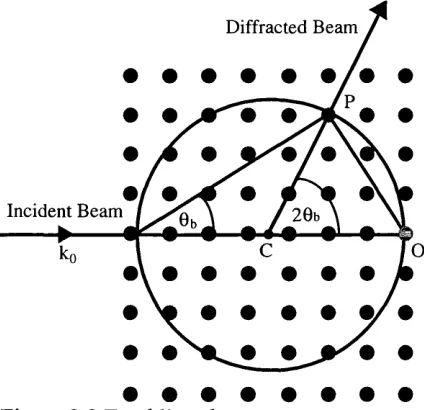
In E w a ld ’s constru ctio n, O is the o rig in w here the in cid en t w ave, kg,
term inates and C is the centre o f a sphere o f radius
MX.
The condition for a Braggreflection is achieved only if one or m ore points such as P, lie anyw here on the
sphere and happen to coincide w ith a reciprocal lattice point, m aking an angle called
the Bragg angle 0 ^ such that Z OCP = 20
Diffracted Beam
Incident Beam
Figure 2.2 E w ald’s sphere
W aves scattered by different atom s interfere w ith one another and the overall
scattering pow er or structure factor, for the reflection h,k,l, is given by:
E = X! f ; exp( - 27ii(hx + k y + lz )exp( - W ) (X -rays)
1 1 1
where Xj, y. and Zj are the fractional coordinates o f the ith atom , f- is the scattering
am p litude for X -ray s and
b-
the scatterin g len gth for neutron s and W is theD ebye-W aller isotropic tem peratu re facto r w hich is; W ,= s in ^ 9 ( u )
( u ^ ) i s the m ean square displacem ent o f the atom. The intensity o f the reflections is
proportional to the square o f the am plitude o f the structure factor.
2.1.1 Rietveld Refinement
Structures w ere solved using R ietveld refinem ent f ^ o f both X -ray and neutron
diffraction profiles. T his is a least squares m ethod, w here structure inform ation
including atom positions is refined to b est m atch the observed data. In the R ietveld
m ethod, the profile is assum ed to be the sum o f a num ber o f Bragg peaks and the
calcu lated in ten sity at each p o in t o n the p ro file is o btain ed by su m m ing the
contributions from the background and each reflection at that point. This calculated
profile is com pared w ith the observed p ro file and the param eters are refined to
m inim ise the function:
S^ = EwXy-y
w here y^ is the observed intensity for i * step and y^j is the calculated intensity for
the i^^ step. The w eighting o f the observables is calculated as w = — . F or X -ray
i y O b s
diffraction, the calculated intensity for each
hkl
reflection is given by,y = s V L
IF P A ( | ) ( 2 e - 2 0
)PT+ y
ci ^ hkl hkl i i hkK hkl hi
hkl
where: s is the scale factor,
L^j^j is a contribution from the Lorentz, polarisation and m ultiplicity factors,
is the structure factor for the particular hkl reflection,

![Figure 1.12 CuGeO] (Cu is red, Ge is green, O is blue)](https://thumb-us.123doks.com/thumbv2/123dok_us/8610238.1399946/30.595.137.491.121.484/figure-cugeo-cu-is-red-ge-green-blue.webp)