4241
IJSTR©2020
A Score Level Fusion Approach For
Multimodal Biometric Fusion
Dr. Rohit Srivastava
Abstract: Biometrics has been an emerging field of interest now days. The major concern for Biometric Security is the acquisition of the Biometric Feature or template. The acquisition involves the outcome of the features captured from sensors. The initial method of capturing the Biometric sample was unimodal in nature i.e. capturing was done for a single biometric feature viz. face, finger, iris etc. The paper constitutes a methodology of combination of multiple Biometric features: Face, Finger and Palm print in a single fashion to provide authentication based on Score level fusion.
Keywords: Multimodal biometrics; False Accept Rate; False Reject Rate; Genuine Accept Rate, Score level fusion
—————————— ◆ ——————————
I.
INTRODUCTION
Biometric framework is on a very basic level a programmed acknowledgment framework that perceives a man by deciding the validity of their particular attributes controlled by a person. Since a decade ago, biometric framework blasts in different ventures and keeps on giving higher security highlights for confirmation [1]. In reality application, the unimodal biometric frameworks are utilized for confirmation. In the meantime, they are powerless to assortment of issues and prompts less essentialness. To diminish the blunder rate, the multimodal biometric frameworks is utilized what's more, it coordinates at least two biometrics frameworks. Due to the presence of various and autonomous biometrics, these frameworks are more solid and securable [2]. In this paper, the distinctive modalities utilized are Palm print, Finger and Face dataset. Indeed, even indistinguishable twins who share the same DNA arrangements have distinctive palm prints. These line structures are steady and stay unaltered all through the life of a person. Finger is wealthy in surface highlights, contactless picture securing, invariant to feelings and effortlessly available. Human facial highlights and finish confront acknowledgment should be possible naturally by non-contact. So combination of these three biometric will clearly create great execution in the multimodal framework. Human recognition innovation guarantees new life to numerous security counseling firms and individual identification framework makers. The physiological or natural features of an individual, called biometrics, are one of a kind to every human and stay unaltered during an individual's lifetime and give a promising answer for security the board. The most pivotal and ongoing headway in biometrics has been the improvement of multimodal biometric frameworks. Throughout the last decade, multimodal biometrics has been produced into a standout amongst the most intense and quickest developing advances in the field of biometrics. The unending development of multimodal biometric frameworks as of late has required an audit of the most recent drifts in multimodal biometric frameworks. The audit will be very profitable for managing or choosing the suitable biometric qualities and combination systems for planning multimodal biometric frameworks. The foci of this part are on giving a rundown of imperative and propelled recognition strategies on face, palm print, and finger print impression just as multimodal biometric frameworks.
The ORL confront database was utilized for the execution assessment. Nagesh kumar et al. [5] utilized palm print and face biometric and created a proficient secure multimodal biometric framework. Combination of Palm print and Face highlights enhanced the individual confirmation. Lin et al. [6] actualized a calculation which joins Primary Component Analysis (PCA), Scale Invariant Highlight Transform (SIFT) and angle highlights for confront acknowledgment. Diverse neighborhood slope descriptors were extricated by SIFT in which the element vectors were invariant to picture scaling and pivot. Furthermore PCA was connected for the measurement decrease and lessening in calculation time. At that point the K-implies classifier was connected to bunch of the neighborhood descriptors. Reproduction results exhibited that PCA-SIFT neighborhood descriptors were vigorous to articulation varieties and delivered better execution than other similar techniques. Moreover, PCA-SIFT blend lessened the storage room and raised the computational productivity. Zhang et al. [7] connected Scale Invariant Feature Transform (Filter) Flow for video based human activity acknowledgment. Nearby appearance descriptors, neighborhood movement descriptors and movement limit histogram (MBH) were assessed utilizing Filter streams. They looked at the execution utilizing unique classifier like sack of-words approach, bolster vector machines, straight and nonlinear to group the element vectors. The created novel approach in light of key focuses delivered focused outcomes when contrasted and other best in class results.
2 MATERIAL AND METHODS
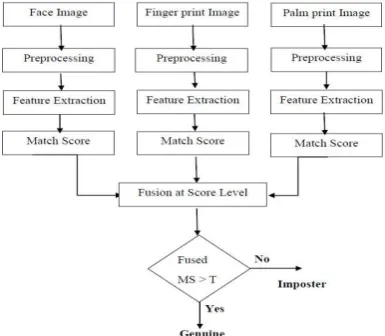
The block diagram of the proposed multimodal framework is appeared in Fig 1. The distinctive modalities utilized in this framework are Palm print, Finger and Face pictures. Every methodology is handled autonomously. First pre-preparing is performed to remove the district of intrigue (ROI) from each biometric picture. The component layout was framed by removing the highlights utilizing Scale invariant element change (SIFT) and Speeded up powerful highlights (SURF) independently for the prepared dataset.
_______________________________
• Dr. Rohit Srivastava Assistant Professor Department of
Cybernetics, SoCS, UPES EMail:
Fig. 1: Stream Diagram of Multimodal Biometric System for Recognition
Additionally for the test dataset, the highlights are separated what’s more, coordinated with the component layouts which are gotten from prepared dataset. The coordinating scores are acquired by considering the separation between the components purposes of the test picture with the format. Coordinating scores from the three unimodal biometric frameworks are joined to shape an exceptional coordinating score. The systems utilized for score level combination are MAX, MIN, PROD and SUM. On the off chance that the melded coordinating score (MS) is more prominent than the edge T then it is certified, generally fraud dispersion. This moved forward configuration takes the benefit of capability of each unimodal biometric framework.
3 HIGHLIGHT EXTRACTION
In the present investigation, SIFT and SURF calculations are utilized for the individual acknowledgment framework. These calculations are utilized to extricate the highlights from the pictures of different biometrics, for example, Palmprint, finger and Face. Extricated include vectors are observed to be particular, strong to pivot, hearty to scale and invariant to brightening. Therefore, highlights of test pictures can be coordinated precisely with high probability against highlights separated from the database pictures.
Scale Invariant Feature Transform
SIFT was exhibited for removing the features from pictures with various variation, for example, translation, scaling, and revolution. In this technique the picking of key areas at neighborhood minima and nearby maxima in the Difference of Gaussian (DOG) work utilized in the scale space. The neighborhood minima and nearby maxima are worked by examining the picture. Minima and maxima of the scale space work are evaluated by matching every pixel with its closest pixel. Again looking at, all SIFT points of the main pictures are matched with the second picture. SIFT points are counted when the point and its neighboring points is adequately higher than the separation among point and another neighboring key points. The initial step of SIFT feature extraction is scale space development at that point, key point localization, orientation task, and last step is key point descriptor.
Speeded up Robust Features
SURF [11] is a productive technique for key-point discovery what's more, descriptor development. Highlight vectors of SURF are shaped by methods for neighborhood
designs around key-focuses which are identified utilizing scaled up channel. Vital Image has the total of dark scale pixel estimations of the picture. It is a halfway portrayal for the picture. The advantage of vital picture is quick calculation of the total of the powers over rectangular area. The SURF focuses were identified by Hessian lattice guess utilizing box channels for Gaussian second request subordinates. SURF (Speeded up Robust Features) is a component extractor and a matcher for the focal points in any picture and that is utilized in object acknowledgment. SURF feature extraction depends on same technique and stages as the SIFT. In the initial step SURF utilizes square-formed channels for approximation of Gaussian (AOG) for smoothing the picture with a square which is a lot quicker. SURF utilizes mass locator like as Hessian network to discover point of interest. The principle point of descriptor is to offer a one of a kind and solid portrayal of an image feature.
4 MATCHING PROCESS FOR RECOGNITION
For the acknowledgment, include sets of the considerable number of pictures in the database are coordinated with the list of capabilities of the question picture. For unimodal, the K closest neighbor (KNN) what's more, bolster vector machine (SVM) are utilized to characterize the pictures of the prepared information with the test information. In multimodal, the coordinating scores are found by utilizing Euclidean separation. The separation between the components focuses of question pictures and the layout is computed. On the off chance that the coordinating sets are more between the pictures implies, more prominent will be the likeness. A man with various subject pictures is considered for the database. The coordinating between distinctive subjects of same client is called bona fide. While coordinating between various clients is called fraud.5 SCORE LEVEL FUSION FOR MULTIMODAL
FUSION
Score level combination alludes to the combination of coordinating scores given by single biometric framework. This framework is explored by three different fusion schemes: Max (MAX), Min (MIN) and Sum rule (SUM). These combination approaches are broadly utilized by specialists in various framework. The multimodal framework gives ease usage, calculated straightforwardness, down to earth perspectives, and so forth. MAX combination technique picks the most extreme of the three unimodal biometric scores as the multimodal score esteem. MAX control is given by,
MAX_MS=max (MS Face, MS Finger, MS Palm print)
MIN combination strategy picks the base of the three-unimodal biometric scores as the multimodal score esteem. MIN manage is given by,
MIN_MS=min (MS Face, MS Finger, MS Palm print) .
Whole combination technique utilizes aggregate of the coordinating scores of the three unimodal biometric characteristics and is given by
4243
SYSTEMS
False Acceptance Rate (FAR), False Rejection Rate (FRR) and Genuine Acceptance Rate (GAR) [12, 13] estimate the execution of the biometric check framework. The equation used to discover the execution of the framework is given by
FAR= α/β × 100
Where α = Number of acknowledged faker β = Total number of faker access
FRR= γ/μ × 100
Where γ = Number of rejected customers μ = Total number of customer get to Bona fide acknowledgment rate is characterized as a level of bona fide clients acknowledged by the framework.
GAR=1-FRR
Level with blunder rate is where false acknowledgment rate and false dismissal rate are ideal.
EER = (FAR+FRR)/2
The productivity of the proposed strategy is figured by utilizing the equation
Exactness = 100-(FAR+FRR)/2
7 RESULTS AND DISCUSSION
In this paper, the proposed investigation has been finished with Palm print, Fingerprint and Face pictures, which are acquired from IIT-D, and Poly-U Data set. The element extraction calculation to be specific SIFT and SURF was utilized to get the list of capabilities of the test pictures and additionally coordinated with the element format which helps the personality of the people. The execution of SIFT and SURF are processed utilizing FAR, FRR and GAR. For examination ten examples of hundred clients absolutely 1000 Palm print pictures, 1000 Finger print pictures and 1000 Face pictures are utilized to prepare the confirmation demonstrate. Ten examples for every client are utilized as test information. Most astounding GAR (0.985) is seen in Palm print confirmation which yields FAR = 0.07, FRR = 0.015 and infers the equivalent blunder rate of 4.25% for SIFT calculation utilizing KNN. Low GAR of 0.9627 is scored for Fingerprint with FAR = 0.05, FRR = 0.0373 and approach blunder rate of 4.365%. By utilizing SVM classifier, most elevated GAR of 0.9796 is seen in Face confirmation that yields FAR = 0.05, FRR = 0.0204 and approach blunder rate of 3.52%. Low GAR of 0.9652 is scored for Fingerprint with FAR = 0.04, FRR = 0.0348 and level with mistake rate of 3.74%.
Table 1: Palm print, Fingerprint and Face based confirmation
utilizing SIFT
The present investigation utilizes the combination of Palm print; Fingerprint and Face biometric framework for check utilizing SIFT. The MAX, MIN and SUM rules are utilized in score level combination. The multimodal framework achieved the best execution for MAX, with FAR = 0.04, FRR = 0.0123 and EER = 2.615%.
Table 2: Palm print, Fingerprint and Face based check-utilizing
SURF
The table 2 demonstrates the test results for Palm print, Fingerprint and Face combinations at score level utilizing SURF. The combination rules like MAX, MIN and SUM is utilized. The multimodal framework accomplishes the best execution with 0.9795 GAR for MAX, with FAR = 0.03, FRR = 0.0205 and EER = 2.525%.
Fig: 2 ROC Curve using Sum Rule Fusion
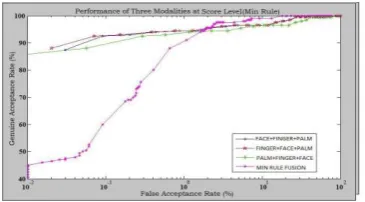
The score level fusion is performed over two Biometric modalities. The same methodology is now applied on three Biometric modalities implementing all the three rules. The score level fusion f Face, Finger and Palm is done on the three different rules i.e. Sum Rule, Min Rule and Max Rule. The ROC curve for all the three biometric modalities is generated for different rules. In Figure 2 Sum rule ROC is generated, in Figure 3 Min Rule ROC is generated and in Figure 4 Max Rule ROC curve is plotted. All the three ROC curves depict the performance of Score level fusion when done for three different biometric traits.
Fig: 4 ROC Curve using Max Rule Fusion
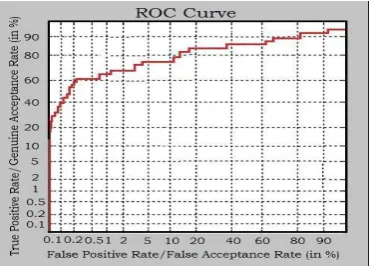
The SIFT and SURF descriptors are determined independently for face, finger and palm print images separately. The scores from all the three combination components are then joined together to produce a consolidated combination score to verify a human. In the individual SIFT and SURF calculation whenever connected separately the GAR was about 90.23% and 92.34% separately. In the proposed method descriptors are determined by SIFT and afterward the equivalent is utilized as a contribution for producing SURF feature descriptor. After the mix of both the descriptors scores are created for a similar utilizing combination rules. The combination decides are confined to such an extent that they apply all the three biometric modalities and produce the score in the wake of matching the test picture with the database pictures. The ROC for the equivalent is portrayed in Figure 5 and the Python simulation is shown in Figure 6.
Figure 5: ROC curve for final fusion scheme
Figure 6: Python Simulation for final fusion scheme
8 CONCLUSION
This paper introduces the unimodal and multimodal acknowledgment framework utilizing Palm print, Fingerprint also, Face. To diminish the current disadvantages of single biometric modular, an incorporated approach has been utilized to enhance the acknowledgment. The highlights are separated utilizing Filter and SURF calculation. The SVM classifier produces better outcomes in the acknowledgment framework. The multimodal incorporated the coordinating scores of three biometric characteristics Palm print, Fingerprint and Face. The combination strategies MAX, MIN and SUM are utilized to intertwine the coordinating score in the multimodal framework. The proposed design appears that the accuracy rate for SIFT and SURF when used separately comes out to be less than 93% whereas the combination of both algorithm when cosine similarity is used for feature descriptors matching yields an accuracy rate of 95.48% which indicates the effectiveness of the proposed algorithm better in comparison of SIFT and SURF when used separately.
9 REFERENCES
1. A. Meraoumia, S. Chitroub, and S. Mohamed, 'Individual's Acknowledgment Using Palmprint Based On 2D Gabor Filter Reaction Advanced ideas for keen vision frameworks'. Proc. of eleventh universal gathering on ACIVS, Bordeaux, France pp. 720-731, Springer 2009.
2. A. Meraoumia, S. Chitroub, and A. Bouridane, ‘Combination of Finger-Knuckle-Print and palm print for an Efficient Multi-biometric System of Person Recognition'. Proc. of the IEEE International Conference on Communications, Kyoto, Japan, pp. 1-5, 2011.
3. D. Maltoni, D. Maio, A. K. Jain, and S. Prabhakar, 'Multimodal biometric frameworks', Handbook of Fingerprint Acknowledgment, Springer-Verlag, 2003.
4. S.D. Lin, B.F Liu, and J. H. Lin. 'Joining Speeded-Up Powerful Features with Principal Component Analysis in Face Recognition System’, Global Journal of Imaginative Computing, Information and Control, December 8(12), pp. 8545-8556, 2012.
5. V. M. Nagesh kumar, P. Mahesh, and M. Swamy, 'An Proficient Secure Multimodal Biometric Fusion utilizing Palm-print and Face Image,' The International Journal of Software engineering 1(2), pp. 49-53, 2009.
6. S.D. Lin, J. H. Lin, and C.C. Chiang, ‘Utilizing inclination highlights from scale-invariant key points on confront acknowledgment', International Journal of Innovative Registering, Information and Control, 7(4), pp.1639-1649, 2011.
7. J.T. Zhang, A.C. Tsoi, and S.L. Lo, 'Scale Invariant Highlight Transform Flow direction approach with applications to human activity acknowledgment'. Proc. of Worldwide Joint Conference on Neural Networks, pp. 1197 - 1204, 2014.
8. VIII. T. A. A. Asadi, and A. J. Obaid, 'Protest discovery what's more, acknowledgment by utilizing improved Speeded Up Robust Highlight', International Journal of Computer Science and System Security, 16(4), pp. 66-71, 2016.
9. A. Azeem, M. Sharif, J. H. Shah, and M. Raza, 'Hexagonal scale invariant element change (H-SIFT) for facial element Extraction', Journal of Applied Research furthermore, Technology, 13(3), pp. 402– 408, 2015. 10. D.G Lowe. 'Unmistakable picture highlights from scale
4245 pp. 91– 110, 2004.
11. H. Cove, T. Tuytelaars, and L. Van Gool, 'SURF: Speeded up Robust Features'. Proc. European Conference on PC Viion, Vol. 110, pp. 407-417, 2006. 12. T. Sabareeswari, and S. Stuwart, 'Recognizable proof
of a Individual Using Multimodal Biometric System', Global Journal of Computer Applications 3(9), pp. 0975 – 8887, 2010.
13. L. Hong, and A. Jain, 'Coordinating appearances and fingerprints for individual recognizable proof', IEEE Trans. Ex-
ample Anal. Mach. Intell., December, 20(12), pp. 1295– 1307, 1998.
14. Wu, Q. Zhao, and W. Bu, 'A SIFT Based contactless palmprint check approach utilizing iterative RANSAC what's more, neighborhood palmprint descriptors,' Pattern Recognition, 47(10), pp. 3314-3326, 2014.
15. H. R. Chennamma, L. Rangarajan, and Veerabhadrappa. 'Face distinguishing proof from controlled facial pictures utilizing Filter', in Proceedings of the third International Conference on Emerging Trends in Engineering and Technology (ICETET '10), pp. 192– 195, 2010.
16. D. D.Y. Po, and M. N. Do, "Directional multiscale displaying of pictures utilizing the contourlet change", IEEE Exchanges on Image Processing, 15(6), pp. 1610-1620, 2006.
17. Hoda Marouf and Karim Faez 'Zernike Moment-Based Highlight Extraction for Facial Recognition of Identical Twins 'Worldwide Journal of Computer Science, Anne Wincy, J et al, Designing and Information Technology (IJCSEIT), 3(6),pp.1-8, 2013. 18. S. Neware, K. Mehta, and A.S. Zadgaonkar, 'Finger Knuckle Identification utilizing Principal Component Examination and Nearest Mean Classifier' International Diary of Computer Applications ,70(9), pp:18-23, 2013.
19. S. D. Vijayalaxmi and Pushpalata, 'Palmprint Recognition Framework Using Independent Component Analysis and Gabor Texture Descriptors' International Journal of Propelled Research in Computer Engineering and Innovation (IJARCET)
4(5), pp:2340-2344, 2015.
20. Mithuna Behera and V.K. Govindan 'Palm print Verification Using PCA Technique' International Diary of Computer Science and Information Innovations, 5 (3) , pp:3638-3640, 2014.