Available online at http://ijdea.srbiau.ac.ir
Int. J. Data Envelopment Analysis (ISSN 2345-458X)
Vol.5, No.1, Year 2017 Article ID IJDEA-00422, 8 pages Research Article
Robust data envelopment analysis with
uncertain date: An analysis to measure hotel
efficiency in Crete
Neda Manavizadeh
a*, Hamed Farrokhi-Asl
b, Masoud Rabbani
c(a)
Department of Industrial Engineering, KHATAM University, Tehran, Iran
(b)School of Industrial Engineering, Iran University of Science & Technology,
Tehran, Iran
(c)
School of Industrial Engineering, College of Engineering, University of Tehran,
Tehran, Iran
Received September 18, 2016, Accepted December 28, 2106
Abstract
Due to strict competition in the global market for Tourism services and Hotels in the tourism industry and also the importance of satisfying tourists, awareness about the efficiency of hotel for hotel owners and hotel managers is very important. The purpose of this paper is measuring performance of hotels in Crete by using Robust Data Envelopment analysis (RDEA) technique considering uncertain data. The proposed method of this paper develops a RDEA method with the consideration of uncertainty on output parameters. In order to use robust optimization methods in this article, after the introduction of input and output, we calculate the efficiency of 50 luxury hotel in Crete by means of GAMS software. The method is based on the adaption of robust optimization approaches proposed in the literature. Finally, we compare the performance achieved with previous research on these hotels and our results. It is found that the efficiency decreases, but the level of confidence increases.
Keywords: data envelopment analysis, uncertainty, robust, hotel efficiency.
* Corresponding author, Email address: [email protected]
1140
1. Introduction
With time and further clarify the importance of the development of monetary and financial markets, and especially the hotels, as a contributing factor to support the economy and ultimately economic prosperity, evaluating the performance of hotels has attracted researchers’ attention in recent years. Performance reflects the concept that an organization or an enterprise how much uses their resources in production, compared to the best possible performance at any point in time. Therefore, when it comes to functionality, enterprises or institutions measure all inputs and outputs carefully in order to successfully produce the maximum possible output of a series of fixed production technology [24]. Efficiency in the DEA context deals with the optimization of the resource allocations among alternative uses. DEA yields a linear production surface which, in economic terms, represents the best production possibility frontier. By reflecting a decision making unit (DMU) to this frontier and comparing it with a single reference unit or a convex combination of other reference units, the DMU’s efficiency is estimated. DEA developed by Charnes, Cooper, and Rhodes [9] based on Farrell [12] idea. This approach estimates relative efficiency of sets of decision making units by using of inputs and outputs. DEA separates units in two different category including efficient and inefficient units. Charnes, Cooper, and Rhodes [9] presented CCR as first model in DEA. Banker, Charnes, and Cooper [4] presented BCC with assumption of variable return to scale (VRS). This assumption makes BCC more real than CCR.
Donthu, Hershberger, and Osmonbekov [11] developed a model in which DEA focuses on input and outputs. The first step entails identifying a company (or set of companies) that is acknowledged as the best performer and the second step is setting benchmarking goals. Inputs of the model include Advertising cost, Manger
N. Manavizadeh, et al /IJDEA Vol.5, No.1, (2017).1139-1146
1141
active airlines are practically inefficient and the government could significantly increase the efficiencies of the airports by setting new regulations and rules. They decided to choose 21 active airports to provide a meaningful comparison. The results
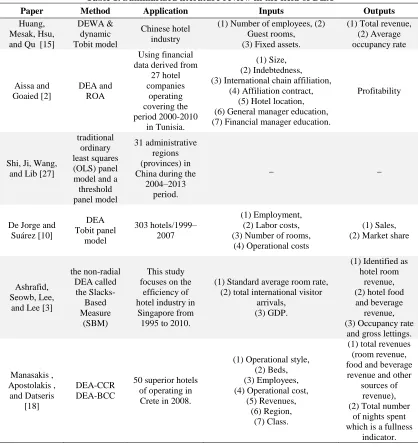
indicate that eighteen units use their terminal space very efficiently. Moreover, Studies conducted in the field of DEA is summarized in the Table (1).
Table 1. Summarized literature review in the field of DEA
Paper Method Application Inputs Outputs
Huang, Mesak, Hsu, and Qu [15]
DEWA & dynamic Tobit model
Chinese hotel industry
(1) Number of employees, (2) Guest rooms, (3) Fixed assets.
(1) Total revenue, (2) Average occupancy rate Aissa and Goaied [2] DEA and ROA Using financial data derived from
27 hotel companies operating covering the period 2000-2010 in Tunisia. (1) Size, (2) Indebtedness, (3) International chain affiliation,
(4) Affiliation contract, (5) Hotel location, (6) General manager education, (7) Financial manager education.
Profitability
Shi, Ji, Wang, and Lib [27]
traditional ordinary least squares (OLS) panel model and a threshold panel model
31 administrative regions (provinces) in China during the
2004–2013 period.
_ _
De Jorge and Suárez [10] DEA Tobit panel model 303 hotels/1999– 2007 (1) Employment, (2) Labor costs, (3) Number of rooms,
(4) Operational costs
(1) Sales, (2) Market share
Ashrafid, Seowb, Lee,
and Lee [3]
the non-radial DEA called the Slacks-Based Measure (SBM) This study focuses on the
efficiency of hotel industry in
Singapore from 1995 to 2010.
(1) Standard average room rate, (2) total international visitor
arrivals, (3) GDP.
(1) Identified as hotel room
revenue, (2) hotel food and beverage revenue, (3) Occupancy rate
and gross lettings.
Manasakis , Apostolakis , and Datseris [18] DEA-CCR DEA-BCC
50 superior hotels of operating in
Crete in 2008.
(1) Operational style, (2) Beds, (3) Employees, (4) Operational cost,
(5) Revenues, (6) Region,
(7) Class.
(1) total revenues (room revenue, food and beverage revenue and other
sources of revenue), (2) Total number
of nights spent which is a fullness
indicator.
2. Robust Data Envelopment Analysis After specifying models to evaluate efficiency, in this section robust modeling approach is examined including Soyster
1142
solutions which are conservative. In order to ensure solution robustness in this approach, we may be far away from nominal problem optimality. Ben-Tal and Nemirovski’s approach, lead to nonlinear and conical robust formulations so their approach cannot be used directly for discrete optimization problems. Bertsimas and Sim’s approach can operate in a reasonable conservative level and leads to a linear optimization pattern, so we can use this approach for discrete optimization patterns. With respect to this feature and linearity of robust solution in this approach, we use it for data envelopment analysis designing. Now we can apply robust CCR model based on Bertsimas and Sim’s approach for considering outputs data uncertainty that presented in Peykani and Mohammadi [23] as below:
. . -( . )+ 0 0+ 0
1 1
1 1
- +Zj 0 ;
1 1 1
j = 1,...,n ; r = 1,...,s
Z + P 0 r0 yro
Z + P y ;
j = 1,...,n ; r = 1,...,s
- ur
Max
s s
s t yro ru Z Pr
r r
m x vio i i
s m s
y urj r x vij i j Pjr
r i r
r
r
j jr rj
r
r = 1,...,s
P jr 0 j = 1,...,n ; r = 1,...,s
0 r = 1,...,s r r (1)
Z i 0 j = 1,...,n
u 0 r = 1,...,s
v 0 i=1,...,m
r
i
3. Case study
In this article, we have three inputs and two outputs for 50 hotels in Crete and they have
gained a solid performance, so we can do calculation by using them. The selection of the sample for the purposes of this paper is based on a database maintained by the ICAP Group, the largest company offering business information services in the Balkans. Also, the year of study is 2008. Regarding the input and output variables used in the present study, these are Chosen in a way that to make this study’s results comparable with the relevant literature. The Variables which are chosen as inputs in the study reflect the required resources to achieve particular managerial goals. The number of employees measures the human Resources in a hotel [6, 16], the number of beds and the total operational cost of a hotel [13,19] measure the capital inputs used. The variables which are chosen as outputs in the present study reflect broad managerial goals and objectives. The first output variable is total revenues, comprising of room revenue, food and beverage revenue and other sources of revenue[1, 20]. The second output variable which is chosen is the total number of nights spent which is a fullness indicator [28]. It should be noted that these two output variables are consistent, since total revenues depends on the total number of nights spent; and both of them were used in Barros [6] and Barros and Mascarenhas [5]. All variables except overnight stays (collected through direct contact with hotel managers) were collected through the ICAP Group Databank. The data sources guarantee data integrity, as well as standardization and non-measurement errors which suggest reliability of the results.
4. Results
N. Manavizadeh, et al /IJDEA Vol.5, No.1, (2017).1139-1146
1143
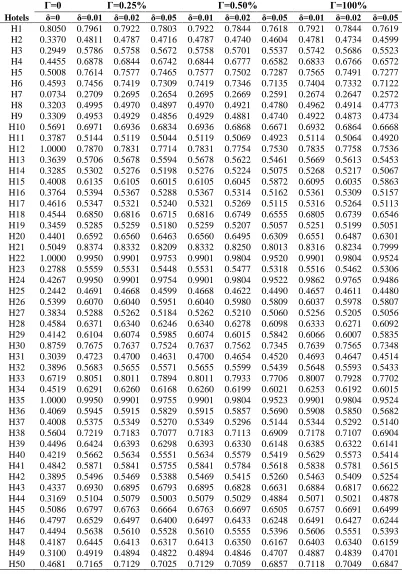
Table 2. Results of robust CCR model
Γ=0 Γ=0.25% Γ=0.50% Γ=100%
Hotels δ=0 δ=0.01 δ=0.02 δ=0.05 δ=0.01 δ=0.02 δ=0.05 δ=0.01 δ=0.02 δ=0.05
1144
5. Conclusions
Due to the importance of the hotel industry and its sensitivity robust optimization is a suitable method for analyzing the performance. This article is a robust optimization method based on CCR, BCC and additive models .In this article, we examined the performance of hotels in CRETE with robust optimization methods then results compared with previous studies conducted by researchers in previous works. The results showed that, although the efficiency is reduced, but we can get access to more accurate results. Future studies in this topic could consider uncontrollable factors such as volume, weather and… in solving the DEA and
N. Manavizadeh, et al /IJDEA Vol.5, No.1, (2017).1139-1146
1145
References:
[1] Anderson RI, Fish M, Xia Y, Michello F. Measuring efficiency in the hotel industry: a stochastic frontier approach. International journal of hospitality Management. 1999 Mar 31;18(1):45-57.
[2] Aissa SB, Goaied M. Determinants of Tunisian hotel profitability: The role of managerial efficiency. Tourism Management. 2016 Feb 29;52:478-87.
[3] Ashrafi A, Seow HV, Lee LS, Lee CG. The efficiency of the hotel industry in Singapore. Tourism Management. 2013 Aug 31; 37:31-4.
[4] Banker RD, Charnes A, Cooper WW. Some models for estimating technical and scale inefficiencies in data envelopment analysis. Management science. 1984 Sep;30(9):1078-92.
[5] Barros CP, Mascarenhas MJ. Technical and allocative efficiency in a chain of small hotels. International Journal of Hospitality Management. 2005 Sep 30; 24(3):415-36.
[6] Barros CP. Measuring efficiency in the hotel sector. Annals of Tourism Research. 2005 Apr 30;32(2):456-77.
[7] Ben-Tal A, Nemirovski A. Robust solutions of linear programming problems contaminated with uncertain data. Mathematical programming. 2000 Sep 1;88(3):411-24.
[8] Bertsimas D, Sim M. The price of robustness. Operations research. 2004 Feb;52(1):35-53.
[9] Charnes A, Cooper WW, Rhodes E. Measuring the efficiency of decision making units. European journal of operational research. 1978 Nov
30;2(6):429-44.
[10] De Jorge J, Suárez C. Productivity, efficiency and its determinant factors in hotels. The Service Industries Journal. 2014 Mar 12;34(4):354-72.
[11] Donthu N, Hershberger EK, Osmonbekov T. Benchmarking marketing productivity using data envelopment analysis. Journal of Business Research. 2005 Nov 30;58(11):1474-82.
[12] Farrell MJ. The measurement of productive efficiency. Journal of the Royal Statistical Society. Series A (General). 1957 Jan 1;120(3):253-90.
[13] Fu HP, Chu KK, Chao P, Lee HH, Liao YC. Using fuzzy AHP and VIKOR for benchmarking analysis in the hotel industry. The Service Industries Journal. 2011 Nov 1; 31(14):2373-89.
[14] Hafezalkotob A, Banihashemi MH, Akhavan E, Tavakoli RH. Robust approach to DEA technique for supplier selection problem: A case study at Supplying Automotive Parts Company (SAPCO). Journal of Industrial and Systems Engineering. 2014;7(1):56-79.
[15] Huang Y, Mesak HI, Hsu MK, Qu H. Dynamic efficiency assessment of the Chinese hotel industry. Journal of Business Research. 2012 Jan 31;65(1):59-67.
[16] Hwang, S. N., & Chang, T. Y. (2003). Using data envelopment analysis to measure hotel managerial efficiency change in Taiwan. Tourism Management, 24(4), 357-369.
1146
Engineering. 2012 Aug 30;2012.
[18] Manasakis C, Apostolakis A, Datseris G. Using data envelopment analysis to measure hotel efficiency in Crete. International Journal of Contemporary Hospitality Management. 2013 May 24;25(4):510-35.
[19] Min H, Min H, Joo SJ. A data envelopment analysis-based balanced scorecard for measuring the comparative efficiency of Korean luxury hotels. International Journal of Quality & Reliability Management. 2008 Apr 18;25(4):349-65.
[20] Neves JC, Lourenço S. Using data envelopment analysis to select strategies that improve the performance of hotel companies. International Journal of Contemporary Hospitality Management. 2009 Aug 21;21(6):698-712.
[21] Oliveira R, Pedro MI, Marques RC. Efficiency and its determinants in Portuguese hotels in the Algarve. Tourism Management. 2013 Jun 30;36:641-9.
[22] Omrani H. Robust data envelopment analysis model with fuzzy perturbation in inputs and outputs. International Journal of Industrial and Systems Engineering. 2013 Jan 1;15(4):426-42.
[23] Peykani, P., Mohammadi, E., Jabbarzadeh, A.Jandaghian,A .,2016. Utilizing Robust Data Envelopment Analysis Model for Measuring Efficiency of Stock, A case study: Tehran Stock
Exchange, Journal of New Researches in Mathematics, JNRM Vol.1, No.4, p: 16-24.
[24] Rabbani M, Farrokhi-Asl H, Manavizadeh N. Using Robust-DEA optimization approach to analyze performance and efficiency of a mine in north of Iran. Management Science Letters. 2017;7(2):97-110.
[25] Roghanian E, Foroughi A. An empirical study of Iranian regional airports using robust data envelopment analysis. International Journal of Industrial Engineering Computations. 2010 Jul 1;1(1):65-72.
[26] Sigala M. Integrating customer relationship management in hotel operations: managerial and operational implications. International Journal of Hospitality Management. 2005 Sep 30; 24(3):391-413.
[27] Shi R, Ji S, Wang X, Li F. Impacts of star-rated hotel expansion on inbound tourism development: evidence from China. Applied Economics. 2016 Jul 8;48(32):3033-48.