Licensed under Creative Common Page 561
http://ijecm.co.uk/
ISSN 2348 0386
CONSTITUENCY DEVELOPMENT FUND AND PROJECT
IMPLEMENTATION IN BUTERE, KENYA
James Opiyo
Student Department of accounting and finance,
Masinde Muliro University of Science and Technology, Kenya [email protected]
Charles Yugi Tibbs
Department of accounting and finance,
Masinde Muliro University of Science and Technology, Kenya [email protected]
Albert Odhiambo
Department of accounting and finance,
Masinde Muliro University of Science and Technology, Kenya [email protected]
Abstract
This study sought to look at Constituency Development Fund and project implementation in
Butere, Kenya. The objectives of the study were to determine the effect of fund allocation on
project implementation also to determine the effect of fund disbursement on project
implementation and finally to establish the effect of monitoring on project implementation.
Conceptual model was established to show the interrelationship between variables under study.
The study adopted a case study design that enabled the researcher to establish the association
between and among the study variables. The study targeted a population of 135, a sample of
100 was selected using purposive sampling method, Data was collected using questionnaires
and analyzed by use of chi-square at 5% significant level. Reliability of study questionnaire a
data collection tool was ascertained through a pilot study that was conducted in two
Licensed under Creative Common Page 562 two tests were compared to determine the degree of reliability of data. Cronbach alpha
coefficient of validity was 78%.Kuderr Richard coefficient of reliability was found to be 80% for
both coefficients the threshold is 70%.Findings showed that, Fund allocation, fund disbursement
and monitoring affect project implementation in Butere, Kenya. The study recommended that
the government should increase its budget allocation and there should be separation of powers
between fund allocators and implementers to avoid cases where MPs are both fund allocators
and play implementation. The study concludes that there is high influence of fund allocation,
disbursement and monitoring on project implementation in Butere, Kenya.
Keywords: Constituency development fund, Fund allocation, Fund disbursement, Monitoring,
Project implementation
INTRODUCTION
African countries; more so, East African countries in comparison with western countries like USA, France, Bolivia, Chile, Denmark, Finland, Greece, Italy, Indonesia, have been criticized over number of years due to discriminative way of resource allocation, taking USA as country of study , USA is divided into 50 states which are autonomous. Walda (1930) examines the recent debate on devolution of fiscal responsibilities from USA; several economists have highlighted the efficiency benefits of devolution and suggested several policy changes such as substitution of block grants for matching entitlements and greater flexibility for states in making use of federal grants. Due to increase in critic of block release of national funds, legislation was passed in Kenya into law in December (2003) with the aim of devolving some funds to the grassroots so that people would have a say on developments.
Besides Kenya other African countries like Tanzania, Ghana, Namibia, Zambia, Uganda, and Southern Sudan have embraced CDF. Previously the government has formulated a series decentralization program, although there implementation has in all cases fallen far short of expectations. The most notable being Majimbo development grant program (1966), the special rural development program ( 1969/70) the rural development fund, district development planning (1971) and the district focus for rural development (1983, 84). According to Chuweya (2008), “CDF is a form of devolution since it involves re-distribution of decision, resources and authority through legislation”. Despite the fact that national government has been consciously allocating
2.5% of budgeted income to constituency development fund. Projects. Most projects have remained incomplete and under funded projects have a lion’s share out of all projects required
Licensed under Creative Common Page 563 Constituency development projects have been facing criticism from time to time, According to shiundu(2013) more than 50% of projects implemented have become stale, incomplete or underfunded. Constituency development projects which the act accepts to be funded fall in the following sectors; education (32%), health (26%), water (19%) building of physical infrastructures (8%), agriculture, security and social services. (CDF Act 2013). Areas already studied by different scholars include; General awareness of CDF by Kenyan verdict (2000), evaluation of corruption in CDF in Kenya by Ethics and anti-corruption commission(2015),effect of CDF on social development in Kenya by IEA (2005),area under effect of CDF funding on project implementation in Kenya has not attracted attention so far. Best project management practices by Wanambisia (2013) directs, regardless of methodology employed that careful consideration must be given to overall project objectives, time frame and cost as well as roles and responsibilities of all participants and stake holders.
Traditional theory and Prince 2 methodology theories identify 5 development faces of a project as initiation, planning and design, Execution and control, monitoring and control and completion. The major limitation of these theories is that not all projects go through all stages, some projects terminate before completion. The theories describe procedures to co-ordinate people and activities in projects, how to design and supervise the project and what to do if a project is going against plan. This research seeks to find out how government Allocation, disbursement, regulatory policies and monitoring affect constituency project implementation. Besides the government funding, which other factors affects project implementation? What should government do to solve the problem? It’s in the height of narrative above that my study
will undertake to evaluate the relationship between constituency development fund allocation and project implementation in Kenya.
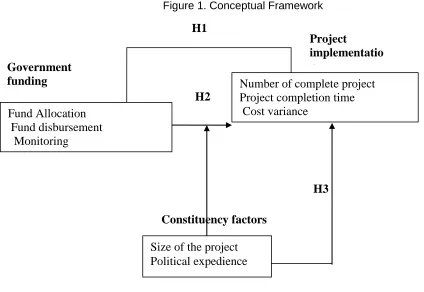
Conceptual framework
Licensed under Creative Common Page 564 Figure 1. Conceptual Framework
H2
H2
H3
Constituency factors
HO3
Statement of research problem
Constituency development projects between 2014 and 2015have faced a lot of challenges. This invariably has led to the collapse of some development projects. One of the catalysts in this scenario may be government allocation policies. Government allocates 2.5% of total budget to constituency project every year of this 2.5% of the ordinary Government revenue 75% is allocated equally to all constituencies in the country. The remaining 25% is allocated based on the population size and the poverty index of each constituency. However the following statutory funding ceilings must be observed:-Bursary 15%, Emergency 5%, office administration 3%, recurrent expenditure 3%, monitoring and evaluation 2%, sports 2%, environmental activities 2% and all other projects 68%.
The fund allocated is to be disbursed twice a year but some extent it extends up to several financial years (Chweya, 2015). Project implementation and management as per section21(1)of the CDF amendment Act 2007 states that the projects funded under CDF shall be community based in order to ensure that the prospects benefits are available to a widespread cross-section of the inhabitants of a particular area.CDF projects are identified at location and sub location level through a community initiative. When the community initiates a project, it elects among itself a project management committee to manage the project. The community elects committee to represent the interest of that community during and after the
Fund Allocation
Fund disbursement
Monitoring
Number of complete project
Project completion time
Cost variance
Size of the project
Political expedience
Government
funding
Project
implementatio
n
Licensed under Creative Common Page 565 implementation of the projects. Conflict has risen over allocation, disbursement and monitoring over a number of years. Disbursement policies highlighted by the Act are violated.
According to statement said by Kilok (2015), “We received shs63million which is a 50%
of the total allocation to the constituency for the financial year ending in June 2015, which means rest of 50%will be received in the next financial year 2015/2016.” “Over shs16billion
meant for development in the constituencies is lying in Government coffers two months before the end of the current financial year”. The report indicates that out of sh29billion allocated for use by the country’s 290 constituencies, only sh13billion has so far been disbursed once again raising questions on the slow uptake of CDF”.The question has been, does government
regulations on disbursement of funds operational?
The problems manifests in multiple ways. Number of incomplete projects, stall projects and money lying idle. My critical concern has been the extent at which constituency project implementation have been affected by government allocation, disbursement monitoring and regulatory policies. Number of stall project has increased dramatically despite the fact that government allocation has been increased from 2.5% to 5%.”The Constituency development
projects affect economic development of the state. The gaps of the study include; To what extent do the constituency fund allocation and disbursement strategies affect implementation of CDF projects? Do the constituency factors moderate the relationship between constituency fund and project implementation? Do the constituency factors affect the project implementation? Generally the study will endeavor to evaluate the effect of CDF fund on project implementation in Butere. The study is vital since if not conducted Government and public at large will suffer since the impact of CDF funds on projects will never be felt.
Research objectives
i) To examine the effect of fund allocation on project implementation in Butere Constituency. ii) To determine the effect of fund disbursement on CDF project implementation in Butere
Constituency.
iii) To assess the effect of monitoring on project implementation in Butere Constituency.
RESEARCH METHODOLOGY
Licensed under Creative Common Page 566 100 projects out of 135 projects were selected using a scientific tool.
n= 𝑁
1+𝑒2𝑁(Yamane, T. 1967),where N=Target population, e= level of significant error.
This study adopted Purpose sampling to select 100 respondents to be involved in the study and purposive sampling was used to select teachers, members of the community, committee members and CDF staffs. Primary data was gathered using self-administered questionnaires and interviewing the sample population.
ANALYSIS AND RESULTS
Prior to processing the responses all completed and received questionnaire was coded to ascertain that they were complete and consistent across respondents and to identify omission if any. Data on the other hand was calibrated under different variables with their frequencies. Descriptive characteristics were used to analyze the data this included frequencies and percentages, on the other hand inferential statistics used in testing the study hypothesis included Chi square techniques , All hypothesis were subjected to a two tailed test at a 95% confidence level (a level of significance x=0.05) the results were then presented in frequency tables.
Table 1: Model Fitting fund allocation and project implementation in Butere Kenya
Model -2 Log Likelihood Chi-Square Df Sig.
Intercept Only 69.763
Final 51.270 18.493 3 .000 Link function: Complementary Log-log.
Results from table 1 indicate that fund allocation influence implementation of CDF projects. The significance level for the chi-square statistic was less than 0.05 (0.000) as indicated in the model fitting information hence the study rejected the null hypothesis (There is no government influence on CDF fund allocation on project implementation in Kenya).
Licensed under Creative Common Page 567 Table 2: Model fitting on fund disbursement and implementation of CDF projects
Model -2 Log Likelihood Chi-Square df Sig.
Intercept Only 40.906
Final 39.652 1.254 3 .740 Link function: Complementary Log-log.
Results from table 2 established that CDF fund disbursement influence implementation of projects. The significance level for the chi-square statistic was greater than 0.05 (0.740) as indicated in the model fitting information hence the study rejected the null hypothesis which states that Government fund disbursement have no effect on the relationship between CDF-fund and project implementation in Kenya.
It is supported that among CDF factors affecting implementation are political expedience and size of the project. This result concurs with Sihanya (2015), “CDF has become a serious
political factor especially when it comes to elections. Some MPS have used it well and gained huge political capital while others misuse it and kill their career” Wahome (2015). Further the
implication is that big project require large amount of disbursement and this can affect general development projects if politicians misuse such disbursed funds.
Table 3: Monitoring and implementation of CDF Projects
Model -2 Log Likelihood Chi-Square Df Sig.
Intercept Only 46.079
Final 44.374 1.706 3 .636 Link function: Complementary Log-log.
Licensed under Creative Common Page 568 Mapesa & Kibua (2006) carried out a survey on assessment of the management and utilization of the constituency development fund (CDF) in Kenya. They argued in their research that mechanisms for transparency and accountability were absent or missing. There were design problem particularly with regard to insufficient technical staff with essential skills to assist communities in preparing and implementing projects. They also argued that there are some legal challenges such as confusion among various devolved funds such as CDF and Ministry projects fund- resulting into duplication of funding of projects. They made some recommendations which included formulating strategic plans for all constituencies, Amendment of the CDF Act, deployment of Development coordinators at constituency level, enforcement of civic education for awareness, promotion of monitoring and evaluation, standardization of designs and parameters, and creation of a citizen’s report card. The CDF Act requires
involvement of line ministries in implementation of CDF projects to provide expertise but in practice they do not participate. The reason for non-participation is what the study is investigating.
CONCLUSIONS AND RECOMMENDATIONS
The study concludes that fund allocation had a great effect on project implementation in Butere, Kenya. Fund allocation processes and regulations have been revealed to be relatively weak. Fund allocation process arises as an issue because the funds of the state are limited, whereas CDF projects are unlimited. This implies that satisfaction will only happen when CDF allocations are increased and people centered.
The Kenyan program for CDFs faces challenges on disbursement of funds to fully achieve the program’s intended goals. First, it must ensure sufficient resources to complete the
necessary internal and external oversight and audits that are in the CDF legislation. Second, there is no guarantee that ordinary constituents will be fully knowledgeable and able to act effectively in developing plans for CDF projects. Third, the CDF program is subject to a cumbersome process of disbursement and implementation that involves a high number of stakeholders, which can lead to problems of coordination with other government agencies, fraud and corruption. This is especially significant against broader efforts at decentralization. Fourth, it will be necessary to develop procedures for effective fund disbursement in support of project implementation. Finally, it will be necessary to address the politicized nature of these funds, so that projects begun in one mandate will be completed regardless of electoral result.
Licensed under Creative Common Page 569 line ministry staff in supervision of projects. It is pointed out that there is low level community participation in project selection, execution, selection of committee members and monitoring and evaluation due to lack of awareness among the community members. People do not know their rights and responsibilities in the CDF programme or any devolved funds. These are some of the possibilities causing poor community participation in CDF projects across the country.
LIMITATIONS OF THE STUDY
The study was subject to some limitations. First the study was based on only one constituency and therefore conclusion of findings may not reflect the general situation of entire country, if the same study was conducted in the other areas of the country then it would be possible to make a reliable judgment on effects of constituency development funding on project implementation. There existed a strong indication to biased information due to political desires hence residual effect of respondents’ bias may affect outcome of the study. Finally study period was 2014/2015
which could not reflect general activities carried out since inception of CDF. To overcome this researcher held several seminars with provincial administrations and people to explain the purpose of research study.
REFERENCES
Chweya, N. (2015). Constituency development paper.
CDF Act (2003). Establishment of Constituency Development Fund and its operational guidelines.CDF was focus of Uhurus stimulus plan.” The standard online edition.Standard.net. 12th June 2009. Retrieved first Jun 2010.Constituency development fund, the (Kenyan) institute for social accountability.
Kilok, M. (2014). Constituency development fund.
David, S.M. (2003). World Without End, Economics, Environment and Sustainable Development. Deucht publishers: Edinburgh.
Elizabeth, W. H. (2006). Urban, Renewal and Social Work, 1991 Foy C. and Helmich H., Public Support for International Development. Schenkman Publishing Company. Cambridge.
Elizabeth, J. (2006).Transparency manner and equitably.
GOK, (2003). The constituencies’ development funds act, government printer. GOK, (2005) National management committee CDF annual report 2004 – 2005. GOK, (2005) Parliamentary constituencies’ fund committee report.
GOK, (2004). Kenya gazette supplements number 27 (legislative supplement number 17). GOK, African economic outlook (2012).
Smael. R, (1995) Improving living standards.
Kabua, N and Mapesa, M. (2006). An assessment of the management and utilization of constituency development Fund.
Licensed under Creative Common Page 570 Poul, S. (2004) “Holding the state to account” public affairs centre, Bungalore, Indianwww.pacindia.org. Ministry of finance treasury circular ref. PPD 2/2029a/10, 18TH Nov. 2004.
Shiundu, K. (2015) Institute for social responsibility.
Wahome, W. K. (2010). Factors Influencing Board of Management in Managing Constituency Development Fund Projects in Public Secondary Schools in Kenya. Nairobi: Kenya.